U.S. Gen. Xavier Brunson (C), chief of the South Korea–U.S. Combined Forces Command, attends a combined exercise (maneuvering, wet gap crossing) with South Korean soldiers from the Lightning Brigade, Capital Mechanized Infantry Division and 7th Engineer Brigade, as part of the Freedom Shield 26 exercise, in Yeoncheon, Gyeonggi province, South Korea, 14 March 2026. According to South Korea’s Joint Chiefs of Staff (JCS), North Korea launched ballistic missiles into the east sea on 14 March as South Korea and the United States were conducting their military exercise. Photo by JEON HEON-KYUN/EPA
March 27 (Asia Today) — The United States and South Korea have established a new joint command unit aimed at integrating nuclear and conventional forces to strengthen deterrence against North Korea, according to defense officials.
The unit, known as J10, has been set up within U.S. Forces Korea headquarters at Camp Humphreys in Pyeongtaek. It is designed to move beyond the traditional concept of a “nuclear umbrella” and enable real-time operational coordination between U.S. strategic assets and South Korean conventional forces.
Originally separated from the U.S. Forces Korea planning directorate in June 2024, J10 is led by a colonel-level commander and serves as a centralized command structure for combined nuclear and conventional operations.
Military experts said the creation of J10 marks a shift from declaratory deterrence to operational readiness, allowing faster execution of joint responses in the event of a North Korean nuclear threat.
The unit is expected to play a key role in implementing decisions made by the bilateral Nuclear Consultative Group established under the Washington Declaration, with the ability to coordinate immediate response measures from the Korean Peninsula.
J10 will oversee operational planning that aligns U.S. strategic assets – such as long-range bombers and nuclear-powered submarines – with South Korean support forces. It is also expected to match response options to specific North Korean threat scenarios to accelerate execution speed.
Previously, U.S. nuclear operations were largely managed by command structures based in the United States. The new arrangement places a dedicated coordination function on the Korean Peninsula, enabling continuous, real-time management of response planning.
Analysts said the move is intended to strengthen integration between South Korea’s “three-axis” defense system and U.S. nuclear capabilities, increasing military pressure on North Korea.
However, officials noted that the effectiveness of J10 will depend on the level of real-time intelligence sharing between the two allies.
A senior official described J10 as “the final piece” in building an integrated extended deterrence framework, adding that its capabilities will be tested in upcoming large-scale joint military exercises.
SARAH Beeny is revamping her failing dating app in a last-ditch attempt to turn around its fortunes.
She’s launching the “world’s first” video dating app – and is looking for singletons to find love in a bold new move.
Sign up for the Showbiz newsletter
Thank you!
Sarah Beeny is hoping to revive the fortunes of her ailing dating siteCredit: InstagramSarah is best known for being a property guruCredit: Channel4
Sarah might have the Midas touch when it comes to flogging houses, but didn’t have quite so much luck wielding Cupid’s bow and arrow.
The telly star and property guru runs a dating website called My Single Friend and it is heavily in debt.
Now she’s revealed that the site will be overhauled.
She said on Instagram: “I have to admit, I’m so excited because I’m going to relaunch My Single Friend as the world’s first video dating app and it’s coming next week and I can’t wait.
“But as we are launching completely empty, I’m looking for the first 50 people who would like to be on the app when we launch, so if you have a single friend you’d like to pop on or are single yourself, send me a DM.”
The most recent figures show it didn’t make a penny in a year, plus singletons looking for love have been less than kind in online reviews of the firm.
Books posted on Companies House showed that for 2023 the firm had zero equity and it didn’t pay a penny in Corporation Tax, meaning it didn’t make enough cash on which to be taxed. It also owed £1.5m.
The firm was founded in 2004.
A review on Trustpilot read: “The matches they offer up have nothing to do with my search criteria, I suspect there aren’t many people signed up on my area. Customer service good though.”
Another person added: “Most profiles are inactive. Some profiles appear twice under different IDS The quality of the individuals is questionable… most guys over 50 look like bald spuds and send d**k pics.”
My Single Friend told would-be members: “Our clever two-way matching system can help you find your perfect match; our highly-rated and super-lovely customer service team is on-hand every day.
“Fall in love with love again. We can’t wait to help you take the first step.”
Household name Sarah — who beatbreast cancer in 2023 — shot to fame fronting Property Ladder in 2001 before going on to front a host of property shows on TV.
Sarah has overcome breast cancer, getting the all-clear in 2023Credit: Getty
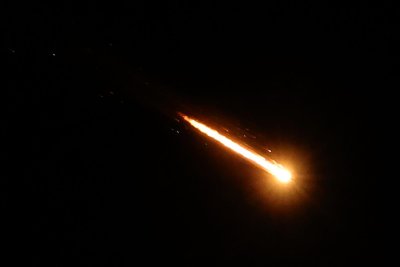
A projectile crosses the sky above the West Bank city of Nablus, on Friday. The Israeli military reported that it had detected missiles launched from Iran toward Israel, several of which struck central Israel. Photo by Alaa Badarneh/EPA
March 27 (UPI) — Iranian Foreign Minister Abbas Araghchi said Friday that his country “will exact [a] heavy price” for Israeli strikes on infrastructure Friday.
In a post on X, he said the strikes hit two of Iran’s largest steel factories, a power plant, civilian nuclear sites and other infrastructure.
“Israel claims it acted in coordination with the U.S.,” Araghchi wrote.
The airstrikes came less than a day after U.S. President Donald Trump extended a pause on U.S. attacks on Iran’s energy sites for 10 days. Trump said he extended the deadline because negotiations between the United States and Iran had been going “well,” and Iran had permitted several oil tankers to transit the Strait of Hormuz.
The “attack contradicts POTUS extended deadline for diplomacy,” Araghchi wrote.
“Iran will exact HEAVY price for Israeli crimes.”
The Guardian reported that the airstrikes hit the Khondab heavy-water plant near Arak and a uranium production facility in Ardakan. They also hit steel plants in Khuzestan and Mobarakeh.
Iran’s state-run Tasnim news agency said Tehran was considering launching attacks on six steel factories in Israel in retaliation for Friday’s attack.
The Israeli military said Friday it had intercepted missiles launched by Iran, NBC News reported.
“A short while ago, the [Israel Defense Forces] identified missiles launched from Iran toward the territory of the State of Israel,” the military said in a statement. “Defensive systems are operating to intercept the treat.”
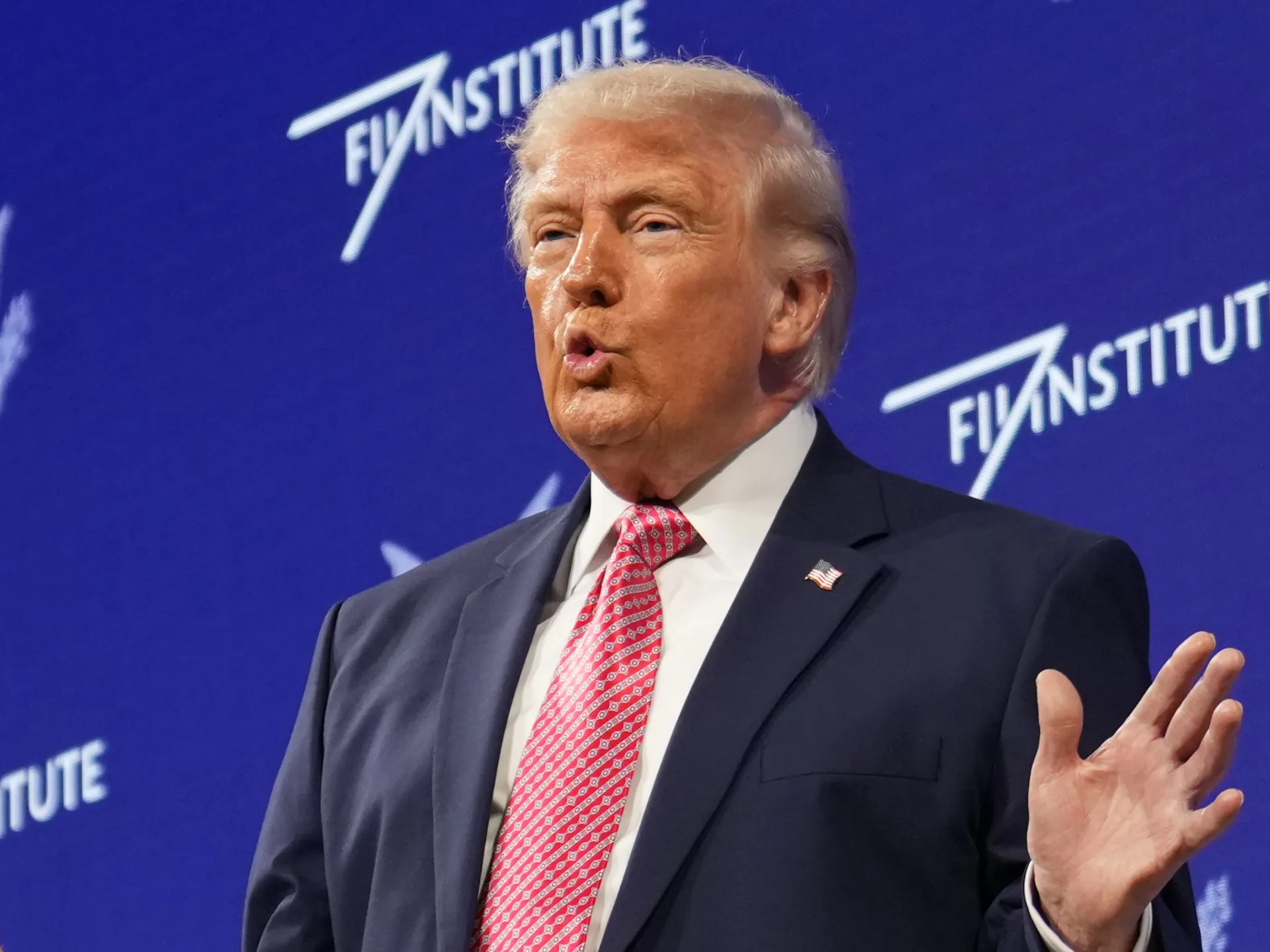
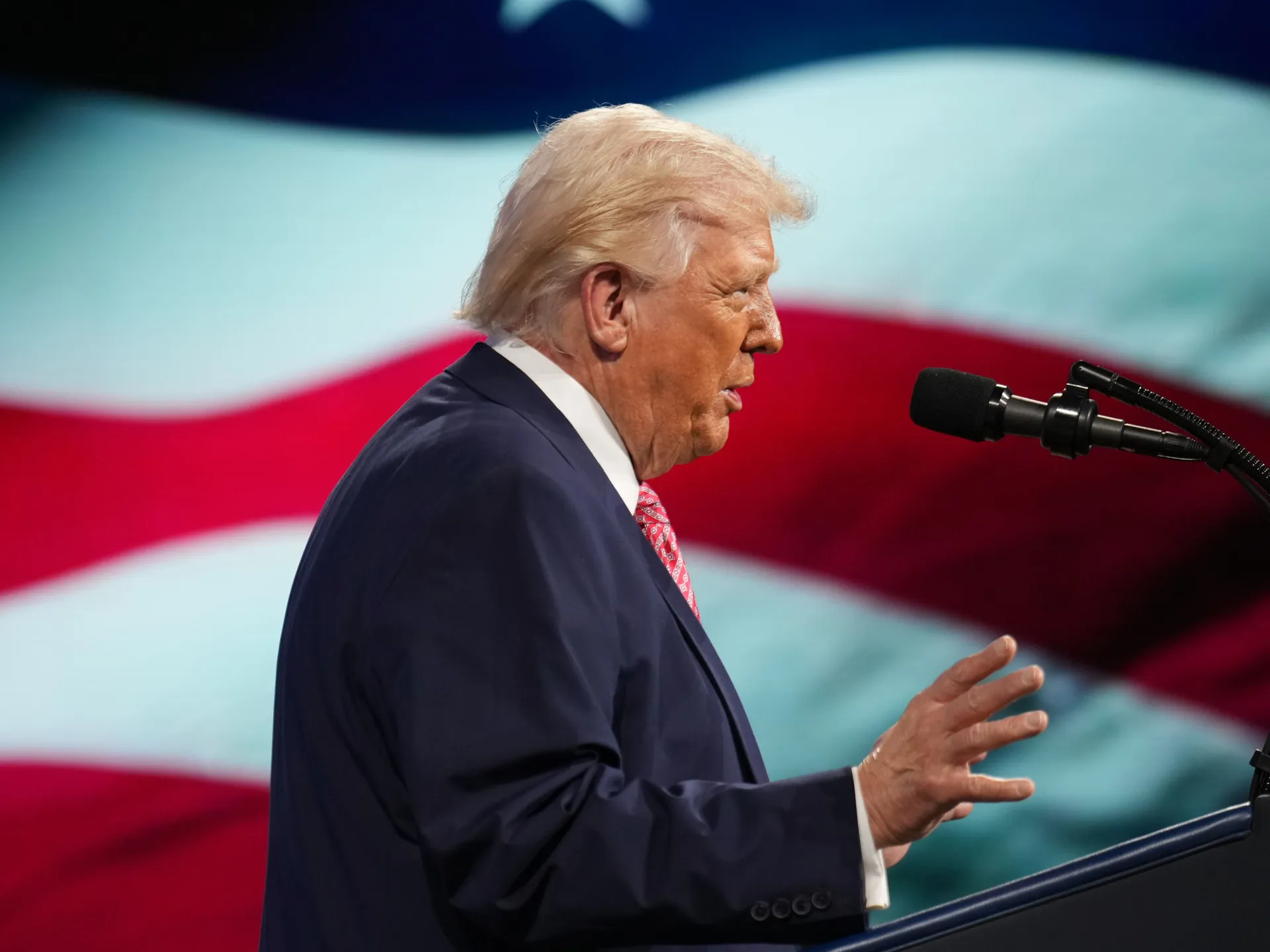
Speaking Friday evening at the Future Investment Initiative in Miami, Trump said Iran is “on the run,” one month after the United States and Israel jointly began attacking the country. The violence came amid negotiations in which the United States sought to limit Iran’s nuclear program.
“Tonight, we’re closer than ever to the rise of the Middle East that is finally free at least from Iranian terror, aggression and nuclear blackmail,” Trump said.
Iran is “being decimated,” he added.
“We are talking now, they want to make a deal.”
The United States offered a proposed 15-point peace plan to Iran this week, but Araghchi said Iranian officials had no plans to negotiate it “for now.”
“This is Israel’s war, and people of the region and people of the U.S. are paying the price for it,” he said.
Iran’s Red Crescent Society reported Friday that more than 70,000 residential units, 600 schools and 300 health facilities had been damaged since the start of the war.
The Iran-aligned Yemeni group have the ability to target key shipping lanes around the Arabian Peninsula.
Published On 27 Mar 202627 Mar 2026
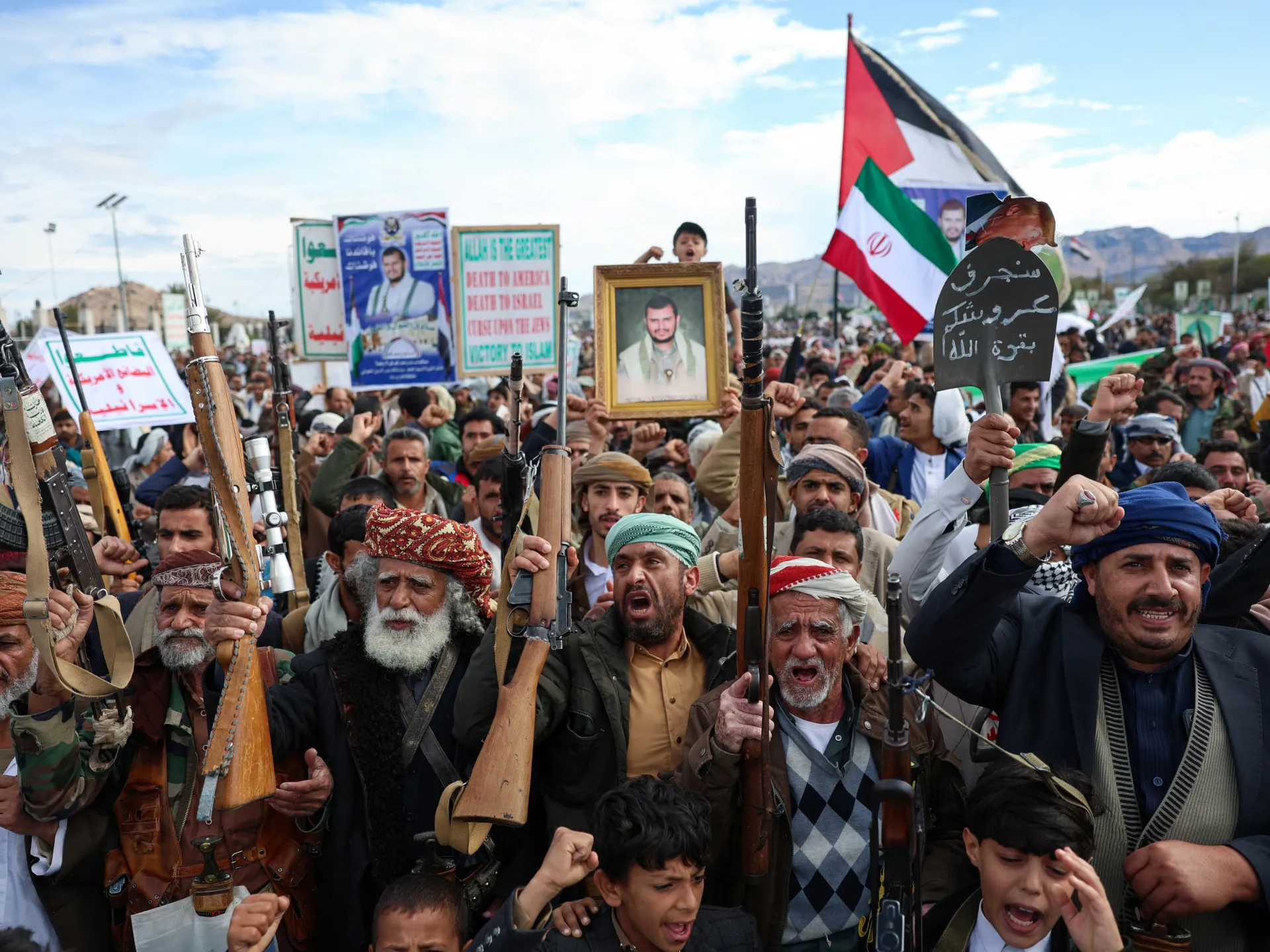
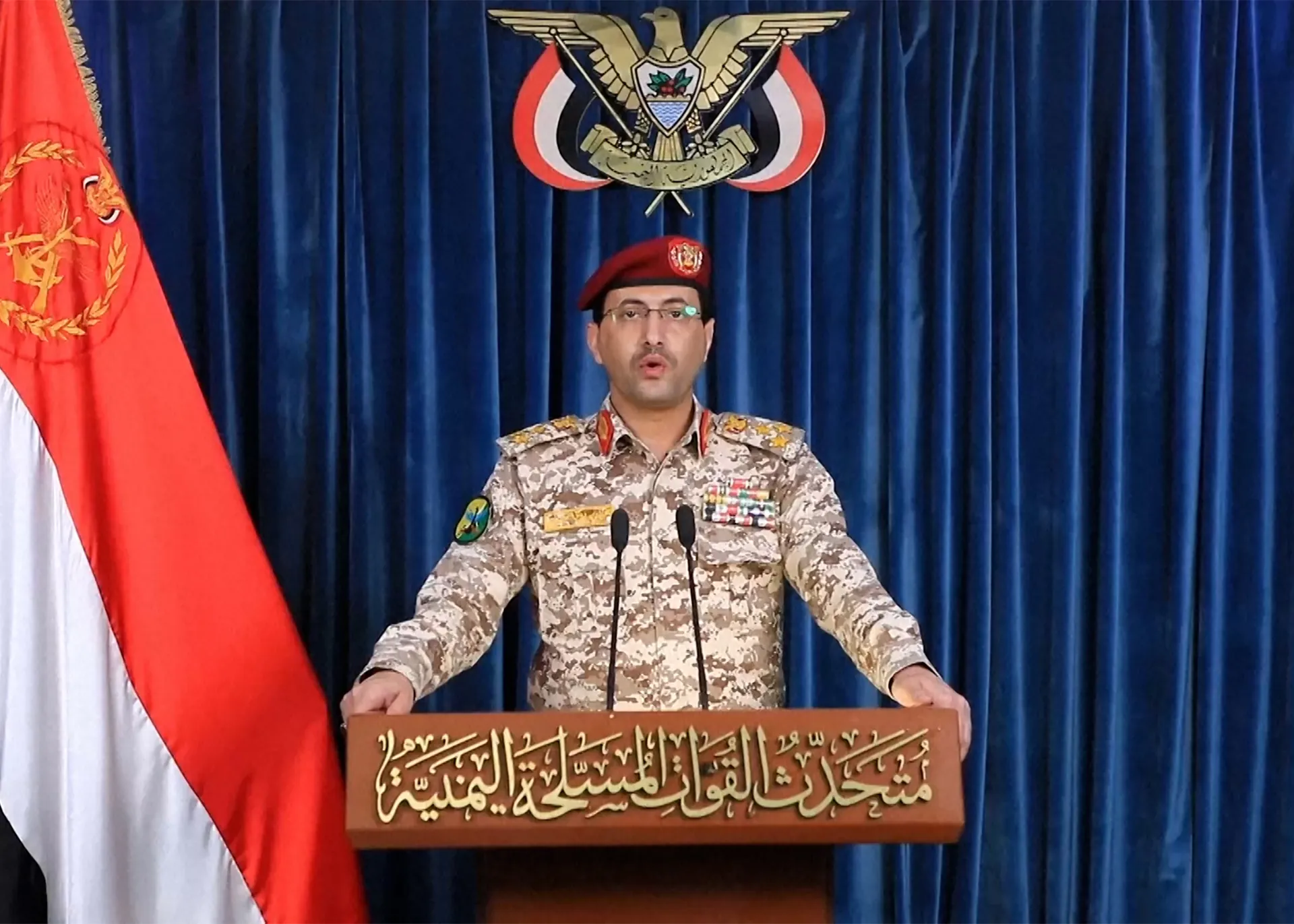
Yemen’s Iran-allied Houthis say they are prepared to intervene militarily if other countries join the United States and Israel in their war against Iran, or if the Red Sea is used to launch attacks on their ally.
“We confirm that our fingers are on the trigger for direct military intervention” if any new alliances join Washington and Israel against Iran and its allies, or if the Red Sea is used for “hostile operations” against Iran, the group’s military spokesperson Yahya Saree said in a televised speech on Friday.
Recommended Stories
list of 3 itemsend of list
Saree also said the Houthis were prepared to act if what he called the escalation against Iran and the “axis of resistance” continued, but did not say what form any intervention would take.
The warning raises the prospect of a broader regional war, particularly given the Houthis’ ability to strike targets far beyond Yemen and disrupt shipping lanes around the Arabian Peninsula.
The Yemeni rebel group has controlled the capital Sanaa and much of the country’s northwest since 2014.
After Israel launched its genocidal war on Gaza in October 2023, the Houthis targeted vessels in the Red Sea and carried out drone and missile attacks against Israel, saying that they are acting in solidarity with Palestinians under fire in Gaza.
Israel and the US have regularly struck the war-torn country, targeting civilian infrastructure, including residential buildings and the main international airport, while killing dozens at a time.
But in May, the Houthis and the US agreed to a truce, which included a Houthi agreement to stop attacks on US shipping in the Red Sea.
The group later stopped attacks on Israel and Israeli-linked shipping after the October Gaza ceasefire deal.
In his speech on Friday, Saree also said the group would not allow the Red Sea to be used to carry out “hostile operations” against Iran or any Muslim country.
He warned against any further tightening of what he described as “the blockade on Yemen”.
Saree called for an immediate halt to US and Israeli attacks on Iran, the Palestinian territory, Lebanon and Iraq.
A classic period drama, one that popularised the genre globally, is still regarded as one of the finest to ever grace our screens. Period drama enthusiasts will be familiar with the show in question — Upstairs, Downstairs.
Upstairs, Downstairs laid the groundwork for Downton Abbey with a story that will be familiar with fans who have only seen the modern sensation. As the definitive period dramas of their era, the parallels between Upstairs, Downstairs and Downton Abbey are self-evident.
Both shows portray the personal struggles of an aristocratic family and their servants against a backdrop of social and political upheaval on an overlapping timeline.
Like Downton Abbey, it spans three decades, covering both World Wars and the roaring 20s through to the Great Depression. The classic show chronicled the turbulent lives of the aristocratic Bellamy family and their servants in the early 1900s.
They diverge in numerous ways, however, and one is immediately apparent.
The seventies programme is less high-end, a quality that can taken as nostalgic or a dealbreaker. Upstairs, Downstairs premiered in 1971 and ran for five years, predating Downton Abbey by a good 50 years.
In fairness, Downton’s setting is inherently more luxurious. The Bellamy family inhabit a London townhouse, a far cry from the Crawley family’s lavish country estate that was a character in its own right.
And while Downton’s visuals proved a triumph, a frequent criticism from audiences is that the programme descended into melodrama. In contrast, Upstairs, Downstairs has been likened to a stage play for its more understated visuals and plotlines.
Fans of both period dramas shared their preferences. One viewer sparked a debate on Reddit, asking: “If you have seen both shows, which show do you think is better?”
“Upstairs Downstairs without question,” replied one viewer decisively. Another agreed: “I like Downton Abbey better, but Upstairs, Downstairs is the better show.
“I have tried watching the Upstairs/Downstairs remake multiple times and I always end stopping after about two episodes,” commented a third. “It just doesn’t grab me like Downton.”
Upstairs, Downstairs is available to watch on ITVX.
So far, the U.S. Navy has fired more than 850 Tomahawk missiles in the war with Iran, officials familiar with the matter told TheWashington Post. This has prompted discussions about how more missiles could be made available.
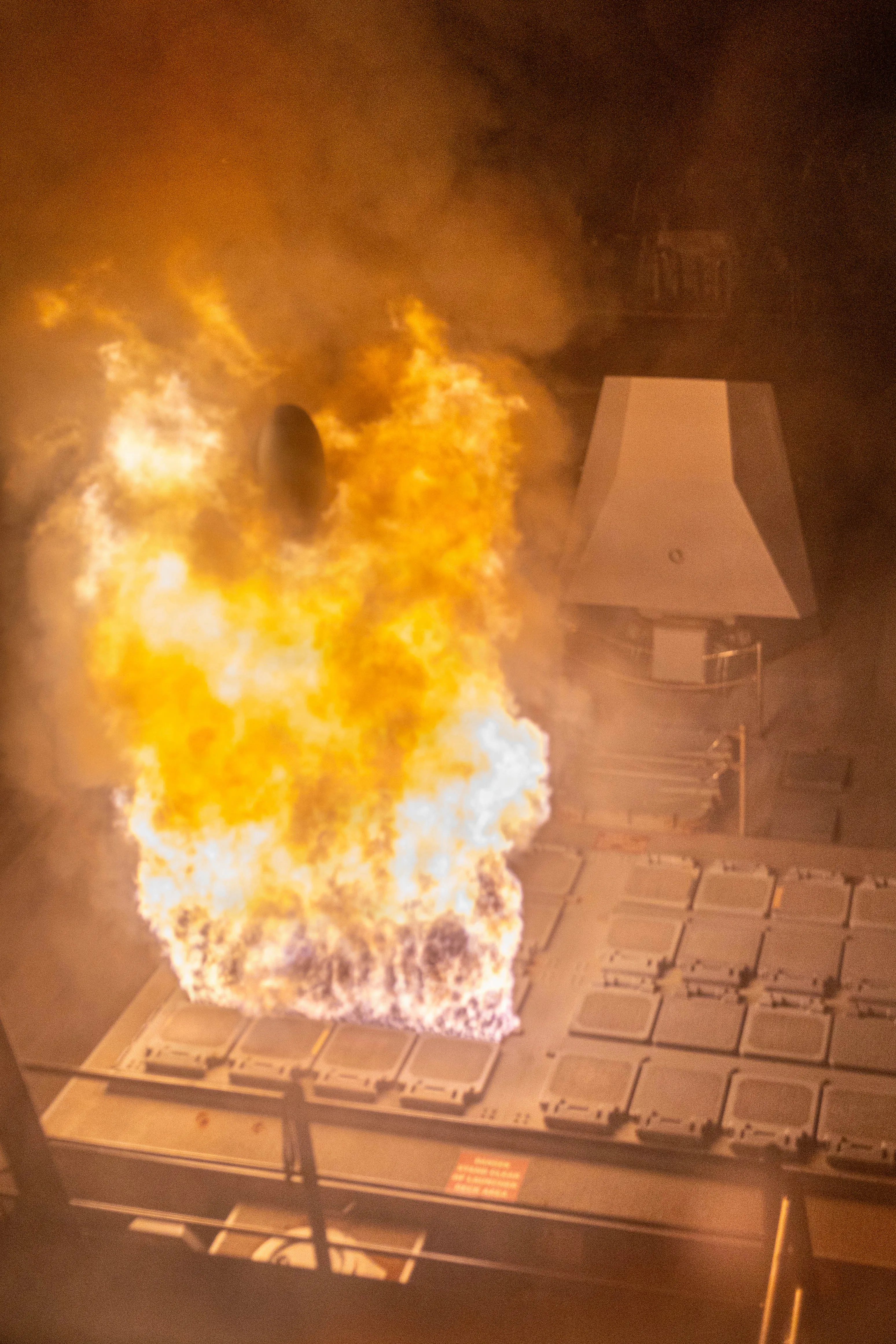
The Arleigh Burke class destroyer USS Bainbridge (DDG 96) fires Tomahawk missiles from the forward missile deck while underway in the Eastern Mediterranean Sea, in support of Operation Epic Fury, March 3, 2026. U.S. Navy Photo U.S. Central Command Public Affa
As it stands, only a few hundred examples of the critical long-range strike weapon are manufactured each year, meaning the global supply is limited. The exact number available to the U.S. military at any given time is a closely guarded secret, although the article suggested a higher-end figure of between 4,000 and 4,500 Tomahawk missiles on hand at the start of Epic Fury, and a lower-end figure closer to 3,000 missiles. Again, the Tomahawk would be a primary weapon system used in a conflict with China, where the target sets can range into the tens of thousands, and the country’s anti-access umbrella will require the use of standoff munitions like none other in history.
“The Pentagon has tracked the number of Tomahawks used with an increasing focus on what the burn rate will mean for not only a sustained campaign against Iran but for future military operations as well,” the report states.
I’ve posted nearly every TLAM launch video released by the DOD, major launch salvoes had continued until at least the weekend of the 14th. https://t.co/xYP9yaVySs
One official told TheWashington Post that the number of Tomahawks left in the Middle East was “alarmingly low,” while another said that without intervention, the Pentagon is closing in on “Winchester” — military slang meaning out of ammunition — for its supply of the missiles in the region.
The Tomahawk also comes with a hefty price tag: up to $3.6 million for some of the more recent versions, and each round can require up to two years to build. The Navy also faces a problem in that, in recent years, only small batches have been purchased: just 57 examples were included in last year’s defense budget.
At the same time, the Trump administration has repeatedly claimed that critical munitions stockpiles have not been dangerously depleted in the Iran war.
White House press secretary Karoline Leavitt said earlier this month that the U.S. military “has more than enough munitions, ammo and weapons stockpiles to achieve the goals of Operation Epic Fury laid out by President Trump — and beyond.”
Every indication we have seen is that for some munitions, that is not reality. The war in Ukraine and constant crisis in the Middle East have depleted those stockpiles, and many of the weapons take years to build, with finite caps on how many can be delivered in any given year. This is a story we have been covering for years. The Trump administration is working to greatly expand production of advanced munitions, but even the fruits of those efforts will take years to realize.
UPDATES:
We have concluded updates for the day.
UPDATE: 10:37 PM EST-
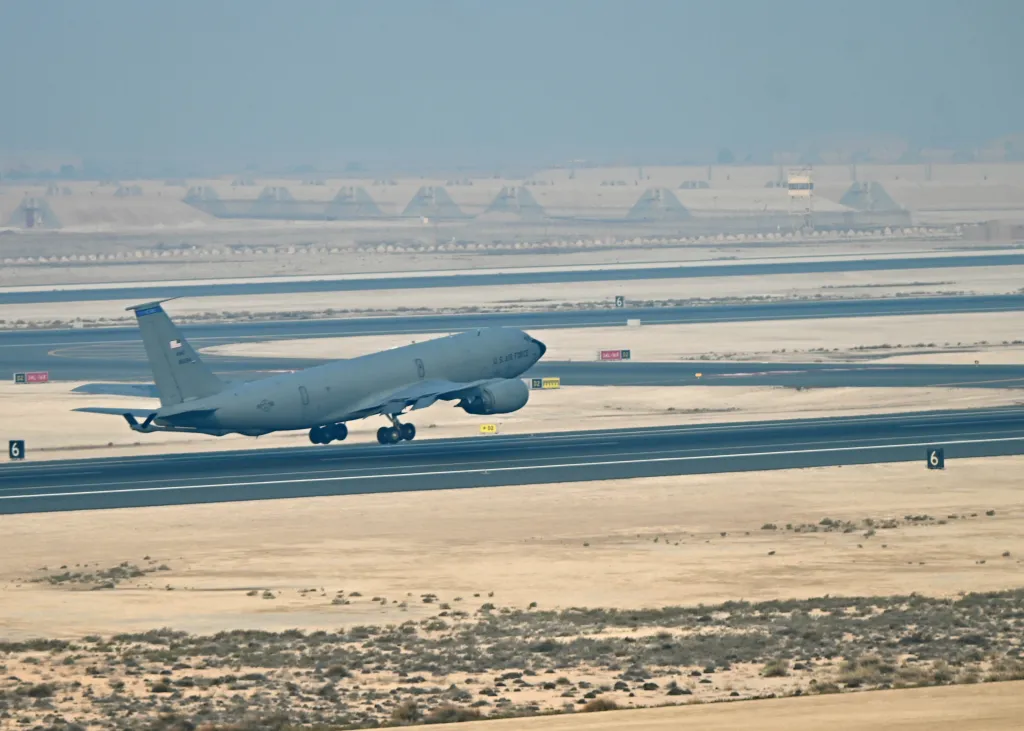
A missile and drone attack on Prince Sultan Air Base in Saudi Arabia has led to significant injuries to U.S. personnel. 10 American service members were wounded, two of which were seriously injured. It isn’t clear what damage was done to aircraft, but we have seen at least one tanker destroyed in recent satellite imagery. This is in addition to the attack that damaged multiple tankers and destroyed another earlier in the war.
Ten American service members were wounded in an Iranian drone and missile attack on Prince Sultan Airbase earlier today-Multiple US and Arab officials to the WSJ
“The injured service members were inside a building on the base that was struck in the attack, the officials said…At least one missile struck the base, as well as several unmanned aerial vehicles…The missile strike is at least the second to strike the base during the war… pic.twitter.com/bI5MrwmEDE
Trump is threatening to abandon NATO after member nations did not pitch in with opening the Strait:
NOW – Trump suggests the U.S. may abandon NATO countries: “We would’ve always been there for them [NATO], but now based on their actions I guess we don’t have to be.” pic.twitter.com/NKgO72FUvf
As expected, the USS George Washington and its strike group are deploying to the Middle East:
New: The USS George H.W. Bush aircraft carrier will deploy to U.S. Central Command’s area of responsibility, the major combatant command overseeing American military operations against Iran, sources told @JimLaPorta@ellee_watson and me. @CBSNews
Reuters is reporting that Arab states in the Gulf are urging the United States to ensure that any deal with Tehran should do more than end the war. Instead, it must ensure Iranian missile and drone capabilities are “permanently curbed” and that Iran will never again be able to “weaponize” global energy supplies. The agency cites four unnamed Gulf sources.
Meanwhile, it appears that Qatar, Oman, and Kuwait are prioritizing a quick end to the war, while the UAE, Saudi Arabia, and Bahrain are more willing for the fighting to continue, if their longer-term aims are met in any deal to end the war.
Qatar, Oman and Kuwait are pushing behind closed doors for a swift end to the war. The UAE, Saudi Arabia and Bahrain say they are ready to absorb an escalation of the war and will not accept a post-war Iran that is still able to use the Strait of Hormuz as a bargaining chip. https://t.co/LI26CkM40E
The Iranian foreign minister, Abbas Araghchi, has confirmed that Israel struck two of its most important steel production facilities, as well as nuclear sites — presumably including the Khondab Heavy Water Complex (see previous updates).
Araghchi said that Friday’s strikes contradicted President Donald Trump’s pledge to postpone attacking Iran’s energy infrastructure for 10 days after he claimed talks were “going well.” He further said that Tehran would exact a “heavy price” for the attacks.
Iran’s Foreign Minister Abbas Araghchi:
Israel has hit 2 of Iran’s largest steel factories, a power plant and civilian nuclear sites among other infrastructure. Israel claims it acted in coordination with the U.S.
Attack contradicts POTUS extended deadline for diplomacy.
Saudi Arabia wants the U.S. military to ramp up its attacks on Iran, according to a Saudi intelligence source, and the kingdom is meanwhile reportedly also considering joining the fight directly, alongside the United States and Israel. Whether or not Saudi Arabia also starts launching strikes against Iran remains to be seen, but it is the clearest indication so far that the kingdom might become more deeply involved in the conflict, at least at some level.
A Saudi intelligence source confirmed to The Guardian that Riyadh was urging the United States to both continue and intensify the military campaign against Iran. The same source confirmed similar reporting in The New York Times, which states that Saudi Arabia’s de facto leader, Crown Prince Mohammed bin Salman, had called upon Trump to not curtail Operation Epic Fury, and that the U.S.-Israeli campaign represented a “historic opportunity” to remake the Middle East.
U.S. President Donald Trump meets with Crown Prince and Prime Minister Mohammed bin Salman of Saudi Arabia during a bilateral meeting in the Oval Office of the White House on November 18, 2025. Photo by Win McNamee/Getty Images Win McNamee
Earlier this week, Trump told journalists that the crown prince is “a warrior. He’s fighting with us.”
At this point, however, there are no reports of active Saudi military involvement in the conflict, but the kingdom is now at least weighing up that option, if peace efforts fail.
This week, The Wall Street Journal and Jerusalem Post both reported that Saudi Arabia has decided to open up additional military bases for the use of the U.S. military in its operations against Iran. Reportedly, the facilities include King Fahd Air Base in Taif in western Saudi Arabia.
If Saudi Arabia were to begin strikes on Iran, the powerful Royal Saudi Air Force fleet of F-15 Eagles would likely figure prominently. These examples are taxiing at King Faisal Air Base, in the Kingdom of Saudi Arabia. U.S. Air Force photo by Senior Airman Leala Marquez Senior Airman Leala Marquez
Saudi Arabia has come under direct Iranian attack since the start of Epic Fury, including a drone strike last week on the oil refinery in Yanbu on the Saudi Red Sea coast.
At the same time, Saudi oil exports are not as vulnerable as those of other countries in the region, so it has not suffered to the same degree as other Gulf states. Much of Saudi Arabia’s oil exports are carried by a pipeline to the Red Sea, purposefully avoiding the Strait of Hormuz.
There is also the threat that the Iran-backed Houthis in Yemen, which have long waged a separate war with Saudi Arabia, could be drawn into the current conflict if the Saudi position changes.
Were that to happen, the vital Red Sea oil pipeline could become a very prominent target for Iran and the Houthis.
Iran’s Islamic Revolutionary Guard Corps (IRGC) declared today that shipping “to and from ports of allies and supporters of the Israeli-American enemies” is prohibited through any corridor or to any destination, Iranian state media reported.
The IRGC added that the Strait of Hormuz remains closed and any attempted transit through the strategic waterway will face “harsh measures.”
There have been reports today of three container ships of various nationalities turning back from the Strait of Hormuz, after warnings were issued by the IRGC Navy.
IRGC:
This morning, following the lies of the corrupt president of America regarding the openness of the Strait of Hormuz, three container ships of different nationalities moved toward the designated corridor for the transit of ships with permits, which were turned back with a… pic.twitter.com/uIvDmzpBQJ
Following COSCO’s announcement to resume booking acceptance to Gulf destinations, new developments overnight suggest the situation in the Strait of Hormuz remains highly unstable.
As we reported in our previous rolling coverage, Trump threatened last Saturday that he would destroy Iranian power plants if Tehran did not reopen the Strait of Hormuz within 48 hours.
On Monday, the U.S. leader postponed his threat for five days (until Friday), citing “very good and productive conversations” with Iran on ending the war — something that Tehran has described as “fake news.”
Now, Trump is pushing that deadline back again, pausing his threat to attack Iran’s energy infrastructure for 10 days until April 6, claiming that the request came from Tehran and that talks were going “very well.”
At the same time, there are suggestions that the Iran war, in general, may be of diminishing interest to the U.S. president.
“[Trump] is getting a little bored with Iran,” a senior White House official told Jake Traylor of MS NOW. “Not that he regrets it or something — he’s just bored and wants to move on.”
There are suggestions of something of a rift between Israel and the United States, as to the course the conflict should take.
According to Israeli journalist Barak Ravid, U.S. Vice President JD Vance had a “difficult” call with Israeli Prime Minister Benjamin Netanyahu earlier this week.
Reportedly, Vance said that Israeli assessments for toppling the Iranian regime were not realistic enough, saying, “You were too optimistic in your assessments regarding the overthrow of the regime in Iran.”
According to Barak Ravid, U.S. Vice President JD Vance had a difficult call with Israeli Prime Minister Benjamin Netanyahu on Monday where he said that Israeli assessments for toppling the Iranian regime were not realistic enough, saying “You were too optimistic in your… pic.twitter.com/KfEuGbUkzt
As we reported earlier this week, F-35Cs from the U.S. Marine Corps are the latest fighters poised to deploy to the Middle East region for Operation Epic Fury. The movement of these aircraft to RAF Lakenheath in England signals what is set to be the first land-based combat deployment for the F-35C, the carrier variant of the Joint Strike Fighter flown by both the Navy and Marine Corps. We now have some better imagery of the first visit of these aircraft to a base in the United Kingdom.
🇺🇸 The Tomcats / VMFA-311
Four Lockheed Martin F-35Cs of Marine Fighter Attack Squadron 311 (VMFA-311) based at MCAS Miramar departed RAF Lakenheath on the 26th March as MAZDA 31-34.
This is the first time ever that F-35Cs have visited the United Kingdom.
The United Arab Emirates has told allies that it would participate in a multinational maritime task force intended to reopen the Strait of Hormuz, as it pushes to form a coalition to ensure shipping can pass through the vital waterway, the Financial Timesreports.
According to the FT, the UAE has told the United States and other Western nations that it would take part, and that Abu Dhabi would deploy assets from its own navy.
Like Saudi Arabia, the UAE is taking a harder line on Iran, as it comes under regular attack by Tehran’s retaliation strikes.
The same report also states that the UAE is working on a UN Security Council resolution with Bahrain to provide any future task force with a mandate.
The UAE is pushing to form a multinational naval force to reopen the Strait of Hormuz.
It’s willing to deploy its own navy and is lobbying allies and the UN for support.
Only Bahrain has backed the plan so far, while others remain cautious.
According to an assessment from the Center for Strategic and International Studies (CSIS) in Washington, D.C., the U.S. strike campaign has settled into a “sustainable pace of bombing,” striking between 300 and 500 targets per day. U.S. forces are also now mainly using stand-in weapons, rather than more expensive standoff munitions. As a result of the “munitions transition,” the costs of running the war have been greatly reduced — although not without risk to aircraft and airmen.
“The U.S. strike campaign has settled into a sustainable pace of bombing between 300 and 500 targets per day. U.S. forces also now predominantly use far less expensive, short-range munitions.” https://t.co/iQm636cWwO
The Pentagon is looking at sending up to 10,000 additional ground troops to the Middle East, the Wall Street Journal has reported, quoting Defense Department officials. Having more troops in the region would give Trump more military options and greater bargaining power, as he seeks to bring Tehran to the negotiating table.
House Speaker Mike Johnson has said that “it should not be necessary” for U.S. forces to invade Iran. “I think we can get this resolved without it,” he added.
House Speaker Mike Johnson tells @BretBaier, “It should not be necessary” for U.S. forces to invade Iran. “I think we can get this resolved without it.”
Secretary of State Marco Rubio has also suggested that the U.S. military will not need to deploy ground troops to accomplish U.S. objectives in the war, although he also reflected on the importance of giving Trump “maximum optionality” for any contingency.
NEW: Secretary of State Marco Rubio tells me at the airport before leaving France that the US does NOT need to deploy ground troops to accomplish its objectives in the #IranWar.
But part of the cabinet’s job is to always give President Trump maximum optionality, he adds. pic.twitter.com/oYQrmF6Fdy
So far, it seems that Iran’s new Supreme Leader, Mojtaba Khamenei, has not yet agreed to negotiations.
Should the U.S. military conduct some kind of ground operation, various energy infrastructure within the United Arab Emirates (UAE) would come under Iranian attack, with a target list published by Iran’s state-backed Fars News Agency. Designated targets include desalination plants, nuclear power plants, and other power hubs across the UAE.
Iran’s state-backed Fars News Agency has released a target list of energy infrastructure within the United Arab Emirates (UAE) that they plan to strike if the U.S. conducts a ground operation against the strategically and economically important Kharg Island or any other Iranian… pic.twitter.com/PbwM14SPIZ
The Israel Defense Forces (IDF) say they carried out further strikes on targets in Tehran early on Friday. A brief military statement said Israeli forces “completed a wide-scale wave of strikes targeting infrastructure of the Iranian terror regime in the heart of Tehran.”
In a separate statement, the IDF said that it had also struck “ballistic missiles and aerial defense systems production sites across Iran.” It reported hitting missile launchers and storage sites in western Iran, as well as missile production sites in the capital. Other targets apparently included Iran’s primary facility for the production of naval cruise missiles and sea mines in Yazd, Iran.
“The site was used for the planning, development, assembly, and storage of advanced missiles intended for launch from cruise platforms, submarines, and helicopters toward both mobile and stationary maritime targets,” the IDF said.
🎯🌊 STRUCK: Iranian Regime’s primary facility for the productions of missiles and sea mines in Yazd, Iran
The site was used for the planning, development, assembly, and storage of advanced missiles intended for launch from cruise platforms, submarines, and helicopters toward…
The latest round of U.S.-Israeli strikes hit a heavy water reactor in central Iran, Iranian media reported today.
“The Khondab Heavy Water Complex was targeted in two stages by aggression from the American and Zionist enemy,” the Fars News Agency reported, citing Hassan Ghamari, an official in the central Markazi province. Fars and other media said there were no casualties or radiation leaks from the site.
The facility is intended to produce the heavy water used to cool nuclear reactors. As a byproduct of this process, plants of this kind also produce plutonium, which can potentially be used in nuclear weapons. This would offer another route to procuring a nuclear warhead, other than enriched uranium.
There are reports out of Iran that recent U.S. and Israeli airstrikes targeted key steel production facilities. The semi-official Iranian Mehr news outlet claims that steel plants were hit in the central Iranian city of Isfahan, with separate attacks on the Khuzestan Steel and Mobarakeh Steel factories.
In response to an inquiry from The Jerusalem Post, the Israeli military said that it was not aware of any Israeli strikes on the facilities.
Reports from Iran suggest that all three of Iran’s largest steel production plants were struck in a coordinated targeted strikes.
This could substantially affect the national steel industry and manufacturing pic.twitter.com/mmrnyDS8UX
The U.S. military has deployed uncrewed surface vessels (USVs) for patrols as part of its operations against Iran, the Pentagon has said, according to the Jerusalem Post. The specific type of drone boats that have been deployed was not reported, although this is not the first time that the U.S. military has used USVs in the region, notably in the Persian Gulf and the Strait of Hormuz.
The Iranian foreign minister, Abbas Araghchi, has accused the U.S. military of using Persian Gulf citizens as human shields.
“From outset of this war, U.S. soldiers fled military bases in GCC [Gulf Cooperation Council] to hide in hotels and offices. They use citizens as human shield. Hotels in U.S. deny bookings to officers who may endanger customers. GCC hotels should do same,” Abbas Araghchi said in a post on his X account.
IRGC:
The cowardly American and Zionist forces, who lack the courage and ability to defend their own military bases, are attempting—out of fear of the firepower of Islamic fighters—to use civilian locations and innocent people as human shields.
As we reported yesterday, Iranian bombardment of U.S. military facilities in the wider region does appear to be driving the relocation of soldiers, although there is no suggestion of a human shield policy.
According to a report from The New York Times, citing military personnel and American officials, a significant number of U.S. troops have been forced to relocate from their bases to hotels and office spaces throughout the region.
Iranian Foreign Minister Abbas Araghchi claims that since the start of the war, US troops have left military bases in the GCC to shelter in civilian spaces, effectively using residents as human shields, and urges Gulf hotels to follow US counterparts in denying accommodation to… pic.twitter.com/MJrUht8Di1
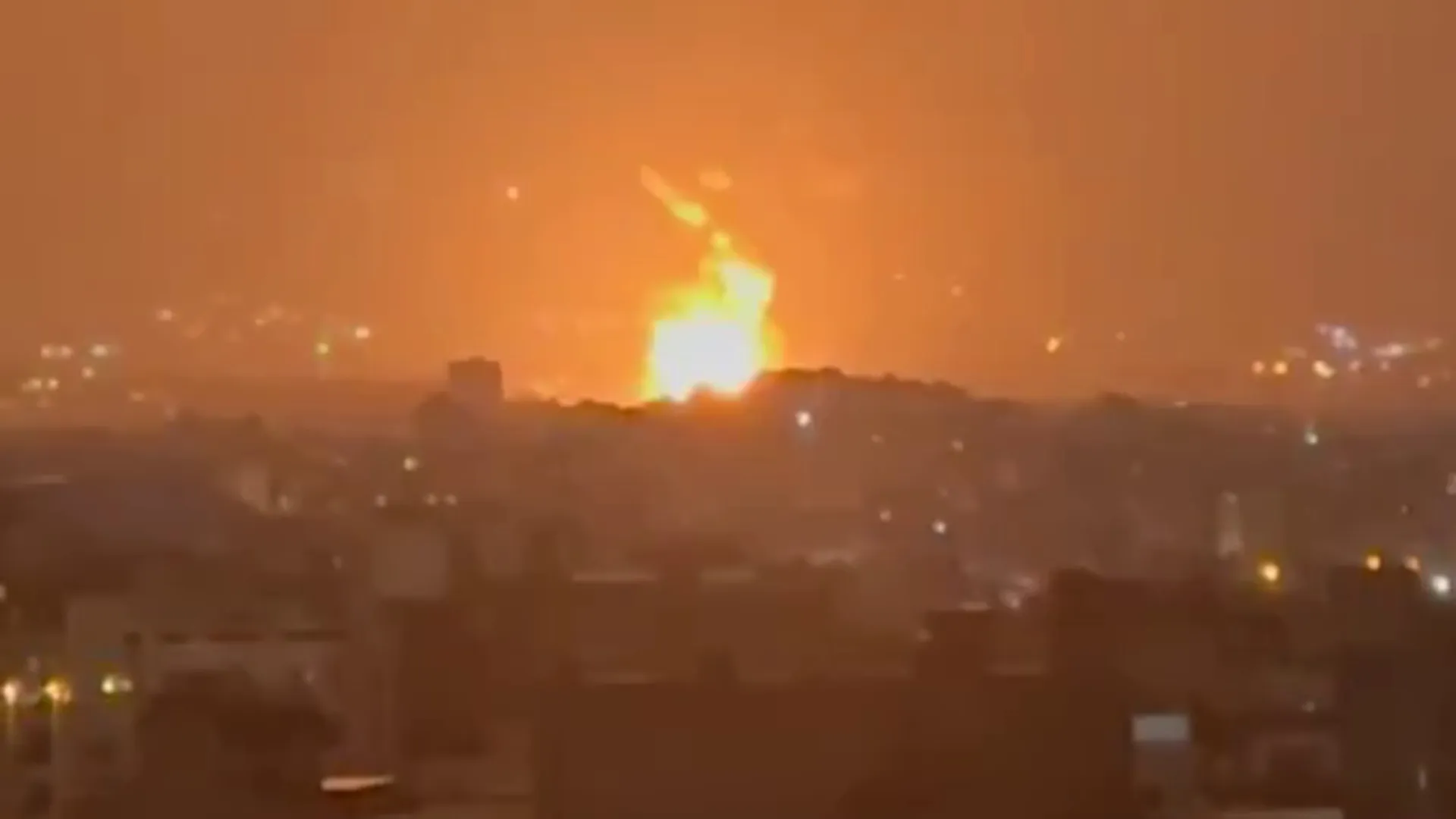
Reports in the Lebanese media suggest that an Israeli strike hit Beirut’s southern suburbs early today. Several explosions were heard in the area, which is considered a Hezbollah stronghold. Israel has previously issued evacuation warnings for the area but provided no specific warning in advance of Friday’s strike, AFPsaid.
An Israeli M109 self-propelled howitzer artillery fires rounds towards southern Lebanon from a position in the upper Galilee in northern Israel near the border on March 26, 2026. Photo by Jack GUEZ / AFP JACK GUEZ
Kuwait’s Shuwaikh port was hit by drones, causing material damage with no injuries reported, the Kuwait Ports Authority said today.
The international airport in Kuwait City also appears to have been on the receiving end of recent Iranian attacks, with a significant blaze there today, after a reported drone strike.
🔥 Fire breaks out at fuel tanks at Kuwait International Airport following an Iranian drone attack on Thursday
Iran-linked hackers today claimed they had accessed FBI Director Kash Patel’s personal email inbox, Reutersreports. The group claims to have published photographs of the director and other documents on the internet.
Satellite imagery of the Yazd missile complex, one of the most important in Iran, from earlier this month, reveals the shadow of an apparent Khorramshahr missile before being launched toward Israel. The original Khorramshahr first emerged publicly in 2017, and it is assessed to be derived, at least in part, from a North Korean design. It is a liquid-fuel medium-range ballistic missile (MRBM) with a claimed range of around 1,250 miles (2,000 kilometers).
Recent analysis from ThePrint, an Indian digital news platform, suggests that Iran has launched around 4,300 missiles and drones since the start of the current conflict, with the majority of these targeting Gulf nations, rather than Israel. The analysis states that Tehran has launched at least 1,815 drones and 372 missiles at the UAE since the start of the war. Israel, in comparison, has faced roughly 930 missile and drone attacks in the same period.
Interesting number crunching by my colleague @Keshav_Paddu
4,300 missiles & drones since day 1 of war: Gulf nations, not Israel faced brunt of #Iran’s retaliation#Israel, in comparison, has faced roughly 930 missile, drone attacks in the same period.https://t.co/WLOancpE8z
In related news, Reuters today published an assessment stating that, so far, the Pentagon can only confirm that about a third of the Iranian missile arsenal has been destroyed.
Satellite imagery from yesterday indicates that the aircraft carrier USS Gerald R. Ford has left Naval Support Activity Souda Bay in Crete, Greece, escorted by three patrol boats. The supercarrier went to Souda Bay for repairs after a fire broke out in the laundry area while underway in the Middle East on March 12, injuring two sailors.
Ukrainian President Volodymyr Zelensky says that his country has “reached an important arrangement” with Saudi Arabia on defense cooperation. The agreement between the defense ministries of the two countries is almost certain to involve counter-drone technologies and expertise.
“We are ready to share our expertise and systems with Saudi Arabia and to work together to strengthen the protection of lives,” Zelensky wrote on X. “Now into the fifth year, Ukrainians are resisting the same kind of terrorist attacks — ballistic missiles and drones — that the Iranian regime is currently carrying out in the Middle East and the Gulf region. Saudi Arabia also has capabilities that are of interest to Ukraine, and this cooperation can be mutually beneficial.”
We have reached an important Arrangement between the Ministry of Defense of Ukraine and the Ministry of Defense of the Kingdom of Saudi Arabia on defense cooperation. The document was signed ahead of our meeting with the Crown Prince of Saudi Arabia, Mohammed bin Salman Al Saud.… pic.twitter.com/j3aXzLXSNr
— Volodymyr Zelenskyy / Володимир Зеленський (@ZelenskyyUa) March 27, 2026
Last May, a strange thing happened on the U.S. album charts. Two metal bands (or at least metal-adjacent hard rock acts) scored No. 1 albums in the same month. The genre hadn’t seen multiple bestsellers in the same year since 2019 — and those were from veteran acts. So it was notable when the young U.K. group Sleep Token crushed on streaming and Ghost topped charts with a Taylor Swift-sized vinyl rollout. Meanwhile, avant-garde heavy rockers Deftones became unexpected TikTok darlings and arena stars.
Metal had not-so-quietly reemerged as a commercial force, and not just in the live sphere, where it’s always thrived and continues to grow. Pop culture seemed ready to welcome back a breed of hitmaker thought lost to time — the sleeve-tatted, throat-shredding hard rock star.
So the wider pop world should acquaint itself with the Virginia-born group Bad Omens, whose slam-packed Thursday night show at the Forum in Inglewood reaffirmed that they’re one of the most ambitious and skilled young bands in heavy rock, and have the star wattage and ravenous fan culture to get even bigger.
Bad Omens — with singer Noah Sebastian, bassist Nicholas Ruffilo, guitarist Joakim Karlsson and drummer Nick Folio — are not brand new. They’ve slugged it out on the metalcore and heavy rock circuit for a decade, signed to the small-ish but influential imprint Sumerian Records. But they hit their stride with 2022’s “The Death of Peace of Mind,” which melded a Weeknd-worthy R&B falsetto with rotted, churning guitars and tasteful electronics.
The band became festival headliners and racked up billions of streams, surely aided by Sebastian’s dreamboat-goth-BF good looks and striking range as a vocalist, where he veers from an ear-tickling whisper to an operatic howl and a shriek worthy of Norway in the ‘90s (sometimes on the same song, as he did on “Like a Villain”).
The band has tipped a new album for some time, though for this career-peak arena tour, it had only a handful of new singles in tow. No matter. At the Forum, the band cohered its catalog with an eye-popping stage production, one that made its case as an ultra-modern heavy rock act with the reach to be huge stars, even if they take genuine fame with some ambivalence.
That force-of-gravity was evident in the days leading up to the Forum show, where fans debated how many hours early they needed to be at the Forum to be on the barricades (the consensus — get there by breakfast). Mid-set, Sebastian pointed out one fan whom he recognized from years on the road. “You’ve been coming to see us since we sucked,” he said, laughing.
That commitment wouldn’t be possible if the music didn’t have a preternatural force to speak to current anxieties. From the first notes of its new single “Specter” — a brooding vocal workout for Sebastian that ended on pulverizing riffs — Bad Omens used cutting-edge tools and underground influence to elicit arena-rock catharsis.
One early peak of the set came when Jake Duzsik of the L.A. industrial-rock trio Health came out to duet on “The Drain,” a lurching, menacing collaborative single and a standout for both bands. Heavy-rock veterans see something compelling in Bad Omens, which helps situate the band’s pop-savvy tracks like “Left for Good” and “Just Pretend” (a platinum-selling single that wrapped up the main set) with earned feeling rather than calculation.
After the Forum show, I understood why it’s taking them so long to finish a new LP. Sebastian has been open about his mental health struggles. The band is pitched right at a difficult juncture at which their artistic ambitions abut real, life-altering attention.
They can make songs like “What It Cost” (a hooky, lecherous electro track that I’d totally believe was co-written with Max Martin if you told me) and the serrated metal that them earned them their fanbase and would cause a revolt without. It’s not easy to pair the two in a natural way. (Just ask Code Orange, once pitched as metal’s breakout stars who got bogged down in electronic experiments.) Having a K-pop-caliber devoted fanbase is great on the way up, but it’s a tense relationship.
But first and foremost, Bad Omens are gifted musicians, and whatever eldritch magic Sebastian wields onstage will always be bolstered by a serious band contorting metal, dark pop and electronic music. I saw nothing that would stop that one fan from coming back for 10 more years of Bad Omens shows, and plenty to suggest others are going to follow him.
A pair of U.S. Air Force F-16Cs from the 457th Expeditionary Fighter Squadron sit prior to take-off from Prince Sultan Air Base in Saudi Arabia, June 13, 2023. On Friday, an Iranian missile and drone attack at the base injured 10 U.S. service members. File Photo by Tech. Sgt. Alexander Frank/U.S. Air Force
March 27 (UPI) — An Iranian attack on an air base in Saudi Arabia on Friday injured 10 U.S. service members — two seriously — unnamed officials familiar with the incident told media outlets.
The attack took place at the Saudi military’s Prince Sultan Air Base in Al Kharj, striking a building where the U.S. service members were, U.S. officials told The Wall Street Journal. NBC News and CBS News also confirmed the attack, citing unnamed sources.
Iran used missiles and drones to carry out the attack, which also damaged multiple refueling vehicles.
Since the start of the war in Iran a month ago, more than 300 Americans have been injured and 13 killed.
The United States and Israel began attacks on Iran beginning Feb. 28 amid stalling talks regarding Iran’s nuclear program. On Thursday, President Donald Trump said the United States would forgo attacks on Iran’s energy sites for 10 days to give time for further negotiations to end the war.
Iran on Friday blamed Israeli for contradicting Trump’s 10-day delay by launching attacks on infrastructure sites, including an energy plant.
The U.S. Air Force’s 378th Air Expeditionary Wing has been based at Prince Sultan base since 2019.
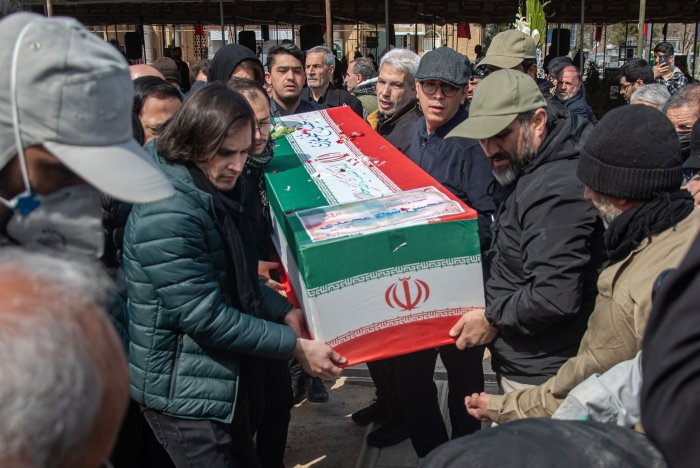
Iranians attend a funeral for a person killed in recent U.S.-Israel airstrikes at Behesht-e Zahra cemetery on the southern outskirts of Tehran in Iran on March 9, 2026. Photo by Hossein Esmaeili/UPI | License Photo
Police are charging professional golfer Tiger Woods with driving under the influence for a second time after he rolled his Land Rover SUV near his Florida home.
The Grammy-winning composer behind the signature opening chant in the song “Circle of Life” for “The Lion King” movies is taking a comedian to court for allegedly damaging his reputation by misrepresenting the song’s meaning on a viral podcast episode.
In a federal lawsuit filed this month seeking millions in damages, Lebohang Morake, known as Lebo M, accused Zimbabwean comedian Learnmore Jonasi of intentionally botching the translation of the lyrics, central to both the Disney films and the musical theater adaptations.
“I’m getting sued for $27 million and to make matters worse, I got served the lawsuit while I was performing,” Jonasi said in a post on social media Tuesday. The post included a clip of the comedian performing at the Laugh Factory when a manila envelope is tossed onstage.
“Right now, I’m looking for a lawyer. … I can’t believe I’m getting sued for telling a joke. What kind of stupid world do we live in?” he added.
It all started when Jonasi’s appearance on the “One54” podcast went viral late last month. In the episode of “One54” cited in the lawsuit, one of the podcast’s Nigerian hosts, Akbar Gbajabiamila, prompts the comedian with “I heard you had a problem with the ‘Lion King,’ why?” He then breaks into song, trying his hand at the chant and butchering the delivery.
“That’s not how you sing it, don’t mess up our language like that,” Jonasi says, before singing the correct lyrics in Zulu. When the hosts ask what it means, he says it translates to: “Look, there’s a lion. Oh, my God.”
The hosts erupt with laughter, saying that they’d always thought the chant was something more “beautiful and majestic.”
Jonasi often uses the same “Lion King” bit in his stand-up routines. He translates the song’s lyrics from Zulu and Xhosa, two of South Africa’s 12 national languages, and offers a broader critique on the film.
In Season 19 of “America’s Got Talent,” the comedian won over audiences by joking about how American movies about Africa often confuse Africans, asking, “Why do the lions have American accents?”
The civil lawsuit accuses Jonasi of intentionally mocking “the chant’s cultural significance with exaggerated imitations,” according to the complaint.
Disney’s official translation of the opening phrase “Nants’ingonyama bagithi Baba” is “All hail the king, we all bow in the presence of the king.”
“Hay! baba, sizongqoba,” the chant continues. It translates to “Through you we will emerge victoriously,” according to Lebo M.
Lebo M’s lawyers acknowledged in the complaint that “ingonyama” can literally translate to “lion,” but said it’s used in the song as a “royal metaphor” that invokes kingship, and that Jonasi intentionally misrepresented “an African vocal proclamation grounded in South African tradition.”
Jonasi “received a standing ovation” for a similar joke he made about the song during a March 12 stand-up performance in Los Angeles, according to the lawsuit. Such viral statements, it says, are interfering with Lebo M’s business relationships with Disney and his income from royalties, causing more than $20 million in actual damages. The lawsuit also seeks $7 million in punitive damages.
The complaint also argues that Jonasi presented his translation “as authoritative fact, not comedy,” so it shouldn’t get the 1st Amendment protections afforded to parody and satire.
Jonasi and reps for Lebo M didn’t respond to emails seeking comment, but the two have been busy on social media, making alternating statements and sub-posting each other for weeks.
Earlier this month, Jonasi revealed that he’d been receiving threats on social media for offending his fellow Africans. “It was never my intention to disrespect anybody,” he said in the video posted to Instagram. “When I went on that podcast, my intention was actually to talk about African identity. … I’d like to apologize to anybody that I hurt. But my comedy was a way to crack open a window for a conversation.”
“I had no idea the chant from ‘The Lion King’ was a royal welcoming song … I speak a little bit of Zulu, so I directly translated the words, and I even spoke to some of my South African friends, and most of them don’t even know what it means. And the rest of the world thought it was actually gibberish.”
A few days later, Lebo M posted his own Instagram video, saying he had attempted to speak with Jonasi privately, but claimed the comedian had disrespected him. “You are riding a huge wave of going viral on negativity,” he said in the video.
“I would like to encourage you to please slow down. You have a long way to go. I wish you success, but you cannot disrespect other people’s cultures that gave you the first opportunity to start with and claim it’s comedy. … You continue making a mockery of my work … the likes and the viral things won’t be there when it’s just you.”
After exchanging a few more public statements via Instagram, Jonasi was served with court papers.
He shared the news online and announced he’s selling merchandise and launching a GoFundMe to raise money for his defense. The shirts and hoodies for sale feature two different designs — one reads “Look it’s a lion,” and the other “Look it’s a lawsuit, Oh, my God.” As of Friday afternoon, Jonasi’s GoFundMe raised more than $17,000.
The tense situation seemed to be cooling on Friday morning, when Lebo M posted a lengthy statement to Instagram signaling a shift from an impending courtroom showdown to what his team is calling a “white flag moment.”
According to the post, Lebo M’s team has contacted Jonasi to “explore the possibility of a structured settlement.”
Donald Trump touted the US-Israel war on Iran as “bold” and “historic,” telling a Saudi investment conference that the Middle East will soon be free from Iranian “nuclear blackmail.”
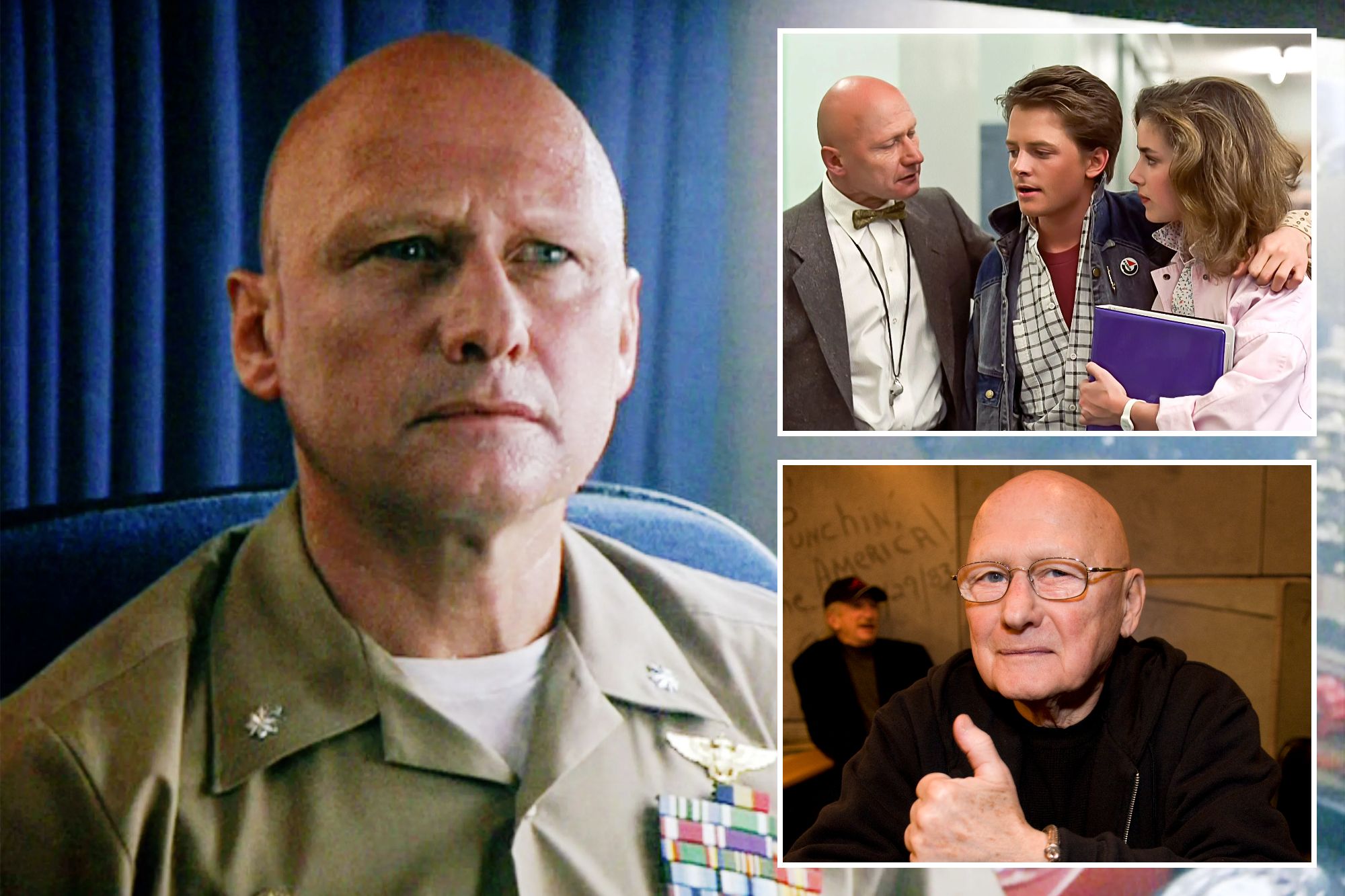
BACK to the Future and Top Gun actor James Tolkan has sadly died aged 94.
The Hollywood star passed away peacefully at his New York state home on Thursday after a celebrated TV and stage career spanning 55 years.
Sign up for the Showbiz newsletter
Thank you!
Hollywood actor James Tolkan has passed away aged 94Credit: GettyTolkan as tough teacher Mr. Strickland in Back to the FutureCredit: AlamyThe actor was also known for his role as Commander “Stinger” Jardian in Top GunCredit: Getty
His death was announced on the Back to the Future website as well as by writer-producer Bob Gale, but a cause was not provided.
Tolkan played the slacker-hating teacher Mr. Strickland in the first two films of the iconic 80s franchise, returning as the grandfather of his character in the third.
He was also known for his performance as air group commanding officer “Stinger” Jardian in the 1986 blockbuster Top Gun, alongside stars Tom Cruise, Val Kilmer and Meg Ryan.
Tolkan’s five-decade-long career started in the 1960s series Naked City and called it a day after the 2015 film Bone Tomahawk.
He was born on June 20, 1931 in Calumet, Michigan and served in the brutal Korean War as part of the United States Navy.
The young sailor was discharged due to a heart condition and set his sights on becoming an actor, earning a BA in drama from the University of Iowa.
An obituary on the Back to the Future website says that he then “got on a bus for New York City with $75 in his pocket, went to work on the docks and enrolled with both Stella Adler and Lee Strasburg to learn the art of acting.
“He spent 25 years in New York theater, from off off Broadway to the great White Way.
Most read in Entertainment
“Notably, he was a member of the original ensemble cast of the ‘Glengarry Glen Ross’.”
Tolkan moved his career from New York to California and Canada in 1983 when he was cast in War Games.
After his roles in Back to the Future and Top Gun, Tolkan had a dual role in Woody Allen’s Love and Death.
Tolkan is survived by his wife of 54 years, Parmelee – whom he met in the off-Broadway play Pinkville in 1971 – and his three nieces in Des Moines, Iowa.
The late actor adored animals and the obituary asked for donations in his memory to your local animal shelter, animal rescue organisation or Humane Society chapter.
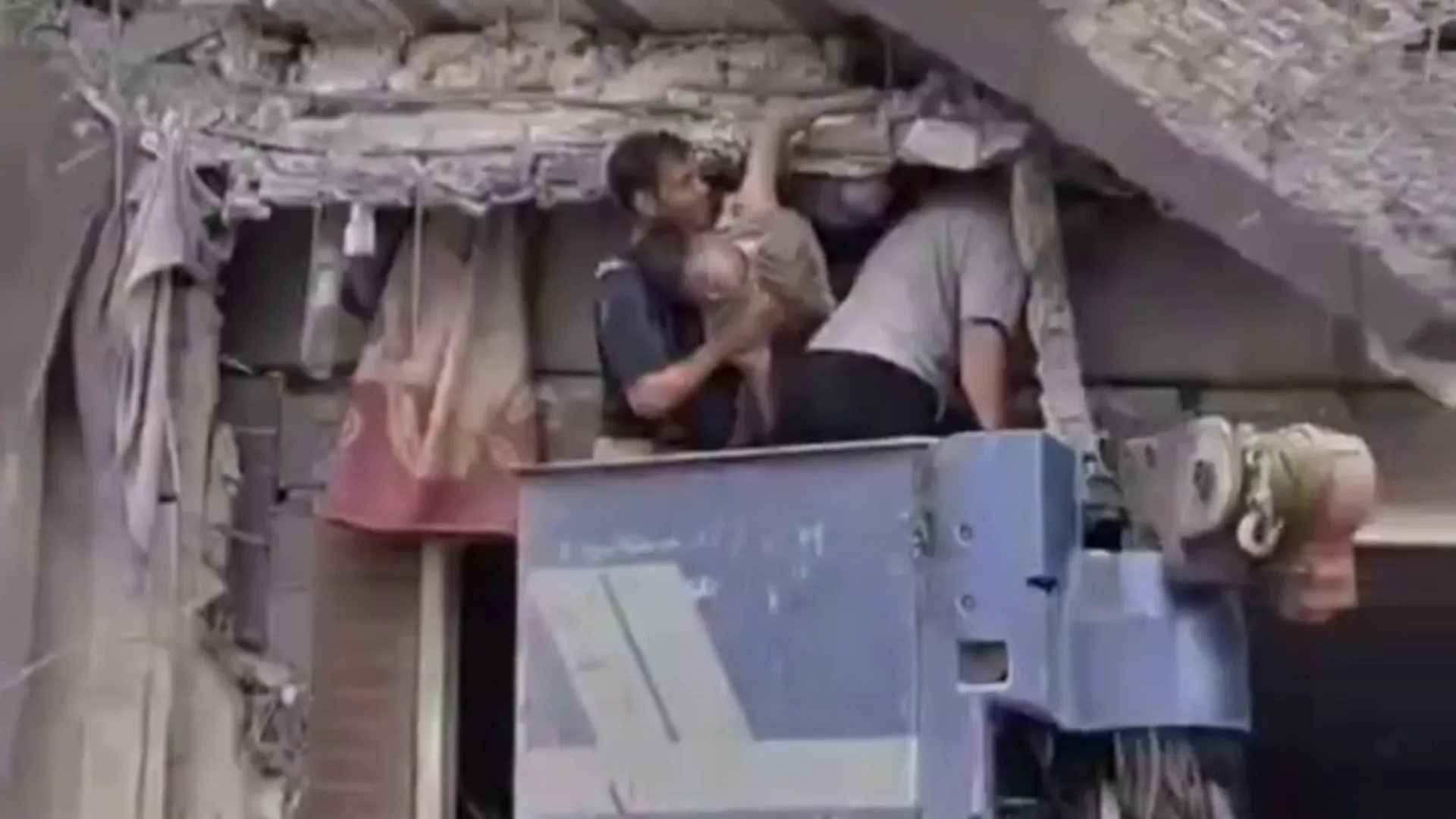
Iranian rescue workers have been pulling survivors and bodies out of a residential building in south Tehran after a US-Israeli missile strike. Al Jazeera’s Tohid Asadi was at the scene.
Weekly insights and analysis on the latest developments in military technology, strategy, and foreign policy.
With its facilities in the Middle East frequently targeted by Iranian missiles and drones, U.S. Central Command is looking for better ways to protect its troops and capabilities. This week, the command and its subordinate units put out two calls for information from companies that can design and provide hardened infrastructure, including underground facilities, as well as shelters. The need for hardened shelters is something that The War Zone has been raising for years, especially when it pertains to aircraft.
The attacks have been so intense that they’ve forced “many American troops to relocate to hotels and office spaces throughout the region,” The New York Times reported on Thursday, citing military personnel and American officials. “So now much of the land-based military is, in essence, fighting the war while working remotely, with the exception of fighter pilots and crews operating and maintaining warplanes and conducting strikes.”
You can see video from one of those Iranian attacks, on the U.S. Navy base in Bahrain, below.
The troop relocations spurred Iran’s powerful Speaker of the Parliament Mohamed Bagher Ghalibaf to mock the U.S. war effort in a post on X.
How can the US, which can’t even protect its own soldiers at its bases in the region and instead leaves them stashed away in hotels and parks, protect them on our soil?
— محمدباقر قالیباف | MB Ghalibaf (@mb_ghalibaf) March 27, 2026
On Wednesday, U.S. Air Forces Central (AFCENT) put out a call for vendors who are able to help bolster force protection at Al Udeid Air Base in Qatar, the largest American military installation in the Middle East. Like many other bases in the region, it has come under frequent attack from Iran. AFCENT is seeking information from companies able to plan and design “a hardened, underground, secure, Combat Center Building…and squadron operations buildings supporting a variety of airframe and missions to include, but not limited to, bombers, fighters, and unmanned aircraft systems for intelligence, surveillance, and reconnaissance (ISR).”
The sources sought solicitation, which could lead to a sole-source contract award, states that the plan may also seek construction of additional facilities, including administrative offices, command and control facilities, operational readiness and life support facilities for specialized personnel, elevators, and a parking garage. However, there is a long lead time for this project, even if it gets approved. A contract solicitation won’t be issued until April 2027, with the award anticipated in January 2028.
CENTCOM is looking for companies who can design a hardened, underground sheltered command center at Al Udeid. (U.S. Air Force photo by Senior Airman Sarah Williams) Senior Airman Sarah Williams
The underground shelter plan for Al Udeid is part of Strategic Master Plan 2040 (SMP2040), “a portfolio of over 170 Qatar-funded projects worth $10 billion that will be carried out from the first quarter of 2026 until 2040,” according to AFCENT. “Most of the projects are designed and will be constructed by Qatar with a few being U.S.-designed and constructed.”
It is unclear whether the new shelter project was spurred by current events, but a Feb. 3 AFCENT release on SMP2040 makes no mention of such structures. That fact that the plan will take years to come to fruition also raises questions about why it had not been unveiled sooner, given that Al Udeid has long been known to be a target of potential Iranian attacks. It is also not publicly known whether the proposed Combat Center Building at Al Udeid will replace or augment the current Combined Air Operations Center (CAOC) that serves as a command and control headquarters for U.S. and allied aircraft operating across the Middle East. We’ve reached out to AFCENT for clarification, but they deferred us to CENTCOM, which declined comment.
Attacks on and damage to Al Udeid from Iranian missiles can be seen below.
This satellite imagery is noteworthy. It appears to show at least two precise impact points on a large bunker used by U.S. forces at Al Udeid Air Base in Qatar 🇶🇦, located at 25°06’45.71″N 51°20’43.17″E.
In a more immediate request, CENTCOM is looking for vendors capable of providing “prefabricated, transportable, hardened shelter systems designed to protect personnel from blast and fragmentation threats,” according to a sources sought posting on Monday. “All proposed solutions must be deliverable to the Aqaba Air Cargo Terminal at King Hussein International Airport in Aqaba, Jordan.”
Unlike the Al Udeid plan, CENTCOM is looking for a quick turnaround on these shelters, asking that vendors submit “three potential delivery options reflecting estimated timelines of 3 days, 15 days, and 30 days.”
“Responses shall include a comprehensive description of the materials used in fabrication, including composition, structural design, and any reinforcement features,” according to the solicitation. “Vendors must also clearly identify the protection level of each proposed bunker, including the highest level of threat (e.g., blast force, fragmentation, or ballistic impact) the system is designed to withstand.”
The total quantity of these shelters is currently unknown and vendors are being asked to provide pricing structures “that reflect any available economies of scale.” The timeline for this project is unclear. Responses are due today, but there is no contract award deadline listed in the solicitation. CENTCOM declined our request for details, citing operational security concerns.
“Vendors are requested to submit three potential delivery options reflecting estimated timelines of 3 days, 15 days, and 30 days.”
“The USG’s review of documentation priorities are delivery timeline first, followed by protection level of the bunker systems.”
The most recent incident took place earlier this month when Barksdale Air Force Base in Louisiana experienced waves of drone incursions. The base is home of B-52 Stratofortress bombers and nuclear weapons storage facilities, and is a key part of the airborne leg of America’s nuclear triad.
I have spent a good part of my career just getting people to believe this was actually happening. Now we are here. With 15 drones, you can lose roughly 1/4 of the B-52 force as it sits idle on the ground. This was always the most concerning scenario. Time to move to hardening.… https://t.co/bBgE5taas9
One of the biggest concerns we have raised over the years is the lack of shelters at the massive and highly strategic Andersen Air Force Base on the island of Guam. The base, a key location for U.S. power projection in the Pacific, will be a prime target for Chinese long-range missiles in the event of a war.
Friday morning, retired Air Force Lt. Gen. David Deptula, now dean of the Mitchell Institute, concurred with our concerns about the lack of shelters and other hardened infrastructure.
“It absolutely has been needed and I made that case back when [Al Udeid] was being built,” Deptula told us. “But it’s all about money. That, along with not hardening aircraft shelters in Guam.
Deputla added that he tried to get hardened shelters built in Guam back when he was Director of Air and Space Operations for Pacific Air Forces more than 20 years ago.
“We were passed over due to other priorities at the time,” he explained.
As for the concept for hardened infrastructure at Al Udeid, Deptula said he was not aware of the plan, “but it is too little too late for this war.”
The reluctance about hardened shelters may be starting to change. Last year, the U.S. Army Corps of Engineers (USACE) announced anti-drone updates to the Modular Protective System-Overhead Cover (MPS-OHC). MPS-OHC was originally developed during the Global War on Terror era in response to indirect fire threats like artillery shells, rockets, and mortar rounds that U.S. forces were facing in Afghanistan and Iraq. The modular shelters, while still hardened, could provide a more temporary and cost-effective way to protect aircraft, other equipment and personnel from drones.
A Modular Protective System-Overhead Cover. (US Army Corps of Engineers)
Meanwhile, weeks before Epic Fury was launched, the Pentagon released new guidelines for hardening civilian and military facilities in the homeland from the growing threat from small drones that The War Zone has long warned about. These concerns have been spurred by years of incursions over U.S. bases and critical facilities and were hammered home by Ukraine’s 2025 near-field attack, dubbed Operation Spider Web, that wiped out a large number of Russia’s bombers with concealed arrays of drones stashed near airbases.
Epic Fury, of course, presents a different threat as U.S. bases get hit by ballistic missiles and large drones like Shahed-136s, in addition to first-person view (FPV) drones. Regardless, this conflict has once again highlighted the need to find better ways of protecting American troops and assets.
Ranting about the decline of comedy specials while releasing a new one at the same time feels a bit like an oxymoron. But somehow it still makes sense coming from alt-comedy pioneer David Cross, who isn’t just complaining; he’s finding his own route to making specials feel special again. The only way to do that is by putting one out in the manner he’d like to see more often — starting by making the whole crowd stand up too.
Capturing the energy of a concert at the famous 40 Watt Club in Athens, Ga., was the first step in differentiating “The End of the Beginning of the End” from the typical hour you watch on a big streamer. And, with this new special, Cross is able to get back to his own beginnings of touring across the country with love bands as his openers, performing for crowds for as long as he could until he had to run offstage to pee.
Premiering the special earlier this month on his website (and on April 7, it will be available on YouTube via production company 800 Pound Gorilla), Cross is hoping the special connects with comedy fans in a way that we’ve forgotten specials could.
This interview has been edited for length and clarity
Your new special is called “The End of the Beginning of the End.” What does that title mean to you as it relates to the impending doom of what we’re all living right now.
David Cross: Well, you can look at it in a couple different ways. To me, it signifies that the beginning of the end has occurred. And we are now at the end of the beginning of the end. And from where you go with that, that’s for you to decide.
One of the things I love about the special is the fact that you shoot it at a club in the style of a live–music concert.
I’ve shot specials in theaters and it’s just different, not that one is better than the other, but they’re just different. You have a different relationship with the audience. When I first started touring, I would go to music venues and I’d have a band open for me and then I would just go up and pretty much [perform] as long as I could until I had to pee. Sometimes I’d have a band playing, sometimes two bands, then I’d go out. And I did that a couple of times, and then stopped doing that and did theaters, and I decided for the last two specials I’m going to go to, when I shoot it, I’ll go to a music venue, and I was at the 40 Watt Club in Athens this last time, I was at the Metro in Chicago before that, both places I played on earlier tours, and, you know, it’s not seated. People are standing there at the stage, and I prefer it. It’s more fun. It’s not as lucrative but, to me, a more fun show to do.
Comedian David Cross
(Jason Armond / Los Angeles Times)
The ambience of it was great.You can hear people shouting and drinking and having a good time, and the crowd work is also a little more spontaneous and fun than it would be in a regular venue.
Yeah, well, there’s more opportunity for that. But my thing has never been about crowd work. I like engaging with it, it’s kind of a nice distraction from the set that you’ve been doing 100 times, 150 times at that point. So it’s always fun to have that thing happen and that feeling of spontaneity. And like the guy [who I talk to in the crowd during the special], I could not have asked for [someone better]. I mean, even if it was scripted, it wouldn’t have been as good. The guy who [I talk to] during the stuff about hiking Machu Picchu [with Bob Odenkirk], that’s just… [chef’s kiss].
Speaking of Bob Odenkirk, you guys have this long relationship. How would you describe the dynamic of working with Bob and just how you guys bounce ideas off each other?
I mean, it’s great. We have an inordinate amount of respect for each other, both as people and as creative partners. And so there’s never any real issues. There’s things we will definitely disagree with, but we’re both decent people. So you know somebody backs off and says, “OK, let’s do it that way.” But even then, there aren’t that many of those [issues]. We just have really worked well at building something or molding it, creating it and shaping it. And our aforementioned hike to Machu Picchu, we have a documentary about that, that will be premiering at a fancy festival at some point in the near-future. And so we got that doc and we’ve been working on that. And for the way we work now, because he lives in L.A. and I live in New York, and it’s been like that for a while, he’ll write a bunch of stuff, I’ll make notes, I’ll write my things, send it back. And so we’re able to do that and not necessarily have to be in the same room because we’ve had 30-plus years of working with each other.
It’s a kind of like an unspoken language you guys probably have in terms of comedy, which is super important, I imagine, just for collaborating.
Yeah, and it’s something we discovered very early on … before there was even “Mr. Show,” what would ultimately become “Mr. Show,” when we got together to write sketches for this bigger kind of comedy collective thing, and these shows that we would all do with each other, for each other, and the stuff that we would write together was just, like, really good, easy writing — again, one person adding this thing and one person saying here’s a switch yeah and another person adding this thing in. It was fun, it’s cool, still is. One thing he doesn’t get credit for is he’s a really decent human being. And with all the awfulness in the world that’s magnified, every sense is bombarded with it — it’s just good to be hanging with somebody whose energy is a good person, a decent person and an equitable, nice guy, so that’s good as well.
Comedian David Cross poses for a portrait ahead of his comedy special “The End of the Beginning of the End.”
(Jason Armond / Los Angeles Times)
One thing you guys also have in common is you both have kids, and he has a comedy show for kids called “The Appropriate Show.” Have you taken your daughter to see it?
It’s a sketch show [in which] all the sketches are appropriate for kids to watch. And the sketches have been done in other sketch shows onstage, live. And he puts together this thing once, twice a year here in L.A. And I took my daughter to it last year. It’s just sketches that kids can [understand]. At least if they don’t understand the actual references they get the archetype. “Oh, that’s the boss, that’s that uh… And it’s great, it’s a really cool idea uh… “ And would an ass— think of [a show like] that? No, one good decent person; a good man. But listen, this interview isn’t about me, it’s about Bob Odenkirk, so let’s get back to that.
Well, speaking of having comedy geared toward kids, your daughter’s at an age where she’s probably consumed or seen some of your comedy at this point.
Not, not really. No, no.
Do you shield her from your stuff, or are you not so concerned about it?
I don’t actively shield her, but I don’t introduce her to anything. So I was a little bummed out, and I got over it pretty quickly, but when I found out that she had seen a little bit of “Alvin and the Chipmunks,” and only because I don’t want to spoil the enjoyment of what movies are and what kids’ movies are and how things work. And I feel like that would introduce an element of reality that I want her to be able to just enjoy these things without — she’s seen “Kung Fu Panda”when she was younger, like, I don’t know, three, four, five times, has no idea that I’m in that, that my voice is in there. She knows I do stand-up, she gets that now. And when she was younger, she’d say, “Daddy’s silly for a living.” … I’m just trying to ride the balance of letting her have those childhood joys and experiences.
Comedian David Cross.
(Jason Armond / Los Angeles Times)
Does having a kid make you think about what’s coming up in the future of comedy, or what kids are gonna maybe find funny, or what they find funny now? Do you have any thoughts on kid comedy in general?
Not really. I mean, I can see that she and her friends, who are kind of like-minded, are naturally funny, and then that’s kind of encouraging and heartwarming and they’re silly, but I’ll be long gone when that generation is is providing comedy. And I’m still, although I’ve kind of given up, I’m still trying to grasp what works now. I mean, it’s short-term TikTok, Instagram stuff. There are some amazing, like really, really great things being done as far as film sketches for YouTube channels. “Almost Friday,” they’ve got genius-level stuff. I mean, really good. And where the sketch goes in a place, you’re never ahead of it, goes in a place where you’re not expecting. It’s really well written and well performed.
What are your thoughts on what a comedy special is nowadays or what it should be?
I mean, that’s a great question. I think anybody who plays with the form, whether I think it’s that funny or not, is different. But I’m happy when anybody kind of tries at least to play with a form. I just went to Rory Scovel‘s taping last week of his latest special. I don’t know when that’ll air, but if you’ve seen the beginning to his first special, stuff like that where you’re like, “Wait, what’s happening? What’s going on?” I love stuff like that.
I still get excited to watch specials by some of my favorite comics, but there’s a quality that’s missing. And these are stand-ups I love, and they’re not that great. They’re not bad but they’re not special, you know? And all those guys I mentioned, and more, have great specials. Like, you can go back and they’re great. And I don’t know why that is. I mean, there’s still funny stuff, but I don’t ever want to get to that place where its just feels a little phoned-in a little bit… that is, in part, why the last two specials were shot in this more intimate setting that feels special. And … as I said, the energy’s different, it’s a little bit different, and it’s less slick. It feels like you’re in the moment. You don’t need a million dollars to shoot a special. You don’t 28 camera angles, it‘s just bull—. And it takes something away.
Comedian David Cross
(Jason Armond / Los Angeles Times)
It all should feel the right amount of unsafe as well, I think.
That’s never gonna happen at a theater show. You’re never gonna feel that. And I don’t know, it really does feel almost like maybe we peaked in a sense, like there’s too much, and because of that, these things aren’t special. They’re not revelatory, they’re not unique. I dunno, can 18,000 people in an arena really relate to a … billionaire talking about how they’re gonna get canceled. I mean, is that a thing I guess? Those other big, slick specials that are shot in, like, a 3,200-seat, 3,500-seat theater, it just feels like, “Oh this person is up there and I’m listening to their jokes.” There’s nothing wrong with that. They’re often very funny jokes, but it doesn’t go beyond that. It’s just like, “All right, tell me your joke.” It might as well be an audio thing, you know?
Well, hopefully the robots aren’t coming for your job anytime soon.
Absolutely not. I mean, this could be naive, but I feel 100% safe that you are never going to replicate an evening of stand-up at a nigtclub like that. And not sitting down at tables while you’re having drinks and waitresses are coming by. I’m talking about everybody’s up on the stage, sold-out, maximum capacity; everybody’s there, focused, we’re all sharing that thing. You can’t. AI’s not going to be able to do that.
Yeah, the robots can’t do that, Terminator can’t do that..
Oh, I forgot about Terminator. He could do that. G— it.
“We affirm that our fingers are on the trigger.” The Houthis have warned that they are ready for direct military intervention in the US-Israeli war on Iran, laying out the conditions that could prompt their involvement.