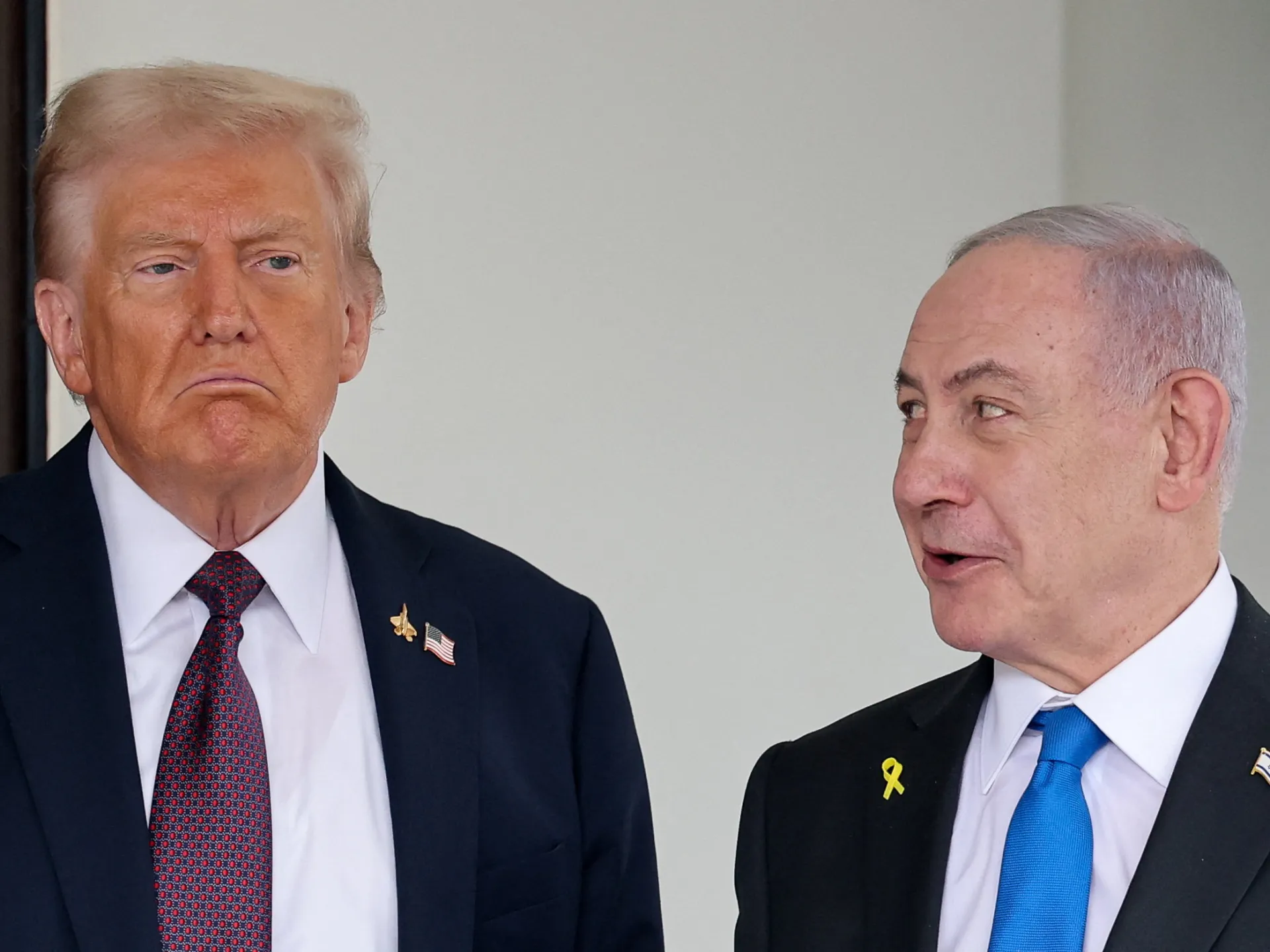
Israeli Prime Minister Benjamin Netanyahu will visit the United States to meet with President Donald Trump as regional turmoil approaches a boiling point amid Israel’s attacks in Palestine, Lebanon and Syria and mounting tensions with Iran.
Netanyahu is to hold talks with Trump at the president’s Mar-a-Lago resort in Florida on Monday as Washington pushes to complete the first phase of the Gaza truce.
Recommended Stories
list of 3 itemsend of list
The visit comes as the US continues to pursue its 20-point “peace plan” in the Palestinian enclave despite near-daily Israeli violations of the truce.
Israel is also escalating attacks in the occupied West Bank, Lebanon and Syria as Israeli officials suggest that another war with Iran is possible.
What will Netanyahu discuss with Trump, and where do US-Israel ties stand?
Al Jazeera looks at the prime minister’s trip to the US and how it may play out.
When will Netanyahu arrive?
The Israeli prime minister will arrive in the US on Sunday. However, the talks will not take place at the White House. Instead, Netanyahu will meet Trump in Florida, where the US president is spending the holidays.
The meeting between the two leaders is expected to take place on Monday.
How many times has Netanyahu visited Trump?
This will be Netanyahu’s fifth visit to the US in 10 months. The Israeli prime minister has been hosted by Trump more than any other world leader.
In February, he became the first foreign leader to visit the White House after Trump returned to the presidency.
He visited again in April and July. In September, he also met with Trump in Washington, DC, after the United Nations General Assembly in New York.
What has the relationship between Trump and Netanyahu been like so far?
Netanyahu often says Trump is the best friend Israel has ever had in the White House.
During his first term, Trump pushed US policy further in favour of Israel’s right-wing government. He moved the US embassy to Jerusalem, recognised and claimed Israeli sovereignty over Syria’s occupied Golan Heights and cut off funding to the United Nations agency for Palestinian refugees (UNRWA).
Since returning to the White House this year, Trump has shown a greater willingness to publicly disagree with Netanyahu. Still, his administration has provided unflinching support for Israel, including the decision to renew the genocidal war on Gaza in March after a brief ceasefire.
Trump joined the Israeli attack on Iran in June to the dismay of some segments of his base. And he pushed to secure the current truce in Gaza.
The US president also opposed the Israeli attack on Doha in September. And he swiftly lifted sanctions against Syria despite some apparent Israeli reservations.
The ties between the two leaders have seen some peaks and valleys. In 2020, Trump was irked when Netanyahu rushed to congratulate Joe Biden on his election victory against Trump, who has falsely insisted the election was fraudulent.
“I haven’t spoken to him [Netanyahu] since,” Trump told the Axios news site in 2021. “F*** him.”
The strong ties between the two leaders were rekindled after Trump won the presidency again in 2024 and unleashed a crackdown on Palestinian rights activists in the US.
In November, Trump formally asked Israeli President Isaac Herzog to pardon Netanyahu, who is facing corruption charges at home.
The two leaders, however, are not in complete alignment, and cracks in their positions are showing up over issues that include Gaza, Syria and the US partnerships with Turkiye and the Gulf states.
During his US visit, Netanyahu may seek to flatter Trump and project a warm relationship with the US president to advance his agenda and signal to his political rivals in Israel that he still enjoys support from Washington.
How has Netanyahu dealt with the US since October 7, 2023?
Since the outbreak of the war in Gaza, Netanyahu has asked for unchecked US diplomatic and military support.
Then-President Biden travelled to Israel 11 days after Hamas’s October 7, 2023, attacks on southern Israel, and he declared that support for the US ally is “vital for America’s national security”.
His “bear hug” of Netanyahu on arrival at the airport in Tel Aviv would set the stage for the US backing of Israel as it unleashed horror and destruction on Gaza, which has translated into more than $21bn in military aid and multiple vetoes at the UN Security Council over the past two years.
Netanyahu has seized on the notion that Israel is an extension of US interests and security structure. In a speech to the US Congress last year, the prime minister argued that Israel is fighting Iran indirectly in Gaza and Lebanon.
“We’re not only protecting ourselves. We’re protecting you,” he told US lawmakers.
Throughout the war, there have been countless reports that Biden and Trump have been displeased or angry with Netanyahu. But US weapons and political backing for Israel have continued to flow uninterrupted. And Netanyahu makes a point of always expressing gratitude to US presidents, even when there may be apparent tensions.
Where does the US stand on the Gaza truce?
US Secretary of State Marco Rubio said last week that the top priority for the Trump administration is to complete the first stage of the Gaza ceasefire and move from mere cessation of hostilities to long-term governance, stabilisation and reconstruction of the Palestinian enclave.
Israel has been violating the ceasefire in Gaza regularly, recently killing at least six Palestinians in an attack that targeted a wedding.
But Trump, who claims to have brought peace to the Middle East for the first time in 3,000 years, has focused on broadly moving the truce forward rather than on Israel’s daily conduct.
“No one is arguing that the status quo is sustainable in the long term, nor desirable, and that’s why we have a sense of urgency about bringing phase one to its full completion,” Rubio said last week.
The top US diplomat has also suggested that there could be some flexibility when it comes to disarming Hamas under the agreement, saying the “baseline” should be ensuring that the group does not pose a threat to Israel rather than removing the guns of every fighter.
But Israel appears to be operating with a different set of priorities. Defence Minister Israel Katz said on Tuesday that the country is looking to re-establish settlements in Gaza, which are illegal under international law.
He later walked back those comments but stressed that Israel would maintain a permanent military presence in the territory, which would violate the Trump plan.
Expect Gaza to be a key topic of discussion between Netanyahu and Trump.
Can a Syria agreement be reached?
Trump has literally and figuratively embraced Syrian President Ahmed al-Sharaa over the past year, lifting sanctions against the country and beginning security cooperation with his government’s security forces.
But Israel is pursuing its own agenda in Syria. Hours after the collapse of the government of former President Bashar al-Assad a year ago, Israel began expanding its occupation of Syria beyond the Golan Heights.
Although the new Syrian authorities stressed early on that they did not seek confrontation with Israel, the Israeli military launched a bombardment campaign against Syria’s state and military institutions.
Israeli forces have also been conducting raids in southern Syria and abducting and disappearing residents.
After the Israeli military killed 13 Syrians in an air raid last month, Trump issued a veiled criticism of Israel.
“It is very important that Israel maintain a strong and true dialogue with Syria and that nothing takes place that will interfere with Syria’s evolution into a prosperous state,” he said.
Syria and Israel were in talks earlier this year to establish a security agreement short of full diplomatic normalisation. But the negotiations appeared to collapse after Israeli leaders insisted on holding onto the land captured after al-Assad’s fall.
With Netanyahu in town, Trump will likely renew the push for a Syria-Israel agreement.
Why is Iran back in the headlines?
Netanyahu’s visit comes amid louder alarm bells in Israel about Iran rebuilding its missile capacity after their 12-day war in June.
NBC News reported last week that the Israeli prime minister will brief the US president about more potential strikes against Iran.
The pro-Israel camp in Trump’s orbit seems to be already mobilising rhetorically against Iran’s missile programme.
US Senator Lindsey Graham visited Israel this month and called Iran’s missiles a “real threat” to Israel.
“This trip is about elevating the risk ballistic missiles pose to Israel,” Graham told The Jerusalem Post.
Trump authorised strikes against Iran’s nuclear sites during the June war, which he said “obliterated” the Iranian nuclear programme.
Although there is no evidence that Iran has been weaponising its nuclear programme, fears about a possible Iranian atomic bomb were the driving public justification for the US involvement in the conflict.
So it will be hard for Netanyahu to persuade Trump to back a war against Iran, said Sina Toossi, a senior fellow at the Center for International Policy.
The president is portraying himself as a peacemaker and prioritising a possible confrontation with Venezuela.
“It could just as well backfire on Netanyahu,” Toossi said of the push for more strikes against Iran. But he underscored that Trump is “unpredictable”, and he has surrounded himself with pro-Israel hawks, including Rubio.
What is the state of US-Israel relations?
Despite growing dissent on the left and right of the US political spectrum, Trump’s support for Israel remains unwavering.
This month, the US Congress passed a military spending bill that includes $600m in military aid to Israel.
The Trump administration has continued to avoid even verbal criticism of Israel’s aggressive behaviour in the region, including Gaza ceasefire violations and the expansion of illegal settlements in the West Bank.
At a White House Hanukkah celebration on December 16, Trump bemoaned the growing scepticism of unconditional support for Israel in Congress, falsely likening it to anti-Semitism.
“If you go back 10, 12, 15 years ago, at the most, the strongest lobby in Washington was the Jewish lobby. It was Israel. That’s no longer true,” Trump said.
“You have to be very careful. You have a Congress in particular which is becoming anti-Semitic.”
Despite Trump’s position, analysts said the gap between the strategic priorities of the US and Israel is growing.
While Washington is pushing for economic cooperation in the Middle East, Israel is seeking “total dominance” over the region, including US partners in the Gulf, Toossi said.
“Israel is pushing this uncompromising posture and strategic objective that I think is going to come to a head more with core US interests,” Toossi told Al Jazeera.
What’s next for the US-Israel alliance?
If you drive down Independence Avenue in Washington, DC, you will likely see more Israeli than American flags displayed on the windows of congressional offices.
Despite the shifting public opinion, Israel still has overwhelming support in Congress and the White House. And although criticism of Israel is growing within the Republican base, Israel’s detractors have been pushed to the margins of the movement.
Marjorie Taylor Greene is leaving Congress; commentator Tucker Carlson is facing constant attacks and accusations of anti-Semitism; and Congressman Tom Massie is facing a Trump-backed primary challenger.
Meanwhile, Trump’s inner circle is filled with staunch Israel supporters, including Rubio, megadonor Miriam Adelson and radio show host Mark Levin.
But amid the erosion of public support, especially among young people, Israel may face a reckoning in American politics in the long term.
On the Democratic side, some of Israel’s strongest supporters in Congress are facing primary challenges from progressive candidates who are centring Palestinian rights.
The most powerful pro-Israel lobbying group, the American Israel Public Affairs Committee (AIPAC), is increasingly becoming a toxic brand for Democrats.
On the right, the faultlines in the consensus in support of Israel are growing wider. That trend was put on display at the right-wing AmericaFest conference this month when debates raged around support for Israel, a topic that was a foregone conclusion for conservatives a few years ago.
Although the Trump administration has been pushing to codify opposition to Zionism as anti-Semitism to punish Palestinian rights supporters, Vice President JD Vance has presented a more nuanced view on the issue.
“What is actually happening is that there is a real backlash to a consensus view in American foreign policy,” Vance recently told the UnHerd website.
“I think we ought to have that conversation and not try to shut it down. Most Americans are not anti-Semitic – they’re never going to be anti-Semitic – and I think we should focus on the real debate.”
Bottom line, the currents are changing, but the US commitment to Israel remains solid – for now.