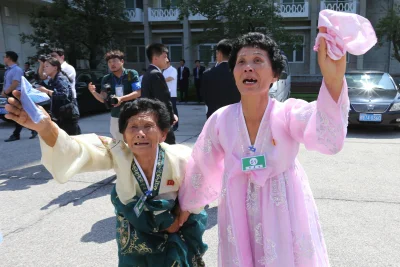

Some 75% of South Koreans registered as separated from family in the North have died of old age, government data showed Thursday. In this 2018 file photo, North Korean women react after seeing off a family member during a reunion at the Mount Kumgang resort, North Korea. Pool File Photo by O Jongchan/EPA-EFE
SEOUL, Jan. 15 (UPI) — More than three-quarters of South Koreans registered as members of families separated by the 1950-53 Korean War have died without being reunited with relatives in North Korea, official government data showed Thursday.
As of Dec. 31, 2025, a total of 134,516 people had registered with South Korea’s government as separated family members, the Ministry of Unification said in its latest statistical release. Of those, 101,148 — about 75% — were confirmed dead, leaving just 34,368 survivors.
The figures highlight the rapid aging of the remaining survivors. More than 65% of living registrants are aged 80 or older, including 10,885 people aged 90 or above, the data showed.
North and South Korea have held 21 family reunions since 2000, with the most recent taking place in August 2018 during a period of inter-Korean detente. Relations have frozen over in recent years, however, and time is not on the side of family members still hoping to connect with long-lost relatives.
Since taking office in June, President Lee Jae Myung has called for restoring humanitarian cooperation with Pyongyang, identifying separated family reunions as a priority issue in efforts to stabilize inter-Korean relations.
“I believe that it is the responsibility of all political leaders in both the South and the North to ensure that these tragically separated families can confirm the fate of their relatives and, at the very least, exchange letters,” Lee said in October.
Seoul has also sought to advance humanitarian engagement through institutional measures. In December, the Ministry of Unification released a 2026 policy plan aimed at “peaceful coexistence” with North Korea, pledging to expand separated family programs such as DNA testing, video messages and efforts to confirm the status of missing relatives.
Unification Minister Chung Dong-young underscored the sense of urgency during a recent visit with elderly separated family members, including a 105-year-old man in Seoul. “Separated families represent the greatest sorrow born of national division,” Chung said, adding that “time is running out.”
North Korea has not responded to recent proposals for humanitarian exchanges, however, as inter-Korean communication channels remain dormant amid heightened tensions over Pyongyang’s nuclear and missile programs. In February, North Korea began dismantling the facility used for family reunions at its Mount Kumgang tourist zone, a further sign of deteriorating relations.
Kim Yo Jong, the influential sister of North Korean leader Kim Jong Un, said on Tuesday that South Korea’s hopes for improved ties were an “illusion.”
“As far as Seoul’s various hope-filled wild dreams called ‘repair of (North-South) relations’ are concerned, they all can never come true,” Kim said in a statement carried by the official Korean Central News Agency.