Football leans on tradition, providing convenient cover for the NFL’s lenient stance on smelling salts, ammonia crystals that players believe enhance performance when inhaled.
Does the olfactory exhilaration also enhance play-calling, amplifying one’s grasp of X’s and O’s?
Kyle Shanahan apparently believes so.
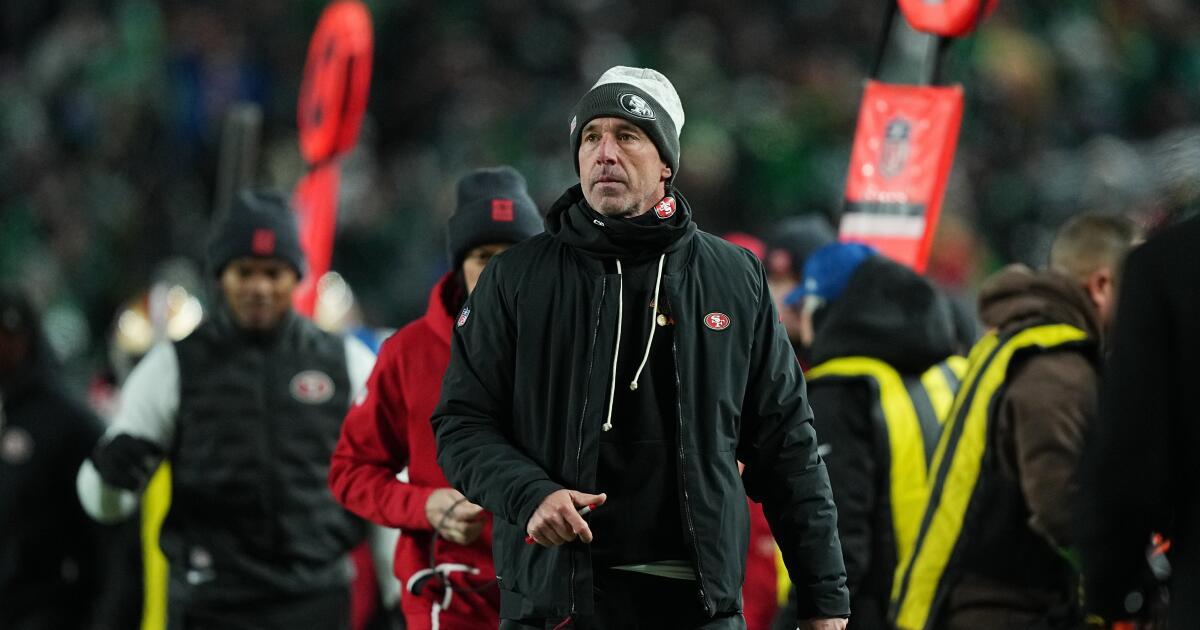
The San Francisco 49ers coach was caught by a Fox television camera moments before a playoff game Sunday against the Philadelphia Eagles taking several whiffs from a small packet before handing it to an assistant.
Earlier this season, the San Francisco Chronicle reported that 49ers players created a system to make sure everyone has immediate access to smelling salts during games. General manager John Lynch and Shanahan are users, according to the story, which stated that Shanahan “isn’t opposed to the occasional whiff.”
Is the NFL OK with this? The answer is a qualified yes.
Ahead of the 2025 season, the league’s head, neck and spine committee recommended that teams end the longtime practice of providing smelling salts to players. The decision was prompted by a U.S. Food and Drug Administration warning about the potential side effects of inhaling ammonia, which include lung damage and masking signs of a concussion.
Players all but panicked. George Kittle, the 49ers All-Pro tight end, jumped on an NFL Network broadcast to proclaim that smelling salts were crucial to his performance.
“I’m a regular user of smelling salts, taking them for a boost of energy before every offensive drive,” he said. “We have got to figure out a middle ground here, guys. Somebody help me out.”
The NFL came to his rescue, saying smelling salts — also known as ammonia inhalants, or AIs — were not banned. Teams could no longer provide them, but players could bring their own. It’s a compromise that may or may not pass the smell test. Either way, it’s not just the 49ers using them.
An ESPN Magazine piece in 2017 reported that “just a few minutes into the game, the Cowboys have discarded so many capsules that the area in front of their bench looks like the floor of a kid’s bedroom after trick-or-treating.”
Bottom line, legions of NFL players believe AIs enhance performance. They do so by irritating the linings of the nose and lungs, triggering a reflex that increases breathing rate and blood flow, fostering alertness.
Their effectiveness was discovered long before football was invented. Craft beer drinkers know Pliny the Elder as the inspiration for his namesake double IPA. The noted Roman naturalist and historian was indeed an early expert in fermentation, yet he also wrote about “sal ammoniac” — yes, smelling salts — in his encyclopedic work “Natural History,” published in AD 79.
Their popularity spread through Europe until, in Victorian tradition, they were used to rouse women after fainting spells. Later they were used in battle, with British medics supplying World War II soldiers with a whiff of the substance that doctors say triggers the body’s “fight-or-flight” response.
These days, the Federal Aviation Administration requires that U.S. airlines carry smelling salts onboard in case a pilot needs to be awakened after fainting. Blocking and tackling on a flight, however, remains strictly forbidden.
The NFL’s middling position isn’t curious. Experts say it’s an attempt to reduce liability in case of concussions or other medical complications. But it is their constant use that concerns doctors.
“The use of smelling salts in sports is definitely not their intended use,” Dr. Laura Boxley, a neuropsychologist at Ohio State’s Wexner Medical Center, told NPR. “What’s happening with some athletes is they’re using them with much higher frequency than their intended use.”
Given the relative safety of the sidelines, Shanahan isn’t in danger of a brain-rattling concussion. Shortly after the NFL ceased supplying AIs, he was asked by a reporter whether he had concerns about their prevalence.
“I mean, I don’t,” Shanahan replied with a grin. “If someone gives me one, I’ll take a smell of the salt. I’m not too worried about it. I like to take one to wake myself up and lock myself in.”