trump administration

Justice Department releases Epstein files, with redactions and omissions

The Justice Department released a library of files on Friday related to Jeffrey Epstein, partially complying with a new federal law compelling their release, while acknowledging that hundreds of thousands of files remain sealed.

The portal, on the department’s website, includes videos, photos and documents from the years-long investigation of the disgraced financier and convicted sex offender, who died in federal prison in 2019. But upon an initial survey of the files, several of the documents were heavily redacted, and much of the database was unsearchable, in spite of a provision of the new law requiring a more accessible system.

The Epstein Files Transparency Act, which passed with overwhelming bipartisan support in Congress, unequivocally required the department to release its full trove of files by midnight Friday, marking 30 days since passage.

But a top official said earlier Friday that the department would miss the legal deadline Friday to release all files, protracting a scandal that has come to plague the Trump administration. Hundreds of thousands more were still under review and would take weeks more to release, said Todd Blanche, the deputy attorney general.

“I expect that we’re going to release more documents over the next couple of weeks, so today several hundred thousand and then over the next couple weeks, I expect several hundred thousand more,” Blanche told Fox News on Friday.

The delay drew immediate condemnation from Democrats in key oversight roles.

Rep. Robert Garcia (D-Long Beach), the ranking member of the House Oversight Committee, and Rep. Jamie Raskin (D-Md.), the ranking member of the House Judiciary Committee, accused President Trump and his administration in a statement Friday of “violating federal law as they continue covering up the facts and the evidence about Jeffrey Epstein’s decades-long, billion-dollar, international sex trafficking ring,” and said they were “examining all legal options.”

The delay also drew criticism from some Republicans.

“My goodness, what is in the Epstein files?” Rep. Marjorie Taylor Greene (R-Ga.), who is leaving Congress next month, wrote on X. “Release all the files. It’s literally the law.”

“Time’s up. Release the files,” Rep. Thomas Massie (R-Ky.) wrote on X.

Already, congressional efforts to force the release of documents from the FBI’s investigations into Epstein have produced a trove of the disgraced financier’s emails and other records from his estate.

Some made reference to Trump and added to a long-evolving portrait of the social relationship that Epstein and Trump shared for years, before what Trump has described as a falling out.

In one email in early 2019, during Trump’s first term in the White House, Epstein wrote to author and journalist Michael Wolff that Trump “knew about the girls.”

In a 2011 email to Ghislaine Maxwell, who was later convicted of conspiring with Epstein to help him sexually abuse young girls, Epstein wrote, “I want you to realize that the dog that hasn’t barked is trump. [Victim] spent hours at my house with him … he has never once been mentioned.”

Maxwell responded: “I have been thinking about that…”

Trump has strongly denied any wrongdoing, and downplayed the importance of the files. He has also intermittently worked to block their release, even while suggesting publicly that he would not be opposed to it.

His administration’s resistance to releasing all of the FBI’s files, and fumbling with their reasons for withholding documents, was overcome only after Republican lawmakers broke off and joined Democrats in passing the transparency measure.

The resistance has also riled many in the president’s base, with their intrigue and anger over the files remaining stickier and harder to shake for Trump than any other political vulnerability.

It remained unclear Friday afternoon what additional revelations would come from the anticipated dump. Among the files that were released, extensive redactions were expected to shield victims, as well as references to individuals and entities that could be the subject of ongoing investigations or matters of national security.

That could include mentions of Trump, experts said, who was a private citizen over the course of his infamous friendship with Epstein through the mid-2000s.

Epstein was convicted in 2008 of procuring a child for prostitution in Florida, but served only 13 months in custody in what was considered a sweetheart plea deal that saved him a potential life sentence. He was charged in 2019 with sex trafficking, and died in federal custody at a Manhattan jail awaiting trial. Epstein was alleged to have abused over 200 women and girls.

Many of his victims argued in support of the release of documents, but administration officials have cited their privacy as a primary excuse for delaying the release — something Blanche reiterated Friday.

“There’s a lot of eyes looking at these and we want to make sure that when we do produce the materials we are producing, that we are protecting every single victim,” Blanche said, noting that Trump had signed the law just 30 days prior.

“And we have been working tirelessly since that day to make sure that we get every single document that we have within the Department of Justice, review it and get it to the American public,” he said.

Trump had lobbied aggressively against the Epstein Files Transparency Act, unsuccessfully pressuring House Republican lawmakers not to join a discharge petition that would force a vote on the matter over the wishes of House Speaker Mike Johnson (R-La.). He ultimately signed the bill into law after it passed both chambers with veto-proof majorities.

Rep. Ro Khanna (D-Fremont), who introduced the House bill requiring the release of the files, warned that the Justice Department under future administrations could pursue legal action against current officials who work to obstruct the release of any of the files, contravening the letter of the new law.

“Let me be very clear, we need a full release,” Khanna said. “Anyone who tampers with these documents, or conceals documents, or engages in excessive redaction, will be prosecuted because of obstruction of justice.”

Given Democrats’ desire to keep the issue alive politically, and the intense interest in the matter from voters on both ends of the political spectrum, the fact that the Justice Department failed to meet the Friday deadline in full was likely to stoke continued agitation for the documents’ release in coming days.

In their statement Friday, Garcia and Raskin hammered on Trump administration officials — including Atty. Gen. Pam Bondi — for allegedly interfering in the release of records.

“For months, Pam Bondi has denied survivors the transparency and accountability they have demanded and deserve and has defied the Oversight Committee’s subpoena,” they said. “The Department of Justice is now making clear it intends to defy Congress itself.”

Among other things, they called out the Justice Department’s decision to move Maxwell, who is serving a 20-year sentence for sex trafficking, to a minimum security prison after she met with Blanche in July.

“The survivors of this nightmare deserve justice, the co-conspirators must be held accountable, and the American people deserve complete transparency from DOJ,” Garcia and Raskin said.

Sen. Adam Schiff (D-Calif.), in response to Blanche saying all the files wouldn’t be released Friday, said the transparency act “is clear: while protecting survivors, ALL of these records are required to be released today. Not just some.”

“The Trump administration can’t move the goalposts,” Schiff wrote on X. “They’re cemented in law.”
Source link

Rubio fields questions on Russia-Ukraine, Gaza and Venezuela

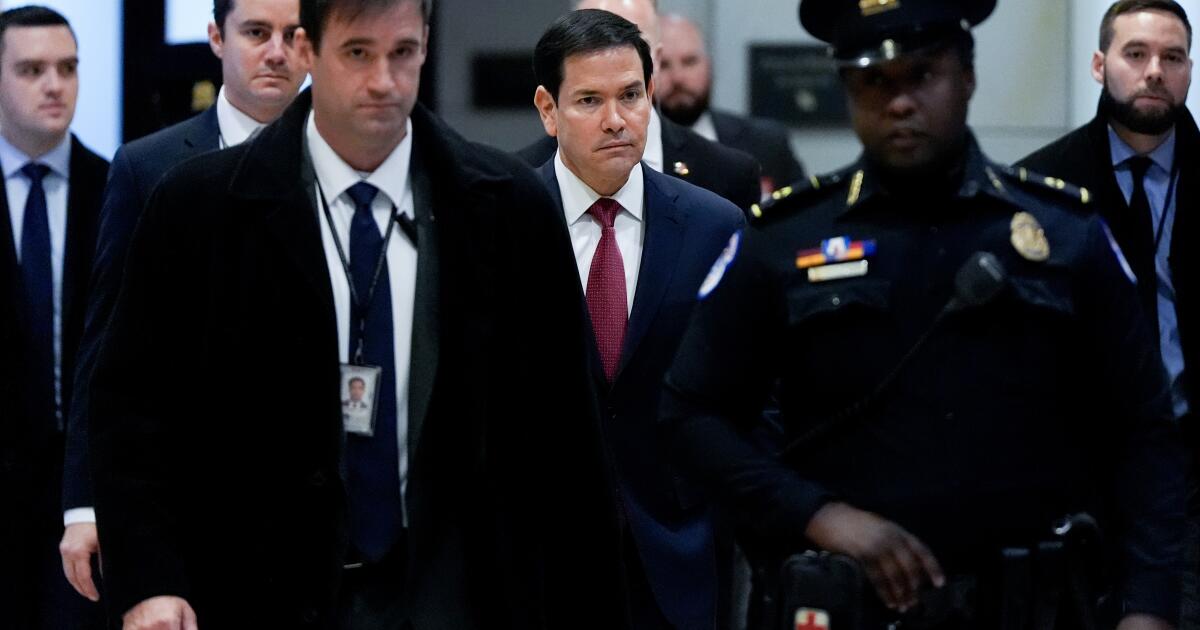
Secretary of State Marco Rubio weighed in on Russia-Ukraine and Israel-Hamas peace efforts and defended the Trump administration’s increasing military pressure on Venezuela during a rare, end-of-year news conference Friday.

In a freewheeling meeting with reporters running more than two hours, Rubio also defended President Trump’s radical overhaul in foreign assistance and detailed the administration’s work to reach a humanitarian ceasefire in Sudan in time for the new year.

Rubio’s appearance in the State Department briefing room comes as key meetings on Gaza and Russia-Ukraine are set to be held in Miami on Friday and Saturday after a tumultuous year in U.S. foreign policy. Rubio has assumed the additional role of national security advisor and emerged as a staunch defender of Trump’s “America First” priorities on issues ranging from visa restrictions to a shakeup of the State Department bureaucracy.

The news conference is taking place just hours before Trump’s special envoy Steve Witkoff meets with senior officials from Egypt, Turkey and Qatar to discuss the next phase of the Republican president’s Gaza ceasefire plan, progress on which has moved slowly since it was announced in October.

Witkoff and other U.S. officials, including Trump son-in-law and informal advisor Jared Kushner, have been pushing to get the Gaza plan implemented by setting up a “Board of Peace” that will oversee the territory after two years of war and create an international stabilization force that would police the area.

On Saturday, Witkoff, Kushner and Rubio, who will be at his home in Florida for the holidays, are to meet with Russian President Vladimir Putin’s adviser Kirill Dmitriev in Miami to go over the latest iteration of a U.S.-proposed plan to end the Russia-Ukraine war.

Rubio said there would be no peace deal unless both Ukraine and Russia can agree to the terms, making it impossible for the U.S. to force a deal on anyone. Instead, the U.S. is trying to “figure out if we can nudge both sides to a common place.”

“We understand that you’re not going to have a deal unless both sides have to give, and both sides have to get,” Rubio said. “Both sides will have to make concessions if you’re going to have a deal. You may not have a deal. We may not have a deal. It’s unfortunate.”

The U.S. proposal has been through numerous versions with Trump seesawing back and forth between offering support and encouragement for Ukraine and then seemingly sympathizing with Putin’s hard-line stances by pushing Ukrainian President Volodymyr Zelensky to agree to territorial concessions. Kyiv has rejected that concession in return for security guarantees intended to protect Ukraine from future Russian incursions.

On Venezuela, Rubio has been a leading proponent of military operations against suspected drug-running vessels that have been targeted by the Pentagon in the Caribbean Sea and the eastern Pacific Ocean since early September. The Trump administration’s actions have ramped up pressure on leftist Venezuelan President Nicolás Maduro, who has been charged with narco-terrorism in the U.S.

In an interview with NBC News on Friday, Trump would not rule out a war with Venezuela. But Rubio and Defense Secretary Pete Hegseth have publicly maintained that the current operations are directed at “narco-terrorists” trying to smuggle deadly drugs into the United States. Maduro has insisted the real purpose of the U.S. military operations is to force him from office.

Rubio sidestepped a direct question about whether the U.S. wants “regime change in 2026” in the South American country.

“We have a regime that’s illegitimate, that cooperates with Iran, that cooperates with Hezbollah, that cooperates with narco-trafficking and narco-terrorist organizations,” Rubio said, “including not just protecting their shipments and allowing them to operate with impunity, but also allows some of them to control territory.”

Rubio defended Trump’s prerogatives on Venezuela and said the administration believes “nothing has happened that requires us to notify Congress or get congressional approval or cross the threshold into war.” He added, “We have very strong legal opinions.”

Trump has spoken of wanting to be remembered as a “peacemaker,” but ceasefires his administration helped craft are already in trouble due to renewed military action between Cambodia and Thailand in Asia and Rwanda and the Democratic Republic of the Congo in Africa. Rubio, however, said those deals helped create a list of commitments that can now be used to bring both sides back to peace.

“Those commitments today are not being kept,” Rubio said of the Thailand-Cambodia conflict, which now threatens to reignite following Thai airstrikes. ”The work now is to bring them back to the table.”

Rubio’s news conference comes just two days after the Trump administration announced a massive $11-billion package of arms sales to Taiwan, a move that infuriated Beijing, which has vowed to retake the island by force if necessary.

Trump has veered between conciliatory and aggressive messages to China since returning to the Oval Office in January, hitting Chinese imports with major tariffs but at the same time offering to ease commercial pressure on Beijing in conversations with China’s President Xi Jinping. The Trump administration, though, has consistently decried China’s increasingly aggressive posture toward Taiwan and its smaller neighbors in disputes over the South China Sea.

Since taking over the State Department, Rubio has moved swiftly to implement Trump’s “America First” agenda, helping dismantle the U.S. Agency for International Development and reducing the size of the diplomatic corps through a significant reorganization. Previous administrations have distributed billions of dollars in foreign assistance over the last five decades through USAID.

Critics have said the decision to eliminate USAID and slash foreign aid spending has cost lives overseas, although Rubio and others have denied this, pointing to ongoing disaster relief operations in the Philippines, the Caribbean and elsewhere, along with new global health compacts being signed with countries that previously had programs run by USAID.

“We have a limited amount of money that can be dedicated to foreign aid and humanitarian assistance,” Rubio said. “And that has to be applied in a way that furthers our national interest.”

Lee and Klepper write for the Associated Press. AP writer Bill Barrow contributed to this report.

Source link

Trump administration moves to cut off transgender care for children

The U.S. Department of Health and Human Services on Thursday unveiled a series of regulatory actions designed to effectively ban gender-affirming care for minors, building on broader Trump administration restrictions on transgender Americans.

The sweeping proposals — the most significant moves this administration has taken so far to restrict the use of puberty blockers, hormone therapy and surgical interventions for transgender children — include cutting off federal Medicaid and Medicare funding from hospitals that provide gender-affirming care to children and prohibiting federal Medicaid dollars from being used to fund such procedures.

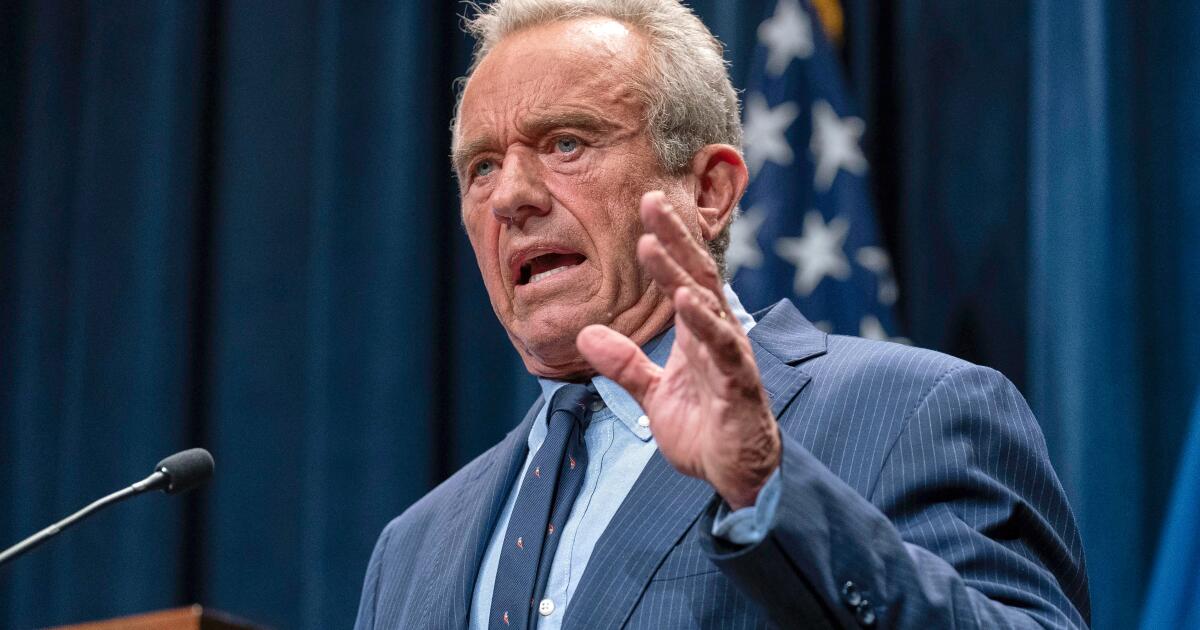
“This is not medicine, it is malpractice,” Health Secretary Robert F. Kennedy Jr. said of gender-affirming procedures on children in a news conference on Thursday. “Sex-rejecting procedures rob children of their futures.”

Kennedy also announced Thursday that the HHS Office of Civil Rights will propose a rule excluding gender dysphoria from the definition of a disability.

In a related move, the Food and Drug Administration issued warning letters to a dozen companies that market chest-binding vests and other equipment used by people with gender dysphoria. Manufacturers include GenderBender LLC of Carson, California and TomboyX of Seattle. The FDA letters state that chest binders can only be legally marketed for FDA-approved medical uses, such as recovery after mastectomy surgery.

Medicaid programs in slightly less than half of states currently cover gender-affirming care. At least 27 states have adopted laws restricting or banning the care. The Supreme Court’s recent decision upholding Tennessee’s ban means most other state laws are likely to remain in place.

Thursday’s announcements would imperil access in nearly two dozen states where drug treatments and surgical procedures remain legal and funded by Medicaid, which includes federal and state dollars.

The proposals announced by Kennedy and his deputies are not final or legally binding. The federal government must go through a lengthy rulemaking process, including periods of public comment and document rewrites, before the restrictions becoming permanent. They are also likely to face legal challenges.

But the proposed rules will likely further intimidate health care providers from offering gender-affirming care to children and many hospitals have already ceased such care in anticipation of federal action.

Nearly all U.S. hospitals participate in the Medicare and Medicaid programs, the federal government’s largest health plans that cover seniors, the disabled and low-income Americans. Losing access to those payments would imperil most U.S. hospitals and medical providers.

The same funding restrictions would apply to a smaller health program when it comes to care for people under the age of 19, the State Children’s Health Insurance Program, according to a federal notice posted Thursday morning.

Moves contradict advice from medical organizations and transgender advocates

Dr. Mehmet Oz, the administrator of the Centers for Medicare and Medicaid Services, on Thursday called transgender treatments “a Band-Aid on a much deeper pathology,” and suggested children with gender dysphoria are “confused, lost and need help.”

Polling shows many Americans agree with the administration’s view of the issue. An Associated Press-NORC Center for Public Affairs Research survey conducted earlier this year found that about half of U.S. adults approved of how Trump was handling transgender issues.

Chloe Cole, a conservative activist known for speaking about her gender-transition reversal, spoke at the news conference to express appreciation. She said cries for help from her and others in her situation, “have finally been heard.”

But the approach contradicts the recommendations of most major U.S. medical organizations, including the American Medical Association, which has urged states not to restrict care for gender dysphoria.

Advocates for transgender children strongly refuted the administration’s claims about gender-affirming care and said Thursday’s moves would put lives at risk.

“In an effort to strongarm hospitals into participating in the administration’s anti-LGBTQ agenda, the Trump Administration is forcing health care systems to choose between providing lifesaving care for LGBTQ+ young people and accepting crucial federal funding,” Dr. Jamila Perritt, a Washington-based OB/GYN and president and CEO of Physicians for Reproductive Health, said in a statement. “This is a lose-lose situation where lives are inevitably on the line. “

Rodrigo Heng-Lehtinen, senior vice president at The Trevor Project, a nonprofit suicide prevention organization for LBGTQ+ youth, called the changes a “one-size-fits-all mandate from the federal government” on a decision that should be between a doctor and patient.

“The multitude of efforts we are seeing from federal legislators to strip transgender and nonbinary youth of the health care they need is deeply troubling,” he said.

Actions build on a larger effort to restrict transgender rights

The announcements build on a wave of actions President Trump, his administration and Republicans in Congress have taken to target the rights of transgender people nationwide.

On his first day in office, Trump signed an executive order that declared the federal government would recognize only two immutable sexes: male and female. He also has signed orders aimed at cutting off federal support for gender transitions for people under age 19 and barring transgender athletes from participating in girls’ and women’s sports.

On Wednesday, a bill that would open transgender health care providers to prison time if they treat people under the age of 18 passed the U.S. House and heads to the Senate. Another bill under consideration in the House on Thursday aims to ban Medicaid coverage for gender-affirming care for children.

Young people who persistently identify as a gender that differs from their sex assigned at birth are first evaluated by a team of professionals. Some may try a social transition, involving changing a hairstyle or pronouns. Some may later also receive hormone-blocking drugs that delay puberty, followed by testosterone or estrogen to bring about the desired physical changes in patients. Surgery is rare for minors.

Swenson, Perrone and Shastri write for the Associated Press. Shastri reported from Milwaukee. AP writer Geoff Mulvihill contributed to this report.

Source link

‘We want it back’: Trump asserts U.S. claims to Venezuelan oil and land

President Trump has ordered a partial blockade on oil tankers going to and from Venezuela, potentially crippling the nation’s already battered economy, and accused Caracas of stealing “oil, land other assets” from the United States — a significant escalation of Washington’s unrelenting campaign against the government of President Nicolás Maduro.

Asked about Venezuela on Wednesday, Trump said the United States will be “getting land, oil rights and whatever we had.”

“We want it back,” Trump said without further elaboration. It was unclear if Trump planned to say more about Venezuela in a televised address to the nation late Wednesday night.

The blockade, which aims to cripple the key component of Venezuela’s faltering, oil-dependent economy, comes as the Trump administration has bolstered military forces in the Caribbean, blown up more than two dozen boats allegedly ferrying illicit drugs in both the Caribbean and the Pacific, and threatened military strikes on Venezuela and neighboring Colombia.

“Venezuela is completely surrounded by the largest Armada ever assembled in the History of South America,” Trump said in a rambling post Tuesday night on his Truth Social site. “It will only get bigger, and the shock to them will be like nothing they have ever seen before.”

Not long after Trump announced the blockade Tuesday night, the government of Venezuela denounced the move and other Trump efforts as an attempt to “rob the riches that belong to our people.”

Leaders of other Latin American nations called for calm and United Nations Secretary-General Antonio Guterres, after a phone call with Maduro, called on U.N. members to “exert restraint and de-escalate tensions to preserve regional stability.”

Also Wednesday, Trump received rare pushback from the Republican-dominated Congress, where some lawmakers are pressuring the administration to disclose more information about its deadly attacks on alleged drug boats.

The Senate gave final approval to a $900-billion defense policy package that, among other things, would require the administration to disclose to lawmakers specific orders behind the boat strikes along with unedited videos of the deadly attacks. If the administration does not comply, the bill would withhold a quarter of Defense Secretary Pete Hegseth’s travel budget.

The bill’s passage came a day after Hegseth and Secretary Marco Rubio came to Capitol Hill to brief lawmakers on the U.S. military campaign. The briefings left lawmakers with mixed reaction, largely with Republicans backing the campaign and Democrats expressing concern about it.

The White House has said its military campaign in Venezuela is meant to curb drug trafficking, but the U.S. Drug Enforcement Administration data shows that Venezuela is a relatively minor player in the U.S.-bound drug trade.

Trump also declared that the South American country had been designated a “foreign terrorist organization.” That would apparently make Venezuela the first nation ever slapped with a classification normally reserved for armed groups deemed hostile to the United States or its allies. The consequences remain unclear for Venezuela.

Regional responses to the Trump threats highlight the new ideological fault lines in Latin America, where right-wing governments in recent years have won elections in Chile, Argentina and Ecuador.

The leftist leaders of the region’s two most populous nations — Brazil and Mexico — have called for restraint in Venezuela.

“Whatever one thinks about the Venezuelan government or the presidency of Maduro, the position of Mexico should always be: No to intervention, no to foreign meddling,” Mexican President Claudia Sheinbaum said Wednesday, calling on the United Nations to look for a peaceful solution and avoid any bloodshed.

Brazilian President Luiz Inácio Lula da Silva has also urged Trump to pull back from confrontation. “The power of the word can outweigh the power of the gun,” Lula said he told Trump recently, offering to facilitate talks with the Maduro government.

But Chile’s right-wing president-elect, José Antonio Kast, said he supports regime-change in Venezuela, asserting that it would reduce migration from Venezuela to other nations in the region.

“If someone is going to do it, let’s be clear that it solves a gigantic problem for us and all of Latin America, all of South America, and even for countries in Europe,” Kast said, referring to Venezuelan immigration.

In his Tuesday post, Trump said he had ordered a “complete blockade of all sanctioned oil tankers going into, and out of, Venezuela.” While potentially devastating to Venezuela’s economy, the fact that the blockade will only affect tankers already sanctioned by U.S. authorities does give Venezuela some breathing room, at least for now.

Experts estimated that only between one-third and one-half of tankers transporting crude to and from Venezuela are likely part of the so-called “dark fleet” of sanctioned tankers. The ships typically ferry crude from Venezuela and Iran, two nations under heavy U.S. trade and economic bans.

However, experts said that even a partial blockade will be a major hit for Venezuela’s feeble economy, reeling under more than a decade of of U.S. penalties. And Washington can continue adding to the list of sanctioned tankers.

“The United States can keep sanctioning more tankers, and that would leave Venezuela with almost no income,” said David A. Smilde, a Venezuela expert at Tulane University. “That would probably cause a famine in the country.”

The growing pressure, analysts said, will likely mean the diminishing number of firms willing to take the risk of transporting Venezuelan crude will up their prices, putting more pressure on Caracas. Purchasers in China and elsewhere will also likely demand price cuts to buy Venezuelan oil.

Trump has said that Maduro must go because he is a “narco-terrorist” and heads the “Cartel de los Soles,” which the While House calls is a drug-trafficking syndicate. Trump has put a $50 million bounty on Maduro’s head. Experts say that Cartel de los Soles is not a functioning cartel, but a short-hand term for Venezuelan military officers who have been involved in the drug trade for decades, long before Maduro or his predecessor and mentor, the late Hugo Chávez, took office.

In his comments on Tuesday, Trump denounced the nationalization of the Venezuelan oil industry, a process that began in the 1970s, when Caracas was a strong ally of Washington.

Echoing Trump’s point that Venezuela “stole” U.S. assets was Stephen Miller, Trump’s homeland security advisor, who declared on X: “American sweat, ingenuity and toil created the oil industry in Venezuela. Its tyrannical expropriation was the largest recorded theft of American wealth and property.”

Among those believed to be driving Trump’s efforts to oust Maduro is Secretary of State Maro Rubio, the son of Cuban immigrants to Florida. Rubio has long been an outspoken opponent of the communist governments in Havana and Caracas. Venezuelan oil has helped the economies of left-wing governments in both Cuba and Nicaragua.

Christopher Sabatini, a senior fellow for Latin America at Chatham House, said Rubio has been on a long-time campaign to remove Maduro.”He has his own political project,” Sabatini said. “He wants to get rid of the dictators in Venezuela and Cuba.”

Staff writers McDonnell and Linthicum reported from Mexico City and Ceballos from Washington. Contributing was special correspondent Mery Mogollón in Caracas.

Source link

Senators dig into FCC chairman’s role in Jimmy Kimmel controversy

U.S. senators peppered Federal Communications Commission Chairman Brendan Carr with questions during a wide-ranging hearing exploring media censorship, the FCC’s oversight and Carr’s alleged intimidation tactics during the firestorm over ABC comedian Jimmy Kimmel’s comments earlier this fall.

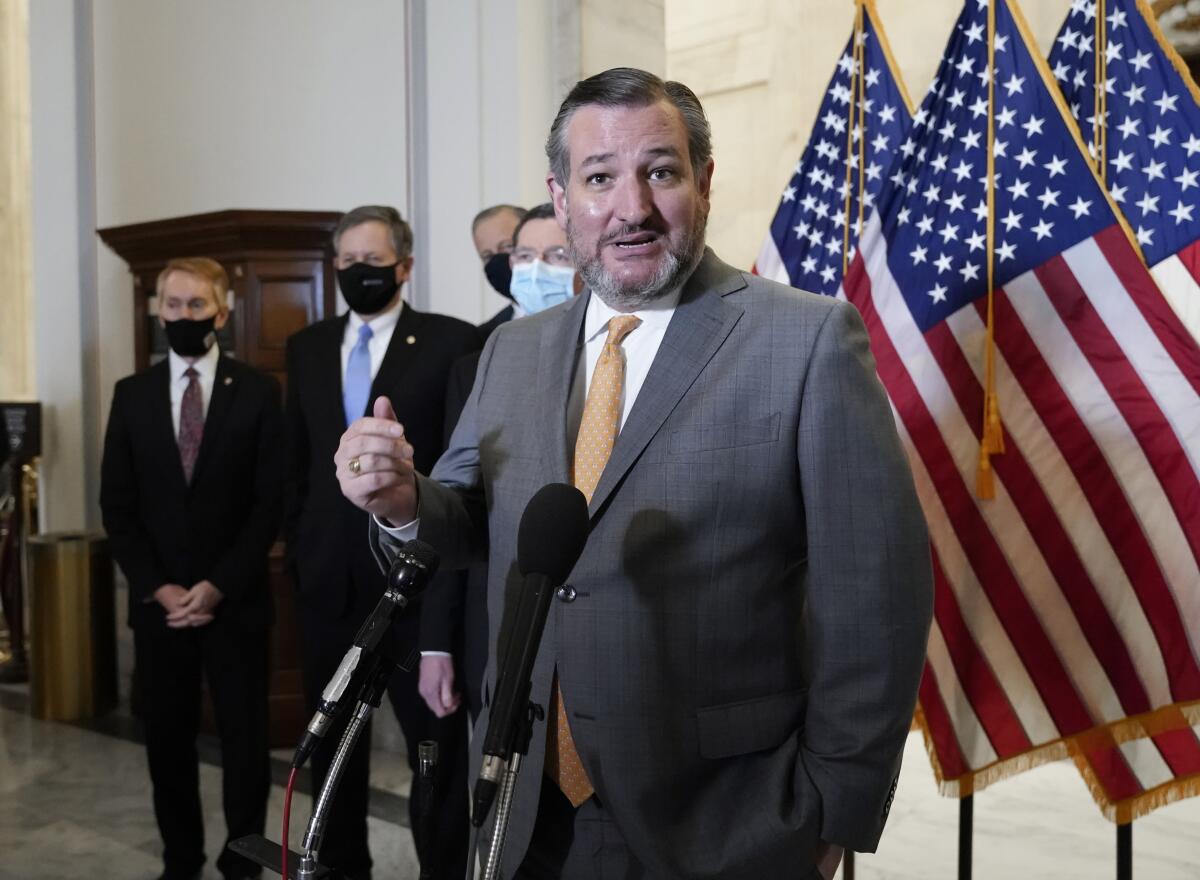
Sen. Ted Cruz (R-Texas) called Wednesday’s hearing of the Senate Commerce, Science and Transportation Committee following the furor over ABC’s brief suspension of “Jimmy Kimmel Live!” amid social media backlash over Kimmel’s remarks in the wake of conservative activist Charlie Kirk’s killing.

Walt Disney Co. leaders yanked Kimmel off the air Sept. 17, hours after Carr suggested that Disney-owned ABC should punish the late-night comedian for his remarks — or face FCC scrutiny. Soon, two major TV station groups announced that they were pulling Kimmel’s show, although both reinstated the program several days after ABC resumed production.

Progressives were riled by the President Trump-appointed chairman’s seeming willingness to go after broadcasters in an alleged violation of their First Amendment rights. At the time, a few fellow Republicans, including Cruz, blasted Carr for suggesting to ABC: “We can do this the easy way or hard way.”

Cruz, in September, said that Carr’s comments belonged in the mob movie “Goodfellas.”

On Wednesday, Carr said his comments about Kimmel were not intended as threats against Disney or the two ABC-affiliated station groups that preempted Kimmel’s show.

The chairman argued the FCC had statutory authority to make sure that TV stations acted in the public interest, although Carr did not clarify how one jumbled sentence in Kimmel’s Sept. 15 monologue violated the broadcasters’ obligation to serve its communities.

Cruz was conciliatory Wednesday, praising Carr’s work in his first year as FCC chairman. However, Democrats on the panel attempted to pivot much of the three-hour session into a public airing of the Trump administration’s desire to punish broadcasters whom the president doesn’t like — and Carr’s seeming willingness to go along.

Sen. Ted Cruz, R-Texas, in a file photo.

Sen. Ted Cruz (R-Texas) called Wednesday’s Senate committee hearing.

(Associated Press)

Carr was challenged by numerous Democrats who suggested he was demonstrating fealty to the president rather than running the FCC as an independent licensing body.

Despite the landmark Communications Act of 1934, which created the FCC, the agency isn’t exactly independent, Carr and fellow Republican Commissioner Olivia Trusty testified.

The two Republicans said because Trump has the power to hire and fire commissioners, the FCC was more akin to other agencies within the federal government.

“Then is President Trump your boss?” asked Sen. Andy Kim (D-N.J.). The senator then asked Carr whether he remembered his oath of office. Federal officials, including Carr, have sworn to protect the Constitution.

“The American people are your boss,” Kim said. “Have you ever had a conversation with the president or senior administration officials about using the FCC to go after critics?”

Carr declined to answer.

Protesters outside the Jimmy Kimmel Theater in September 2025.

Protesters flocked to Hollywood to protest the preemption of “Jimmy Kimmel Live!” after ABC briefly pulled the late-night host off air indefinitely over comments he made about the fatal shooting of conservative activist Charlie Kirk.

(Genaro Molina / Los Angeles Times)

The lone Democrat on the FCC, Anna M. Gomez, was frequently at odds with her fellow commissioners, including during an exploration of whether she felt the FCC was doing Trump’s bidding in its approach to merger approvals.

Trump separately continued his rant on media organizations he doesn’t like, writing in a Truth Social post that NBC News “should be ashamed of themselves in allowing garbage ‘interviews’” of his political rivals, in this case Sen. Raphael Warnock (D-Ga.).

Trump wrote that NBC and other broadcasters should pay “significant amounts of money for using the very valuable” public airwaves.

Earlier this year, FCC approval of the Larry Ellison family’s takeover of Paramount stalled for months until Paramount agreed to pay Trump $16 million to settle a lawsuit over his grievances with edits of a CBS “60 Minutes” pre-election interview with Kamala Harris.

“Without a doubt, the FCC is leveraging its authority over mergers and enforcement proceedings in order to influence content,” Gomez said.

Parts of the hearing devolved into partisan bickering over whether Democrats or Republicans had a worse track record of trampling on the 1st Amendment. Cruz and other Republicans referenced a 2018 letter, signed by three Democrats on the committee, which asked the FCC to investigate conservative TV station owner Sinclair Broadcast Group.

“Suddenly Democrats have discovered the 1st Amendment,” Cruz said. “Maybe remember it when Democrats are in power. The 1st Amendment is not a one-way license for one team to abuse the power.

“We should respect the free speech of all Americans, regardless of party,” Cruz said.

Source link