Top Stories

Florida Goodwill store evacuated after live grenade donated

The staff of a Goodwill store in Palatka, Fla., found a live hand grenade among donations that a local bomb squad recovered and safely detonated at a secure location on Thursday. Photo by Bonnie Cash/UPI. | License Photo

Dec. 12 (UPI) — Staff at a Goodwill store in Palatka, Fla., found a live grenade among donations, which prompted the store’s evacuation on Thursday.

A store employee discovered the grenade in a bin near a door reserved for donations at the Goodwill store at 103 South State Road 19 in Palatka.

Officials for the Palatka (Fla.) Police Department said they responded immediately upon the grenade being reported and evacuated the building, First Coast News reported.

Personnel with the St. Johns County Sheriff’s Office Bomb Squad removed the grenade and remotely detonated it in a secure location.

A Goodwill spokeswoman Liz Morgan said the grenade was not placed on the store’s retail floor and said it’s important for people to ensure they don’t accidentally donate dangerous items.

“We want to remind the community to thoroughly check all items before donating, ensuring that hazardous items, such as explosives, firearms or ammunition, are not accidentally included,” the Palatka Police said in a prepared statement shared with NBC News.

“If you ever locate something that appears to be a hand grenade or other explosive device, do not touch it or handle it,” the PPD statement said. “Immediately evacuate the area and call law enforcement.”

Palatka is located in northeastern Florida and about 60 miles south of Jacksonville.

Source link

National Trust files suit against Trump to stop ballroom construction

The demolition of the East Wing of the White House is seen during construction in Washington, D.C., on Nov. 17. The National Trust for Historic Preservation has filed a lawsuit to stop construction of the ballroom. Photo by Bonnie Cash/UPI | License Photo

Dec. 12 (UPI) — The National Trust for Historic Preservation has filed a lawsuit against the President Donald Trump administration to block construction of a ballroom on White House grounds.

The suit claims the ballroom construction is unlawful and asks the court to stop further construction until the plans go through a review process, as required by law.

Former White House attorney under presidents Bill Clinton and Barack Obama, Greg Craig, is representing the Trust. Defendants in the suit include the president, the National Park Service, the Department of the Interior, the General Services Administration and their leaders. The lawsuit was filed Friday in the U.S. District Court for the District of Columbia.

“No president is legally allowed to tear down portions of the White House without any review whatsoever — not President Trump, not President Biden, not anyone else,” the filing said. “And no president is legally allowed to construct a ballroom on public property without giving the public the opportunity to weigh in. President Trump’s efforts to do so should be immediately halted, and work on the ballroom project should be paused until the defendants complete the required reviews — reviews that should have taken place before the defendants demolished the East Wing, and before they began construction of the ballroom — and secure the necessary approvals.”

Trump initially said the project wouldn’t interfere with the building and would be “near it but not touching it.” But then the East Wing was demolished to make way for the ballroom project. The now-$300 million project is being funded by donors, Trump has said.

The National Trust said it sent a letter to the Park Service, the National Planning Commission and the Commission of Fine Arts in October asking them to stop the demolition and begin review procedures. But it didn’t get a response.

“Yet it appears the site preparation and preliminary construction of the proposed new ballroom is proceeding without any review by either commission or by Congress, and without the necessary approvals,” the suit said. “By evading this required review, the defendants are depriving the public of its right to be informed and its opportunity to comment on the defendants’ proposed plans for the ballroom project.”

White House press secretary Karoline Leavitt said in October that the president doesn’t need approval for demolition but only needs it for “vertical construction.”

White House spokesperson Davis Ingle said in a statement Friday: “President Trump has full legal authority to modernize, renovate, and beautify the White House — just like all of his predecessors did.”

Source link

Former Terraform CEO Do Kwon sentenced to 15 years in prison for crypto scheme

Police officers escort South Korean crypto mogul Do Kwon (C) to a holding facility pending his extradition in Podgorica, Montenegro, on March 23, 2024. A U.S. judge sentenced Kwon to 15 years in prison Thursday for a fraudulent cryptocurrency scheme. File Photo by Boris Pejovic/EPA-EFE

Dec. 12 (UPI) — A federal judge in New York sentenced Do Kwon, the former CEO of blockchain and cryptocurrency company Terraform Labs, to 15 years in prison for a scheme that cost victims billions of dollars.

The 34-year-old South Korean native received a higher sentence than defense lawyers and even prosecutors sought — five years and 12 years, respectively, The New York Times reported. Prosecutors agreed to let Kwon serve the second half of his sentence in South Korea.

U.S. District Judge Paul A. Engelmayer for the Southern District of New York said he went with the 15-year sentence because Kwon’s crimes represented “fraud on an epic, generational scale.” He also ordered Kwon to pay more than $19 million in proceeds from the scheme.

The judgment was handed down in court Thursday, some four months after Kwon pleaded guilty to one count of conspiring to commit commodities fraud, securities fraud and wire fraud as well as one count of committing wire fraud. Authorities arrested Kwon in Montenegro after he led them on an 18-month manhunt, The Guardian reported.

“Do Kwon devised elaborate schemes to mislead investors and inflate the value of Terraform’s cryptocurrencies for his own benefit,” U.S. Attorney Jay Clayton said Thursday in a news release.

“When his crimes caught up to him, Kwon embarked on a deceptive public relations campaign to cover up his fraud, laundered the proceeds of his illegal schemes and sought to purchase political protection in foreign countries to evade criminal prosecution.”

Federal prosecutors said Terraform, under Kwon, offered a unique blockchain that issued stablecoins under a distinct protocol that it falsely claimed would maintain a fixed value even when market conditions fluctuated. He told investors the company’s stablecoin, UST, could always be exchanged for $1 of its blockchain’s native LUNA token.

Kwon received investments from several firms across the globe to buy or lend Terraform’s cryptocurrencies built on the company’s blockchain. The market value of all UST and LUNA surpassed $50 billion by spring 2022.

Prosecutors said, though, that much of that growth was due to Kwon’s falsifications about Terraform’s technology, causing the two cryptocurrencies to collapse in value and losing investors $40 billion. Kwon hid the losses through a fraudulent audit.

Company Kawasaki Heavy Industries presents its latest humanoid robot, “RHP Kaleido 9,” during the 2025 International Robot Exhibition in Tokyo on December 3, 2025. Photo by Keizo Mori/UPI | License Photo

Source link

U.S. offers $5M reward for information on Francisco Manuel Bermudez Cagua

Dec. 12 (UPI) — The State Department is offering a $5 million reward for information leading to the arrest or conviction of Francisco Manuel Bermudez Cagua, an alleged leader of the Ecuadorian Los Choneros cartel who is wanted in the United States on drug trafficking charges.

The reward, announced Thursday, is being offered under the Narcotics Rewards Program of the State Department’s Bureau of International Narcotics and Law Enforcement Affairs.

Bermudez Cagua, also known as Churron, is the alleged leader of Los Choneros, which was designated a Foreign Terrorist Organization and a Specially Designated Global Terrorists by the Trump administration in September amid President Donald Trump‘s crackdown on illegal drugs and immigration.

Federal prosecutors in the Eastern District of New York indicted Bermudez Cagua, along with Jose Adolfo Macias Villamar, the principal leader of the Los Choneros, in a superseding indictment unsealed June 27, 2025, charging him with international cocaine distribution conspiracy, international cocaine distribution and use of firearms in furtherance of drug trafficking offenses.

“As alleged, Bermudez Cagua is a top lieutenant within the leadership of Los Choneros, an extremely violent foreign terrorist organization responsible for pumping drugs into the United States, causing harm to our communities, and wreaking havoc in his homeland of Ecuador,” U.S. Attorney Joseph Nocella Jr. said in a statement.

According to the State Department, the 29-year-old Bermudez Cagua reports to Macias Villamar and became his right-hand man while in prison. Once they both escaped, Bermudez Cagua became Macias Villamar’s spokesperson.

“Bermudez Cagua regularly participated in the decisions Macias Villamar made related to the organization’s drug and weapons trafficking and served as an intermediary, relaying critical information between Macias Villamar and their associates,” according to the State Department website.

Los Choneros is considered one of Ecuador’s most violent criminal organizations and is linked to the infamous Sinaloa Cartel of Mexico. Ecuador designated the group as a terrorist organization in 2024, and the U.S.’ Treasury imposed sanctions against it that same year.

Source link

Trump signs executive order limiting states ability to regulate AI

An illustration picture shows the introduction page of ChatGPT, an interactive AI chatbot model trained and developed by OpenAI, on its website in Beijing, China, in 2023. President Donald Trump signed an executive order Thursday limiting the ability of American states to regulate AI. File Photo ChatGPT. EPA-EFE/WU HAO

Dec. 11 (UPI) — President Donald Trump signed an executive order Thursday night that limits states’ ability to regulate artificial intelligence companies.

The order is designed “to sustain and enhance the United States’ global AI dominance through a minimally burdensome national policy framework for AI,” according to a release on the White House website.

“To win, United States AI companies must be free to innovate without cumbersome regulation,” the order says. “But excessive State regulation thwarts this imperative.”

Trump has been a strong proponent of U.S. leadership in AI development, and said at the executive order signing ceremony Thursday night that AI companies “want to be in the United States, and they want to do it here, and we have big investment coming. But if they had to get 50 different approvals from 50 different states, you could forget it.”

The order instructs Attorney General Pam Bondi to establish an “AI Litigation Task Force” within 30 days whose “sole responsibility shall be to challenge State AI laws” that don’t align with the Trump administration’s minimal approach to regulation.

It could also revise existing state laws, and directs Commerce Secretary Howard Lutnick to identify state laws that “require AI models to alter their truthful outputs,” which aligns with Trump’s efforts to prevent what he describes as “woke AI.”

Trump has also used federal funding as an incentive to encourage states with such laws not to enforce them. Under terms of the executive order, federal AI law would preempt state regulations. State AI laws designed to protect children would not be affected.

The executive order comes after congress voted in July and November against creating a similar policy.

Critics of the plan created by the executive order call it an attempt to block meaningful regulation on AI and say congress is not equipped to replace state-specific laws with a single, nationwide standard.

Tech companies have been supportive of efforts to limit the power of states to regulate AI. The executive order marks a victory for tech companies like Google and OpenAI, which have launched campaigns through a super PAC, and have as much as $100 million to spend in an effort to shape the outcome of next year’s midterm elections.

The order is also seen as a move to thwart Democrat-led states such as California and New York from exerting state laws over AI development

Source link

Trump says he’s he pardoned election denier Tina Peters; Colorado says it’s invalid

Dec. 11 (UPI) — President Donald Trump on Thursday said he granted “a full Pardon” to election denier Tina Peters who was convicted for helping outsiders illegally breach voting machine security, though Colorado officials say he has no power to do so for state crimes.

Peters, a 70-year-old former Mesa County, Colo., clerk, is serving a nine-year prison sentence. She was convicted in August 2024 of attempting to influence a public servant and criminal impersonation for aiding an unauthorized person in copying voting-machine hard-drive data during a 2021 software update.

That data, including sensitive election-system information, was later leaked online by election-fraud conspiracy theorists who claimed it proved Trump’s Big Lie that the 2020 election had been stolen from him.

While maintaining the unfounded claim that the 2020 election was stolen, Trump has been a vocal supporter of the effort to secure Peters’ release, describing Peters as a pro-democracy activist.

“Tina is sitting in a Colorado prison for the ‘crime’ of demanding Honest Elections,” Trump said Thursday evening in a post to his Truth Social account.

“Today I am granting Tina a full Pardon for her attempts to expose Voter Fraud in the Rigged 2020 Presidential Election!”

Colorado state officials have been adamant amid Trump’s demands for Peters’ release that he does not have the authority to pardon her, as she was convicted on state charges.

“Tina Peters was convicted by a jury of her peers, prosecuted by a Republican District Attorney and found guilty of violating Colorado state laws, including criminal impersonation,” Colorado Gov. Jared Polis said in a statement Thursday in response to Trump’s announcement.

“No President has jurisdiction over state law nor the power to pardon a person for state convictions,” Polis continued. “This is a matter for the courts to decide, and we will abide by court orders.”

Trump has feuded with Polis, a Democrat, over Peters’ incarceration, calling the governor a “SLEAZEBAG” earlier this month on Truth Social for refusing “to allow an elderly woman, Tina Peters, who was unfairly convicted of what the Democrats do, cheating on Elections, out of jail!”

Trump’s declaration of Peters’ pardon came hours after her lawyer, Peter Ticktin, announced he had formally asked Trump to pardon his client, whom he called “a necessary witness in exposing election misconduct.”

“Tina Peters is rightfully in Colorado state prison,” Sen. Michael Bennet, D-Colo., said in a statement on X on Thursday.

“Trump’s corrupt and political attempts at a pardon won’t work here. Once again, if you can’t do the time, don’t do the crime.”

Since returning to the White House, Trump has used his powers to issue pardons to many of those connected to the effort to overturn the 2020 election who were convicted on federal charges, including the more than 1,500 people who stormed Congress on Jan. 6, 2021.

Source link

Kilmar Abrego Garcia released from ICE custody

1 of 2 | Kilmar Abrego Garcia pictured in August before his check in at the ICE Field Office in Baltimore Md., Immigration Customs Enforcement officials sought to deport Abrego Garcia to Africa where he has no connection, despite his ongoing protection from removal to El Salvador. He was released Thursday from an ICE detention center after a federal judge’s ruling. File Photo by Shawn Thew/UPI

Dec. 11 (UPI) — Kilmar Abrego Garcia, a wrongfully deported Salvadoran immigrant, was released from Immigration and Customs Enforcement detention Thursday following a federal judge’s order.

Garcia is facing U.S. charges by the Trump administration. His attorneys confirmed that he had been released by Thursday afternoon.

Immigration Customs Enforcement officials sought to deport Abrego Garcia to an African nation where he has no connection, despite his ongoing protection from removal to El Salvador.

U.S. District Judge Paula Xinis said that the Trump administration lacked the legal authority to continue holding Abrego Garcia in an ICE detention facility.

“Because Abrego Garcia has been held in ICE detention to effectuate third-country removal absent a lawful removal order, his requested relief is proper,” according to U.S. District Judge Paula Xinis.

The judge mandated his “immediate” release.

“Separately, respondents’ conduct over the past months belie that his detention has been for the basic purpose of effectuating removal, lending further support that Abrego Garcia should be held no longer,” Xinis added.

The order cleared ICE to release Abrego Garcia, but he still must comply with pretrial conditions in an ongoing human smuggling case.

“This is naked judicial activism by an Obama-appointed judge,” a U.S. Department of Homeland Security spokesperson wrote on social media.

DHS claimed the order “lacks any valid legal basis and we will continue to fight this tooth and nail in the courts.”

Abrego Garcia is a Salvadoran national who illegally entered the U.S. almost 15 years ago and drew nationwide attention after his wrongful March deportation to El Salvador’s notorious megaprison despite a protective order.

He has accused the White House of vindictive prosecution.

It ignited controversy amid U.S. President Donald Trump‘s hardline immigration enforcement push.

The administration labeled him an MS-13 gang member, which he has denied.

“The history of Abrego Garcia’s case is as well known as it is extraordinary,” said Xinis.

With a standing order that prevents deportation to El Salvador, Trump administration officials pivoted to proposing an African destination.

“This evidently remained an inconvenient truth for respondents,” Xinis wrote.

“But more to the point, respondents’ persistent refusal to acknowledge Costa Rica as a viable removal option, their threats to send Abrego Garcia to African countries that never agreed to take him, and their misrepresentation to the court that Liberia is now the only country available to Abrego Garcia, all reflect that whatever purpose was behind his detention, it was not for the ‘basic purpose’ of timely third-country removal,” the judge wrote.

President Donald Trump makes remarks during a roundtable meeting with high-tech business executives in the Roosevelt Room of the White House on Wednesday. The president announced that the United States has seized an oil tanker near Venezuela and a revealed a new special corporate immigration gold card focused on keeping students in the United States. Photo by Aaron Schwartz/UPI | License Photo

Source link

Powerball prize climbs to $2 billion after 40 winnerless drawings

Dec. 11 (UPI) — The Powerball jackpot has jumped to $1 billion after no one stepped forward with the winning ticket in Wednesday night’s drawing.

It’s the second time the prize has climbed to a billion dollars this year, and the seventh biggest prize in the history of the game, Powerball said.

Powerball said the jackpot is worth an estimated $461.3 million in cash value. Winners have a choice between annual payments worth an estimated $1 billion, or receiving a lump sum cash prize.

The largest ever prize in the game’s history, $2.04 billion, was claimed on Nov. 7, 2002.

Since two tickets in Missouri and Texas split the $1.787 billion dollar prize on Sept. 6, there have been 40 consecutive drawings with no winner.

The next Powerball drawing is scheduled for Saturday.

The odds of winning are one in 292. 2 million, according to Powerball. Tickets are $2 each.

Source link

Trump diehard supporter Mike Lindell announces run for Minnesota governor

Dec. 11 (UPI) — Mike Lindell, creator of the MyPillow and a noted conspiracy theorist, has announced he is running for governor of Minnesota.

Lindell is a longtime friend and supporter of President Donald Trump and is known for saying that voting machines in the United States are rigged and can flip elections.

Though he’s lost lawsuits for his election denials, he is still saying that the 2020 election was stolen.

He enters a crowded field of Republicans vying for Gov. Tim Walz’s office, including speaker of the Minnesota House of Representatives Lisa Demuth, former state senator and 2022 Republican nominee for governor Scott Jensen, lawyer Chris Madel and state Rep. Kristin Robbins.

Walz’s campaign is already attacking Lindell for his ties to Trump, labeling him “the far-right CEO, election denier, and Donald Trump’s top ally in Minnesota.”

“Mike Lindell is selling conspiracies, MAGA extremism, and pillows. He has no business holding the highest office in our state,” Walz’s campaign said in a fundraising email last week.

Lindell announced his campaign on Thursday, with an eight-minute video filmed on the factory floor of his MyPillow company. He claimed that the President Joe Biden administration “targeted my banks, they targeted my suppliers, they even took my phone.”

He said he wants to stop the “rampant fraud” in Walz’s administration, stop rising property taxes and “the crime that threatens you and your family.” He also wants to change the state’s voting system so that voters submit paper ballots that are then hand-counted.

The fraud Lindell references comes from an investigation of dozens of people who allegedly stole from the state’s program to feed children during the COVID-19 pandemic. Several Somali immigrants allegedly created small companies that billed state agencies for millions in social services that never went to the intended people. Walz has said that anyone who stole from the government will be prosecuted.

Trump has responded by ending deportation protections for all Minnesota Somalis.

Lindell told the Minneapolis Star Tribune that he told Trump he was thinking of running for governor back in August, but he wouldn’t say what Trump’s response was.

But Trump didn’t back him in his bid for chair of the Republican National Committee in 2023. He only got four votes in that election.

Trump’s former personal lawyer Rudy Giuliani now works for Lindell on his media network, LindellTV, and he’s been giving Lindell political advice.

“He’s been part of many campaigns,” Lindell told the Star Tribune. “He knows what he’s doing.”

LindellTV now has credentials to cover the White House and the Pentagon, The New York Times reported.

Lindell calls his story “the American Dream on steroids,” touting his rise from crack cocaine addiction to successful business owner. He considers himself the frontrunner in the field of candidates and said, “I believe I will stand on my own merit,” Lindell said.

President Donald Trump stands with Saudi Arabia’s Crown Prince Mohammed bin Salman during a black tie dinner at the White House in Washington, on November 18, 2025. Photo by Anna Rose Layden/UPI | License Photo

Source link

Competing Senate healthcare bills fail to pass

Dec. 11 (UPI) — The Senate failed to approve either of two competing healthcare plans meant to address healthcare costs likely to rise in the new year with the expiration of Affordable Care Act tax credits.

Democrats and Republicans each put forth their own healthcare plans, but neither mustered the 60 votes needed to overcome the Senate’s filibuster rule with identical 51-48 vote totals, NBC News and The Hill reported.

Each proposal mostly received party-line support, with only Sen. Rand Paul, R-Ky. voting against the GOP proposal, which all Senate Democrats also opposed.

Senate Democrats received some GOP support for their proposal, with Sens. Susan Collins, R-Maine, Josh Hawley, R-Mo., Lisa Murkowski, R-Alaska, and Dan Sullivan, R-Alaska, voting in favor.

Sen. Steve Daines, R-Mont., did not cast a vote for or against either measure.

The Democrats’ plan included a three-year extension of enhanced ACA subsidies beyond the Jan. 1 expiration date. The proposal would also limit health insurance premiums under the ACA to 8.5% of the policyholders’ incomes.

The enhanced subsidies were put in place during the COVID-19 pandemic as part of the 2021 American Rescue Plan.

To pass, Democrats needed at least 13 Republicans to vote in favor of the plan.

The expiring subsidies were the crux of a six-week government shutdown this fall. Democrats refused to vote in favor of a House Republican-drafted stopgap funding measure without including language that would see the subsidies extended beyond December.

Without the subsidies, healthcare premiums through the ACA were forecast to more than double in some cases. The Congressional Budget Office projects about 3.8 million will drop coverage annually over the next eight years without the additional subsidies. In 2025, a record 24 million Americans got their health insurance through the healthcare marketplace.

“We have 21 days until Jan.1,” Senate Democratic leader Chuck Schumer said on the Senate floor Wednesday. “After that, people’s healthcare bills will start going through the roof. Double, triple, even more.

“There is only one way to avoid all of this. The only realistic path left is what Democrats are proposing — a clean, direct extension of this urgent tax credit.”

Republicans, however, refused to consider the subsidies as part of the continuing resolution. Ultimately, Republicans agreed to consider a separate healthcare vote as a tradeoff to reopening the government.

The Republican plan, unveiled Tuesday by Sens. Bill Cassidy and Mike Crapo, doesn’t extend the subsidies but provides $1,500 health savings accounts for those earning less than 700% of the poverty level.”

“It delivers the benefit directly to the patient, not to the insurance company, and it does it in a way that actually saves money to the taxpayer,” Senate Republican leader John Thune said.

He described the Democrats’ plan as a “partisan messaging exercise” and called the idea that it would lower healthcare costs a “tour of fantasy land,” according to ABC News.

President Donald Trump makes remarks during a roundtable meeting with high-tech business executives in the Roosevelt Room of the White House on Wednesday. The president announced that the United States has seized an oil tanker near Venezuela and a revealed a new special corporate immigration gold card focused on keeping students in the United States. Photo by Aaron Schwartz/UPI | License Photo

Source link

Architects of artificial intelligence named Time Person of the Year

An illustration picture shows the introduction page of ChatGPT, an interactive AI chatbot model trained and developed by OpenAI. Time magazine named the creators of artificial intelligence as the Time Person of the Year. File Photo by Wu Hao/EPA-EFE

Dec. 11 (UPI) — Time magazine on Thursday named the architects of artificial intelligence as the 2025 Person of the Year.

While no one specific person was singled out by the magazine for the annual honor, the cover story for the edition featured interviews with Nvidia CEO Jensen Huang, Softbank CEO Masayoshi Son, U.S. Energy Secretary Chris Wright and Baidu CEO Robin Li.

Time editor in chief Sam Jacobs, in a letter to readers about the selection, said no one had a greater impact on individuals than those who created AI.

“This was the year when artificial intelligence’s full potential roared into view, and when it became clear that there will be no turning back or opting out,” he wrote.

“For these reasons, we recognize a force that has dominated the year’s headlines, for better or worse. For delivering the age of thinking machines, for wowing and worrying humanity, for transforming the present and transcending the possible, the architects of AI are Time’s 2025 Person of the Year.”

The Person of the Year edition of the magazine features two covers this year — one depicting builders on scaffolding constructing the letters “AI” and another showing several tech leaders sitting on a steel beam above a cityscape, reminiscent of an iconic 1932 photo of construction workers eating lunch on a steel beam. The edition goes on sale beginning Dec. 19.

Time also named YouTube CEO Neal Mohan as CEO of the Year; Leonardo DiCaprio as Entertainer of the Year; A’ja Wilson as Athlete of the Year; and KPop Demon Hunters as Breakthrough of the Year.

Company Kawasaki Heavy Industries presents its latest humanoid robot, “RHP Kaleido 9,” during the 2025 International Robot Exhibition in Tokyo on December 3, 2025. Photo by Keizo Mori/UPI | License Photo

Source link

DOJ sues Minneapolis schools over ‘DEI’ employment policies

Dec. 11 (UPI) — The Justice Department is suing the Minneapolis Public School District, alleging its provision to hire more teachers of color is a civil rights violation amid the Trump administration’s crackdown on diversity, equity and inclusion policies.

The lawsuit, filed Tuesday but announced Wednesday, accuses the district of discriminating against teachers based on their race, color, sex and national origin.

“Discrimination is unacceptable in all forms, especially when it comes to hiring decisions,” Attorney General Pam Bondi said in a statement.

“Our public education system in Minnesota and across the country must be a bastion of merit and equal opportunity — not DEI.”

Diversity, equity and inclusion, known as DEI, is a conceptual framework that promotes fair treatment and full participation of all people. It has for years been a target of Republican lawmakers and conservative activists, who claim DEI policies amount to unlawful racial preferences or discrimination against White individuals.

Since returning to the White House, Trump has led a campaign to erase DEI from the federal government, as well as private and public institutions, bringing a number of lawsuits against state and local governments, as well as schools and universities.

The lawsuit announced Wednesday focuses on the collective bargaining agreement the district signed with a teachers union that provides underrepresented teachers preferential treatment in employment decisions.

According to the lawsuit, the agreement requires the district when reassigning teachers, to do so based on seniority unless a teacher is from an underrepresented community. The agreement also directs the district to prioritize reinstatement of teachers from underrepresented communities.

In times of layoffs, teachers from underrepresented communities are allowed to be exempt, the Justice Department argues in the lawsuit.

“While defendants claim that these provisions are to stop discrimination, they require defendants to blatantly discriminate against teachers based on their race, color, sex and national origin,” the Trump administration said in the lawsuit,

“The United States brings this action to stop Defendants from engaging in race- and sex-based discrimination and thereby violating Title VII of the Civil Rights Act of 1964.”

Source link

Kentucky Republican Rep. Thomas Massie introduces legislation for U.S. to leave NATO

Dec. 10 (UPI) — U.S. Rep. Thomas Massie, a Republican serving a House district in Kentucky, introduced legislation for the United States to pull out of NATO.

Rep. Anna Paulina Luna, a Republican from Florida, posted on X that she would be a co-sponsor of the Not a Trusted Organization Act, or NATO Act. Utah Republican Mike Lee introduced the same legislation in the Senate earlier this year.

“NATO is a Cold War relic,” Massie said in a statement Tuesday. “We should withdraw from NATO and use that money to defend our own country, not socialist countries.

“NATO was created to counter the Soviet Union, which collapsed over 30 years ago. Since then, U.S. participation has cost taxpayers trillions of dollars and continues to risk U.S. involvement in foreign wars.”

He added: “Our Constitution did not authorize permanent foreign entanglements, something our Founding Fathers explicitly warned us against. America should not be the world’s security blanket – especially when wealthy countries refuse to pay for their own defense.”

NATO was founded in 1949 by 12 members as a military alliance involving European nations, as well as the U.S. and Canada in North America. There are now 32 members, with Finland joining in 2023 and Sweden in 2024.

The NATO Act would prevent the use of U.S. taxpayer funds for NATO’s common budgets, including its civil budget, military budget and the Security Investment Program.

Article 13 of the North Atlantic Treaty allows nations to opt out.

“After the Treaty has been in force for 20 years, any Party may cease to be a Party one year after its notice of denunciation has been given to the Government of the United States of America, which will inform the Governments of the other Parties of the deposit of each notice of denunciation,” the treaty reads.

During the last NATO summit in The Hague, the Netherlands, President Donald Trump told reporters he agrees with NATO’s Article 5 mutual defense treaty.

“I stand with it. That’s why I’m here,” Trump said. “If I didn’t stand with it, I wouldn’t be here.”

Article 5 was invoked for the first time after the 9/11 attacks in the United States, leading to NATO’s involvement in Afghanistan.

The Kentucky Republican, who calls himself a “fiscal hawk” and a “constitutional conservative,” has been at odds with Trump on several issues, including fiscal spending, foreign policy/war powers, government surveillance and transparency.

Trump has also been critical of NATO.

During his 2016 election campaign, Trump called the alliance “obsolete.”

He urged nations to spend at least 3.5% of gross domestic product on core defense needs by 2035.

In June, NATO allies agreed to a new defense spending guideline to invest 5% of GDP annually in defense and security by 2035.

Five nations were above 3% in 2024: Poland at 4.12%, Estonia at 3.43%, U.S. at 3.38%, Latvia at 3.15% and Greece at 3.08%. In last is Spain with 1.28% though Iceland has no armed forces and Sweden wasn’t listed.

Some Republican senators want stronger involvement in the alliance, including Joni Ernst of Iowa and Sen. Roger Wicker of Mississippi. Wicker is chairman of the Senate Armed Services Committee.

For passage, a House majority is needed, but 60 of 100 votes in the Senate to break the filibuster and then a majority vote. Trump could also veto the bill.

Source link

Gregg Phillips, election denier and FEMA critic, to help lead agency

Dec. 10 (UPI) — Gregg Phillips has been selected for a leadership position in the Federal Emergency Management Administration, though he hasn’t managed emergencies at the state or federal level and has been critical of the agency.

Philipps, 65, is best known for claiming millions of noncitizens voted in the 2016 election.

Phillips will lead the Office of Response and Recovery, which is FEMA’s largest division, as first reported by The Handbasket. The position doesn’t need to be confirmed by the U.S. Senate.

Karen Evan, FEMA’s newly appointed interim leader, also doesn’t have major management experience. She replaced David Richardson, who resigned as FEMA’s acting administrator on Nov. 17 after being appointed on May 8, and also didn’t have emergency experience.

Phillips will be “joining the FEMA leadership team, bringing experience in emergency and humanitarian response, state government operations, and large-scale program reform,” a spokesperson for the Department of Homeland Security, which oversees FEMA, wrote in an email to The Hill.

In a LinkedIn post last year, he wrote: “I have been a very vocal opponent of FEMA” and believes that the agency has failed people in need.

Homeland Security Secretary Kristi Noem, whose agency oversees FEMA, has said there is a need to “eliminate FEMA as it exists today.”

Since January, the number of active FEMA employees has decreased by approximately 2,500 from around 25,800.

The FEMA’ Fiscal Year 2025 budget is approximately $59.2 billion, which includes annual appropriations and supplemental funding for the Disaster Relief Fund. The initial budget request was $27.9 billion.

Phill will “support FEMA leadership as the agency advances reforms aligned with the direction set by President Trump and Secretary Noem, focused on clarifying federal responsibilities, strengthening coordination with states, and improving accountability in disaster operations,” the spoekspereson said.

The office recommends to FEMA’s administrator whether a disaster should be declared. They distribute manufactured housing after disasters, assist communities after disasters or terrorism, provide disaster response and ensure FEMA’s field operations are timely and effective.

A longtime, unnamed FEMA official told The Washington Post: “You want that person to have deep technical knowledge to say ‘This is why this should get declared [a disaster] and why this shouldn’t.’ So the administrator can look and say ‘yep, that makes total sense, let’s send this to the White House.’ ”

He led the Texas Health and Human Services Commission and was deputy Commissioner of the Mississippi Department of Human Services. Phillips’ work was

He was accused of ethical misconduct in funneling contracts to his private companies.

Elections denial

Phillips has been an ardent supporter of Donald Trump.

After the 2016 election, Phillips claimed that mass voter fraud had denied Trump the popular votes against Hillary Clinton.

He said his Texas-based nonprofit, True the Vote, gathered data showing that 3 million “noncitizens.”

Trump later posted the information on Twtter, which is now X, writing: In addition to winning the Electoral College in a landslide, I won the popular vote if you deduct the millions of people who voted illegally.”

Phillips didn’t produce evidence about his claim and later disputed Joe Biden won the 2020 election.

In 2022, Phillips and True the Vote’s president were jailed because they defied a court order to turn over information backing their allegations that an election software company helped Biden win.

He was also featured in the discredited film 2000 Mules in 2022 about 2020 election fraud.

Source link

Homeland Security signs deal to buy 6 planes for deportations

Department of Homeland Security Secretary Kristi Noem took a tour of CECOT in Tecoluca, El Salvador, in March. This week, the Department of Homeland Security signed a contract to buy six planes with which to deport people. File Photo by Tia Dufour/U.S. Department of Homeland Security | License Photo

Dec. 10 (UPI) — The Department of Homeland Security has inked a deal to buy six Boeing 737 planes to deport immigrants.

U.S. Immigration and Customs Enforcement has used charter planes in the past for deportation flights, but this deal will allow it to operate its own fleet.

The money comes from the $170 billion that Congress authorized for Trump’s immigration control plans in a spending bill earlier this year, according to the Washington Post.

In late October, DHS announced it had deported nearly 600,000 people this year.

DHS spokesperson Tricia McLaughlin said in a statement to The Post that the planes would save money “by allowing ICE to operate more effectively, including by using more efficient flight patterns.” She said it would save $279 million in taxpayer dollars, though she didn’t elaborate.

“We are delighted to see The Washington Post is highlighting the Trump administration’s cost-effective and innovative ways of delivering on the American people’s mandate for mass deportations of criminal illegal aliens,” she said in a statement.

She added that Trump and Homeland Security Secretary Kristi Noem “are committed to quickly and efficiently getting criminal illegal aliens OUT of our country.”

In November, The Wall Street Journal reported that Noem and her chief adviser, Corey Lewandowski, directed ICE officials to buy 10 planes from Spirit Airlines for deportation flights and their own travel. But Spirit didn’t own the planes, which did not have engines.

The DHS contract is with Virginia-based Daedalus Aviation, created in February 2024, according to corporate records, The Post reported. Daedalus’s website says it “offers a full range of commercial and charter aviation services” and “provides comprehensive responsive flight operations tailored to the unique needs of each mission.”

John Sandweg, former acting director of ICE under President Barack Obama, said the purchase shows that ICE has a lot of money, but isn’t likely to be cost-effective.

“It’s so much easier to issue a contract to a company that already manages a fleet of airplanes,” Sandweg told The Post. “So this move I’m surprised by because what the administration wants to accomplish, by and large, can be accomplished through charter flights already.”

Source link

House to debate military funding bill; some GOP members unhappy

Dec. 10 (UPI) — The House of Representatives will vote on Wednesday on the bipartisan $900 billion defense policy bill, though some lawmakers take issue with some of its provisions.

The 3,086-page bill authorizes $8 billion more in spending than President Donald Trump had asked for.

“This year’s National Defense Authorization Act helps advance President Trump and Republicans’ Peace Through Strength Agenda by codifying 15 of President Trump’s executive orders, ending woke ideology at the Pentagon, securing the border, revitalizing the defense industrial base, and restoring the warrior ethos,” House Speaker Mike Johnson said in a statement.

The bill would codify the use of active-duty troops at the U.S.-Mexico border, create a “Golden Dome” to protect the U.S. from aerial attacks and ban diversity, equity and inclusion programs at the Department of Defense. The bill would also create a 3.8% raise for all service members.

It includes a ban on transgender women competing in sports at military academies.

The annual legislation has normally been approved with bipartisan support. But several Republicans have voiced dissent.

“I think that it’s in trouble because it’s not the version we sent over,” Rep. Anna Paulina Luna, R-Fla., told The Hill. She said she was disappointed with the bill because it authorizes funds for the Ukraine Security Assistance Initiative. It includes $400 million for military help to Ukraine in fiscal years 2026 and 2027.

Last week, Rep. Elise Stefanik, R-N.Y., criticized Johnson for blocking a provision requiring the FBI to tell Congress when it begins counterintelligence investigations on candidates running for federal office. It was later added.

Rep. Marjorie Taylor Greene, R-Ga., said on X that the bill will “fund foreign aid and foreign country’s wars.” She also accused Republican leadership of breaking a promise to include a ban on creating a central bank digital currency. Hardline conservatives have argued that the digital currency could be used to spy on Americans.

“Conservatives were promised that an anti-Central Bank Digital Currency language, authored by Tom Emmer, the whip, would be in the NDAA,” Rep. Keith Self, R-Texas, said on Fox Business Monday. “There are red lines that we need to put in here.”

Emmer, R-Minn., said about leaving the anti-CBDC segment out, “they’ll understand what is going on, and they’ll be fine,” The Hill reported.

Rep. Andy Harris, R-Md., said he doesn’t like that the bill allows “8 billion more than we should have.”

Defense Secretary Pete Hegseth will see his travel budget cut under the bill until the Pentagon releases the footage of strikes against alleged drug boats near Venezuela. His travel budget would be reduced by 25% until he shares “unedited video of strikes conducted against designated terrorist organizations in the area of responsibility of the United States Southern Command.”

It also requires him to submit some overdue reports before getting his travel budget back.

“That was a bipartisan shot across the bow to Donald Trump to hand over the tapes, done by Republicans. I salute them for their courage for bucking Trump and bucking Hegseth,” Senate Minority Leader Chuck Schumer, D-N.Y., said on the Senate floor Tuesday.

President Donald Trump walks on the South Lawn of the White House after arriving on Marine One in Washington on Tuesday. Trump said people were “starting to learn” the benefits of his tariff regime. Photo by Graeme Sloan/UPI | License Photo

Source link

Judge: Epstein grand jury files can be released

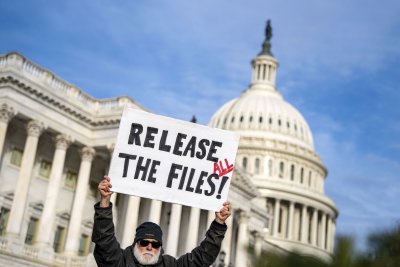
A demonstrator holds a poster during a press conference on the Epstein Files Transparency Act on Nov. 18 in Washington, D.C. On Wednesday, a New York federal judge ruled that the grand jury files in the case against Jeffrey Epstein can be released. File Photo by Bonnie Cash/UPI | License Photo

Dec. 10 (UPI) — A federal judge in New York said Wednesday that the 2019 grand jury files in the case against convicted sex offender Jeffrey Epstein can be released.

U.S. District Judge Richard Berman had denied a previous request by the Department of Justice. Grand jury proceedings are normally sealed. But the Epstein Files Transparency Act — signed into law on Nov. 19 — now allows for the release, Berman said.

“The Court hereby grants the Government’s motion in accordance with the Epstein Files Transparency Act and with the unequivocal right of Epstein victims to have their identity and privacy protected,” he said in the four-page ruling.

A federal judge in Florida on Dec. 5 ordered the release of grand-jury transcripts from the investigation against Epstein from 2005 to 2007. That investigation was abandoned.

The ruling comes one day after a similar ruling in which a judge allowed the release of grand jury files in the case of Epstein’s accomplice, Ghislaine Maxwell, who is serving 20 years for child sex trafficking. Epstein died by suicide in prison in 2019.

Congressional Democrats recently released photos of Epstein’s private island, Little St. James, in the U.S. Virgin Islands.

President Donald Trump walks on the South Lawn of the White House after arriving on Marine One in Washington on Tuesday. Trump said people were “starting to learn” the benefits of his tariff regime. Photo by Graeme Sloan/UPI | License Photo

Source link

‘So help me God’: S.C. atheist calls oath requirement unconstitutional

Dec. 10 (UPI) — A South Carolina atheist is suing for the right to serve as a poll worker without having to swear an oath to God.

James Reel alleges a requirement that citizens make a statement of belief in a monotheistic deity or forgo working at the polls violates the constitutional rights of nontheists or those who worship more than one deity.

The Greenville County resident became passionate about defending the American form of governing after observing negative political rhetoric during the 2020 election designed to undermine public trust in the electoral process, according to his suit. Reel decided to train as a poll worker.

But after completing three online courses in December 2023 and beginning in-person training, Reel learned he would be required to take an oath that ends with “so help me God.” He asked instead to be allowed to use a secular affirmation, which is a solemn vow without reference to a religious deity, but election officials denied the request.

The Freedom From Religion Foundation, a national nonprofit based in Madison, Wis., stepped in last year to help.

In letters to the South Carolina Election Commission and the Greenville County Voter Registration and Elections Board in late 2024 and early 2025, foundation staff attorney Madeline Ziegler said Reel does not want to profess a belief in a god, “which would make a mockery out of the oath and the solemn promise to support both the federal and state constitutions.”

The distinction between an oath and affirmation is critical because the opportunity to substitute an affirmation is required under federal law, Ziegler said.

“Article 6 of the United States Constitution prohibits the government from requiring any kind of religious test for public office, including to volunteer as a poll worker,” she wrote.

The required oath of office for public officials is in Article III, Section 26 of the South Carolina Constitution and in Title 7, Chapter 13 of the state code.

It says: “I do solemnly swear (or affirm) that I am duly qualified, according to the Constitution of this State, to exercise the duties of the office to which I have been appointed, and that I will, to the best of my ability, discharge the duties thereof, and preserve, protect and defend the Constitution of this State and of the United States. So help me God.”

To be appointed as a poll worker, state code requires citizens to take a training course conducted by one of the 46 county boards of voter registration and elections. Howard Knapp, the now former executive director of the election commission, said current policies and procedures make no particular reference to the contents of the oath, which must be signed by the prospective poll worker.

Although the commission has the authority to set policy on the conduct of elections by the county boards, “this grant of authority does not extend to a power to create election related policies and procedures that contradict explicit statutory requirements, and then instruct the county boards to ignore what is clearly stated in the code,” Knapp said in a January letter.

He added the commission has limited oversight authority over the boards, which are independent county government offices.

Bob Schaffner, chairman of the Greenville County Voter Registration and Elections Board, responded to the foundation that the board is subject to South Carolina laws and standard procedures determined by the State Election Commission in the Poll Manager Handbook issued to all poll workers.

The board is unaware of any specific complaint and the issue has never been raised in his 28 years of service, said Schaffner, who recently retired. He said in a March letter that the South Carolina attorney general might be a better agency to get clarification on state law.

After the requests for a secular affirmation were rejected, South Carolina attorney Steven Edward Buckingham and foundation attorneys Sam Grover and Kyle Steinberg acting as co-counsel filed suit on Reel’s behalf.

The suit, filed Oct. 8 in United States District Court for the District of South Carolina, names as defendants Jenny Wooten, executive director of the South Carolina State Election Commission; Conway Belangia, director of Voter Registration & Elections in Greenville County; and the Greenville County Voter Registration & Elections Board. Wooten and Belangia are being sued in their official capacities.

The lawsuit alleges violations of Article VI and the First Amendment’s free speech, free exercise of religion and establishment of religion clauses. Reel is seeking a permanent injunction against requiring poll workers to swear “so help me God” and the provision of a secular affirmation.

The suit says the state of South Carolina routinely allows attorneys, jurors, witnesses and many others to make a secular affirmation as a matter of conscience.

The oath mandate bars a growing number of people from serving as poll workers, according to the suit, which cites a 2024 Pew Research Center report that says about 28% of the population is religiously unaffiliated. In South Carolina, approximately 16% are unaffiliated.

Foundation Co-president Annie Laurie Gaylor called the oath requirement a “discriminatory and blatantly unconstitutional practice.”

“Jim Reel, a veteran who wants to continue serving his community as a poll worker, should be congratulated, not barred simply because he is an atheist,” Gaylor said.

In answers to the suit filed late last month, the defendants deny they are violating individuals’ rights and assert their actions in their official capacity were taken in good faith in compliance with existing state law and the South Carolina Constitution. They also argue they have immunity from being sued and ask that the suit be dismissed.

The lawsuit and foundation letters cite previous complaints about requirements to swear an oath referencing a belief in God to qualify to serve in a position or run for an office.

The U.S. Supreme Court ruled unanimously in 1961 that the states and the federal government could not force a person to profess a belief or disbelief in any religion because the requirement violated the Constitution.

The justices found in favor of Roy Torcaso, a Maryland man whose appointment as a notary public was revoked after he refused to take an oath declaring the existence of God.

In 1992, Herb Silverman’s application to be a notary public in South Carolina was denied because he crossed out the words “so help me God” on the form. He filed suit, and the state Supreme Court issued a unanimous ruling that the religious test requirement to hold public office violated the U.S. Constitution.

The foundation has brought two similar lawsuits recently. James Tosone, a nontheist, ran unsuccessfully for the New Jersey Senate in 2017 and 2021 and for the U.S. House of Representatives in 2018, and each time, he had to swear “so help me God” because there was no secular option for candidates for public office.

Since 2022, Tosone had sought to run for election, but was no longer willing to take the oath. The foundation, which alleged the secretary of state and the state of New Jersey were coercing a statement of belief in a monotheistic deity by requiring nontheists or those who worship more than one deity to swear “so help me God, filed suit in federal court in October 2023. The suit was settled in about a month after the state agreed to adopt a secular affirmation option.

In 2021, the foundation sued Alabama for requiring people who were registering to vote to sign an oath on a form that concluded, “so help me God.” A settlement allowed voters to check a box declining to include those four words.

Source link

Reports: Kentucky State University shooting leaves 1 dead, 1 hospitalized

Dec. 9 (UPI) — A suspect has been arrested and the campus secured following a shooting that killed one and left another hospitalized Tuesday afternoon at Kentucky State University in Frankfort.

The Frankfort Police Department responded to an emergency call reporting an active aggressor at the KSU campus at 3:35 p.m. EST, WKYT reported.

Two students were shot, with one deceased and the other hospitalized in critical condition, ABC News reported.

Officials with the Frankfort police said the campus remained on lockdown until further notice as of 4:35 p.m.

Kentucky Gov. Andy Beshear announced that he is aware of the shooting and a suspect was arrested.

The shooting occurred near the residential Witney M. Young Jr. Hall and was due to a personal dispute, according to the Frankfort Police Department.

“At this time, there is no ongoing threat to the campus community,” university officials told students in a statement.

University officials told CNN they are “in the process of gathering accurate and complete information” before providing media with an official statement.

Frankfort is located 40 miles northwest of Lexington, and KSU has more than 2,200 enrolled students and 450 faculty and staff.

The university is a historically black university that was founded in 1886.


Source link

Gene Simmons, others testify on proposed American Music Fairness Act

Dec. 9 (UPI) — KISS co-founder Gene Simmons and others testified for and against the proposed American Music Fairness Act during a Senate Judiciary subcommittee hearing Tuesday in Washington.

Simmons told the Senate Judiciary Intellectual Property Subcommittee that he supports the bill that would force AM/FM radio stations to pay royalties to the copyright holders of respective works played, according to Roll Call.

“It looks like a small issue [when] there are wars going on and everything,” Simmons said. “But our emissaries to the world are Elvis and Frank Sinatra.”

He said artists such as Elvis, Sinatra and Bing Crosby are treated “worse than slaves” by radio broadcasters.

“Slaves get food and water,” Simmons said. “Elvis and Bing Crosby and Sinatra got nothing for their performance.”

Also testifying in support of the proposed act was Michael Huppe, president and chief executive officer of SoundExchange, which helps music creators to collect royalties whenever their music is played internationally.

He said radio corporations made $250 billion in ad revenue over the past 16 years, while recording artists “were paid exactly zero.”

Broadcasters are using “other people’s property” to make money without paying them, and the United States is the only country that does not pay performers when they music is played on radio, Huppe said, adding that “even Russia and China pay.”

He said online streaming services pay recording artists, but not AM/FM stations.

Broadcasters once argued that radio promoted artists and new music, Huppe explained, but that no longer is the case.

He said most people now are exposed to new music online and via social platforms, such as TikTok and YouTube.

“The days of hearing a song on the radio and going out and buying a CD or an album at a store are long gone,” Huppe told the subcommittee.

Because the United States does not require royalty payments when songs are played on AM/FM radio, foreign governments do not pay royalties to U.S.-based artists.

Instead, he said nations like France collect royalties on U.S.-made music from French broadcasters and give them to French musical artists.

All other music delivery platforms pay artists, but AM/FM does not despite making nearly $14 billion in advertising last year from playing music, Huppe explained.

Broadcast radio stations pay DJs, talk show radio hosts and artists when the same programming is paid online, but not when they are played on analog broadcasts and AM/FM radio.

“No legitimate business or policy reason can justify that difference,” he said.

Opposing the proposed American Music Fairness Act, Henry Hinton, president of Inner Banks Media and longtime talk radio host in North Carolina, said the nation’s more than 5,100 free radio stations would suffer harm if it became law.

“I know firsthand the value and collaborative partnership of our stations and what we have with recording artists,” Hinton said, “but make no mistake: I also know firsthand that a new performance royalty imposed on local radio will create harm for stations, listeners and these very same artists.”

He called broadcast radio a “uniquely free service” that serves local communities “in a way that no other media can.”

Examples include hosting radiothons to raise money for local causes and providing “entertainment, inspiration and information,” including during emergencies and natural disasters.

Radio stations inform people of approaching danger and stay on the air, which at times is the only means of communication between emergency services personnel and the general public.

The Senate Judiciary subcommittee hearing lasted about 1.5 hours.

Attorney General Pam Bondi (C), FBI Director Kash Patel (R), U.S. Attorney for the District of Columbia Jeanine Pirro and others hold a press conference at the Department of Justice Headquarters on Thursday. The FBI arrested Brian Cole of Virginia, who is believed to be responsible for placing pipe bombs outside the Republican and Democratic party headquarters the night before the January 6, 2021, insurrection. Photo by Bonnie Cash/UPI | License Photo

Source link

Imprisoned former Colorado clerk Tina Peters seeks pardon from Trump

Dec. 9 (UPI) — Former Colorado clerk Tina Peters seeks a pardon from President Donald Trump after her request to be released via a writ of habeas corpus was denied.

Peters, 70, was the Mason County (Colo.) clerk and kept a copy of Colorado’s 2020 election results as reported by Dominion Voting Systems, according to her attorney.

Attorney Peter Ticktin wrote the president on Saturday while seeking Peters’ pardon and said other inmates have threatened and attacked her several times, The Hill reported.

“About 6 months ago, Mrs. Peters was threatened with harm … by a group of inmates” who said they would “stab and kill her,” Ticktin wrote.

“This was reported to the FBI and DOJ, which had agents interview her,” he said, adding that she was moved to a different unit.

“In the new unit, she was attacked by other prisoners three times in different locations where guards had to pull inmates off of her,” Ticktin said.

Peters has sought a transfer to a safer unit six times, but was denied each time, Axios Denver reported.

‘They stole our whole country’

Peters is serving a nine-year sentence after being convicted in 2024 of attempting to influence a public official, conspiracy to commit criminal impersonation, first-degree official misconduct, violation of duty and failure to comply with Colorado Secretary of State requirements.

Ticktin called her trial a “travesty” and said she was not allowed to raise her defenses.

“Tina Peters is a critical and necessary witness to the most serious crime perpetrated against the United States in history,” he wrote. “They stole our whole country for four years.”

He accused Dominion officials of carrying out an “illegal operation on our soil, which was supported and controlled by foreign actors.”

Ticktin said Dominion officials told Colorado Secretary of State Jena Griswold to help delete all data collected by Dominion voting machines and demanded criminal charges be filed against Peters when they learned she had a lawful copy of the state’s 2020 election data.

He told the president that Peters’ copy of that data is “essential” and that she is a “necessary and material witness” who can testify regarding chain of custody and other evidence regarding alleged misconduct during the 2020 election in Colorado.

Release petition denied

The pardon request preceded U.S. District Court of Colorado Chief Magistrate Judge Scott Varholak on Monday denying Peters’ request to be given a bond and released from prison pending the outcome of an active appeal of her conviction that is active in the Colorado Court of Appeals.

Varholak said three conditions must exist for a federal court to intervene in a state-level case and grant a writ of habeas corpus in the matter.

One is that there is an ongoing case, which her appeal satisfied, while another is that there be an important state interest, which Varholak agreed exists in the matter.

The third condition is that there be an adequate opportunity to raise federal claims in the state court proceeding, and the judge ruled her bond request satisfies that requirement.

When the three conditions are met, the federal court then must determine if one of three exceptions apply for it to intervene in a state case.

The exceptions are that the prosecution was done in bad faith or to harass the petitioner, is unconstitutional or related to any other extraordinary circumstances that create a “‘threat of irreparable injury, both great and immediate,'” Varholak explained.

He said Peters did not establish grounds for the federal court to determine one or more of the exceptions apply in her case and dismissed without prejudice her writ of habeas corpus petition.

Source link

BLS: Job openings rose slightly in October

Dec. 9 (UPI) — Job openings inched up slightly in October, despite fears of shrinkage.

The Bureau of Labor Statistics released its government shutdown-delayed October Job Openings and Labor Turnover Summary Tuesday, showing a small uptick in job openings that month.

But the job market isn’t rosy quite yet. Hiring stalled, layoffs increased and employees did not quit their jobs. The voluntary quits rate was at a five-year low.

The report also includes some data from September, which hadn’t been released because of the government shutdown from Oct. 1 to Nov. 12. The October data also was affected by the agency’s inability to collect data during the month.

At the end of October, there were about 7.67 million job openings in the United States, which is a slight raise from 7.66 million in September and 7.23 million in August, the report said.

In October, the number and rate of total separations (quits, layoffs, firings) were little changed at 5.1 million and 3.2%. The number of total separations decreased in health care and social assistance by 111,000 and in the federal government by 34,000.

The quits were at 2.9 million and 1.8%, which was down by 276,000 over the year. A drop in quits can indicate a lack of confidence in the job market.

The Federal Reserve is expected to release its decision on interest rates on Wednesday.

Furloughed federal workers line up as Jose Andres’ World Central Kitchen’s Relief Team sets up a free meal distribution site in Washington, D.C., on Monday. Photo by Bonnie Cash/UPI | License Photo

Source link