RACE

Democrats keep 2024 election review under wraps, saying a public rehash won’t help them win in 2026

Democrats will not issue a postelection report on their 2024 shellacking after all.

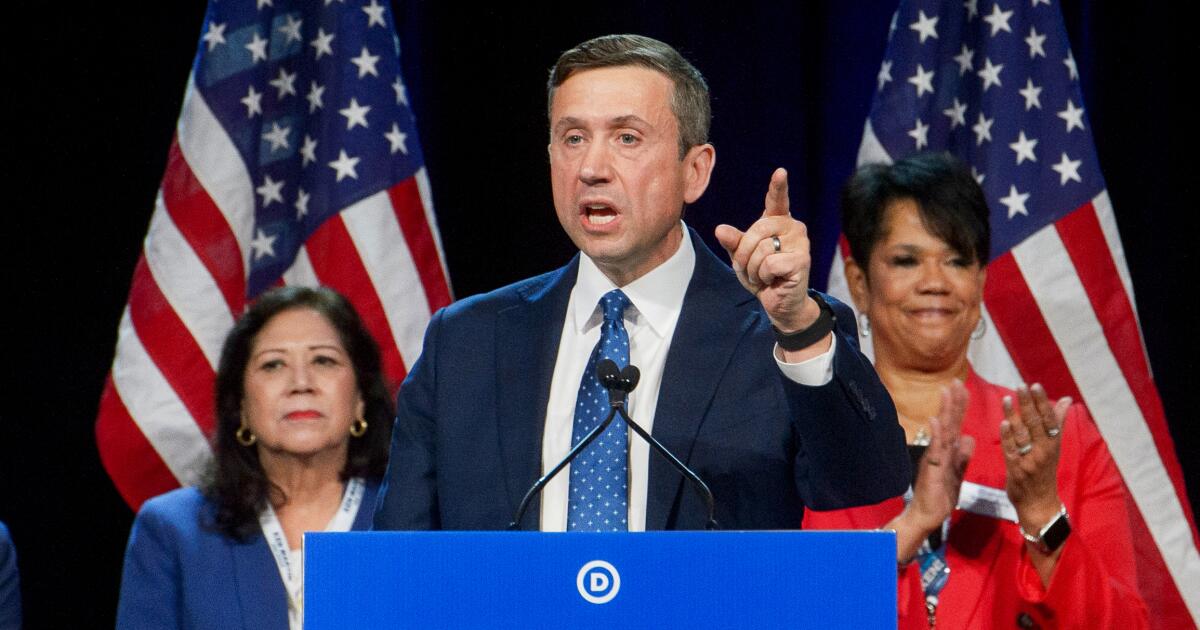
The Democratic National Committee head has decided not to publish a formal assessment of the party’s defeat that returned Donald Trump to power and gave Republicans complete control in Washington.

Ken Martin, a Minnesota party leader who was elected national chair after Trump’s election, ordered a thorough review of what went wrong and what could be done differently, with the intent they would circulate a report as Republicans did after their 2012 election performance. Martin now says the inquiry, which included hundreds of interviews, was complete but that there is no value in a public release of findings that he believes could lead to continued infighting and recriminations before the 2026 midterms when control of Congress will be at stake.

“Does this help us win?” Martin said in a statement Thursday. “If the answer is no, it’s a distraction from the core mission.”

Martin’s decision, first reported by the New York Times, spares top Democrats from more scrutiny about their campaigns, including former President Biden, who withdrew from the race after announcing his second-term run, and his vice president, Kamala Harris, who became the nominee and lost to Trump.

Keeping the report under wraps also means Martin does not have to take sides in the tug-of-war between moderates and progressives or make assessments about how candidates should handle issues that Trump capitalized on, such as transgender rights.

“We are winning again,” Martin said.

Martin’s announcement follows a successful string of 2025 races, both in special elections and off-year statewide votes, that suggest strong enthusiasm for Democratic candidates.

In November, Abigail Spanberger and Mikie Sherrill won races for governor in Virginia and New Jersey, respectively. In New York’s mayoral election, Zohran Mamdani, a democratic socialist, defeated establishment Democrat-turned-independent Andrew Cuomo.

In U.S. House special elections throughout 2025, Democratic nominees have consistently outperformed the party’s 2024 showing, often by double-digit percentages. Democrats have flipped state legislative districts and some statewide seats around the country, even in Republican-leaning places.

Although the DNC’s report will not be made public, a committee aide said some conclusions will be integrated into the party’s 2026 plans.

For example, the findings reflect a consensus that Democratic candidates did not adequately address voter concerns on public safety and immigration, two topics that Trump hammered in his comeback campaign. They also found that Democrats must overhaul their digital outreach, especially to younger voters, a group where Trump saw key gains over Harris compared with previous elections.

Barrow writes for the Associated Press.

Source link

The U.S. economy was stagnant in 2025 — with one exception

Today’s political consensus crosses all ages, demographics and party lines: Three out of four Americans think the economy is in a slump. It is not just in their heads. Economic growth this year has been practically stagnant, save for one exception, economists say.

You’re reading the L.A. Times Politics newsletter

George Skelton and Michael Wilner cover the insights, legislation, players and politics you need to know in 2024. In your inbox Monday and Thursday mornings.

By continuing, you agree to our Terms of Service and our Privacy Policy.

A national California economy

Hundreds of billions of dollars invested by California-based tech giants in artificial intelligence infrastructure accounted for 92% of the nation’s GDP growth this year, according to a Harvard analysis, supported by other independent economic studies.

It is a remarkable boon for a handful of companies that could lay the groundwork for future U.S. economic leadership. But, so far, little evidence exists that their ventures are expanding opportunities for everyday Americans.

“You have to watch out for AI investments — they may continue to carry the economy or they may slow down or crash, bringing the rest of the economy together with them,” said Daron Acemoglu, an economics professor at MIT. “We are not seeing much broad-based productivity improvements from AI or other innovations in the economy, because if we were, we would see productivity growth and investment picking up the rest of the economy as well.”

Even in California itself, where four of the top five AI companies are based, the AI boom has yet to translate into tangible pocketbook benefits. On the contrary, California shed 158,734 jobs through October, reflecting rising unemployment throughout the country, with layoffs rippling through the tech and entertainment sectors. Consumer confidence in the state has reached a five-year low. And AI fueled a wave of cuts, cited in 48,000 job losses nationwide this year.

“It is evident that the U.S. economy would have been almost stagnant, absent the capital expenditures by the AI industry,” said Servaas Storm, an economist at the Institute for New Economic Thinking, whose own analysis found that half of U.S. economic growth from the second quarter of 2024 through the second quarter of 2025 was due to spending on AI data centers.

The scale of investments by AI companies, coupled with lagging productivity gains expected from AI tools, is spawning widespread fears of a new bubble on Wall Street, where Big Tech has driven index gains throughout the year.

The top 10 stocks listed in the Standard & Poor’s 500 index, most of which are in the tech sector, were responsible for 60% of the yearlong rally, far outperforming the rest of the market. And the few who benefited from dividends fueled much of the rest of this year’s economic growth, with the vast majority of U.S. consumption spending attributed to the richest 10% to 20% of American households.

“There were ripple effects into high-end travel, luxury spending, high-end real estate and other sectors of the economy driven by the financial elite,” said Peter Atwater, an economics professor at William & Mary and president of Financial Insyghts, a consulting firm. “It tells the average consumer that while things are good at the top, they haven’t benefited.”

Stan Veuger, a senior fellow in economic policy studies at the American Enterprise Institute and a frequent visiting lecturer at Harvard, said that slowing growth and persistently high inflation were diminishing the effects of the AI boom.

“Obviously, that’s not a recipe for sustainable growth,” he said.

U.S. growth today is based on “the hope, optimism, belief or hype that the massive investments in AI will pay off — in terms of higher productivity, perhaps lower prices, more innovation,” Storm added. “It should tell everyday Americans that the economy is not in good shape and that the AI industry and government are betting the farm — and more — on a very risky and unproven strategy involving the scaling of AI.”

Trump’s AI bet

The Trump administration has fully embraced AI as a cornerstone of its economic policy, supporting more than $1 trillion in investments over the course of the year, including a $500-billion project to build out massive data centers with private partners.

Trump recently took executive action attempting to limit state regulations on AI designed to protect consumers. And House Republicans passed legislation this week that would significantly cut red tape for data center construction.

Administration officials say the United States has little choice but to invest aggressively in the technology, or else risk losing the race for AI superiority to China — a binary outcome that AI experts warn will result in irreversible, exponential growth for the winner.

But there is little expectation that their investments will bear fruit in the short term. Data centers under construction under the Stargate program, in partnership with OpenAI and Oracle, will begin coming online in 2026, with the largest centers expected to become operative in 2028.

“AI can only fulfill its promise if we build the compute to power it,” OpenAI Chief Executive Sam Altman said at the launch of the Stargate project. “That compute is the key to ensuring everyone can benefit from AI and to unlocking future breakthroughs.”

In the meantime, the Americans expected to benefit are those who can join in the investment boom — for as long as it lasts.

“2025 has been a very good year for people who already have significant wealth, a mediocre year for everyone else,” said Kenneth Rogoff, a prominent economist and professor at Harvard. “While the stock market has exploded, wage growth has been barely above inflation.”

“Whether the rest of the economy will catch fire from AI investment remains to be seen, but near term it is likely that AI will take away far more good jobs than it will create,” Rogoff added. “The Trump team is nevertheless optimistic that this will all go their way, but the team is largely built to carry out the president’s vision rather than to question it.”

What else you should be reading

The must-read: After the fires: A glance back at The Times’ coverage of the Eaton and Palisades wildfires
The deep dive: ‘Both sides botched it.’ Bass, in unguarded moment, rips responses to Palisades, Eaton fires
The L.A. Times Special: Hiltzik: Republicans don’t have a healthcare plan, just a plan to kill Obamacare

More to come,
Michael Wilner

Was this newsletter forwarded to you? Sign up here to get it in your inbox.

Source link

Can India catch up with the US, Taiwan and China in the global chip race? | Technology News

In October, a small electronics manufacturer in the western Indian state of Gujarat shipped its first batch of chip modules to a client in California.

Kaynes Semicon, together with Japanese and Malaysian technology partners, assembled the chips in a new factory funded with incentives under Indian Prime Minister Narendra Modi’s $10bn semiconductor push announced in 2021.

Modi has been trying to position India as an additional manufacturing hub for global companies that may be looking to expand their production beyond China, with limited success.

One sign of that is India’s first commercial foundry for mature chips that is currently under construction, also in Gujarat. The $11bn project is supported by technology transfer from a Taiwanese chipmaker and has onboarded the United States chip giant Intel as a potential customer.

With companies the world over hungering for chips, India’s entry into that business could boost its role in global supply chains. But experts caution that India still has a long way to go in attracting more foreign investment and catching up in cutting-edge technology.

Unprecedented momentum

Semiconductor chips are designed, fabricated in foundries, and then assembled and packaged for commercial use. The US leads in chip design, Taiwan in fabrication, and China, increasingly, in packaging.

The upcoming foundry in Gujarat is a collaboration between India’s Tata Group, one of the largest conglomerates in the country, and Taiwan’s Powerchip Semiconductor Manufacturing Corporation (PSMC), which is assisting with the plant’s construction and technology transfer.

On December 8, Tata Electronics also signed an agreement with Intel to explore the manufacturing and packaging of its products in Tata’s upcoming facilities, including the foundry. The partnership will address the growing domestic demand.

Last year, Tata was approved for a 50 percent subsidy from the Modi government for the foundry, along with additional state-level incentives, and could come online as early as December 2026.

Even if delayed, the project marks a pivotal moment for India, which has seen multiple attempts to build a commercial fab stall in the past.

The foundry will focus on fabricating chips ranging from 28 nanometres (nm) to 110nm, typically referred to as mature chips because they are comparatively easier to produce than smaller 7nm or 3nm chips.

Mature chips are used in most consumer and power electronics, while the smaller chips are in high demand for AI data centres and high-performance computing. Globally, the technology for mature chips is more widely available and distributed. Taiwan leads production of these chips, with China fast catching up, though Taiwan’s TSMC dominates production for cutting-edge nodes below 7nm.

“India has long been strong in chip design, but the challenge has been converting that strength into semiconductor manufacturing,” said Stephen Ezell, vice president for global innovation policy at the Washington, DC-based Information Technology and Innovation Foundation (ITIF).

“In the past two to three years, there’s been more progress on that front than in the previous decade – driven by stronger political will at both the central and state levels, and a more coordinated push from the private sector to commit to these investments,” Ezell told Al Jazeera.

Easy entry point

More than half of the Modi government’s $10bn in semiconductor incentives is earmarked for the Tata-PSMC venture, with the remainder supporting nine other projects focused mainly on the assembly, testing and packaging (ATP) stage of the supply chain.

These are India’s first such projects – one by Idaho-based Micron Technology, also in Gujarat, and another by the Tata Group in the northeastern Assam state. Both will use in-house technologies and have drawn investments of $2.7bn and $3.3bn, respectively.

The remaining projects are smaller, with cumulative investments of about $2bn, and are backed by technology partners such as Taiwan’s Foxconn, Japan’s Renesas Electronics, and Thailand’s Stars Microelectronics.

“ATP units offer a lower path of resistance compared to a large foundry, requiring smaller investments – typically between $50m and $1bn. They also carry less risk, and the necessary technology know-how is widely available globally,” Ashok Chandak, president of the India Electronics and Semiconductor Association (IESA), told Al Jazeera.

Still, most of the projects are behind schedule.

Micron’s facility, approved for incentives in June 2023, was initially expected to begin production by late 2024. However, the company noted in its fiscal 2025 report that the Gujarat facility will “address demand in the latter half of this decade”.

Approved in February 2024, the Tata facility was initially slated to be operational by mid-2025, but the timeline has now been pushed to April 2026.

When asked for reasons behind the delays, both Micron and Tata declined to comment.

One exception is a smaller ATP unit by Kaynes Semicon, which in October exported a consignment of sample chip modules to an anchor client in California – a first for India.

Another project by CG Semi, part of India’s Murugappa Group, is in trial runs, with commercial production expected in the coming months.

The semiconductor projects under the Tata Group and the Murugappa Group have drawn public scrutiny after Indian online news outlet Scroll.in reported that both companies made massive political donations after they were picked for the projects.

As per Scroll.in, the Tata Group donated 7.5 billion rupees ($91m) and 1.25 billion rupees ($15m), respectively, to Modi’s Bharatiya Janata Party (BJP) just weeks after securing government subsidies in February 2024 and ahead of national elections. Neither group had made such large donations to the party before. Such donations are not prohibited by law. Both the Tata Group and the Murugappa Group declined to comment to Al Jazeera regarding the reports.

Meeting domestic demand a key priority

The upcoming projects in India – both the foundry and the ATP units – will primarily focus on legacy, or mature, chips sized between 28nm and 110nm. While these chips are not at the cutting-edge of semiconductor technology, they account for the bulk of global demand, with applications across cars, industrial equipment and consumer electronics.

China dominates the ATP segment globally with a 30 percent share and accounted for 42 percent of semiconductor equipment spending in 2024, according to DBS Group Research.

India has long positioned itself as a “China Plus One” destination amid global supply chain diversification, with some progress evident in Apple’s expansion of its manufacturing base in the country. The company assembles all its latest iPhone models in India, in partnership with Foxconn and Tata Electronics, and has emerged as a key supplier to the US market this year following tariff-related uncertainties over Chinese shipments.

Its push in the ATP segment, however, is driven largely by the need to meet the growing domestic demand for chips, anticipated to surge from $50bn today to $100bn by 2030.

“Globally, too, the market will expand from around $650bn to $1 trillion. So, we’re not looking at shifting manufacturing from China to elsewhere. We’re looking at capturing the incremental demand emerging both in India and abroad,” Chandak said.

India’s import of chips – both integrated circuits and microassemblies – has jumped in recent years, rising 36 percent in 2024 to nearly $24bn from the previous year. An integrated circuit (IC) is a chip serving logic, memory or processing functions, whereas a microassembly is a broader package of multiple chips performing combined functions.

The momentum has continued this year, with imports up 20 percent year-on-year, accounting for about 3 percent of India’s total import bill, according to official trade data. China remains the leading supplier with a 30 percent share, followed by Hong Kong (19 percent), South Korea (11 percent), Taiwan (10 percent), and Singapore (10 percent).

“Even if it’s a 28 nm chip, from a trade balance perspective, India would rather produce and package it domestically than import it,” Ezell of ITIF said, adding that domestic capability would enhance the competitiveness of chip-dependent industries.

Better incentives needed

The Modi government’s support for the chip sector, while unprecedented for India, is still dwarfed by the $48bn committed by China and the $53bn provisioned under the US’s CHIPS Act.

To achieve scale in the ATP segment for meaningful import substitution – and to advance towards producing chips smaller than 28nm – India will need continued government support, and there is a second round of incentives already in the works.

“The reality is, if India wants to compete at the leading edge of semiconductors, it will need to attract a foreign partner – American or Asian – since only a handful of companies globally operate at that level. It’s highly unlikely that a domestic firm will be competitive at 7nm or 3nm anytime soon,” Ezell said.

According to him, India needs to continue focusing on improving its overall business environment – from ensuring reliable power and infrastructure to streamlining regulations, customs and tariff policies.

India’s engineers make up about a fifth of the global chip design workforce, but rising competition from China and Malaysia to attract multinational design firms could erode that edge.

In its latest incentive round, the Indian government limited benefits to domestic firms to promote local intellectual property – a move that, according to Alpa Sood, legal director at the India operations of California-based Marvell Technology, risks driving multinational design work elsewhere.

“India already has a thriving chip design ecosystem strengthened by early-stage incentives from the government. What we need, to further accelerate and build stronger R&D muscle – is incentives that mirror competing countries like China [220 percent tax incentives] and Malaysia [200 percent tax incentives]. This will ensure we don’t lose the advantage we’ve built over the years,” Sood told Al Jazeera.

Marvell’s India operations are its largest outside the US.

The Trump effect

India’s upcoming chip facilities, while aimed at meeting domestic demand, will also export to clients in the US, Japan, and Taiwan. Though US President Donald Trump has threatened 100 percent tariffs on semiconductors made outside the US, none have yet been imposed.

A bigger concern for India-US engagement – so far limited to education and training – is Washington’s 50 percent tariff on India over its Russian crude imports. Semiconductors remain exempt, but the broader trade climate has turned uncertain.

“Over half the global semiconductor market is controlled by US-headquartered firms, making engagement with them crucial,” Chandak said. “Any alignment with these firms, either through joint ventures or technology partnerships – is a preferred option.”

The global chip race is accelerating, and India’s policies will need to keep pace to become a serious player amid growing geo-economic fragmentation.

“These new 1.7nm fabs are so advanced they even factor in the moon’s gravitational pull – it’s literally a moonshot,” Ezell said. “Semiconductor manufacturing is the most complex engineering task humanity undertakes – and the policymaking behind it must be just as precise.”

Source link

Judges quiz California and GOP attorneys in Prop. 50 redistricting case

A trio of federal judges questioned attorneys for Gov. Gavin Newsom and the California Republican Party on Wednesday in a legal case that will decide the fate of California’s new voter-approved congressional districts for the 2026 midterm elections.

Attorneys for the California Republican Party and the Trump administration’s Department of Justice during the hearing recapped the argument they made in their legal complaint, accusing Democratic legislators and redistricting experts of racial gerrymandering that illegally favored Latinos.

The state’s legal representatives, meanwhile, argued their primary goal was not racial but political — they worked to weaken Republicans’ voting power in California to offset similar gerrymandering in Texas and other GOP-led states.

But Wednesday was the first time the public got to hear the three federal judges of the Central District of California challenge those narratives as they weigh whether to grant the GOP’s request for a temporary injunction blocking the reconfigured congressional districts approved by voters in November under Proposition 50.

The GOP has repeatedly seized on public comments from Paul Mitchell, a redistricting expert for California’s Democratic-led Legislature who designed the Proposition 50 congressional districts, that “the No. 1 thing” he started thinking about was “drawing a replacement Latino majority/minority district in the middle of Los Angeles.”

On Wednesday, District Court Judge Josephine Staton suggested that GOP attorneys focused too much on the intent of Mitchell and Democratic legislators and not enough on the voters who ultimately approved Proposition 50.

“Why would we not be looking at their intent?” Staton asked Michael Columbo, an attorney for California Republicans. “If the relative intent is the voters, you have nothing.”

Nearly two-thirds of California voters approved the new Proposition 50 congressional district map in a Nov. 4 special election after Newsom pitched the idea as a way to counter partisan gerrymandering after President Trump pressed Texas to redraw maps to shore up the GOP’s narrow House majority.

The stakes for California and the nation are high.

If the new map is used for the 2026 midterms, it could give California Democrats up to five additional U.S. House seats. That could allow them to push back against the gains Republicans make due to redistricting in staunchly GOP states and increase Democrats’ chance of seizing the House and shifting the balance of power in Congress.

A win for Democrats could also boost Newsom’s national clout and help him pitch himself as the nation’s strongest and most effective Trump critic as he enters his final year as California governor and weighs a White House bid.

During closing arguments Wednesday, an attorney for the U.S. Department of Justice argued that the race-based aspect of the redrawn districts started with the drafting of the Assembly bill that led to Proposition 50 being placed on the ballot.

Staton, however, seemed unconvinced.

“These maps have no effect,” she said, “until the voters give them effect.”

The GOP cannot challenge the map on grounds of political gerrymandering: The Supreme Court decided in 2019 that such complaints have no path in federal court. That leaves them focusing on race.

But proving that race predominated over partisanship is a challenge, legal scholars say, and paying attention to race is not, in itself, prohibited under current law. To prove that race was the key motivation, plaintiffs have to show there is another way for map makers to achieve their desired political result without a racial impact.

During the hearing, Staton stressed that the burden was on the challengers of Proposition 50 to prove racial intent.

To that end, the GOP brought to the stand RealClearPolitics elections analyst Sean Trende, who said the new 13th Congressional District in the San Joaquin Valley had an “appendage” that snaked northward into Stockton. Such contorted offshoots, he said, are “usually indicative of racial gerrymandering.” Trende produced an alternative map of the district that he said retained Democratic representation without being driven by race.

But Staton questioned whether Trende’s map was substantially different from Mitchell’s, noting they both seemed to fall within a similar range of Latino representation.

U.S. District Judge Wesley Hsu lambasted Columbo over what he called the “strawman” attempt to pick out one district, the 13th Congressional District, to make the case that there was a race-conscious effort in the attempt to flip five seats in the Democrats’ favor.

Jennifer Rosenberg, an attorney for the state, also argued that Trende’s analysis was too narrow.

“Dr. Trende failed to conduct a district by district analysis,” Rosenberg said. “And as we can see, he only addressed two tiny portions of District 13 and really only focused on one of the subparts.”

U.S. District Judge Kenneth Lee questioned Rosenberg on how much she believed Mitchell’s public statements about wanting to create a Latino district in Los Angeles influenced his redrawing.

“He was talking to interested groups,” Rosenberg said. “He did not communicate that intent to legislators.”

However, Lee said that Mitchell’s closeness to Democratic interest groups was an important factor. Mitchell “delivered on” the “wants” of the Latino interest groups he interacted with, Lee said, based on his public statements and lack of testimony.

Lee also took issue with Mitchell not testifying at the hearing and the dozens of times he invoked legislative privilege during a deposition ahead of the hearing.

Abha Khanna, who represented the Democratic Congressional Campaign Committee, argued there was no racial predominance in Mitchell’s statements.

She showed judges the text of Proposition 50, an official voter guide and statements from Newsom, arguing they were overt declarations of partisan intent. She also pointed out instances in which Republican plaintiffs discussed Proposition 50 in exclusively partisan terms.

If the federal judges grant a preliminary injunction, California would be temporarily blocked from using the newly drawn map in the 2026 election. Attorneys for the state would probably appeal to the U.S. Supreme Court.

Just two weeks ago, the nation’s highest court allowed Texas to temporarily keep its newly drawn congressional districts — which also faced complaints of racial gerrymandering — after a federal court blocked the Texas map, finding racial considerations probably made it unconstitutional.

The U.S. Supreme Court indicated it viewed the Texas redistricting as motivated primarily by partisan politics. In its ruling, it explicitly drew a connection between Texas and California, noting that several states, including California, have redrawn their congressional map “in ways that are predicted to favor the State’s dominant political party.”

Source link

Court battle begins over Republican challenge to California’s Prop. 50

Republicans and Democrats squared off in court Monday in a high-stakes battle over the fate of California’s Proposition 50, which reconfigures the state’s congressional districts and could ultimately help determine which party controls the U.S. House in the 2026 midterms.

Dozens of California politicians and Sacramento insiders — from GOP Assembly members to Democratic redistricting expert Paul Mitchell — have been called to testify in a Los Angeles federal courtroom over the next few days.

The GOP wants the three-judge panel to temporarily block California’s new district map, claiming it is unconstitutional and illegally favors Latino voters.

An overwhelming majority of California voters approved Prop. 50 on Nov. 4 after Gov. Gavin Newsom pitched the redistricting plan as a way to counter partisan gerrymandering in Texas and other GOP-led states. Democrats admitted the new map would weaken Republicans’ voting power in California, but argued it would just be a temporary measure to try to restore national political balance.

Attorneys for the GOP cannot challenge the new redistricting map on the grounds that it disenfranchises swaths of California Republicans. In 2019, the U.S. Supreme Court decided that complaints of partisan gerrymandering have no path in federal court.

But the GOP can bring claims of racial discrimination. They argue California legislators drew the new congressional maps based on race, in violation of the Equal Protection Clause of the 14th Amendment and the 15th Amendment, which prohibits governments from denying citizens the right to vote based on race or color.

On Monday, attorneys for the GOP began by homing in on the new map’s Congressional District 13, which currently encompasses Merced, Stanislaus, and parts of San Joaquin and Fresno counties, along with parts of Stockton.

When Mitchell drew up the map, they argued, he over-represented Latino voters as a “predominant consideration” over political leanings.

They called to the stand RealClearPolitics elections analyst Sean Trende, who said he observed an “appendage” in the new District 13, which extended partially into the San Joaquin Valley and put a crack in the new rendition of District 9.

“From my experience [appendages] are usually indicative of racial gerrymandering,” Trende said. “When the choice came between politics and race, it was race that won out.”

Republicans face an uphill struggle in blocking the new map before the 2026 midterms. The hearing comes just a few weeks after the U.S. Supreme Court allowed Texas to temporarily keep its new congressional map — a move that Newsom’s office says bodes poorly for Republicans trying to block California’s map.

“In letting Texas use its gerrymandered maps, the Supreme Court noted that California’s maps, like Texas’s, were drawn for lawful reasons,” Brandon Richards, a spokesperson for Newsom, said in a statement. “That should be the beginning and the end of this Republican effort to silence the voters of California.”

In Texas, GOP leaders drew up new congressional district lines after President Trump openly pressed them to give Republicans five more seats in the U.S. House of Representatives. A federal court blocked the map, finding racial considerations likely made the Texas map unconstitutional. But a few days later the Supreme Court granted Texas’ request to pause that ruling, signaling they view the Texas case, and this one in California, as part of a national politically-motivated redistricting battle.

“The impetus for the adoption of the Texas map (like the map subsequently adopted in California),” Justice Samuel A. Alito Jr. argued, “was partisan advantage pure and simple.”

The fact that the Supreme Court order and Alito’s concurrence in the Texas case went out of their way to mention California is not a good sign for California Republicans, said Richard L. Hasen, professor of law and director of the Safeguarding Democracy Project at UCLA School of Law.

“It’s hard to prove racial predominance in drawing a map — that race predominated over partisanship or other traditional districting principles,” Hasen said. “Trying to get a preliminary injunction, there’s a higher burden now, because it would be changing things closer to the election, and the Supreme Court signaled in that Texas ruling that courts should be wary of making changes.”

Many legal scholars argue that the Supreme Court’s ruling on the Texas case means California will likely keep its new map.

“It was really hard before the Texas case to make a racial gerrymandering claim like the plaintiffs were stating, and it’s only gotten harder in the last two weeks,” said Justin Levitt, a professor of law at Loyola Marymount University.

Hours after Californians voted in favor of Prop. 50 on Nov. 4, Assemblymember David J. Tangipa (R-Fresno) and the California Republican Party filed a lawsuit alleging that the map enacted in Prop. 50 for California’s congressional districts is designed to favor Latino voters over others.

The Department of Justice also filed a complaint in the case, arguing the new congressional map uses race as a proxy for politics and manipulated district lines “in the name of bolstering the voting power of Hispanic Californians because of their race.”

Mitchell, the redistricting expert who drew up the maps, is likely to be a key figure in this week’s battle. In the days leading up to the hearing, attorneys sparred over whether Mitchell would testify and whether he should turn over his email correspondence with legislators. Mitchell’s attorneys argued he had legislative privilege.

Attorneys for the GOP have seized on public comments made by Mitchell that the “number one thing” he started thinking about” was “drawing a replacement Latino majority/minority district in the middle of Los Angeles” and the “first thing” he and his team did was “reverse” the California Citizens Redistricting Commission’s earlier decision to eliminate a Latino district from L.A.

Some legal experts, however, say that is not, in itself, a problem.

“What [Mitchell] said was, essentially, ‘I paid attention to race,’” Levitt said. “But there’s nothing under existing law that’s wrong with that. The problem comes when you pay too much attention to race at the exclusion of all of the other redistricting factors.”

Other legal experts argue that what matters is not the intent of Mitchell or California legislators, but the California voters who passed Prop. 50.

“Regardless of what Paul Mitchell or legislative leaders thought, they were just making a proposal to the voters,” said Hasen, who filed an amicus brief in support of the state. “So it’s really the voters’ intent that matters. And if you look at what was actually presented to the voters in the ballot pamphlet, there was virtually nothing about race there.”

Source link

Column: California Democrats have momentum, Republicans have problems

You’re reading the L.A. Times Politics newsletter

Anita Chabria and David Lauter bring insights into legislation, politics and policy from California and beyond. In your inbox three times per week.

By continuing, you agree to our Terms of Service and our Privacy Policy.

It turns out Proposition 50 smacked California Republicans with a double blow heading into the 2026 congressional elections.

First, there was the reshaping of House districts aimed at flipping five Republican-held seats to Democrats.

Now, we learn that the proposition itself juiced up Democratic voter enthusiasm for the elections.

Voter enthusiasm normally results in a higher casting of ballots.

It’s all about the national battle for control of the U.S. House of Representatives — and Congress potentially exercising its constitutional duty to provide some checks and balance against the president. Democrats need a net pickup of only three seats in November’s elections to dethrone Republicans.

President Trump is desperate to keep his GOP toadies in power. So, he has coerced — bullied and threatened — some red-state governors and legislatures into rejiggering Democratic-held House seats to make them more Republican-friendly.

When Texas quickly obliged, Gov. Gavin Newsom retaliated with a California Democratic gerrymander aimed at neutralizing the Lone Star State’s partisan mid-decade redistricting.

California’s counterpunch became Proposition 50, which was approved by a whopping 64.4% of the state’s voters.

Not only did Proposition 50 redraw some GOP-held House seats to tinge them blue, it stirred up excitement about the 2026 elections among Democratic voters.

That’s the view of Mark Baldassare, polling director for the nonpartisan Public Policy Institute of California. And it makes sense. Umpteen millions of dollars were spent by Newsom and Proposition 50 backers advertising the evils of Trump and the need for Democrats to take over the House.

A PPIC poll released last week showed a significant “enthusiasm gap” between Democratic and Republican voters regarding the House contests.

“One of the outcomes of Proposition 50 is that it focused voters on the midterm elections and made them really excited about voting next year,” Baldassare says.

At least, Democrats are showing excitement. Republicans, not so much.

In the poll, likely voters were asked whether they were more enthusiastic than usual about voting in the congressional elections or less enthusiastic.

Overall, 56% were more enthusiastic and 41% less enthusiastic. But that’s not the real story.

The eye-opener is that among Democrats, an overwhelming 72% were more enthusiastic. And 60% of Republicans were less enthusiastic.

“For Democrats, that’s unusually high,” Baldassare says.

To put this in perspective, I looked back at responses to the same question asked in a PPIC poll exactly two years ago before the 2024 elections. At that time, Democrats were virtually evenly split over their enthusiasm or lack of it concerning the congressional races. In fact, Republicans expressed more enthusiasm.

Still, Democrats gained three congressional seats in California in 2024. So currently they outnumber Republicans in the state’s House delegation by a lopsided 43 to 9.

If Democrats could pick up three seats when their voters weren’t even lukewarm about the election, huge party gains seem likely in California next year. Democratic voters presumably will be buoyed by enthusiasm and the party’s candidates will be boosted by gerrymandering.

“Enthusiasm is contagious,” says Dan Schnur, a former Republican operative who teaches political communication at USC and UC Berkeley. “If the party’s concentric circle of committed activists is enthusiastic, that excitement tends to spread outward to other voters.”

Schnur adds: “Two years ago, Democrats were not motivated about Joe Biden or Kamala Harris. Now they’re definitely motivated about Donald Trump. And in order to win midterm elections, you need to have a motivated base.”

Democratic strategist David Townsend says that “enthusiasm is the whole ballgame. It’s the ultimate barometer of whether my message is working and the other side’s is not working.”

The veteran consultant recalls that Democrats “used to go door to door handing out potholders, potted plants, refrigerator magnets and doughnuts trying to motivate voters.

“But the best turnout motivator Democrats have ever had in California is Donald J. Trump.”

In the poll, 71% of voters disapproved of the way Trump is handling his job; just 29% approved. It was even worse for Congress, with 80% disapproving.

Among Democratic voters alone, disapproval of Trump was practically off the chart at 97%.

But 81% of Republicans approved of the president.

Among voters of all political persuasions who expressed higher than usual enthusiasm about the House elections, 77% said they‘d support the Democratic candidate. Also: 79% said Congress should be controlled by Democrats, 84% disapproved of how Congress is handling its job and 79% disapproved of Trump.

And those enthused about the congressional elections believe that, by far, the most important problem facing the nation is “political extremism [and] threats to democracy.” A Democratic shorthand for Trump.

The unseemly nationwide redistricting battle started by Trump is likely to continue well into the election year as some states wrestle with whether to oblige the power-hungry president and others debate retaliating against him.

Sane politicians on both sides should have negotiated a ceasefire immediately after combat erupted. But there wasn’t enough sanity to even begin talks.

Newsom was wise politically to wade into the brawl — wise for California Democrats and also for himself as a presidential hopeful trying to become a national hero to party activists.

“Eleven months before an election, nothing is guaranteed,” Schnur says. “But these poll numbers suggest that Democrats are going to start the year with a big motivational advantage.”

Trump is the Democrats’ proverbial Santa who keeps on giving.

What else you should be reading

The must-read: Kristi Noem grilled over L.A. Purple Heart Army vet who self-deported
The TK: Newsom expresses unease about his new, candid autobiography: ‘It’s all out there’
The L.A. Times Special: A Times investigation finds fraud and theft are rife at California’s county fairs

Until next week,
George Skelton


Was this newsletter forwarded to you? Sign up here to get it in your inbox.

Source link