national

Australia holds national day of reflection one week after Bondi Beach massacre

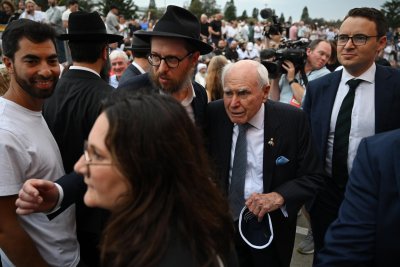
Former Australian Prime Minister John Howard attends the National Day of Reflection vigil and commemoration for the victims and survivors of the Bondi Massacre at Bondi Beach in Sydney, Australia, 21 December 2025. Photo by Dean Lewins/EPA

Dec. 21 (UPI) — Seven days after a mass shooting devastated Bondi Beach, Australians gathered on Sunday for a national day of reflection.

The commemorations come as Prime Minister Anthony Albanese faces intense public scrutiny and has ordered an urgent investigation into the nation’s intelligence and police frameworks.

The tragedy, which claimed 15 lives during a Hanukkah seaside event, is the deadliest mass shooting Australia has seen in nearly three decades.

Authorities have officially classified the massacre — which killed a 10-year-old girl, a British rabbi and a Holocaust survivor, among others — as a terrorist act aimed at the Jewish community.

As the clock struck 6:47 p.m., marking the exact moment the first shots rang out the previous Sunday, a minute of silence was observed. Mourners at Bondi Beach and across the country stood in unison to honor the fallen, according to the BBC.

The atmosphere in Sydney was one of high alert, NBC News reported, with a massive security detail involving rooftop snipers and water patrols.

The Sydney Opera House also paid tribute, illuminating its iconic sails with candle projections to mark the day of mourning.

Despite the somber occasion, Albanese met a hostile reception, NBC News reported. Sections of the crowd booed the prime minister upon his arrival, a sign of the growing friction between the government and the grieving Jewish community.

The BBC also reported that one protester shouted, “Blood on your hands,” while security personnel had to intercept an individual attempting to approach the prime minister.

In an acknowledgment of the criticism, Albanese said during the observation that he accepts his share of responsibility as the nation’s leader.

Addressing the crowd, David Ossip, president of the New South Wales Jewish Board of Deputies, delivered a eulogy.

“Like the grass here at Bondi was stained with blood, so, too, has our nation been stained,” Ossip said, per NBC News. “We have landed up in a dark place.”

Ossip also shared a message of resilience from Ahmed al-Ahmed, a Syrian-Australian shop owner who was injured while heroically disarming one of the gunmen.

From his hospital bed, al-Ahmed’s message to the mourners was, “The Lord is close to the broken-hearted. Today I stand with you, my brothers and sisters.”

Unlike Albanese, New South Wales Premier Chris Minns was met with applause, the BBC reported.

Minns offered a blunt apology for the state’s inability to prevent the shooting, stating, “The government’s highest duty is to protect its citizens. And we did not do that one week ago.”

He further warned that the tragedy exposed a “deep vein of antisemitic hate” that the country must now confront.

After the ceremony, the federal government pivoted toward legislative action.

Albanese announced a comprehensive review of federal intelligence and law enforcement to determine if current powers are sufficient for the modern security landscape. He characterized the “ISIS-inspired” attack as proof of a shifting threat environment.

Additionally, the government has committed to a massive national gun buyback initiative, the scale of which has not been seen since the 1996 Port Arthur massacre.
Source link

Swedish authorities board sanctioned Russian ship in national waters | News

Authorities board vessel off Swedish coast after it suffered an engine failure.

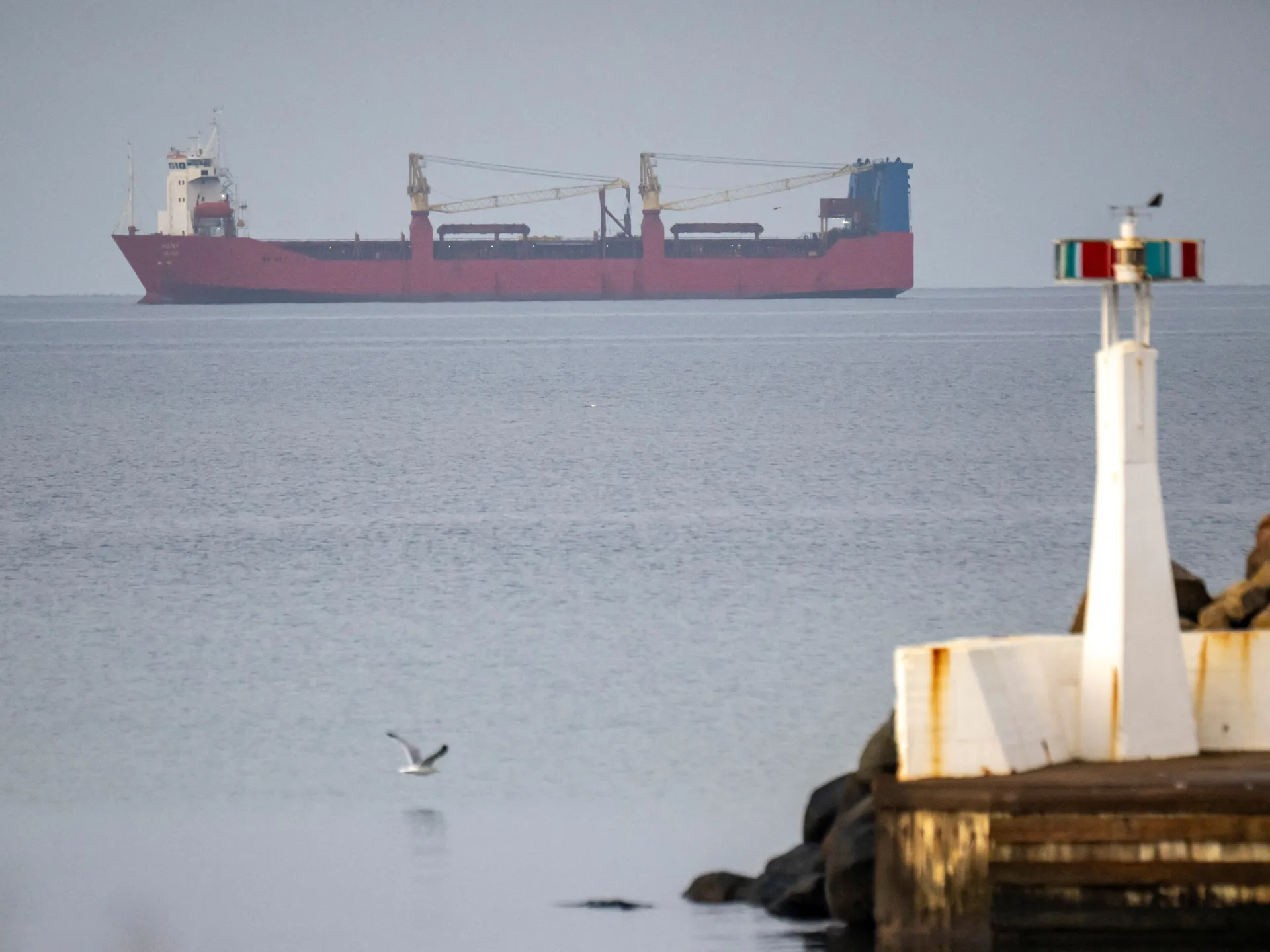
Sweden’s customs service has said that authorities boarded a Russian freighter that anchored in Swedish waters on Friday after developing engine problems, and were conducting an inspection of the cargo.

The owners of the vessel, the Adler, are on the European Union’s sanctions list, Martin Hoglund, spokesman at the customs authority, said on Sunday.

Recommended Stories

list of 4 itemsend of list

“Shortly after 0100 (00:00 GMT) last night we boarded the ship with support from the Swedish Coast Guard and the police service in order to make a customs inspection,” Hoglund said. “The inspection is still ongoing.”

Hoglund declined to say what the customs service had found on board the ship.

According to ship-tracking service Marine Traffic, the Adler is a 126-metre-long, roll-on, roll-off container carrier. It is anchored off Hoganas in southwest Sweden.

EU and US sanctions

In addition to the Adler being on an EU sanctions list, the vessel and its owners, M Leasing LLC, are also both subject to US sanctions, suspected of involvement in weapons transport, according to OpenSanctions, a database of sanctioned companies and individuals, persons of interest and government watchlists.

Hoglund said the ship had left the Russian port of St Petersburg on December 15, but he said customs did not have any information about its destination.

The night-time operation was led by the Swedish Customs Administration along with the coastguard, National Task Force, Swedish Security Service and prosecutors.

In a previous incident, the Adler was boarded by Greek forces in the Mediterranean in January 2021. The operation was carried out under the auspices of the EU’s Operation Irini, which monitors the United Nations arms embargo on Libya.

Source link

Trump pays respects to 2 Iowa National Guard troops, interpreter killed in Syria

President Trump on Wednesday paid his respects to two Iowa National Guard members and a U.S. civilian interpreter who were killed in an attack in the Syrian desert, joining their grieving families as their remains were brought back to the country they served.

Trump met privately with the families at Dover Air Force Base in Delaware before the dignified transfer, a solemn ritual conducted in honor of U.S. service members killed in action. The civilian was also included in the transfer.

Trump, who traveled to Dover several times in his first term, once described it as “the toughest thing I have to do” as president.

The two Iowa troops killed in Syria on Saturday were Sgt. Edgar Brian Torres-Tovar, 25, of Des Moines, and Sgt. William Nathaniel Howard, 29, of Marshalltown, according to the U.S. Army. Both were members of the 1st Squadron, 113th Cavalry Regiment, and have been hailed as heroes by the Iowa National Guard.

Torres-Tovar’s and Howard’s families were at Dover for the return of their remains, alongside Iowa Gov. Kim Reynolds, members of Iowa’s congressional delegation and leaders of the Iowa National Guard. Their remains will be taken to Iowa after the transfer.

A U.S. civilian working as an interpreter, identified Tuesday as Ayad Mansoor Sakat, of Macomb, Mich., was also killed. Three other members of the Iowa National Guard were injured in the attack. The Pentagon has not identified them.

They were among hundreds of U.S. troops deployed in eastern Syria as part of a coalition fighting the Islamic State group.

The process of returning service member remains

There is no formal role for a president at a dignified transfer other than to watch in silence, with all thoughts about what happened in the past and what is happening at Dover kept to himself for the moment. There is no speaking by any of the dignitaries who attend, with the only words coming from the military officials who direct the highly choreographed transfers.

Trump arrived without First Lady Melania Trump, who had been scheduled to accompany him, according to the president’s public schedule. Her office declined to elaborate, with spokesperson Nick Clemens saying the first lady “was not able to attend today.”

During the process at Dover, transfer cases draped with the American flag that hold the soldiers’ remains are carried from the belly of a hulking C-17 military aircraft to a waiting vehicle under the watchful eyes of grieving family members. The vehicle then transports the remains to the mortuary facility at the base, where the fallen are prepared for burial.

Iowa National Guard members hailed as heroes

Howard’s stepfather, Jeffrey Bunn, has said Howard “loved what he was doing and would be the first in and last out.” He said Howard had wanted to be a soldier since he was a boy.

In a social media post, Bunn, who is chief of the Tama, Iowa, police department, said Howard was a loving husband and an “amazing man of faith.” He said Howard’s brother, a staff sergeant in the Iowa National Guard, would escort “Nate” back to Iowa.

Torres-Tovar was remembered as a “very positive” family-oriented person who always put others first, according to fellow Guard members who were deployed with him and issued a statement to the local TV broadcast station WOI.

Dina Qiryaqoz, the daughter of the civilian interpreter who was killed, said Wednesday in a statement that her father worked for the U.S. Army during the invasion of Iraq from 2003 to 2007. Sakat is survived by his wife and four adult children.

The interpreter was from Bakhdida, Iraq, a small Catholic village southeast of Mosul, and the family immigrated to the U.S. in 2007 on a special visa, Qiryaqoz said. At the time of his death, Sakat was employed as an independent contractor for Virginia-based Valiant Integrated Services.

Sakat’s family was still struggling to believe that he is gone. “He was a devoted father and husband, a courageous interpreter and a man who believed deeply in the mission he served,” Qiryaqoz said.

Trump’s reaction to the attack in Syria

Trump told reporters over the weekend that he was mourning the deaths. He vowed retaliation. The most recent instance of U.S. service members killed in action was in January 2024, when three American troops died in a drone attack in Jordan.

Saturday’s deadly attack followed a rapprochement between the U.S. and Syria, bringing the former pariah state into a U.S.-led coalition fighting the Islamic State group.

Trump has forged a relationship with interim Syrian President Ahmed al-Sharaa, the onetime leader of an Islamic insurgent group who led the ouster of former President Bashar Assad.

Trump, who met with al-Sharaa last month at the White House, said Monday that the attack had nothing to do with the Syrian leader, who Trump said was “devastated by what happened.”

During his first term, Trump visited Dover in 2017 to honor a U.S. Navy SEAL killed during a raid in Yemen, in 2019 for two Army officers whose helicopter crashed in Afghanistan, and in 2020 for two Army soldiers killed in Afghanistan when a person dressed in an Afghan army uniform opened fire.

Price writes for the Associated Press. AP writers Konstantin Toropin and Darlene Superville in Washington, Isabella Volmert in Lansing, Mich., and Hannah Fingerhut in Des Moines, Iowa, contributed to this report.

Source link

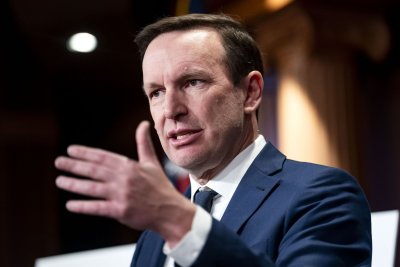
No legal, national security justifications for ship strikes, says Sen. Murphy

Dec. 17 (UPI) — There are no legal or national security justifications for the Trump administration’s attacks on ships in the eastern Pacific and Caribbean Sea, Sen. Chris Murphy said following a bipartisan classified briefing on the strikes.

At least 95 people have been killed in 25 military strikes on ships the Trump administration accuses of being used by drug cartels and gangs designated as terrorist organizations since Sept. 2.

The strikes have drawn mounting domestic and international condemnation and questions over their legality by both Democratic and Republican lawmakers.

The administration defends the strikes as legal under both U.S. and international law, arguing the United States is at war with the drug cartels who are flooding the country with deadly substances.

State Secretary Marco Rubio and Defense Secretary Pete Hegseth held a classified briefing on the strikes with members of Congress on Tuesday, with many Democrats, including Murphy, D-Conn., calling foul.

“While I obviously can’t tell you any classified information I learned, I can tell you this: that the administration had no legal justification for these strikes, and no national justification for these strikes,” Murphy said in a video posted to his X account.

On the national security front, the administration admitted to the lawmakers that there is no fentanyl coming to the United States from Venezuela and the cocaine that is coming from Venezuela is mostly going to Europe, he said.

“And so we are spending billions of your taxpayer dollars to wage a war in the Caribbean to stop cocaine from going from Venezuela to Europe,” he said. “That is a massive waste of national security resources and of your taxpayer dollars.”

On the legal front, the administration is justifying the strikes by stating they are targeting gangs and cartels that the Trump administration has designated as terrorist organizations.

Since February, President Donald Trump has designated 10 cartels and gangs as terrorist organizations, with Clan de Golfo blacklisted on Tuesday.

Murphy said that while the president has the power to designate groups as terrorist organizations, it does not give him the ability to carry out military strikes targeting them.

“A designated ‘terrorist organization’ allows the president to impose sanctions on those organizations and individuals,” he said. “Only Congress, only the American public, can authorize war. And there’s just no question that these are acts of war.”

Source link

National Guard troops under Trump’s command leave Los Angeles

Dozens of California National Guard troops under President Trump’s command apparently slipped out of Los Angeles under cover of darkness early Sunday morning, ahead of an appellate court’s order to be gone by noon Monday.

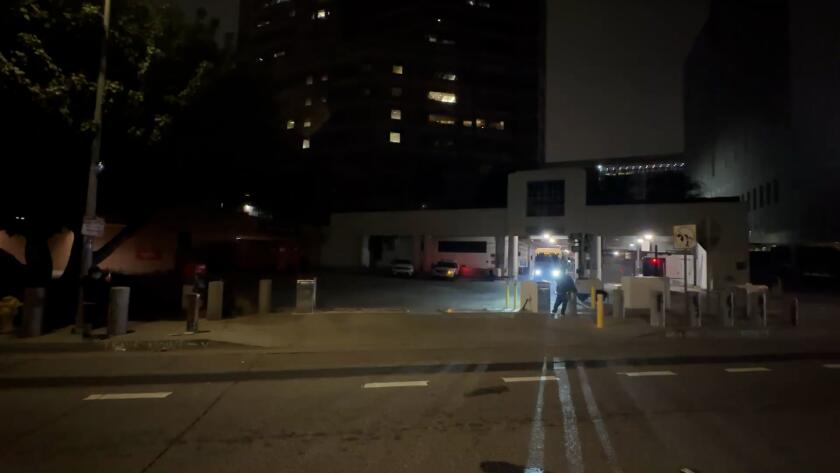
Administration officials would not immediately confirm whether the troops had decamped. But video taken outside the Roybal Federal Building downtown just after midnight on Sunday and reviewed by The Times shows a large tactical truck and four white passenger vans leaving the facility, which has been patrolled by armed soldiers since June.

About 300 California troops remain under federal control, some 100 of whom were still active in Los Angeles as of last week, court records show.

“There were more than usual, and all of them left — there was not a single one that stayed,” said protester Rosa Martinez, who has demonstrated outside the federal building for months and was there Sunday.

Troops were spotted briefly later that day, but had not been seen again as of Monday afternoon, Martinez said.

The development that forced the troops to leave was part of a sprawling legal fight for control of federalized soldiers nationwide that remains ongoing.

The U.S. 9th Circuit Court of Appeals issued the order late Friday but softened an even more stringent edict from a lower court judge last week that would have forced the president to relinquish command of the state’s forces. Trump federalized thousands of California National Guard troops in June troops to quell unrest over immigration enforcement in Los Angeles.

“For the first time in six months, there will be no military deployed on the streets of Los Angeles,” California Atty. Gen. Rob Bonta said in a statement. “While this decision is not final, it is a gratifying and hard-fought step in the right direction.”

The ruling Friday came from the same three-judge panel that handed the president one of his most sweeping second-term victories this summer, after it found that the California deployment could go forward under an obscure and virtually untested subsection of the law.

That precedent set a “great level of deference” as the standard of review for deployments that have since mushroomed across the country, circumscribing debate even in courts where it is not legally binding.

But the so-called Newsom standard — California Gov. Gavin Newsom was the lead plaintiff on the lawsuit — has drawn intense scrutiny and increasingly public rebuke in recent weeks, even as the Trump administration argues it affords the administration new and greater powers.

In October, the 7th Circuit — the appellate court that covers Illinois — found the president’s claims had “insufficient evidence,” upholding a block on a troop deployment in and around Chicago.

“Even applying great deference to the administration’s view of the facts … there is insufficient evidence that protest activity in Illinois has significantly impeded the ability of federal officers to execute federal immigration laws,” the panel wrote.

That ruling is now under review at the Supreme Court.

In November, the 9th Circuit vacated its earlier decision allowing Trump’s Oregon federalization to go forward amid claims the Justice Department misrepresented important facts in its filings. That case is under review by a larger panel of the appellate division, with a decision expected early next year.

Despite mounting pressure, Justice Department lawyers have doubled down on their claims of near-total power, arguing that federalized troops remain under the president’s command in perpetuity, and that courts have no role in reviewing their deployment.

When Judge Mark J. Bennett asked the Department of Justice whether federalized troops could “stay called up forever” under the government’s reading of the statute at a hearing in October, the answer was an unequivocal yes.

“There’s not a word in the statute that talks about how long they can remain in federal service,” Deputy Assistant Atty. Gen. Eric McArthur said.

For now, the fate of 300 federalized California soldiers remains in limbo, though troops are currently barred by court orders from deployment in California and Oregon.

Times staff writers David Zahniser and Kevin Rector contributed to this report.

Source link

Hong Kong court to deliver verdict in Jimmy Lai national security case

Jimmy Lai, founder of Apple Daily, is escorted by police after he was arrested at his home in Hong Kong in August 2020. File Photo by Vernon Yuen/EPA-EFE

Dec. 14 (UPI) — A Hong Kong court is scheduled to deliver its verdict Monday in the national security case against media founder and former publisher Jimmy Lai, one of the city’s most prominent pro-democracy figures and the founder of the now-defunct newspaper Apple Daily.

Lai, 78, whose Chinese name is Lai Chee-ying, is charged alongside several companies linked to Apple Daily, including Apple Daily Limited, Apple Daily Printing Limited and AD Internet Limited, according to the court’s docket.

Prosecutors allege that Lai conspired to collude with foreign forces, an offense punishable by as much as a life sentence in prison under Hong Kong’s national security law.

Court records show the case is listed for verdict at 10 a.m. local time in the Court of First Instance at the West Kowloon Law Courts Building.

The Hong Kong Judiciary issued special public seating and ticketing arrangements for the hearing, citing high demand. According to court notices, admission tickets will be distributed on a first-come, first-served basis beginning 45 minutes before the hearing, with overflow seating and live broadcasts provided in multiple courtrooms.

The case has also drawn international attention, with governments and press freedom groups warning that the prosecution reflects a broader erosion of civil liberties and press freedom in Hong Kong since the national security law was imposed in 2020.

Lai has pleaded not guilty to two counts of “conspiracy to collude with foreign forces” and a separate count of conspiracy to publish seditious material in Apple Daily, The New York Times reported. He has been jailed since his arrest five years ago.

Source link