In 2013, before the Affordable Care Act helped millions get health insurance, California’s Placer County provided limited healthcare to some 3,400 uninsured residents who couldn’t afford to see a doctor.
For several years, that number has been zero in the predominantly white, largely rural county stretching from Sacramento’s eastern suburbs to the shores of Lake Tahoe.
The trend could be short-lived.
County health officials there and across the country are bracing for an estimated 10 million newly uninsured patients over the next decade in the wake of Republicans’ One Big Beautiful Bill Act. The act, which President Trump signed into law this summer, is expected to reduce Medicaid spending by more than $900 billion over that period.
“This is the moment where a lot of hard decisions have to be made about who gets care and who doesn’t,” said Nadereh Pourat, director of the Health Economics and Evaluation Research Program at UCLA. “The number of people who are going to lose coverage is large, and a lot of the systems that were in place to provide care to those individuals have either gone away or diminished.”
It’s an especially thorny challenge for states such as California and New Mexico where counties are legally required to help their poorest residents through what are known as indigent care programs. Under Obamacare, both states were able to expand Medicaid to include more low-income residents, alleviating counties of patient loads and redirecting much of their funding for the patchwork of local programs that provided bare-bones services.
Placer County, which estimates that 16,000 residents could lose healthcare coverage by 2028, quit operating its own clinics nearly a decade ago.
“Most of the infrastructure that we had to meet those needs is gone,” said Rob Oldham, Placer County’s director of health and human services. “This is a much bigger problem than it was a decade ago and much more costly.”
In December, county officials asked to join a statewide association that provides care to mostly small, rural counties, citing an expected rise in the number of uninsured residents.
New Mexico’s second-most populous county, Doña Ana, added dental care for seniors and behavioral health benefits after many of its poorest residents qualified for Medicaid. Now, federal cuts could force the county to reconsider, said Jamie Michael, Doña Ana’s health and human services director.
“At some point we’re going to have to look at either allocating more money or reducing the benefits,” Michael said.
Straining state budgets
Some states, such as Idaho and Colorado, abandoned laws that required counties to be providers of last resort for their residents. In other states, uninsured patients often delay care or receive it at hospital emergency rooms or community clinics. Those clinics are often supported by a mix of federal, state and local funds, according to the National Assn. of Community Health Centers.
Even in states like Texas, which opted not to expand its Medicaid program and continued to rely on counties to care for many of its uninsured, rising healthcare costs are straining local budgets.
“As we have more growth, more people coming in, it’s harder and harder to fund things that are required by the state Legislature, and this isn’t one we can decrease,” said Windy Johnson, program manager with the Texas Indigent Health Care Assn. “It is a fiscal issue.”
California lawmakers face a nearly $18-billion budget deficit in the 2026-27 fiscal year, according to the latest estimates by the state’s nonpartisan Legislative Analyst’s Office. Gov. Gavin Newsom, who recently acknowledged he’s mulling over a White House run, has rebuffed several efforts to significantly raise taxes on the ultrawealthy. Despite blasting the bill passed by Republicans in Congress as a “complete moral failure” that guts healthcare programs, the Democrat this year rolled back state Medi-Cal benefits for seniors and for immigrants without legal status after rising costs forced the program to borrow $4.4 billion from the state’s general fund.
H.D. Palmer, a spokesperson for the state’s Department of Finance, said that the Newsom administration is still refining its fiscal projections and that it would be premature to discuss potential budget solutions.
Newsom will unveil his initial budget proposal in January. State officials have said California could lose $30 billion a year in federal funding for Medi-Cal under the new law, as much as 15% of the state program’s entire budget.
“Local governments don’t really have much capacity to raise revenue,” said Scott Graves, a director at the independent California Budget & Policy Center with a focus on state budgets. “State leaders, if they choose to prioritize it, need to decide where they’re going to find the funding that would be needed to help those who are going to lose healthcare as a result of these federal funding and policy cuts.”
Reviving county-based programs in the near term would require “considerable fiscal restructuring” through the state budget, the Legislative Analyst’s Office said in an October report.
No easy fixes
It’s unclear how many people are enrolled in California’s county indigent programs, because the state doesn’t track enrollment and utilization. But enrollment in county health safety net programs dropped dramatically in the first full year of Affordable Care Act implementation, going from about 858,000 people statewide in 2013 to roughly 176,000 by the end of 2014, according to a survey at the time by Health Access California.
“We’re going to need state investment,” said Michelle Gibbons, executive director of the County Health Executives Assn. of California. “After the Affordable Care Act and as folks got coverage, we didn’t imagine a moment like this where potentially that progress would be unwound and folks would be falling back into indigent care.”
In November, voters in affluent Santa Clara County approved a sales tax increase, in part to backfill the loss of federal funds. But even in the home of Silicon Valley, where the median household income is about 1.7 times the statewide average, that is expected to cover only a third of the $1 billion a year the county stands to lose.
Health advocates fear that, absent major state investments, Californians could see a return to the previous patchwork of county-run programs, with local governments choosing whom and what they cover and for how long.
In many cases, indigent programs didn’t include specialty care, behavioral health or regular access to primary care. Counties can also exclude people based on immigration status or income. Before the ACA, many uninsured people who needed care didn’t get it, which could lead to them winding up in emergency rooms with untreated health conditions or even dying, said Kiran Savage-Sangwan, executive director of the California Pan-Ethnic Health Network.
Rachel Linn Gish, interim deputy director of Health Access California, a consumer advocacy group, said that “it created a very unequal, maldistributed program throughout the state.”
“Many of us,” she said. “including counties, are reeling trying to figure out: What are those downstream impacts?”
KFF Health News is a national newsroom that produces in-depth journalism about health issues and is one of the core operating programs at KFF, the independent source for health policy research, polling and journalism.
WASHINGTON — Lawmakers unhappy with Justice Department decisions to heavily redact or withhold documents from a legally mandated release of files related to Jeffrey Epstein threatened Saturday to launch impeachment proceedings against those responsible, including Pam Bondi, the U.S. attorney general.
Democrats and Republicans alike criticized the omissions, while Democrats also accused the Justice Department of intentionally scrubbing the release of at least one image of President Trump, with Senate Minority Leader Chuck Schumer (D-N.Y.) suggesting it could portend “one of the biggest coverups in American history.”
Trump administration officials have said the release fully complied with the law, and that its redactions were crafted only to protect victims of Epstein, a disgraced financier and convicted sex offender accused of abusing hundreds of women and girls before his death in 2019.
Rep. Ro Khanna (D-Fremont), an author of the Epstein Files Transparency Act, which required the release of the investigative trove, blasted Bondi in a social media video, accusing her of denying the existence of many of the records for months, only to push out “an incomplete release with too many redactions” in response to — and in violation of — the new law.
Khanna said he and the bill’s co-sponsor, Rep. Thomas Massie (R-Ky.), were “exploring all options” for responding and forcing more disclosures, including by pursuing “the impeachment of people at Justice,” asking courts to hold officials blocking the release in contempt, and “referring for prosecution those who are obstructing justice.”
“We will work with the survivors to demand the full release of these files,” Khanna said.
He later added in a CNN interview that he and Massie were drafting articles of impeachment against Bondi, though they had not decided whether to bring them forward.
Massie, in his own social media post, said Khanna was correct in rejecting the Friday release as insufficient, saying it “grossly fails to comply with both the spirit and the letter of the law.”
The lawmakers’ view that the Justice Department’s document dump failed to comply with the law echoed similar complaints across the political spectrum Saturday, as the full scope of redactions and other withholdings came into focus.
The frustration had already sharply escalated late Friday, after Fox News Digital reported that the names and identifiers of not just victims but of “politically exposed individuals and government officials” had been redacted from the records — which would violate the law, and which Justice Department officials denied.
Among the critics was Rep. Marjorie Taylor Greene (R-Ga.), who cited the Fox reporting in an exasperated post late Friday to X.
“The whole point was NOT to protect the ‘politically exposed individuals and government officials.’ That’s exactly what MAGA has always wanted, that’s what drain the swamp actually means. It means expose them all, the rich powerful elites who are corrupt and commit crimes, NOT redact their names and protect them,” Greene wrote.
Senior Justice Department officials later called in to Fox News to dispute the report. But the removal of a file published in the Friday evening release, capturing a desk in Epstein’s home with a drawer filled of photos of Trump, reinforced bipartisan concerns that references to the president had been illegally withheld.
In a release of documents from the Epstein family estate by the House Oversight Committee this fall, Trump’s name was featured over 1,000 times — more than any other public figure.
“If they’re taking this down, just imagine how much more they’re trying to hide,” Schumer wrote on X. “This could be one of the biggest coverups in American history.”
Several victims also said the release was insufficient. “It’s really kind of another slap in the face,” Alicia Arden, who went to the police to report that Epstein had abused her in 1997, told CNN. “I wanted all the files to come out, like they said that they were going to.”
Trump, who signed the act into law after having worked to block it from getting a vote, was conspicuously quiet on the matter. In a long speech in North Carolina on Friday night, he did not mention it.
However, White House officials and Justice Department leaders strongly pushed back against the notion that the release was somehow incomplete or out of compliance with the law, or that the names of politicians had been redacted.
“The only redactions being applied to the documents are those required by law — full stop,” said Deputy Atty. Gen. Todd Blanche. “Consistent with the statute and applicable laws, we are not redacting the names of individuals or politicians unless they are a victim.”
Other Republicans defended the administration. Rep. James Comer (R-Ky.), chair of the House Oversight Committee, said the administration “is delivering unprecedented transparency in the Epstein case and will continue releasing documents.”
Epstein died in a Manhattan jail awaiting trial on sex trafficking charges. He’d been convicted in 2008 of procuring a child for prostitution in Florida, but served only 13 months in custody in what many condemned as a sweetheart plea deal for a well-connected and rich defendant.
Epstein’s crimes have attracted massive attention, including among many within Trump’s own political base, in part because of unanswered questions surrounding which of his many powerful friends may have also been implicated in crimes against children. Some of those questions have swirled around Trump, who was friends with Epstein for years before the two had what the president has described as a falling out.
Evidence has emerged in recent months that suggests Trump may have had knowledge of Epstein’s crimes during their friendship.
Epstein wrote in a 2019 email, released by the House Oversight Committee, that Trump “knew about the girls.” In a 2011 email to Ghislaine Maxwell, who was convicted of conspiring with Epstein to help him sexually abuse girls, Epstein wrote that “the dog that hasn’t barked is trump. [Victim] spent hours at my house with him … he has never once been mentioned.”
Trump has ardently denied any wrongdoing.
The records released Friday contained few if any major new revelations, but did include a complaint against Epstein filed with the FBI back in 1996 — which the FBI did little with, substantiating longstanding fears among Epstein’s victims that his crimes could have been stopped years earlier.
Sen. Adam Schiff (D-Calif.), one of the president’s most consistent critics, wrote on X that Bondi should appear before the Senate Judiciary Committee to explain under oath the extensive redactions and omissions, which he called a “willful violation of the law.”
“The Trump Justice Department has had months to keep their promise to release all of the Epstein Files,” Schiff wrote. “Epstein’s survivors and the American people need answers now.”
Dec. 19 (UPI) — House Democrats said they’re looking into legal options after U.S. Deputy Attorney General Todd Blanche said the Justice Department would release some but not all of the files related to its investigation of convicted sex offender Jeffrey Epstein on Friday, missing a congressional deadline.
Blanche, in an appearance on Fox News Friday morning, said the department will release the remaining files “over the next couple of weeks,” citing the length of time it has taken for officials to go through each document and redact the names of victims.
“I expect that we’re going to release several hundred thousand documents today,” he said.
“There’s a lot of eyes looking at these, and we want to make sure that when we do produce the materials that we’re producing, that we’re protecting every single victim.”
President Donald Trump signed the Epstein Files Transparency Act passed by Congress in November. The law gave the Justice Department 30 days to make the records “publicly available in a searchable and downloadable format.”
Rep. Jamie Raskin, the ranking Democratic on the Judiciary Committee, and Rep. Robert Garcia, the top Democrat on the Committee on Oversight and Government Reform, said the Justice Department was in violation of federal law by not releasing all documents Friday. In a statement, they accused the Trump administration of covering up facts about the case.
“Courts around the country have repeatedly intervened when this administration has broken the law,” they said in a joint statement.
“We are now examining all legal options in the face of this violation of federal law. The survivors of this nightmare deserve justice, the co-conspirators must be held accountable and the American people deserve complete transparency from DOJ.”
Both chambers of Congress were nearly unanimous in supporting the bill — all but Rep. Clay Higgins, R-La., voted in favor of it and five didn’t vote. The bill allowed for the Justice Department to redact the names of victims or information that would hinder active federal investigations. A summary of redactions, including the legal basis, must be provided to Congress.
Earlier in November, Democrats on the House Oversight and Government Reform Committee released some documents, which included emails between Epstein and Ghislaine Maxwell, who helped Epstein sex traffic girls.
While at least one of the references is somewhat cryptic in its reference to Trump, others more openly appear to discuss what the president knew about Epstein’s scheme to bring women and underage girls to his private island for his friends to sexually abuse.
The committee released more documents Thursday evening, this time 68 photos from Epstein’s private island estate.
Among the high-profile people seen in photos with Epstein were Trump, Republican strategist Steve Bannon, former President Bill Clinton, former Treasury Secretary Lawrence Summers, Microsoft co-founder Bill Gates and filmmaker Woody Allen. All have denied wrongdoing and none has been charged.
Epstein died by suicide in 2019 in a Manhattan prison while awaiting trial.
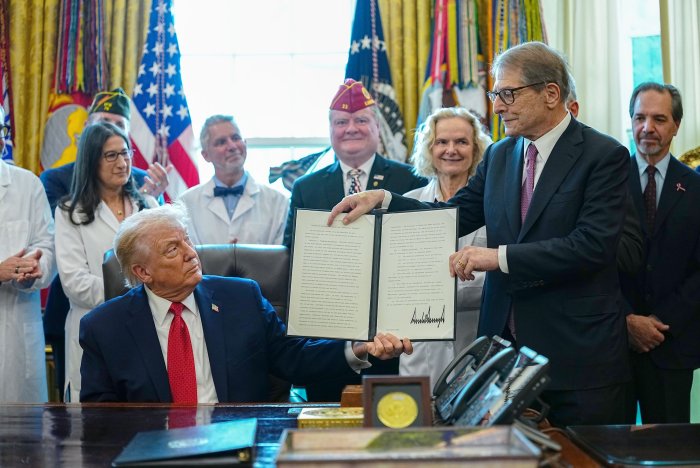
President Donald Trump holds a signed executive order reclassifying marijuana from a schedule I to a schedule III controlled substance in the Oval Office of the White House on Thursday. Photo by Aaron Schwartz/UPI | License Photo
The Visalia Unified School District’s public board meeting in March was a festive and upbeat affair with a performance by a student chamber music group and a commendation for a high school cheer squad.
When the seven-member board went into closed session, the agenda was decidedly grimmer: Six former students were suing the district over sexual abuse they said they suffered decades earlier at the hands of a kindergarten teacher.
Out of public view, the board unanimously approved a $3-million settlement with provisions intended to keep the community in the dark forever.
Under the terms of the agreement, the women, their lawyers and families were prohibited from disclosing any aspect of the deal, including the amount they were paid.
“The Parties agree that they will respond to any inquiries they may receive from any third parties regarding the lawsuit by stating only that ‘the matter has been resolved’ without any further elaboration, discussion or disclosure,” the settlement instructed.
It was Visalia’s fifth secret settlement in the last three years, one of a flurry that districts are quietly approving statewide.
A Times investigation found that California’s public schools, faced with a historic surge of sex abuse lawsuits, are increasingly using nondisclosure agreements and other tactics that celebrities and big corporations rely upon to protect their reputation.
At least 25 districts have resolved suits or other claims in ways that hinder taxpayers from learning about the allegations, the cost of settling them or both, The Times found. These hidden settlements total more than $53 million. Legal experts say that these settlements may be in violation of state law, and that some should be investigated by the state attorney general.
While shielding the names and identifying details of sex abuse victims is widely accepted, courts have repeatedly said the public has a right to know allegations leveled against government employees and the money spent to compensate accusers.
Lawmakers in California have also largely banned the use of confidentiality provisions for settlements involving sexual assault and harassment, on the belief that transparency helps victims heal and leads to public accountability.
“There’s very significant problems with government agencies acting like private companies and requesting or insisting on these kinds of nondisclosure or non-disparagement clauses in settlement agreements,” said David Loy, legal director of the First Amendment Coalition, based in San Rafael. “Because at the end of the day, the government works for the people and the people have a very compelling interest in knowing about claims and allegations of misconduct.”
California’s school districts are now grappling with a deluge of sex abuse cases resulting from a 2019 law that changed the statute of limitations for childhood sexual abuse and created a new window — from 2020 to 2022 — in which anyone could file a lawsuit for past alleged abuse.
The Times identified more than 1,000 lawsuits against school districts filed since 2020, with more than 750 filed due to the new law. Some lawsuits allege abuse as far back as the 1950s. Most cases are still making their way through the courts, but more than 330 have settled for roughly $700 million, with $435 million paid out for claims related to the new law. The state projects that local education agencies will ultimately pay out between $2 billion and $3 billion once cases work through the court system. Much of this is taking place outside the public eye.
Sex abuse cases against California school districts
The Times reached out to more than 930 school districts in California and submitted public records requests seeking information about all sexual misconduct suits and claims filed against districts and copies of settlement agreements for all sexual misconduct suits since Jan. 1, 2020. Click on the expand icon to see details for settled cases including court documents and settlement agreements.
Case information is up to date as of March 1, 2025, although some cases may have since settled and are not reflected. Palos Verdes Peninsula Unified School District refused to turn over any records. Los Angeles Unified only provided a list of AB218 cases as of June 2024, and settlements executed through January 2025. See something missing or incorrect? Contact matt.hamilton@latimes.com.
Gabrielle LaMarr LeMeeLOS ANGELES TIMES
In Visalia, confidentiality clauses negotiated by district lawyers acknowledged the public’s right to obtain the information — and then attempted to make sure they never would. Four agreements specifically barred former students receiving secret payouts from “directly or indirectly” encouraging others to file a request under the state Public Records Act — the method The Times used to review copies of agreements referenced in this story.
A spokesperson for Visalia Unified declined an interview request, and the school district did not answer written questions.
Anaheim Union High School District paid three men, who said they had been abused by a junior high teacher, $3.3 million in 2023.
(Robert Gauthier / Los Angeles Times)
Several districts attempted to prevent allegations from becoming public by paying off accusers before they filed lawsuits that would have detailed the claims of sex abuse for anyone to see.
Anaheim Union High School District paid a trio of men who said they had been abused by a junior high teacher $3.3 million in 2023 after their attorney sent the district a draft of a lawsuit he said he was prepared to file in Superior Court.
The terms of the payout two years ago required that the men and their lawyers “not seek publicity relating to the facts and circumstances giving rise” to their claims, and indeed, the settlements have not been previously reported.
John Bautista, a spokesperson for Anaheim Union, said in a statement that the district and its insurer settled the draft lawsuits after going through discovery in a related case and “did not want to incur additional expenses of filing a lawsuit.”
“Nothing in the agreement would prevent the claimant/plaintiff from speaking with the press concerning the facts of the case if the press contacted [them],” Bautista said.
At least one district paid an accuser before anything was put in writing, records show. Victor Elementary School District in the High Desert negotiated a $350,000 settlement with one former student after his lawyer relayed abuse allegations in a phone call. Asked by The Times for a document describing the claimed misconduct, a district official said no such records existed.
Some districts suggest the confidentiality restrictions are needed to avoid a “snowball effect” of further litigation.
San Diego Unified, hit by more than a dozen lawsuits over alleged sex abuse since 2020, has settled four for a total of $2.44 million, each with a confidentiality clause that, at a minimum, prevents the accuser or her lawyer from disclosing the settlement amount. One of the settlements blocks the accuser from discussing the matter with anyone except her lawyer or financial advisor or in response to a subpoena.
San Diego officials acknowledged that confidentiality is ultimately limited — the documents can be disclosed via public records requests — but the district proceeded with pursuing restrictions on the accusers and their representatives.
“The purpose is to keep plaintiffs’ lawyers from using these settlements as marketing tools,” said James Canning, a spokesman for San Diego Unified.
Former state Sen. Connie Leyva, seen here while in the Legislature in 2019, said she was taken aback by school districts using confidentiality provisions. “That sounds illegal,” Leyva said.
(Rich Pedroncelli / Associated Press)
Efforts to curb the use of secret settlements gained momentum in the 1980s, with growing public awareness of how confidentiality agreements had kept the public in the dark about environmental or health hazards, such as asbestos.
In 2016, California prohibited settlement agreements that block the disclosure of factual information about sexual abuse or any sex offense that could be prosecuted as a felony.
In the wake of the #MeToo movement, lawmakers in 2018 passed the STAND Act, which prohibits nondisclosure agreements in sexual harassment, discrimination and other sexual assault cases that don’t rise to felony prosecution. Three years later, the Silenced No More Act widened the prohibition on nondisclosure agreements to include any harassment case. The law still gives victims the option to protect their identity.
The lead sponsor of both bills, former state Sen. Connie Leyva, said she was taken aback by school districts using confidentiality provisions.
“That sounds illegal,” said Leyva, now the executive director of public radio and TV station KVCR. “We did not speak specifically about children or about schools, but it shouldn’t be happening.” She added, “Our bill was meant to apply to everyone everywhere.”
Several settlement agreements obtained by The Times included caveats by stating they were “confidential to the extent allowed by law,” or contained similar carve-outs. Experts said such provisos still have the effect of muzzling a victim’s speech and hindering public accountability.
“While it’s possible that these work-arounds don’t violate the letter of the STAND Act, they certainly violate its spirit,” said Nora Freeman Engstrom, a professor at Stanford Law School, who co-authored a study on the effect of the STAND Act in L.A. courts.
Southern Kern Unified School District agreed to pay $600,000 to a former student who alleged sex abuse and included an acknowledgment of the STAND Act in the agreement. Still, the settlement bars the former student, Corey Neufer, from “actively” publicizing the deal.
Reached by phone, Neufer said that although he deliberately chose to sue under his own name, rather than as John Doe, he was told that the confidentiality provision was standard and necessary for the final settlement.
“That was one of the stipulations — that I don’t speak about it or give any details,” said Neufer, who indicated the confidentiality was far broader than the text of his settlement suggests. “My lawyer instructed me to not talk about the case.”
The STAND Act allows for plaintiffs or claimants to put language in a settlement agreement that shields their identity and disclosure of any facts that could lead to their identity. However, if a public official or government agency — such as a school district — is part of the settlement, that language cannot be included.
Of the dozens of settlements reviewed by The Times, two specifically noted that the accuser wanted confidentiality to shield their identity.
Several had restrictions that appeared to exceed the STAND Act, such as a 2024 settlement for $787,500 paid by Ceres Unified to a custodian who said she was sexually harassed by a colleague. The signed agreement states that the settlement, its terms and any belief that the district or its employees engaged in unlawful behavior were all confidential. If asked, the custodian could only say, “The matter has been resolved.”
David Viss, an assistant superintendent at Ceres Unified, said in an email that the agreement complied with the law: “We believe the settlement agreement is consistent with the STAND Act.”
The overwhelming majority of sex abuse cases filed against school districts reach a settlement. For districts, a settlement can be more cost-effective than mounting a legal defense through a jury trial, and unlike a panel of jurors, a settlement provides a level of fiscal certainty. At times, the decision to settle is driven less by school board members than an insurance company or liability coverage provider.
John Manly, whose law firm specializes in childhood sex abuse, said school districts and their insurance providers frequently ask for confidentiality and non-disparagement clauses when negotiating a payout.
Lawyer John Manly, seen at his law offices in Irvine in 2023, has represented sex abuse survivors for more than 20 years. He says that confidentiality agreements “benefit one person, which is the perpetrator, and those who enable them.”
(Allen J. Schaben / Los Angeles Times)
“We get these requests all the time, and we decline,” Manly said. “Confidentiality agreements benefit one person, which is the perpetrator, and those who enable them.”
At Los Angeles Unified School District, scores of people accused former San Fernando High School wrestling coach Terry Gillard of abuse. In 2022, LAUSD agreed to pay 23 accusers a total of $52 million to settle molestation and abuse claims — a settlement negotiated by Manly’s law firm.
A year later, LAUSD agreed to pay three other women who alleged abuse by Gillard a total of $7.5 million.
Although those represented by Manly’s team did not have a confidentiality or non-disparagement agreement in their settlement, LAUSD sought an extensive confidentiality agreement for the payout to the three other women, curtailing discussion of the settlement and underlying abuse claims.
That settlement barred their lawyer from making any sort of statement — or encouraging others to make a statement — about the compensation deal, and barred comments that could “defame, disparage or in any way criticize” LAUSD, its employees and leaders.
Only the women, their lawyer, “immediate family” and “tax professional” could know about the settlement, according to the agreement.
“If asked about the status of this dispute, plaintiffs counsel may only state, ‘they have voluntarily and fully resolved their claims against the Los Angeles Unified School District,’ or words to that effect,” declares the settlement agreement.
The lawyer for the women, Anthony DeMarco, did not respond to messages seeking comment.
Manly said the State Bar of California should investigate lawyers on both sides who agree to language that they know conflicts with state law. And he called on Atty. Gen. Rob Bonta to investigate school districts that continue to lock victims into such restrictive agreements.
“It’s wrong. It’s bad for the community and it’s bad for the victim. The lawyers that do it — defense and plaintiff — should be ashamed of themselves.”
L.A. Unified, which has added confidentiality provisions in at least seven settlements since 2020, defended its practices as a way to amicably resolve litigation, according to a statement from a spokesperson.
“These settlement agreements keep the settlement details, such as the amount, confidential. They do not prohibit the disclosure of the facts behind the claims,” the LAUSD spokesperson said.
Some legal experts want Atty. Gen. Rob Bonta to investigate school districts that continue to lock victims into restrictive nondisclosure agreements.
(Genaro Molina / Los Angeles Times)
While several districts use secrecy provisions in settlement agreements to hide the details of sex abuse cases, others, like Visalia Unified, also are able to keep payouts quiet by approving them in closed session at regular school board meetings.
In 2021, the president of the board of Wasco Union High School District received a letter from a lawyer based in Iowa who represented a former Wasco student. The lawyer said his client had been sexually abused nearly a decade earlier by her former coach and teacher, and accused her then-principal, Kevin Tallon, among others, of not taking appropriate steps when confronted with evidence of abuse.
Tallon, now Wasco’s superintendent, was named as a defendant in the draft lawsuit, and the lawyer included a copy. He gave the district 14 business days to respond.
“If I do not hear back from you, I will proceed with the lawsuit,” wrote the lawyer, Thomas Burke.
The letter touched off a negotiation that culminated at the Wasco school board’s final meeting of 2021. The meeting’s agenda for the closed session was circumspect: “Conference with Legal Counsel — Settlement Agreement.” But behind closed doors, the board voted 5 to 0 to approve a settlement, according to meeting minutes, ensuring that there would probably never be a public airing of the allegations against the teacher or superintendent. The meeting minutes reflect only that a settlement was approved — not the amount or nature of the abuse accusations. The district paid $475,000 in the settlement, a sum that The Times obtained via records request.
Tallon, the superintendent who was named in the draft lawsuit, declined an interview but provided written responses to questions. He said the district and its staff “fulfilled its duties diligently and with integrity,” and said the settlement was approved in a way that adhered to the Brown Act, the state’s open meeting law.
“The settlement was not intended to conceal allegations; it was meant to responsibly limit risk and bring closure to a sensitive situation,” Tallon said in the statement.
Legal experts agreed that Wasco’s school board complied with the Brown Act — thereby exposing that law’s limits and potential loopholes. Since the threat of litigation did not result in a filed case or formal claim, the board could treat it as “anticipated litigation” and discuss it in closed session, away from the public. And since settlement offers — like any contract negotiation — are not final until agreed upon, they too can be approved in closed session, away from the public.
Loy, the legal director of the First Amendment Coalition, said the Brown Act could be amended to proactively require public agencies to ultimately disclose the details and amounts of settlements. School districts, he added, could also opt to be more open, without being compelled to by state lawmakers.
“Agencies owe a duty to the public to be more proactive and more transparent, even than the bare minimum letter of the law might allow them to get away with,” Loy said.
The lack of transparency also coincides with a crisis in local news, which has resulted in far less coverage of city halls, courthouses and school boards from the Imperial Valley to the shores of Eureka.
At one time, newspapers big and small had reporters at school board meetings who probably would have noticed settlements on the agenda and submitted records requests to reveal them.
With local media absent, agencies have quietly approved settlements in closed session, with no watchdog to suss out the underlying facts.
“Diligent people or reporters know to do that: Please give me copies of every settlement approved this week or this month,” said Loy, the First Amendment Coalition’s legal director. “But that requires an extra step.”
Former President Yoon Suk Yeol appears at a military court in central Seoul on Thursday. (Photo by Yonhap)
Ousted former President Yoon Suk Yeol on Thursday apologized to key military commanders who are standing trial for their involvement in his failed martial law bid, defending their action as the result of compliance with his orders.
Yoon made the remarks at a martial law trial against the commanders at the military court in central Seoul, which he attended as a witness. Defendants included Kwak Jong-keun, former chief of the Army Special Warfare Command; Yeo In-hyung, former head of the Defense Counterintelligence Command; and Lee Jin-woo, former head of the Capital Defense Command.
“It is pitiful to see senior military and police officials whom I know appear at the court,” Yoon said.
“I feel very sorry as they are people who did what they have to do upon my decision,” he said, adding he prayed late into the night after returning to the detention center following trials.
During Thursday’s trial, Yoon reiterated that he had no intention of maintaining martial law for an extended period and that the declaration was aimed only at exposing the “blatant” behavior of the then main opposition party.
“The martial law was imposed to raise an alarm bell to the public on the country’s perilous situation,” the former president said. “I was thinking that it would last half a day, or a day at the most.”
Yoon said he did not instruct any official, other than former Defense Minister Kim Yong-hyun, to review or prepare for the imposition of martial law.
The then opposition party’s drive to impeach the state auditor chief on the night before the martial law imposition became the “decisive trigger” for him to instruct for preparations for martial law, he claimed.
Speaking on a recent reshuffle of officials dispatched to the Defense Counterintelligence Command, Yoon said institutions pivotal to national security should not be neutralized due to their involvement in the martial law bid.
Yoon’s appearance at the military court, located within the defense ministry compound that also houses the presidential office, marked his first visit to his former office compound in about a year. It also came on his 65th birthday.
Copyright (c) Yonhap News Agency prohibits its content from being redistributed or reprinted without consent, and forbids the content from being learned and used by artificial intelligence systems.
A woman shows coca leaves during an event for the National Day of Acullico (chewing of the plant) in Santa Cruz, Bolivia, in January. Then-Bolivian President Luis Arce said his countrymen have shown the world that the coca leaf ‘is not cocaine, File Photo by Juan Carlos Torrejon/EPA
Dec. 17 (UPI) — The government of President Rodrigo Paz said it will push to revise Bolivia’s legal framework for coca leaf cultivation after official data showed that planted areas exceed authorized limits and continue to expand.
According to the 2024 Coca Crop Monitoring Report by the United Nations Office on Drugs and Crime, presented in La Paz, Bolivia ended 2024 with about 34,000 hectares of coca crops, a 10% increase from the previous year.
That figure exceeds by 12,000 hectares the cap set by the 2017 General Law of Coca, which authorizes 22,000 hectares for legal cultivation.
Coca leaf is recognized in Bolivia’s Constitution for traditional, medicinal and cultural uses, but part of the production is diverted to cocaine manufacturing, the report said.
Earlier this month, the World Health Organization decided to keep coca leaf on its list of controlled substances, citing the risk to public health posed by its easy conversion into cocaine.
Against that backdrop, the Office on Drugs and Crime urged the Paz administration to strengthen control strategies, particularly in protected areas, and to update data on domestic demand for licit consumption.
Vice Minister for Social Defense and Controlled Substances Ernesto Justiniano said the government plans to amend the law, but said new parameters will depend on a fresh study to determine how much coca is needed for traditional use in Bolivia, according to local newspaper El Deber.
“Bolivia has more coca than it needs for traditional uses. Crops have not stayed at 22,000 hectares. By 2024, they were at 34,000, and in the next report, we will probably be close to 40,000 hectares because very little was eradicated this year — barely 1,700 hectares,” Justiniano said.
He said he recalled a study released in 2013 estimated that 14,700 hectares were sufficient for legal consumption, but that the limit was raised to 22,000 hectares in 2017 — a decision the new government now questions as lacking “technical justification,” the outlet ERBOL reported.
At the same time, the government said the eradication of illegal coca crops will again become a central pillar of its anti-drug strategy, with a focus on what it calls surplus production feeding drug trafficking.
To prepare the new study on domestic demand for coca leaf, authorities said they will invite representatives from coca-growing groups, academic institutions and other sectors to ensure transparency of the data.
Officials expect that once the findings are released, negotiations will begin with coca growers from the Chapare, a coca-producing region in central Bolivia.
Justiniano said farmers there blocked eradication efforts this year, mainly in the tropical Cochabamba region, an area widely regarded as the political stronghold of former President Evo Morales.
Republicans and Democrats squared off in court Monday in a high-stakes battle over the fate of California’s Proposition 50, which reconfigures the state’s congressional districts and could ultimately help determine which party controls the U.S. House in the 2026 midterms.
Dozens of California politicians and Sacramento insiders — from GOP Assembly members to Democratic redistricting expert Paul Mitchell — have been called to testify in a Los Angeles federal courtroom over the next few days.
The GOP wants the three-judge panel to temporarily block California’s new district map, claiming it is unconstitutional and illegally favors Latino voters.
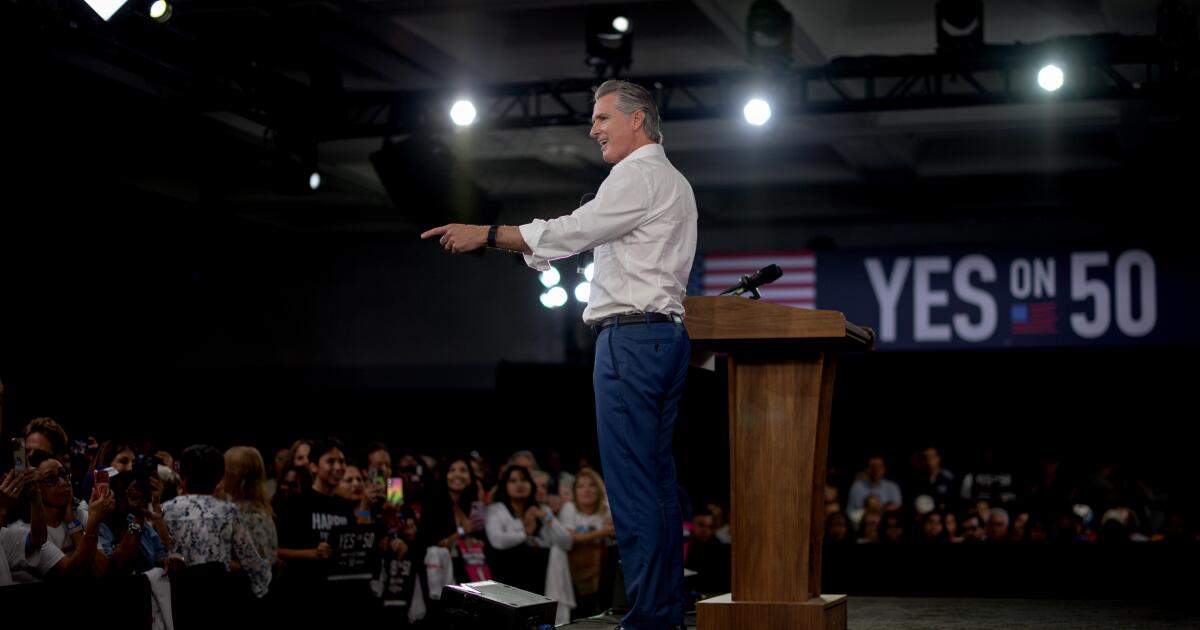
An overwhelming majority of California voters approved Prop. 50 on Nov. 4 after Gov. Gavin Newsom pitched the redistricting plan as a way to counter partisan gerrymandering in Texas and other GOP-led states. Democrats admitted the new map would weaken Republicans’ voting power in California, but argued it would just be a temporary measure to try to restore national political balance.
Attorneys for the GOP cannot challenge the new redistricting map on the grounds that it disenfranchises swaths of California Republicans. In 2019, the U.S. Supreme Court decided that complaints of partisan gerrymandering have no path in federal court.
But the GOP can bring claims of racial discrimination. They argue California legislators drew the new congressional maps based on race, in violation of the Equal Protection Clause of the 14th Amendment and the 15th Amendment, which prohibits governments from denying citizens the right to vote based on race or color.
On Monday, attorneys for the GOP began by homing in on the new map’s Congressional District 13, which currently encompasses Merced, Stanislaus, and parts of San Joaquin and Fresno counties, along with parts of Stockton.
When Mitchell drew up the map, they argued, he over-represented Latino voters as a “predominant consideration” over political leanings.
They called to the stand RealClearPolitics elections analyst Sean Trende, who said he observed an “appendage” in the new District 13, which extended partially into the San Joaquin Valley and put a crack in the new rendition of District 9.
“From my experience [appendages] are usually indicative of racial gerrymandering,” Trende said. “When the choice came between politics and race, it was race that won out.”
Republicans face an uphill struggle in blocking the new map before the 2026 midterms. The hearing comes just a few weeks after the U.S. Supreme Court allowed Texas to temporarily keep its new congressional map — a move that Newsom’s office says bodes poorly for Republicans trying to block California’s map.
“In letting Texas use its gerrymandered maps, the Supreme Court noted that California’s maps, like Texas’s, were drawn for lawful reasons,” Brandon Richards, a spokesperson for Newsom, said in a statement. “That should be the beginning and the end of this Republican effort to silence the voters of California.”
In Texas, GOP leaders drew up new congressional district lines after President Trump openly pressed them to give Republicans five more seats in the U.S. House of Representatives. A federal court blocked the map, finding racial considerations likely made the Texas map unconstitutional. But a few days later the Supreme Court granted Texas’ request to pause that ruling, signaling they view the Texas case, and this one in California, as part of a national politically-motivated redistricting battle.
“The impetus for the adoption of the Texas map (like the map subsequently adopted in California),” Justice Samuel A. Alito Jr. argued, “was partisan advantage pure and simple.”
The fact that the Supreme Court order and Alito’s concurrence in the Texas case went out of their way to mention California is not a good sign for California Republicans, said Richard L. Hasen, professor of law and director of the Safeguarding Democracy Project at UCLA School of Law.
“It’s hard to prove racial predominance in drawing a map — that race predominated over partisanship or other traditional districting principles,” Hasen said. “Trying to get a preliminary injunction, there’s a higher burden now, because it would be changing things closer to the election, and the Supreme Court signaled in that Texas ruling that courts should be wary of making changes.”
Many legal scholars argue that the Supreme Court’s ruling on the Texas case means California will likely keep its new map.
“It was really hard before the Texas case to make a racial gerrymandering claim like the plaintiffs were stating, and it’s only gotten harder in the last two weeks,” said Justin Levitt, a professor of law at Loyola Marymount University.
Hours after Californians voted in favor of Prop. 50 on Nov. 4, Assemblymember David J. Tangipa (R-Fresno) and the California Republican Party filed a lawsuit alleging that the map enacted in Prop. 50 for California’s congressional districts is designed to favor Latino voters over others.
The Department of Justice also filed a complaint in the case, arguing the new congressional map uses race as a proxy for politics and manipulated district lines “in the name of bolstering the voting power of Hispanic Californians because of their race.”
Mitchell, the redistricting expert who drew up the maps, is likely to be a key figure in this week’s battle. In the days leading up to the hearing, attorneys sparred over whether Mitchell would testify and whether he should turn over his email correspondence with legislators. Mitchell’s attorneys argued he had legislative privilege.
Attorneys for the GOP have seized on public comments made by Mitchell that the “number one thing” he started thinking about” was “drawing a replacement Latino majority/minority district in the middle of Los Angeles” and the “first thing” he and his team did was “reverse” the California Citizens Redistricting Commission’s earlier decision to eliminate a Latino district from L.A.
Some legal experts, however, say that is not, in itself, a problem.
“What [Mitchell] said was, essentially, ‘I paid attention to race,’” Levitt said. “But there’s nothing under existing law that’s wrong with that. The problem comes when you pay too much attention to race at the exclusion of all of the other redistricting factors.”
Other legal experts argue that what matters is not the intent of Mitchell or California legislators, but the California voters who passed Prop. 50.
“Regardless of what Paul Mitchell or legislative leaders thought, they were just making a proposal to the voters,” said Hasen, who filed an amicus brief in support of the state. “So it’s really the voters’ intent that matters. And if you look at what was actually presented to the voters in the ballot pamphlet, there was virtually nothing about race there.”