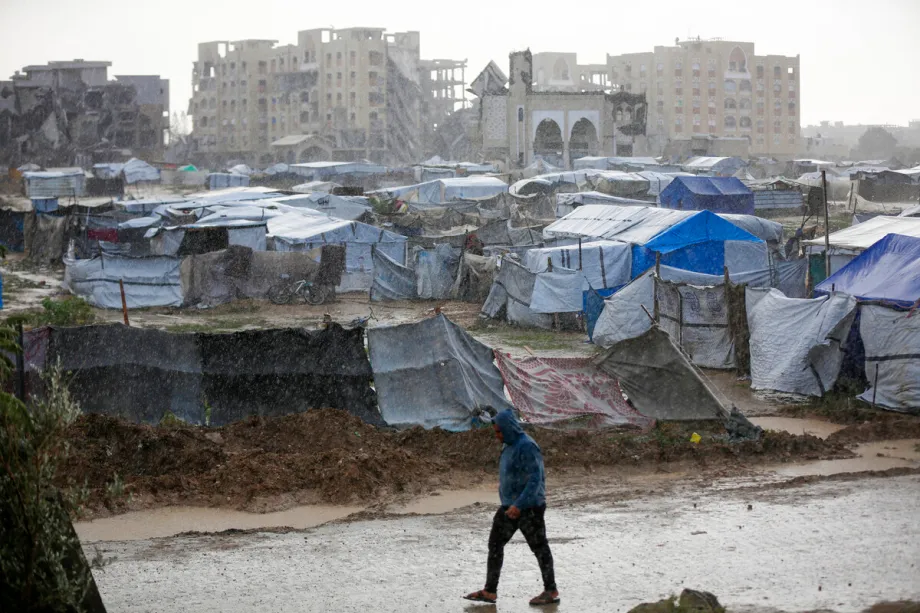
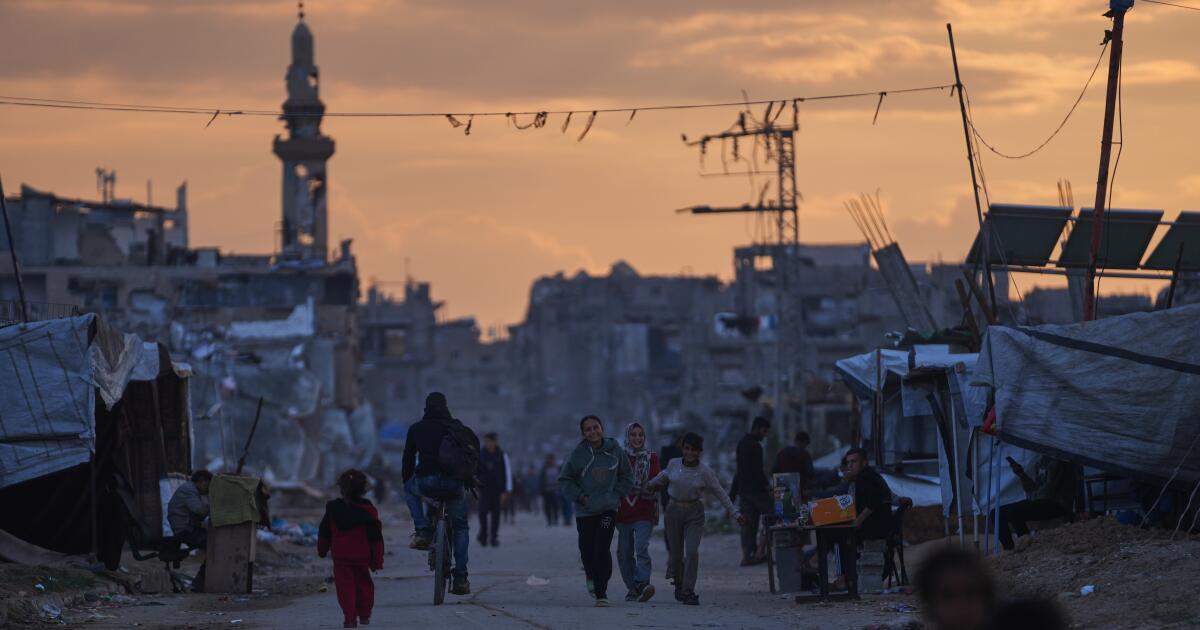
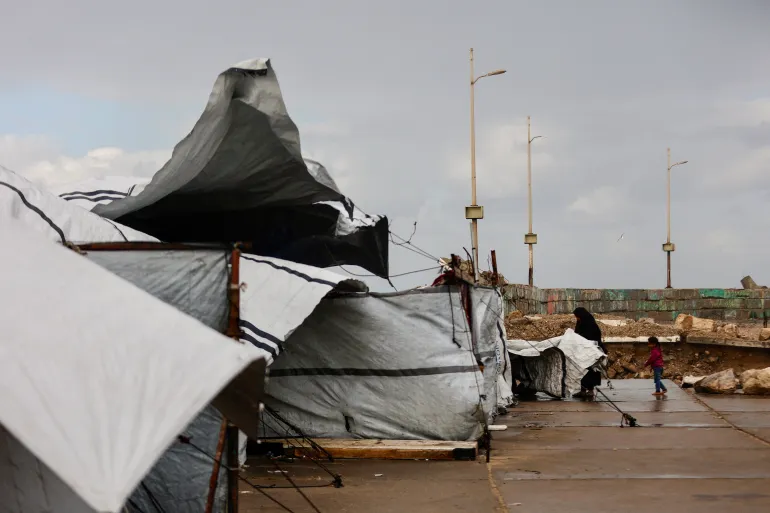
Civil defence crews in Gaza are racing to rescue people trapped under war-damaged buildings that have collapsed from heavy rain and strong winds during a severe winter storm.
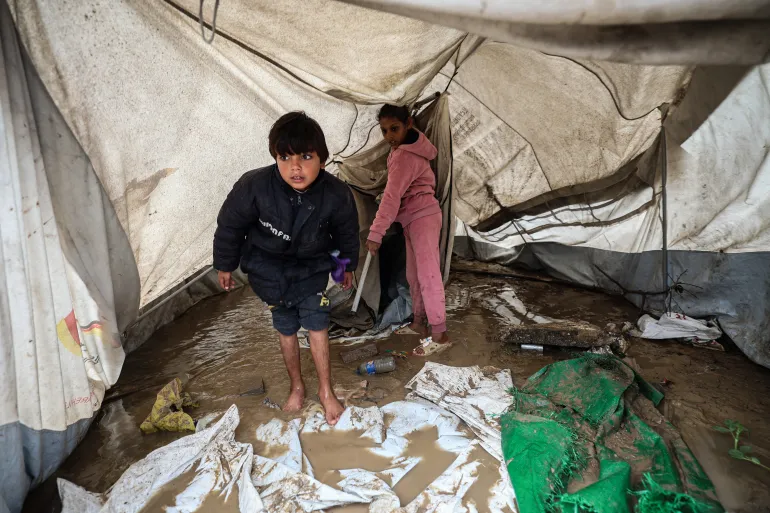
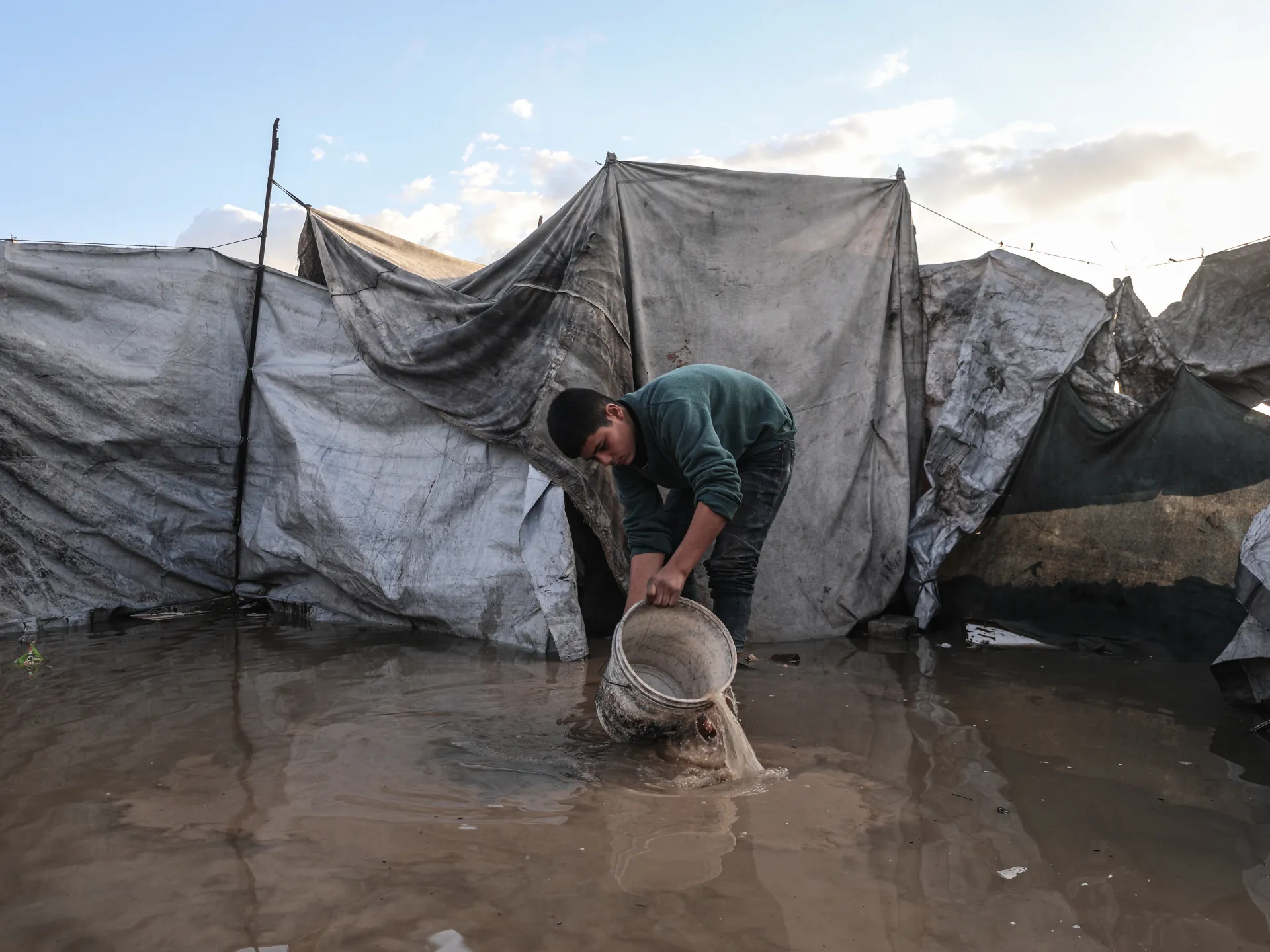
Winter came to Gaza last month with a violent storm. I woke up at night to a disaster. Our tent was flooded with water which had transformed our “floor” into a shallow pool. The mattresses and pillows were completely soaked, cooking pots were submerged, the clothes were drenched, and even our bags— which function as our “closets”—were filled with water. Nothing inside remained dry.
As I tried to understand what was happening, I suddenly heard children crying at the entrance of our tent. I opened it quickly and found three children from the neighbouring tents, their lips blue from the cold, with their mother trembling behind them saying, “We are completely soaked… the rain leaked inside and the water reached everywhere.”
The same tragic scene was repeated all around us: women, children, and elderly people sitting in the street under the rain, their bedding drenched and their belongings scattered, while confusion and cries filled the air.
All 1.4 million displaced Palestinians who lack proper shelter suffered that day—people with no protection against the weather or its sudden storms.
For us, it took two full days for our belongings to dry because the sun barely appeared; everything stayed cold and damp. We didn’t move to another place—we stayed where we were, trying to salvage whatever we could, because there was simply nowhere else to go.
Only a week later, an even stronger winter storm arrived with severe rainfall. Tents were flooded again; little children froze in the rain again.
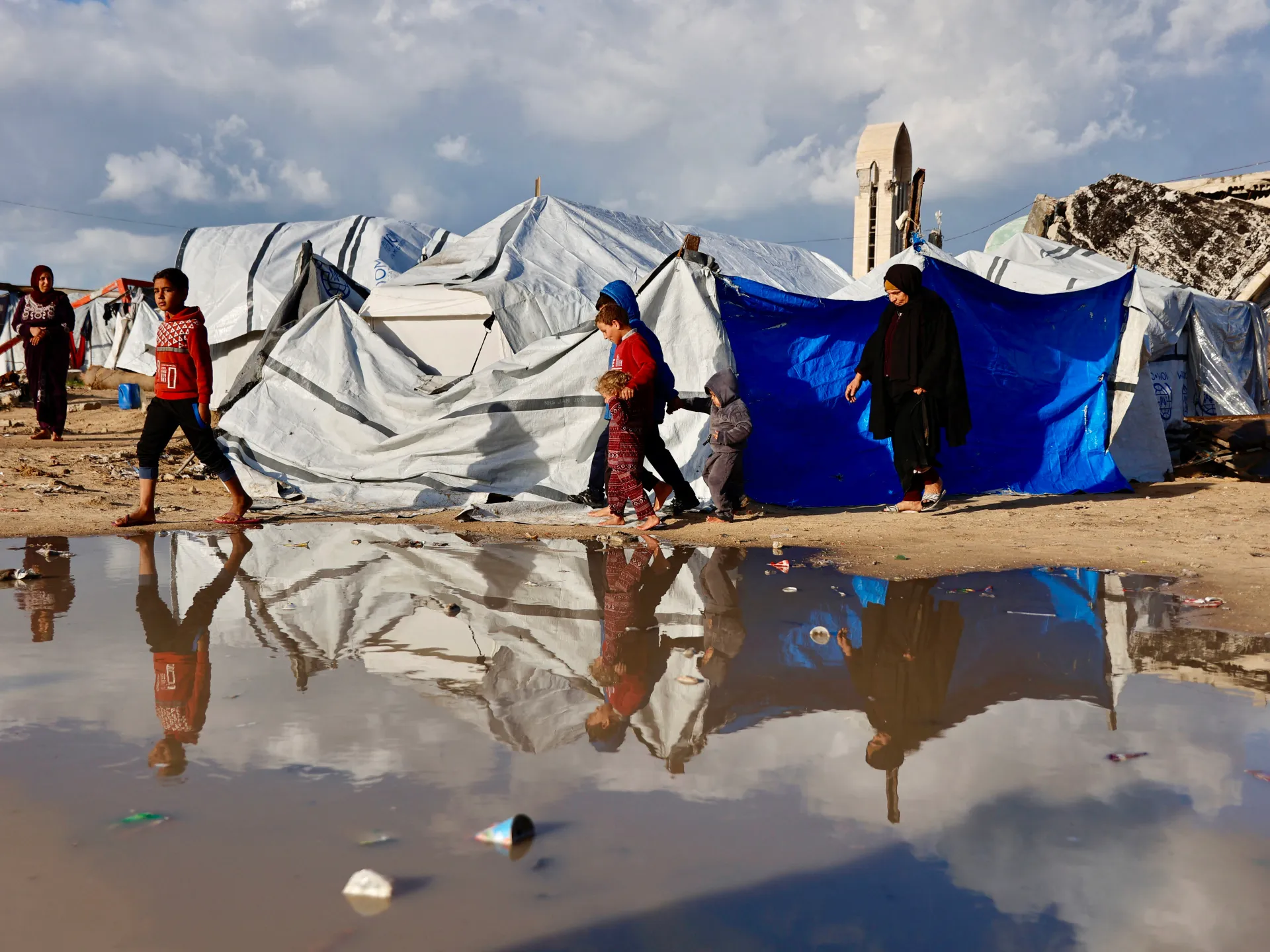
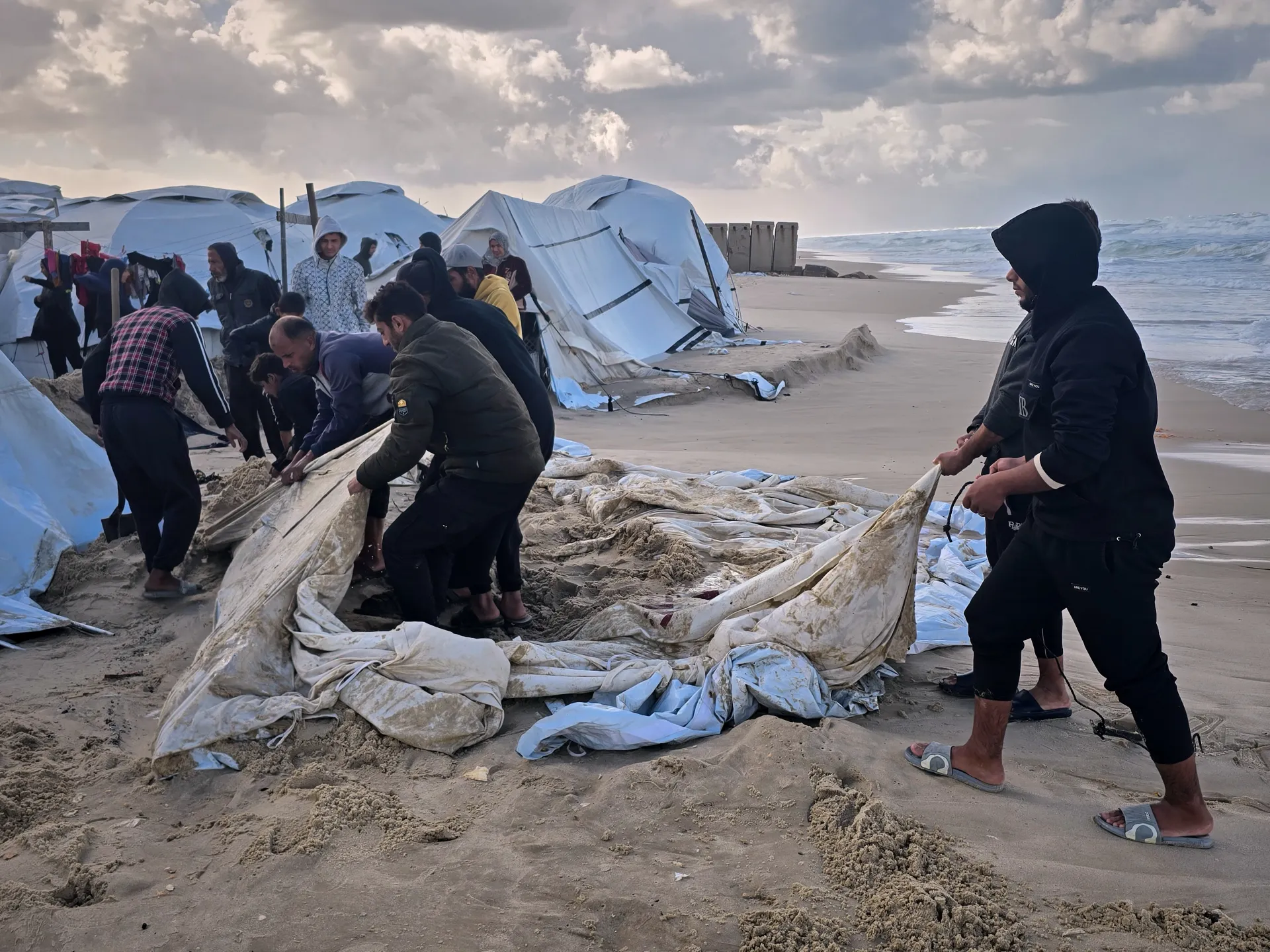
This week, when Storm Byron hit, we were flooded once again. Despite all our efforts to reinforce the tents, secure them tightly, and bring in stronger tarps, nothing worked. The winds were fiercer, the rain heavier, and the water pushed its way inside from every direction. The ground no longer absorbed anything. The water began rising rapidly beneath our feet, turning the entire area into a swamp.
According to the authorities, the strong winds destroyed at least 27,000 tents. These are 27,000 families who already struggled and now have nothing, no shelter, nowhere to hide from the rain and cold.
The rain also brought down damaged homes where people had been sheltering. Every time there is a storm or strong wind, we hear the sound of falling debris and concrete pillars from badly damaged buildings near us. This time, the situation was so bad that 11 people were killed by collapsed buildings.
It is clear that after everything we have endured, we – like other displaced Palestinians – cannot survive a third winter in these harsh conditions. We survived two winters in displacement, living in tents that protected neither from cold nor rain, waiting with exhausted patience for a ceasefire that would end our suffering. The ceasefire finally came, but relief did not. We remain in the same place, with bodies drained by malnutrition and illness, under tents worn out by the sun and wind.
We are a family of seven living in a tent that is four by four metres (13 feet by 13 feet). Among us are two children aged five and 10 and our grandmother, aged 80. We, the adults, can push through the cold and hardship. But how can the elderly and children bear what we live every day?
We sleep on mattresses pressed directly against the ground, with cold seeping in from below and above, with only two blankets that can’t shield us from the freezing nights. Everyone in the tent has two blankets each, barely enough to offer temporary warmth. There is no source of heating—no electricity, no heater—just tired bodies trying to share whatever warmth remains.
My grandmother cannot tolerate the cold at all. I watch her shiver through the night, her hand on her chest as if trying to hold herself together. All we can do is pile every blanket we have on top of her and watch anxiously until she is able to fall asleep.
Many people in Gaza live in conditions far worse than ours.
Most families who just want a modest tent over their heads cannot afford one. The price of tents can go as high as $1,000; the rent one has to pay to pitch a tent on a piece of land can be as much as $500. Those who cannot pay live in the street in makeshift shelters.
Salah al-Din Street, for example, is crowded with them. Most are simply blankets hung and wrapped around small spaces for minimal privacy, offering no protection from rain or cold. With any strong gust of wind, they burst open.
There are also children living directly in the streets, sleeping on the cold ground. Many have lost their mothers or fathers during the war. When you pass by, you see them—sometimes silent, sometimes crying, sometimes searching for something to eat.
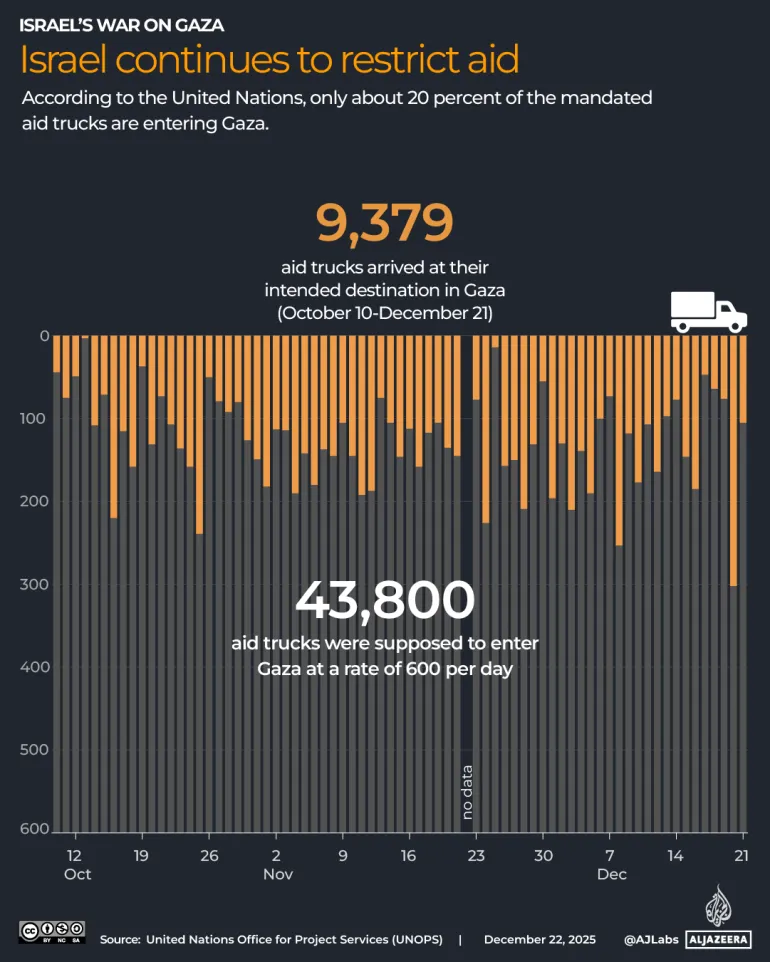
Despite repeated promises of aid and reconstruction, the trickle of supplies that entered Gaza has made almost no difference on the ground. Earlier this month, the United Nations announced it had managed to distribute only 300 tents during November; 230,000 families received a single food parcel each.
We did not receive any food parcel—there are simply too many people in need, and the quantities are far too small for everyone to access. Even if we had received one, its contents wouldn’t have lasted us longer than a week or two.
Food prices continue to be high. Nutritious items like meat and eggs are either unavailable or cost too much. Most families have not eaten a proper protein meal in months.
There is no mass campaign to remove rubble or level the ground so people can pitch their tents due to an equipment shortage. No steps have been taken to provide permanent housing for families.
All of this means we now face a terrifying possibility: that life in a tent—one that can be flooded or ripped apart by the wind at any moment—may become our long-term reality. This is an unbearable thought.
During the bombardment, we lived with the constant fear of death, and perhaps the intensity of the war overshadowed everything else—the cold, the rain, the tents shaking above our heads. But now, after the mass bombing has stopped, we are facing the full ugliness of Gaza’s “new normal”.
I fear this winter will be much worse for Gaza. With no heating, no real shelter, and the weather getting worse each day, we are likely to see many deaths among the children, the elderly and the chronically ill. Already, the first deaths from hypothermia were reported – babies Rahaf Abu Jazar and Taim al-Khawaja and nine-year-old Hadeel al-Masri. If the world is really committed to ending the genocide in Gaza, it needs to take real, urgent action and ensure that we have at least the basic conditions for survival: food, housing and medical care.
The views expressed in this article are the author’s own and do not necessarily reflect Al Jazeera’s editorial stance.
From the cleanup efforts in Sri Lanka in the wake of Cyclone Ditwah’s destruction to the devastating Myanmar military air attack on a hospital that killed 30 people, here is a look at the week in photos.
Dublin, Ireland – When I was accepted to Trinity College Dublin, I imagined a fresh start, new lectures, late-night study sessions and a campus alive with possibility.
The plan was clear: begin my studies in September 2024 and finally step into the future I had worked so hard for.
Recommended Stories
list of 3 itemsend of list
But when September came, the borders of Gaza were shut tight, my neighbourhood was being bombed almost every day, and the dream of university collapsed with the buildings around me. Trinity sent me a deferral letter, and I remember holding it in my hands and feeling torn in two.
I didn’t know whether to feel relieved or heartbroken. That letter became a strange symbol of hope, a reminder that maybe, someday, my life could continue. But everything else was falling apart so quickly that it was hard to believe in anything.
My family and I were displaced five times as the war intensified. Each time, we left something behind: books, clothes, memories, safety.
After the first temporary truce, we went home for a short time. But it no longer felt like the place we had built our lives. The walls were cracked, windows shattered, and floors coated in dust and debris.
It felt haunted by what had happened.
I knew I had to go
I’m the middle child among three siblings. My older sister, Razan, is 25, and my younger brother, Fadel, is 23.
You might think being a middle child spares you, but during the war, I felt responsible for them. On nights when bombings shook the building and fear crept into every corner, I tried to be the steady one. I tried to comfort them as I trembled inside.
Then, in April 2025, my name appeared on a small, restricted list of people allowed to leave Gaza. About 130 people could cross at that time, dual-nationality holders, family reunification cases and a handful of others. My name on that list felt unreal.
The morning I approached the crossing, I remember the long, tense line of people waiting, gripping documents, holding bags, clutching their children’s hands. No one talked.
When two IDF officers questioned me, I answered as steadily as I could, afraid that something, anything, might go wrong and they’d send me back.
When they finally waved me through, I felt relief and guilt at the same time.
I didn’t call home until I got to Jordan. When my mother heard my voice, she cried. I did, too. I told her I was safe, but it felt like I had left a part of my heart behind with them.
Alagha had to leave her mobile phone behind in Gaza; this is one of the few photos she still has, of her mother embracing her on her graduation day in Gaza [Courtesy of Rawand Alagha]
My family is now in Khan Younis, still living through the chaos.
I arrived in Amman on April 18, my heart heavy with the weight of what I had escaped. The next morning, I boarded a flight to Istanbul, with nothing around me feeling real.
The sounds of normalcy, laughter, announcements, and the rustle of bags were jarring after the constant bombardment. I had been living in a world where every sound could signal danger, where the air was thick with fear and uncertainty.
I felt like a ghost, wandering through a world that no longer belonged to me.
Finally, after hours of flying, waiting, being screened and watching departure boards, I landed in Dublin. The Irish air felt clean, the sky impossibly open. I should’ve been happy, but I was engulfed by crushing guilt, the joy overshadowed by the pain of separation.
I wasn’t completely alone. A Palestinian colleague from Gaza had arrived in April 2024, and two friends were also in Ireland. There was an unspoken understanding between us.
“You recognise the trauma in each other without saying a word,” I often tell people now. “It’s in the way we listen, the way we sit, the way we carry ourselves.”
Back in Gaza, my daily life had shrunk to pure survival: running, hiding, rationing water, checking who was alive. Bombings hit every day, and nighttime was the worst. Darkness makes every sound feel closer, sharper.
You don’t sleep during war. You wait.
Those nights, the silence was deafening, punctuated by the distant echoes of explosions. I would lie awake, straining to hear danger.
The darkness wrapped me like a suffocating blanket, amplifying every creak of the building, every whisper of the wind.
During the day, people on the street moved quickly, eyes darting, alert.
Water was a precious commodity; we would line up for hours at distribution points, often only to receive a fraction of what we needed. It was never enough.
No human should live like that
Five times, we fled in search of safety, packed in minutes, hearts racing with fear.
In one building where dozens of displaced families stayed, people slept on thin mattresses, shoulder to shoulder. Children cried quietly, adults whispered, trying to comfort one another, but every explosion outside sent ripples of panic through the rooms.
No human being should have to live like that, but millions of us did.
As I sit in Dublin, I carry the weight of my family’s struggles with me, a constant reminder of the life I left behind.
The guilt of survival is a heavy burden, but I hold onto hope that one day, I can return and help rebuild what has been lost.
Even now, far from Gaza, I feel it. You don’t leave war behind; you carry it with you like a second heartbeat.
A workshop at the University of Dublin welcoming the Palestinian students [Courtesy of Rawand Alagha]
Watching a world I’m not part of yet
I often stop in the campus courtyards. Not just because they’re beautiful, though they are, but because I need those moments to remind myself that I survived.
The laughter of children here feels foreign, a reminder of joy that has been stolen from so many.
Walking through Trinity College today feels surreal. Students laugh over coffee, rush to lectures and complain about assignments. Life moves so seamlessly here.
I message my family every day. Some days, they reply quickly. Other days, hours pass with no response. Those silent days feel like torture.
But I’m determined. Being here is about rebuilding a life, about honouring the people I left behind.
Survival comes with weight.
I carry the dreams of those who couldn’t leave. That responsibility shapes the way I move through the world; quieter, more grateful, more aware.
I hope someday I can bring my family to safety. I hope to finish my studies, rebuild my life and use my voice for people still trapped in war.
I want people to know what it takes to stand in that line at the border, to leave everything behind, to walk into a future alone.
The army claims the member was working to re-establish Hamas’s capabilities in the Strip.
Published On 13 Dec 202513 Dec 2025
Share
The Israeli military has said it struck a “key” Hamas member in the area of Gaza City, without elaborating on who they may be.
In a post on Telegram, the army alleged that the member had been operating to re-establish Hamas’s capabilities, which have been severely depleted by more than two years of Israel’s genocidal war on Gaza.
Recommended Stories
list of 3 itemsend of list
There was no immediate comment from the Palestinian group.
The Wafa news agency reported that an Israeli drone hit a vehicle at the Nabulsi junction in the west of Gaza City, resulting in casualties.
The agency did not report on specific numbers, and it was not clear if the attack was the one that allegedly killed the Hamas member.
Since the ceasefire started in October, Israel has continued to attack Gaza daily – reaching nearly 800 times – in a clear breach of the agreement, according to authorities in Gaza.
Israel also continues to block the majority of aid trucks from entering the enclave. The United Nations General Assembly on Friday overwhelmingly backed a resolution demanding that Israel open unrestricted humanitarian access to the Gaza Strip, stop attacking UN facilities, and comply with international law, in line with its obligations as an occupying power.
Last month, I was waiting for a shared taxi at the Nuseirat roundabout when I witnessed a heartbreaking scene. As I stood by the side of the road, I felt a small hand tugging at my clothes.
I looked down and saw a little girl, no older than eight. She was barefoot, her shirt was torn, and her hair was messy and unwashed. Her eyes were beautiful, and her face showed innocence, yet exhaustion and despair clouded it.
She pleaded: “Please, please, give me just one shekel, God bless you.”
Before I gave her the money, I decided to speak with her. I knelt down and asked, “What is your name, my dear?”
She replied in a frightened voice, “My name is Nour, and I am from the north.” Her name, which means “light” in Arabic, stood in stark contrast to the darkness surrounding her.
I asked her, “Why are you asking for money, Nour?”
She looked at me hesitantly, then whispered, “I want to buy an apple… I crave one.”
In Gaza, a single apple now costs $7; before the war, a kilogramme of apples was less than a dollar.
I tried to ignore the pain rising in my chest. I thought about the circumstances we now face, where young children are forced to beg in the street just to buy an apple.
I gave Nour one shekel ($0.30), but as soon as I did, the situation worsened. A large group of children, all Nour’s age or younger, gathered around me, repeating the same request. I felt immense distress.
For more than two years, we have faced genocide. We have witnessed countless tragedies and horrors. But for me, the sight of children begging in the streets is particularly unbearable.
Before the war, Gaza was still a poor place. We used to see child beggars, but they were few, mostly roaming in a few areas. Now, they are everywhere, from the north to the south.
The genocidal war has destroyed families and livelihoods across Gaza. The carnage has orphaned more than 39,000 children, and the enormous destruction has deprived more than 80 percent of the workforce of their jobs, driving countless children into extreme poverty and forcing them to beg for survival.
But child begging is not just a result of poverty; it is a sign of a deep disintegration affecting the family, the education system, and the community. No parent sends their child to beg because they want to. The war has left many families in Gaza without options, and in many cases, there are no surviving parents to keep the children away from the streets.
Child beggars do not just lose their childhood; they also face exploitation, harsh labour, illiteracy and psychological trauma that leaves a lasting effect.
The more begging children increase in number, the more the hope for this generation diminishes. Houses can be rebuilt, infrastructure can be restored, but a young generation that is deprived of education and hope for the future cannot be rehabilitated.
The strength Gaza possessed before the war was not just about military power; it was about human power, the main pillar of which was education. We had one of the highest levels of literacy in the world. The enrolment rate for primary education stood at 95 percent; for higher education, it reached 44 percent.
Education stood as a counterforce to the debilitating siege that dispossessed the people of Gaza and crippled the economy. It nourished skills and ingenuity within the young generations to help them cope with an increasingly harsh economic reality. More importantly, education gave children a sense of direction, security and pride.
The systematic attack on Gaza’s education system – the destruction of schools, universities, libraries and the killing of teachers and professors – has pushed what used to be a remarkably resilient and effective educational system to the brink. The pillar that protected children and guaranteed them a clear future is now falling apart.
After I left the Nuseirat roundabout, Nour’s eyes stayed with me. It was not just because of the pain of seeing an innocent child being forced to beg. It was also because of the realisation that this encounter brought about: That the capacity of the next generation to rebuild Gaza one day is being taken away.
The world allowed Israel to carry out genocide in Gaza for two years. It knew what was going on, and yet it chose complicity and silence. Today, it cannot erase its guilt, but it can choose to redeem itself. It can take all necessary action to save the children of Gaza and to grant them the rights they are inherently given by the Convention on the Rights of Children: The right to food, water, healthcare, a safe environment, education, and protection from violence and abuse.
Anything short of that would mean continuing support for the slow genocide of Gaza.
The views expressed in this article are the author’s own and do not necessarily reflect Al Jazeera’s editorial stance.
VR headsets are offering injured, traumatised Palestinian children some respite from hardship in war-torn Gaza.
Published On 13 Dec 202513 Dec 2025
Share
Inside a makeshift tent in the heart of the besieged Gaza Strip, Israel’s genocidal war, which has destroyed neighbourhoods, schools and hospitals, decimated families and shattered lives for more than two years, no longer exists.
Virtual reality technology is taking Palestinian children struggling with physical and psychological wounds to a world away, where they can feel safe again.
Recommended Stories
list of 3 itemsend of list
“After I was injured in the head, I try to forget the pain,” Salah Abu Rukba, a Palestinian child taking part in the sessions, told Al Jazeera at the VR Tent in az-Zawayda, central Gaza.
“When I put on the headset, I forget the injury. I feel comfort as I forget the destruction, the war, and even the sound of the drones disappears.”
Salah Abu Rukba sustained an injury to his head during Israel’s genocidal war on Gaza [Screen grab/ Al Jazeera]
Lama Abu Dalal, communication officer at Gaza MedTech – the technology initiative spearheading the project – said Abu Rukba and the others have constant reminders of the war etched in their bodies.
But the VR headset makes them forget their life-changing wounds and simply be children again, if only for a few moments.
Gaza MedTech was launched by Palestinian innovator Mosab Ali, who used VR to comfort his injured son. Ali was later killed in an Israeli attack.
Studies have confirmed that VR can have beneficial effects in the treatment of mental disorders, including post-traumatic stress disorder (PTSD). Offering this service in Gaza is hard to sustain, as spare parts of the equipment are barred from entry into Gaza by Israel’s ongoing punishing blockade.
Gaza MedTech was launched by Palestinian innovator Mosab Ali, who used VR to comfort his injured son [Screen grab/Al Jazeera]
Since a ceasefire formally went into effect on October 10, Israel has allowed slightly more aid in, although far less than Gaza’s needs and what the agreement clearly stipulated. Israel continues to restrict the free flow of humanitarian aid and medical supplies.
Authorities in Gaza say the truce has been violated by Israel at least 738 times since taking effect.
The United Nations estimates that more than 90 percent of children in Gaza are showing signs of severe stress driven by the loss of safety and stability, and will require long-term support to heal from the psychological effect of the conflict.
Multiple UN bodies, including the World Health Organization (WHO), the UN humanitarian office OCHA, and independent UN experts, have called for immediate and unimpeded access to Gaza for essential medical equipment and psychological support.
Dili, East Timor – On the 50th anniversary of Indonesia’s invasion of East Timor, longtime independence advocate and now the country’s President Jose Ramos-Horta reflected on the last half-century of politics and diplomacy in his country.
Ramos-Horta was serving as the foreign minister of the newly declared Democratic Republic of East Timor in the days leading up to Indonesia’s invasion in December 1975.
Recommended Stories
list of 4 itemsend of list
Formed by the independence party Fretilin after colonial Portugal’s withdrawal from the country, the new government in East Timor’s capital Dili was under pressure from Indonesia and its threat of invasion.
As the danger intensified, Ramos-Horta flew to the United Nations in New York to plead for international recognition and protection for East Timor’s fragile independence. Despite unanimous support at the UN for Timorese self-determination, Indonesian troops launched their invasion on December 7, 1975.
Ramos-Horta’s colleagues, including Prime Minister Nicolau Lobato and other Fretilin leaders, either went into hiding or were killed in the ensuing attack. Unable to return home, Ramos-Horta became East Timor’s voice in exile for the next 24 years.
During his exile, Ramos-Horta lobbied governments, human rights organisations, and the UN to condemn Indonesia’s occupation, which resulted in the deaths of an estimated 200,000 Timorese through conflict, famine, and repression.
Silenced by a military-imposed media blackout for much of the 1980s, it was only in the 1990s that reports of Indonesian atrocities – including the 1991 Santa Cruz massacre – began to filter out and East Timor’s struggle for independence gained international attention.
Ramos-Horta’s tireless advocacy earned him a Nobel Peace Prize, along with Bishop Carlos Belo, in 1996.
A UN-sponsored referendum delivered an overwhelming vote for independence in 1999, leading to a fully independent East Timor in 2002. However, the country continues to face economic challenges and remains one of Southeast Asia’s poorest nations.
In the years overseeing his country’s transition from conflict to reconciliation, Ramos-Horta has held the roles of foreign minister, prime minister and now president.
Al Jazeera’s Ali MC sat down with Ramos-Horta on a recent trip to East Timor, where the president spoke about his country’s long road to peace and hopes for it to prosper from membership of the Association of Southeast Asian Nations (ASEAN), increased trade with China, and development of the offshore Greater Sunrise gas field.
Al Jazeera: Reflecting on your role as an ambassador for East Timor after Indonesia’s 1975 invasion, what were some of the key challenges that you faced while advocating for your country on the international stage?
Ramos-Horta: First, we were in the midst of the Cold War with that catastrophic US engagement in the wars against North Vietnam, Cambodia and Laos.
Then, you can say – the US defeat, if not military defeat, it was a total political defeat at the hands of the Vietnamese. So, it was in the midst of all of this that Indonesia invaded Timor-Leste [the official Portuguese-language name for East Timor], on December 7, 1975. The day before, US President Gerald Ford and Secretary of State Kissinger were in Jakarta, and they officially gave the green light to President Soeharto to invade – immorally – with the use of American weapons.
So, it was within this context that it was very challenging for us to mobilise sympathy, support and the media. The invasion merited only one small, short column in The New York Times.
In Australia, there was more coverage. But the coverage didn’t last long, because Indonesia did a very good job, with Australian complicity, in blocking any news out of East Timor. At that time, not a single journalist came – the first foreign journalist to come here was in 1987.
The absence of [proof of] death is the worst enemy of any struggle. There were terrible massacres on the day of the invasion, hundreds of people shot and dumped into the sea, including an Australian, Roger East [a journalist killed by Indonesian forces on the day of the invasion].
Many, many countless people shot on the spot. Many were alive and dragged to the port of Dili, shot and fell into the sea. Many more killed randomly around town. And zero media coverage, not a single camera.
East Timorese President Jose Ramos-Horta addresses the 78th Session of the UN General Assembly in New York City, US, in 2023 [File: Brendan McDermid/Reuters]
AJ: How did that lack of media coverage make it difficult for you, as an ambassador overseas, to describe to the international community exactly what was happening in East Timor?
Ramos-Horta: Terribly difficult.
To mobilise people who are potentially sympathetic, you can do so effectively if you have a backup for what you say, what you allege, what you report. This must be backed up with visuals.
But people were sympathetic and listened to me. I was persuasive enough for them to believe what might be going on.
AJ: Given your own personal experience in the struggle for independence in East Timor, does that influence the way that you advocate? Does that bring a more personal response to your diplomacy?
Ramos-Horta: My personal instinct as a person is not shaped by anyone, by any school, any religion. It is me, always, against injustice and abuse.
Then came our experience and the fight for independence. When we fought for independence and for freedom, I went around the world begging for support, begging for sympathy. Then, we became independent.
Well, how can I not show sympathy in a real way towards the Palestinians? Why would I not show sympathy in a real way towards the people of Myanmar? Just showing sympathy, because we cannot do much more.
What can we do? We are not even a mid-sized country. But speaking out – a voice – is very important.
AJ: What are your reflections on what has occurred in Gaza?
Ramos-Horta: It is one of the most abominable humanitarian catastrophes in modern times, in the 21st century, next to the killing fields in Cambodia during Pol Pot’s regime.
The amount of bombs dropped on Gaza is more than the combined amount of the bombs dropped on London and Dresden during World War II, and more than the bombs dropped on Cambodia by the Americans during the Vietnam War.
The suffering inflicted on civilians, women and children is just unbelievable.
How we, human beings in this 21st century, can descend so low and how Israel, a country that I always admired, first out of sympathy for what Jewish people went through, through their lives, through their history – always persecuted, always having to flee, and then culminating in the horrendous Holocaust. When you survive a Holocaust experience, like the Jews, I would think that you are a person that is the most sympathetic to anyone yearning for freedom, for peace, for dignity. Because you understand.
They [Israelis] are doing the opposite.
And you have to understand, also, the people who are on the other side. You know the Palestinians, who had 70 years of occupation and brutality, they are not going to show any sympathy to the Jews or Israelis. So, this whole situation has generated hatred and polarisation as never before.
Palestinian President Mahmoud Abbas, right, meets East Timor’s President Jose Ramos Horta in the occupied West Bank city of Ramallah in 2011 [File: Mohamad Torokman/Reuters]
AJ: What can the international community learn from the experience of East Timor and people such as yourself?
Ramos-Horta: I am thoroughly disillusioned with the so-called international community, particularly the West, that enjoy entertaining themselves lecturing Third World countries on democracy, human rights, transparency, anticorruption, etc, etc.
They could never find the case to help poorer countries getting out of extreme poverty. But they found billions of dollars for the last three years to pump into the war in Ukraine.
I don’t condemn that. It is white people supporting white people being attacked. But then they are silent on Israel as it bulldozes the whole of Palestine; carpet bombing, killing tens of thousands of civilians.
And yet, with incredible, nauseating hypocrisy, when they are asked to comment on this, they say Israel has the right to defend itself!
Defend itself against children, against women, against students, against academics, against universities, that they bulldoze completely. Defend themselves against doctors and nurses in hospitals that they bulldoze.
And in an incredible contortion, you have the secretary-general of NATO say Iran presents a threat to the whole world. I know the whole world, literally, and I don’t know of anyone in the whole world that I know that considers Iran a threat to them.
I feel nauseated with such dishonesty, such inhumanity. So, I’m thoroughly disappointed. And I was always an admirer of the West.
AJ: Reflecting on many decades in politics in East Timor, is there anything that stands out to you as a personal success or something that you feel most proud about?
Ramos-Horta: I feel proud that we have been able to keep the country at peace. We have zero political violence. We have zero ethnic-based or religious-based tensions or violence. We don’t have even organised crime. We have never had a bank robbery or armed robbery in someone’s home. We don’t have that. And we are ranked among having the freest media in the world and the freest democracy in the world. I’m proud of my contribution in that.
A Pride Parade from East Timor’s capital, Dili, to the famed Cristo Rei statue of Christ, which was built by the Indonesians during the occupation. While East Timor has a large Catholic population, LGBT rights have become more accepted, with even President Ramos-Horta expressing support [Ali MC/Al Jazeera]
AJ: East Timor is set to join the Association of Southeast Asian Nations (ASEAN). What will be the benefits of being a part of that?
Ramos-Horta: We’ll be part of a community of 700 million people, a community whose combined GDP is at least $4 trillion.
And that means the possibility of Timor-Leste benefitting from our neighbours is greater. There will be more free movement of capital. There’ll be more people attracted to visit Timor-Leste and more embassies opening.
These are the benefits of being associated with an organisation like ASEAN. There are concrete, material benefits besides the importance of the strategic alliance, the strategic partnership, with our neighbours.
AJ: China is really emerging in the Southeast Asia and Pacific regions. Are there any tensions over East Timor’s relationship with China?
Ramos-Horta: We don’t view China as an enemy of anyone, unlike some in America.
The US is not able to digest the fact that China today is a global superpower, that China today is a major global financial and economic power. That it is no longer the US that rules this unipolar world, that it has a competitor.
But the Chinese are very modest, and they say they are not competing to be number one with the US.
Any rational, intelligent person who is informed about China – even if a leader emerged in China that would view Australia and the US with hostility – would, in his right mind, think that you can overpower the US economically and militarily.
AJ: What is the projected benefit economically for East Timor from the Greater Sunrise Gas Field?
Ramos-Horta: The existing studies point to it taking seven years for the whole project to be completed and deliver gas and revenue to Timor-Leste.
But long before that, the day we sign the agreement, within the following few months, two years, a lot of investments already start to happen. Because we have to build all the infrastructure on the south coast that will run into the tens of millions of dollars, hundreds of millions of dollars.
The pipeline will take its time to reach Timor, but the pipeline will be served by all the infrastructure built on the south coast, plus housing. Hundreds, maybe thousands of houses for workers, for people and so on. Then improvement in the agriculture sector. Farmers in the community benefitting because they will sell produce to the company, to the workers and so on.
Despite more than two decades of independence, East Timor remains one of the poorest countries in the region [Ali MC/Al Jazeera]
Rescuers pulled bodies from under the rubble of a collapsed house in Gaza’s Beit Lahiya after heavy rain and winds brought the heavily damaged building crumbling to the ground. At least 12 people have died over the last 24 hours as Storm Byron inflicts further damage on the remnants of Israel’s genocide war.
Displaced Palestinians in dire need of tents, blankets, warm clothing in harsh winter climate.
A baby girl whose family was displaced by Israel’s genocidal war against the Palestinian people in Gaza has died of exposure to the winter cold as Storm Byron lashed the enclave amid Israel’s continued restrictions on essential winter supplies.
Eight-month-old Rahaf Abu Jazar was reported dead on Thursday after her family’s tent in Khan Younis took in water as heavy rainfall flooded tent camps across the enclave overnight, according to the Reuters news agency.
Recommended Stories
list of 3 itemsend of list
Her mother, Hejar Abu Jazar, fed the baby before they went to sleep. “When we woke up, we found the rain over her and the wind on her, and the girl died of cold suddenly,” she told Reuters.
With hundreds of thousands of Palestinian families now sheltering in flimsy tents, Gaza’s civil defence agency struggled to cope, receiving more than 2,500 phone calls over a 24-hour period.
The agency reported that three buildings collapsed in Gaza City due to the storm.
Meanwhile, tents and other winter supplies remain blocked at the border as Israel continues to restrict the flow of aid into the enclave.
The Norwegian Refugee Council (NRC) said only 15,600 tents had been brought into Gaza since the ceasefire came into effect in October.
Those tents have gone to help approximately 88,000 Palestinians, according to NRC. This is in a territory where 1.29 million people are in need of shelter.
Israeli rights group B’Tselem said more than 6,500 trucks are currently waiting to be allowed by Israel into Gaza with essential winter supplies, including tents, blankets, warm clothing and hygiene materials.
Jonathan Crickx, chief of communication at UNICEF Palestine, said the scale of the disaster was “huge”, warning of a looming health disaster as children wandered the camps barefoot.
“What we’re scared of is that there is very poor hygiene, and all that pouring rain could enable the appearance of waterborne diseases like acute diarrhoea,” he said.
Reporting from Gaza City, Al Jazeera’s Hani Mahmoud said many families were leaving the seaport area as the winds picked up on Thursday. “They’re trying to get deeper inside Gaza City, to shelter in any of the remaining intact buildings – at least for the night,” he said.
As twilight descended, Mahmoud said many families faced a difficult night ahead. “Along with every other struggle that people have been going through for the past two years, there’s another battle now with the forces of nature,” he said.
Farhan Haq, spokesperson for United Nations chief Antonio Guterres, warned that more children could die of hypothermia. “That’s why we need to make sure that we can get warm clothing, tents and tarps and shelters [into Gaza],” he said.
The UN’s humanitarian office processed more than 160 flooding alerts since Thursday morning as Storm Byron barrelled through the enclave, said Haq.
Storm Byron is set to hit Gaza as nearly 1.5 million Palestinians shelter in flood-prone camps with little protection. Aid groups say Israel’s restrictions on vital shelter materials — including timber and tent poles — have left families exposed to severe winds, rain, and disease.
Storm Byron is threatening to heap new miseries on Palestinians in Gaza, with families making distress calls from flooded tents and hundreds of others fleeing their shelters in search of dry ground as the fierce winter storm lashes heavy rains on the besieged territory.
Officials warned Wednesday that the storm was forecast to bring flash floods, strong winds and hail until Friday, conditions expected to wreak havoc in a territory in the grip of a humanitarian crisis, where hundreds of thousands of displaced people live in tents, temporary structures, or damaged buildings after two years of Israel’s genocidal war against the Palestinian people in Gaza.
Recommended Stories
list of 4 itemsend of list
Humanitarian workers said Israeli restrictions on the entry of tents, tools to repair water and sewage systems have left Gaza poorly equipped to respond to the storm, and called on the international community to pressure the Netanyahu government to urgently allow in supplies.
In the southern city of Rafah, the Palestinian Civil Defence said its teams had already received distress calls from displacement camps, with families reporting “flooded tents and families trapped inside by heavy rains”.
“Despite limited resources and a lack of necessary equipment, our teams are working tirelessly to reach those in need and provide assistance,” the rescue agency said on Telegram.
Footage posted on social media and verified by Al Jazeera showed Palestinians shovelling a ditch around tents in a desperate attempt to create barriers that would prevent them from flooding.
Displacement camps at risk
Nearly 850,000 people sheltering in 761 displacement sites face the highest risk of flooding, according to the UN Office for the Coordination of Humanitarian Affairs (OCHA).
Flooding has previously been recorded at more than 200 of the highest-risk sites, affecting more than 140,000 people, the office said.
Previous storms had contaminated displacement sites with sewage and solid waste, swept away families’ tents and driven them out of makeshift shelters.
Reporting from Gaza City, Al Jazeera’s Tareq Abu Azzoum said that UN agencies and local authorities were warning that any significant rainfall could have devastating consequences for Gaza’s population, with the displacement camps built on barren, open terrain that would be highly susceptible to flooding.
The tents available to people were typically flimsy, unreinforced and often torn, he said, offering negligible protection from heavy rains, which were likely to seriously damage whatever possessions families had left.
Risk of water contamination, disease
Amjad Shawa, director of the Palestinian NGOs network, said Israeli restrictions on the entry of aid and equipment had left Gaza ill-equipped to deal with the storm.
He said only 40,000 tents, out of a needed 300,000, had been allowed in, while tools that would likely be needed to repair sewage systems and water networks were also restricted.
Flooding would bring a serious risk of sewage and solid waste contaminating drinking water or food supplies, raising the risk of diseases in the densely populated Strip, where 2.2 million people are crammed into just 43 percent of the territory, while the remaining 57 percent remains under Israeli military control.
“If Israel were to allow the entrance of supplies, things would be different. But for now, it has done all it can to make life more complicated for Palestinians,” Shawa said.
Oxfam humanitarian response adviser Chris McIntosh agreed, telling Al Jazeera that the people of Gaza were bracing for a “very tragic situation”.
“Persistent bureaucracy prevented us from bringing in adequate dwellings for people in Gaza,” McIntosh said. “The Israelis have not permitted tents to enter Gaza for many months. The only thing they’re allowing at this point is some tarpaulin, which isn’t going to do much for people who need proper shelter.”
He said Palestinians were being forced to live in “deplorable conditions”, with well more than 50 percent of the population living in tents.
He anticipated many would attempt to find dry ground inside bombed-out buildings that were at heightened risk of collapse amid the forecast heavy rains and winds.
Families flee flooding risk
Farhan Haq, a spokesperson for UN Secretary-General Antonio Guterres, warned that vulnerable groups, including newborn children, are at particular risk from the incoming winter storm.
About 200 families were expected to arrive at a new displacement site in eastern Khan Younis in the south of the Strip, fleeing a heightened risk of flooding in their present location, he said.
“These households made the decision to move given the impact of the frequent rains and the risk of flooding,” he said.
Ismail al-Thawabta, director of Gaza’s Government Media Office, told Al Jazeera that about 288,000 Palestinian families were without shelter as Storm Byron bore down on the enclave, and issued a call to the international community to pressure Israel to allow in supplies to help respond to the storm.
“We are issuing an urgent appeal to the world, [United States] President Trump and the [United Nations] Security Council to pressure the Israeli occupation,” he said.
Francesca Albanese, the UN special rapporteur on human rights in the occupied Palestinian territory, condemned global inaction as families in Gaza braced for the storm.
“Palestinians in Gaza are literally left alone, freezing and starving in the winter storm,” she posted on X.
“I keep asking how we became such monsters, [i]ncapable of stopping this nightmare.”
The catastrophic violence in Gaza has unfolded within an international system that was never designed to restrain the geopolitical ambitions of powerful states. Understanding why the United Nations has proved so limited in responding to what many regard as a genocidal assault requires returning to the foundations of the post–World War II order and examining how its structure has long enabled impunity rather than accountability.
After World War II, the architecture for a new international order based on respect for the UN Charter and international law was agreed upon as the normative foundation of a peaceful future. Above all, it was intended to prevent a third world war. These commitments emerged from the carnage of global conflict, the debasement of human dignity through the Nazi Holocaust, and public anxieties about nuclear weaponry.
Yet, the political imperative to accommodate the victorious states compromised these arrangements from the outset. Tensions over priorities for world order were papered over by granting the Security Council exclusive decisional authority and further limiting UN autonomy. Five states were made permanent members, each with veto power: the United States, the Soviet Union, France, the United Kingdom, and China.
In practice, this left global security largely in the hands of these states, preserving their dominance. It meant removing the strategic interests of geopolitical actors from any obligatory respect for legal constraints, with a corresponding weakening of UN capability. The Soviet Union had some justification for defending itself against a West-dominated voting majority, yet it too used the veto pragmatically and displayed a dismissive approach to international law and human rights, as did the three liberal democracies.
In 1945, these governments were understood as simply retaining the traditional freedoms of manoeuvre exercised by the so-called Great Powers. The UK and France, leading NATO members in a Euro-American alliance, interpreted the future through the lens of an emerging rivalry with the Soviet Union. China, meanwhile, was preoccupied with a civil war that continued until 1949.
Three aspects of this post-war arrangement shape our present understanding.
First, the historical aspect: Learning from the failures of the League of Nations, where the absence of influential states undermined the organisation’s relevance to questions of war and peace. In 1945, it was deemed better to acknowledge power differentials within the UN than to construct a global body based on democratic equality among sovereign states or population size.
Second, the ideological aspect: Political leaders of the more affluent and powerful states placed far greater trust in hard-power militarism than in soft-power legalism. Even nuclear weaponry was absorbed into the logic of deterrence rather than compliance with Article VI of the Non-Proliferation Treaty, which required good-faith pursuit of disarmament. International law was set aside whenever it conflicted with geopolitical interests.
Third, the economistic aspect: The profitability of arms races and wars reinforced a pre–World War II pattern of lawless global politics, sustained by an alliance of geopolitical realism, corporate media, and private-sector militarism.
Why the UN could not protect Gaza
Against this background, it is unsurprising that the UN performed in a disappointing manner during the two-plus years of genocidal assault on Gaza.
In many respects, the UN did what it was designed to do in the turmoil after October 7, and only fundamental reforms driven by the Global South and transnational civil society can alter this structural limitation. What makes these events so disturbing is the extremes of Israeli disregard for international law, the Charter, and even basic morality.
At the same time, the UN did act more constructively than is often acknowledged in exposing Israel’s flagrant violations of international law and human rights. Yet, it fell short of what was legally possible, particularly when the General Assembly failed to explore its potential self-empowerment through the Uniting for Peace resolution or the Responsibility to Protect norm.
Among the UN’s strongest contributions were the near-unanimous judicial outcomes at the International Court of Justice (ICJ) on genocide and occupation. On genocide, the ICJ granted South Africa’s request for provisional measures concerning genocidal violence and the obstruction of humanitarian aid in Gaza. A final decision is expected after further arguments in 2026.
On occupation, responding to a General Assembly request for clarification, the Court issued a historic advisory opinion on July 19, 2024, finding Israel in severe violation of its duties under international humanitarian law in administering Gaza, the West Bank, and East Jerusalem. It ordered Israel’s withdrawal within a year. The General Assembly affirmed the opinion by a large majority.
Israel responded by repudiating or ignoring the Court’s authority, backed by the US government’s extraordinary claim that recourse to the ICJ lacked legal merit.
The UN also provided far more reliable coverage of the Gaza genocide than was available in corporate media, which tended to amplify Israeli rationalisations and suppress Palestinian perspectives. For those seeking a credible analysis of genocide allegations, the Human Rights Council offered the most convincing counter to pro-Israeli distortions. A Moon Will Arise from this Darkness: Reports on Genocide in Palestine, containing the publicly submitted reports of the special rapporteur, Francesca Albanese, documents and strongly supports the genocide findings.
A further unheralded contribution came from UNRWA, the UN agency for Palestinian refugees, whose services were essential to a civilian population facing acute insecurity, devastation, starvation, disease, and cruel combat tactics. Some 281 staff members were killed while providing shelter, education, healthcare, and psychological support to beleaguered Palestinians during the course of Israel’s actions over the past two years.
UNRWA, instead of receiving deserved praise, was irresponsibly condemned by Israel and accused, without credible evidence, of allowing staff participation in the October 7 attack. Liberal democracies compounded this by cutting funding, while Israel barred international staff from entering Gaza. Nevertheless, UNRWA has sought to continue its relief work to the best of its ability and with great courage.
In light of these institutional shortcomings and partial successes, the implications for global governance become even more stark, setting the stage for a broader assessment of legitimacy and accountability.
The moral and political costs of UN paralysis
The foregoing needs to be read in light of the continuing Palestinian ordeal, which persists despite numerous Israeli violations, resulting in more than 350 Palestinian deaths since the ceasefire was agreed upon on October 10, 2025.
International law seems to have no direct impact on the behaviour of the main governmental actors, but it does influence perceptions of legitimacy. In this sense, the ICJ outcomes and the reports of the special rapporteur that take the international law dimensions seriously have the indirect effect of legitimising various forms of civil society activism in support of true and just peace, which presupposes the realisation of Palestinian basic rights – above all, the inalienable right of self-determination.
The exclusion of Palestinian participation in the US-imposed Trump Plan for shaping Gaza’s political future is a sign that liberal democracies stubbornly adhere to their unsupportable positions of complicity with Israel.
Finally, the unanimous adoption of Security Council Resolution 2803 in unacceptably endorsing the Trump Plan aligns the UN fully with the US and Israel, a demoralising evasion and repudiation of its own truth-telling procedures. It also establishes a most unfortunate precedent for the enforcement of international law and the accountability of perpetrators of international crimes.
In doing so, it deepens the crisis of confidence in global governance and underscores the urgent need for meaningful UN reform if genuine peace and justice are ever to be realised.
The views expressed in this article are the author’s own and do not necessarily reflect Al Jazeera’s editorial stance.
According to Gaza’s Health Ministry, Israeli fire since the start of the ceasefire has killed at least 377 people.
Hamas has said the ceasefire cannot move forward while Israel continues its violations of the agreement, with Gaza authorities saying the truce has been breached at least 738 times since taking effect in October.
Husam Badran, a Hamas official, called on mediators to increase pressure on Israel to fully implement its existing commitments.
Recommended Stories
list of 4 itemsend of list
“The next phase cannot begin as long as the [Israeli] occupation continues its violations of the agreement and evades its commitments,” Badran said.
“Hamas has asked the mediators to pressure the occupation to complete the implementation of the first phase,” he added.
The ceasefire, which came into effect on October 10, focused on the exchange of captives held in Gaza for Palestinian prisoners held by Israel, and a partial withdrawal of Israeli forces from Gaza.
But details of the next phase, including Gaza’s future governance, the potential deployment of an international stabilisation force, and the establishment of what has been termed a “board of peace”, remain unresolved.
Meanwhile, anger continues to rise among Palestinians and the international community as Israeli attacks persist. According to Gaza’s Ministry of Health, Israeli attacks since the start of the ceasefire have killed at least 377 people and wounded 987.
Talks progressing, but major challenges remain
A United States official told Al Jazeera Arabic that negotiations on the next phase of the ceasefire are advancing, but key obstacles still need to be overcome.
The official said Washington expects the first deployment of an international stabilisation force to begin in early 2026.
Talks are currently focused on which countries would contribute to such a force, how it would be commanded and what its rules of engagement would be.
It comes as former United Kingdom Prime Minister Tony Blair has reportedly been dropped by the “board of peace”, a panel envisioned by the US to oversee redevelopment in Gaza.
The official said the US-backed ceasefire plan, endorsed by the United Nations Security Council, clearly stipulates Israel’s complete withdrawal from Gaza and Hamas’s disarmament.
They added that discussions are under way to form a police force drawn from the local population in Gaza.
The US is also aware of the increasing demands for humanitarian access, the official said, and is working to remove barriers to aid delivery.
Meanwhile, UN spokesman Stephane Dujarric responded to a claim by Israeli Lieutenant General Eyal Zamir that the so-called “yellow line”, currently marking Israeli-held territory inside Gaza, constitutes a “new border”.
Israeli forces have remained in about 58 percent of Gaza since a partial withdrawal to the yellow line. Under the ceasefire plan, Israeli forces are meant to withdraw fully from the territory, although there is no timeframe for a withdrawal in the agreement.
More Israeli strikes reported
The Israeli military has launched an air strike and artillery attacks on areas of Khan Younis still under its control. There have been no reports of casualties.
In northern Gaza, the Israeli army has continued building demolitions in Beit Lahiya.
“These actions constitute a blatant violation of international humanitarian law and a deliberate undermining of the essence of the ceasefire and the provisions of its attached humanitarian protocol,” Gaza authorities said in a statement.
Israel’s genocidal war against the Palestinian people in Gaza has killed at least 70,366 Palestinians and wounded 171,064 since October 2023, according to Gaza health authorities.
At least of 1,139 people were killed during the October 7, 2023, Hamas-led attack on southern Israel, according to Israeli statistics, and more than 200 others were seized as captives.
Blair was the only figure named for the board when Donald Trump announced a 20-point plan to end Israel’s war on Gaza.
Published On 9 Dec 20259 Dec 2025
Share
Tony Blair has been dropped from consideration for a role on a proposed US-led “board of peace” for Gaza after objections from Arab and Muslim governments, the Financial Times (FT) newspaper has reported.
Blair was the only figure named for the board when Donald Trump announced a 20-point plan to end Israel’s genocidal war against the Palestinian people in Gaza in September, with the US president describing the former UK prime minister as a “very good man”.
Recommended Stories
list of 4 itemsend of list
Blair praised the plan as “bold and intelligent” and signalled he was willing to serve on the board, which would be chaired by Trump himself.
But diplomats from several Arab and Muslim states objected to Blair’s involvement, the FT reported on Monday.
As British Prime Minister, Blair strongly supported the US-led so-called “war on terror” and sent tens of thousands of British troops to join the 2003 US-led invasion of Iraq, which was launched based on false claims that Iraq’s then leader, Saddam Hussein, had developed weapons of mass destruction.
In the Middle East region, Blair remains widely viewed as partially responsible for the war’s devastation.
Since leaving office in 2007, he has set up the Tony Blair Institute (TBI), which has worked with governments accused of repression to help improve their image.
His institute was also involved with a project, led by Israeli business figures, developing “day-after” plans for Gaza alongside Israeli business figures.
The project included proposals for a coastal resort dubbed the “Trump Riviera” and a manufacturing hub named after Elon Musk – ideas critics said ignore human rights and threaten Palestinians with displacement.
There was no immediate comment from Blair’s office. An ally quoted by the FT rejected claims that opposition from regional governments had forced him out of Trump’s planned “peace board”, insisting discussions were ongoing.
Another source said Blair could still return in “a different capacity”, noting he is favoured by both Washington and Tel Aviv.
Trump’s Gaza plan led to a tenuous ceasefire between Israel and Hamas, with Israeli forces continuing attacks across the besieged territory. At least 377 people have been killed in Israeli attacks since the ceasefire took effect in October, according to Gaza authorities. More than 70,000 people have been killed since Israel launched its genocidal war against the Palestinian people in Gaza in October 2023, according to Gaza health authorities.
The Palestinian Civil Defence exhumed the bodies of more than 150 people who were quickly buried in the courtyards of al-Shifa Hospital during Israel’s genocidal war on Gaza. Some of the victims remain unidentified. Civil defense teams are moving them to cemeteries to give them a proper final resting place.
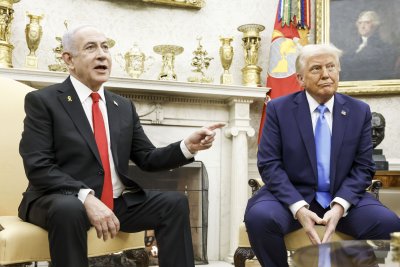
German Chancellor Friedrich Merz has affirmed support for the creation of a Palestinian state, while Israeli Prime Minister Benjamin Netanyahu has again rejected such a move, during the German leader’s inaugural visit to the country.
At a joint press conference on Sunday following a meeting in Jerusalem, the two leaders spoke of their respective priorities for Gaza and the occupied West Bank.
Merz told the news conference that Germany, one of Israel’s most unwavering allies, wanted a new Middle East that recognised a Palestinian state alongside the State of Israel.
“Our conviction is that the prospective establishment of a Palestinian state alongside Israel presumably offers the best prospect for this future,” the German chancellor said.
But he said his government had no intention of recognising a Palestinian state “in the foreseeable future”.
“The German federal government remains of the opinion that recognition of a Palestinian state should come at the end – not the beginning – of such a process (peace negotiations),” he said, putting Germany at odds with several other key European nations, including France, Spain and the Untied Kingdom, who have all confirmed formal recognition.
But Netanyahu said that the Israeli public was opposed to any two-state solution, and that the political annexation of the occupied West Bank – a concern raised by Merz and also rejected by the administration of United States President Donald Trump – remained a subject of discussion, although the status quo was expected to remain for the foreseeable future.
“The purpose of a Palestinian state is to destroy the Jewish state,” Netanyahu claimed without expanding.
The Israeli premier added that the first phase of Trump’s Gaza plan was nearly completed, and that he would be having “very important conversations” at the end of December on how to ensure the second phase would be achieved.
He would also meet Trump later this month, he added.
Relationship strained over Gaza
The war on Gaza has tested the traditionally strong ties between Israel and Germany, for whom support for Israel is a core tenet of its foreign policy, built in during decades of historical guilt over the Third Reich’s Holocaust.
In August, Israel’s actions in Gaza drove Germany – Israel’s second-largest arms supplier after the US – to restrict sales of weapons for use in Gaza. At the time, Merz said – in a public criticism of Israel that was rare for a German leader – that his government could no longer ignore the worsening toll on civilians in the besieged and bombarded enclave.
Netanyahu expressed his anger at the restrictions, which were lifted two weeks ago.
Speaking at the news conference, Merz said the decision to restrict weapons sales had changed nothing “in our very basic attitude towards Israel and Israel’s security, in our support of Israel, in our military support of Israel as well.”
No reciprocal visit on cards
Merz’s visit – coming seven months since he assumed power – has come relatively late in his tenure as chancellor compared to his predecessors, with Olaf Scholz having visited Israel after three months and Angela Merkel after two.
Speaking at the press conference in Jerusalem, Merz said the leaders did not discuss a visit by Netanyahu – who faces an arrest warrant for alleged war crimes in Gaza from the International Criminal Court (ICC) – to Berlin.
“We did not discuss the possibility of Prime Minister Netanyahu travelling to Germany. There is no reason to discuss this at the moment,” Merz told reporters.
“If time permits, I would issue such an invitation if appropriate. But this is not an issue for either of us at the present time.”
Earlier this year, Merz vowed to invite the Israeli leader and assured him he would not be arrested on German soil.
In the meantime, back in Germany, activists in the capital Berlin held a demonstration to condemn Israel’s ongoing genocidal war on Gaza, to demand a halt to arms exports to Israel, and to express their support for Palestine.
There has also been criticism from the political opposition in Germany to Merz making the trip at all to meet a leader with an ICC arrest warrant hanging over him.
Germany ‘must stand up’ for Israel
Prior to meeting Netanyahu, Merz had visited the Yad Vashem Holocaust memorial in Jerusalem, where he reiterated Berlin’s enduring support.
During the visit, he said “Germany must stand up for the existence and security of Israel,” after acknowledging his country’s “enduring historical responsibility” for the mass extermination of Jews during World War II.
On his arrival in Israel on Saturday, Merz was met at Tel Aviv’s Ben Gurion Airport by Israeli Foreign Minister Gideon Saar, who called Merz “a friend of Israel”. He then met Israeli President Isaac Herzog in Jerusalem later that evening.
German support resolute despite criticism
Reporting from Ramallah in the occupied West Bank, Al Jazeera’s Nour Odeh said the relationship between Germany and Israel remained “very strong”, despite recent strains over Gaza.
Not only had Germany resumed arms exports to Israel following a short-lived partial suspension, but it had recently signed a $4.5bn deal for an Israeli-made missile defence shield, reportedly the largest arms export agreement in Israeli history.
Speaking at Sunday’s news conference, Netanyahu said the deal reflected a “historical change” in Israel’s relationship with Germany.
“Not only does Germany work in the defence of Israel, but Israel, the Jewish state, 80 years after the Holocaust, works for the defence of Germany,” he said.
Odeh said Germany’s support had proven controversial at home and abroad, and had seen Germany being accused of complicity in genocide for its military support to Israel, before judges at the International Court of Justice (ICJ) ruled against issuing emergency orders to stop German arms exports.
“The visit itself is quite controversial given that Germany is a member of the International Criminal Court and is obliged to hand over Netanyahu to the court, not meet with him,” Odeh noted.
She said Israel had little tolerance for criticism from Germany, but understood that its occasional comments taking issue with its actions had little bearing on Berlin’s policy response.
“The Israeli political system … understands that even that criticism … doesn’t really amount to much in terms of policy,” she said, describing Berlin as acting as “a brick wall at the European Union against any criticism, any action, any sanctions against Israel”.
After the US government placed sanctions on the United Nations’ special rapporteur on the occupied Palestinian territories, Francesca Albanese, her life turned upside down.
Credit cards stopped working, she told Al Jazeera. A hotel reservation booked by the European Parliament was cancelled. Medical insurance was denied. For Albanese, the consequences of her work on Israel’s genocide against the Palestinian people of Gaza were not just professional — they were personal, too.
Recommended Stories
list of 4 itemsend of list
“We are turned into non-persons,” she said at the Doha Forum, calling the sanctions imposed against her “unlawful” under international law.
“But again, for me, it’s important that people understand the extent … the United States, Israel and others would go to silence the voice of justice, the voice of human rights,” Albanese said.
As leaders, diplomats, and legal experts gathered in Qatar’s capital for the Doha Forum this weekend under the theme “Justice in Action: Beyond Promises to Progress”, the crisis in Gaza dominated discussions.
Allegations of genocide against Israel, repeated vetoes blocking UN ceasefire resolutions, and growing pressure on international justice mechanisms have made Gaza a test case for the rules-based international order, raising questions about whether international law is capable of providing justice.
‘Sense of insecurity around me’
According to Albanese’s legal assessments, Israel’s conduct in its war on Gaza constitutes a genocide, a term that prominent human rights groups such as Amnesty International, Human Rights Watch and Israel’s B’Tselem have also used.
When announcing the sanctions on Albanese, US Secretary of State Marco Rubio accused her of waging a “campaign of political and economic warfare against the United States and Israel”. She says the allegation is baseless.
“I have been subjected to smear campaigns,” she said, adding that US officials have accused her of being an anti-Semite, of supporting violence, and of failing to condemn the crimes committed on October 7 against Israeli civilians.
“It has created a sense of insecurity around me. I have received threats from all corners,” Albanese said.
United Nations Special Rapporteur Francesca Albanese is the UN’s expert on the situation of human rights in the occupied Palestinian territory [File: Pierre Albouy/Reuters]
In addition to targeting Albanese, the US imposed sanctions in August on nine judges and prosecutors of the International Criminal Court (ICC), including two European citizens, after the court began investigating alleged Israeli war crimes in Gaza.
“This is mafia-style intimidation that we are subjected to, just for doing our job,” Albanese noted, warning that sanctions and intimidation of legal experts set a dangerous precedent.
“There will be that pressure [on ICC judges and legal experts] that, if I go on this route, this is going to be scrutinised. This is the idea, to make it impossible for the organisation, for the ICC to work,” she cautioned.
“Imagine that every US person interacting with us, someone who works in the US or is a citizen, could go to jail for up to 20 years. It creates a chilling effect.”
Western hesitance
In November 2024, the ICC issued arrest warrants for Israeli Prime Minister Benjamin Netanyahu and former Defence Minister Yoav Gallant for alleged “war crimes”.
The US called the move “outrageous”, and while the United Kingdom and Canada said they would adhere to international law, they did not make clear if they would uphold the warrant.
Many Western countries have not described Israel’s actions in Gaza as genocide and have continued to send the country arms, despite growing allegations of war crimes occurring in Gaza.
Albanese emphasised that nations continuing to transfer arms are failing in their legal obligations.
“They have the obligation to prevent a genocide that has already been recognised as plausible in January 2024 by the International Court of Justice,” she said.
Janine Di Giovanni, co-founder of the Reckoning Project, which documents war crimes in Sudan, Ukraine and Gaza, said the position of many Western states reeked of a glaring “double standard”.
“There is one set of laws and rules that pertain to Ukraine … and another set for brown and Black people,” she said, pointing to the ICC’s historical focus on African leaders and the failure of Western powers to hold Israel accountable.
Di Giovanni directed her criticism at European Union foreign policy chief Kaja Kallas, saying the former Estonian prime minister had been “negligent” when it came to Gaza.
“She points out over and over again what [Russian President] Putin has done in Ukraine, but not a word about Gaza,” she added.
“She’s the EU foreign policy chief. She has a responsibility to point out Israel’s criminality.”
Is international law still relevant?
With multilateral institutions and the international law system coming under growing pressure from nation-states, Albanese said that international law does work and that “we need to make it work”.
“I often make the example, if a cure doesn’t work, would you trash all medicine? No,” she asserted.
“This is the first genocide in history that has awakened a conscience, a global conscience, and has the potential to be stopped.”
Meanwhile, Reckoning Project’s Di Giovanni said the UN General Assembly could be “activated to work at a higher level and a more effective level than what they’re doing, while the Security Council is blocked”.
“But maybe this shows us that we need to have a greater reform for how the Security Council works,” she said.
Di Giovanni added that it was crucial to address the “extraordinary heinous crimes that Netanyahu and others” have committed, or else it would send a message that “impunity is rampant”.
“Without accountability, there is no global security,” she said.
As Israel and Hamas prepare to move towards phase two of a United States-led blueprint to end Israel’s genocidal war on Gaza, disagreements loom over the as-yet undefined role of an international stabilisation force in the besieged Palestinian enclave.
Senior Hamas official Basem Naim said on Sunday that the US draft required “a lot of clarifications”. While the group was ready to discuss “freezing or storing” weapons during the ongoing truce, he said it would not accept that an international stabilisation force take charge of disarmament.
Recommended Stories
list of 4 itemsend of list
“We are welcoming a [United Nations] force to be near the borders, supervising the ceasefire agreement, reporting about violations, preventing any kind of escalations,” he said, adding that Hamas would not accept the force having “any kind of mandates” on Palestinian territory.
His comments came after Israeli Prime Minister Benjamin Netanyahu said earlier in the day that he would meet with Donald Trump to discuss entering a new phase of the US president’s plan at the end of the month. The focus of the meeting, he said, would be on ending Hamas governance in Gaza and ensuring it fulfilled its “commitment” to the plan, which calls for demilitarisation of the enclave.
“We have a second phase, no less daunting, and that is to achieve the disarmament of Hamas and the demilitarisation of Gaza,” Netanyahu said during a news conference with visiting German Chancellor Friedrich Merz.
It was not clear whether Naim’s comments on the group freezing or storing arms would satisfy Israel’s demands for full disarmament. The Hamas official said the group retained its “right to resist”, adding that laying down arms could happen as part of a process leading to a Palestinian state, with a potential long-term truce lasting five to 10 years.
The US-drafted plan for Gaza leaves the door open to Palestinian independence, but Netanyahu has long rejected this, asserting that creating a Palestinian state would reward Hamas.
Vague plan
Trump’s 20-point plan offers a general way forward on such plans as the establishment of the stabilisation force and the formation of a technocratic Palestinian government operating under an international “board of peace”, but does not offer concrete details or timelines.
US officials have said they expect “boots on the ground” early next year, but while countries like Indonesia have agreed to contribute troops, there is no roadmap for setting up the force, and its exact makeup, command structure and responsibilities have not been defined.
Netanyahu appeared to recognise the plan’s vagueness. “What will be the timeline? What are the forces that are coming in? Will we have international forces? If not, what are the alternatives? These are all topics that are being discussed,” he said on Sunday.
The Israeli prime minister said that phase two of the plan, which will be set in motion once Hamas returns the last Israeli captive, a policeman killed in the October 7 attack on southern Israel, would be “more difficult”.
Stage one of the plan has already proven challenging, with Israel continuing to bomb Gaza throughout the ceasefire, killing more than 370 Palestinians, according to health officials. Meanwhile, it has accused Hamas of dragging out captive returns.
Israeli army says yellow line ‘new border’
The plan’s initial steps saw Israeli forces withdraw to positions behind a so-called yellow line in Gaza, though the Israeli military remains in control of 53 percent of the territory. The Israeli military said on Sunday that the line of demarcation was a “new border”.
“We have operational control over extensive parts of the Gaza Strip, and we will remain on those defence lines,” said Israeli military chief Lieutenant General Eyal Zamir. “The yellow line is a new border line, serving as a forward defensive line for our communities and a line of operational activity.”
Qatari Prime Minister Sheikh Mohammed bin Abdulrahman bin Jassim Al Thani warned at the Doha Forum on Saturday that the truce was at a “critical moment” and could unravel without rapid movement towards a permanent deal.
He said a true ceasefire “cannot be completed unless there is a full withdrawal” of Israeli forces, alongside restored stability and freedom of movement for Palestinians, which has so far not transpired under phase one of the plan. He did not allude to the yellow line in his comments.
Amid growing momentum for a move to phase two of the peace plan, Israeli and Qatari officials met with US counterparts in an effort to rebuild relations after Israel’s air strike on Doha in September, Axios reported, citing unnamed sources.
GENEVA — Public broadcasters in Ireland, the Netherlands, Spain and Slovenia on Thursday pulled out of next year’s Eurovision Song Contest after organizers decided to allow Israel to compete, putting political discord on center stage over a usually joyful celebration of music.
The walkouts came after the general assembly of the European Broadcasting Union — a group of public broadcasters from 56 countries that runs the glitzy annual event — met to discuss concerns about Israel’s participation, which some countries oppose over its conduct of the Israel-Hamas war in Gaza.
At the meeting, EBU members voted to adopt tougher contest voting rules in response to allegations that Israel manipulated the vote in favor of their contestants, but took no action to exclude any broadcaster from the competition.
The feel-good pop music gala that draws more than 100 million viewers every year has been roiled by the war in Gaza for the last two years, stirring protests outside the venues and forcing organizers to clamp down on political flag-waving.
“It’s a historic moment for the European Broadcasting Union. This is certainly one of the most serious crises that the organization has ever faced,” said Eurovision expert Dean Vuletic. “Next year, we’re going to see the biggest political boycott of Eurovision ever.”
Vuletic, author of “Postwar Europe and the Eurovision Song Contest,” predicted “tense” weeks and months ahead as other countries contemplate joining the walkout and protests set to overshadow the contest’s 70th anniversary in Vienna next May.
A report on the website of Icelandic broadcaster RUV said its chiefs would meet Wednesday to discuss whether Iceland would take part: Its board last week recommended that Israel be barred from the event in the Austrian capital.
The broadcasting union said it was aware that four broadcasters — RTVE in Spain, AVROTROS in the Netherlands, RTÉ in Ireland and Slovenia’s RTVSLO — had publicly said they would not take part.
A final list of participating countries will be announced by Christmas, EBU said.
Controversy over Israel
Israeli President Isaac Herzog said on social platform X that he was “pleased” Israel will again take part, and hoped “the competition will remain one that champions culture, music, friendship between nations and cross-border cultural understanding.”
“Thank you to all our friends who stood up for Israel’s right to continue to contribute and compete at Eurovision,” he added.
Austria, which is set to host the competition after Viennese singer JJ won this year with “Wasted Love,” supported Israel’s participation. Germany, too, supported Israel along with countries like Switzerland and Luxembourg, Vuletic said.
AVROTROS, the Dutch broadcaster, said the participation of Israel “is no longer compatible with the responsibility we bear as a public broadcaster.”
Spain’s RTVE said the situation in Gaza — despite the recent ceasefire — and “Israel’s use of the contest for political purposes, make it increasingly difficult to maintain Eurovision as a neutral cultural event.”
RTÉ said Ireland’s participation “remains unconscionable given the appalling loss of lives in Gaza” and the humanitarian crisis there.
Some broadcasters — which run their country’s news programs and wanted Israel kept out — cited killings of journalists in the conflict in Gaza and Israel’s continued policy of denying international journalists access to the territory.
Israeli broadcaster KAN’s Chief Executive Golan Yochpaz questioned whether EBU members are “willing to be part of a step that harms freedom of creation and freedom of expression.”
KAN officials said the Israeli broadcaster was not involved in any prohibited campaign intended to influence the results of the latest song contest in Basel, Switzerland, last May — when Israel’s Yuval Raphael placed second.
Divided over politics
The contest pits acts from dozens of nations against one another for Europe’s musical crown. It strives to put pop before politics, but has repeatedly been embroiled in world events. Russia was expelled in 2022 after its full-scale invasion of Ukraine.
The war in Gaza has been its biggest challenge, with pro-Palestinian protesters demonstrating against Israel outside the last two Eurovision contests in Basel, Switzerland, in May and Malmo, Sweden, in 2024.
Opponents of Israel’s participation cite the war in Gaza, which has left more than 70,000 people dead, according to the territory’s Health Ministry, which operates under the Hamas-run government and whose detailed records are viewed as generally reliable by the international community.
Israel’s government has repeatedly defended its campaign as a response to the attack by Hamas-led militants that started the war on Oct. 7, 2023. The militants killed around 1,200 people — mostly civilians — in the attack and took 251 hostage.
A number of experts, including those commissioned by a U.N. body, have said that Israel’s offensive in Gaza amounts to genocide, a claim that Israel — home to many Holocaust survivors and their relatives — has vigorously denied.
A boycott by some European broadcasters could have implications for viewership and money at a time when many broadcasters are under financial pressure from government funding cuts and the advent of social media.
The pullouts include some big names in the Eurovision world. Spain is one of the “Big Five” large-market countries that contribute the most to the contest. Ireland has won seven times, a record it shares with Sweden.
The controversy over Israel’s 2026 participation also threatens to overshadow the return next year of three countries — Bulgaria, Moldova and Romania — after periods of absence because of financial and artistic reasons.
“Next year’s edition is certainly going to be one of the most politicized ever,” Vuletic said. “It’s the 70th anniversary. It was meant to be a big celebration, a big party, but it’s going to be shrouded in political controversy yet again.”
Keaten and Lawless write for the Associated Press. Lawless reported from London.