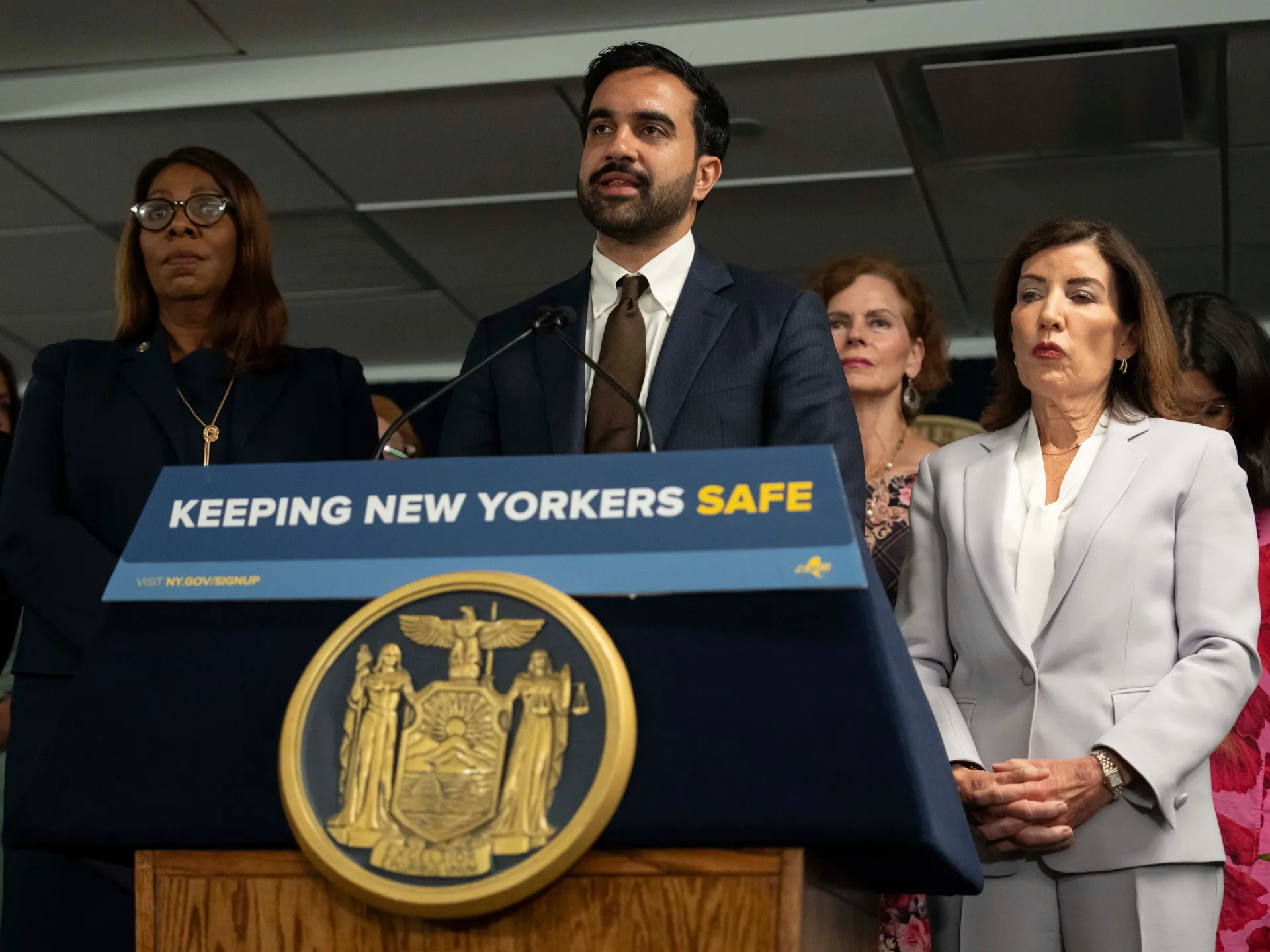
New York City, United States – Mayor Zohran Mamdani is challenging a new law that would give New York City’s teaching aides a one-time $10,000 bonus, arguing it goes against the city’s collective bargaining laws.
On Wednesday, the bill, which was passed by New York City’s City Council, automatically became law because the mayor had opted not to veto it. Instead, Mamdani filed a lawsuit to block it because the City Council had enough votes to override his veto.
Recommended Stories
list of 4 itemsend of list
The bill, called the Respect Check Act, was backed by the United Federation of Teachers (UFT), a labour union representing teachers across New York City’s public school system and was championed by City Council Speaker Julie Menin, who has often clashed with the mayor.
Teaching assistants are among the lowest-paid workers in the city’s school system, according to a statement released by Menin’s office on Wednesday. Their pay is as low as $32,000. According to MIT’s living wage calculator, the living wage in New York City is $79,469 for Manhattan, $67,558 for Brooklyn, $73,258 for Queens, $67,974 in Staten Island, and $60,341 for the Bronx.
When the bill passed in July, Mamdani argued that the law directly violated a state law called the Taylor Law, a nearly 60-year-old law that gives public sector workers the right to organise. The UFT, which endorsed Mamdani in July 2025 ahead of the city’s election, pushed back on the mayor’s claims. The group argued the City Council did not undermine collective bargaining.
“The City Council would not have introduced – let alone passed – this bill if it were illegal, and we would not have supported a bill that threatened our collective bargaining rights,” Michael Mulgrew, president of the UFT, said in a statement provided to Al Jazeera.
“This moment is an opportunity for Mayor Mamdani to create a new, fairer system and build the kind of city he said he wanted to lead. This administration must keep its promises, and we won’t stop until it does.”
The City Council crafted the law to avoid violating New York’s Taylor Law, a UFT representative told Al Jazeera.
Under a 2023 state appeals court ruling, additional payments to public employees are mandated to be independent of a worker’s regular salary and cannot be tied to collective bargaining, they argue.
“The Court of Appeals has found that the Taylor Law does not prevent a municipality from unilaterally providing an economic benefit,” Beth Norton, general counsel for the UFT, said in testimony in front of the City Council in 2025, provided to Al Jazeera.
Pushing back
New York City Hall sees it differently.
“Council labels these ‘stabilisation’ payments; they effectively function as stipends or salary bonuses and, regardless of terminology, are an additional form of compensation and, as such, a mandatory subject of bargaining,” the 18-page filing obtained by Al Jazeera said.
“I think the mayor is right that this sets a bad precedent,” Adin Lenchner, founder of the New York-based political consultancy Carroll Street Campaigns, told Al Jazeera.
“Him and his team are either posturing, negotiating, or using this as a moment to negotiate toward some other kind of deal. I think everyone would agree that, substantively and philosophically, this is aligned with the mayor’s public policy approach and his vision for the city,” Lenchner added.
“So, if I had to guess, this is, on the one hand, about not wanting to establish a bad precedent and, on the other hand, a step toward a longer-term negotiation.”
Citizens Budget Commission (CBC), a nonpartisan think tank, urged the mayor in July to veto the bill, arguing that City Council should not make this decision. It says the now-law would add $325m in city spending.
“The City should continue to determine employee compensation at the bargaining table, not the legislative chamber,” vice president for research at CBC, Ana Champeny, said in a press release in mid-July.
Mamdani echoed that sentiment when he was asked about the law earlier this month.
“Conversations around compensation are better left at the bargaining table,” Mamdani said in a news conference on August 6.
However, the mayor voiced support on the campaign trail for legislation that would provide support payments to these paraprofessionals. That legislation supported recurring payments, not a one-time payment.
“The version he supported last fall made the payment recurring; what passed last month only guarantees it for one year. That’s the line between then and now, so not much of a flip-flop,” Lenchner added.
“We will not allow the political process to replace the collective bargaining table. The City is filing a lawsuit to protect the right of every union to negotiate on behalf of its members, to fight for the workplace they deserve and ensure that workers – not politicians – determine their own futures,” Matt Rauschenbach, a spokesperson for the mayor, said in a statement provided to Al Jazeera.
“We will work towards a quick resolution that respects workers, protects the City’s finances, and ensures that the Council does not interfere with collective bargaining in the future.”
Walkout over late payments comes as public health officials confirm that the virus has reached two more provinces.
Published On 13 Jul 202613 Jul 2026
Staff at a hospital treating Ebola patients in the Democratic Republic of the Congo (DRC) have gone on strike, alleging they have not been paid for months, bringing the facility to a standstill.
Dozens of employees at Rwampara General Hospital in Ituri province, the epicentre of the outbreak, walked off the job on Monday. The strike action came as authorities revealed that the virus has spread to two further provinces in northern DRC.
Recommended Stories
list of 3 itemsend of list
The striking workers included epidemiologists, case investigators, drivers and gravediggers.
“We don’t know how it is possible to not have been paid for two months,” Bahati Claude, a health worker at the centre, told The Associated Press.
The outbreak, concentrated in northern DRC, is the worst in Africa’s history and has already caused severe economic damage, pushing nearly one million people into poverty, according to the United Nations.
Efforts to hold back the spread of the virus have been complicated by the presence of paramilitary rebels, who control parts of the region in a bid to access its valuable mineral deposits.
The response to the outbreak has also been complicated by misinformation, deeply rooted burial practices and a lack of trust in health officials.
Health workers have been attacked by communities that believe the disease is a form of witchcraft, while bereaved families have ignored safety protocols by holding traditional burial ceremonies.
DRC’s National Public Health Institute confirmed on Sunday that the virus has spread to two new northeastern provinces: Haut-Uele and Tshopo.
The World Health Organization has warned that an accelerated response from local, national and international partners is urgently needed to bring the outbreak under control.
DRC Health Minister Roger Kamba said last week that the government was working to resolve the payroll issues and ensure employees were paid.
“We must ensure that these payments reach the right people,” Kamba said. “We have faced a few challenges, notably changes to the lists, which have led to complaints from people saying they are not being paid even though they are working. We have the means to sort this out.”
According to the latest figures, the number of Ebola cases in the DRC has risen to 1,926, with 702 deaths. The spread of the disease to Haut-Uele and Tshopo means five provinces now have confirmed Ebola cases.
The International Rescue Committee (IRC) has warned that the situation is worsening in areas already affected as transmission accelerates, while the risk of the disease spreading to neighbouring South Sudan is increasing as the outbreak expands into new areas.
Meanwhile, a second United States citizen infected with Ebola was admitted to a special isolation unit at Frankfurt University Hospital in Germany on Monday. Timo Wolf, head of the special isolation unit, said the patient’s condition was “currently stable”.
The man, who is in his 60s, was confirmed to have contracted the disease on Friday while working for a Christian aid group in the DRC.
New Delhi, India – On a searing hot afternoon in a dense working class neighbourhood of the Indian capital, Shehnaz Bano sits on the dilapidated floor of her one-room home, deftly stitching pieces for a new leather jacket.
To make each piece – a sleeve, a front or back panel or a shoulder yoke – the 38-year-old mother of two teenage sons spends hours, but is paid a mere 100 rupees (about $1) for each piece.
Recommended Stories
list of 4 itemsend of list
“Imagine if I was a regular employee and I did the same work for the same hours, but on a factory floor. I would have been paid more, right?” Bano asked.
“Just because I work from home, I don’t get equal pay or rights.”
That is because Bano, like nearly 260 million others across the world, is a home-based worker (HBW) – people employed to produce goods or services in or near their homes. The HBWs are part of what is referred to as the global informal economy. Such a form of employment is characterised by low wages, denial of workers’ rights, lack of social security or established hours of work, or paid leave.
The HBWs are also a highly-feminised workforce, with nearly 57 percent being women, according to a 2024 estimate by Women in Informal Employment: Globalising and Organising (WIEGO), a United Kingdom-based global research organisation focused on improving conditions for the working poor, especially women, in the informal economy.
On this day 30 years ago, however, an effort was made to change the condition of the HBWs – with little success so far.
The International Labour Organisation (ILO), a United Nations’ body, during a conference at its headquarters in Geneva, Switzerland, adopted the landmark “Convention 177”, or the Home Work Convention on June 20, 1996, recognising HBWs at the same level as traditional wage earners.
It was the first comprehensive call to set an international standard for the HBWs. The convention called upon ILO members to adopt and implement policies that promote equality of treatment between HBWs and other wage earners.
Convention 177 officially came into force on April 22, 2000.
However, only 13 countries have ratified it so far and none from South Asia. That is despite Asia and the Asia-Pacific regions accounting for the largest concentration of HBWs, as well as being the hub of global fashion and manufacturing supply chains.
Renana Jhabvala was in the room in Geneva – along with hundreds of government and non-government delegates – when the home-based worker Convention was adopted.
As a member of the Self Employed Women’s Association (SEWA), a prominent Indian trade union of women workers, the 73-year-old activist was at the ILO’s International Labour Conference (ILC), and still remembers the exhilaration and optimism in the room.
“Discussions had gone on for nearly 21 days, but none of us knew whether the Convention would get adopted or not. We were all in a really big hall at the ILC… There was a majority in the final vote and the Convention got passed,” she told Al Jazeera.
But labour rights activists, experts and labour economists say a lack of recognition of the HBWs despite three decades of adopting the ILO convention has deepened structural inequalities among the workers, especially in a developing country like India.
According to them, the HBWs, especially women, remain largely “invisible” to the policymakers, while they are forced to work for inadequate wages under unsafe and exploitative working conditions.
“Convention 177 has been instrumental in recognising home work as ‘real work’ and home workers as workers entitled to labour rights,” Deepa Bharathi, a senior specialist of gender and non-discrimination at ILO’s Bangkok-based Decent Work Team, emailed Al Jazeera.
“In South Asia, home-based work is often embedded in complex subcontracting arrangements, making employment relationships difficult to identify and regulate. Challenges in labour inspection, gaps in data and the invisibility of home workers in policy frameworks have also slowed progress,” Bharathi said in response to a question on the low ratification of the Convention, particularly in South Asia.
With most home-based workers in the region being women, their work is often seen as an extension of household responsibility, Bharathi said. “This undervaluation, combined with broader gender inequalities, has been a significant barrier to ratification and implementation,” she added.
When asked about the ILO’s priorities for strengthening the Convention’s implementation, Bharathi said: “For women home-based workers in particular, the focus must remain on visibility, fair pay, social protection, safe working conditions, access to training and childcare and a stronger collective voice.”
‘I cannot go out and work’
Bano lives in New Delhi’s Kapashera area, a settlement of mainly migrant workers on the city’s southwestern edge whose name literally translates to a “cotton settlement” in English. The area is known for its cotton and leather garment manufacturing units.
In its congested alleys lie buildings that rent out single room units to informal worker families. In one such room lives Bano with her sons and her husband who works as a lift operator in an upscale mall in Gurugram, a business district housing several Fortune 500 companies on the outskirts of New Delhi.
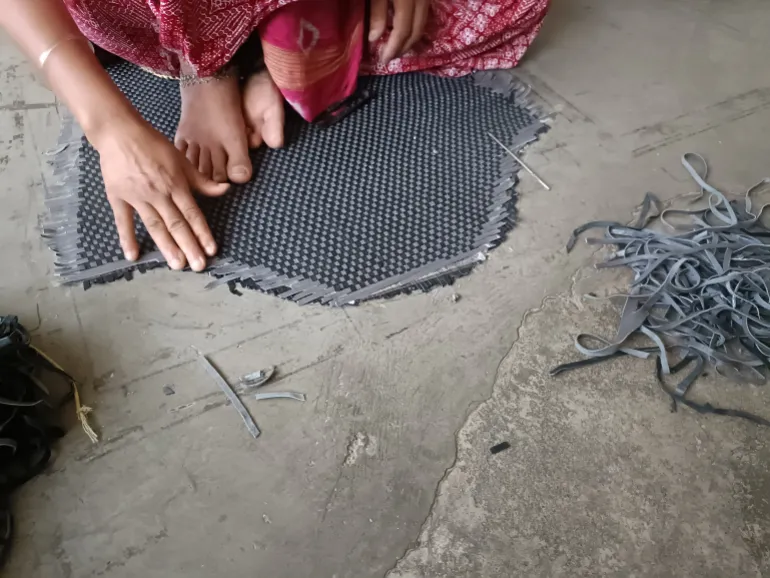
The leather panel of a jacket that Bano is working on in New Delhi, India [Anuja/Al Jazeera]
Bano epitomises the arc of a typical HBW in India. She began working as a beedi (a tiny, hand-rolled cigarette) roller in her village in neighbouring Uttar Pradesh state’s Azamgarh district. After marriage, she joined her husband in New Delhi and took to stitching leather jacket pieces from home.
The move from her rural employment as a beedi roller to a piece-rate worker in the city did not change her continuing precarious situation: long hours, irregular work, low wages and work that leaves her eyes strained and fingers aching.
She is paid barely one dollar for her work on each piece of a leather jacket that is sold in a foreign market for $200 or more – more than double Bano’s average monthly income. Moreover, to cut costs and maximise profit, the contractors often split such work among several workers.
“Only those who are in distress do this kind of work. We have rent, bills, grocery and school fees to pay. How much will my husband do alone?” Bano told Al Jazeera.
The HBWs fall into two categories: own account workers with direct access to markets and piece rate workers who are usually employed through intermediaries. Bano belongs to the latter, which is considered more vulnerable due to low and arbitrary piece rate payments.
In another corner of Kapashera, Sangeeta Devi, 30, puts the final touches – buttoning, repairing, finishing – before the garments she makes return to the factories.
She is doing all this inside an 8×8 foot (2.4m) room, where her family of six, including four schoolchildren sleep, eat, work and study. She cooks, cleans and even bathes in the same room.
“I cannot go out and work because then who will take care of my children?”
“On any given day, there are 100 pieces of clothing in this tiny room. Each time, I have to keep them aside while doing household chores,” the migrant worker from Bihar, one of India’s poorest states, told Al Jazeera.
Sangeeta Devi gets a dollar for every 100 garment pieces she completes.
“I really want to do a job where I can work easily from home, take care of my children and get paid well. I don’t know if that’s even possible,” she told Al Jazeera.
Her neighbour, Putul Devi, does similar work and earns about $20 a month.
“I have been cooking on firewood because of high fuel costs. And when it rains, I don’t know what to save from spoiling – the firewood or the cloth pieces that I bring home,” she told Al Jazeera.
Putul Devi at her home in New Delhi, India [Anuja/Al Jazeera]
Shalini Sinha, home-based work sector specialist at WIEGO, said female HBWs in India face “continued invisibility” even after three decades of recognition of their work.
“Home continues to be seen as a place of habitat and not as a place of work,” Sinha told Al Jazeera.
“There is also the broader issue of women’s economic work not being adequately recognised in labour discourse when it is done from home. It is often seen as an extension of her care work,” she added.
From an Indian perspective, said Sinha, there is an “urgent need for better statistics and a dedicated policy or law for home-based workers, which still does not exist”.
Elizabeth Khumallambam, who works for Community for Social Change and Development (CSCD), an NGO that works with women HBWs in Kapashera, said a social security code introduced in India in 2020 mentions HBWs, but “no one knows” how it will be implemented on the ground.
Introduced as part of India’s labour reform laws, the code consolidated nine social security-related laws into a single framework to ensure social security protection for all workers, including those in the unorganised sector.
“Frankly, for us the challenge begins at making workers understand the value of their own work. Many don’t consider this as work and so they do not think it needs due rights and protection,” Khumallambam told Al Jazeera.
Alakh N Sharma, a labour economist and director at New Delhi-based non-profit, the Institute for Human Development, said there is a “bias in the system”, due to which women’s work is being left behind in statistics and official counting.
According to him, technology-aided counting, probing questions and sensitivity among investigators, could help in addressing the statistical blind spot.
“Safety concerns, mobility constraints and social norms – all these factors stop women from joining formal workplace-based employment. But the single biggest reason is often care work responsibility, particularly childcare,” Sharma told Al Jazeera.
In 2022, Sandosh Kumar P, a Communist Party of India (CPI) parliamentarian moved a legislation aimed at the welfare of the BHWs, but the parliament did not take it up for discussion.
In December 2024, India’s ministry of labour and employment was again asked in parliament whether it has an official assessment of the HBWs, and if it was proposing to enact a law on them. It replied that the Code on Social Security 2020 provides social security to the unorganised workers, including the HBWs. It also said the government has created a national database of such workers.
Looking back at the 30 years since the historic recognition of HBWs, Jhabvala said she did not view such Conventions or laws from the lens of success or failure.
“It is like a weapon, a tool of change. If we want to fight, this option is available,” she said.


![India home-based workers [Anuja/Al Jazeera]](https://i0.wp.com/occasionaldigest.com/wp-content/uploads/2026/06/HBW-Putul-Devi-at-her-one-room-home-in-New-Delhi-1781976215.jpg?w=640&ssl=1)