War in Ukraine

U.S. and Ukrainian delegations make next attempt at peace plan

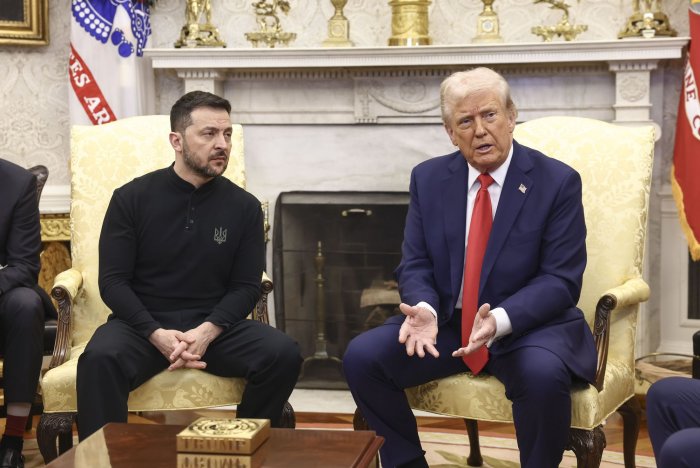
Nov. 30 (UPI) — Top Ukrainian and American leaders are scheduled to meet late Sunday to renew talks about a plan to end the latest chapter in the decades-long battle between Russia and Ukraine.

Secretary of State Marco Rubio and President Donald Trump‘s special envoy Steve Witkof are set to meet with a Ukrainian delegation to discuss details of the U.S. backed plan to bring the violence to an end.

Ukraine seeks international security guarantees as part of the agreement, as well as a ceasefire based on the existing frontlines, and has refused to cede any Ukrainian territory that is not already under Russian control.

Russian President Vladimir Putin does not appear set to offer any concessions, instead demanding that any military aggression will end “once Ukrainian troops withdraw from the territories they occupy,” according to CNN.

Rubio met with the Ukrainian delegation in Geneva last week to discuss a 28-point plan to end the war, which included demands by Putin that Russia regain its standing on the international stage and that Ukraine be forbidden from joining NATO, a group to which it has long sought membership.

Ukraine said then that the plan was highly favorable to Russia, and that it required “additional work.” The plan ultimately fell by the wayside, prompting the need for the Sunday meeting between the U.S. and Ukrainian delegations.

Russian officials have said they have received some details of the new plan, but have not disclosed them.

“This isn’t an official one, but we do have the document,” Putin aide Yuri Ushakov said. “We haven’t discussed it with anyone yet because the points in it require truly serious analysis and discussion.”

Trump suggested a Thanksgiving Day deadline for a deal to be signed, but later backed away from that, or any, timeline for the war to end.

“You know what the deadline is for me? When it’s over,” Trump said.

The negotiations are happening amidst Russian missile and drone attacks on key infrastructure in cities across Ukraine.

Ukrainian President Volodymyr Zelensky claimed Sunday that over the last week, Russia has launched at least 1,400 drone attacks, 1,100 guided aerial bomb strikes and carried out 66 missile attacks on Ukraine.

Ukraine has responded by targeting Russian energy and military infrastructure outposts, striking them with long-range drones and missiles. It also launched drone attacks over the weekend on two tankers shipping oil to Russia in the Black Sea.

President Donald Trump and first lady Melania Trump walk on the South Lawn of the White House before boarding Marine One on Tuesday. Photo by Aaron Schwartz/UPI | License Photo

Source link

Human Rights Watch blacklisted in by Russian Justice Ministry

Russian police detain a protester during a rally in Moscow in 2022, against the entry of Russian troops into Ukraine. Russia has designated Human Rights Watch as an “undesirable foreign organization,” the nation’s Ministry of Justice announced Friday. File Photo by Maxim Shipenkov/EPA

Nov. 28 (UPI) — Russia has designated Human Rights Watch as an “undesirable foreign organization,” the nation’s Ministry of Justice announced Friday.

This decision means the organization, which was founded in 1978, is banned from operating in Russia. HRW is in 78 nations.

“Designating rights groups undesirable is brazen and cynical,” Philippe Bolopion, executive director at Human Rights Watch, said in a news release. “It only redoubles our determination to document the Russian authorities’ human rights violations and war crimes, and ensure that those responsible are held accountable.”

HRW has documented human rights violations in Russia and the military committing war crimes in Ukraine.

“For over three decades, Human Rights Watch’s work on post-Soviet Russia has pressed the government to uphold human rights and freedoms,” Bolopion said. “Our work hasn’t changed, but what’s changed, dramatically, is the government’s full-throttled embrace of dictatorial policies, its staggering rise in repression, and the scope of the war crimes its forces are committing in Ukraine.”

In 2015, Russia introduced the “undesirable” law to silence independent media, opposition groups and foreign organizations.

Russian authorities have designated at least 280 organizations as “undesirable,” including the Moscow Times. Courts have issued administrative and criminal sentences, including in their absence, against several hundred people, HRW said.

“Undesirable” organizations, as determined by the Prosecutor’s Office, undermine Russia’s security, defense or constitutional order.

The Prosecutor General’s Office banned HRW on Nov. 10.

Those who continue to engage with these organizations, in Russia or abroad, may face administrative and criminal penalties, including a maximum six-year prison sentence. The authorities interpret “engagement” widely and arbitrarily, HRW said.

The organization leaders risk up to six years, according to Russian law.

In 2021, Andrei Pivovarov, a political activist, was sentenced to four years in prison for social media posts, which the authorities said promoted Open Russia, a political opposition movement designated “undesirable.” Russian authorities released and expelled him from the country in 2024 as part of a prisoner exchange with Western nations.

In May 2025, a Moscow court sentenced Grigory Melkonyants, a prominent Russian rights defender and election monitor, to five years in prison after authorities wrongly equated the Russian election monitoring group Golos with the European Network of Election Monitoring Organizations, which were designated “undesirable” in 2021.

After the initial full-scale invasion of Ukraine by Russia in February 2022, HRW was among several international organizations and non-government organizations with offices shut down in Moscow.

HRW had operated in Russia since 1992 with the breakup of the Soviet Union. During the Soviet era, HRW began working there in 1978.

The UN High Commissioner for Human Rights, a rapporteur for the Organization for Security and Cooperation in Europe and the Venice Commission, an advisory body to the Council of Europe, have criticized the legislation.

Source link

Zelensky’s top aide resigns after corruption investigators raid home

Nov. 28 (UPI) — Andriy Yermak, Ukrainian President Volodymyr Zelensky‘s chief of staff, resigned Friday after a raid on his home in a sweeping corruption scandal.

Yermak had led Ukraine‘s negotiating team in peace talks with the President Donald Trump administration. He was the most powerful political figure in Ukraine behind Zelensky.

“This is the perfect storm. There is a lot of uncertainty right now,” a Ukrainian official told Axios.

He was scheduled to travel to Miami on Saturday for talks with Trump’s team, but that meeting has been canceled.

On Friday, Hungarian President Viktor Orban met with Russian President Vladimir Putin in Moscow in defiance of the rest of the European Union members. Orban said his visit was an attempt to secure Russian energy supplies for the winter for Hungary, Slovakia and Serbia.

Zelensky announced Yermak’s resignation and said he will appoint a new chief of staff soon.

No charges have been filed as of this writing.

“Russia really wants Ukraine to make mistakes. There will be no mistakes on our side,” Zelensky said in a video on X. “We do not have the right to ease the pressure. We do not have the right to retreat or to quarrel among ourselves. If we lose our unity, we risk losing everything.”

Investigators from Ukraine’s National Anti-corruption Bureau and Specialized Anti-Corruption Prosecutor’s Office did the searches Thursday morning targeting Yermak, the Kyiv Post reported.

In a Telegram post, Yermak confirmed the searches.

“Today, NABU and SAPO are indeed conducting procedural actions at my home. There are no obstacles for the investigators,” he said.

Yermak said investigators were given full access to his apartment.

“My lawyers are on site, interacting with law enforcement officers. From my side, I am providing full assistance,” he added.

While officials have not confirmed why the searches were conducted, reporter Christopher Miller of the Financial Times said that his sources confirmed it was part of Operation Midas, an investigation into large-scale bribery in the energy sector in Ukraine.

NABU also confirmed the searches.

“NABU and SAPO are conducting investigative actions (searches) at the head of the Office of the President of Ukraine. The investigative actions are authorized and are being carried out within the framework of the investigation. Details to follow,” the agency said on Telegram.

Justice Minister Herman Halushchenko and Energy Minister Svitlana Hrynchuk resigned Nov. 12 after investigators uncovered that officials at the state nuclear energy company Energoatom had manipulated contracts to generate bribes and laundered about $100 million.

On Nov. 13, Zelensky sanctioned his former business partner Timur Mindich over his role in the scandal.

Source link

European leaders question U.S. peace plan for Russia, Ukraine; Rubio says talks ‘productive’

US Secretary of State Marco Rubio speaks to the media after visiting the Civil-Military Coordination Center in southern Israel in October. Marco Rubio, pictured speaking to the media in Israel last month, is in Switzerland to help broker a peace deal between Russia and Ukraine. File pool Photo by Fadel Senna/UPI | License Photo

Nov. 23 (UPI) — Talks between the United States and Ukraine in Switzerland have been the “most productive and meaningful so far,” Secretary of State Marco Rubio said Sunday.

Officials from both countries are meeting in Switzerland as the United States works to broker peace between Russia and Ukraine in the latest chapter of war between the two counties, which has dragged on since early 2022.

Ukrainian and Russian officials have presented the draft of a 28-point plan aimed at ending the war. President Donald Trump has said he wants Ukraine to agree to the deal by Thursday, the BBC reported.

The plan suggests that Russia could be given more Ukrainian territory than it currently holds, puts limits on Ukraine’s army and prevents Ukraine from even becoming a member of NATO. These conditions hew very closely to Moscow’s demands for peace.

Poland’s Prime Minister Donald Tusk said in a social media post Sunday that European leaders stand ready to reach a deal “despite some reservations,” but said “Before we start our work, it would be good to know for sure who is the author of the plan and where was it created.”

A bipartisan group U.S. Senators told reporters that Rubio told them the deal was not authored by the United States, nor was it the sole position of the Trump administration, but a proposal drafted by Russia and given to U.S. special envoy Steve Witkoff, NBC News reported.

Sen. Angus King, I-Me., said the plan appeared to be a “wish list of the Russians.”

Later, the U.S. State Department countered that claim, called King’s words “patently false,” and said the plan was indeed, the position of the Trump administration.

“The peace proposal was authored by the U.S.,” Rubio wrote on social media Saturday night. “It is based on input from the Russian side. But it is also based on previous and ongoing input from Ukraine.”

The plan proposes that areas of Ukraine’s Donbas region still under Ukrainian control are ceded to Russia, that Crimea, Luhansk and Donetsk are recognized as Russian territory by the United States and that Ukraine will reduce the number of troops in the region to 600,000.

Perhaps most controversially, the proposals also calls for Russia “to be reintegrated into the global economy” and be invited to rejoin the G8, an international forum for leaders of the world’s eight most industrialized nations.

President Donald Trump meets with New York City mayor-elect Zohran Mamdani in the Oval Office at the White House in Washington, on Friday. Photo by Yuri Gripas/UPI | License Photo

Source link

G-20 mulls Ukraine-Russia peace plan amid U.S. boycott

1 of 3 | South Africa’s President Cyril Ramaphosa, right, talks with European Council President Antonio Costa during a G20 Leaders’ Summit plenary session at the Nasrec Expo Centre in Johannesburg, South Africa, of Saturday. Photo by EU Press Service/UPI | License Photo

Nov. 22 (UPI) — The South Africa-hosted G20 summit began Saturday with some member states weighing a proposed peace plan to end the Russian-Ukraine war.

The two-day event is being held in Johannesburg amid a U.S. boycott due to South Africa’s policies toward Afrikaners.

The 28-point plan would require Ukrainian leaders to concede territorial gains by Russia, which they previously rejected, and limit the size of their military, The New York Times reported.

The proposed plan would give Russia some parts of the eastern Donbas region and force Ukraine to forego any possibility of joining NATO, according to The Guardian.

President Donald Trump presented the peace plan to Ukrainian President Volodymyr Zelensky earlier this week and advised him to decide whether to accept or reject it by next week.

European leaders attending the G-20 conference held a side meeting to review the plan and generally agreed that it needs to be revised to gain their support.

The plan “includes important elements that will be essential for a just and lasting peace,” they said afterward in a joint statement.

“But it is a basis that will require additional work,” they said, adding: “Borders must not be changed by force.”

Representatives from Britain, Finland, France, Germany, Ireland, Italy, the Netherlands, Norway, Spain and the European Union signed the joint statement.

The peace plan is not a final offer, though, Trump said on Saturday.

While several participating nations weighed the peace proposal, South African President Cyril Ramaphosa delivered the opening speech for the gathering of the world’s 20-largest economies, minus the United States.

Indian Prime Minister Narendra Modi lauded the summit being held in South Africa and said it’s time for the world’s leading economies support sustainable development.

“With Africa hosting the G-20 summit for the first time, now is the right moment for us to revisit our development parameters and focus on growth that is inclusive and sustainable,” Modi said in a post on X.

“India’s civilizational values, especially the principle of integral humanism, offers a way forward,” he added.

President Donald Trump meets with New York City mayor-elect Zohran Mamdani in the Oval Office at the White House in Washington, on Friday. Photo by Yuri Gripas/UPI | License Photo

Source link

Zelensky: U.S. peace plan creates a ‘difficult choice’ for Ukraine

Nov. 21 (UPI) — Ukrainian President Volodymyr Zelensky told his people that the country “may soon face an extremely difficult choice” in response to the peace plan put forward by the President Donald Trump administration.

“Either the loss of dignity or the risk of losing a key partner. Either 28 complicated points or the hardest winter yet — and the risks that follow,” the Kyiv Independent reported Zelensky said on Telegram.

The speech came just one day after U.S. Army Secretary Dan Driscoll delivered the plan to Zelensky, who said he is willing to negotiate with Trump.

The president on Thursday indicated that he is giving Ukraine until Thanksgiving to accept the plan. He said on Fox News Radio’s Brian Kilmeade Show, “Well, we have, you know, I’ve had a lot of deadlines, but if things are working well, you tend to extend the deadlines,” Trump to a question about the deadline. “But Thursday is, we think, an appropriate time.”

The administration has said that if Zelensky doesn’t accept by the deadline, Ukraine will lose U.S. support, The Washington Post reported.

The plan asks Ukraine to allow Russia to take some Ukrainian territory in the Donbas region in southeast Ukraine. Zelensky has in the past refused any effort to give Russia land. It would also require Ukraine to significantly cut the size of its army and give up many of its weapons.

“Ukraine’s national interest must be taken into account,” Zelensky said in his speech. “We will pursue a calm dialogue with America and all of our partners. There will be a constructive search for solutions with our main partner.”

He also said that the country needs more unity.

“We need to pull ourselves together, stop the quarrels, stop the political games. The state must function. The parliament of a country at war must work in unity. The government must work effectively,” he said.

Some European leaders have voiced their support of Ukraine since the details were released. They’ve insisted that any decisions must be made by Kyiv.

German Chancellor Friedrich Merz, French President Emmanuel Macron and British Prime Minister Keir Starmer had a joint call with Zelensky Friday and, “agreed to continue to pursue the goal of safeguarding vital European and Ukrainian interests in the long term,” CNN reported.

A German press office statement said that includes “ensuring that the line of contact is the starting point for an understanding and that the Ukrainian armed forces remain capable of effectively defending Ukraine’s sovereignty.”

Zelensky told his people that he would work around the clock and would not betray his country.

“I will present arguments, I will persuade, I will offer alternatives, but we will definitely not give the enemy any reason to say that Ukraine does not want peace, that it is disrupting the process, and that Ukraine is not ready for diplomacy,” he said.

White House Press Secretary Karoline Leavitt speaks during the press briefing in the James S. Brady Briefing Room at the White House on Thursday. Photo by Bonnie Cash/UPI | License Photo
Source link

U.S. approves sale of Patriot missile launchers to Ukraine for $105M

Ukrainian President Volodymyr Zelensky (L) and German Defense Minister Boris Pistorius speak during their visit to the training of Ukrainian soldiers on the Patriot anti-aircraft missile system at a military training area in Germany on June 11, 2024. File Photo by Jens Buettner/EPA/pool

Nov. 19 (UPI) — The U.S. State Department has approved the possible sale of Patriot air defense launchers to Ukraine worth up to $105 million.

The Defense Security Cooperation Agency, which is within the Department of Defense, delivered the certification to the U.S. Congress, the agency said in a news release Tuesday.

DSCA’s primary mission is to support U.S. foreign policy to train, educate, advise and equip foreign partners to respond to shared challenges, including in Europe.

The Patriot system will not will not alter the basic military balance in the region, or the impact on U.S. defense readiness, the agency said.

The Patriot contractors are RTX Corp. of Arlington, Va., and Lockheed Martin of Bethesda, Md.

The United States first shipped Patriot systems to Ukraine in April 2023, more than a year after Russia invaded its neighbor under the direction of Russian President Vladimir Putin.

“We’ve been talking about closing the sky since day one of this war,” Zelenskyy wrote on X on Nov. 10. “We understand that it’s our vulnerability. And we realize that Putin had a huge number of missiles, while we had very few air‑defense systems and only a small remaining stock of Soviet‑era missiles.

“These systems were no shield at all. Nevertheless, we built the air‑defense we could, and we continue to develop it.”

The Patriots are a deterrent to missiles and drones against military targets and civilian locations.

Ukrainian Defense Minister Denys Shmyhal applauded the decision, posting on X: “We are grateful to our American partners for such an important decision. Peace can only be achieved through strength!”

Zelensky has been pushing for more Patriot system.

“We want to order 25 Patriot systems from the United States,” Zelenskyy wrote in July. “For us, that’s a clear budget, and we understand the financial scope; however, certain elements are missing from the agreement.

“European colleagues can help us here — they can lend us their systems now and then take back ours once they arrive from the manufacturers. These systems are produced over several years, and we would not want to wait.”

Ukraine had requested an upgrade of M901 launchers to M903 configuration; classified and unclassified prescribed load lists and authorized stockage lists for ground support equipment; necessary ancillaries, spare parts, support, training and accessories; and other related elements of logistics and program support.

M903 launchers can carry up to PAC-3 missiles and other types of Patriot missiles, according to Lockheed Martin. The PAC-3 MSE has improved capabilities, such as updated software and systems that allow it to home in on and destroy an enemy target.

Implementation of this proposed sale will require five additional U.S. government and 15 U.S. contractor representatives to the European Combatant Command for up to one month to support training and periodic meetings.

The actual dollar value depends on final requirements, budget authority and signed sales agreement.

“The Patriots won’t solve all, or perhaps even many of the problems associated with Russia’s strikes against Ukraine, however they will provide an additional layer of coverage and redundancy that can help protect Ukraine’s civilian population, civilian infrastructure, and military forces,” Retired U.S. Army Lt. Col. Amos Fox, now a fellow at Arizona State University’s Future Security Initiative, told the Kyiev Post.

Retired US Army Colonel Richard Williams, a former deputy director in NATO’s Defense Investment Division, also told the Kyiev Potg that European nations are “perhaps more suited to assist Ukraine with this threat.”

In July, the United States told Switzerland it would send Patriot systems intended for sale to the Swiss to Ukraine instead.

President Donald Trump made the announcement to reporters at Joint Base Andrews in Maryland after attending the Club World Cup final at New Jersey’s MetLife Stadium.

“They’re going to have some because they do need protection, but the European Union is paying for,” he said. “We’re not paying anything for it, but we will send it.”

Other nations have sent Patriots to Ukraine.

During a conference in Germany in July, NATO’s top commander said that he will send more Patriot systems to Ukraine.

Patriot production has been limited, with nations not wanting to send their systems and to maintain stockpiles.

The United States and other partner nations also need Patriot batteries elsewhere, including in the Middle East and Taiwan, which would use them against a possible Chinese invasion.

Source link

20 killed, more than 100 hurt in Russian airborne strikes on Ukraine

Ukrainian emergency personnel work in the early hours of Wednesday to extinguish blazes in Kharkiv in the northeast of the country after Russian drone strikes that injured at least 30 people. The attacks were part of a major, deadly airborne assault across Ukraine. Photo by Sergey Kozlov

Nov. 19 (UPI) — At least 20 people were killed and more than 100 injured after Russian forces unleashed more than 500 drones and missiles against targets across Ukraine overnight.

The deadliest strike was in the western city of Ternopil, 70 miles southeast of Lviv, where 20 people died and 66 were injured, including 16 children, when a nine-story apartment building was almost completely destroyed, according to Interior Minister Ihor Klymenko.

Images and footage from the scene show the residential building reduced to smoldering rubble above the third floor.

Emergency rescue teams were continuing to search the wreckage for victims Wednesday morning and local authorities ordered residents to stay in their homes and keep windows closed due to the presence of harmful gases and particulates in the air at six times the normal levels.

The neighboring Lviv, Ivano-Frankivsk and Khmelnytskyi provinces were also hit in attacks targeting energy, transport and other civilian infrastructure. Three people were injured in Ivano-Frankivsk while in Khmelnytskyi, damage to power-generating and distribution facilities left as many as 2,000 people without electricity in sub-zero temperatures.

At the other end of the country, at least 30 people were injured after drones attacked three districts of Kharkiv, Ukraine’s second-largest city, setting buildings and cars on fire.

President Volodymyr Zelensky said in a post on X that the Kyiv, Mykolaiv, Cherkasy, Chernihiv and Dnipro regions were also struck in the attack, which he said involved more than 470 attack drones and 48 missiles, mostly cruise missiles.

In a social media update, the Ukrainian military said that while 442 of the drones and 41 cruise missiles were intercepted, seven missiles and 34 drones were able to penerate air defenses, successfully targeting 14 locations. A further six locations were impacted by falling debris from downed drones and missiles.

The attacks came as Zelensky headed to Turkey from Spain on Wednesday to meet with President Recep Tayyip Erdogan, saying he was seeking to “reinvigorate” peace talks with Moscow which have been stalled for months.

Reports have emerged that U.S. special envoy Steve Witkoff has been engaging behind the scenes with his Russian counterpart, Kirill Dmitriev, to work toward a peace plan.

Kremlin spokesman Dmitry Peskov would not confirm the U.S.-Russia negotiations and said Moscow would not be sending any representative to Wednesday’s talks in Ankara.

The move was linked to a meeting between Zelensky and U.S. Army Secretary Dan Driscoll and U.S. Army Chief of Staff General Randy George in Kyiv on Thursday. Driscoll and George are the most senior U.S. officials to visit Ukraine in nine months.

Source link

5 plead guilty in North Korean IT worker schemes in the United States

Four U.S. citizens and a Ukrainian have pleaded guilty to participating in criminal schemes aimed at generating funds for North Korean arms development, the Department of Justice announced on Friday. Photo by KCNA/EPA-EFE

Nov. 14 (UPI) — Four U.S. citizens and a Ukrainian pleaded guilty to participating in North Korean internet technology worker and virtual currency theft schemes.

The Department of Justice announced the guilty pleas on Friday for the illegal schemes that generated funding for North Korea’s armaments program and other uses at various times, from 2019 to 2024.

“Facilitators in the United States and Ukraine assisted North Korean actors with obtaining remote IT employment with U.S. companies,” the DOJ said.

“The facilitators provided their own, false or stolen identities and hosted U.S. victim company-provided laptops at residences across the United States to create the false appearance that the IT workers were working domestically.”

The DOJ said the employment schemes affected at least 136 U.S. companies and used the identities of more than 18 U.S. citizens or legal residents to generate more than $2.2 million for the North Korean government.

The three U.S. defendants who pleaded guilty are Audricus Phagnasay, 24; Jason Salazar, 30; and Alexander Paul Travis, 34, all of whom entered their guilty pleas in the U.S. District Court for Southern Georgia.

The three pleaded guilty to providing U.S. identities to those who are located outside of the United States to enable them to obtain remote work with U.S. firms in exchange for between $3,450 and $51,397 in compensation.

Salazar and Travis at times completed drug testing on behalf of the overseas individuals.

The three defendants also kept laptops at their homes to make it look like the foreign individuals were located in the United States.

The IT worker scheme generated about $1.28 million in pay for the overseas workers.

Erick Ntekereze Prince, 30, also pleaded guilty to a conspiracy to commit wire fraud charge in the U.S. District Court for Southern Florida on Nov. 6.

Federal prosecutors said Prince used his company Taggcar Inc. to contract and supply overseas IT workers to U.S. firms by misrepresenting them as U.S.-based workers.

He also hosted laptops at several Florida residences and installed remote-access software to make it look like the overseas workers were working from locations in Florida.

Prince was paid more than $89,000 for his participation in the scheme, according to the DOJ.

Ukrainian Oleksander Didenky also pleaded guilty to conspiracy to commit wire fraud and aggravated identity theft in the U.S.District Court for the District of Columbia.

He agreed to forfeit $1.4 million for helping North Korean and other IT workers to get jobs at 40 U.S. companies.

A North Korean military hacking group identified as Advanced Persistent Threat 38 also carried out virtual currency heists totaling millions of dollars in value in 2023 while targeting four overseas platforms, according to the DOJ.

“While APT38 actors continued to launder their ill-gotten gains for these heists, the U.S. government froze and seized more than $15million worth of virtual currency that it now seeks to forfeit for eventual return to their rightful owners,” the DOJ said.

The criminal activities arise from the North Korean government’s efforts to evade U.S. sanctions and generate millions of dollars to help fund its weapons programs, including nuclear arms development, said Roman Rozhavsky, assistant director of the FBI’s Counterintelligence Division.

“These guilty pleas send a clear message: No matter who or where you are, if you support North Korea’s efforts to victimize U.S. businesses and citizens, the FBI will find you and bring you to justice,” Rozhavsky said.

“We will ask all our private sector partners to improve their security process for vetting remote workers and to remain vigilant regarding this emerging threat,” he added.

Source link

U.S. bishops give ‘special’ message against Trump immigration policy

1 of 2 | American Catholic bishops pictured April 2008 singing in the Crypt Church of the Basilica of the National Shrine in Washington, D.C. On Wednesday, the U.S. Conference of Catholic Bishops issued sharp criticism to the Trump administration’s ongoing mass deportation of immigrants. File Photo by Alexis C. Glenn/UPI | License Photo

Nov. 13 (UPI) — America’s Catholic bishops sent sharp criticism of rising fear in the United States and ongoing mass deportations in a rebuke of Trump administration immigration policy.

On Wednesday, the U.S. Conference of Catholic Bishops said its some 273 active bishops were “disturbed” to see that “among our people a climate of fear and anxiety around questions of profiling and immigration enforcement.”

“We are saddened by the state of contemporary debate and the vilification of immigrants,” the group wrote in its statement.

It arrived after U.S.-born Pope Leo XIV directed bishops in the United States to be vocal and speak out against President Donald Trump‘s hardline crackdown on migration.

The U.S. religious leaders approved the rare “special message” with 5 votes against and 3 abstentions of 216 ballots cast at its meeting Wednesday in Baltimore, Md.

“We recognize that nations have a responsibility to regulate their borders and establish a just and orderly immigration system for the sake of the common good,” the plethora of all-male bishops added. “Without such processes, immigrants face the risk of trafficking and other forms of exploitation. Safe and legal pathways serve as an antidote to such risks.”

It marked the first time in 12 years the USCCB invoked its urgent way of collectively speaking as a body.

“We are concerned about the conditions in detention centers and the lack of access to pastoral care,” the bishops added. “We lament that some immigrants in the United States have arbitrarily lost their legal status.”

Trump has targeted immigration enforcement in Democratic-run cities such as the nation’s capital, Los Angeles and in Chicago with the presence of masked ICE agents leading to violent activity, arrests and sprayed tear gas.

The bishops wrote that Catholic teaching “exhorts nations to recognize the fundamental dignity of all persons, including immigrants.”

“We bishops advocate for a meaningful reform of our nation’s immigration laws and procedures,” they continued. “Human dignity and national security are not in conflict.”

The new pope has called for an end to Israel’s war in Gaza with the militant wing Hamas, expanded access to much-needed aid for hundreds of thousands of Palestinian refugees and children and a cease to Russia’s full-scale invasion of Ukraine.

On Wednesday, the Catholic leaders said national security and human dignity both “are possible if people of good will work together.

Source link

U.S. imposes another tranche of sanctions targeting Iran

Nov. 12 (UPI) — The United States on Wednesday imposed another tranche of sanctions targeting Iran’s ballistic missile and drone production capabilities, as the Trump administration continues to target Tehran under the resumption of its so-called maximum pressure campaign.

Thirty-two individuals and entities in Iran, the United Arab Emirates, Turkey, China, Hong Kong, India, Germany and Ukraine were blacklisted Wednesday on accusations of operating weapons procurement networks for Iran.

According to the U.S. Treasury, Iran is seeking to reconstitute its proliferation capabilities following its 12-day armed conflict with Israel in mid-June, and the sanctions announced Thursday are to hinder that effort by blocking proliferation networks from accessing the U.S. financial system.

“Across the globe, Iran exploits financial systems to launder funds, procure components for its nuclear and conventional weapons programs, and support its terrorist proxies,” Under Secretary of the Treasury for Terrorism and Financial Intelligence John Hurley said in a statement.

“At the direction of President Trump, we are putting maximum pressure on Iran to end its nuclear threat.”

Iran — and its nuclear capabilities — has been a focal point of Trump’s foreign policy since his first term. In 2018, he unilaterally withdrew the United States from the Obama-era landmark multinational Joint Comprehensive Plan of Action, calling it “defective at its core,” and reimposed sweeping sanctions designed to force Iran back to the negotiating table.

Iran, instead, advanced its nuclear activities, including enriching uranium to higher levels, while restricting monitoring.

In February, a month after returning to office, Trump reimposed his maximum pressure campaign on Iran. Then in September, the United Nations reimposed an arms embargo and other sanctions on Iran for violating the JCPOA.

The sanctions imposed on Wednesday are the second of punitive measures the Trump administration has imposed since the U.N. reimposed its sanctions on Iran.

“The United States will continue to use all available means, including sanctions on entities based in third countries, to expose, disrupt and counter Iran’s procurement of equipment and items for its ballistic missile and UAV programs, which jeopardize regional security and international stability,” U.S. State Department Principal Deputy Spokesperson Tommy Pigott said in a statement, adding that the Thursday actions were in support of the U.N.’s reimposition of sanctions targeting Iran.

Source link

EU disburses $2B in financial stability aid to Ukraine

European Commission President Ursula von der Leyen (L) and Ukraine’s President Volodymyr Zelensky meet in Rome, Italy, April 26, 2025. On Tuesday, the EU disbursed $2 billion in financial stability aid to Ukraine. File Photo by Andrew Medichini/EPA-EFE

Nov. 5 (UPI) — European lawmakers have agreed to a fifth disbursement of $2 billion for Ukraine, supporting its financial stability and government as its defense against a Russian invasion nears its fourth year.

The European Council, the collegiate body of the 27-member bloc, adopted a decision Monday to disburse the funds under its Ukraine Facility, the EU’s main framework for sustaining Ukraine’s economy, governance and reconstruction.

The disbursement comes after Kyiv’s successful completion of nine steps required for the money to be released and one outstanding step from the fourth disbursement of $3.6 billion in August.

“The funding aims primarily to bolster Ukraine’s macro-financial stability and support the continued operation of its public administration,” the council said in a statement.

The Ukraine Facility was adopted in February 2024 and came into force the next month to provide Ukraine with up to $57.4 billion in stable financing in the form of grants and loans through 2027.

Up to $36.7 billion of the funds are earmarked for reforms and investments established in the Ukraine Plan, which will also accelerate Kyiv’s EU accession.

Under the Ukraine Facility, the EU has disbursed about $6.8 billion in bridge financing, $2.1 billion in pre-financing and now five installments of $4.8 billion, $4.1 billion, $4 billion, $3.6 billion and $2 billion on Tuesday.

The disbursement came as the European Commission, the executive branch of the bloc, published a report assessing that Ukraine has made progress in its accession process.

President Volodymyr Zelensky of Ukraine said in a statement that the report “is the best assessment to date — proof that even as we defend against Russia’s full-scale aggression, Ukraine continues to reform and transform according to European standards.”

“Ukraine’s progress on the path to the EU is achieved by efforts of millions of our people,” he said.

“We are committed to working together to strengthen Europe and our shared values.”

Source link