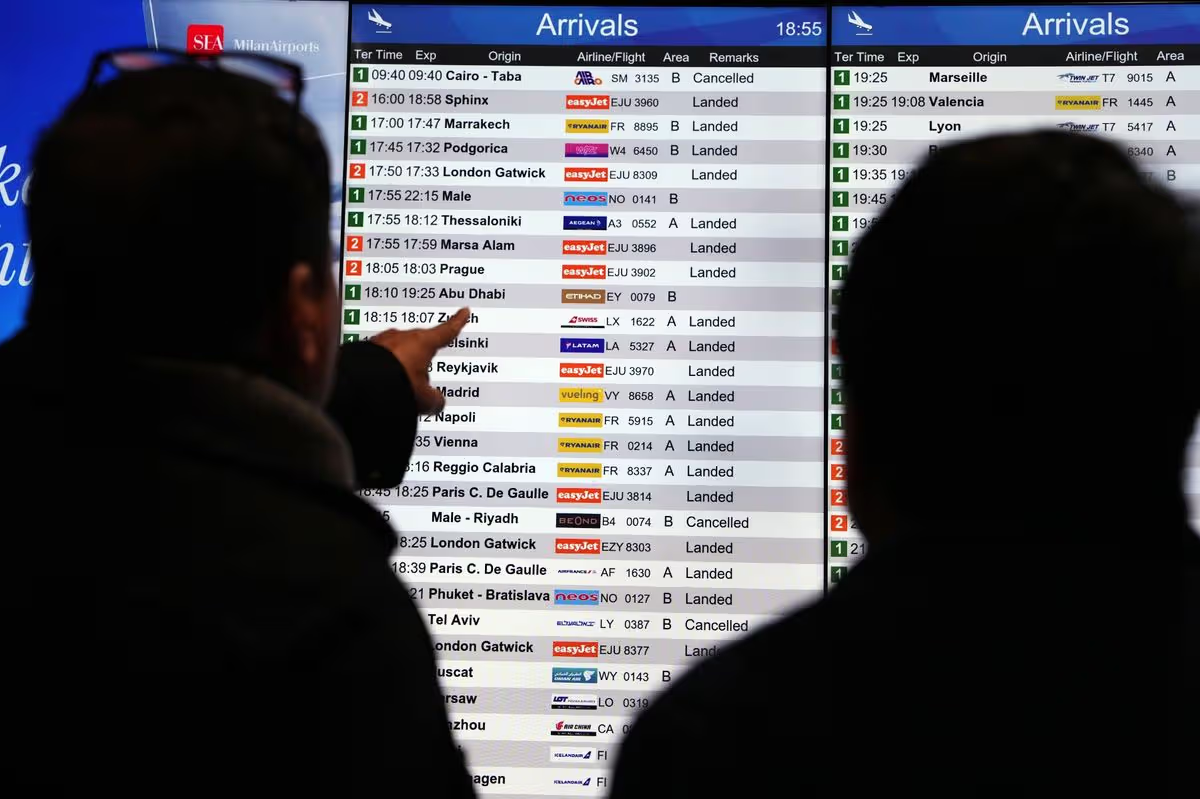
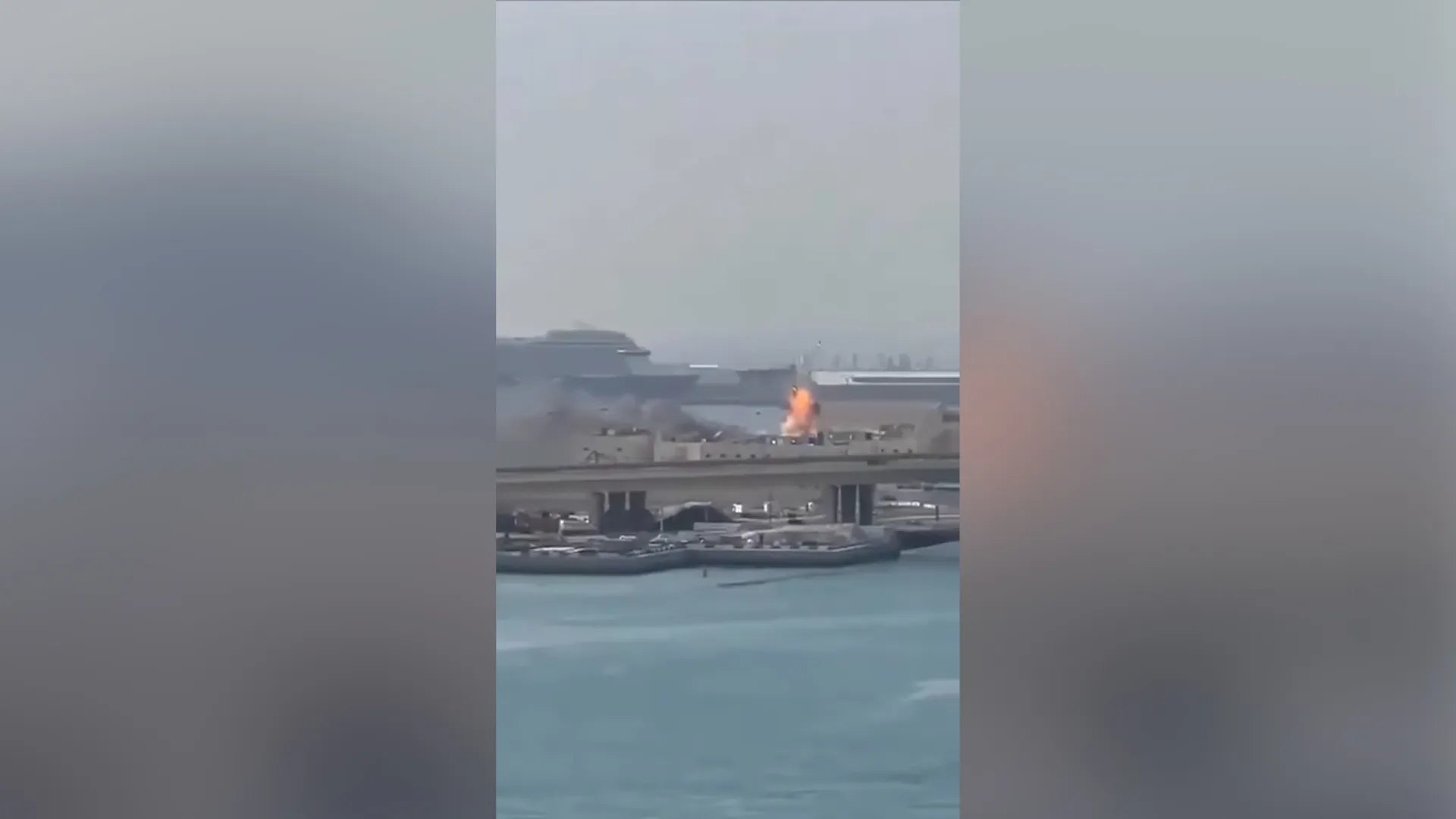
The US and Israel’s war on Iran is intensifying, as Trump again claims Iranian leaders want to ‘make a deal’.
Published On 26 Mar 202626 Mar 2026
The United States and Israel’s war on Iran continues, with an Al Jazeera correspondent in Tehran reporting strikes are “increasing in number and in intensity” amid conflicting claims about whether negotiations are taking place.
US President Donald Trump says talks are happening, but Iran rejects the talks, saying it will continue to “resist” US aggression.
On Thursday, Iran carried out retaliatory strikes against Israel and several Gulf countries, as the Middle East conflict sees no signs of ending, and global energy and food prices continue to rise.
In Iran
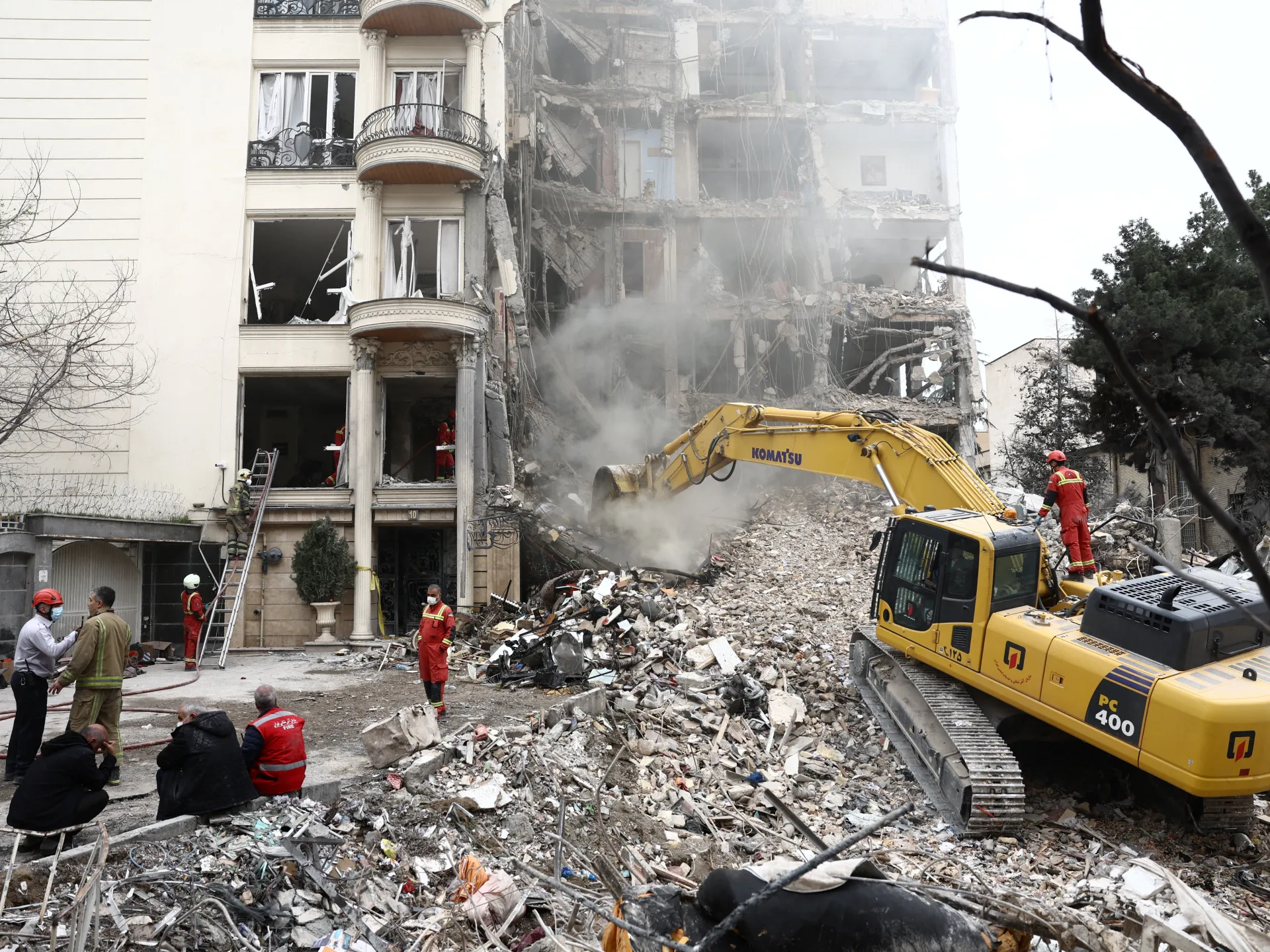
Intensifying attacks: US-Israeli attacks on Iran are “increasing in number and in intensity”, according to Al Jazeera correspondent, with Israel announcing extensive strikes on central Isfahan. Alongside US forces, Israel has launched a “wave of extensive strikes” across Iran.
Civilian casualties reported: Iranian media reported that two teenage boys were killed in a recent US-Israeli strike on a residential area in a village in the county of Shiraz.
Iran talks: US President Donald Trump insisted that Iran was taking part in peace talks.
Iran chooses ‘resistance’: Foreign Minister Abbas Araghchi said Tehran will continue its “resistance” and does not intend to negotiate.
US targets missile capacities: The US has hit two-thirds of Iran’s production facilities for missiles and drones, a top officer said.
Threat to Iranian island: Tehran warned enemies may try to occupy one of its islands with support from an unnamed regional country.
Iran’s leverage: Jane Foley, an analyst from Rabobank, noted that Tehran’s position on negotiations leaves the ball firmly in their court. Because the critical Strait of Hormuz remains effectively closed, she suggests Iran could have the power to dictate the terms of any resolution.
New toll legislation: The Iranian parliament is preparing a draft law that would mandate the collection of tolls and duties from ships and tankers transiting the Strait of Hormuz, treating the waterway like a standard transit corridor.
In the Gulf
Hezbollah plot uncovered in Kuwait: Authorities arrested six people allegedly linked to Hezbollah, accused of planning assassinations in the Gulf state, the Interior Ministry said.
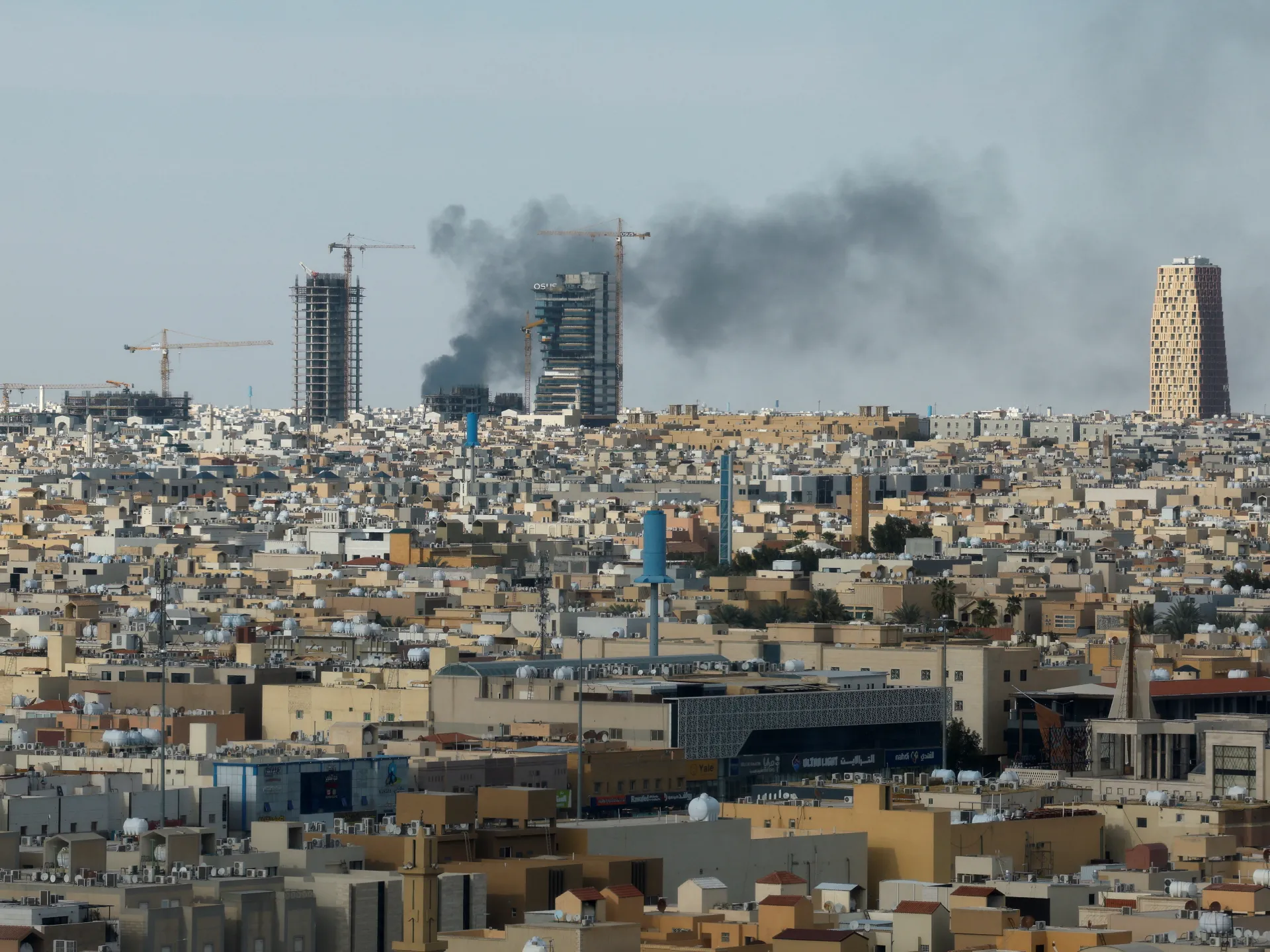
Saudi Arabia: Saudi Arabia’s Defence Ministry on Thursday morning announced the interception and destruction of a drone in the Eastern Province. Its air defence systems intercepted and destroyed at least two dozen drones targeting the Eastern Province, home to the majority of the kingdom’s oil facilities, on Wednesday.
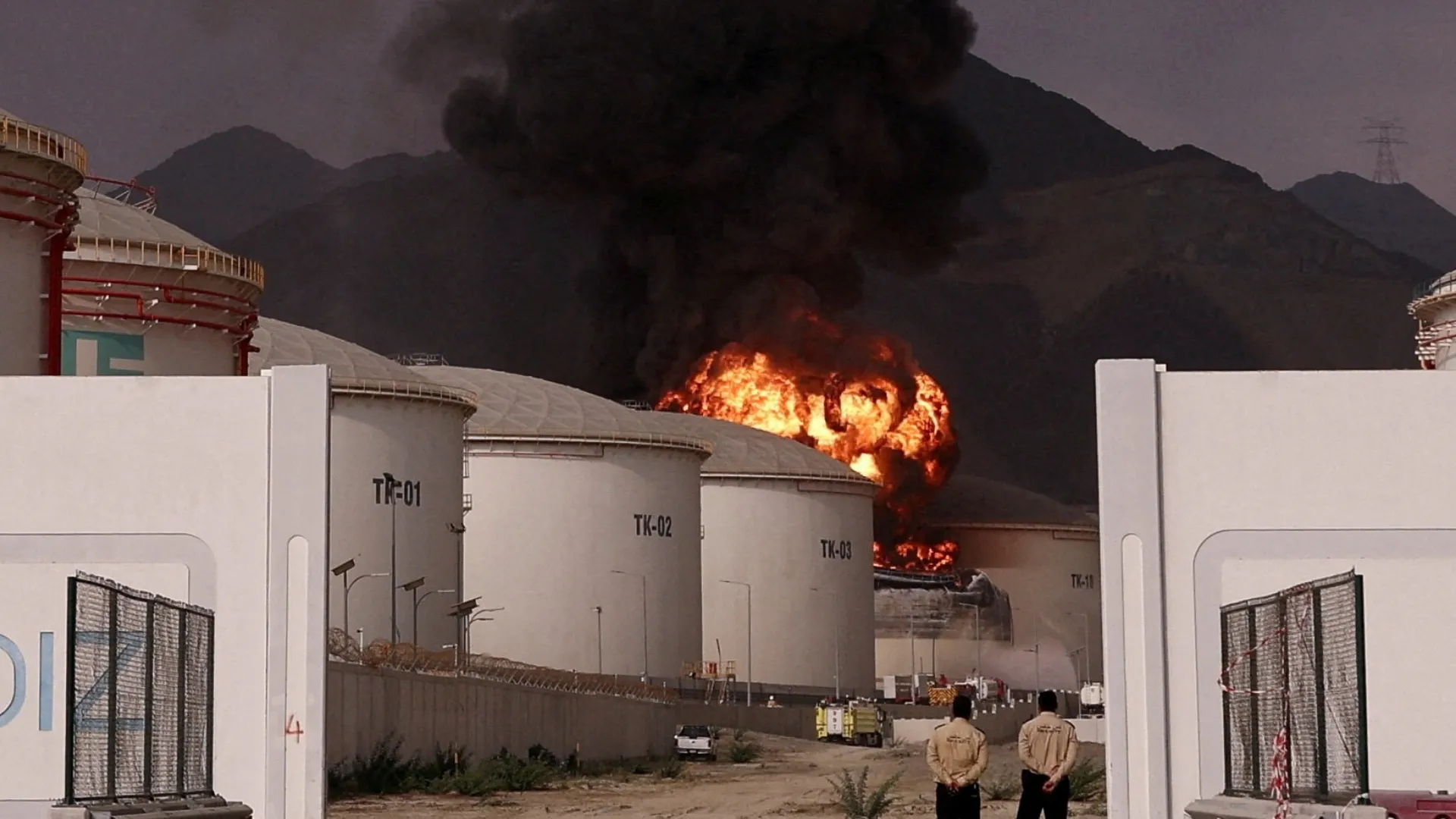
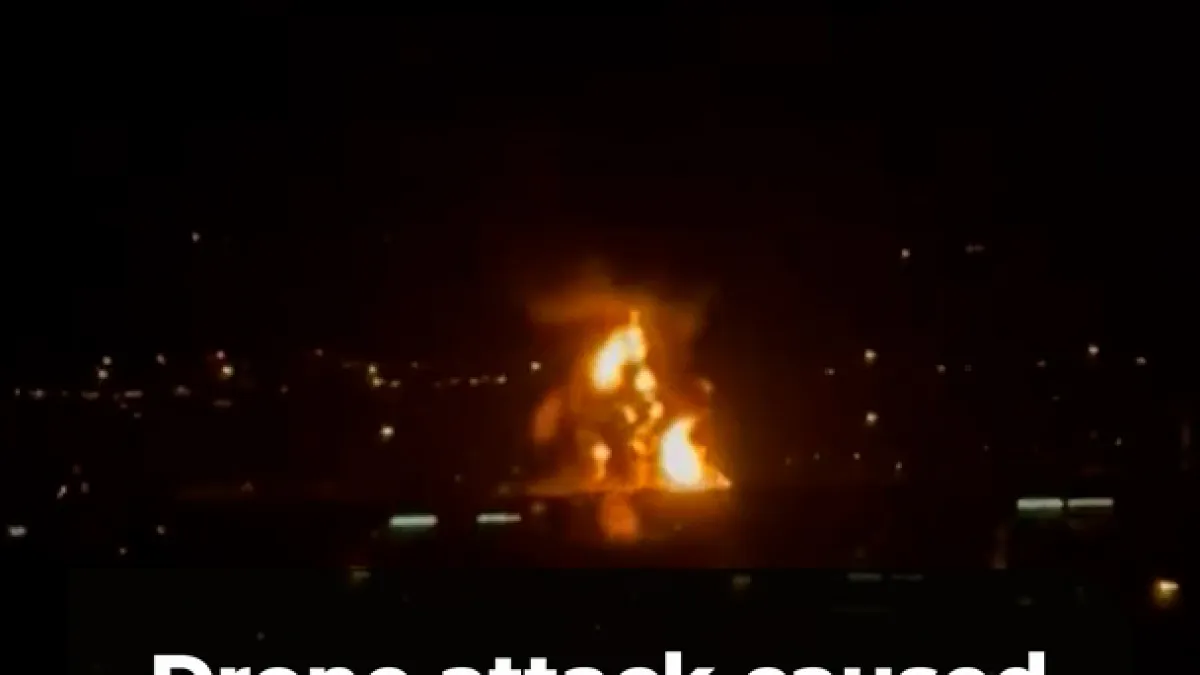
Bahrain: A fire broke out at a facility in the Muharraq Governorate due to what the Interior Ministry described as “Iranian aggression”.
United Arab Emirates: The UAE’s Defence Ministry said on Thursday that its air defence systems have been actively responding to and intercepting incoming missiles and drones from Iran.
In the US
Trump says Iran wants a deal: Trump again claims Iranian leaders want to “make a deal so badly” but are afraid to say so “because they figure they’ll be killed by their own people”.
Trump threatens ‘hell’ if no deal: Trump is ready to “unleash hell” on Iran if Tehran does not accept a deal to end the war, the White House warned on Wednesday.
Strategic posturing: Jason Campbell, a former Pentagon official, said US threats to “hit Iran harder” are more about signalling than intensifying attacks.
Intentional vagueness: Campbell told Al Jazeera that Trump is deliberately omitting specific details because he wants the Iranian regime to believe the US is fully capable and willing to execute these harsher attacks.
In Israel
Missile salvoes: Israel’s army on Thursday morning said it had detected a wave of missiles from Iran heading towards the country, the second salvo in less than 30 minutes.
Rockets and missiles targeting Israel: Iranian missiles continue to target central and northern Israel. Additionally, Hezbollah has fired volleys of rockets into the Western Galilee region.
In Iraq, Lebanon
Gulf issues Iraq demand: Gulf states and Jordan have urged Iraq to stop attacks by pro-Iran armed groups from its territory.
Ground clashes with Hezbollah: Israeli troops have crossed the border into Lebanese territory and are actively engaging in ground combat. Hezbollah says its fighters are continuing to clash with invading Israeli troops in south Lebanon.
Defending Lebanese soil: Hezbollah’s Secretary-General Naim Qassem stated that the group is now in a war against both the US and Israel and will do everything it can to defend Lebanese territory.
Oil markets and food
Oil prices climb: Oil prices have climbed higher amid fading hopes of de-escalation in the Iran war following Tehran’s rejection that talks with the US are under way.
Food supply shocks: Antony Currie, a columnist for Breakingviews, warned that the Iran war will likely have a more severe impact on global food security than Russia’s 2022 invasion of Ukraine.
A week into the United States-Israeli war on Iran, and Iran’s attacks on its Gulf neighbours, Jaya Khuntia spoke – as he often did – to his Doha-based son Kuna on the phone.
It was March 6, about 10pm, and Khuntia and the family were worried. “He told me, ‘I am safe here, don’t worry,’” the father recalled from the conversation with Kuna.
It was the last time they spoke.
The next day, the family in Naikanipalli village of India’s eastern Odisha state received a phone call from Kuna’s roommate telling them that the son had suffered a heart attack after hearing the sound of missiles and debris from interceptions falling near their residence. He collapsed and was later declared dead. Kuna’s body reached home days later.
Al Jazeera cannot independently confirm the cause of Kuna’s death, but the family of the 25-year-old, who worked as a pipe fitter in Qatar’s capital, is among millions across South Asia directly affected by the war in the Middle East.
Of the eight people killed in the United Arab Emirates in Iranian attacks, two were Emirati military personnel, a third a Palestinian civilian, and the remaining five were from South Asia: Three from Pakistan, and one each from Bangladesh and Nepal. All three people killed in Oman were from India. An Indian national and a Bangladeshi national are the only deaths in Saudi Arabia.
Migrant workers from South Asia total nearly 21 million people in the Gulf nations, a third of the total population of the region. At stake, for their families back home, is the safety of their loved ones and the future of their dreams.
The Khuntia family had taken on a 300,000-rupee ($3200) debt in 2025 for the marriages of their two daughters. Kuna’s income in Doha – where he had moved only in late 2025 – of 35,000 rupees ($372) was helping them collect what they needed to pay back the loan. Kuna had been sending back about 15,000 rupees ($164) every month.
“We thought our suffering was finally ending,” Jaya said, his voice trembling. “My only son would say, ‘Baba, don’t worry, I am here.’ He was our only hope… our everything.”
That hope is now extinguished. “That one call finished us,” Jaya cried. “He promised to return after clearing our debts … but he came back in a coffin. We have nothing left now. Losing our only son is the biggest debt we have to live with.”
Kuna Khuntia, a 25-year-old pipe fitter from India’s Odisha, who died of a heart attack in Doha, Qatar [Photo courtesy the Khuntia family]
‘I thought we would be next’
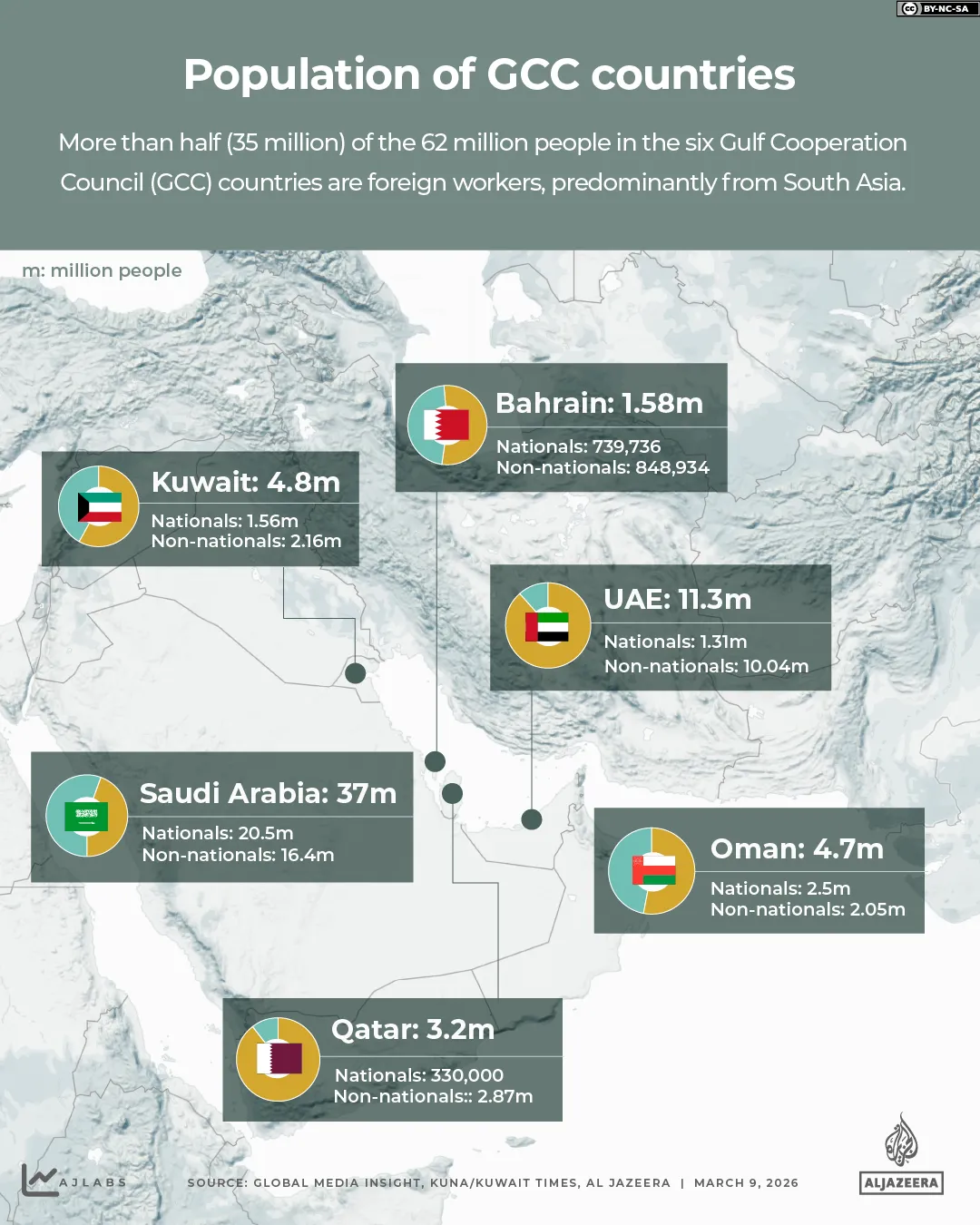
In all, Bahrain, Kuwait, Oman, Qatar, Saudi Arabia and the UAE – the six Arab countries in the Gulf – host 35 million foreign nationals, who form a majority of their total population, 62 million.
They include 9 million people from India, 5 million each from Pakistan and Bangladesh, 1.2 million from Nepal, and 650,000 from Sri Lanka. Most of them are engaged in blue-collar work, building or supporting the industries and services that are at the heart of the Gulf’s success and prosperity.
But since the US and Israel launched their war on Iran, these migrant workers have often been among the most vulnerable. That vulnerability extends beyond deaths and injuries to the very nature of their work: Oil refineries, construction areas, airports and docks, where many work, have been targeted in Iranian attacks.
The suspension of work at many of these facilities, coupled with fears of a major economic downturn in the region, has also left many workers and their families worried about the future of their jobs.
Hamza*, a Pakistani migrant labourer working at an oil storage facility in the UAE, recalled a recent attack that he witnessed. “A drone struck a storage unit right in front of us. We were completely shaken. Most of us there are from India, Pakistan and Bangladesh.
“We couldn’t sleep for nights after that. The drone was so close that it could have killed us, too,” Hamza added. “For a moment, I thought we would be next.”
Despite these dangers, he said, leaving is not an option.
“We want to go back, but we can’t,” Hamza said. “Our families depend on us. It’s dangerous here, but if we stop working, they will have nothing to eat. We have no choice.”
Experts say Hamza’s sentiment is common across South Asian blue-collar workers in the Gulf, because of poverty and limited employment opportunities back home.
Imran Khan, a faculty member at the New Delhi Institute of Management working on migration economics, said migrant labourers from South Asia are often driven by desperation to take up jobs in the Middle East. He said Western countries have, in recent years, dramatically raised entry barriers for less-educated blue-collar foreign workers.
“These workers are the worst affected during crises – whether war or natural disasters,” he says. “I have been speaking to several migrant labourers, particularly Indians in the Middle East, and many are living in distress since the conflict began.”
But, like Hamza, most cannot afford to leave, Khan said.
“They cannot simply quit. Their income would stop immediately, and there are very limited opportunities back home,” he explained. “They have families to support, and without these jobs, survival becomes difficult.”
Indian labourers work at the construction site of a building in Riyadh, November 16, 2014 [Faisal Al Nasser/Reuters]
Families – and societies – that depend on remittances
Middle Eastern countries remain a key source of remittances for South Asian nations such as India, Pakistan, Bangladesh, Sri Lanka and Nepal. The remittances these five countries receive from the region, $103bn, are comparable to Oman’s total gross domestic product (GDP).
Just the remittances that India receives from the Gulf, $50bn, are more than Bahrain’s entire GDP. Pakistan receives $38.3bn in remittances, Bangladesh $13.5bn, Sri Lanka $8bn, and Nepal $5bn.
With the recent escalation of conflict in the Middle East, experts warn these flows could be significantly affected, especially if Gulf economies contract and layoffs follow.
Faisal Abbas, an expert in international economics and director at the Centre of Excellence on Population and Wellbeing Studies, a Pakistan-based research institute, said remittances from the Middle East form a crucial economic backbone for South Asian nations, not just families.
“Remittances are a critical pillar for Pakistan and other South Asian economies, and a large share comes from Middle Eastern countries,” he explained. “If the situation worsens, it will not be a positive development for the region.”
Pakistan’s remittances from the Gulf constitute nearly 10 percent of its GDP, about $400bn.
Abbas added that the effect may extend beyond remittance flows. “Migration patterns could also be disrupted. Many workers may return home, while those planning to migrate might reconsider,” he said. “This could further increase unemployment in a region already facing job shortages.”
Unlike Hamza, a number of South Asian workers are planning to return home.
Noor*, a migrant worker from Bangladesh employed at an oil facility in Saudi Arabia, said he no longer feels safe and plans to return home once his contract ends.
“I will never come back here again,” he said. “It’s too dangerous. We can’t even sleep at night. The fear never leaves us.”
Noor said drone attacks had occurred close to his workplace. “We saw it happen in front of us,” he said. “That fear stays with you… It doesn’t go away.”
His family, too, is deeply affected. “My children cry every time they call me. They are scared for my life,” he added.
He said he knows that returning to Bangladesh would mean more economic hardship for his family. But Noor said he had made up his mind.
“I would rather go back and struggle to survive with my family than live here in constant fear,” he said. “At least there, I will be with them.”
*Some names have been changed at the request of workers who fear retribution from contractors for speaking to the media.
Iran’s Revolutionary Guard Corps calls Trump a ‘deceitful American president’, saying his ‘contradictory behaviour will not make us lose sight of the battlefront’.
Oil and gas facilities in the Gulf have been attacked since early in the war on Iran.
The war in the Middle East took a serious turn when Israel bombed Iran’s energy facilities, pushing Iran to step up attacks on its Gulf neighbours.
The damage has been significant and will take years to repair. It also has long-term consequences, with Qatar already warning of a reduction in exports.
Recommended Stories
list of 3 itemsend of list
The escalation is dangerous, experts say, as energy exports from the Gulf region account for a fifth of global output.
So, what are the risks of turning energy facilities into battlefields?
Presenter: Imran Khan
Guests:
Mohsen Baharvand – Former Iranian ambassador to the United Kingdom
Jim Walsh – Research associate in MIT’s security studies programme
John Sfakianakis – Chief economist at the Gulf Research Center
Tehran has warned of zero restraint if energy facilities are attacked again, while Netanyahu signals that there could be a ‘ground component’ to the war.
Published On 20 Mar 202620 Mar 2026
Iran has warned it will show “zero restraint” if its energy facilities are attacked again, a day after Israel struck the South Pars gasfield and Tehran attacked energy sites across the Gulf.
In the United States, President Donald Trump raised controversy during a meeting with Japan’s Prime Minister Sanae Takaichi by invoking the 1941 bombing of Pearl Harbour while defending the element of surprise in the Iran attack.
Meanwhile, as the conflict intensifies, concerns over supply disruptions have pushed global oil and gas prices higher, with sharp increases reported across the United Kingdom and Europe.
In Iran
Escalation: After Israel struck Iran’s South Pars gasfield, Tehran hit targets in Haifa, Israel, and Ras Laffan, Qatar, warning of “zero restraint” if its energy facilities are attacked again and claiming Iran has only used a “fraction” of its firepower so far.
Widespread regional missile strikes: Iran’s Islamic Revolutionary Guard Corps (IRGC) announced a new wave of missile and drone attacks on US bases and central and southern Israel, including Tel Aviv, Haifa, and Jerusalem.
Humanitarian toll: The Iranian Red Crescent Society reported that more than 18,000 civilians have been injured and 204 children have been killed in Iran since the war began on February 28. In all, more than 1,400 people have been killed in Iran.
US airbase in Germany: Iran said it had asked Germany to clarify the role of the Ramstein Air Base in the war. “The role of Ramstein is not officially clear for us,” Tehran’s ambassador to Germany, Majid Nili, said. The Ramstein Air Base matters because it is one of the US military’s most important hubs and a key link in operations in the Middle East.
Macron eyes UN action on Hormuz: French President Emmanuel Macron said he will consult United Nations Security Council members on a framework to secure navigation in the Strait of Hormuz, a vital global chokepoint through which about 20 percent of the world’s oil and gas flows – once fighting subsides.
In the Gulf
Gulf attacks: UAE and Kuwaiti air defences were responding to missile attacks on Friday, authorities in the Gulf states said. Saudi Arabia’s Ministry of Defense said it had intercepted and destroyed 10 drones in the country’s east and another in the north.
UAE arrests: Authorities detained at least five members of a “terrorist network” linked to Iran and Hezbollah that allegedly used business fronts to infiltrate the economy as part of a coordinated external plan, the official WAM news agency reported.
Qatar – Ras Laffan attack: Iran hit Qatar’s key LNG facility, cutting about 17 percent of output for as long as five years, the CEO of QatarEnergy has said. With Qatar supplying 20 percent of global LNG, disruptions are expected, with force majeure likely on some contracts to Belgium, Italy, South Korea, and China. Diplomatically, Qatar’s prime minister and Turkiye’s foreign minister held a joint news conference condemning the act of sabotage as a “dangerous escalation” by Iran. On Thursday, Qatar’s defence forces again reported ballistic missile attacks.
Missile and drone interceptions in Bahrain: Bahrain’s Defence Force reported shooting down five incoming missiles recently, bringing its total interceptions to 139 missiles and 238 drones since the start of the conflict more than two weeks ago.
In the US
‘Pearl Harbour’ remarks: Trump defended not informing allies about the US strikes on Iran, saying “we wanted surprise.” He then turned to Japanese Prime Minister Sanae Takaichi, who was visiting the White House and was seated next to him, and invoked the 1941 bombing of Pearl Harbour, saying, “Who knows better about surprise than Japan? Why didn’t you tell me about Pearl Harbour, OK? Right?”
Diplomatic shockwaves: Analyst Mireya Solis called Trump’s Pearl Harbour remark to Japan’s PM “unusual – a shock” that brings up a bitter rivalry rather than emphasising shared allied bonds.
US war objectives unchanged: Defense Secretary Pete Hegseth said US goals remain the same since February 28 – targeting Iran’s missile systems, military industry and navy, and preventing a nuclear weapon, with no set end date.
No US ground troops: Trump said he was not sending US ground troops to Iran, telling reporters: “If I were, I certainly wouldn’t tell you. But I’m not putting troops.” However, Trump has frequently changed his position on whether he is open to deploying boots on the ground in Iran.
F-35 incident: A US F-35 fighter jet made an emergency landing at a Middle East airbase after a combat mission over Iran. The aircraft landed safely and the pilot is stable, while US officials investigate reports it may have been struck by Iranian fire. If that is the case, it would be the first US jet struck by Iran during the current war.
In Israel
Explosions over Jerusalem: Israel’s military said it had identified three rounds of missile fire in the hour and a half preceding midnight, and another a few hours later.
Netanyahu says Iran ‘decimated’: Israeli Prime Minister Benjamin Netanyahu said at a news conference he saw “this war ending a lot faster than people think … We are winning and Iran is being decimated.”
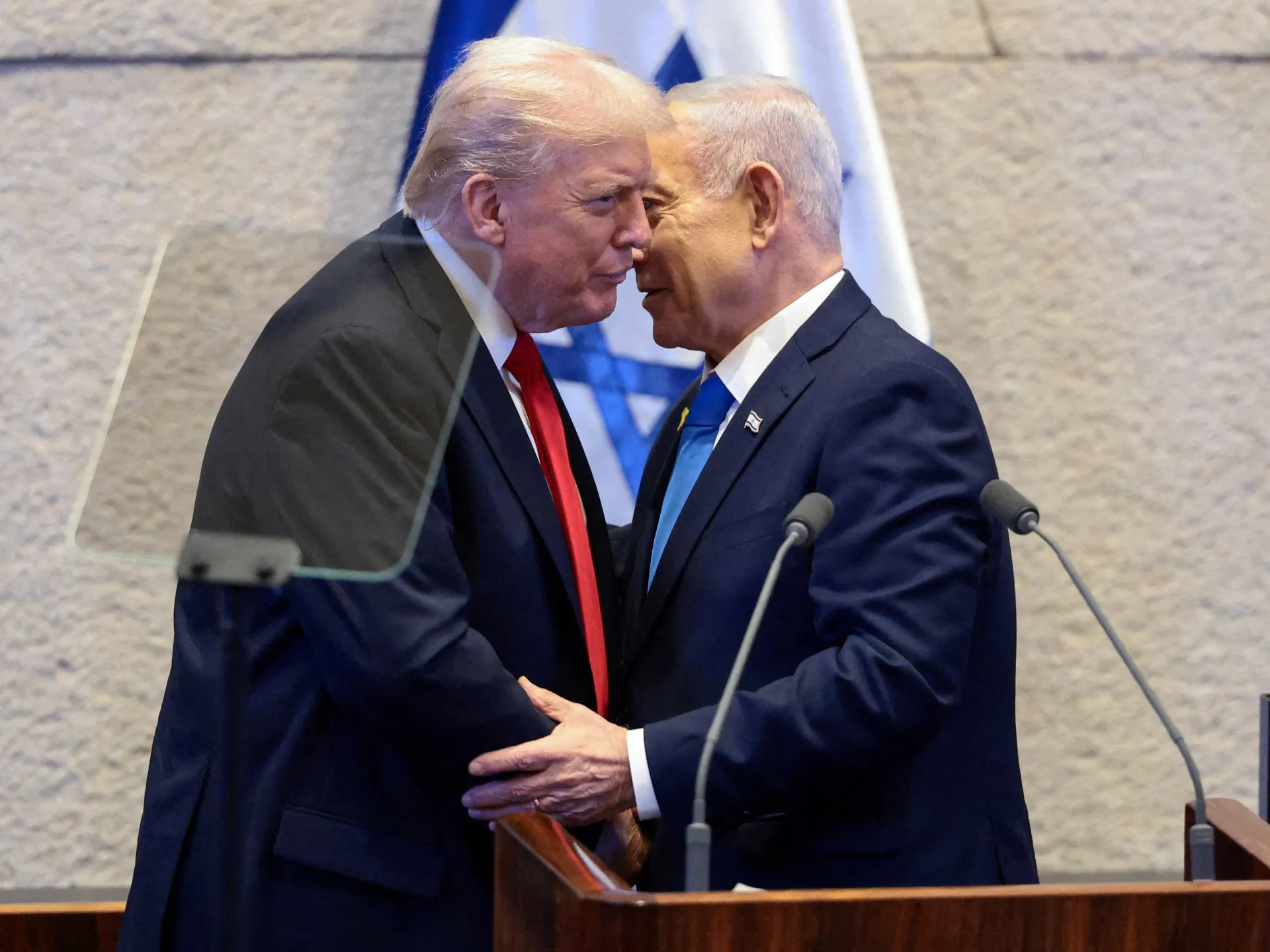
Trump and Netanyahu: Netanyahu also denied that Israel “dragged” the US into the war, asking, “Does anyone really think that someone can tell President Trump what to do?”
Israel ‘acted alone’: The PM also said Israel acted on its own when it struck an Iranian gasfield. “President Trump asked us to hold off on future attacks and we’re holding out.”
Netanyahu signals possible ground phase: “It is often said that you can’t win, you can’t do revolutions from the air. That is true. You can’t do it only from the air. You can do a lot of things from the air, and we’re doing, but there has to be a ground component as well,” the Israeli prime minister said in his remarks.
Next stage questions: Al Jazeera’s Rob McBride described Netanyahu’s comments about a possible ground component as “intriguing”, suggesting a potential next stage while raising questions about how it would unfold. Netanyahu’s remarks were also seen as an attempt to reassure Israelis that the nearly three-week war has been worthwhile.
Core objectives: Netanyahu also reiterated goals of dismantling Iran’s nuclear programme, degrading its ballistic missile capabilities, and shaping conditions for a future without the “current regime”.
Regional framing: “In a wider sense, he was also claiming that with their American allies, they were reshaping the Middle East altogether, and that the balance of power and the dynamics within that – that Israel, he said, had never been stronger, while Iran, he claimed, had never been weaker,” McBride said.
In Lebanon
Severe humanitarian crisis and displacements: Since Israeli attacks on Lebanon escalated on March 2, the death toll in the country has surpassed 1,000 people, with at least 2,584 wounded. Furthermore, residents in towns such as Machghara and Sahmar in the Bekaa Valley reported receiving threatening phone calls from foreign numbers urging them to evacuate.
Ongoing clashes and military actions: Fierce fighting continues in southern Lebanon, where the Israeli army has expanded its ground troop presence. Hezbollah has claimed responsibility for multiple attacks, including firing missiles at Israeli soldiers and vehicles in the southern Lebanese towns of al-Aadaissah, Meiss el-Jabal, and Maroun al-Ras.
Diplomatic efforts for a truce: Amidst the heavy fighting, Lebanese President Joseph Aoun has renewed calls for a truce and the opening of negotiations with Israel to end the war.
Oil and gas
Global economic effect: The Ras Laffan strike cut about 17 percent of LNG capacity, with losses near $20bn a year and an estimated 9 percent annual hit to Qatar’s gross domestic product, according to Al Jazeera’s Dmitry Medvedenko, who was reporting from Doha.
Soaring global prices: Concerns over these supply disruptions have triggered a surge in global oil and gas prices. Gas prices have risen sharply across the UK and Europe. The ripple effects are being felt in developing nations as well; for instance, fuel prices in Zimbabwe recently topped $2 per litre for the first time as a direct result of the conflict’s effect on oil and gas exports.
International pushback and warnings: Due to the escalating energy crisis, the European Council has urgently called for a moratorium on strikes against energy and water facilities.
US may ‘unsanction’ Iranian crude: US Treasury Secretary Scott Bessent said Washington might “unsanction” Iranian oil that is already being shipped to ease oil prices. In comments to Fox Business, Bessent also said the US government could release more oil from its strategic reserves.
Saudi Arabia’s Foreign Minister warns Iran that regional neighbours have ‘significant’ capabilities with which to respond to Tehran’s aggression.
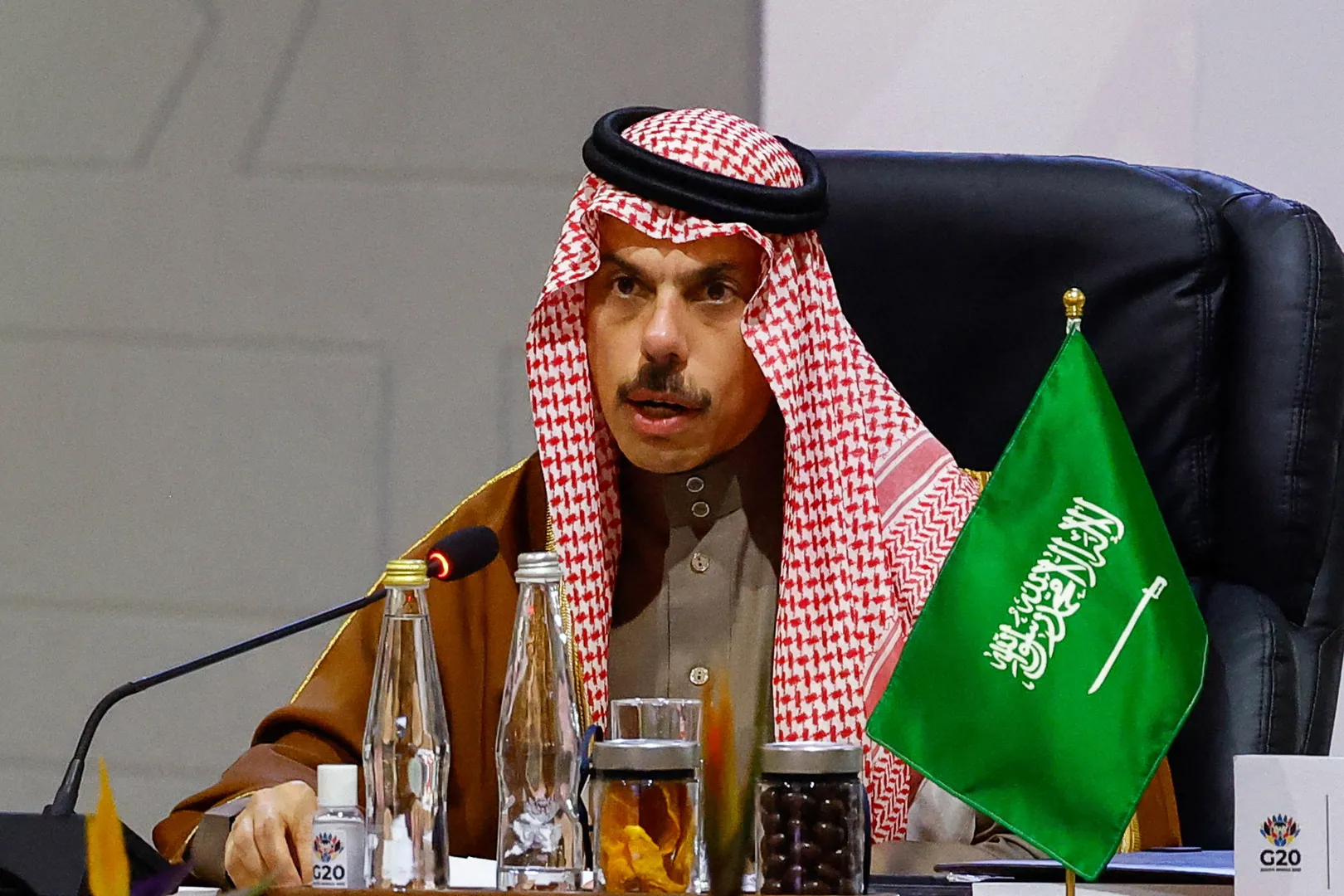
Saudi Arabia’s Foreign Minister Prince Faisal bin Farhan Al Saud has warned Iran that tolerance of its attacks on his country and those of neighbouring Gulf states is limited, calling on Tehran to immediately “recalculate” its strategy.
Warning that Saudi Arabia and other Gulf states have “very significant capacities and capabilities” that could be drawn on should they “choose to do so”, the foreign minister told a news conference early on Thursday that Iran had carefully planned its strategy for striking regional neighbours, despite denials from Tehran’s diplomats.
Recommended Stories
list of 4 itemsend of list
“The level of accuracy in some of this targeting – you can see it in our neighbours as well as the kingdom – indicates that this is something that was premeditated, preplanned, preorganised and well thought out,” Prince Faisal said.
“I’m not going to lay out what would and would not precipitate a defensive action by the Kingdom [of Saudi Arabia] because I think that is not a wise approach to signal to the Iranians,” the foreign minister continued.
“But I think it’s important for the Iranians to understand that the kingdom, but also its partners who have been attacked and beyond, have very significant capacities and capabilities that they could bring to bear should they choose to do so,” he said.
“The patience that is being exhibited is not unlimited. Do they [the Iranians] have a day, two, a week? I’m not going to telegraph that,” he added.
“I would hope they understand the message of the meeting today and recalculate quickly and stop attacking their neighbours. But I am doubtful they have that wisdom.”
Prince Faisal’s warning followed a meeting of foreign ministers from Arab and Islamic countries in the Saudi capital earlier in the day to discuss the expanding war in the region, which on Wednesday saw Iranian attacks on Gulf energy sites, including Qatar’s Ras Laffan gas facility, where significant damage was reported, and the United Arab Emirates’ Habshan gas facility.
Qatar’s Ministry of Foreign Affairs expressed its “strong condemnation and denunciation of the blatant Iranian attack targeting Ras Laffan Industrial City”, located 80km (50 miles) northeast of the Qatari capital Doha, which is the world’s largest liquefied natural gas (LNG) production facility, producing some 20 percent of the world’s LNG supply.
Iran’s Islamic Revolutionary Guard Corps (IRGC) had warned earlier that oil and gas facilities in Qatar, Saudi Arabia and the UAE would face retaliation for an Israeli strike on Iran’s South Pars gasfield.
Iranian state media reported that facilities linked to the country’s huge offshore South Pars field – located off the coast of southern Iran’s Bushehr province – had come under attack.
Saudi Arabia’s Ministry of Defence also said on Wednesday that its air defences had intercepted four Iranian ballistic missiles that targeted Riyadh and two launched towards the country’s eastern region.
Air defences in the UAE dealt with 13 ballistic missiles and 27 drones, according to the country’s Defence Ministry, while operations were suspended at the Habshan gas facility as authorities responded to incidents caused by fallen debris after the successful interception of a missile.
The Saudi foreign minister also told the news conference on Thursday that while the war will end one day, it will take much longer to restore relations with Iran as trust “has completely been shattered” due to Tehran’s tactics of targeting its neighbours.
“We know for a fact that Iran has been building this strategy over the last decade and beyond,” Prince Faisal said.
“This is not something that is a reaction to an evolving circumstance where Iran is improvising. This has been built into their war planning: targeting their neighbours and using that to try and put pressure on the international community,” he said.
“So when this war eventually ends, in order for there to be any rebuilding of trust, it will take a long time. And I have to tell you, if Iran doesn’t stop … immediately, I think there will be almost nothing that can re-establish that trust,” he added.
Qatar, UAE, Kuwait and Saudi Arabia report new blasts, interceptions, with war edging to 3-week mark.
Published On 18 Mar 202618 Mar 2026
Iran has fired missiles and drones at several Gulf Arab nations, which have sought to intercept them, in a now-daily fallout from the United States-Israel war launched on Iran nearly three weeks ago that has engulfed the Middle East with deaths, destruction, assassinations, and an energy crisis spreading far beyond the region.
Early Tuesday, Qatar’s Ministry of Defence said its armed forces intercepted a missile attack against the country.
Recommended Stories
list of 4 itemsend of list
The Kuwait National Guard said it shot down an unmanned aircraft at dawn. The statement came hours after the Kuwaiti army said it was intercepting hostile missile and drone attacks.
The UAE, Saudi Arabia and Bahrain have also reported intercepting missiles and drones in recent hours.
Saudi Arabia’s Ministry of Defense reported the interception and destruction of a drone in the Eastern Region.
Earlier Tuesday, the UAE Ministry of Defence said the country’s air defences were “currently responding to incoming missile and drone threats from Iran”. The announcement came four hours after another reported attack from Iran. Later, a loud bang was heard in Dubai as authorities said air defences were dealing with a missile threat.
Al Jazeera’s Zein Basravi, reporting from Dubai, said, “The UAE has been the hardest hit by Iran’s retaliation. For instance, there have been 3000 different projectiles – missiles and drones – fired at GCC countries by Iran in terms of its retaliation. More than half, well over half, have targeted places in the UAE. Overnight was no different … Multiple explosions heard throughout the city.
“That glow of defensive weapons and interceptions in the night skies, something that has become all too familiar, not just in Dubai, but in cities across the GCC. Once again seen over the skies here.
“Dubai’s media office confirming that they were the result of air defence interception operations,” he added.
There have been several deaths in the Gulf nations, where an economic effect is also being acutely felt since the war began.
Gulf economies bear brunt of Iran war
The economies of the Gulf are suffering some of the worst damage.
Iran has launched continuous attacks on Gulf states since the onset of the conflict on February 28, arguing that it is attacking military bases used by the US for the war. Gulf nations have rejected Tehran’s claims, insisting the attacks on them are unjustified.
The Iranian strikes have upended energy production and inflicted major disruption to tourism and travel, putting the region at risk of some of the most severe economic harm since the 1990-1991 Gulf War.
After nearly three weeks of war, the economic effect on the region has already been substantial.
Middle Eastern oil producers’ daily output declined from 21 million barrels to 14 million barrels after a little more than a week of conflict as they deal with the closure of the Strait of Hormuz, according to Rystad Energy.
Ukrainian President Zelenskyy says Moscow and Tehran are ‘brothers in hatred’; claims Iran’s drones ‘contain Russian components’.
More than 200 Ukrainian military experts are in the Gulf region and wider Middle East helping governments in their defence against Iran’s drone attacks, Ukraine’s President Volodymyr Zelenskyy has said.
In an address to dozens of members of the United Kingdom Parliament in London on Tuesday, the Ukrainian leader said 201 Ukrainian anti-drone experts are in the region and another 34 “are ready to deploy”.
Recommended Stories
list of 4 itemsend of list
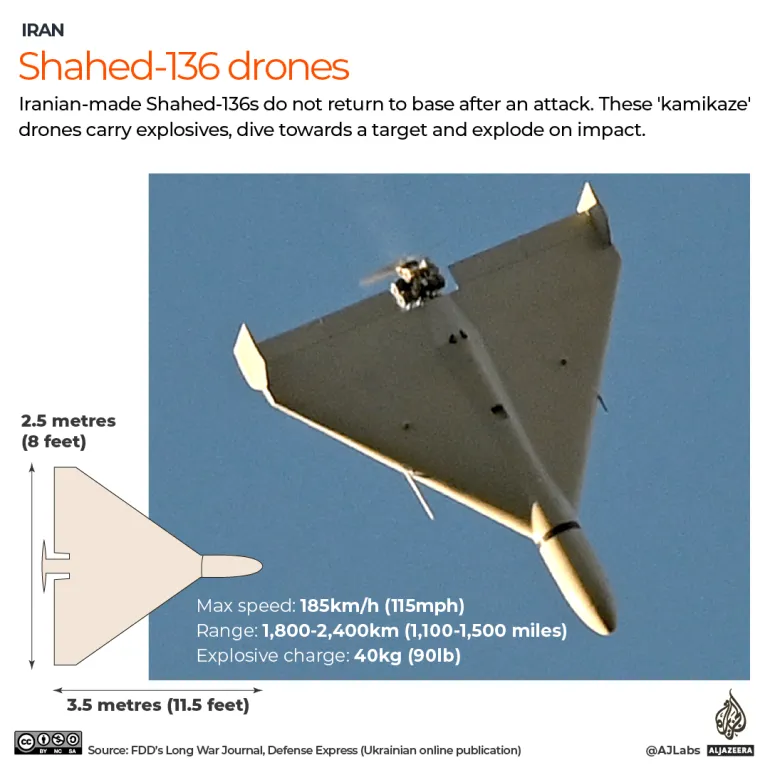
“These are military experts, experts who know how to help, how to defend against Shahed drones,” Zelenskyy said in his speech, referring to the Iranian-designed “kamikaze” drones that Russia has been using in its war against Ukraine since 2022.
“Our teams are already in the Emirates, Qatar, Saudi Arabia, and on the way to Kuwait,” the Ukrainian leader said.
“We are working with several other countries – agreements are already in place. We do not want this terror of the Iranian regime against its neighbours to succeed,” he said.
Last week, the Ukrainian leader said military teams had been sent to several Gulf states and Jordan.
Zelenskyy, who met with UK Prime Minister Keir Starmer and NATO chief Mark Rutte earlier on Tuesday, said Russia had received the Shahed-136 drones from the Iranians, who had “taught Russia how to launch them and gave it the technology to produce them”.
“Russia then upgraded them. And now we have clear evidence that Iranian Shaheds used in the region contain Russian components,” Zelenskyy said, describing the drones as designed for “low-cost destruction of expensive critical infrastructure”.
“So what is happening around Iran today is not a faraway war for us, because of the cooperation between Russia and Iran,” he said.
“The regimes in Russia and Iran are brothers in hatred, and that is why they are brothers in weapons. And we want regimes built on hatred to never win – in anything,” he added.
The Ukrainian leader then addressed his country’s newly developed prowess in drone warfare and manufacturing, claiming that 90 percent of Russian losses on the front lines in Ukraine are being “caused by our drones”.
Ukraine has moved on from making sea and aerial drones to producing interceptors that target drones, he said, adding that Ukraine is capable of producing at least 2,000 interceptors per day – half of which are required for its own defence and the remainder available for use by Kyiv’s allies.
“If a Shahed needs to be stopped in the Emirates – we can do it. If it needs to be stopped in Europe or the United Kingdom – we can do it. It is a matter of technology, investment, and cooperation,” he said.
While Ukraine has become one of the world’s leading producers of sophisticated, battlefield-proven drone interceptors, US President Donald Trump has said he does not need Ukraine’s help with countering Tehran’s drones targeting military targets in the Middle East.
After meeting with Zelenskyy at 10 Downing Street, Starmer said Russian President Vladimir Putin “can’t be the one who benefits from the conflict in Iran, whether that’s oil prices or the dropping of sanctions”.
During Zelenskyy’s visit on Tuesday, London and Kyiv signed a deal on a “defence partnership”, which is said to combine “Ukraine’s expertise and the UK’s industrial base to manufacture and supply drones and innovative capabilities”.
Witness videos captured missile interceptors launching and burning debris raining from the sky near the Dubai International Convention and Exhibition Centre.
Footage shows a fire burning near Dubai International Airport after a drone ignited a fuel tank, according to authorities in the UAE. Flights have been suspended. Civil defence crews say the blaze is under control.
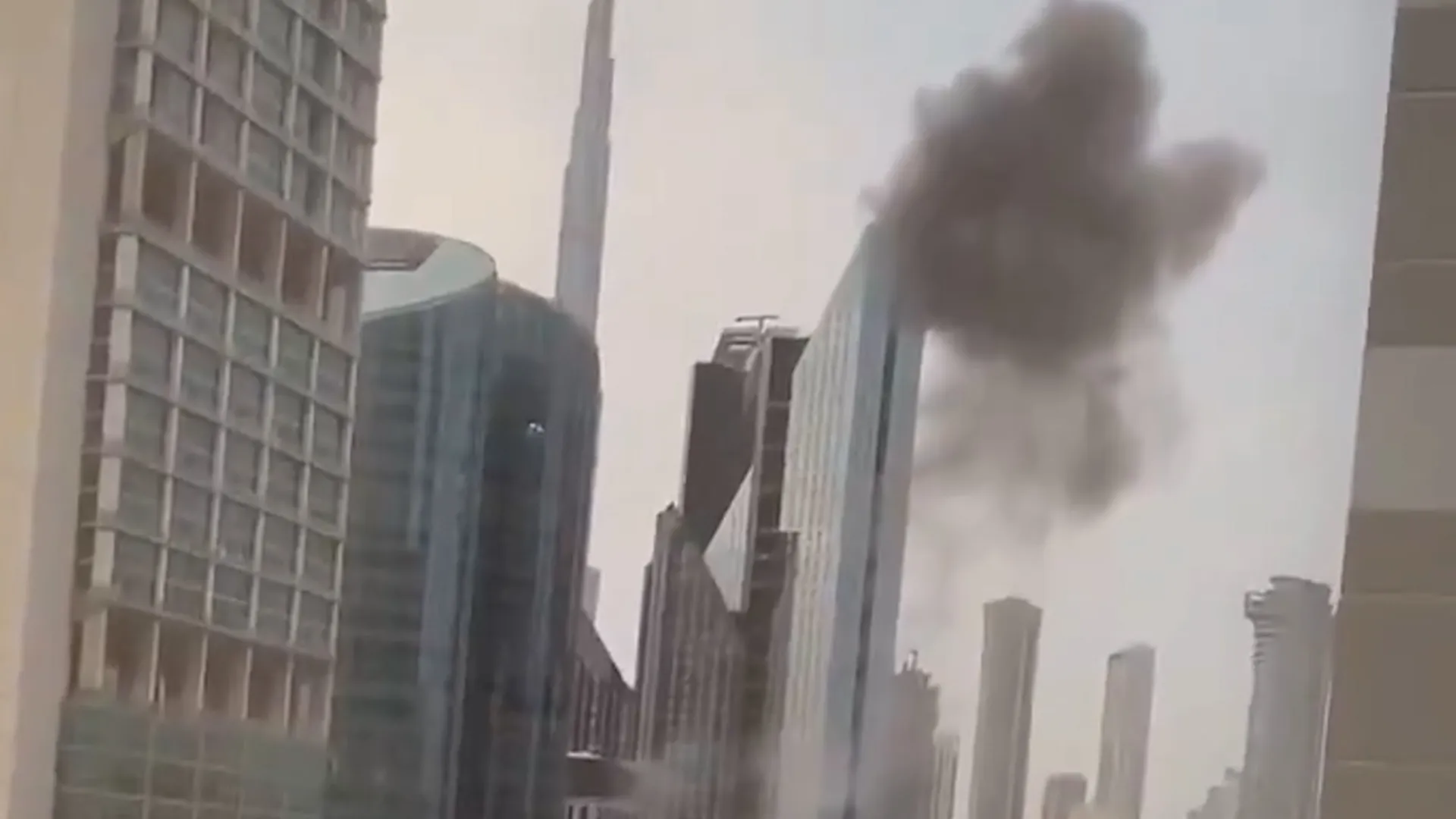
Black smoke could be seen in Dubai’s financial district where witnesses reported hearing explosions on Friday morning. Authorities there said a building was hit by debris from an intercepted missile.
Heavy Israeli strikes have hit Tehran, Iran, as its allies launch attacks across Gulf states, and shipping through the Strait of Hormuz has been severely disrupted, sending global oil prices soaring.
Meanwhile, political pressure is mounting in Washington as the conflict spreads across the region.
Recommended Stories
list of 1 itemend of list
Here is what we know about what has been happening in the past 24 hours:
In Iran
Supreme leader speaks: Appointed last week following the assassination of his father, Iran’s new Supreme Leader Mojtaba Khamenei has issued his first statement, warning that attacks on Israel and US military assets and infrastructure in the Middle East will continue unless bases hosting US forces in the region are closed.
Heavy strikes on Tehran: The Israeli military has launched a new “extensive wave” of air attacks on Iran’s capital, Tehran, leaving the city covered in thick smoke on Friday morning.
Strait of Hormuz closure and surging oil prices: The Strait of Hormuz, which connects the Gulf to the Gulf of Oman, is closed, causing Brent crude oil prices to surge past $100 per barrel. The strait, which falls into the territorial waters of Iran and Oman, is the only waterway to the open sea available to oil and gas producers in the Gulf. Iran has stated that the strait is under Iranian control and US-and Israel-linked ships are banned. Other vessels must receive Iranian permission to pass.
Civilian casualties: Iran’s ambassador to the United Nations, Amir Saeid Iravani, said at least 1,348 civilians have been killed, with victims ranging in age from eight months to 88 years old.
A navy vessel is seen sailing in the Strait of Hormuz [Sahar Al Attar/AFP]
In Gulf countries
Regional retaliation and attacks: Iran has launched waves of drones and missiles towards Gulf countries that host US military assets and troops, and has targeted oil tankers and facilities.
Bahrain: The nation has reported intercepting 114 missiles and 190 drones since the war began on February 28.
Saudi Arabia: The country intercepted 10 drones over its eastern region and later destroyed an additional 28 drones that breached its airspace.
Attacks on the UAE: The country has strongly condemned Iranian strikes on the region, and said they have hit Dubai International Airport and some hotels.
Evacuations: Australia has ordered all “non-essential” officials to leave the United Arab Emirates and Israel, and urged its citizens to evacuate the Middle East while it is still safe to do so
Qatar’s response: Qatar’s airspace is officially closed, but Qatar Airways has scheduled more than 140 special flights to help repatriate stranded residents and citizens.
Qatar has strongly rejected Israeli media claims that it intentionally paused liquefied natural gas (LNG) production to manipulate US energy prices; officials clarified that the suspension was actually forced by an Iranian drone attack.
A view of the damaged part of the Dubai Creek Harbour tower after it was hit by an Iranian drone attack in Dubai, United Arab Emirates [EPA]
In the US
Trump claims war moving ‘rapidly’: US President Donald Trump told reporters the war against Iran was moving “very rapidly”.
“It’s doing very well, our military is unsurpassed,” he said at the White House, not directly responding to the latest comments from Iran’s new supreme leader.
Domestic opposition: More than 250 US organisations have signed a letter calling on Congress to halt funding for the war. They argue the $11.3bn spent in the first six days of the conflict is diverting crucial funds from urgent domestic needs, such as food benefits.
No ‘need’ for ground troops in Iran: US Senator Lindsey Graham has played down the possibility of US troops being deployed to Iran, but suggested the war could continue for some time. “I don’t see this conflict ending today,” the Republican senator told reporters in Washington, DC.
In Israel
New missile wave launched at Israel: The Israeli military said early on Friday that Iran had fired a new barrage of missiles towards Israel, and instructed people in affected areas to head to shelters.
Israel strikes Basij force: Israel’s military said it had struck checkpoints set up in Tehran by the Basij force of Iran’s Revolutionary Guards as part of efforts to undermine control by the authorities.
Regime change: Israeli Prime Minister Benjamin Netanyahu said Israel can create conditions for regime change, but it is up to Iran’s people to take to the streets. He also said Israel is aiming to stop Iran from moving nuclear and ballistic projects underground.
In Lebanon, Iraq
Downed US aircraft: A US KC-135 refuelling aircraft crashed in western Iraq. While the Islamic Resistance in Iraq claimed it shot the aircraft down using air defence systems, US Central Command (CENTCOM) stated the aircraft went down in “friendly airspace” and was not the result of hostile fire.
Iraqi port closures: Iraq has shut its port operations after an Indian crew member was killed during an attack on a US-owned oil tanker in Iraqi waters.
Six French soldiers hurt: A drone attack wounded six French soldiers in Erbil, in Iraq’s autonomous Kurdish region, President Emmanuel Macron said on Thursday.
Deadly attacks in southern Lebanon: Israeli bombardments continue on southern towns and villages. A strike on the village of Arki, near Sidon, killed nine people, including five children.
Mounting death toll and mass displacement: Lebanese officials have reported that at least 687 people have been killed in Israeli attacks on Lebanon since last Monday, including 98 children. The intense bombardments have displaced an estimated 700,000 to 750,000 people from their homes.
Australian Prime Minister Anthony Albanese said air-to-air missiles and a reconnaissance plane will be sent to region amid conflict with Iran.
Published On 10 Mar 202610 Mar 2026
Share
Prime Minister Anthony Albanese said Australia will deploy a long-range reconnaissance aircraft and send air-to-air missiles to help countries in the Gulf region defend against Iranian attacks.
“The Iranian conflict in the Middle East began just over a week ago, and Iran’s reprisal attacks continue to escalate, already at a scale and depth we haven’t seen before. Twelve countries across the region, from Cyprus through to the Gulf, are continuing to be targeted,” Albanese said in a news conference on Tuesday.
Recommended Stories
list of 4 itemsend of list
He said the Royal Australian Air Force will send an E7A Wedgetail surveillance aircraft and supporting personnel to “protect and secure airspace above the Gulf” for the next four weeks, and help the region with its “collective self-defence”.
Australia will also send advanced medium-range air-to-air missiles to the United Arab Emirates, he said, following a phone call with UAE President Mohammed bin Zayed Al Nahyan.
Albanese cited the 115,000 Australians living in the Middle East – among them, 24,000 in the UAE – as a major factor behind the deployment of military assets.
“Helping Australians means also helping the United Arab Emirates and other Gulf nations defend themselves against what are unprovoked attacks,” he told reporters, stressing that the deployments were for defensive purposes only.
“My government has been clear: We are not taking offensive action against Iran, and we are clear we are not deploying Australian troops on the ground in Iran,” he said.
Some 2,600 Australians have left the Middle East since last week, Albanese said, but “significant challenges” remain in helping those who want to leave but remain in the region.
The prime minister’s announcement was immediately slammed by the opposition Greens party, which said Australia risks becoming embroiled in another US-led “forever war”.
Australia joined the US-led invasions of Afghanistan and Iraq in 2001 and 2003, and lost more than 50 personnel during the conflicts, according to the Australian War Memorial.
Greens Senator Larissa Waters said she feared more Australian lives were at risk with the announced deployments, which the government, led by the Labor Party, said would be accompanied by 85 Australian personnel.
“Australians do not want to get dragged into Trump and Netanyahu’s illegal war on Iran. Labor shouldn’t be sending troops to help a military that’s killed 150 schoolchildren in a primary school bombing. That will only escalate an illegal conflict that’s already spiralling out of control, and leave Australia trapped in yet another forever war,” Waters said in a statement on Tuesday.
“Every day Trump and Netanyahu’s demands of Australia keep growing. It was refuelling US spy planes yesterday, a recon jet and missiles today, and could be ever more troops tomorrow. Labor has no red lines when it comes to appeasing Donald Trump and Benjamin Netanyahu,” she said, referring to the US president and Israeli prime minister, respectively.
Albanese said separately on Tuesday that Canberra has formally granted asylum to five members of Iran’s women’s football team, who were visiting Australia for the Asian Football Confederation Women’s Asian Cup 2026 in Queensland.
Albanese said the women had been issued with humanitarian visas and moved to a safe location with the assistance of Australian Federal Police.
“Australians have been moved by the plight of these brave women. They’re safe here, and they should feel at home here,” Albanese told reporters.
More than half of the 62 million people in the six Gulf Cooperation Council (GCC) countries are foreign workers.
Nearly 62 million people living in the six Gulf Cooperation Council (GCC) countries have been caught in the crossfire of the latest US-Israel war on Iran.
Known for their economic opportunities, these countries, including Bahrain, Kuwait, Oman, Qatar, Saudi Arabia and the United Arab Emirates (UAE), collectively host nearly 35 million foreign workers from around the world, predominantly from South Asia.
Recommended Stories
list of 4 itemsend of list
With the exception of Saudi Arabia and Oman, foreign workers make up the bulk of the populations of people living in the remaining four GCC countries.
The map below illustrates the national and non-national populations in each of the GCC countries.
Where do GCC foreign workers come from?
Generations of foreign workers in the GCC countries have significantly contributed to the workforce, including labourers, construction workers, household staff, security personnel, and cleaners, all vital to building the modern infrastructures that Gulf nations are known for.
Millions consider the Gulf their home, despite holding nationalities from other countries.
Additionally, highly skilled foreign workers have a long history in industries such as banking, finance, technology, engineering, aviation, medicine and the media.
Saudi Arabia is the largest of the six GCC countries, with a population of nearly 37 million.
Aerial view of Riyadh city is seen from Mamlaka tower, a 99-story skyscraper, in Riyadh, Saudi Arabia [Amr Nabil/AP Photos]
The oil-rich country has a local population of about 20.5 million and an additional 16.4 million foreign residents.
The five largest groups of non-nationals living in Saudi Arabia are people from:
Bangladesh: 2,590,000
India: 2,310,000
Pakistan: 2,230,000
Yemen: 2,210,000
Egypt: 1,800,000
Sudan: 1,000,000
The UAE
The United Arab Emirates has the second-largest population in the GCC, totaling some 11.3 million people.
Dubai skyline is visible with the Burj Khalifa, the world’s tallest building, during the COP28 U.N. Climate Summit, in Dubai, United Arab Emirates, Thursday, November 30, 2023 [Kamran Jebreili/ AP Photo]
It consists of seven emirates, including the capital Abu Dhabi, Dubai, Sharjah, Ajman, Umm Al Quwain, Ras Al Khaimah, and Fujairah.
Emiratis make up nearly 12 percent of the population, with foreigners at almost 88 percent.
The five largest groups of non-nationals living in the UAE are from:
India: 4,360,000
Pakistan: 1,900,000
Bangladesh: 840,000
Philippines: 780,000
Iran: 540,000
Egypt: 480,000
Kuwait
With a population of 4.8 million, Kuwait has the third-largest population in the GCC.
A drone view shows Kuwait City in Kuwait, February 28, 2026 [Stephanie McGehee/Reuters]
Approximately 1.56 million are Kuwaiti citizens, and 2.16 million are foreign workers.
The five largest groups of non-nationals living in Kuwait are from:
India: 1,000,000
Egypt: 700,000
Bangladesh: 350,000
Philippines: 250,000
Pakistan: 200,000
Nepal: 120,000
Oman
Oman’s population stands at approximately 4.7 million people. Oman’s 2.5 million citizens account for nearly 59 percent of the population, while the remaining 2.05 million (or 41 percent) are foreign workers.
General view of old Muscat the day after Oman’s Sultan Qaboos bin Said was laid to rest in Muscat, Oman, January 12, 2020 [Christopher Pike/Reuters]
The five largest groups of non-nationals living in Oman are from:
India: 766,735
Bangladesh: 718,856
Pakistan: 268,868
Egypt: 46,970
Philippines: 45,213
Uganda: 20,886
Qatar
The Doha skyline, seen here [Showkat Shafi/Al Jazeera]
Qatar has a population of some 3.2 million people, with 2.87 million foreign workers accounting for about 88 percent of them. Qatari citizens number around 330,000, making up 12 percent.
The five largest groups of non-nationals living in Qatar are from:
India: 700,000
Bangladesh: 400,000
Nepal: 400,000
Egypt: 300,000
Philippines: 236,000
Pakistan: 180,000
Bahrain
With a total population of 1.58 million, Bahrain has the smallest population in the GCC. Bahraini citizens make up just under half of the population.
A general view of residential buildings in the Juffair district of Manama, Bahrain, June 22, 2025 [Hamad I Mohammed/Reuters]
The five largest groups of non-nationals living in Bahrain are from:
VICKY Pattison and her husband Ercan Ramadan are making their way back to the UK after becoming stranded in Dubai amid the Iran war.
Last Saturday (February 28), Iran launched a barrage of rockets at nations across the Middle East after vowing revenge for Trump and Israel’shuge blitz on the rogue nation.
Sign up for the Showbiz newsletter
Thank you!
Vicky and Ercan shared an update after fleeing Dubai in favour of nearby OmanCredit: InstagramThe pair shared they chartered a bus to take them and their friends across the borerCredit: InstagramThe star thanked the company for their help amid the crisis, and assured fans she was OKCredit: InstagramThe pair travelled for 11 hours, including spending three hours at the border on the busCredit: Instagram
Vicky was en-route with Ercan for a planned trip to Australia and New Zealand, and had a planned stop in Dubai when the attacks started.
She’s since only given small updates, noting how she didn’t want to speculate to scare her followers and was “limiting time spent on social media due to a growing amount of misinformation that feels really counterproductive to staying calm.”
However, she returned to Instagram today to share “a little update” on where she and Ercan were, after Dubai airport was also subject to a drone attack amid the evening of strikes, with both Iranian and Iraqi airspace closed as the conflicts intensify.
Sharing a photograph of herself and Ercan with a group of other people on a mini-bus this afternoon, she apologised for the “radio silence” over the past week, noting things were “changing so rapidly” and she didn’t want to say anything that could be deemed insensitive.
“We really appreciate all your messages of concern and just wanted to reassure everyone that we’re fine,” she wrote.
“After three cancelled flights and the realisation that we definitely weren’t going to make it on to Australia and New Zealand we wanted to try and get home as quickly and safely as possible.
“I understand that there are a lot of people still in Dubai feeling really calm and safe however, we wanted to be back to our babies, work and normality and we felt like Oman was our best option.”
The star went on to explain that she had arranged a public transfer van with friends, with the team driving for 11 hours to get to Oman – including two to three hours to cross the border.
“For anyone stuck in Dubai and wanting to get home via Oman, I will put more information on @vickysvacays,” she said. “I just don’t want to overwhelm or bore anyone on here.
“We are going to try and enjoy our last days away and explore Oman hopefully 🥹”
“The last week has been quite unsettled and we understand people feeling unsafe and uncertain,” she added. “We have experienced moments like that, but ultimately feel like it’s important we acknowledge our position of privilege.
“We are extremely grateful to be making our way home and are thinking of anyone feeling fearful or unsettled, anywhere in a world that is rapidly becoming an increasingly scary place to be.”
“Finally just a little Thankyou to @addressbeachresort and [the UAE government] for keeping us safe, calm and informed when possible 🩵”
Friends and fans were quick to send their well-wishes to the star, saying they were glad she and Ercan were somewhere safe.
“Glad you’re both okay! Not what you had planned, but such is life. Not long until you’re reunited with the boys” wrote one.
Candice Brown added: “So glad you are on your way back darling x”
“So happy you’re both safe, sending you all the love” wrote another.
Vicky and Ercan have limited their social media use to prevent spreading misinformationCredit: AlamyThe star said she was “extremely privileged” to charter a bus to drive her and her friends across the borderCredit: InstagramVicky and Ercan were in Dubai while on route to go to AustraliaCredit: Instagram/vickypattisonThe couple have said that they are safeCredit: Instagram
The president of the United Arab Emirates spoke for the first time on the widening war in the Middle East as Iran continues to strike Gulf countries hosting US military assets with drones and missiles.
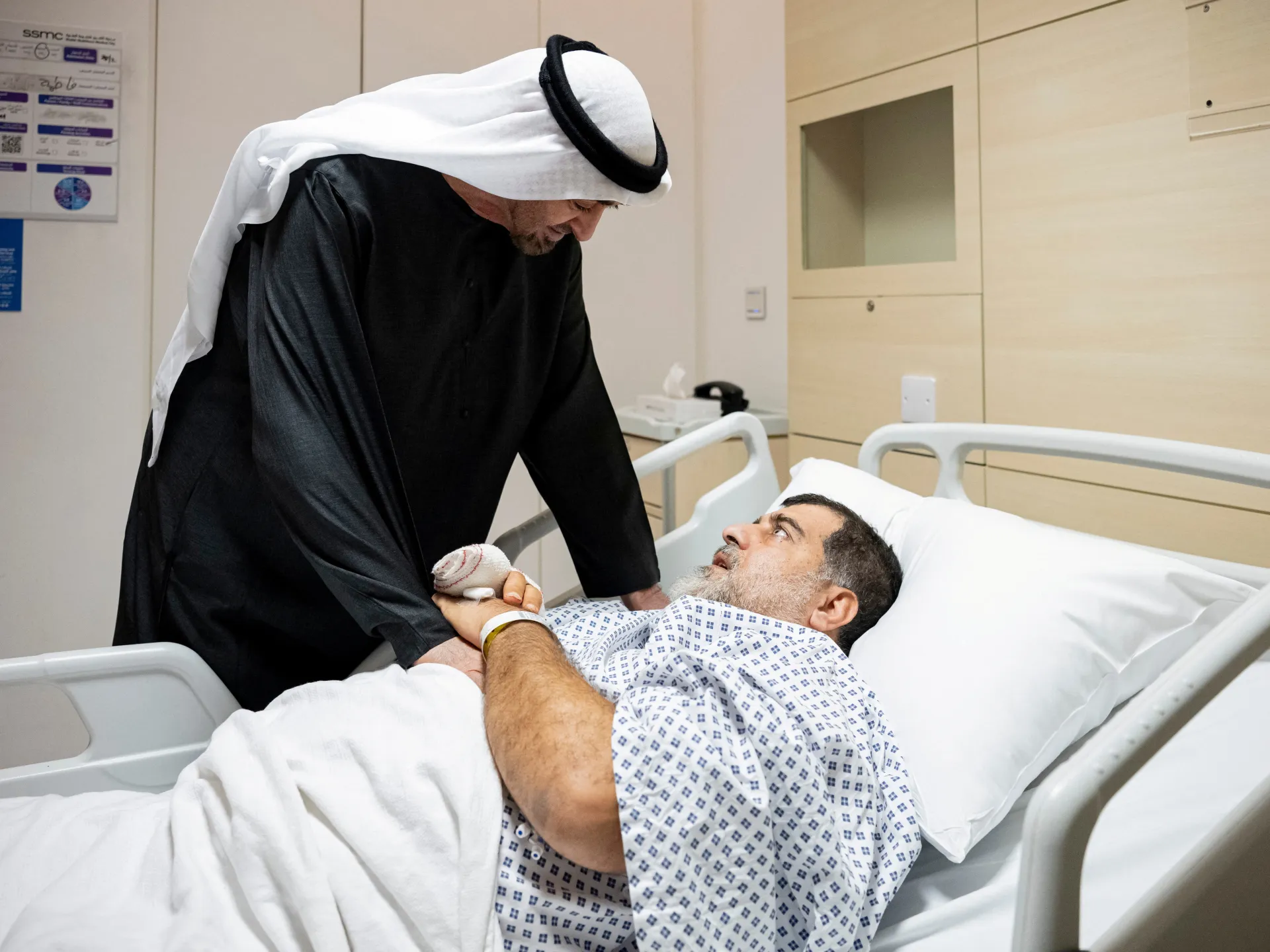
“The UAE has thick skin and bitter flesh – we are no easy prey,” said Sheikh Mohamed bin Zayed Al Nahyan in comments aired by Abu Dhabi TV on Saturday as he visited wounded patients in a hospital.
Recommended Stories
list of 4 itemsend of list
He added the UAE is in “a period of war” but would “emerge stronger”.
In a social media post, Sheikh Mohamed said the UAE, which has seen attacks affecting hubs such as airports, tourist attractions, and the US consulate in Dubai, is prepared to confront “threats” against the “security and the protection of all citizens”.
One driver was killed when debris from an intercepted projectile slammed into his vehicle, Dubai’s Media Office said, describing the victim as Asian but providing no further details.
Sheikh Mohamed’s comments were aired as the region entered a second week of war sparked by a major US-Israeli attack on Iran.
Earlier, Iranian President Masoud Pezeshkian offered an apology to neighbouring nations for launching strikes on their countries housing US military bases. His comments were swiftly contradicted by Iranian judiciary chief Gholamhossein Mohseni Ejei, also a member of the interim leadership council.
“Evidence from Iran’s armed forces shows that the geography of some countries in the region is openly and covertly at the disposal of the enemy,” he said. “The heavy attacks on these targets will continue.”
Pezeshkian himself rolled back on his remarks that Gulf countries would not be targeted unless attacks originated from their territories, caveating that while his country emphasised “the preservation and continuation of friendly relations,” Iran still has an “inherent right” to defend itself against US-Israeli aggression.
Iran’s Foreign Minister Abbas Araghchi also clarified the leader’s comments on X, saying, “President Pezeshkian expressed openness to de-escalation within our region – provided that our neighbours’ airspace, territory, and waters are not used to attack the Iranian people.”
Iran retaliates after attack on water supplies
All the Gulf Cooperation Council (GCC) nations – Saudi Arabia, Qatar, the United Arab Emirates, Kuwait, Bahrain and Oman – have been targeted because of the presence of US assets within and around their borders.
In the Gulf, the deadly attacks have caused major disruption to flights, closure of airspace, and heavy knock-on impacts on oil-and-gas production reverberating across the world.
On Saturday, Iranian state media reported the country’s Islamic Revolutionary Guard Corps targeted US forces at Bahrain’s Jufair airbase in retaliation for an attack on a freshwater desalination plant on Qeshm Island.
Araghchi called the US attack on the plant a “dangerous move with grave consequences”, accusing the US of committing a “blatant and desperate crime”, which affected the water supply to 30 villages.
Iran’s parliament speaker, Mohammad Bagher Ghalibaf, later said the attack was carried out with support from one of the airbases in a southern neighbouring country, stressing nations will not enjoy peace as long as the US has bases in the region.
Harlan Ullman, a senior adviser with the Atlantic Council, told Al Jazeera that attacks on water supplies could bring “greater chaos” to the Gulf.
“About 95 percent of all water in the Gulf comes from desalination,” he said. “If Iran wants to target desalination and water installation plants, they can bring the Gulf to a halt.”
Other attacks on Gulf
The UAE, a US ally and home to US military installations, has been the most heavily targeted nation in the Gulf during the war.
The Emirati Ministry of Defence said on Saturday it was targeted with 16 ballistic missiles and more than 120 drones.
Hours after Pezeshkian’s apology, the IRGC said their drones struck a US air combat centre at al-Dhafra airbase near Abu Dhabi, capital of the UAE.
Later, an unidentified object was intercepted near Dubai airport, the world’s busiest for international traffic, forcing it to briefly suspend operations.
Iranian attacks also hit Abu Dhabi airport, the upmarket Palm Jumeirah development, and the Burj Al Arab luxury hotel over the past week, while drone debris caused a fire at the US consulate in Dubai.
Also on Saturday, Qatar’s armed forces intercepted a missile attack, according to the Ministry of Defence. No immediate details were released about possible damage or casualties.
In Saudi Arabia, the defence ministry said a ballistic missile landed in an uninhabited area after being launched towards Prince Sultan Air Base, southeast of Riyadh, which hosts US troops.
Kuwait also reported intercepting a drone while the country’s national oil company announced a “precautionary” cut to its production of crude because of Iranian attacks and threats to the Strait of Hormuz, a key transit point for Gulf hydrocarbons.
Iran to select new supreme leader
Posting on social media on Saturday, US President Donald Trump warned his country would hit Iran “very hard” and threatened to expand strikes to include new targets.
Speaking at an event hosting Latin American leaders in Miami, Florida, Trump said on Saturday his country’s forces sank 42 Iranian navy ships in three days.
Israel launched what its military described as a new wave of strikes on Tehran and Isfahan. The military said on Saturday that more than 80 fighter jets completed a wave of strikes on Iranian army sites, missile launchers and other targets.
In a statement, the army said targets hit in Iran included missile storage sites, ballistic missile launchers and military facilities linked to Iran’s security forces.
Among the attacks, it said it struck 16 aircraft at Tehran’s Mehrabad airport, which belonged to the Quds Force branch of Iran’s Revolutionary Guard overseeing its foreign operations.
The Israeli military reported missiles were fired from Iran at Israel on eight different occasions on Saturday, setting off air raid sirens in parts of the country and actioning air defences.
Iranian state media reported Saturday that the IRGC hit a Marshall Islands-flagged tanker in Hormuz.
Iran’s Assembly of Experts will be meeting in the next 24 hours to choose a new supreme leader, according to assembly member Ayatollah Mozafari.
Iran’s ambassador to the United Nations, Amir Saeid Iravani, has rejected Trump’s demands to have a say in selecting Iran’s new supreme leader.
The Gulf states have spent years trying to broker peace between Iran and the West: Qatar brokered nuclear talks, Oman provided back-channel diplomacy, and Saudi Arabia maintained direct dialogue with Iran through 2024 and into 2025. Iran attacked them anyway. The idea that the Gulf states have a responsibility, a moral one, to protect Iran from the consequences of its actions because of good neighbourliness is now grotesque in context. Iran did not return good neighbourliness. Iran returned ballistic missiles.
Iran’s position is based on three propositions. First, that Iran acted in lawful self-defence pursuant to Article 51 of the UN Charter; that host countries relinquished territorial sovereignty by allowing US military bases on their territory; and that the definition of aggression in Resolution 3314 justifies the attack on those bases as lawful military objectives. Each of these propositions is legally flawed, factually skewed, and tactically wrong. Collectively, they add up to a legal argument that, if accepted, would ensure that the Gulf is permanently destabilised, the basic principles of international law are destroyed, and, in a curious twist, the very security threats that Iran is reacting to are reinforced.
The self-defence claim does not meet the required legal threshold
The UN Charter, in Article 51, permits the use of force only in self-defence against an “armed attack”, and this term is not defined by reference to the state invoking it. The International Court of Justice, in cases such as Military and Paramilitary Activities in and against Nicaragua (Nicaragua v. United States) (1986) and Oil Platforms (Iran v. United States) (2003), has interpreted the requirement of an “armed attack” under Article 51 of the UN Charter restrictively. The Court distinguished between the most grave forms of the use of force, which qualify as armed attacks triggering the right of self-defence, and less grave uses of force that do not. Accordingly, not every use of force, such as minor incidents or limited military activities, amounts to an armed attack. In this light, the mere presence of foreign military bases in Gulf states, maintained for decades under defence agreements with host governments, would not in itself constitute an armed attack against Iran.
Necessity and proportionality are also part of customary international law, requiring that self-defence be necessary and proportional. Iran has not demonstrated either. Targeting the territory of other sovereign Arab states in response to the policy decisions of the United States is neither necessary, since diplomatic and United Nations avenues are still available, nor proportional, since it imposes military consequences on states that are not a party to any conflict with Iran.
Critically, Article 51 also has a mandatory procedural element, in that any state employing self-defence is immediately required to notify the Security Council. Iran has consistently evaded this requirement in each of its escalatory actions. While this may seem to be a minor element, it is in fact the means by which the international community is able to verify and check self-defence claims. A state that evades this requirement is not employing Article 51. It is exploiting the language of Article 51.
Iran’s reading of Resolution 3314 is a fundamental distortion
The provision of Article 3(f) of the Annex to United Nations General Assembly Resolution 3314 (XXIX) (1974) states that an act of aggression includes the “action of a State in allowing its territory, which it has placed at the disposal of another State, to be used by that other State for perpetrating an act of aggression against a third State”. Iran could rely on this provision to hold the Gulf states that host United States military bases liable for any act of aggression committed from their territories against Iran. Nevertheless, the mere presence of military bases is not sufficient to hold them to be lawful military objectives; this will depend on their actual contribution to military activities against Iran based on the rules of international humanitarian law.
Thus, such an Iranian reading would be wrong on three distinct legal grounds.
First, Resolution 3314 is definitional in nature. The resolution was adopted to assist the Security Council in determining when aggression has taken place, not to confer upon states the unilateral power to punish states deemed to have committed aggression through the use of force. The resolution itself, in Article 2, asserts the power of the Security Council to make the determination of what constitutes aggression. The self-application of Article 3(f) of the resolution is therefore bypassed altogether.
Second, Article 3(f) speaks of the active launching of an attack, not the passive hosting of a military base. The legal distinction is fundamental. A state, in signing a defence treaty with another and hosting the latter’s troops on its soil, is engaging in a measure of sovereignty. A state, actively launching, coordinating, or enabling military strikes against a third party, is engaged in a different matter altogether. Iran has not credibly shown this latter case. The presence of US troops or bases in the Gulf has been a fact for decades, and this has not constituted armed aggression against Iran under any legal standard.
Third, even if Article 3(f) were applicable, the appropriate course would be to bring the matter to the Security Council, not to launch unilateral military strikes. General Assembly resolutions do not override the Charter. Iran cannot rely upon a non-binding resolution defining terms to override the Chapter VII requirements for the use of force or the clear criteria of Article 51.
Sovereignty cannot be dictated by a neighbour’s strategic preferences
Iran, in invoking the principle of good neighbourliness, asks the Arab Gulf states to deny the United States basing rights. Good neighbourliness is a two-way principle, and it does not allow for interference in the internal affairs of other states, certainly not interference in the decisions of other states simply because they are deemed inconvenient to the interfering state. All UN states possess the inherent right to conclude defence treaties with whomever they choose, and this is so regardless of the opinion of their neighbours.
The asymmetry of Iran’s position is striking and self-disqualifying. Iran itself has active military relationships with Russia and China. Iran arms, finances, trains, and supports the activities of non-state military actors in Lebanon, Syria, Iraq, and Yemen. The Islamic Revolutionary Guard Corps Quds Force operates openly in various states, and this has been extensively documented in United Nations Panels of Experts reports, as well as other international monitoring reports. According to the standards that Iran applies to the Gulf states, any state that hosts the activities of the IRGC, the transfer of Iranian arms, or the coordination of Iranian proxies on its soil would be engaging in aggression against third parties. Iran will not accept this principle when it is applied to itself. A legal principle that is unacceptable to the party to whom it would be applied is not a legal principle at all; it is a political tool.
A doctrine that defeats Iran’s own strategic interests
From the perspective of international relations theory, Iran’s position follows the logic of offensive realism, which seeks to remove the external balancing architecture of regional neighbours by claiming it to be hostile in nature. However, this approach is empirically self-defeating.
Under balance of threat theory, states react to offensive capability, geographic proximity, and aggressive intentions. Iran’s doctrine, in asserting the right to strike any state that hosts forces it perceives as a threat, drives each and every threat variable to maximum levels for each and every state in the region. The obvious consequence, evident in the data, is that the states in the region and external powers are becoming more, rather than less, securely integrated. The Fifth Fleet’s permanent base in Bahrain, the UAE’s negotiations over F-35s, Saudi Arabia’s deployments of THAADs, and Qatar’s expansion of the Al Udeid base are reactions to Iran’s escalation, not causes of it.
From the perspective of constructivism, the legitimacy of a legal argument is also partly based on the normative credibility of the state that presents the argument. The record of Iran’s compliance with IAEA regulations, including the enrichment of uranium to a purity level of 60 percent or more in 2023–2024, interference with inspections, the removal of monitoring cameras, and the overall violation of the non-proliferation regime, has undermined the credibility of the state significantly. A state that is itself a violator of the legal regime cannot claim the role of a law-abiding state seeking protection under the norms of the legal regime.
Iran’s legal rationale was always theoretically wrong. What has occurred since February 28, 2026, has made Iran’s actions morally and politically wrong. Iran did not simply target US military assets. The reality of the situation is now documented and undeniable. Ballistic missiles and drones were launched against Gulf states in the opening days of the conflict. This marked the first time one actor had simultaneously attacked all six GCC states. Iran escalated its attacks in deliberate stages. Day 1: Iranian missiles were fired against military bases. Day 2: Iranian missiles were fired against civilian infrastructure and airports. Day 3: Iranian missiles were fired against the energy sector. Days 3 and 4: The US Embassy in Riyadh was attacked by Iran. International airports in Dubai, Abu Dhabi, and Kuwait were attacked by Iranian missiles, resulting in the suspension of flights throughout the region. Videos from Bahrain documented an Iranian Shahed drone attacking an apartment building. This is not self-defence. This is the collective punishment of sovereign nations that went to extraordinary lengths to avoid the conflict.
The rationale provided by Iran falls flat when one considers the actions Iran itself took. Its doctrine held that only targets involved in the preparation or launch of an attack against Iran were legitimate targets. Civilian airports are not military bases. Hotels in Palm Jumeirah are not military command centres. An apartment complex in Manama is not a weapons storage facility. By Iran’s own stated legal rationale, none of these targets was legitimate, yet they were attacked. This was not a legal doctrine at all; it was a pretext for coercion, and the conduct of war revealed this to be the case.
The views expressed in this article are the author’s own and do not necessarily reflect Al Jazeera’s editorial stance.
The United States used Precision Strike Missiles (PrSMs) for the first time during its ongoing war with Iran, US Central Command (CENTCOM) said on Wednesday.
The war entered its seventh day on Friday, with attacks continuing across Iran and other countries in the Middle East.
CENTCOM stated in an X post that PrSMs provide an “unrivaled deep strike capability”.
“I just could not be prouder of our men and women in uniform leveraging innovation to create dilemmas for the enemy,” the post quoted Admiral Brad Cooper, head of CENTCOM.
It is unclear where these PrSMs were launched from, or which specific targets they hit in Iran.
So what is the PrSM, and why is it significant that it has been used by the US for the first time?
What are Precision Strike Missiles?
PrSMs are described as long-range precision strike missiles by their developer, the Maryland, US-headquartered defence firm Lockheed Martin, which delivered the first PrSMs to the US Army in December 2023.
PrSMs can hit targets ranging from 60km (37 miles) to more than 499km (310 miles) away, according to Lockheed Martin.
The company’s website adds that PrSMs are compatible with the MLRS M270 and HIMARS family of launchers, both also developed by Lockheed and used by both the United Kingdom and US armies.
MLRS stands for multiple-launch rocket systems, used to launch missiles. The UK sent a number to Ukraine in 2022. HIMARS stands for High Mobility Artillery Rocket System. In 2022, the US sent a number to Ukraine, as well.
M-142 HIMARS is a high-tech, lightweight rocket launcher that is wheel-mounted, giving it more agility and manoeuvrability on the battlefield. Each unit can carry six GPS-guided rockets, or larger missiles like Army Tactical Missile Systems (ATACMs) and PrSMs, which can be reloaded in about a minute with only a small crew.
Lockheed Martin adds that PrSMs can be rapidly developed. “We are ready to produce and deliver to meet the US Army’s accelerated timeline for this long-range precision fires priority,” the website says.
PrSMs feature “open systems architecture”, which means that it is easier to plug in new components, upgrade parts, or work with equipment from other companies. Similarly, they are “modular and easily adaptable”, enabling components to be switched around.
They also feature “IM energetic payload”, or Insensitive Munitions energetic payload, which makes explosions safer, the producer says. This means the warhead is made from explosives that are less likely to blow up accidentally if hit by fire, shrapnel or by accident, but still explode properly when triggered as intended.
What is different about the PrSMs?
PrSMs will ultimately replace the ATACMs currently being fired from the HIMARS launchers, significantly increasing their range from 300km (186 miles) to more than 499km (310 miles), without changing the vehicle carrying the missile.
PrSMs also offer double the “missile load” of ATACMs. While a HIMARS launcher is able to carry one ATACMS missile in its pod, it can carry two PrSMs per pod.
Does the PrSM give the US a strategic advantage?
CENTCOM confirmed that PrSMs have been used in the US and Israel’s attacks on Iran, codenamed Operation Epic Fury and launched on February 28.
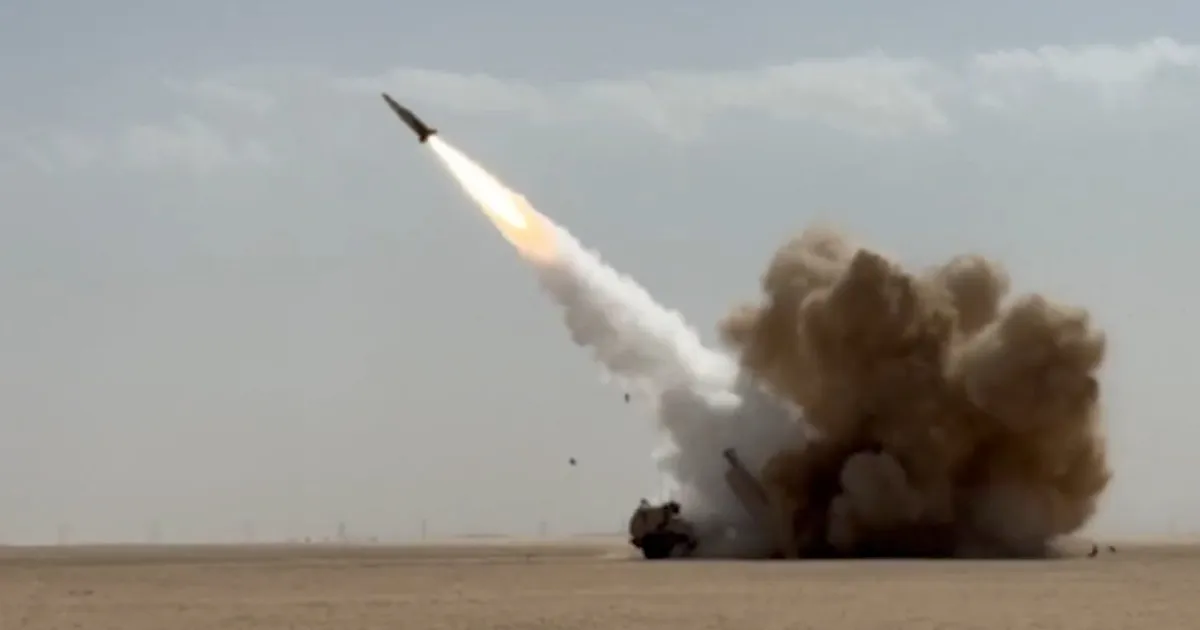
CENTCOM posted a video of the PrSMs being launched from M142 High Mobility Artillery Rocket Systems in an open desert terrain.
PrSMs do give the US military a boost for its pre-existing long-range capabilities.
Gulf countries such as Kuwait, Saudi Arabia, Bahrain, Qatar, the United Arab Emirates and Oman, specifically the Musandam Peninsula, which have military bases hosting US assets and troops, have at least some territory within 400km (250 miles) of Iran.
The US is using PrSMs in conjunction with other long-range missiles such as Low-Cost Unmanned Combat Attack System (LUCAS) one-way drones, MQ-9 Reaper drones, ATACMs and Tomahawk Cruise Missiles.
The range for LUCAS one-way drones is about 800km (500 miles), while the range for ATACMs is about 300km (186 miles) and the range for Tomahawk cruise missiles is about 1,600km (1,000 miles).
Why is the introduction of the PrSM significant?
The range of this missile is significant as it is likely that it would not have been permitted under the Intermediate-Range Nuclear Forces (INF) Treaty with Russia, which the Trump administration withdrew the US from in 2019. This is because it can exceed the maximum 500km (310-mile) range the treaty imposed on certain land-launched missiles.
The treaty was signed in 1987 by US and Soviet Union leaders Ronald Reagan and Mikhail Gorbachev. It sought to eliminate the presence of land-based nuclear missiles and medium-range arsenals between 500km and 5,500km (310 and 3500 miles) from Europe.
The US suspension of the treaty allowed Washington to resume development of its own medium-range, land-based arsenal.
Following the US suspension, Russia invited the US to reciprocate in a unilateral moratorium on the deployment of ground-launched intermediate-range missiles instead. While Washington initially rejected the offer, in 2022, it said it would be willing to discuss this.
In August last year, the Russian Ministry of Foreign Affairs announced Russia’s withdrawal from this moratorium, however, saying the US had “made significant progress” and “openly declared plans to deploy US ground-launched INF-range missiles in various regions”. INF stands for intermediate-range nuclear forces.
The statement added that such actions by Western countries posed a “direct threat” to Moscow’s security.
Global energy markets remain in a state of high alert after several Gulf states suspended oil and gas production following escalating tensions in the region.
Since Saturday’s attacks by the United States and Israel, Tehran has targeted various sites in Israel and across several Gulf countries.
Recommended Stories
list of 4 itemsend of list
Initially, these Iranian attacks focused primarily on US military assets, but Gulf states have reported that Iran has since broadened its scope to target civilian infrastructure, including hotels, airports and energy facilities. Iranian officials have publicly denied targeting Gulf energy facilities, however.
The Middle East remains the world’s dominant source of hydrocarbon reserves and a major driver of crude oil and natural gas output.
How much oil and gas does the Middle East have?
Nearly half of the world’s oil reserves and exports come from the Middle East, which contains five of the seven largest oil reserves in the world.
Once refined, crude oil is used to make various products, including petrol, diesel, jet fuel and a wide range of household items such as cleaning products, plastics and even lotions.
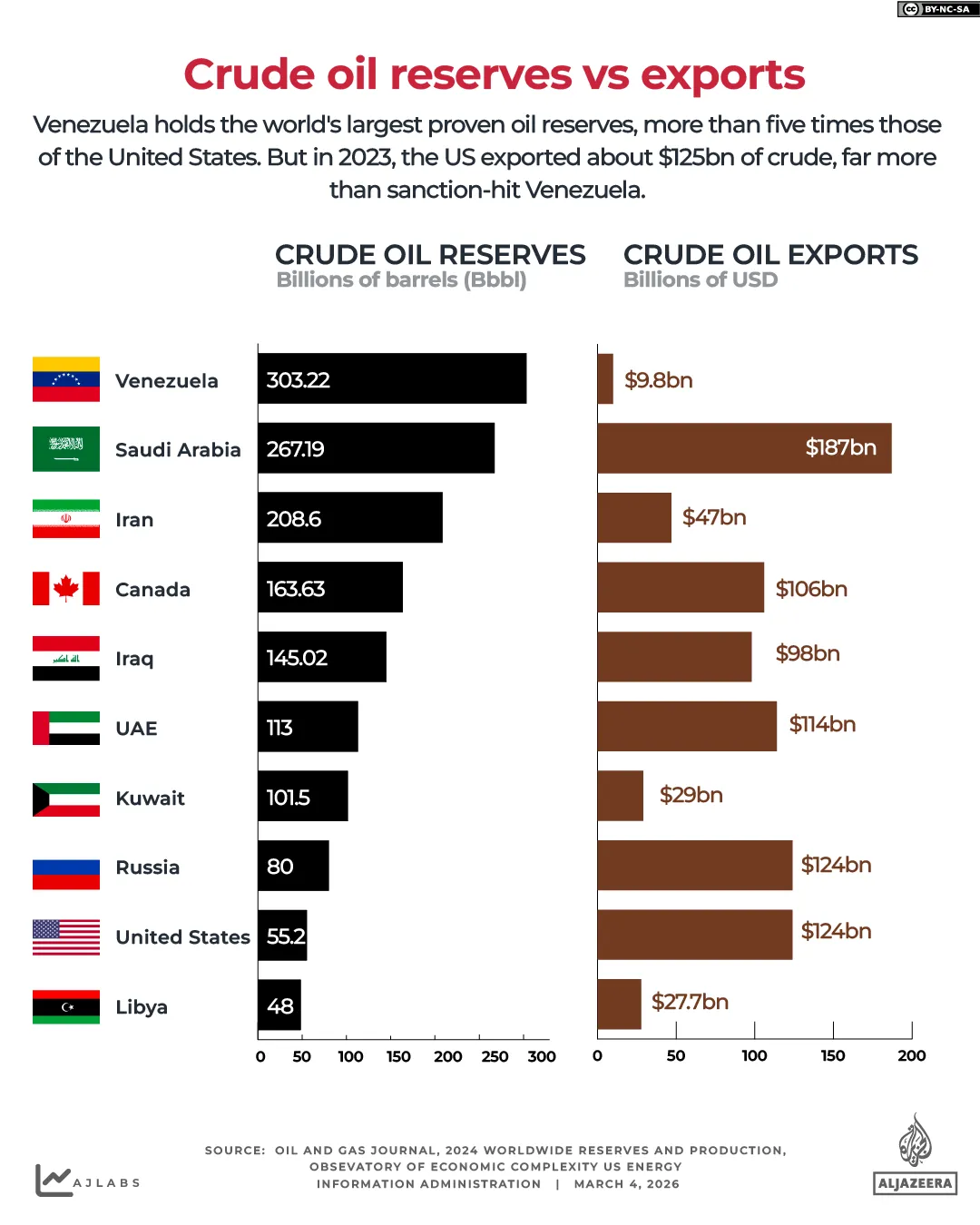
After Venezuela, which has 303 billion barrels, Saudi Arabia holds the world’s second-largest proven crude oil reserves, estimated at 267 billion barrels.
The Middle East’s largest oil reserves:
Saudi Arabia: 267 billion barrels
Iran: 209 billion barrels
Iraq: 145 billion barrels
UAE: 113 billion barrels
Kuwait: 102 billion barrels
Saudi Arabia is also the world’s top oil exporter with an estimated $187bn of crude in 2024, according to data from the Observatory of Economic Complexity (OEC).
The Middle East’s top oil exporters:
Saudi Arabia: $187bn
UAE: $114bn
Iraq: $98bn
Iran: $47bn – largely sold at a discount due to US sanctions
Kuwait: 29bn
Other Middle Eastern countries with sizeable oil exports include: Oman ($28.9bn), Kuwait ($28.8bn) and Qatar ($21bn).
(Al Jazeera)
In addition to crude oil, the Middle East is a global powerhouse for natural gas, accounting for nearly 18 percent of global production and approximately 40 percent of the world’s proven reserves.
Natural gas is primarily used for electricity generation, industrial heating, and in chemicals and fertilisers.
The heart of Middle Eastern gas is a single, massive underwater reservoir called the South Pars/North Dome field. It is the largest gasfield in the world, and it is shared directly between Qatar and Iran.
Gas is transported either through pipelines or by tankers. When using pipelines, the gas is pressurised and moved through steel networks. When pipelines are not feasible, such as across oceans, Liquefied Natural Gas (LNG) is used.
To create LNG, the gas is cooled to approximately -162C (-260F), shrinking its volume and allowing it to be safely loaded onto specialised tanker ships for global transport.
To transport oil and gas, tankers from various Gulf states must navigate the narrow waterway known as the Strait of Hormuz. Approximately one-fifth of global oil and gas passes through this strait, primarily heading to major markets in Asia, including China, Japan, South Korea and India, as well as to Europe.
(Al Jazeera)
Which energy facilities have been attacked?
Here are the facilities which have recorded damage as of Wednesday:
Saudi Arabia – Ras Tanura oil refinery
On Monday, one of the world’s largest oil refining complexes, the Ras Tanura oil refinery owned by Saudi Aramco, was forced to halt operations after debris from intercepted Iranian drones caused a small fire.
This handout satellite image, courtesy of Vantor, released on March 2, 2026, shows damage at Saudi Aramco’s Ras Tanura refinery [AFP]
Saudi Aramco is one of the world’s largest companies, with a market capitalisation exceeding $1.7 trillion and revenue of $480bn. Headquartered in Dhahran, in eastern Saudi Arabia, Aramco controls 12 percent of global oil production, with a capacity of more than 12 million barrels per day (bpd).
On Wednesday, Saudi defence officials reported a second drone attempt on the facility but this was successfully intercepted with no damage or disruption to operations reported.
Qatar – Ras Laffan Industrial City LNG facilities
On Monday, Qatar’s Ministry of Defence reported that Iranian drones had targeted an energy facility in Ras Laffan belonging to QatarEnergy, the world’s largest LNG producer.
While no casualties were reported, QatarEnergy suspended the production of LNG and other products at the impacted sites.
QatarEnergy’s operating facilities on March 3, 2026, in Ras Laffan Industrial City, Qatar [Getty Images]
QatarEnergy’s 81 million metric tonnes of LNG exports are mostly bound for Asian markets, including China, Japan, India, South Korea, Pakistan and other countries in the region. The halt in production hiked global gas prices to a three-year high this week.
Qatar – Mesaieed Industrial City
Qatar’s Defence Ministry said the country was attacked by a second drone launched from Iran on Monday, targeting a water tank belonging to a power plant in Mesaieed, without reporting any casualties.
On Tuesday, QatarEnergy also stopped production of some downstream products like urea, polymers, methanol, aluminium and others.
UAE – Fujairah and Mussafah oil terminals
On Monday, a fire broke out at Mussafah Fuel Terminal in southwest Abu Dhabi after it was struck by a drone.
On Tuesday, falling debris from a drone interception caused a fire at the Fujairah Oil Terminal along the eastern coast of the United Arab Emirates. No injuries were reported.
A large fire and plume of smoke are visible after debris from an intercepted Iranian drone hit the Fujairah oil facility, in Fujairah, United Arab Emirates, on Tuesday, March 3, 2026, according to authorities [Altaf Qadri/AP Photos]
Oman – ports of Duqm and Salalah
On Tuesday, multiple Iranian drones struck fuel tanks and a tanker at the port of Duqm, with at least one direct hit on a fuel storage tank, causing an explosion.
On the same day, a drone strike was recorded at the Port of Salalah, which handles fuel and industrial minerals.
Athe Nova – oil tanker
On Monday, the Athe Nova, a Honduran-flagged tanker positioned off the coast of Khor Fakkan, UAE, was struck by Iranian drones as it was transiting the Strait of Hormuz, setting it ablaze. Despite the fire, the vessel managed to exit the chokepoint into the Gulf of Oman, and no casualties were reported.
Iran’s Islamic Revolutionary Guard Corps (IRGC) claimed responsibility for the strike, identifying the Athe Nova as an “ally of the United States”.
On the same day as the attack, Iran declared the Strait of Hormuz closed, warning that any ship attempting to pass would be “set ablaze”.
Since then, several other tankers have been hit.
(Al Jazeera)
Other regional energy disruptions
Although not directly targeted, the following energy sites suspended operations in response to Iranian retaliatory attacks:
Israeli offshore gasfields – Major gas production fields such as Leviathan and Tamar were shut down as a precaution following regional drone and missile launches linked to Iran.
Oil fields in semiautonomous Iraqi Kurdistan – Producers including DNO, Gulf Keystone and Dana Gas halted output as a safety measure amid the escalation.
Rumaila oilfield – Operations at Iraq’s largest oilfield – operated by BP – in southern Iraq were halted on Tuesday as a security precaution due to its proximity to the escalation zone.
As conflict in the Middle East enters its fifth day on Wednesday, American and Israeli officials are pushing rhetoric suggesting that the campaign against Iran is a religious war.
On Tuesday, Muslim civil rights organisation, the Council on American-Islamic Relations (CAIR), condemned the Pentagon’s use of this rhetoric, deeming it “dangerous” and “anti-Muslim”.
The United States and Israel began their attack on Iran on Saturday and have continued to carry out strikes on Iran since then. In retaliation, Iran has hit back at targets in Israel, and US military assets in Bahrain, Saudi Arabia, Qatar, the United Arab Emirates, Iraq and Cyprus.
A US watchdog has reported that US troops have been told the war is intended to “induce the biblical end of times”. US Secretary of State Marco Rubio also recently stated that Iran is run by “religious fanatic lunatics”.
What are American and Israeli leaders saying?
US watchdog Military Religious Freedom Foundation (MRFF) said it has received emailed complaints that US service members were told the war with Iran is meant to “cause Armageddon”, or the biblical “end times”.
An unnamed noncommissioned officer wrote in an email to MRFF that a commander had urged officers “to tell our troops that this was ‘all part of God’s divine plan’ and he specifically referenced numerous citations out of the Book of Revelation referring to Armageddon and the imminent return of Jesus Christ”.
The MRFF is a nonprofit organisation dedicated to upholding religious freedom for US service members.
The officer claimed the commander had told the unit that Trump “has been anointed by Jesus to light the signal fire in Iran to cause Armageddon and mark his return to Earth”.
Israeli and US leaders have also resorted to religious rhetoric in public.
Last month, Mike Huckabee, the US ambassador to Israel, told conservative US commentator Tucker Carlson during an interview that it would be “fine” if Israel took “essentially the entire Middle East” because it was promised the land in the Bible. However, Huckabee added that Israel was not seeking to do so.
Speaking to the media on Tuesday this week, Rubio said: “Iran is run by lunatics – religious fanatic lunatics. They have an ambition to have nuclear weapons.”
And, the previous day in a Pentagon news briefing, US Secretary of Defense Pete Hegseth said: “Crazy regimes like Iran, hell-bent on prophetic Islamic delusions, cannot have nuclear weapons.”
In its statement, CAIR claimed that Hegseth’s words are “an apparent reference to Shia beliefs about religious figures arising near the end times”.
On Sunday, Israeli Prime Minister Benjamin Netanyahu referenced the Torah, comparing Iran with an ancient biblical enemy, the Amalekites. The “Amalek” are known in Jewish tradition as representing “pure evil”.
“We read in this week’s Torah portion, ‘Remember what Amalek did to you.’ We remember – and we act.”
CAIR said: “We are not surprised to see Benjamin Netanyahu once again using the biblical story of Amalek – which claims that God commanded the Israelites to murder every man, woman, child and animal in a pagan nation that attacked them – to justify Israel’s mass murder of civilians in Iran, just as it did in Gaza.”
The statement added that every American should be “deeply disturbed by the ‘holy war’ rhetoric” being spread by the US military, Hegseth and Netanyahu to justify the war on Iran.
“Mr Hegseth’s derisive comment about ‘Islamist prophetic delusions’, an apparent reference to Shia beliefs about religious figures arising near the end times, was unacceptable. So is US military commanders telling troops that war with Iran is a biblical step towards Armageddon.”
Why are US and Israeli leaders framing the conflict with Iran as a religious war?
By attempting to frame the conflict as a holy war, leaders are using theological beliefs to “justify action, mobilise political opinion, and leverage support”, Jolyon Mitchell, a professor at Durham University in the UK, told Al Jazeera.
“Many on both sides of this conflict believe that they have God on their side. God is enlisted in this conflict, as with many others, to support acts of violence. The demonisation and dehumanisation of the enemy, the ‘other’, will inevitably make building peace after the conflict even harder,” Mitchell said.
“There are several overlapping reasons, and they operate at different levels: domestic mobilisation, civilisational framing, and strategic narrative construction,” Ibrahim Abusharif, an associate professor at Northwestern University in Qatar, told Al Jazeera.
Domestic mobilisation refers to rallying a country’s own people. Leaders can frame conflict as religious and hence morally clear and urgent, rallying public support, he said.
In a video circulating on social media this week, Christian Zionist pastor and televangelist John Hagee is seen delivering a sermon promoting the US assault on Iran. Hagee said that Russia, Turkiye, “what’s left of Iran” and “groups of Islamics” will march into Israel. He said that God will “crush” the “adversaries of Israel”.
“Religious language mobilises domestic constituencies,” Abusharif said, explaining that in the US, this connects deeply with many evangelicals and Christian Zionists, because they already see Middle East wars as part of a religious “end times” story.
“References to the ‘end times’, the Book of Revelation, or biblical enemies are not incidental; they activate a cultural script already present in American political theology.”
Civilisational framing refers to the creation of an “us vs them” dichotomy, casting the conflict as a clash between whole ways of life or faiths, not just a dispute over borders or policy, he added. Hence, statements such as Hegseth’s reference to “prophetic Islamic delusions” simplify the terms of the war in the minds of ordinary people.
“Wars are difficult to justify in technical strategic language,” Abusharif said.
“Casting the conflict as a struggle between ‘civilisation and fanaticism’, or between biblical ‘good and evil’, transforms a complicated regional confrontation into a moral drama that ordinary audiences can easily grasp.”
“Israeli leadership has long used biblical referents as political language. We all are familiar with it. The narratives have become globalised. In Israeli political discourse, this language situates contemporary conflict within a long historical narrative of Jewish survival, and it signals existential stakes,” Abusharif said.
Have US or Israeli leaders made religious references before?
Netanyahu and other Israeli officials have used the term “Amalek” before in reference to Palestinians in Gaza during Israel’s genocidal war in Gaza.
Historically, during wars or military confrontations, US presidents and senior officials have also invoked the Bible or used Christian language.
President George W Bush invoked similar language after the September 11, 2001 attacks.
On September 16, 2001, Bush said: “This crusade, this war on terrorism, is going to take a while.” The Crusades were a series of religiously framed wars, mainly between the 11th and 13th centuries, in which the papacy fought against Muslim rulers for territory.
The White House later tried to distance Bush from the word “crusade” to clarify that Bush was not waging a war against Muslims.
Abusharif said that the war on Iran is about power and politics, but using religious rhetoric energises supporters and “moralises” the conflict.
“The war itself is not theological. It is geopolitical. But the language surrounding it increasingly draws on sacred imagery and civilisational narratives. That rhetoric can mobilise supporters and frame the conflict in morally absolute terms,” Abusharif said.
“Yet it also carries risks: once a war is cast in sacred language, political compromise becomes harder, expectations become higher, and the global perception of the conflict can shift in ways that complicate diplomacy.”
The Foreign, Commonwealth & Development Office (FCDO) is constantly updating its advice as the situation changes in the Middle East and has now issued guidance for stranded Brits trying to get home
12:36, 04 Mar 2026Updated 12:38, 04 Mar 2026
While flight cancellations are ongoing some services from the Middle East are departing(Image: Gian Mattia D’Alberto/LaPresse/Shutterstock )
In the past few days, the Foreign, Commonwealth & Development Office (FCDO) has had to update its advice several times in the wake of the constantly changing situation in the Middle East.
An estimated 132,000 Brits have registered their presence in the Middle East with the FCDO, and many will be looking to leave the area and return to the UK as soon as its safe.
Last night, the FCDO took to X (formerly Twitter) to issue a travel update for Brits currently in Bahrain, Israel, Kuwait, Palestine, Qatar, Saudi Arabia, or the United Arab Emirates (UAE).
The updates offer advice to Brits looking to leave the above countries, including which routes to avoid when travelling by road, and the latest situation with commercial air flights. It also updated information on the Taba Border Crossing, with the updated advice page stating: “International borders in Israel and Palestine could close at short notice, including the Taba border crossing between Israel and Egypt. Check with local authorities and read Israel travel advice and Palestine travel advice before trying to cross.”
Content cannot be displayed without consent
For Brits in the UAE, including Dubai, the FCDO has updated its advice on leaving the country. Its updated information says: “There are a limited number of commercial options available, including by air from UAE and from Oman. If your presence in UAE is not essential, you may wish to consider departing – if you judge you can access these options safely.
“Check for the latest updates from your airline or tour operator, as well as the instructions from local authorities, and the status of any border crossings before you travel. If you are traveling by air do not travel to the airport unless your airline has confirmed your reservation.
“Make sure you have access to emergency supplies and essential medication. Travel within or out of UAE is at your own risk.
“Keep your departure plans under review and ensure your travel documents are up to date, including any visas required for onward travel.”
Some countries also have a Regional Risks section which includes specific advice on which areas should be avoided and the alternatives. However, the FCDO is careful to state that all travel in or out of these countries is still at the individual’s own risk. Brits should still ensure they follow the advice of local authorities and get up to date information before setting off.
While travel between the UK and the Middle East is still severely disrupted, some flights have been running on limited routes to bring Brits home from Dubai since yesterday (March 3).
Emirates and Etihad have been operating a very limited service, and Virgin Atlantic confirmed it is resuming services from Dubai and Riyadh to London-Heathrow.
Brits who are still in the Middle East should register their presence on the FCDO website as this will ensure they get the latest Foreign Office advice. Only UK passport holders can register for this service.
Have a story you want to share? Email us at webtravel@reachplc.com
Video from Abu Dhabi captured the moment a second Iranian drone struck the Al Salam Naval Base. A fire was already burning from an earlier hit and what appears to be a cruise ship could be seen docked in the background.


![Kuna Khuntia, a 25-year-old pipe fitter from India's Odisha, who died of a heart attack in Doha Qatar [Photo courtesy the Khuntia family]](https://i0.wp.com/www.aljazeera.com/wp-content/uploads/2026/03/Kuna-Khuntia-1774503793.jpeg?w=640&ssl=1)