LGBTQ+ athletes struggle to find money in U.S. political climate
Conor McDermott-Mostowy would like to compete at the Milano Cortina Winter Olympic Games. And he certainly has the talent, desire and ambition to do so.
What he lacks is the money.
“You could definitely reach six figures,” David McFarland, McDermott-Mostowy’s agent, said of what the speedskater needs annually to live and train while chasing his Olympic dream.
In the last year, finding that money has been increasingly difficult because McDermott-Mostowy is gay. Since President Trump returned to the White House in January, bringing with him an agenda that is hostile to diversity, equity and inclusion, sponsors who once embraced LGBTQ+ athletes and initiatives have turned away from the likes of McDermott-Mostowy, with devastating effect.
“There’s definitely been a noticeable shift,” said McFarland, who for decades has represented straight and gay athletes in a number of sports, from the NFL and NBA to professional soccer. “Many brands and speaking opportunities that previously highlighted LGBTQ athletes are now being pulled back or completely going away.”
“And these aren’t just symbolic partnerships,” he added. “They’re vital income opportunities that help athletes fund training, fund their competition and their livelihoods.”
The impact is being felt across a wide range of sports where sponsorship dollars often make the difference between winning and not being able to compete. But it’s especially acute in individual sports where the athletes are the brand and their unique traits — their size, appearance, achievements and even their gender preferences — become the things that attract or repel fans and financial backers.
“What’s most frustrating is that these decisions are rarely about performance,” McFarland said. “They’re about perceptions in the LGBTQ community. And that kind of fear-driven retreat harms everyone involved because, beyond the human costs, it’s also very short-sighted. The LGBTQ community and its allies represent a multitrillion-dollar global market with immense buying power.”
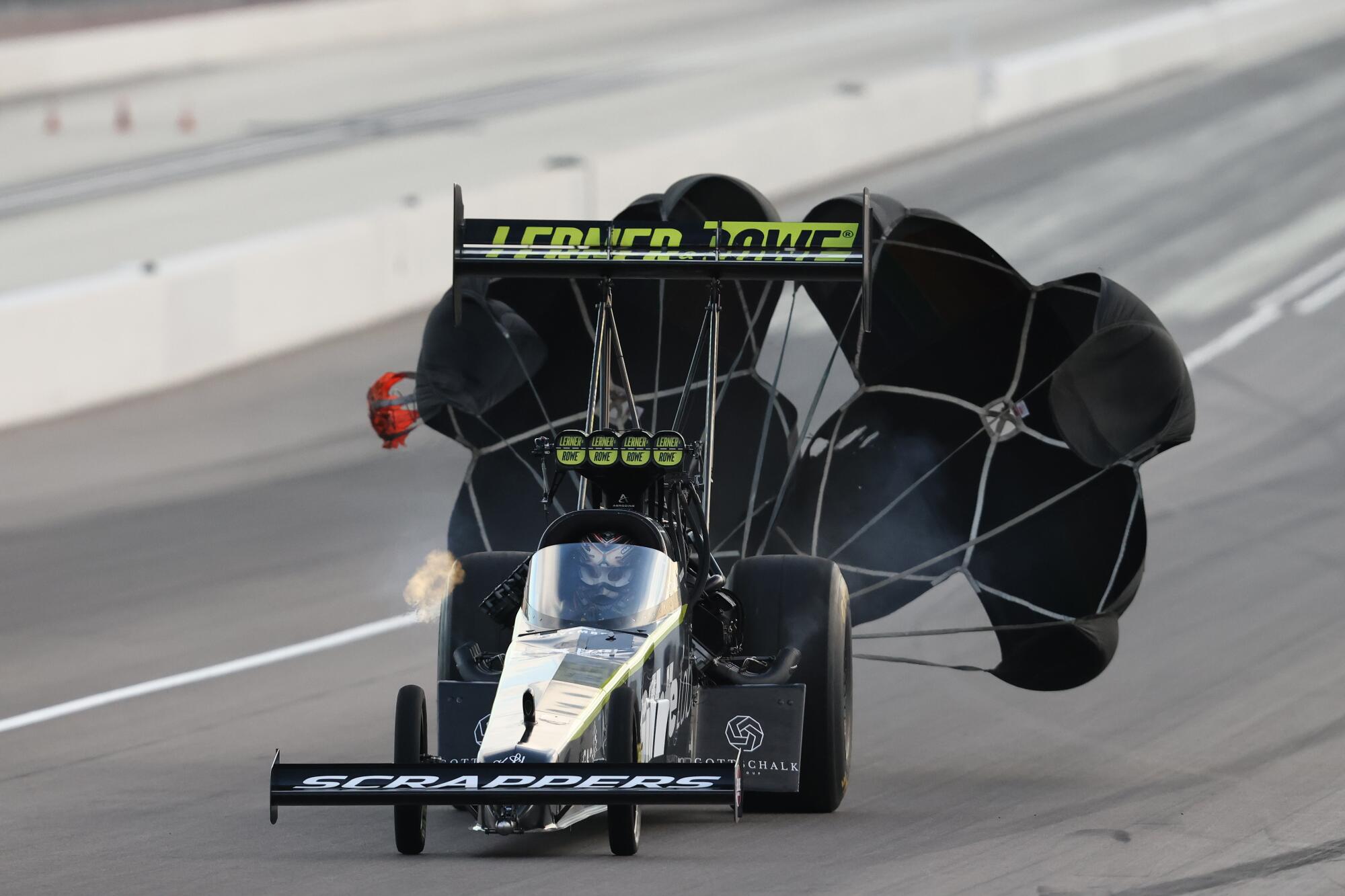
Travis Shumake, the only openly gay driver on the NHRA circuit, ran a career-high five events in 2022 and said he once had deals with major brands such as Mission Foods, Procter & Gamble and Kroger while using a rainbow-colored parachute to slow his dragster.
Kroger is the only one whose support has yet to shrink and as a result, Shumake had to keep his car in its trailer for the final eight months of the year.
And when he did race, his parachute was black.

Travis Shumake competes at the NHRA Nationals at Las Vegas Motor Speedway in November 2024.
(Marc Sanchez / Icon Sportswire via Getty Images)
“It was looking very optimistic and bright,” said Shumake, who spends about $60,000 for an engine and as much as $25,000 for each run down the dragstrip. “Being the only LGBTQ driver would have been very profitable. I ended last season with plans to run six to eight races. Great conversations were happening with big, big companies. And now it’s, I did one race, completely based on funding.”
“When you’re asking for a $100,000 check,” he added, “it’s very tough for these brands to take that risk for a weekend when there could be a large backlash because of my sexual identity.”
A sponsorship manager for a Fortune 500 company that had previously backed Shumake said he was not authorized to discuss the decision to end its relationship with the driver.
Daniel T. Durbin, director of the Institute of Sports, Media and Society at the USC Annenberg school, said there could be several reasons for that. A shrinking economy has tightened sponsorship budgets, for example. But there’s no doubt the messaging from the White House has had a chilling effect.
“It certainly makes the atmosphere around the issue more difficult because advertising and promotion tied to social change has come under fire by the Trump administration,” Durbin said.
In addition, corporate sponsors that once rallied behind diversity, whether out of conviction or convenience, saw the election results partly as a repudiation of that.
“We may be pissing off 50% of the population if we go down this path. Do we really want to do that with our brand?” Durbin said of the conversations corporations are having.
Backing away from causes such as LGBTQ+ rights doesn’t necessarily mean those corporations were once progressive and are now hypocritical. For many, the only color of the rainbow they care about is green.
“You’re trying to give people a philosophy who don’t have a philosophy,” Durbin said. “And even if they believe in causes, they’re not going to self-destruct their company by taking up a cause they believe in. They’re going to take it up in part because they think it’s positive for the bottom line.
“That’s the way it works.”
As a result, others have had to step up to try to help fill the funding gap. The Out Athlete Fund, a 501(c)(3) organization, was recently created to provide financial assistance and other support to LGBTQ+ athletes. McDermott-Mostowy was the first to get a check, after a November event in West Hollywood raised more than $15,000.
“We’re here to help cover their costs because a lot of other people aren’t doing it,” said Cyd Zeigler, a founding board member of the group and co-founder of OutSports, a sports-news website focused on LGBTQ+ issues.
That kind of retrenching, from deep-pocketed corporate sponsors to individuals giving their spare change, is threatening to derail the careers of athletes such as McDermott-Mostowy, who relies on his family and a modest U.S. Olympic & Paralympic Committee stipend for most of his living and training expenses. And since he’ll turn 27 before the Milano Cortina Olympic Games open in February, he may not be able to wait for the pendulum to swing back to have another chance at being an Olympian.
“I’m 99% sure I qualify for [food] stamps,” said McDermott-Mostowy, who medaled in the 1,500- and 500-meter events in October’s national championships, making him a strong contender for the U.S. heading into the Olympic long track trials Jan. 2-5 in Milwaukee. “What really saves us every year is when we travel. Almost all of our expenses are paid when we’re coming [with] the team.
“If I didn’t make the World Cup one year, I would be ruined.”
McDermott-Mostowy’s past success and his Olympic potential are what he pitches to sponsors, not that he’s gay. But that’s what makes him stand out; if he qualifies for Milano Cortina, he would be one of the few gay athletes on the U.S. team.
“I have always been very open about my sexuality. So that wasn’t really a debate,” he said.
“I have definitely heard from my agent that, behind closed doors, a lot of people are like ‘Oh, we’d love to support queer athletes. But it’s just not a good time to be having that as our public face.’”
The debate isn’t a new one, although it has evolved over the years. Figure skater Amber Glenn, who last year became the first out queer woman to win the U.S. championship, remembers gender preferences being a big topic of discussion ahead of the 2014 Games in Russia, where public support for LGBTQ+ expression is banned.
“At that point I wasn’t out, but I was thinking, ‘What would I do? What would I say?’” Glenn said. “Moving forward I hope that we can make it where people can compete as who they are and not have to worry about anything.
“Figure skating is unique. We have more acceptance and more of a community in the queer space. That’s not the case for all sports. We’re definitely making progress, but we still have a long way to go.”

Conor McDermott-Mostowy hopes to be competing for the U.S. in speedskating at the Milano Cortina Olympic Games in February.
(Dean Mouhtaropoulos / Getty Images)
In the meantime, athletes such as McDermott-Mostowy and Shumake may have to find ways to re-present themselves to find new sources of support.
“It’s not like I’m going back in the closet,” said Shumake, who has decided to rent out his dragster to straight drivers next year rather than leave it parked and face bankruptcy. “It’s just that maybe it’s not the main storyline at the moment. I’m trying a bunch of different ways to tell the story, to rebrand.”
“It’s been weird to watch,” added Shumake, who once billed himself as the fastest gay guy on Earth. “I know it will swing back. I also fear, did I make the right choices when I had a partnership with Grindr and I had rainbow parachutes? Like did I come on too strong?
“I’ve chosen to go the gay race car driver route and it’s just a little bit of a slowdown. I don’t think I need to blame myself. It’s just a fear people are having at the moment.”
A fear that’s proving costly to the athletes who can least afford to pay.