Top Stories

Trump administration loses appeal on full SNAP payments

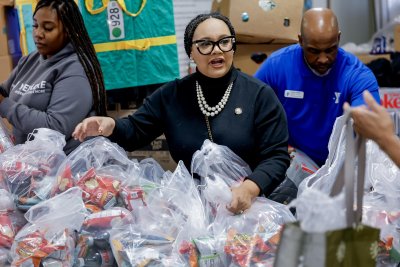
Rep. Nikema Williams, D-Ga., helps distribute food aid bags during a free food distribution at the Young Family YMCA in Atlanta on Thursday. The YMCA’s weekly neighborhood food distribution gave out nearly 10,000 pounds of food to about 400 families. Photo by Erik S. Lesser/EPA

Nov. 7 (UPI) — The Trump administration on Friday night appealed to the U.S. Supreme Court after a federal appeals court upheld a district judge’s order to pay full benefits in November to 42 million in the Supplemental Nutrition Assistance Program.

A short time earlier, the 1st District Circuit left in place a decision on Thursday by Rhode Island federal Judge Jack McConnell, who ordered the administration to pay out the full benefits within one day, saying, “People have gone without for too long.”

The three-member appeals court’s decision means the U.S. Department of Agriculture must take steps to disperse the electronic payments, which are staggered each month. Earlier Friday, the agency said it notified states that it is working to process the payments.

The panel was Chief Appellate Judge David Barron, appointed by President Barack Obama, and Gustavo Atavo Gelpi Jr. and Julie Rikelman, both picked by President Joe Biden.

The judges said that they are still considering a bid for longer relief while assessing the appeal.

Attorney General Pam Bondi posted on X the Trump administration will ask the Supreme Court to stay the Rhode Island-based lower court judge’s ruling, which she called “judicial activism at its worst.”

“A single district court in Rhode Island should not be able to seize center stage in the shutdown, seek to upend political negotiations that could produce swift political solutions for SNAP and other programs, and dictate its own preferences for how scarce federal funds should be spent,” Bondi said.

Seven days ago, McDonnell and U.S. District Court of Massachusetts Judge Indira Talwani told the Trump administration to access available funds to continue. They were both nominated by Obama.

On Monday, the administration told the judge it only had reserved money to pay out 50% of the total $9 billion cost. Then, it was raised to 65%.

The judge directed USDA to find $4 billion “in the metaphorical couch cushions.”

McConnell said the administration could use Section 32 funds, which the USDA uses to help with child nutrition programs. But the administration rejected that plan.

In the appeal, DOJ claimed that the judge’s order “makes a mockery of the separation of powers.” Lawyers said transferring funds would mean diverting money from Child Nutrition Programs.

“Unfortunately, by injecting itself with its erroneous short-term solution, the district court has scrambled ongoing political negotiations, extending the shutdown and thus undercutting its own objective of ensuring adequate funding for SNAP and all other crucial safety-net programs,” they said.

Plaintiffs in the case, which are nonprofit organizations, asked for the full payment, and McConnell agreed.

“The evidence shows that people will go hungry, food pantries will be overburdened, and needless suffering will occur” if SNAP is not fully funded, he said.

“While the president of the United States professes a commitment to helping those it serves, the government’s actions tell a different story,” McConnell wrote in a written order.

The federal government has been shut down since Oct. 1, and the shutdown is now the longest in history.

In every past shutdown, emergency funds have been used to fund the program.

McConnell also mentioned a social media post that Trump made, saying he refused to release any more funds until “the radical-left Democrats open up government, which they can easily do, and not before.”

The post was used as evidence that the administration would ignore McConnell’s order.

Source link

Sen. Chuck Schumer offers path to end government shutdown

Nov. 7 (UPI) — Democrats are ready to end the federal government shutdown if Republicans agree to extend Affordable Care Act credits for another year, Senate Minority Leader Chuck Schumer announced Friday afternoon.

Schumer, D-N.Y., said Senate Democrats favor passing a temporary funding measure and three other bills that would fund the federal government for one year, CNN reported.

“Democrats are offering a very simple compromise,” Schumer said on the Senate floor.

“Now, the ball is in the Republicans’ court,” he added. “We need Republicans to just say yes.”

Schumer’s announcement came after Senate Majority Leader John Thune, R-S.D., earlier said the Senate will work through the weekend to negotiate reopening the federal government and possibly vote after a bipartisan effort failed Thursday.

Thune wanted to hold another vote on the House-approved continuing resolution to fund the federal government through Nov. 21, but Senate Democrats aren’t on board, he told media earlier Friday.

“Our members are going to be advised to be available if, in fact, there’s a need to vote,” he said.

“We will see what happens and whether or not, over the course of the next couple of days, the Democrats can find their way to re-engage again,” Thune added.

Thune earlier this week expressed optimism that a funding agreement would be made this week, but that ended after Senate Democrats met on Thursday.

“All I know is that the pep rally they had at lunch yesterday evidently changed some minds,” he said Friday.

“We had given them everything they wanted and had asked for,” Thune explained. “At some point, I was gonna say they have to take ‘yes’ for an answer, and they were trending in that direction.”

The impasse is due to Senate Democrats not trusting President Donald Trump to agree to extend Affordable Care Act tax credits that expire after December and to stop firing federal employees, The Hill reported.

Senate Democrats held a working lunch on Thursday, as referenced by Thune, during which they rejected a bipartisan proposal to reopen the government.

Sens. Gary Peters, D-Mich., Jeanne Shaheen, D-N.H., and Angus King, I-Maine, had worked out a deal with the GOP, which buoyed Thune’s hope of ending the government shutdown on its record 38th day.

Senate Democrats discussed the bipartisan proposal during their Thursday lunch and rejected it due to their distrust of the president.

The proposal would have included a short-term funding measure to reopen the government and a three-year appropriations bill that would have funded the Agriculture Department, Veterans Affairs, military construction and the legislative branch.

The USDA funding would have meant full funding for currently suspended Supplemental Nutrition Assistance Program benefits.

Lacking strong guarantees that the president would support extending Affordable Care Act credits that initially were enacted during the COVID-19 pandemic and that are scheduled to expire at the end of the year, the Senate Democrats said they won’t support the bipartisan plan to move forward.

Despite the continued opposition from Senate Democrats, Thune doesn’t expect the shutdown to continue into the Thanksgiving holiday weekend at the end of the month, he said while appearing on Fox News Friday.

Thune needs at least five more Senate Democrats to join with Democratic Party Sens. John Fetterman of Pennsylvania, Catherine Cortez Masto of Nevada and King, who caucuses with Senate Democrats, to approve the continuing resolution.

Fetterman, Masto and King consistently have voted in favor of continuing the 2025 fiscal year budget while negotiating the budget for the 2026 fiscal year, which started on Oct. 1.

Republican Sen. Rand Paul of Kentucky is the only Republican senator to continually vote against the measure.

The House-approved continuing resolution consistently has received a majority of support in the Senate, but it has not received the 60 votes needed to overcome the Senate’s filibuster rule for passage.

Source link

Homeland Security OKs additional $155M for Helene recovery in N.C.

Nov. 7 (UPI) — The U.S. Department of Homeland Security has dispersed an additional $155 million for western North Carolina to fund 130 projects from Tropical Storm Helene.

The funding is the most allocated in the state for the storm, which struck the western Appalachian region Sept. 27, causing widespread river flooding and landslides with 30 inches of rain in some areas. There were 85 direct and indirect deaths in the state.

The 2024 storm was the costliest and deadliest in North Carolina’s history at $60 billion. Helene had intensified into a Category 4 hurricane and made landfall in western Florida before hitting the Carolinas. The total impact was $79.8 billion, according to the National Oceanic and Atmospheric Administration.

More than $957 million has been provided for road repair, debris removal, infrastructure repair and emergency protective measures. Since Donald Trump became president Jan. 20, more than $632 million in public assistance reimbursements have been approved to support the recovery efforts in North Carolina. 

A senior HHS spokesman said Trump and HHS Secretary Kristi Noem “are committed to streamlining aid and supporting North Carolina’s recovery from Tropical Storm Helene and other disasters. These millions of dollars in federal assistance will help communities repair critical infrastructure, restore essential services and continue rebuilding stronger for the future.”

The grants from the Federal Emergency Management Agency include $54 million to the North Carolina Department of Transportation to rebuild roads and bridges.

Also, $40 million was awarded for two utilities — French Broad Electric Co. and Rutherford Electric Membership Corp. — for repairs and emergency protective measures.

Other funding includes $14.8 million to Henderson County, $9.6 million to Buncombe County, $1.6 million for city of Boone, $1.4 million for Paddy’s Creek Beach and Catawba Beach, $1.3 million to the Buncombe County School District.

State officials are awaiting on other funding, NC Newsline reported.

A $1.4 billion pool of grant money for a homebuilding program that now has more than 4,000 applicants. Also, another grant program allows FEMA to buy out private properties with applications pending for months.

Source link

UM survey says government shutdown deepened economy worries to lowest point

A shopper pictured March 2020 in a Medina, Ohio, grocery store. The survey released Friday showed consumer sentiment at its lowest in three years and near its worst at UM’s second lowest reading since at least 1978 as the ongoing government shutdown by the Republican-controlled congress widens economic concern. File Photo by Aaron Josefczyk/UPI | License Photo

Nov. 7 (UPI) — A new survey by the University of Michigan suggested that Americans may be frightened over the economy as the ongoing U.S. government shutdown reverberates with no end in sight.

The survey released Friday showed consumer sentiment at its lowest in three years and near its worst at UM’s second-lowest reading since at least 1978 as the shutdown sent confidence to near-record lows as economic concerns deepen.

“With the federal government shutdown dragging on for over a month, consumers are now expressing worries about potential negative consequences for the economy,” according to survey Director Joanne Hsu.

The University of Michigan’s monthly Index of Consumer Sentiment posted a more than 6% decline to a little over 50% for the month. It was a 30% decline from about a year ago.

“This month’s decline in sentiment was widespread throughout the population, seen across age, income and political affiliation,” Hsu added.

UM’s well-documented survey showed a gradual decline in consumer confidence over the year starting in February in the wake of tax-like tariffs imposed by U.S. President Donald Trump.

“Across the economy, segments of the population are increasingly dealing with tighter financial conditions,” Elizabeth Renter, senior economist at NerdWallet, told CNBC.

Renter said that is “certainly true for federal workers and people dependent on food assistance from the federal government. But it’s also likely increasingly true for middle income Americans.”

Source link

Elon Musk’s $1T pay deal backed by Tesla shareholders

Nov. 7 (UPI) — Tesla shareholders approved an unprecedented new package for CEO Elon Musk that could see him become the world’s first trillionaire.

The firm said 75% of shareholders with voting rights on Thursday backed Musk’s 10-year pay deal, which could net him $1 trillion over that time by boosting his stake in Tesla by more than 423 million shares.

The share bonanza is contingent on him delivering on a promise to drive up Tesla’s market capitalization five-fold from is current level of around $1.5 trillion to $8.5 trillion, roughly double the size of the Japanese economy.

Shareholders at the annual general meeting at Tesla HQ in Austin, Texas, voted it through on the recommendation of Tesla’s board, arguing Musk might quit if it were rejected and that the company could not afford to lose him.

Counsel from independent advisors Glass Lewis and Institutional Shareholder Services who said the “astronomical” deal should be rejected due to “unmitigated concerns surrounding the special award’s magnitude and design,” was largely ignored.

Addressing the meeting after the result, Musk thanked the board and shareholders, saying what Tesla was poised to do was not just “a new chapter in the future of Tesla, but a whole new book.”

Under the deal, Musk will receive the stock in tranches tied to delivering financial and production targets, including 20 million new electric vehicles rolling off production lines, 10 million full self-driving subscriptions​, 1 million Optimus humanoid robots and 1 million robotaxis in service.

The first block of stock gets paid to Musk when Telsa market capitalization reaches $2 trillion with the next nine awarded each time the company’s value rises by another $500 billion, up to $6.5 trillion.

Two additional rises in market capitalization, each of $1 trillion, bringing the value to $8.5 trillion, are required for the final two stock grants to kick in.

While the deal is performance-based, it’s not set in stone — with Musk still in line to earn more $50 billion even if he fails to meet the bulk of the targets — and includes riders for so-called “covered events” with the potential to impact Tesla’s future designs, manufacturing and sales.

These include natural disasters, wars, pandemics and changes to “international, federal, state and local law, regulations or other governmental action or inaction.”

In June 2024, Musk reincorporated Tesla in Texas, the company’s headquarters and center of operations, moving from Delaware six months after a court there struck down a $56 billion pay deal the board awarded to Musk in 2018, ruling it was “unfair” and that Musk held excessive power over the rules and size of the deal.

On the same day, shareholders voted to reinstate the package, at the time the largest in corporate history.

In December 2024, the Delaware judge in the case reaffirmed her ruling in favor of the complainant, shareholder Tornetta, and ordered Musk must return what he had already received from the package.

The board eventually awarded Musk a $29 billion “good faith” package in August, aimed at keeping Musk at the helm, that would see him granted 96 million shares after two years of service in a “senior leadership role” at Tesla.

Musk’s mega-deal on Thursday came three weeks after Tesla reported Tesla reported third quarter profits down 37%, despite a jump in revenue to a record $28.1 billion on stronger sales of its electric cars in the domestic market.

Source link

Judge limits federal agents’ use of force in Chicago immigration crackdown

Nov. 7 (UPI) — A federal judge has issued a preliminary injunction barring federal authorities from using force against protesters, journalists and others in Chicago as the Trump administration conducts an immigration crackdown in the city.

U.S. District Judge Sara Ellis issued her ruling Thursday, in a case brought against the Trump administration in early October alleging that federal agents in Chicago have responded to protests and negative media coverage “with a pattern of extreme brutality in a concerted and ongoing effort to silence the press and civilians.”

The ruling explicitly states that the federal agents are prohibited from using crowd control weapons such as batons, rubber or plastic bullets, flash-bang grenades and tear gas against civilians unless there is “a threat of imminent harm to a law enforcement officer.”

In a bench ruling, reported on by The New York Times, Ellis said government officials, including Gregory Bovino, a top Border Patrol official leading the operation in Chicago, lied repeatedly about the tactics they employed against protesters.

The ruling comes amid growing criticism of the Trump administration’s deployment of federal immigration authorities executing Operation Midway Blitz, which began on Sept. 9, targeting undocumented immigrants with criminal records.

Videos circulating online, however, show masked agents hauling a woman, later identified as U.S. citizen Dayanne Figueroa, from her vehicle, which they crashed into, and forcibly detaining a teacher from a daycare in front of school children. Rep. Mike Quigley, D-Ill., said they detained the woman without a warrant, calling the actions of the immigration agents “domestic terrorism.”

Chicago Mayor Brandon Johnson earlier Thursday said during a press conference the daycare employee’s arrest “shocked the conscience of every single Chicagoan.”

In her bench ruling Thursday, Ellis, a President Barack Obama appointee, rejected the government’s description of Chicago as a violent- and riot-riddled city, saying, “That simply is untrue, and the government’s own evidence in this case belies that assertion.”

With pointed remarks at Bovino, she said the federal agent “admitted that he lied” about being hit in the head with a rock in October, which was his reasoning for deploying tear gas canisters.

“Video evidence ultimately disproved this,” she said, CNN reported.

Lawyers with Lovey & Lovey who brought the case before the court described it as protecting the right to protest.

Steve Art, a partner at the firm, called Ellis’ preliminary injunction in a press conference a “powerful ruling.”

“For weeks, the Trump administration has deployed Gregory Bovino and his gang of thugs to terrorize our community. They have tear gassed dozens of residential neighborhoods, they have abused the elderly, they have abused pregnant women, they have abused young children. On our streets, they have used weapons of war,” he said.

“We want to be clear every person who is associated with or who has enabled the Trump administration’s violence in Chicago should be ashamed of themselves.”

Source link

Senate Republicans defeat bill requiring Congress to approve attacking Venezuela

Nov. 7 (UPI) — Republicans narrowly defeated a bipartisan bill in the Senate requiring congressional approval for military action against Venezuela as the Trump administration continues a military buildup in the region and attacks on alleged drug boats in nearby waters.

The GOP lawmakers rejected Senate Joint Resolution 90 in a 51-49 vote on Thursday evening, with Republican Sens. Rand Paul of Kentucky and Lisa Murkowski of Alaska casting ballots in favor of the measure with their Democratic colleagues.

The resolution was introduced by Paul, and Democratic Sens. Adam Schiff of California and Tim Kaine of Virginia in response to reporting that President Donald Trump was considering military ground strikes against Venezuela.

Venezuela has long been a target of Trump, who, during his first administration, launched a failed multiyear pressure campaign to oust its authoritarian leader, President Nicolas Maduro.

Since returning to the White House in January, Trump has used his executive powers to target drug cartels, including the Venezuelan Tren de Aragua gang. Trump has claimed, without providing evidence, that TdA has “invaded” the United States at Maduro’s direction, despite his own National Intelligence Council concluding in May that the regime “probably does not have a policy of cooperating” with TdA.

The vote was held as Defense Secretary Pete Hegseth announced a 17th known military strike on an alleged drug trafficking boat in Caribbean international waters. Since Sept. 2, the United States has killed around 70 people in the attacks.

The attacks have drawn domestic and international criticism and allegations of war crimes, murder and extrajudicial killings. Some Democrats called on the Trump administration to answer questions over the legality of the strikes without gaining proper congressional approval.

Following the Thursday vote, Kaine said the Trump administration told some members of Congress that it lacked legal authority to launch any attacks into Venezuela. Some worry that an attack could devolve into a full-scale war.

“Trump’s illegal strikes on boats in the Caribbean and threats of land strikes in Venezuela recklessly and unnecessarily put the U.S. at risk of war,” Kaine said in a statement.

In a separate statement, he criticized his Republican colleagues, stating: “If the U.S. is going to put our nation’s sons and daughters into harm’s way, then we should have a robust debate in Congress in front of the American people.”

Sen. Todd Young, a Republican of Indiana, voted against the bill on Thursday, and explained in a statement that he has been informed of the legal rationale behind the strikes and does not believe the resolution is appropriate right now, but that could change.

“My vote is not an endorsement of the administration’s current course in the Caribbean and Eastern Pacific. As a matter of policy, I am troubled by many aspects and assumptions of this operation and believe it is at odds with the majority of Americans who want the U.S. military less entangled in international conflicts,” he said.

Source link

U.S. lifts Biden-era arms embargo on Cambodia

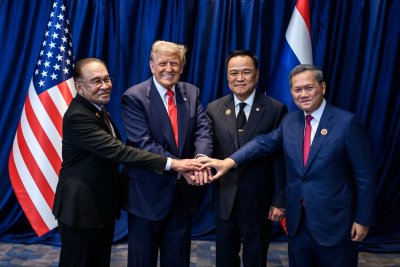
With Malaysia’s Prime Minister Anwar Ibrahim (left) by his side, U.S. President Donald Trump oversees the signing of a ceasefire agreement between Thailand’s Prime Minister Anutin Charnvirakul (second from right) and Cambodia’s Prime Minister Hun Manet (right) on the sidelines of the 47th Association of Southeast Asian Nations (ASEAN) summit in Kuala Lumpur, Malaysia, on Sunday, October 26, 2025. File Photo via The White House/UPI | License Photo

Nov. 6 (UPI) — The United States on Thursday lifted a Biden-era arms embargo on Cambodia following several high-profile meetings between officials of both countries.

The notice filed by the State Department with the Federal Register that explains the Trump administration was removing Cambodia from the International Traffic in Arms Regulations list due to Phnom Penh’s “diligent pursuit of peace and security, including through renewed engagement with the United States on defense cooperation and combating transnational crime.”

The embargo was placed on Cambodia in late 2021 by the Biden administration to address human rights abuses, corruption by Cambodian government actors, including in the military, and the growing influence of China in the country.

It was unclear if any of those issues had been addressed.

“The Trump administration has completely upended U.S. policy toward Cambodia with no regard for U.S. national security or our values,” Rep. Gregory Meeks, D-N.Y., said in a statement criticizing the move to lift the embargo.

“There has been broad bipartisan concern about the Cambodian government’s human rights abuses and its deepening ties to Beijing.”

The embargo was lifted on the heels of Deputy Prime Minister Prak Sokhonn meeting with Michael George DeSombre, U.S. assistant secretary of State for East Asian and Pacific Affairs, in Cambodia on Tuesday.

On Friday, Secretary of Defense Pete Hegseth met with Tea Seiha, another Cambodian deputy prime minister, in Malaysia, where the two agreed to restart “our premier bilateral military exercise,” the Pentagon chief said in a statement.

President Donald Trump has received much praise from Cambodia for his involvement in securing late July’s cease-fire and then last month’s peace declaration between Thailand and Cambodia, which had been involved in renewed armed conflict in their long-running border dispute.

During Tuesday’s meeting between Prak and DeSombre, the Cambodian official reiterated Phnom Penh’s “deep gratitude” to Trump “for his crucial role in facilitating” the agreements, according to a Cambodian Foreign Ministry statement on the talks.

Meeks framed the lifting of the embargo on Thursday as the Trump administration turning a blind eye to Cambodia’s “rampant corruption and repression … because the Cambodian government placated Trump in his campaign for a Nobel Peace Prize.”

“That’s not how American foreign policy or our arms sales process is meant to work,” Meeks said.

Cambodia in August nominated Trump for the Nobel Peace Prize “in recognition of his historic contributions in advancing world peace,” the letter to the Norwegian Nobel Committee stated.


Source link

Federal judge orders U.S. government to distribute full SNAP benefits

Volunteers stack donated food for the North Hollywood Interfaith Food Pantry in Los Angeles on October 24, ahead of the suspension of Supplemental Nutrition Assistance Program benefits for 42 million recipients across the country. Photo by Allison Dinner/EPA

Nov. 6 (UPI) — The Trump administration has one day to fully distribute Supplemental Nutrition Assistance Program benefits for November, a federal judge ruled on Thursday.

U.S. District Court of Rhode Island Judge Jack McConnell ordered the program funding after earlier requiring the Trump administration to access available money to at least partially fund SNAP benefits amid the federal government shutdown.

McConnell required the Trump administration to apprise the court on Wednesday of efforts to fund the program formerly known as “food stamps.”

“People have gone without for too long,” McConnell said during an emergency hearing on Thursday, as reported by CNN.

“Not making payments to them for even another day is simply unacceptable,” he added.

He said the Trump administration has not done enough to access an estimated $4.65 billion in contingency funds to partially fund the SNAP benefits that cost about $9 billion per month to help 42 million recipients put food on their tables.

If SNAP is not funded fully, “people will go hungry, food pantries will be overburdened, and needless suffering will occur,” McConnell said on Thursday, according to CNBC.

“That’s what irreparable harm here means,” he continued. “Last weekend, SNAP benefits lapsed for the first time in our nation’s history.”

He called it a “problem that could have and should have been avoided.”

McConnell ordered the Trump administration to provide the full amount of November SNAP benefits to respective states by Friday, which would enable them to distribute benefits to their residents within a few days.

The federal judge also referenced a Truth Social post made by President Donald Trump on Tuesday.

In that post, the president said SNAP benefits only would be funded “when the radical-left Democrats open up government, which they can easily do, and not before.”

The social media post served as evidence that the Trump administration would ignore McConnell’s prior order requiring it to access as much funding as possible to distribute SNAP benefits.

He criticized the U.S. Department of Agriculture’s decision not to access contingency funds to continue SNAP benefits instead of allowing them to be suspended as of Saturday.

“Even when Nov. 1 came, [the] USDA refused to use the congressionally mandated contingency funds,” McConnell said.

“USDA cannot now cry that it cannot get timely payments to the beneficiary for weeks or months because states are not prepared to make partial payments.”

McConnell is presiding over one of two federal cases filed by up to 25 states seeking to continue federal funding of SNAP benefits despite the record 37-day federal government shutdown that started on Oct. 1.

New York is party to both suits, and state Attorney General Letitia James welcomed McConnell’s ruling on Thursday.

“A judge in Rhode Island just stopped the federal government from starving millions of Americans,” James said in a prepared statement.

“I am relieved that people will get the food they need,” she added, “but it is outrageous that it took a lawsuit to make the federal government feed its own people.”

Source link

Jury acquits Washington resident in sandwich-throwing incident

Nov. 6 (UPI) — Former Justice Department paralegal Sean Dunn is not guilty of assault for throwing a sub sandwich at a Border Patrol agent in Washington, D.C., a federal jury ruled Thursday.

The jury deliberated a misdemeanor assault charge against Dunn on Wednesday and Thursday before rendering its verdict, NBC News reported.

Dunn accosted Border Patrol agent Greg Lairimore in the capital’s U Street area, swore at him called him an unwelcome “fascist” before throwing a footlong sub sandwich that struck him in the chest.

The Border Patrol agent was there as part of President Donald Trump‘s federal law enforcement surge to thwart crime in the nation’s capital.

Lairimore testified that the sandwich “exploded” when it hit his chest, but photos showed it was still wrapped while lying on the ground after striking him.

The case was tried in the U.S. District Court for the District of Columbia, where a grand jury earlier rejected several potential felony charges against Dunn.

U.S. Attorney Jeanine Pirro proceeded with the misdemeanor assault charge against Dunn and agreed to hold a jury trial upon the request of Dunn’s attorneys.

Attorney General Pam Bondi earlier cited Dunn as an example of the “deep state” in Washington and fired him from his DOJ job.

The incident went viral as video footage circulated on social media and inspired murals and other depictions of a masked Dunn preparing to hurl a footlong sub sandwich like a quarterback would throw a football.

Some people also dressed in costumes intended to mimic Dunn, and many Washington-area homes featured skeletons dressed similarly to Dunn during Halloween.

Source link

40 U.S. airports to reduce flights amid government shutdown

Nov. 6 (UPI) — A reduction in flights will affect 40 airports amid the federal government shutdown, which has put a strain on air traffic control staffing, unnamed sources said Thursday.

The Federal Aviation Administration hasn’t listed the airports, but sources released the tentative list to ABC News, CBS News and The Washington Post.

Most of the airports affected are in major cities, such as New York, Chicago, Houston and Los Angeles. But other, less-busy airports are also on the list, such as Tampa Bay, Fla.; Anchorage, Alaska; and San Diego.

Transportation Secretary Sean Duffy announced the 10% flight reduction on Wednesday, and said the cuts will begin on Friday.

“Our sole role is to make sure that we keep this airspace as safe as possible. Reduction in capacity at 40 of our locations. This is not based on light airline travel locations. This is about where the pressure is and how to really deviate the pressure,” FAA Administrator Bryan Bedford Bedford said Wednesday.

​​”If you bring us to a week from today, Democrats, you will see mass chaos,” Duffy said on Tuesday.

A source told ABC News that the flight reductions will start at 4% Friday and work up to 10%. The flight reductions will be from 6 a.m. to 10 p.m. and tentatively affect the following airports:

  1. Anchorage International (Alaska)
  2. Hartsfield-Jackson Atlanta International (Georgia)
  3. Boston Logan International (Massachusetts)
  4. Baltimore-Washington International Marshall (Maryland)
  5. Charlotte Douglas International (North Carolina)
  6. Cincinnati/Northern Kentucky International (Ohio/Kentucky)
  7. Dallas Love Field (Texas)
  8. Reagan National (District of Columbia/Virginia)
  9. Denver International (Colorado)
  10. Dallas-Fort Worth International (Texas)
  11. Detroit Metropolitan Wayne County (Michigan)
  12. Newark Liberty International (New Jersey)
  13. Fort Lauderdale-Hollywood International (Florida)
  14. Honolulu International (Hawaii)
  15. Houston Hobby (Texas)
  16. Washington Dulles International (District of Columbia/Virginia)
  17. George Bush Houston Intercontinental (Texas)
  18. Indianapolis International (Indiana)
  19. John F. Kennedy International (New York)
  20. Las Vegas Reid International (Nevada)
  21. Los Angeles International (California)
  22. LaGuardia Airport (New York)
  23. Orlando International (Florida)
  24. Chicago Midway (Illinois)
  25. Memphis International (Tennessee)
  26. Miami International (Florida)
  27. Minneapolis/St. Paul International (Minnesota)
  28. Oakland International (California)
  29. Ontario International (Canada)
  30. Chicago O’Hare International (Illinois)
  31. Portland International (Oregon)
  32. Philadelphia International (Pennsylvania)
  33. Phoenix Sky Harbor International (Arizona)
  34. San Diego International (California)
  35. Louisville International (Kentucky)
  36. Seattle-Tacoma International (Washington)
  37. San Francisco International (California)
  38. Salt Lake City International (Utah)
  39. Teterboro (New Jersey)
  40. Tampa International (Florida)

The reduction could affect cargo and commercial travelers. It could also cause issues as people prepare to travel for Thanksgiving.

Source link

Experts warn explosive nuclear testing would trigger escalation

Nov. 6 (UPI) — President Donald Trump’s calls to ramp up nuclear weapons testing last week have put nuclear watchdogs and world leaders on alert while experts say the United States has little to gain.

In a post on Truth Social on Oct. 29, Trump said he is ordering the Department of Defense to immediately begin testing nuclear weapons “on an equal basis.” What this means remains unclear, though Energy Secretary Chris Wright said in an appearance on FOX News these would not be full-scale explosive tests.

“These are not nuclear explosions,” Wright said. “These are what we call non-critical explosions.”

The comment by Wright echoes the stance Brandon Williams, under secretary of energy for Nuclear Security in the Department of Energy, shared during his Senate confirmation hearing in May. Williams said testing nuclear weapons above the criticality threshold would not be advisable.

According to the International Campaign to Abolish Nuclear Weapons and Nuclear Weapons Ban Monitor, the United States possesses more than 5,000 nuclear weapons. It has performed 1,054 explosive nuclear tests, more than any other country.

The type of testing the president is calling for is an important distinction to make, Dylan Spaulding, senior scientist for the Union of Concerned Scientists, told UPI. The delivery systems of nuclear weapons and the components of the weapons are commonly tested.

Subcritical tests are also performed. These are tests that do not yield a sustained nuclear reaction that would cause an explosion.

“He did mention testing on an equal basis,” Spaulding said. “If that’s the case, in fact the United States already does conduct all the kinds of tests of our nuclear delivery systems and even the components of the weapons themselves that other countries do.”

The United States and most of the rest of the world, aside from North Korea, have refrained from full-scale nuclear weapons testing for more than 30 years. In 1993, the United States signed a unilateral moratorium on explosive testing under the Comprehensive Nuclear Test Ban Treaty.

Breaking from the treaty is likely to open the door to escalation in the form of other countries, including adversaries like China and Russia, openly testing nuclear explosives, Henry Sokolski, executive director of the Nonproliferation Policy Education Center, told UPI.

“What if those countries decided that maybe this is a cue for them to test?” Sokolski said. “Would that provoke any of the larger states that signed [the treaty] but didn’t ratify to test?”

The only country to break from the agreement in this treaty is North Korea, conducting six nuclear tests concluding in 2017.

Sokolski argues that the United States has the least to gain by breaking the moratorium and setting off a precedent for open nuclear weapons testing. The United States’ research in the field is extensive, beyond that of any other country. Other countries, such as Russia, China, India, Pakistan and North Korea stand to benefit the most from more explosive research while the United States would likely gain little more knowledge.”

“I spend a lot of time talking to weapons designers about this. You don’t test for reliability testing generally,” Sokolski said. “That requires 10 to 20 datapoints. That means 10 to 20 tests of each design. That seems kind of wasteful. You don’t design to prove things you’ve already proven.”

“If you’re doing a design that is totally radical, that’s something different, but we’re not,” he continued. “We’re fiddling with yield-to-weight ratios. There are countries like Israel who have tested once, in 1979, one test. Are you telling me their stockpile is unreliable and doesn’t work? If you want to make weapons you can do it very cheaply and quickly without testing.”

Spaulding agrees that full-scale testing is not necessary, adding that scientists continue to analyze data from the repository of the United States’ nuclear weapons testing history.

“We are still learning from those underground tests,” he said. “Other countries don’t have that advantage right now but we would be essentially giving them permission to catch up by returning to testing.

The argument for more live-testing of nuclear weapons capabilities is that it can insure and assure that the stockpile of weapons is reliable.

The United States has the Stockpile Stewardship Program that already tests the reliability and safety of its nuclear weapons. Daryl Kimball, executive director of the Arms Control Association, told UPI the scientific community is “very confident” in the program.

While the United States is one of only nine countries that have not ratified the treaty, it is legally bound as a signatory to not violate the object or purpose of the agreement, Kimball said. He is doubtful that this will deter Trump.

Of the 1,054 explosive nuclear tests performed by the United States, 928 have been conducted at the Nevada Nuclear Site in south-central Nevada about 65 miles outside of Las Vegas. The site is the only candidate for hosting further nuclear testing, according to experts.

The last explosive test was conducted in 1992 before the United States began observing the international moratorium.

Past tests at the site yielded observable health and environmental impacts on residents of the region and beyond.

“Anyone born in ’63 or earlier, they were exposed to some level of strontium 90, which was showing up in the baby teeth of American children in the 50s and 60s,” Kimball said. “It accumulates in the teeth because you drink milk and it gets concentrated in the teeth.”

The United States joined the Soviet Union and United Kingdom in the Limited Test Ban Treaty in 1963, in part because of the baby teeth study. The treaty banned nuclear weapons testing in the atmosphere, outer space and underwater.

Subjects of the baby teeth study were children in the St. Louis area, more than 1,600 miles from the Nevada nuclear test site.

With the atmospheric testing ban in place, explosive testing was moved underground in deep boreholes. This was meant to limit nuclear fallout, lessening environmental and health implications.

The vertical testing shafts are reinforced to limit geological impacts but the powerful explosions still generate fractures in the earth and the leakage of radionuclides, a hazardous radioactive material.

People who lived downwind of the Nevada test site, known as downwinders, have experienced higher than average rates of cancer.

“These downwinders, in their second generation, they’re still suffering from some of these adverse health effects,” Kimball said. “They are particularly angry. Trump’s announcement is a slap in the face to them as they see it. They want to see all forms of testing, above and below ground, concluded.”

Restarting full-scale testing would be no small task, Sokolski said. What he refers to as a “quick and dirty” test, one that provides an explosion but little in the way of research, would take months and millions of dollars to prepare.

“To get data, depending on how much data, we could be talking about one to two years and much, much more money, maybe approaching a higher order of magnitude, a billion [dollars],” Sokolski said. “Those stumbling blocks are the ones of interest.”

Source link

On This Day, Nov. 6: Americans elect Abraham Lincoln 16th president

Nov. 6 (UPI) — On this date in history:

In 1860, Republican Abraham Lincoln was elected 16th president of the United States.

In 1861, Jefferson Davis was elected president of the Confederate States of America.

In 1869, in the first formal intercollegiate football game, Rutgers beat Princeton, 6-4.

In 1928, Republican Herbert Hoover was elected 31st president of the United States, defeating Democrat Al Smith.

In 1956, U.S. President Dwight D. Eisenhower was re-elected by a wide margin.

In 1965, a formal agreement between the United States and Cuba allowed Cubans who wanted to leave the island nation for America to do so. More than 250,000 Cubans had taken advantage of this opportunity by 1971.

In 1984, U.S. President Ronald Reagan was elected to a second term, winning 49 states.

File Photo by Mal Langsdon/UPI

In 1985, members of the 19th of April Movement took over the Palace of Justice in Bogota, Colombia. The leftist guerrillas would kill more than 100 people (11 of whom where Supreme Court Justices) by the time the siege ended.

In 1991, Russian President Boris Yeltsin issued a decree banning the Communist Party, nationalizing its property and condemning its activities.

File Photo by Jim Ruymen/UPI

In 2012, U.S. President Barack Obama defeated Republican challenger Mitt Romney to win a second term. Federal finance reports showed campaign expenditures broke the $2 billion mark, making the election the most expensive in U.S. history at the time.

In 2013, Avigdor Lieberman, who had resigned as Israel’s foreign minister because of an investigation of alleged corruption, was acquitted and said: “This chapter is behind me. I am now focusing on the challenges ahead.” Lieberman became foreign minister again five days later.

In 2019, the U.S. midterm elections saw a number of milestones and firsts — Ilhan Omar, D-Minn., and Rashida Tlaib, D-Mich., were the first Muslim women elected to the House; Sharice Davids, D-Kan., and Debra Haaland, D-N.M., were the first Native American women elected to the House; Alexandria Ocasio-Cortez, D-N.Y., was the youngest person elected to the House in nearly three decades; and Jared Polis became the country’s first openly gay male governor, in Colorado. Democrats also took back control of the House, while Republicans held onto the Senate.

In 2024, German Chancellor Olaf Scholz dismissed Finance Minister Christian Lindner, resulting in the collapse of his three-party coalition government. A month later, Scholz lost a confidence vote in parliament, triggering an election in February that saw conservative Friedrich Merz put into power.

File Photo by Leo Correa/UPI

Source link

President Donald Trump ends Temporary Protect Status for South Sudan as nation edges toward renewed war

Nov. 6 (UPI) — The Trump administration has moved to end deportation protections for those from South Sudan as the United Nations warns the country is on the brink of war.

Amid President Donald Trump‘s crackdown on immigration, the Department of Homeland Security has targeted countries that have been given Temporary Protected Status, which is granted to countries facing ongoing armed conflict, environmental disasters or other extraordinary conditions.

TPS enables eligible nationals from the designated countries to live and work in the United States legally, without fear of deportation.

DHS announced it was ending TPS for South Sudan on Wednesday with the filing of a Federal Register notice.

The termination will be in effect Jan. 5.

“After conferring with interagency partners, Secretary of Homeland Security Kristi Noem determined that conditions in South Sudan no longer meet the TPS statutory requirements,” DHS said in a statement, which explained the decision was based on a U.S. Citizenship and Immigration Services review of the conditions in South Sudan and in consultation with the Department of State.

South Sudan was first designated for TPS in November 2011 amid violent post-independence instability in the country, and the designation has been repeatedly renewed since.

The Trump administration has sought to end TPS designations for a total seven countries: Afghanistan, Cameroon, Haiti, Honduras, Nicaragua, Nepal, Venezuela and now South Sudan. Court challenges have followed, with decisions staying, at least for now, the terminations for all of the countries except for Afghanistan and Cameroon, which ended July 12 and Aug. 4, respectively.

The move to terminate TPS for South Sudan is also expected to be challenged in court.

The announcement comes a little more than a week after the United Nations Commission on Human Rights in South Sudan warned the General Assembly that the African nation is experiencing escalating armed conflict and political crisis, and that international intervention is needed to halt mounting human rights violations.

A civil war erupted in South Sudan in December 2013, just two years after the country gained independence — a conflict that came to an end with a cease-fire in 2018.

Barney Afako, a member of the human rights commission in South Sudan, said Oct. 29 that the political transition spearheaded by the cease-fire agreement was “falling apart.”

“The cease-fire is not holding, political detentions have become a tool of repression, the peace agreement’s key provisions are being systematically violated and the government forces are using aerial bombardments in civilian areas,” he said.

“All indicators point to a slide back toward another deadly war.”

The DHS is urging South Sudanese in the United States under TPS to voluntarily leave the country using the U.S. Customs and Border Protection smartphone application. If they do, they can secure a complimentary plane ticket, a $1,000 “exit bonus” and potential future opportunities for legal immigration.

Source link

Judge Robert Gettleman orders better conditions at ICE detention site near Chicago

Nov. 5 (UPI) — A federal district judge on Wednesday ordered authorities to improve conditions inside the U.S. Immigration and Customs Enforcement building near Chicago.

U.S. District Judge Robert Gettleman, calling the conditions “unnecessarily cruel,” acted on a class action lawsuit Wednesday after hearing several hours of testimony from five people detained at the Broadview immigration detention site west of Chicago.

“People shouldn’t be sleeping next to overflowing toilets,” Gettleman, who was appointed by President Bill Clinton, said. “They should not be sleeping on top of each other.”

The four-page order also mandates detainees to be able to contact their attorneys. The order on the class action lawsuit will run from Nov. 19, when he will have another hearing though the Trump administration was told to give him a status by Friday on complying with the order.

“The court finds that plaintiffs and members of the punitive class have suffered, and are likely to suffer, irreparable harm absent the temporary relief granted herein, that they are likely to prevail on the merits of the claims, that the balance of the equities tips in their favor,” he said.

They also must be provided with a shower at least every other day; clean toilet facilities; three full meals per day; a bottle of water with each meal; adequate supplies of soap, toilet paper, and other hygiene products; and menstrual products and prescribed medications.

Holding cells also must be cleaned at least twice a day.

Regarding legal defense, detainees must have free and private phone calls with their attorneys and a list of pro bono attorneys in English and Spanish.

And they must be listed in ICE’s online detainee locator system as soon as they arrive at the Broadview facility.

The judge heard several hours of testimony about conditions at the building, which is intended to hold detainees for a few hours.

They described the inadequate food, sleeping conditions, medical care and bathrooms near where they slept. They said they slept on the floor or on plastic chairs.

The lawsuit claimed the facility “cut off detainees from the outside world,” which the government has denied.

The judge didn’t act on the plaintiff’s request to limit how many people would be kept in holding cells and limit them to not more than 12 hours if the changes aren’t enacted.

The U.S. government said the restrictions would “halt the government’s ability to enforce immigration law in Illinois.”

Source link

Anonymous donor helps Pittsburgh family feed others amid SNAP lull

Nov. 5 (UPI) — The disruption of federal benefits that help feed families spurred a Pittsburgh man to create a front-yard food bank to help others as the federal government remains shut down.

A.J. Owen. 36, resides in the Pittsburgh suburb of Whitehall, and initially started his ad-hoc food pantry after completing a $150 food run with his two sons about a week ago, according to TribLIVE.

Owen has large plastic bins containing canned goods and other foods placed on portable tables in his front yard for those who need food and for others to leave food donations.

“The amount of donations we received and the amount of people coming and getting food is both so gratifying and so horrifying,” Owentold TribLIVE.

“So many people need help,” he added, “and I’m so happy to be a resource for them.”

Owen said he initially started the food pantry to teach his sons about the need to help others, but it has become a much greater endeavor, as affirmed by a recent visit from Good Morning America and its cameras.

The single father notified others of his effort on social media, which resulted in additional food donations — including one donation that he said was thousands of dollars’ worth of $100 bills from an anonymous person.

He found the money stuffed in an envelope inside his mailbox with a note saying, “May God prosper and bless your food pantry,” Owen told ABC News.

“My body started shaking,” he said. “I started crying.”

He also said, “This was the best cry ever because whatever you want to believe, an angel truly came down and blessed us that day. And we’ve been good ever since.”

Owen didn’t say how much money was in the envelope, other than it added up to “thousands” of dollars.

He posted a video of the anonymous donation on social media, which drew millions of views and prompted others to visit and donate more food.

Among them were Pittsburgh Steelers defensive end Yahya Blackand his fiancé, who donated “tons of food,” Owen said on social media.

Owen did not say if his food pantry effort might outlast the federal government shutdown, which entered a record 36 days on Wednesday and temporarily disrupted funding of the federal government’s Supplemental Nutrition Assistance Program.

Source link

ADP: October’s 42,000 jobs quell labor fears for now

Nov. 5 (UPI) — ADP reported Wednesday that jobs growth for October provided better insight after fears of further decline after September’s report.

Some 42,000 jobs were added over the month in companies with at least 250 workers following September’s drop of around 29,000, according to Automatic Data Processing Inc. However, a revision showed 3,000 fewer jobs in September.

“Private employers added jobs in October for the first time since July, but hiring was modest relative to what we reported earlier this year,” said Nela Richardson, ADP’s chief economist.

ADP data showed that small business lost around 34,000 employees.

“Meanwhile, pay growth has been largely flat for more than a year, indicating that shifts in supply and demand are balanced,” Richardson said in a release.

Job categories in utility, transpiration and trade gained 47,000, which offset losses in other job areas. In addition, around 26,000 jobs were added in health and education services with 11,000 in finance.

A decline in some 17,000 roles in the area of information services was seen despite the ongoing boom in the artificial intelligence industry.

But the manufacturing sector continues to struggle in the growing aftermath of tax-like tariffs imposed by U.S. President Donald Trump in his bid to revive American manufacturing jobs.

Small business account for three of every four U.S. jobs, according to ADP.

ADP’s chief economist stated the shift away from growth in small business is noteworthy.

“While big companies make headlines, small companies drive hiring,” Richardson told CNBC.

“So to see that weakness at the small company level is still a concern, and I think that’s one of the reasons why the recovery has been so tepid.”

The payroll processing giant reported an average monthly growth of 60,000 jobs a month for the first half of the year, but that figure showed a decline in the year’s second half.

The historic ongoing shutdown by the Republican-controlled federal government resulted in a suspension in data released by the Bureau of Labor Statistics, which typically is at the forefront of detailed job data. In addition, a temporary stop in SNAP benefits is poised to heighten food insecurity in the United States.

Source link

Federal judge may intervene in ‘disgusting’ Chicago ICE detention facility

Nov. 5 (UPI) — A federal judge was expected to rule Wednesday after he called the conditions at an Immigration and Customs Enforcement detention facility in a Chicago suburb “disgusting” after hearing more than 6 hours of testimony.

U.S District Judge Robert W. Gettleman on Tuesday reviewed the conditions at the facility in Broadview, Ill., that ICE is using as part of Operation Midway Blitz. He’s ruling on a lawsuit filed by the American Civil Liberties Union of Illinois last week over detainee access to lawyers and allegedly inhumane conditions there.

Gettleman told the court that what he heard qualifies for court intervention. He said he will issue a final ruling on Wednesday, and that it will not be “impossible to comply with.”

“I think everybody can admit that we don’t want to treat people the way that I heard people are being treated today,” Gettleman said after hearing testimony from five detainees being held at the facility, calling their descriptions of the facility “disgusting” and “unconstitutional.”

“It’s a disturbing record,” Gettleman said. “People sleeping shoulder to shoulder, next to overflowing toilets and human waste — that’s unacceptable.”

The Justice Department argued in a response to the ACLU’s lawsuit that people at the facility are “adequately provided with food, clothing, shelter and medical care before they are transferred to another detention facility.”

During the hearing on Tuesday, Justice Department attorney Jana Brady suggested that the five detainees may not properly recall their experience at the facility, and questioned whether they understood what was going on there in the first place.

Brady also noted, however, that authorities were working to improve conditions at the facility, which was operating beyond its normal capacity. She said there was “a learning curve” as operations continue.

In its lawsuit, the ACLU alleged that agents at the Broadview facility have treated detainees “abhorrently, depriving them of sleep, privacy, menstrual products and the ability to shower,” as well as denied entry and communication with attorneys, members of Congress, and religious and faith leaders.

The MacArthur Justice Center and Roger Baldwin Foundation, of the ACLU, called Broadview a “black hole, and federal officials are acting with impunity inside its walls.”

During the hearing on Tuesday, Gettleman heard from detainees who said they had to step over bodies at night while people slept on the floor; would wake people up when going to the bathroom because they were sleeping next to the toilet; received just a thin foil blanket or a sweater despite freezing temperatures overnight; and observed poor sanitation, clogged toilets, and blood, human fluids and insects in the sinks and the floor.

One detainee told the judge that female detainees at one point used garbage bags to unclog a toilet and that, when they asked for a broom to clean, guards refused.

The facility is a two-story building in an industrial area of the Village of Broadview, about 12 miles west of downtown Chicago, which has long been used by immigration authorities, according to the Chicago Sun-Times.

In June, the Department of Homeland Security changed its policy to allow detainees to be held there for as long as 72 hours, up from the 12 hours that previously had been the limit.

After hearing from witnesses that detainees have been held there for as long as 12 days, and that the building does not have beds, blankets or pillows, Gettleman said the building has “become a prison” and may be “unconstitutional.”

The Department of Homeland Security on Tuesday afternoon said in a post on X that Broadview is not a detention center, but rather a processing center, and that it is processing “the worst of the worst, including pedophiles, gang members and rapists.”

“All detainees are provided with three meals a day, water and have access to communicate with their family members and lawyers,” the department said in the post. “No one is denied access to proper medical care.”

“Any claims there are subprime conditions at the Broadview ICE facility are FALSE,” it added.

Noting that the facility is a key part of the department’s immigration enforcement effort in Chicago, Brady said that a temporary restraining order requiring the department to improve the facility, “as it is currently written, would effectively halt the government’s ability to enforce immigration laws in Illinois.”

An activist uses a bullhorn to shout at police near the ICE detention center as she protests in the Broadview neighborhood near Chicago on October 24, 2025. Photo by Tannen Maury/UPI | License Photo

Source link

Trump renominates Isaacman to lead NASA months after pulling pick

Nov. 4 (UPI) — President Donald Trump tapped Jared Isaacman to lead NASA on Tuesday just months after withdrawing his nomination of the billionaire entrepreneur to lead the space agency.

Trump announced the reversal in a social media post praising Isaacman who has twice flown to space on private missions.

“Jared’s passion for Space, astronaut experience, and dedication to pushing the boundaries of exploration, unlocking the mysteries of the universe, and advancing the new space economy, make him ideally suited to lead NASA into a bold new era,” Trump wrote.

However, Trump did not explain his aboutface on Isaacman, who saw his nomination withdrawn in May just ahead of the Senate’s confirmation vote. At the time, Trump cited a “thorough review of prior associations” as the reason for withdrawing Isaacman’s nomination.

Isaacman is a commercial astronaut who has ties to SpaceX, a space transportation and aeronautics company headed by business titan Elon Musk. Trump withdrew Isaacman’s nomination the same day Musk left the White House after his stint running the Department of Government Efficiency.

Musk’s departure precipitated a very public rift with Trump, who later took to social media to call his former political ally a “train wreck” who had sought to have “one of his close friends run NASA.” That close friend, Trump wrote in his post, was a “blue-blooded Democrat who had never contributed to a Republican before.”

Since withdrawing Isaacman’s nomination, Transportation Secretary Sean Duffy has been serving as interim NASA administrator.

Isaacman, for his part, responded with a post on X thanking Trump and expressing gratitude to the “space-loving community.”

“To the innovators building the orbital economy, to the scientists pursuing breakthrough discoveries and to dreamers across the world eager for a return to the Moon and the grand journey beyond–these are the most exciting times since the dawn of the space age– and I truly believe the future we have all been waiting for will soon become reality,” he wrote.

Source link

Mamdani wins NYC mayoral race; Dems win N.J., Va. gubernorships

Nov. 4 (UPI) — As voters across the country headed to the polls Tuesday, Democrats running in high-profile races are on track to be sent to governor’s mansions in New Jersey and Virginia and the mayor’s office in New York City.

New York City

Zohran Mamdani was poised Tuesday night to be the next mayor of New York City, besting former New York Gov. Andrew Cuomo in a race that was closely watched nationwide, including by President Donald Trump.

Mamdani, a 34-year-old state lawmaker who ran as a democratic socialist, was projected to win the mayoral contest against Cuomo, who ran as an independent and with the last-minute backing of Trump, and Republican Curtis Sliwa, the founder of the volunteer Guardian Angels crime prevention organization.

According to preliminary results from the city’s board of elections, Mamdani held 50.3% of the vote, representing more than 972,000 ballots cast. Cuomo was in second with 41.6% and Sliwa at third with 7.1%.

Mamdani claimed victory in a short video posted to X of a subway car coming to a stop at City Hall.

The race was largely a rematch of June’s Democratic primary where Mamdani beat Cuomo for the party’s nomination in a contest that was seen as a fight between the party’s progressive and establishment wings.

Mamdani’s platform included implementing a rent freeze, making bus transit free, offering free childcare for children aged 6 weeks to 5 years and raising the corporate tax rate while taxing the wealthiest New Yorkers at a flat 2%.

Cuomo ran on his extensive experience as a former governor of the state and prioritized improving public safety, including surging subway transit police. In contrast to Mamdani, Cuomo presented himself as a business-friendly centrist who could work with Trump, who injected himself late into the race.

Trump, who endorsed Cuomo Monday, has repeatedly called Mamdani a “communist” and said if he wins, “it is highly unlikely that I will be contributing federal funds, other than the very minimum required, to my beloved first home.”

Virginia

Former U.S. Rep. Abigail Spanberger, a Democrat, claimed victory Tuesday night over Republican Lt. Gov. Winsome Earle-Sears to become the commonwealth’s 75th governor and first woman to hold its highest office.

Speaking to supporters during an election night watch party in Richmond, Spanberger vowed to serve all Virginians, including those who did not vote for her.

“And that means I will listen to you, work for you and with you,” she said.

“That is the approach I have taken throughout my entire career. I have worked with anyone and everyone regardless of political party to deliver results to the people that I serve. And that is because I believe in this idea that there is so much more that unites us as Virginians and as Americans than divides us,” she said.

“And I know — I know in my heart — we can unite for Virginia’s future and we can set an example for the rest of the nation.”

According to preliminary state results, Spanberger received 56.3% of the vote share for 1.2 million ballots compared to Earle-Sears’ 43.2%, or roughly 968,100 votes, with 107 out of 133 localities reporting.

Pennsylvania Gov. Josh Shapiro, a Democrat, was among the first to comment on Spanberger’s victory, telling Virginians that she “won’t let you down.”

“Tonight, Virginians came together to send a resounding message that folks are ready to stand up for our freedoms and fight for our future,” he said in a statement on X.

“In the face of all the chaos from Washington and the attacks on our democracy, Abigail Spanberger brought people together around a vision for a better, more affordable future for Virginia.”

Polls closed at 7 p.m. EST.

She will replace Gov. Glenn Youngkin, who was barred by Virginia’s unusual constitutional limit on governors being elected to consecutive terms.

Democrats are hoping a win by Spanberger will further cement Virginia’s blue state status ahead of next year’s midterm elections, ABC News reported.

“It is only in Virginia and New Jersey that we have statewide elections where we can prove to the rest of the country — when given, when we have an opportunity to make a change at home in our state, we will take it,” Spanberger said at a recent campaign rally.

“We know the stakes of this election, and we know what we are for. We are for a governor focused relentlessly on lower costs on housing, healthcare and energy.”

Trump, meanwhile, did not officially endorse Earle-Sears, but on Monday he urged Virginia Republicans to show up to the polls, according to The Washington Post.

“Get out and vote for these unbelievably great Republican candidates up and down the line,” he said in a telephone call with supporters.

If elected, Earle-Sears would have been the first Black woman to serve as governor in any state.

New Jersey

In New Jersey, U.S. Rep. Mikie Sherrill, a Democrat, claimed victory in a race against Republican Jack Ciattarelli, who ran in his third bid for governor.

Sherrill, speaking to supporters in East Brunswick, said her opponent conceded defeat.

“This was a tough fight and this is a tough state, but I know you, New Jersey, and I love you,” she said during her victory speech.

“I fought for you, I’ve spoken with thousands of you over the last year. I know your struggles, your hopes, I know your dreams. So serving you is worth any tough fight I have to take on and I’m incredibly honored to be your next governor.”

The traditionally blue state had a larger share of red voters than typical in the 2024 election, and Trump lost the state by 6 points, down significantly from the nearly 16 points he lost by in 2020.

Trump endorsed Ciattarelli, but didn’t campaign for him in person. Trump did take part in a telephone rally on Monday night, MSNBC reported. He also put his weight behind the Republican in multiple Truth Social posts, including one geared toward Lakewood, N.J.’s Orthodox Jewish population on Sunday.

“Your votes in this Election will save New Jersey, a State that is near and dear to my heart,” Trump wrote, saying they “will rue the day” they voted for Sherrill.

Hours into voting Tuesday, officials shut down polling stations throughout New Jersey and moved voting to new election sites after receiving bomb threats via email. Law enforcement said the threats involving polling places in Bergen, Essex, Mercer, Middlesex, Monmouth, Ocean and Passaic Counties were not credible.

Former President Barack Obama, meanwhile, campaigned in support of Sherrill, speaking at a rally in Newark on Saturday.

“If you meet this moment, if you believe change can happen, you will not just elect Mikie Sherrill as your next governor, you will not just put New Jersey on a brighter path, you will set a glorious example for this nation,” he said, according to the New Jersey Monitor.

Ballot measures

On the West Coast, Californians voted for what could be the most consequential ballot measure this year as they decide whether to adopt a new congressional map that is designed to give Democrats an edge in the midterm election. Gov. Gavin Newsom proposed the redistricting in retaliation to a new electoral map in Texas that favors Republicans.

Proposition 50 would redraw the congressional map to make five districts more Democratic-leaning, potentially neutralizing the effects of the new Texas map. Democrats across the country, including Obama, have supported Newsom’s plan as a way to counter Republican gerrymandering in predominantly red states.

“We have a chance at least to create a level playing field in the upcoming midterm elections,” Obama told Prop 50 supporters on a campaign call.

California Republicans, however, accused Democrats, themselves, of gerrymandering, with U.S. Rep. Kevin Kiley calling it a “plague on democracy,” according to ABC News.

“I think it takes power away from voters, undermines the fairness of elections and degrades representative government,” he said.

Other key races

Pennsylvania voters will vote on whether to retain three Democratic justices on the state supreme court for new 10-year terms. The court’s 5-2 Democratic majority could be at stake.

Voters in the Houston area will vote in a special election to fill the U.S. House seat for Texas’ 18th Congressional District. Rep. Sheila Jackson Lee died in 2024 and the winner of the seat in the 2024 general election, former Houston Mayor Sylvester Turner, died three months into office.

Tuesday’s race is a primary, which will eventually go into a runoff.
Source link