Reporting from El Progreso, Honduras — Not long after Jesuit priest Jack Warner met a bearded, 22-year-old Midwesterner in 1980, the two Americans bonded, drawn together by the goals and questions that led them both to El Progreso, a small city not far from vast banana fields — the campos bananeros.
Warner was 35 and had arrived a year earlier to form the Teatro La Fragua, a theater company for Hondurans. As the young priest looked to forge a relationship with the campesinos, his friendship blossomed with Tim Kaine, who had taken a year off from Harvard Law School to join the Jesuit mission.
“He was 22 years old,” Warner said, “and it was the typical thing that a 22-year-old would do: What do I do with my life?”
Kaine, now a 58-year-old U.S. senator from Virginia and the Democratic vice presidential nominee, has often said that his time in Honduras helped him answer that question, giving him “a North Star” to guide his life toward public service. It’s central to his biography and likely to arise Tuesday night when he debates his Republican opponent, Mike Pence.
When Kaine traveled to Honduras, the nation was in the throes of turmoil, flanked by countries torn by civil war and ruled by the heavy hand of a U.S-backed military bent on stamping out what it perceived to be communism spreading in the region.
“I got a firsthand look at a system — a dictatorship — where a few people at the top had all the power and everyone else got left out,” Kaine said in July at the Democratic National Convention.
He also witnessed extreme poverty. His experiences, coupled with the Jesuit goal of being “men for others,” led him to become a civil-rights lawyer for 17 years, specializing in housing-discrimination cases. Honduras convinced him, he said, “that we’ve got to advance opportunity for everyone.”
Kaine now serves on the Senate Committee on Foreign Relations and this year co-sponsored a bill that would increase aid to Central America’s “Northern Triangle” — Guatemala, El Salvador and Honduras.
Key to his experiences in Honduras was the friendship and example of Warner and a handful of other Jesuits. And a Christmastime visit to a poor man’s house taught him a lesson that resonates decades later.
During his time in El Progreso, Kaine lived in a barracks, along with Warner and other Jesuits. After their work days wrapped up about 5 p.m., he and Warner frequently commiserated over office duties, students, the teatro and the poetry Kaine was writing. Warner, a former English teacher, worked with Kaine on his verse. Over time, they became confidants.
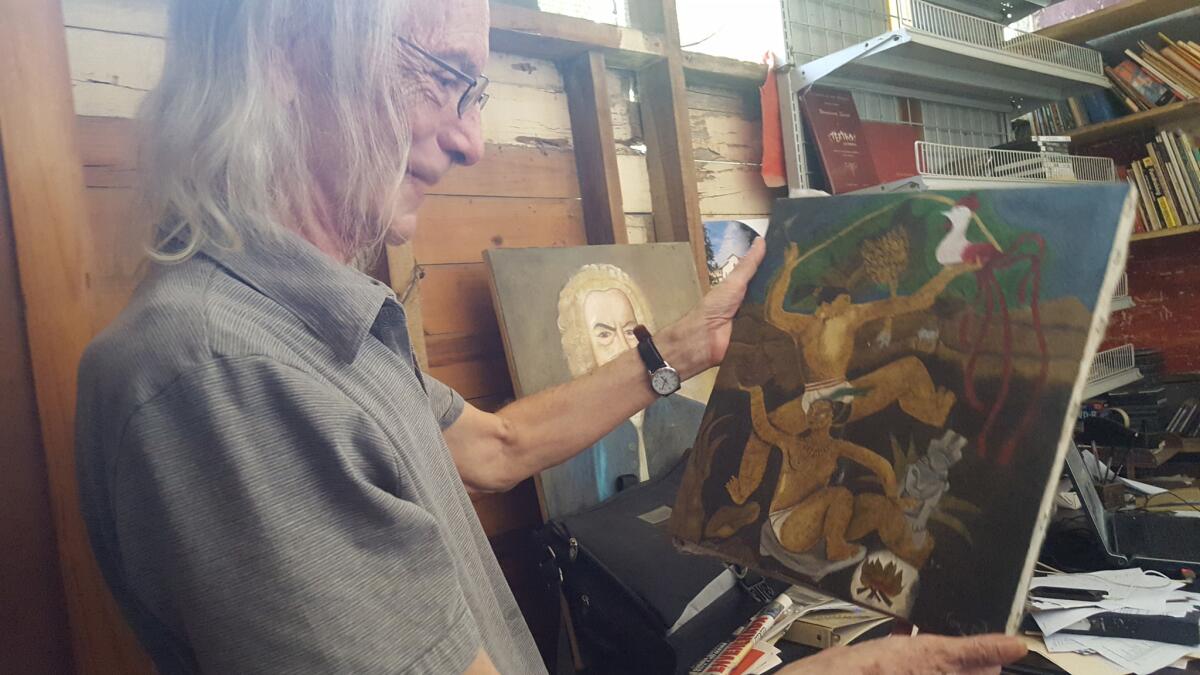
Father Jack Warner admires a painting created by an actor who performs in the Teatro la Fragua in El Progreso, Honduras.
(Veronica Rocha / Los Angeles Times )
Both men grew up in the Midwest — Kaine in the Kansas City, Kan., suburb of Overland Park; Warner in St. Louis — and had been drawn to the Jesuit mission of social justice from an early age.
Kaine attended Rockhurst High School for boys, run by Jesuit priests who ran a demanding schedule of daily Masses, theology classes and community service activities with retreats.
Kaine, who earned a bachelor’s degree in economics at the University of Missouri, was at Harvard Law when he began to question his faith and the path he should take in life, he says. Because he had made a brief trip to Honduras in 1974 to deliver donations to the Jesuits, he decided to write them and see whether they could use some help. They said yes.
“He took a rather strong decision to seek out an answer — not everyone comes to Progreso,” Warner said.
Kaine had to tell his law school dean, and his parents, of this new direction. “The dean, not to mention my parents and friends, were confused about what I was doing and even questioned whether I would come back,” Kaine once recalled in a Virginia Tech speech.
By September 1980, Kaine was rumbling along in a bus into northern Nicaragua, where he visited another American Jesuit, Father James Carney. In Honduras months earlier, Carney had encouraged peasants to fight for their land, and he was expelled by the Honduran military, which saw him as one of the leftist priests who embraced liberation theology and the Sandinista revolution in Nicaragua.
Activists, some of them priests or the peasants they worked with, would be banished or killed by authorities. Carney would later disappear in what was believed to be a clandestine Honduran military operation backed by the CIA.
“It was a time when anytime the police stopped you, you got really nervous. You never knew what was going to happen,” Warner recalled. “We were under a military dictatorship at the time and very heavy military control. It was scary, and one had to live very carefully.”
We were under a military dictatorship at the time and very heavy military control. It was scary, and one had to live very carefully.
— Father Jack Warner, on Honduras in the 1980s
In El Progreso that September, Kaine soon met another Jesuit, Brother James O’Leary, a missionary also from Missouri.
O’Leary, who died in 2002, was often described as an outspoken, occasionally cranky but also skilled carpenter, painter and electrician who built houses and chapels for the poor. Kaine worked with him at his Loyola Technical Vocational Center, helping to boost the school’s enrollment and teaching carpentry and welding. As a youngster, Kaine had picked up skills working in his father’s ironworking shop in the Kansas City area.
Kaine declined to be interviewed for this story, but in a speech at the 2008 Democratic National Convention, he recalled what O’Leary taught him.
“I learned from a great mentor there, Brother Jim O’Leary, that faith is about more than words or doctrine — it’s about action,” he said. “And that led me to spend my life in public service.”
One of Kaine’s former students at the vocational center, Alex Hernandez Monroy, recalled the daily lessons in carpentry and welding from the shaggy-haired young American.
“His Spanish wasn’t very good, but despite all that he interacted with us,” said Hernandez Monroy, then 13 and now 48. Although Kaine couldn’t pronounce certain words, the students appreciated his efforts.
“Something very important that he did was that he visited the families of the students,” he said. “We were not used to interacting with Americans, so it had an impression on us to see someone like him educating us.”
Using some of the skills he learned from Kaine and O’Leary, Hernandez Monroy teaches carpentry to a group of 15 students at the school. “They taught us that we could help our kids,” he said. “The majority of our youth are at risk, so that left an impression on us.”
::
About 35,000 people lived in El Progreso in 1980, when it was dominated by the presence of the United Fruit Co., the world’s largest — and often exploitative — banana company. Today it has a population of about 200,000, and the winding roads leading to the city are lined by brightly colored, one-story concrete homes.
During Kaine’s time there, however, it was a collection of dusty, rural villages and banana camps, with mountaintop towns accessible only by foot or mule. As a center for union activity, it became a target of the communism-fearing Reagan administration.
While war raged in neighboring El Salvador and Nicaragua, Honduras remained calm — but was gripped in fear. It was the staging ground for many of the United States’ clandestine operations aimed at toppling other governments.
People dared not speak about activism or union organizing lest they risk being among those who “disappeared.” More than a dozen priests were killed in the 1970s and 1980s after being associated with liberation theology, considered a Marxist-tinged doctrine that preached to the poor.
While Catholic priests in Central America were attacked for advocating on behalf of the poor, Kaine maintained a low profile and didn’t attract notice from the military.
Warner, a slender man with gray shoulder-length hair, recalled Kaine’s time in Honduras during a recent interview at the theater in El Progreso.
“His interest was in the students and what he was doing in his work, which is what we were all doing,” Warner said. “Trying to figure how we can do the work without being kicked out of the country for exploring it.”
Kaine also saw poverty and expressed his feelings about it through writing, as did Warner.
The priest maintained a daily newsletter with accounts of poverty and life in El Progreso. “We all have our defenses to shut out the existence of human misery, most of which consist of closing our eyes and pretending it doesn’t exist,” Warner wrote in a December 1980 newsletter. “Hopelessness then becomes a way of life for both parties.”
Warner published one of Kaine’s poems, titled “Still Life,” in which he described the “thick misery” of the town of San Pedro Sula. “In the saddest slum of San Pedro, lives are played out in the shade of a highway where buses glide like lost thoughts overhead.”
He likened the challenges, or “questions marks” facing the town to fingers testing the wind. “Each predicts change that just won’t come.”
Kaine spent nine months in El Progreso before returning to Harvard. He has kept in occasional touch with Warner and has returned to Honduras several times, most recently last year. This year, he and 25 senators called for an end to immigration raids in the U.S. targeting women and children who were fleeing violence in Honduras, Guatemala and El Salvador.
When he accepted the nomination for vice president, Kaine said that the three basic values he absorbed in Honduras hold true today: “Fe, familia y trabajo.” Faith, family and work.
Students take a break before heading to class to learn carpentry at Loyola Technical Vocational Center, where Tim Kaine volunteered, in El Progreso, Honduras.
(Veronica Rocha / Los Angeles Times )
“I came to understand the power of faith and communal worship,” Kaine said at Virginia Tech in 2006. “I learned how to speak Spanish and began to understand how the things which can seem to divide us — like language and skin color — were so much smaller than the dreams and fears that unite us.”
Kaine also has repeatedly recalled what became one of his most indelible memories of Honduras.
He and Father Jarrell Wade, a Jesuit known as Father Patricio, had traveled by mule to visit a dirt-poor family around Christmas. As they prepared to leave, the husband handed Wade a bag. “Merry Christmas, padre,” he said.
Inside the worn bag were fruits and vegetables he had saved for the priest. Wade took the bag and thanked him.
Kaine was appalled and angered that the priest would take food from such a poor family — “I was fuming” — until Wade imparted the lesson: “You must be really humble to accept a gift of food from a poor person, and the most important thing in life is the ability to give.”
Minnesota’s governor and attorney general on Wednesday defended their efforts to combat fraud and told a U.S. House committee that their efforts have been hampered by President Trump’s immigration crackdown in the state.
Republicans on the House Oversight Committee accused Gov. Tim Walz and Atty. Gen. Keith Ellison of stalling to fight fraud in government programs, saying they put politics ahead of rooting out abuse instead of pausing payments.
“You have not been good stewards of the taxpayer dollars,” said Republican Rep. James Comer of Kentucky, chair of the committee. “And the Democratic position is keep the money flowing. The American taxpayers have had enough.”
Walz said he wanted to work with the federal government to help with fraud investigations, but the immigration surge was making that more difficult.
“The people of Minnesota have been singled out and targeted for political retribution at an unparalleled scale,” Walz said. “We’re going to prosecute, as we have, every single person that’s involved in fraud, but we can’t do it alone.”
Walz and Ellison defended their efforts on fraud, while also trying to turn the focus of the hearing to the surge of 3,000 federal agents in Minnesota that began in December. The Trump administration cited fraud as one justification for its enforcement action. Homeland Security Secretary Kristi Noem testified Tuesday that about 650 investigators remain in Minnesota as part of a broader fraud probe.
“Operation Metro Surge did nothing to address fraud in our state,” Ellison said. “It harmed our economy and it scarred our people and it dealt a devastating blow to fraud enforcement in Minnesota.”
Ellison noted the series of resignations of lawyers in the U.S. Attorney’s Office in Minnesota, leaving those who remain “drowning in immigration-related petitions” instead of prosecuting fraud. On Tuesday, the U.S. attorney for Minnesota appeared before a judge for a contempt hearing related to Immigration and Customs Enforcement not returning personal property of detainees.
Ellison said his office has “punched above our weight” in winning 300 Medicaid fraud convictions and recovering more than $80 million for taxpayers.
Republican Rep. Clay Higgins of Louisiana called on Ellison to resign, accusing him of not leading investigations into criminal fraud activity.
Last week, Vice President JD Vance said the Trump administration would “temporarily halt” $243 million in Medicaid funding to Minnesota over fraud concerns, as part of what he described as an aggressive crackdown on misuse of public funds. Minnesota sued on Monday to stop the money from being withheld, warning it may have to cut healthcare for low-income families if the money is held back.
Comer on Wednesday accused Walz of not stopping Medicaid payments despite knowledge of fraud because he “didn’t want to rock the boat.”
Comer and other Republicans accused Walz of lying about when he first found out about fraud in a $250-million scheme known as Feeding Our Future and stalling to act in order to protect the Somali American community. Republican Rep. Jim Jordan of Ohio asked Walz if he know how many of those who had been indicted were Somali Americans.
“Their ethnicity is not my concern,” Walz said.
Somali Americans make up 82 of the 92 defendants charged so far in the Feeding Our Future case, according to the U.S. Attorney’s Office for Minnesota.
Democratic Rep. Robert Garcia of Long Beach, as part of the effort to focus the hearing on the immigration crackdown, held up images of children detained by federal officers and a picture of the blood-stained car seat of Renee Good who was killed by an officer. Federal officers also killed another Minnesota resident, Alex Pretti, who had been filming enforcement operations.
“This violence does not make us safer,” Garcia said. “It does not address fraud, waste and abuse.”
Tim Lovejoy made a return to Channel 4 alongside co-host Simon Rimmer on Sunday morning
12:00, 01 Mar 2026Updated 12:00, 01 Mar 2026
Tim Lovejoy was quick to question a guest(Image: Channel 4)
Sunday Brunch suffered an awkward moment as Tim Lovejoy was quick to question a guest on her unexpected “feud” with David Attenborough.
During Sunday’s (March 1) episode of the Channel 4 hit show, Tim made a return to TV alongside co-host Simon Rimmer, for the usual three-hour show packed with celebrity interviews, culinary demonstrations and light-hearted entertainment.
On the long-running programme, the pair chatted to the likes of EastEnders Samantha Womack and American pop star Tiffany Renee Darwish.
However it was their interview with Dame Maggie Aderin-Pocock that took everyone by surprise as Tim was quick to call out the science expert on her unexpected fall out with David Attenborough.
Without hesitation, Tim went on to say: “I’ll just put it out there, we understand you’ve got beef with David Attenborough. You fell out with him.”
Maggie burst out laughing as she replied: “Yeah, It’s an ongoing feud, he’s going down.”
Tim wasted no time digging for information as he jumped in: “Tell us about that because you’re both legends of this country and you don’t like each other.” Simon: “It’s so sad actually.”
Maggie explained: “So I was sitting next to him at dinner and I was gobsmacked sitting next to him and he was lovely and wonderful and we started talking about each other’s lives.”
Tim joked: “When did you fall out, was it the main course?” Maggie burst out laughing as she continued: “We were talking about life beyond the earth. It’s just sort of a lovely topic and he was like, no, no Maggie, you know, life needs water.
“And I was like ‘but David no’. I was thinking because that’s life as we know it. All life on earth needs water. But out there there could be life.”
She added: “So we had this ongoing debate, at the end, I said, ‘okay, David, I’m gonna go out and prove my theory’. He said, ‘Maggie, you’re a star. Stay here with us’.”
Viewers watching at home were pleased to see Dame Maggie as they rushed to social media to share their reaction.
One viewer wrote on X: “I could listen to Dame Dr. Maggie all day. She’s got that infectious enthusiasm that always reels me in. #SundayBrunch.” Meanwhile another added: “I love Maggie she’s so humble and nice #SundayBrunch.”
For the latest showbiz, TV, movie and streaming news, go to the new **Everything Gossip** website.
Ensure our latest headlines always appear at the top of your Google Search by making us a Preferred Source.** Click here to activate**** or add us as your Preferred Source in your Google search settings.**