Tyler Skaggs’ family, Angels reach wrongful-death settlement
The family of pitcher Tyler Skaggs and the Angels reached a settlement Friday, ending a contentious trial as jurors had begun a third day of deliberations regarding Skaggs’ drug-related death on the road with the team. Terms of the agreement, which followed 31 days of testimony and four years of legal wrangling, were not immediately available.
Jury foreman Richard Chung said after the settlement was announced that the panel had agreed to award Skaggs’ family roughly $100 million when they were told to cease deliberations — $60 million to $80 million for economic damages, $5 million to $15 million for emotional distress damages and $10 million to $20 million for punitive damages.
Rusty Hardin, the Skaggs family’s lead attorney, told The Times that although he could not reveal the amount of the agreement, “the Skaggs family is extremely happy with the settlement.”
Early efforts to settle the case had been unsuccessful, with the Angels’ legal team and its insurance carriers rebuffing overtures from the lawyers representing Tyler Skaggs’ widow Carli Skaggs and parents Debbie Hetman and Darrell Skaggs. As recently as Tuesday evening, after the jury had begun deliberations, the lead attorneys from each side met but gained little traction toward a settlement.
The equation changed Wednesday when jurors asked the judge to read back testimony from experts on Skaggs’ future earnings had he lived. The request suggested that that the jury had determined the Angels were responsible for at least a percentage of economic damages. The jury also asked whether it was charged with determining the amount of punitive damages, adding to speculation that it might hand the Skaggs family an award beyond economic and emotional distress damage.
Roughly 95% of civil suits nationwide reach a settlement ahead of or during trial. Plaintiffs and defendants alike overwhelmingly prefer to eliminate the risk of an all-or-nothing jury verdict by agreeing on a compromise dollar figure.

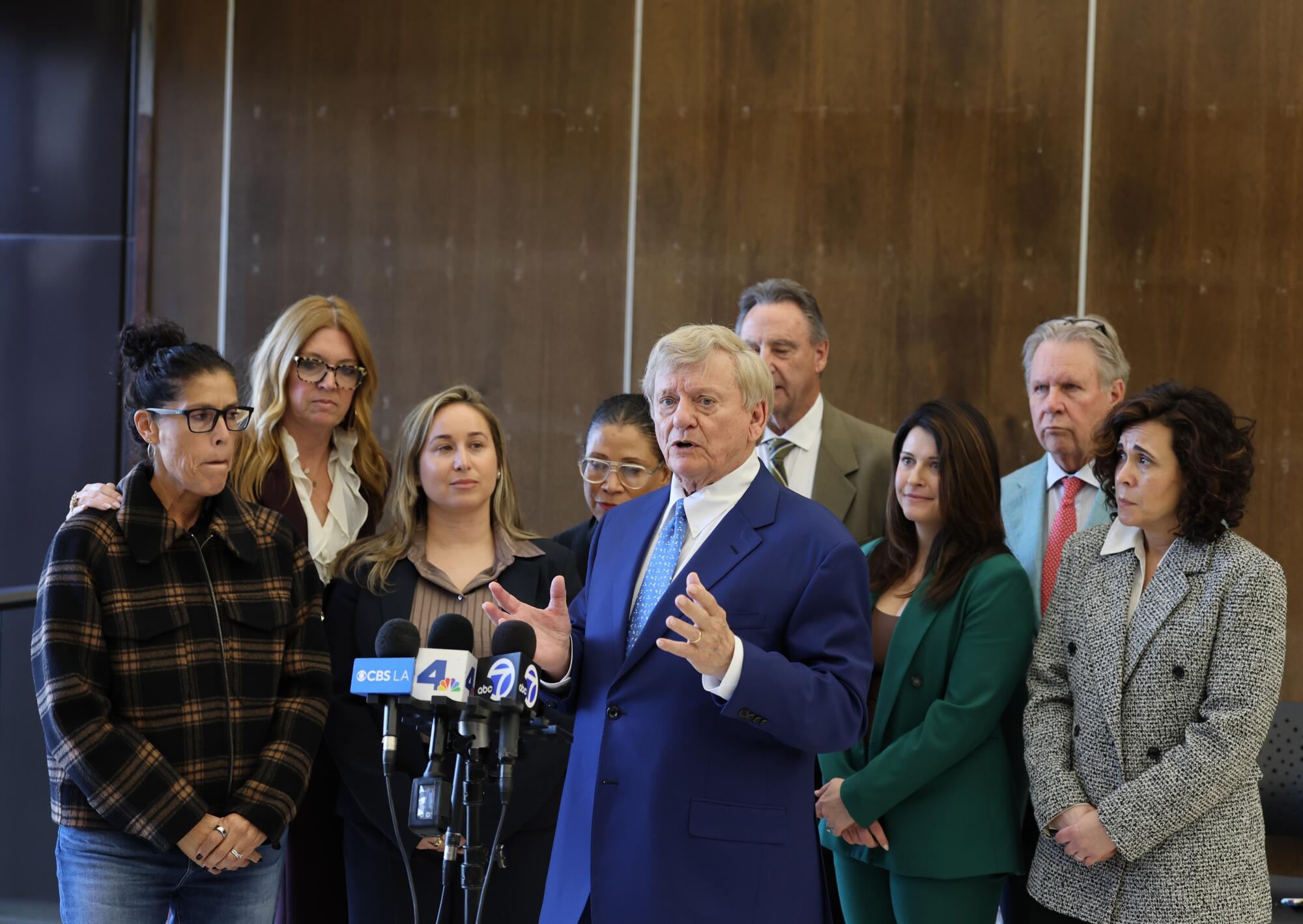
Attorney Rusty Hardin, center, addresses the media Friday on behalf of the Skaggs family after a settlement was reached in their wrongful death lawsuit against the Angels.
(Allen J. Schaben / Los Angeles Times)
Sources on the Skaggs family legal team said they were amenable to a settlement to eliminate the chance of the jury determining the Angels weren’t responsible for Skaggs’ death and denying any award. Also, while either side could have appealed a jury verdict, the settlement ended the case.
Carli Skaggs and Hetman hugged their lawyers and each other when Judge H. Shaina Colover announced that a settlement had been reached and jurors were excused.
“The Skaggs family has reached a confidential settlement with Angels Baseball that brings to a close a difficult six-year process, allowing our families to focus on healing,” the family said in a statement. “We are deeply grateful to the members of this jury, and to our legal team. Their engagement and focus gave us faith, and now we have finality.
“This trial exposed the truth and we hope Major League Baseball will now do its part in holding the Angels accountable. While nothing can bring Tyler back, we will continue to honor his memory.”
MLB declined to comment on the settlement.
A jury verdict favoring the Angels also would have meant the high-powered Skaggs legal team that has spent thousands of hours on the case wouldn’t have been paid. Their contingency fee — typically at least 40% of an award — would have been zero.
Skaggs died July 1, 2019, during an Angels road trip in Texas after snorting an illicit pain pill that was laced with fentanyl.
The pill was given to Skaggs by Angels communications director Eric Kay, who is serving 22 years in federal prison for his role in the pitcher’s death. Skaggs was discovered in his Southlake, Texas, hotel room the next morning, and an autopsy concluded he accidentally died of asphyxia after aspirating his own vomit.
“The death of Tyler Skaggs remains a tragedy, and this trial sheds light on the dangers of opioid use and the devastating effects it can have,” the Angels said Friday in a statement.
Each juror had to fill out a 26-question verdict form during deliberations. The first batch of questions focused on Kay, asking jurors whether the Angels were negligent in their supervision of him, whether the team knew he was distributing illicit pills and whether he was operating within the scope of his employment when he did so.

Carli Skaggs, Tyler Skaggs’ widow, with attorney Rusty Hardin in court Friday in Santa Ana.
(Allen J. Schaben/Los Angeles Times)
If jurors answered “yes” to any of those questions, they were then asked whether the Angels’ negligence and Kay’s “unfitness or incompetence” were substantial factors in the death of Skaggs, as well as harm to his iPad.
Consideration of the iPad, which Skaggs used as a surface to chop up drugs, was related solely to punitive damages.
The first damages the jury considered were economic. Experts for the Skaggs family lawyers testified that he would have made an estimated $102 million had he lived and continued to pitch. Experts for the Angels said his earnings wouldn’t have been more than $30 million.
During closing statements, Skaggs family attorney Daniel Dutko suggested that the Angels were 70 to 90 percent responsible for his death, and that Kay and Skaggs could each be assigned about 10 percent of the blame. Angels attorney Todd Theodora did not suggest a specific percentage, but conceded the jury might find Kay partially responsible for Skaggs’ death.
Also during closing statements, Dutko and Theodora each walked the jury through the nine-page verdict form, suggesting how questions should be answered based on testimony that supported their arguments. While criminal cases require a burden of proof beyond a reasonable doubt, civil cases require only a preponderance of the evidence. At least nine of the 12 jurors are required to agree on a verdict.
Dutko said the Angels for years were negligent in dealing with Kay, a team employee since 1996 whose illicit opioid use became apparent as early as 2009, according to testimony. Evidence showed the Angels concealed Kay’s addiction rather than follow team and Major League Baseball policies in reporting it and punishing Kay, Dutko told the jury.
“Is that reasonable, is that how we want companies in our country to run?” Dutko said. “They didn’t monitor anything. They didn’t do anything.”
“There is no doubt that if Eric Kay wasn’t employed by the Angels, if he wasn’t in that clubhouse, Tyler Skaggs would be alive.”
Kay entered outpatient rehab for substance abuse in the spring of 2019 and returned to work just weeks before he was sent with the Angels to Texas. Skaggs quickly texted Kay asking for oxycodone pills. Theodora argued that the messages showed Skaggs was an uncontrollable addict who had little regard for Kay’s well-being.
Theodora showed the jury a pyramid-shaped graphic with Skaggs at the top and players who evidence had shown were given opioids by Skaggs under him, and argued that Skaggs was as complicit in distributing the drugs as Kay.
The Angels attorney told the jury that the plaintiffs’ stance that Kay should have been fired applied to Skaggs as well. “What you see here is a classic double standard,” Theodora said.
Dutko delivered a rebuttal to Theodora’s closing statement, returning to the theme that the Angels never took any responsibility for Skaggs’ death and told jurors that they can make that clear by reaching a verdict in favor of his wife and parents.
“The only reason Tyler Skaggs is dead is the Angels,” Dutko said. “We have fought for Tyler Skaggs and I will continue to fight for Tyler Skaggs as long as I’m alive. I need you to fight for him, please.”
The jury was close to a verdict that would have favored Skaggs’ family. Chung said the panel was discussing apportionment of responsibility and would have been done by the noon lunch break had they not been told to cease deliberations around 9:30 a.m.
He said his own determination was that the Angels bore 50% of the responsibility for Skaggs’ death while Kay was responsible for 35% and Skaggs for 15%.
“Ultimately, we felt the Angels needed to know that they were at fault,” Chung said. “Just to say, ‘Do better.’ They needed to do better.”