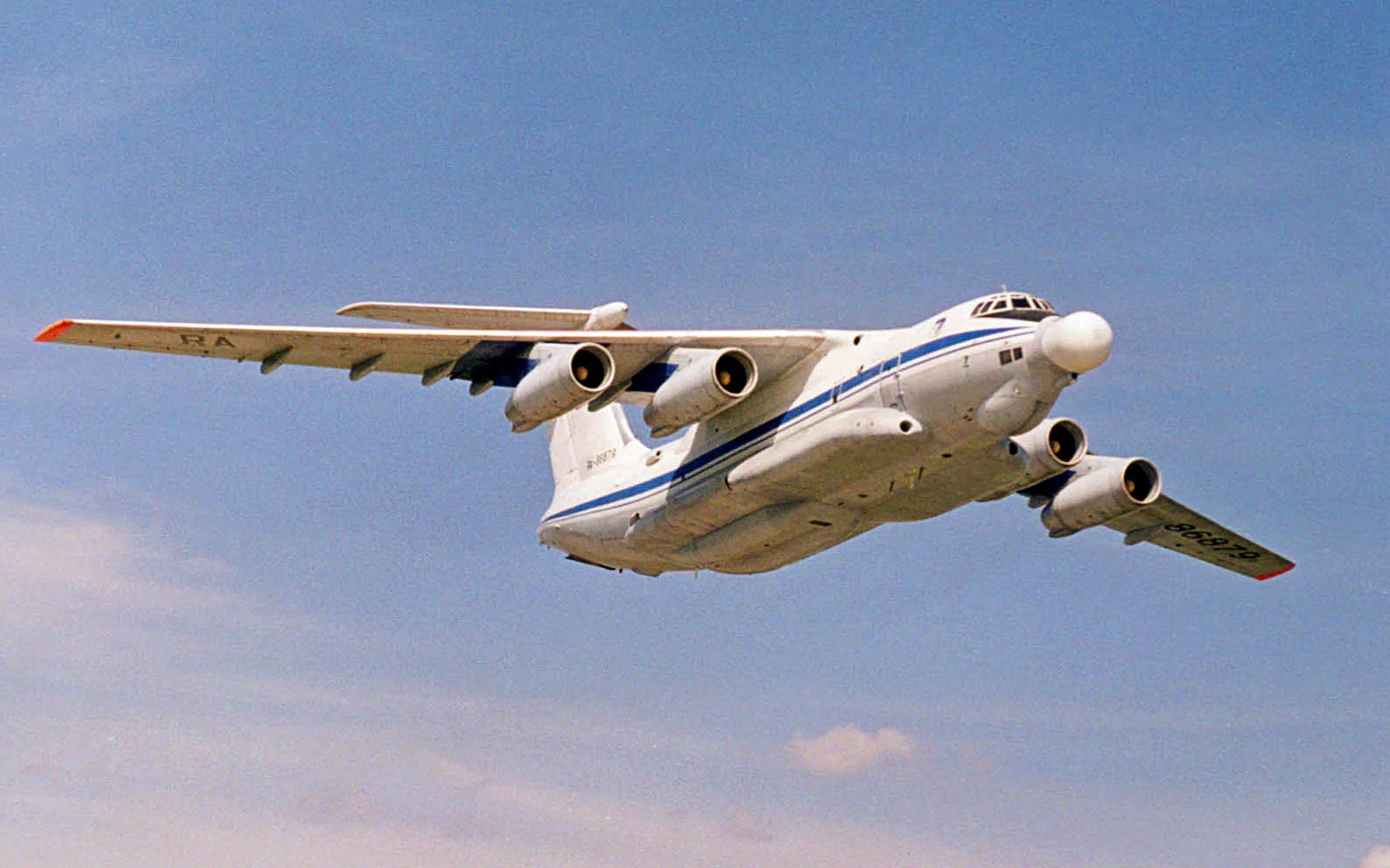
Unique Russian A-60 Laser Testbed Jet Destroyed In Ukrainian Attack
A Ukrainian attack on the aircraft manufacturer Beriev’s facility in Taganrog in southwestern Russia overnight appears to have knocked out a unique laser testbed aircraft, the A-60, and at least one more. While the most recent status of the A-60 program remains unclear, the attack once again underscores Ukraine’s ability to strike high-value Russian military aircraft on their airfields, a capability that has been bolstered through the addition of long-range cruise missiles, as well as an expanding inventory of attack drones, both large and small.
Videos posted to social media reveal the immediate aftermath of the attack, with a significant blaze illuminating the night sky. At least one video shows a burning aircraft, which appears to be the unique A-60, an aircraft based on a converted Il-76MD Candid transport. Its identity was subsequently confirmed by satellite imagery, which also revealed the destruction of another airframe, apparently a testbed associated with Russia’s new airborne early warning and control (AEW&C) platform.
There are differing accounts of whether Ukraine used drones or cruise missiles to attack the factory airfield at Taganrog/Tsentralnyy in the Rostov region, a facility that has also been struck in the past. According to the Ukrainian Ministry of Defense, both Bars jet-powered long-range one-way attack drones and Neptune cruise missiles were employed. As you can read about here, Ukraine has been steadily increasing the range of the land-attack versions of the Neptune missile, which is derived from an anti-ship cruise missile. Meanwhile, the Bars is one of a growing series of Ukrainian munitions that blur the line between drones and traditional cruise missiles, and which also includes the Peklo ‘missile drone’.

The Russian Telegram news channel Astra confirmed that drone strikes had caused a fire at Taganrog/Tsentralnyy, while eyewitness accounts from the area also point to at least one aircraft left burning on the flight line. The Fighterbomber account on Telegram, which is closely connected to the Russian military, also reported the destruction of the A-60.
Subsequent satellite imagery of the airfield confirms that, as well as the A-60, clearly identified by its signature tail-section hump, another aircraft was also destroyed. This may have been an A-100 AEW&C platform, or more likely, the A-100LL test aircraft related to the same program, evidenced by the rear-fuselage supports for the main radome, which is not fitted. Meanwhile, damage is also visible to buildings associated with the Beriev facility.
The strike on Taganrog/Tsentralnyy was part of a wider series of Ukrainian attacks on Russian targets in Krasnodar Krai and the Rostov region overnight. Local officials and Telegram news channels reported that key military infrastructure was among the targets.
The governor of the Rostov region, Yury Slyusar, also confirmed an attack on Taganrog, but did not mention the specific target. According to Slyusar, Ukrainian attacks in the region damaged several homes, a warehouse, and an external gas pipeline. He also said three people were killed and eight people were injured in the attack.
Taganrog/Tsentralnyy, which is co-located with the Taganrog-Yuzhny military airfield, is the main facility of the Beriev Aircraft Company. While best known for its amphibious aircraft designs, Beriev is also responsible for converting special-purpose aircraft, among them the A-50 and A-100 AEW&C platforms and the A-60. Beriev also uses this facility to conduct deep maintenance of Tu-95MS Bear-H strategic missile carriers as well as Tu-142 Bear-F/J long-range maritime patrol aircraft. This also makes it a prime target for Ukraine.

As we have discussed in the past, the A-60 was originally developed by the Soviet Union starting in the mid-1970s as a way of combating high-altitude balloons. It was fitted with the carbon dioxide (CO2) laser gun, thus creating the Dreyf (Drift) system for combating aerostats.
The first experimental A-60 took to the air in 1981. The aircraft’s laser was housed in the cargo hold. On the fuselage spine, there was a large fairing covering a mirror system, which directed the laser ray onto the target. The laser had a range of 25 miles and was able to ‘shoot’ for a total of 50 seconds, at least according to the design specification; reportedly, the actual firing time was only 11 seconds.

The targeting system consisted of a Ladoga radar with an upward-directed five-foot-diameter Cassegrain antenna fitted under a large bulbous fairing in the aircraft’s nose and a laser locator. A balloon could be detected and tracked from 31 to 44 miles.

During one test in 1984, the A-60 flying at an altitude of 32,800 feet damaged a balloon over the Volsk aerostat research center, 430 miles southeast of Moscow.
In 1988, the first A-60 was destroyed in an accidental fire at the Chkalovsky test airfield near Moscow. In 1991, tests commenced with the second experimental aircraft. After two years, however, the trials were suspended due to a lack of funding. By now, the threat from high-altitude balloons had also evaporated.
According to Piotr Butowski, a long-time Russian aerospace observer and TWZ contributor, Russia revived the A-60 project in late 2002, now with the plan to use the laser gun to ‘blind’ the infrared sensors of reconnaissance satellites.

Flight trials of the reworked second A-60 then resumed around 2006, with the official goal of the program being “to counteract infrared surveillance sensors on the ground, the sea, in the air, and in space.”
In late 2019, Russia’s deputy defense minister Alexsei Krivoruchko said that “work is underway on high-power lasers of various types. It is planned to put it on an airplane in the coming years.”
Since then, it’s unclear what, if any, progress the program made, and whether the A-60 that was hit during the attack overnight was actually equipped with a laser weapon.
It is likely that Ukraine was primarily attempting to target Russia’s prized A-50 and A-100 AEW&C aircraft.
These vital assets have already taken a beating during the war in Ukraine, with two examples shot down and another damaged by a drone strike. Russia’s radar plane problems have been exacerbated by difficulties in fielding the new-generation A-100 AEW&C platform, a situation that has led to a proposal to restart production of the A-50. As we have discussed in the past, the viability of relaunching production of these high-value aircraft is questionable, to say the least.
The value of the A-50 fleet to the Russian Armed Forces and their war in Ukraine is something we have written about in the past:
“These aircraft can provide a unique ‘look-down’ air ‘picture’ that can extend deep into Ukrainian-controlled territory, depending on their patrol zone. From the outset, the A-50 was designed to detect low-level cruise missile attacks, and the same capability means it can potentially spot Ukrainian drone attacks, too, as well as low-flying fighter sorties. They also provide command and control and situational awareness for Russian fighters and air defense batteries. Ukrainian authorities also assess that Russia uses A-50s to help plan and execute its own cruise missile attacks.”
Prior to the full-scale invasion of Ukraine, Russia was estimated to have nine A-50s, including a number of modernized A-50Us, in active service. As it stands, the best-case scenario puts seven of these aircraft in active service as of today.
Provided the other aircraft destroyed overnight was the A-100LL (or even an A-100), then the damage inflicted on the Russian radar plane fleet will have been even more significant. The A-100 program has already been hampered by sanctions and has yielded just one operational-standard aircraft so far. Losing the A-100LL, which has been used to prove the new systems for this aircraft, will likely have a significant effect on the progress of the program.
Aside from Taganrog/Tsentralnyy, overnight Ukrainian drone strikes also occurred in Novorossiysk, in Krasnodar Krai, according to reports from Russian officials and media.
The governor of Krasnodar Krai, Veniamin Kondratyev, said that the region “was subjected to one of the longest and most massive attacks” since the full-scale invasion of Ukraine. He claimed that six people were injured and at least 20 homes were damaged in the attack.
The Russian news channel Astra reported that a drone struck a high-rise building close to a Russian military unit operating S-400 air defense systems. This was presumably the Kuban Red Banner Regiment military base, which came under a previous Ukrainian drone attack earlier this month.
A video posted to social media by a resident of Novorossiysk showed what appears to be a Russian air defense missile hitting a high-rise building in the city, after failing to intercept an incoming drone.
Novorossiysk has repeatedly found itself in Ukraine’s sights, its value as a target being derived from its military status, as well as its use as a major transshipment point for oil. The port handles over two million barrels of oil per day, meaning that it’s responsible for roughly five percent of global maritime oil supplies. Meanwhile, the port is also now home to much of the Russian Black Sea Fleet, providing it with something of a safe haven, after its warships were essentially forced out of waters closer to Crimea following a concerted Ukrainian campaign waged against them.
In total, the Russian Ministry of Defense claimed that Russian forces shot down 116 drones over the Black Sea and 76 over Krasnodar Krai overnight. These claims have not been independently verified.
Ukrainian strikes have repeatedly targeted Russian aircraft at their home bases deep inside the country, as well as in occupied Crimea. Most dramatically, Operation Spiderweb, the large-scale Ukrainian drone strike against airbases across Russia in June of this year, targeted Moscow’s fleet of strategic bombers. On that occasion, a reported 117 drones were launched against at least four airfields.
While the full results of the overnight attack on the airfield at Taganrog/Tsentralnyy remain unclear, it seems that, at the very least, Russia’s sole A-60 and another aircraft were put out of action. Since the status of the A-60 program remains mysterious, its long-term effect is hard to determine. The damage to the A-100 program will likely be a harder blow, especially in the short term. Regardless, the A-60 and the A-100LL were both unique assets, and their losses will be hard, if not impossible, for Russia to replace anytime soon.
Contact the author: [email protected]