Weekly insights and analysis on the latest developments in military technology, strategy, and foreign policy.
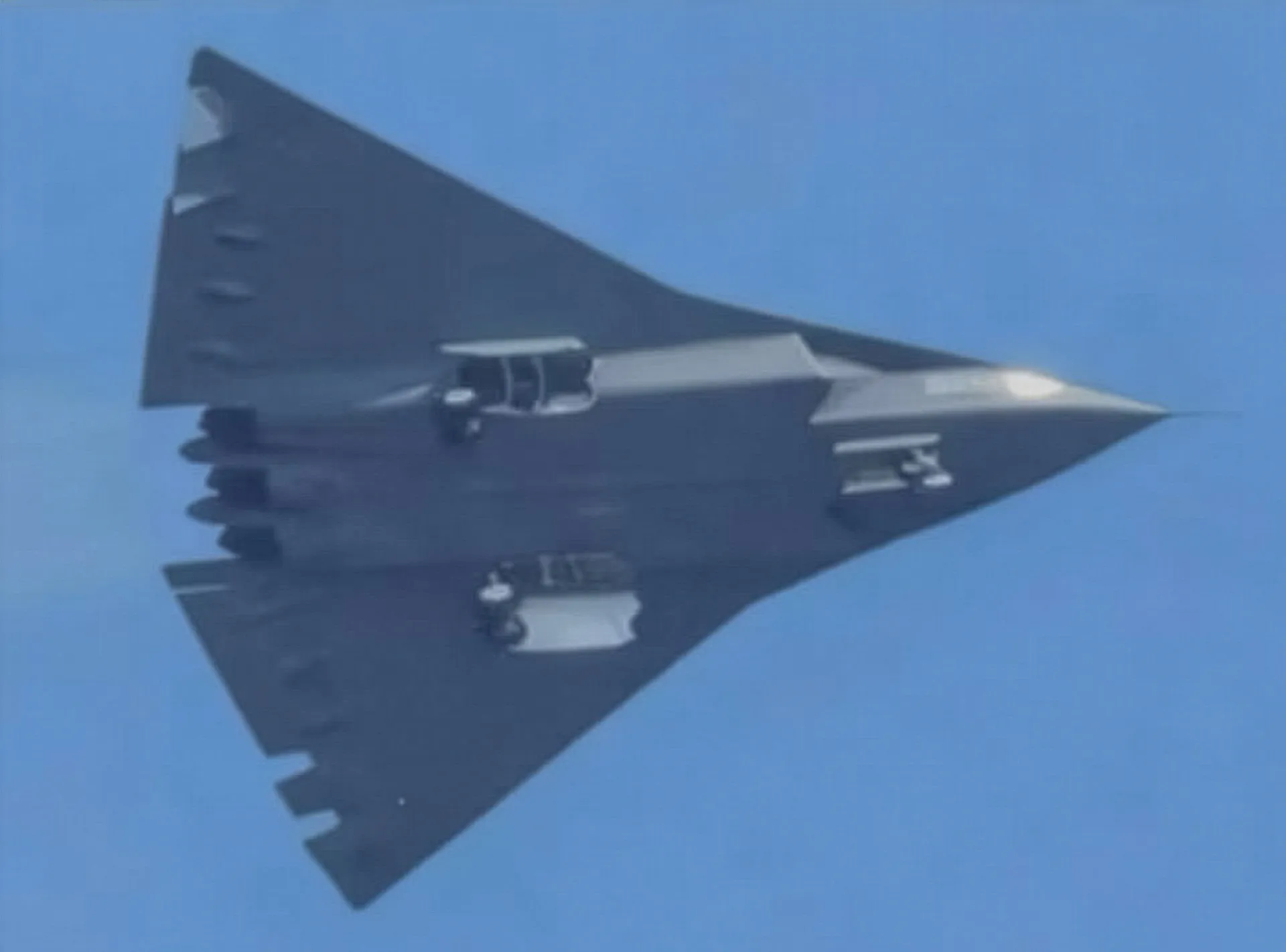
We have gotten two new images of the Chengdu Aircraft Corporation’s second ‘J-36’ heavy tactical jet airframe, which features significant changes over the first. The aircraft first emerged in late October. Along with new inlets and main landing gear, the addition of what appeared to be two-dimensional thrust vectoring across its bank of three engines was highly intriguing. Now we are seeing a rear aspect of this new exhaust configuration that further confirms our original analysis.
You can read our recent report on the new J-36 configuration here and our original deep dive on the J-36 here.
Second J-36 configuration seen in new photos. Shown here is a good look at the DSI inlets, new tandem landing gear arrangement, and 2D thrust vectoring. (Chinese internet via X)
The new images show the J-36 from behind during landing and from directly below. The rear image is the star of the show here, as we can see what appears to be the jet’s three-pack of 2D thrust vectoring nozzles, similar to those found on the F-22. China has been developing this exhaust capability for some time now, but its addition on the J-36 is very interesting.
The external accessories have also clearly been improved, making the engine look more streamlined. Most importantly, this type of “Taihang” engine uses a 2D thrust-vectoring nozzle similar to that of the F-22A fighter. 2/ pic.twitter.com/AVH6wMBjb0
Generally speaking, thrust vectoring provides additional maneuverability throughout different areas of the flight envelope for a tactical jet, including, in many cases, in the post-stall regime. It also allows for better overall controllability and stability, the value of which is magnified on a highly unstable tailless fast jet design. It can also play a key role when operating at high altitudes, a performance goal that could be very beneficial to the J-36, as we discussin our large analysis feature. At the same time, it adds weight and complexity to the aircraft, although this likely isn’t a major concern for a jet as large and complex as the J-36. It is also not as efficient as traditional conical exhausts when it comes to thrust output.
The 2D exhausts appear very similar to what is found on the F-22A’s F119 engines. (Alaska National Guard photo by Seth LaCount) Staff Sgt. Seth LaCount
The first J-36, which emerged just 11 months ago, had recessed trough-like exhausts, vaguely similar to what was found on the YF-23. There is likely a low-observable (stealth) penalty from some rear aspects when trading the previous configuration for this new one.
The addition of thrust vectoring is a major design departure and clearly points to its advantages outweighing its costs. It also will raise the question, once again, about the intended role of this aircraft and how to define it. We went over this in great depth in our original analysis, but suffice it to say, keeping a certain level of maneuverability is likely seen as beneficial, but thrust vectoring provides other advantages beyond straight agility, as we discussed earlier.
The first J-36 had a very different exhaust arrangement, with a recessed arrangement similar to that of the YF-23. (Chinese internet)
All that being said, we still don’t know definitively if this second aircraft is purely evolutionary, depicting something that is truly a step closer to a final production configuration, or if it is experimental and we could see some of its features exchanged for those of the first model on future iterations.
It’s worth noting that the J-36’s smaller counterpart, the J-XDS, also features similar 2D thrust-vectoring capabilities. It’s additionally possible that the J-35, China’s medium stealth fighter, could one day ditch its serrated round exhausts and adopt 2D thrust vectoring, as well. We have seen such a configuration mocked up at Chinese arms expos.
The best-known image of the J-XDS showing its 2D thrust-vectoring arrangement. (Chinese internet)
Carrier Borne VLO 5.0th Generation Fighter Jet #China J-35 The twin engine aircraft will support Carrier operations from PLANAFType-003 Fujian-class aircraft carriers.
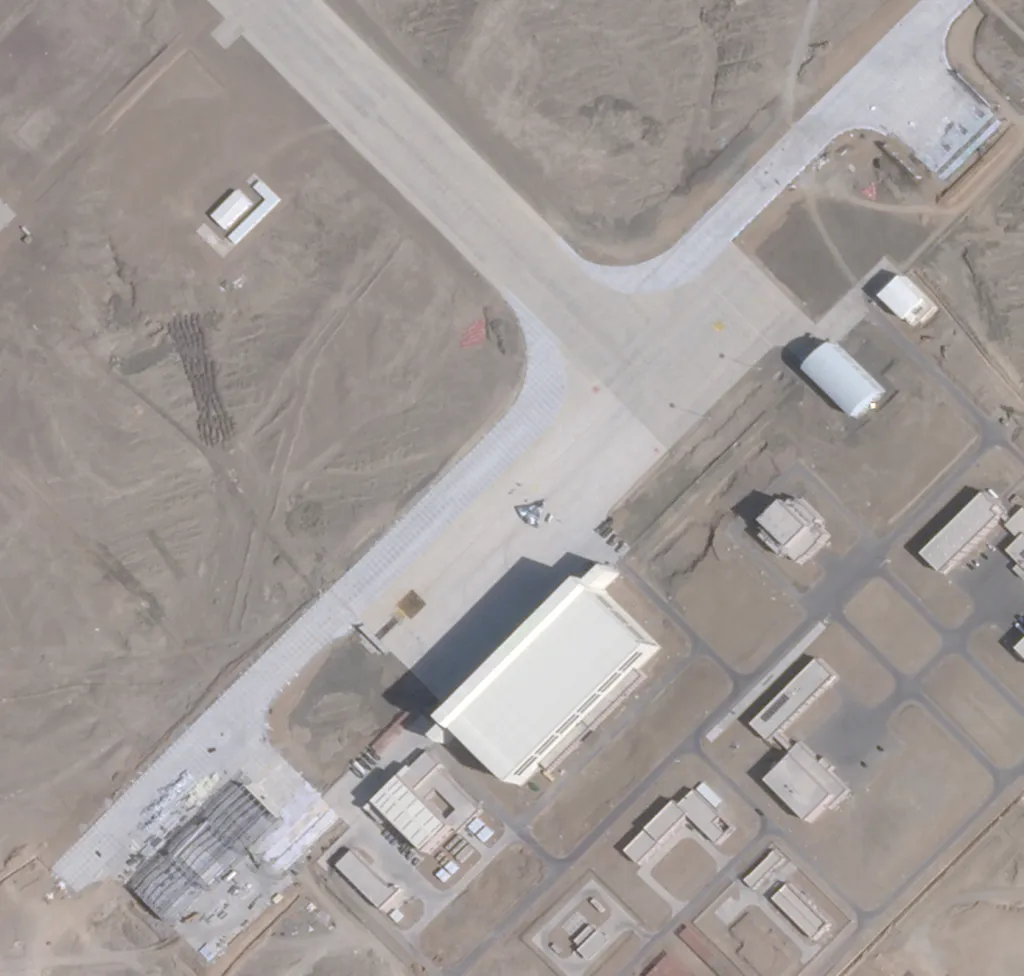
The J-36, readily identifiable by its large modified delta planform and ‘splinter’ camouflage paint scheme, is seen outside the main hangar at the facility’s central apron in an archived satellite image taken on August 27, which The War Zone obtained from Planet Labs. The J-XDS is seen in another Planet Labs image of the airfield taken on September 13. Previously, the J-36 and J-XDS have only been definitively spotted flying in and out of the main airfields associated with their respective manufacturers, Chengdu and Shenyang. Readers can find TWZ‘s very in-depth initial analysis on the J-36 and the J-XDS here.
This particular base near Lop Nur, which has been linked to work on reusable space planes, is also now undergoing a major expansion. It notably already has a runway over 16,400 feet long, or more than 3 miles in total length, making it one of the longest anywhere in the world.
The August 27 satellite image offers new details about the J-36’s size, showing it to have a wingspan of approximately 65 feet and an overall length of some 62 feet. It has already been clear that the three-engined J-36, two distinctly different prototypes of which have now emerged, is a very large tactical aircraft. For comparison, members of the extended Soviet-designed Flanker fighter family, like China’s J-16s, have wingspans of around 48 feet. Flankers are already well known for their large size relative to other fourth-generation fighter designs. As another point of comparison, the variable geometry F-111’s fully extended wingspan was 63 feet.
The September 13 image shows the J-XDS to have a wingspan of around 50 feet and be slightly shorter than the J-36. It’s worth noting that the shadow and image resolution make this estimate more challenging, and readers are advised to take it as such. It has been previously established that the twin-engined J-XDS, also sometimes referred to as the J-50, with its “lambda” wing planform, is smaller and slimmer than the J-36. That being said, it is still firmly in the heavy fighter class.
As mentioned, the remote base near Lop Nur is in the process of being expanded in a major way, overall. The work only started in earnest in the past six months or so, and significant progress has already been made. This includes the enlargement of the main apron, with a single new hangar also having been built at the northeastern end. Three smaller hangars, all joined together and that look to be typical of ones for fighter-sized aircraft, have been constructed at the opposite end, as well.
In addition, a host of other new buildings are seen under construction to the immediate southeast, pointing to plans to expand the scope and scale of work being done at the facility. The series of satellite images below gives a sense of the sheer magnitude of work that has been done just since May of this year.
There had already been a pronounced expansion of the infrastructure at the base in the early 2020s, including the construction of the large main hangar and associated apron. As noted, at that time, the facility seemed largely tied to Chinese military space development efforts. TWZ‘s first report on the airfield came in 2020 after a reusable space plane appeared to have landed there. Last year, we reported on it again after satellite imagery emerged showing a still-mysterious object sitting at one end of the runway.
It seems clear now that the facility has taken on a larger and still growing role in China’s broader advanced aerospace development ecosystem. Comparisons have already been drawn in the past to the U.S. military’s top-secret flight test center at Groom Lake in Nevada, better known as Area 51.
The airfield near Lop Nur is even more remote than China’s existing sprawling test airbase near Malan in Xinjiang province, which also seems to be almost exclusively focused, in terms of aerospace development tasks, on uncrewed aircraft. It also appears to host aircraft detachments for more general training and testing.
The construction of new hangars and other infrastructure at the base in question can only further help with the concealment of assets and other activity there from prying eyes, including in space. That being said, the site is regularly imaged, including by commercial satellites, which clearly did not deter the Chinese from parking the J-36 and J-XDS outside in broad daylight.
Regardless, the appearance of the J-36 and J-XDS at the remote base around the same time is also telling of the facility’s new mission to support the development of advanced air combat technologies. It is further indicative of the state of China’s rapidly evolving sixth-generation fighter programs that they have operated out of this place, possibly alongside each other.
As it seems, for the first time clear images of a GJ-21 in flight are posted and this one – based on the still installed pitots – has its tail hook down. pic.twitter.com/5h1nVZHzIe
Even with major construction still underway, the secretive and remote base near Lop Nur is already becoming busier, and has now given us the first commercial satellite imagery showing the J-36 and J-XDS. The facility expansion is likely to see it support future advanced tactical aircraft developments, playing a bigger part in these endeavors going forward.