Swatting

AH-64 Apache Is Getting Proximity Fuzed 30mm Cannon Ammo For Swatting Down Drones

The AH-64 Apache attack helicopter has evolved into a counter-drone platform in recent years — something we have been following closely. While the Israeli Air Force had pioneered this role for the AH-64 for years, the U.S. Army has now formally codified it and added new capabilities in the process. Now, as we had suggested some time ago, the Apache is getting proximity-fuzed 30mm cannon shells for its chin-mounted M230 cannon that will add to its drone-killing arsenal, giving it a cheaper and more plentiful engagement option than some of the alternatives.

CRAZY footage of an IAF Apache helicopter chasing down a Hezbollah drone over northern Israel and downing it with cannon fire from its chaingun👇 pic.twitter.com/8vdks0PYL4

— Raylan Givens (@JewishWarrior13) November 2, 2024

Apaches live-fire tested the 30x113mm XM1225 Aviation Proximity Explosive (APEX) ammo last December, according to a recent Army release. The trials occurred at the service’s sprawling Yuma Proving Ground (YPG) in southern Arizona. Multiple test engagements occurred against various types of drone targets.

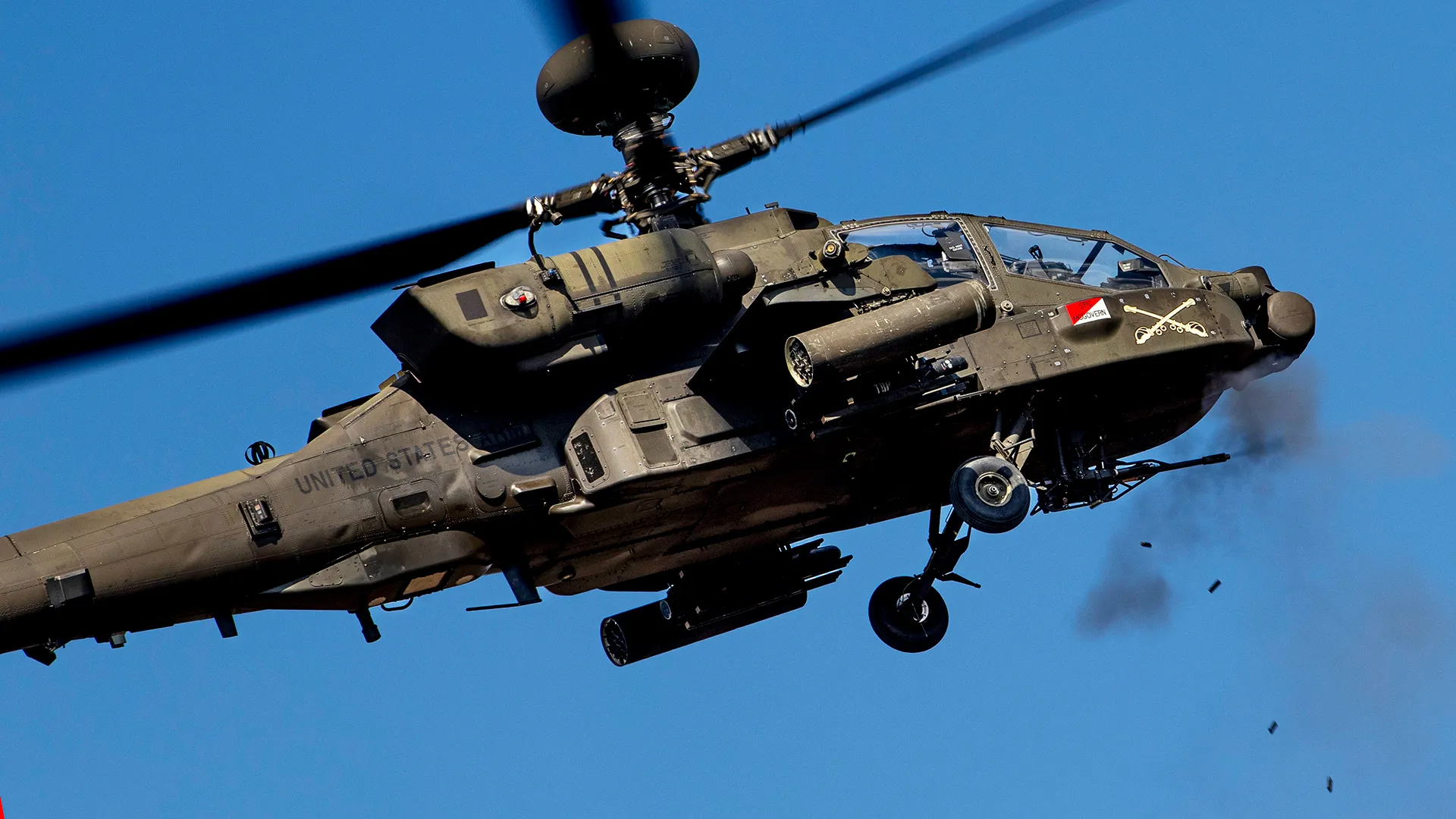
A U.S. Army AH-64 Apache helicopter assigned to the 5-17 Air Cavalry Squadron, 2nd Infantry Division, fires the M230 Bushmaster chain gun during live-fire aerial gunnery training at Rodriguez Live Fire Complex, Republic of Korea, on March 6, 2025. The exercise certified aircrews, sharpened weapons proficiency, and enhanced overall force readiness. (U.S. Army photo by Staff Sgt. Neil McLean)
A U.S. Army AH-64 Apache helicopter assigned to the 5-17 Air Cavalry Squadron, 2nd Infantry Division, fires the M230 Bushmaster chain gun during live-fire aerial gunnery training at Rodriguez Live Fire Complex, Republic of Korea, on March 6, 2025. The exercise certified aircrews, sharpened weapons proficiency, and enhanced overall force readiness. (U.S. Army photo by Staff Sgt. Neil McLean) Staff Sgt. Cornelius McLean

The specialized APEX ammunition works by detonating only when it is close to an object, then it explodes in a spray of shrapnel. This is critical to shooting down drones as they are small, independently moving targets, and the Apache’s monocle-targeted chin gun isn’t exactly a sniper rifle in terms of precision. At the same time, the rounds could also be used against targets on the surface — including personnel, soft-skinned vehicles, and small boats, for instance — offering unique area effects compared to the Apache’s standard impact-detonating, high-explosive ammunition.

(Short video) M230 chain gun follows the head movement of AH-64 Apache gunner


AH-64 Apache attack helicopter taking out Iraqi trucks and artillery with its 30mm cannon


Variants of the M230 cannon, the prime contractor for which is now Northrop Grumman, have already become an increasingly popular choice for dealing with lower-end drone threats from the ground. The light-weight M230LF version, designated the M914 in Army service, has found its way onto counter-drone vehicles. This includes the Sgt. Stout Maneuver Short-Range Air Defense (M-SHORAD) system based on the 8×8 Stryker light armored vehicle. The Army has been separately pursuing self-destructing and other kinds of proximity-fuzed 30mm ammunition for use with the M914. The new APEX ammo offers improved performance that can plug-and-play with the Apache/M230 combo. The other rounds for use in ground-based systems have never been cleared for use on the Apache to our knowledge.

M-SHORAD with its M230 derivative at the center of its multi-munition turret. (US Army)

The M230LF Bushmaster Chain Gun | XM914


An official Army release on the XM1225’s successful testing reads, in part:

“Developed and managed by Product Manager Medium Caliber Ammunition (PdM MCA) from Picatinny Arsenal, NJ, the XM1225 APEX cartridge is designed to counter modern threats, including UAS, exposed personnel, and small boats, without requiring modifications to the Apache’s M230 Area Weapon System or fire control system. The XM1225 has undergone extensive safety testing to ensure reliable performance, making it a safe and effective addition to the Apache’s arsenal. This innovative design ensures seamless integration into existing platforms while delivering enhanced lethality and operational flexibility.

…The primary objective was to evaluate the XM1225 cartridge’s accuracy and compare its performance to the legacy M789 High Explosive Dual Purpose (HEDP) cartridge under identical conditions. A secondary objective was to collect data on mixed loads of XM1225 and M789 rounds against both ground and UAS targets.

Initial results were highly successful, with the XM1225 meeting all accuracy requirements and demonstrating exceptional effectiveness against both ground and UAS targets. The proximity-fuzed capability of the XM1225 allows it to detonate near the target, creating a larger lethal radius and significantly improving its ability to neutralize airborne and dispersed threats. This capability positions the Apache to dominate the battlefield in both air-to-ground and air-to-air engagements, providing warfighters with a critical edge in modern combat scenarios.”

U.S. Soldiers with the 1-151st Attack Reconnaissance Battalion, 59th Aviation Troop Command, South Carolina National Guard, conduct their annual aerial-gunnery qualification table at the Poinsett Range, Sumter, South Carolina, May 22, 2024. Aircrews fired both 30mm rounds and rockets, the training allowed Soldiers to sharpen their armory skills, communication and team work with their assigned AH-64 Apache helicopters. (U.S. Army National Guard photo by Sgt. Tim Andrews)
U.S. Soldiers with the 1-151st Attack Reconnaissance Battalion, 59th Aviation Troop Command, South Carolina National Guard, conduct their annual aerial-gunnery qualification table at the Poinsett Range, Sumter, South Carolina, May 22, 2024. (U.S. Army National Guard photo by Sgt. Tim Andrews) Staff Sgt. Tim Andrews

A key feature of the APEX ammunition is that it requires little additional training for Apache crews to successfully employ it as it acts very similarly, ballistically, to the M789 high-explosive dual-purpose (HEDP) rounds already fielded. Those shells use an impact/grazing fuze to command detonation.

A major issue with using any gun for counter-drone work from the air is that standard high-explosive or incendiary cannon rounds simply keep traveling until they hit something, then they explode. This makes any horizontal or upward aspect shots very problematic, as the rounds can fly many miles before hitting the ground. Anyone or anything in that unpredictable zone would not fare well. Even high-deflection shots are risky, especially considering the size of the drones. Not only will most rounds miss and still hit somewhere below, but the aircraft can easily fly into the drone itself, as judging its distance and keeping track of it in the air is problematic. So, having self-destructing rounds, and even better, proximity fuzed ones that do the same, is key.

U.S Soldiers reload the 30mm rounds in an Apache


As it sits now, the AH-64 has modified AGM-114 missiles that use the Longbow Radar to prosecute aerial targets. Laser-guided Hellfires are potentially another option. Regardless, any Hellfire costs well into the six-digit realm. Advanced Precision Kill Weapon System II (APKWS II) laser-guided rockets are a lower-cost option, having a low-to-mid five-digit price tag. It isn’t clear if the AH-64 has been cleared to use air-to-air optimized Fixed Wing, Air Launched, Counter-Unmanned Aircraft Systems Ordnance (FALCO) versions of the APKWS II, which also use a proximity fuze for going after aerial targets, yet.

So, giving AH-64s the gun option, and in a far more reliable and safer manner via a proximity fuzed round, would be a huge boon for crews tasked with the counter-drone mission. Apaches can carry a whopping 1,200 rounds of 30mm ammunition, and they can be reloaded with more very quickly at forward austere locales on the ground.

So as it sits now, it likely won’t be too long before the AH-64 has a new arrow in its anti-drone quiver.

Contact the author: Tyler@twz.com
Tyler’s passion is the study of military technology, strategy, and foreign policy and he has fostered a dominant voice on those topics in the defense media space. He was the creator of the hugely popular defense site Foxtrot Alpha before developing The War Zone.


Source link

USMC’s Old F/A-18 Hornets To Get Drone Swatting Laser Guided Rockets

U.S. Marine Corps legacy F/A-18C/D Hornets are in line to add air-to-air optimized versions of the 70mm Advanced Precision Kill Weapon System II (APKWS II) rocket to their arsenal. This will give the jets an important, lower-cost boost in their ability to take down drones, as well as certain cruise missiles. APKWS II has already become a principal air-to-air counter-drone weapon for the U.S. force, which began using the rockets in this way on F-16 Vipers back in 2024, and has now extended the capability to the F-15E Strike Eagle and A-10 Warthog.

The recently released 2026 Marine Corps Aviation Plan highlighted a “high-density low-cost counter-Unmanned Aerial Systems (C-UAS)/cruise missile capability” as a top funding priority for the service’s F/A-18C/D fleet. The Marines currently have some 125 legacy Hornets in service, which have been receiving other key upgrades and additions to their arsenal in recent years to help ensure their relevance ahead of their expected retirement around the end of the decade.

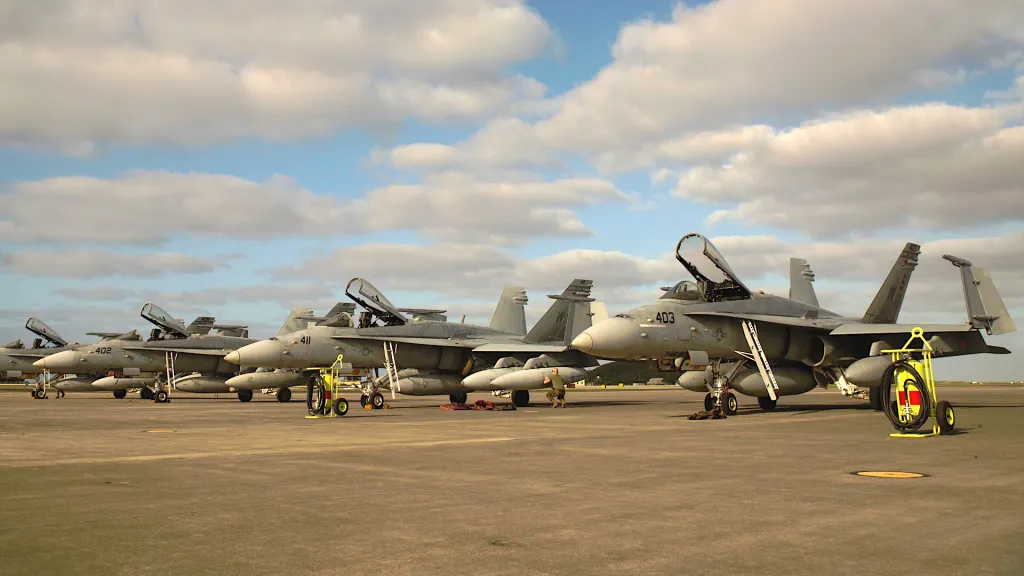
A row of US Marine Corps F/A-18C Hornets. USMC

“The Legacy Hornet continues to generate increased lethality, relevance, and survivability through its final fit,” a Marine Corps spokesperson told TWZ when asked for more information. “Addressing the C-UAS and Cruise missile capability, the F/A-18 has a previously funded, U.S.C. Title X-compliant requirement to incorporate the APKWS in an air-to-air mode and LAU-115/LAU-127 [missile launch rails] to integrate with the AIM-9X.”

Marine legacy Hornets already have the ability to employ the AIM-9X Sidewinder, so it is unclear exactly what changes are being made in this regard, and TWZ has reached back out for details. It is possible that this could entail work to increase the total number of AIM-9Xs the jets can carry at once. The U.S. Navy pursued a similar crash upgrade program for its F/A-18E/F Super Hornets back in 2024 in response to an urgent need for increased capacity to shoot down drones being employed by Iranian-backed Houthi militants in Yemen.

Marines load an AIM-9X Sidewinder onto a legacy Hornet. USMC

The decision to integrate the air-to-air APKWS II capability onto Marine F/A-18C/Ds is more clear cut, and is a logical development. The Air Force has already proven that the rockets are capable anti-air weapons against drones in real combat, which TWZ was first to report. The service initially disclosed that it was experimenting with using APKWS II in this role back in 2019. This is a capability that may also now be in service in Ukraine on that country’s second-hand F-16s, and could be set to appear elsewhere globally. The laser-guided rockets have separately demonstrated their ability to knock down drones when used as surface-to-air weapons in the course of the ongoing conflict in Ukraine.

APKWS II was originally designed as an air-to-surface weapon, and Marine legacy Hornets can already employ them in this mode. The rockets also have a demonstrated surface-to-surface capability. Each one of the rockets has three main parts: a 70mm rocket motor at the rear, one of several standardized warhead options at the front, and a laser guidance section in between.

APKWS, The Innovation Continues


The air-to-air optimized variant, designated the AGR-20F and also referred to as the Fixed Wing, Air Launched, Counter-Unmanned Aircraft Systems Ordnance (FALCO), incorporates a proximity fuze and changes to the munition’s guidance and sensing algorithms.

In the air-to-air role, APKWS II offers valuable cost and magazine depth benefits. The unit cost for the APKWS II guidance section has historically been between $15,000 and $20,000. 70mm rocket motors run in the $1,000 to $2,000 range. The price point for warheads fluctuates more widely, given the breadth of options available, as you can read about more here. By comparison, current generation AIM-9Xs each cost around $450,000, while the latest versions of the AIM-120 Advanced Medium Range Air-to-Air Missile (AMRAAM) have price tags around $1 million.

For tactical jets like the Marine Corps’ legacy Hornets, APKWS II rockets also come loaded in seven-shot pods. At most, an F/A-18C/D can carry up to 12 traditional air-to-air missiles at once, spread across its wingtip, underwing, and intake stations. However, many of those stations are often taken up by range-extending drop tanks and/or podded sensors. Substituting just one seven-shot pod for a single air-to-air missile would give a jet six more engagement opportunities during a sortie. Multiple pods can also be carried on certain pylons, further increasing the aircraft’s magazine depth.

A US Navy legacy Hornet seen carrying 12 missiles – two AIM-9 Sidewinders and 10 AIM-120 AMRAAMs – during a test flight. USN
A pair of seven-shot pods loaded with APKWS II rockets seen on a single pylon under the wing of a Marine Corps legacy Hornet. USN

U.S. operations in recent years against the Houthis in Yemen, as well as in the defense of Israel from Iranian drone and missile attacks, have underscored the importance of more total anti-air capacity, as well as capability. Complex attacks involving large volumes of disparate threats present a real danger of simply overwhelming defenders. This was made clear during Iran’s strikes on Israel in April 2024, when American fighters had to land to rearm and refuel after running out of missiles, all while threats were still passing overhead. In that instance, Air Force F-15E Strike Eagle crews had also unsuccessfully attempted to down Iranian drones with Laser Joint Direct Attack Munition (LJDAM) precision-guided bombs – something else TWZ was first to report – and their aircraft’s built-in 20mm M61 Vulcan cannon.

The specific pairing of air-to-air optimized versions of APKWS II with Marine legacy Hornets will also benefit from the new AN/APG-79(V)4 radars that those aircraft have been receiving in recent years. The APG-79(V)4 is an active electronically scanned array (AESA) type that can ‘see’ further, scan faster, and spot and track targets, even smaller ones, with greater accuracy compared to the previous APG-73 type on the Marine jets.

An APG-79(V)4 radar installed on a legacy Hornet. Raytheon

In their current form, FALCO rockets still have to be guided to their target via laser. This, in turn, requires the active lazing of that target throughout the entire engagement cycle, either by aircraft launching the rocket or another platform. This imposes limits on how fast a launch platform can move on from engaging one target to the next. BAE Systems, the APKWS II’s prime contractor, is now working on a new dual-mode guidance system that adds in an imaging infrared seeker. What this will allow for has been described as a pseudo-fire-and-forget capability, as the rocket would still have to be cued to the target initially via laser.

A model of the dual-mode guidance system now in development for APKWS II. Jamie Hunter

It should also be stressed that the APKWS II is not a dogfighting weapon. The drones and subsonic cruise missiles that the rockets are capable of engaging are relatively steady, non-reactionary, low-performance targets.

Still, APKWS II has clearly emerged as a valuable, if not increasingly critical, lower-cost companion to traditional air-to-air missiles. As already noted, other countries are beginning to at least take notice. For instance, consideration is being given to adding them to the arsenal of the Eurofighter Typhoon.

More platforms are likely to gain this capability in the future. Given the Navy’s own experiences in operations in and around the Red Sea against the Houthis, it is increasingly curious that there has been no announcement of adding air-to-air versions of the APKWS II to the arsenal available for that service’s F/A-18E/F Super Hornets. The discrepancy is even more pronounced now in light of the Marine Corps’ plans for its legacy Hornets.

Contact the author: joe@twz.com

Joseph has been a member of The War Zone team since early 2017. Prior to that, he was an Associate Editor at War Is Boring, and his byline has appeared in other publications, including Small Arms Review, Small Arms Defense Journal, Reuters, We Are the Mighty, and Task & Purpose.


Source link