suffer

Displaced Palestinian families suffer as heavy rains flood Gaza tent camps | Israel-Palestine conflict News

Palestinians call for better tents and other supplies as Israel maintains restrictions on aid to war-ravaged Gaza Strip.

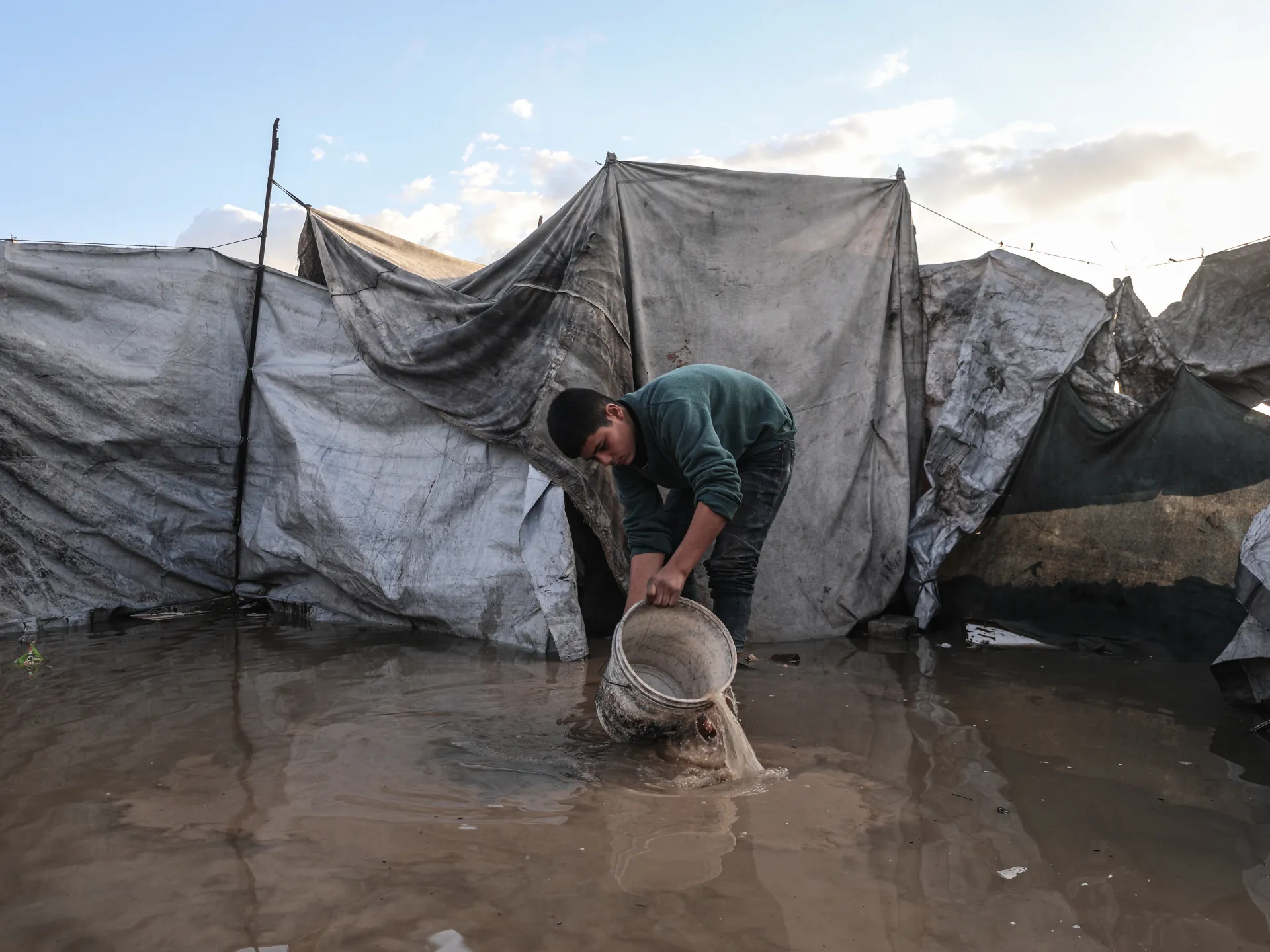
Displaced Palestinians are reeling after heavy rains flooded their tents in makeshift displacement camps in Gaza City, as the United Nations warns that Israeli restrictions on aid have left hundreds of thousands of families without adequate shelter.

Abdulrahman Asaliyah, a displaced Palestinian man, told Al Jazeera on Friday that residents’ mattresses, clothes and other belongings were soaked in the flooding.

Recommended Stories

list of 3 itemsend of list

“We are calling for help, for new tents that can at least protect people from the winter cold,” he said, explaining that nearly two dozen people had been working for hours to get the water to drain from the area.

“This winter rain is a blessing from God, but there are families who no longer wish for it to fall, fearing for the lives of their children and their own survival,” Asaliyah said.

Gaza’s civil defence agency said Friday’s flooding primarily affected Palestinians in the north of the Strip, where hundreds of thousands of people have returned following last month’s ceasefire agreement between Israel and Hamas.

Flooding was also reported in central Gaza’s Deir el-Balah, said the rescue agency, which urged the international community to do more to “address the suffering” of Palestinians whose homes were destroyed in Israel’s two-year war on the enclave.

“We urge the swift delivery of homes, caravans, and tents to these displaced families to help alleviate their suffering, especially as we are at the beginning of winter,” it said in a statement.

While the October 10 ceasefire has allowed more aid to get into the Gaza Strip, the UN and other humanitarian groups say Palestinians still lack adequate food, medicine and other critical supplies, including shelter.

Aid groups working to provide shelter assistance in the occupied Palestinian territory said in early November that about 260,000 Palestinian families, totalling almost 1.5 million people, were vulnerable as the cold winter months approached.

The UN agency for Palestinian refugees (UNRWA) said this week that it has enough shelter supplies to help as many as 1.3 million Palestinians.

But UNRWA said Israel continues to block its efforts to bring aid into Gaza despite the ceasefire deal, which stipulated that humanitarian assistance must be delivered to Palestinians in need.

“We have a very short chance to protect families from the winter rains and cold,” Angelita Caredda, Middle East and North Africa director at the Norwegian Refugee Council (NRC), said in a statement on November 5.

Reporting from Deir el-Balah on Friday, Al Jazeera’s Hind Khoudary said Palestinians across Gaza have been voicing fears that this winter would be particularly difficult due to the lack of safe shelter.

“It only rained for a couple of minutes – 30 minutes or so … [and] they were completely flooded,” she said. “Their tents are very fragile and worn-out; they have been using them for the past two years.”

She added that most Palestinians do not have any other options but to remain in tent camps or overcrowded shelters, despite the difficulties.

“We’re already seeing Palestinian children walking barefoot. They do not have winter clothes. They do not have blankets. And at the same time, the aid that is coming in … is being restricted,” Khoudary said.

Back in Gaza City, another displaced Palestinian man affected by the heavy rains, Abu Ghassan, said he and his family “no longer have a normal life”.

“I’m lifting the mattresses so the children don’t get soaked,” he told Al Jazeera. “But the little ones were already drenched here. We don’t even have proper tents.”

Source link

‘Race against time’: Palestinians suffer from hunger in Gaza despite truce | Israel-Palestine conflict News

Aid agencies are in “a race against time” to get food and other humanitarian supplies into the Gaza Strip, a United Nations official has warned, as Israeli restrictions continue to impede deliveries across the bombarded enclave.

Speaking during a news briefing on Tuesday, a senior spokesperson for the UN’s World Food Programme (WFP) noted that aid deliveries have increased since a ceasefire between Israel and Hamas came into effect last month.

Recommended Stories

list of 3 itemsend of list

But only two crossings into Gaza are open, which “severely limits the quantity of aid” that the WFP and other agencies can bring in, said Abeer Etefa.

“We need full access. We need everything to be moving fast. We are in a race against time. The winter months are coming. People are still suffering from hunger, and the needs are overwhelming,” she said.

WFP, which currently operates 44 food distribution points across Gaza, said it has provided food parcels to more than one million Palestinians in the territory since the ceasefire began on October 10.

But Etefa told reporters that the amount of food getting into Gaza remains insufficient, and reaching northern Gaza, where the world’s top hunger monitor confirmed famine conditions in August, remains a challenge.

“A major obstacle is the continued closure of the northern crossings into the Gaza Strip. Aid convoys are obliged to follow a slow, difficult route from the south,” she said.

“To deliver at scale, WFP needs all crossings to be open, especially those in the north. Full access to key roads across Gaza is also critical to allow food to be transported quickly and efficiently to where it is needed.”

Thousands of Palestinians have returned to their homes in Gaza’s north in recent weeks as the Israeli army withdrew to the so-called “yellow line” as part of the ceasefire agreement.

But most found their homes and neighbourhoods completely destroyed as a result of Israel’s two-year bombardment. Many families remain displaced and have been forced to live in tents and other makeshift shelters.

Khalid al-Dahdouh, a Palestinian father of five, returned to Gaza City to find his house in ruins. He has since built his family a small shelter, using bricks salvaged from the rubble and held together with mud.

“We tried to rebuild because winter is coming,” he told Al Jazeera.

“We don’t have tents or anything else, so we built a primitive structure out of mud since there is no cement … It protects us from the cold, insects and rain – unlike the tents.”

The UN and other aid agencies have been urging Israel to allow more supplies into the Strip, as outlined in the ceasefire agreement, particularly as Palestinians are set to face harsh conditions during the colder winter months.

On Saturday, Gaza’s Government Media Office said that 3,203 commercial and aid trucks brought supplies into Gaza between October 10 and 31, an average of 145 aid trucks per day, or just 24 percent of the 600 trucks that are meant to be entering daily as part of the deal.

Meanwhile, the Israeli army has continued to carry out attacks on Gaza, as well as demolishing homes and other structures.

One person was killed and another wounded on Tuesday after an Israeli quadcopter opened fire in the Tuffah neighbourhood east of Gaza City. A source at al-Ahli Arab Hospital also told Al Jazeera that a person was killed by Israeli army fire in northern Gaza’s Jabalia.

At least 240 Palestinians have been killed and 607 others wounded in Israeli attacks since the ceasefire came into effect, according to Gaza’s Ministry of Health.

Israeli leaders have rejected criticism of those attacks and of continued restrictions on humanitarian aid, accusing Hamas of breaching the deal by not releasing all the bodies of deceased Israeli captives from the territory.

On Tuesday, Israel said it received the remains of an Israeli captive after Hamas handed them over to the International Committee of the Red Cross.

Source link