Su57

Su-57 With New Upgrade Options, Russia Claims First Foreign Delivery Has Already Occurred

Russia’s Sukhoi Su-57 Felon is benefiting from lessons learned in the ongoing conflict in Ukraine, according to the head of the country’s state-run defense conglomerate Rostec. Work to continue evolving the jet’s design is visible at this year’s Dubai Airshow, especially through a model depicting an export “Su-57E” variant featuring two-dimensional thrust-vectoring exhaust nozzles. A pre-production prototype is also on display and flying at the event, sporting a new wide-area cockpit display.

Speaking through a translator, Rostec CEO Sergey Chemezov talked about the Su-57, as well as other Russian aviation and defense industry developments, with TWZ and other outlets on the sidelines of the Dubai Airshow yesterday. Among his remarks, he also claimed that work to improve the Felon’s capabilities based on feedback from real-world combat operations has led to a surge in overseas interest in the type. On Monday, Vadim Badekha, head of the United Aircraft Corporation, of which Sukhoi is currently a division, separately announced the delivery of the first two Su-57s to an unnamed foreign customer, something we will come back to later on.

A pre-production Su-57 prototype seen during a demo flight at the 2025 Dubai Airshow. Jamie Hunter

“So, I will not confirm any contract number or any of our partners,” Chemezov said, responding to a question about export orders, according to the translator. “I can definitely highlight that we have a very huge demand from many countries for this particular aircraft, and we’re hoping to even expand this demand.”

The video below offers a close-up walkaround of the pre-production Su-57 prototype at this year’s Dubai Airshow.

“The upgrade of the fighter jet is kind of a non-stop process that continues as we continue our special military operation, we get the feedback from our pilots from the war zone, and we are tweaking and adjusting our equipment accordingly,” Chemezov also said in response to a separate query about recent updates to the Su-57 design, again per the translator. “And that’s why you can witness the high demand from our foreign customers, because they understand, and they know that our equipment goes through a continuous upgrade based on the experience we gain in the real combat environment.”

The pre-production Su-57 prototype on the ground in Dubai. Jamie Hunter

The extent to which Su-57s have been used in combat in the ongoing war in Ukraine, which the Russian government refers to as a “special military operation,” is unclear. Reports have said the jets flew their first combat missions in support of operations in Ukraine within weeks of Russia launching its all-out invasion in 2022. Additional reporting, as recently as last year, has claimed that Su-57s have continued taking part in the conflict, on and off, at least on some level, flying air-to-air and air-to-ground missions, but hard details remain scant. There are reports that an Su-57 was responsible for shooting down a friendly S-70 Okhotnik-B (Hunter-B) flying wing unmanned combat air vehicle (UCAV) over Ukraine in an incident last year that you can read more about here.

How many Su-57s the Russians have in service currently is also unclear. The Russian Air Force only began to receive serial production examples in 2022 after placing an order for a relatively modest 76 jets. Around 18 aircraft are at least understood to have been delivered between then and the end of 2024. Whether more deliveries have occurred this year is unclear. At least one Su-57 (and possibly two) was at least damaged in a Ukrainian attack on Akhtubinsk airfield last year.

A satellite image taken on June 8, 2024, after the attack on Akhtubinsk airfield, showing damage to one and possibly two Su-57 Felon fighters. Satellite image ©2024 Maxar Technologies A Maxar satellite image taken June 8 after the attack shows damage to one and possibly two Su-57 Felon new generation fighters. Satellite image ©2024 Maxar Technologies

A total of 10 pre-production prototypes, also referred to as T-50s, were also built, but not all of them are flyable, let alone suitable for operational use. The type’s first flight came on January 29, 2010, more than 15 years ago.

Chemezov did not elaborate on how any real combat experiences have directly impacted the design and capabilities of the Su-57 while speaking yesterday in Dubai, where the Su-57 has been heavily showcased. This has included a flight demonstration that offered the best look to date at the jet’s internal weapons bays.

The pre-production Su-57 prototype seen with its weapons bays open during its flight routine at the Dubai Airshow this week. Jamie Hunter

As noted, there is a scale model of an Su-57E with two-dimensional thrust-vectoring exhaust nozzles on display at this year’s Dubai Airshow. This nozzle design has been seen in the past and is also linked to work on an improved engine for the Felon, the AL-51F-1 turbofan, as you can read more about here.

A close-up look at the two-dimensional thrust-vectoring exhaust nozzles on the Su-57E model on display at this year’s Dubai Airshow. Jamie Hunter

The AL-51F rectangular nozzle, like its predecessors the AL-31FP is equipped with a 2D TVC nozzle that is mounted 32 degrees in the horizontal plane and can be deflected ±15 degrees in the vertical plane, creating a corkscrew effect that enhances the aircraft’s turning capability https://t.co/3iWIVfHJlX pic.twitter.com/OOUFIco1f3

— H. Memarian (@HEMemarian) November 16, 2025

As TWZ has previously written:

“In its initial form, the AL-51F-1 also retains a similar three-dimensional thrust vectoring nozzle, but what we see in the new imagery is an alternative nozzle, this time of the two-dimensional type, which provides pitch control as well as limited roll control if engaged asymmetrically. It isn’t clear if the angled installation of the nozzle is meant to provide extra control in the latter.

This kind of stealthy ‘flat’ engine nozzle is also used on the F-22 Raptor, for example, and is primarily chosen to reduce radar signature compared with an axisymmetric nozzle design. It also provides infrared signature advantages, as well.

For the Su-57, the flat nozzle would bring notable advantages in terms of improving its low observability from the rear aspect. The original design of the Felon better optimized low observability from the frontal aspect, with less attention paid to the side and rear aspects. At the same time, the revised nozzles will reduce thrust output to some degree, but this is clearly considered a worthwhile penalty based on the improved low-observable aspects it brings…”

A view of the rear aspect of the pre-production Su-57 prototype at this year’s Dubai Airshow. Jamie Hunter

As an aside, the Russians are also showing off a relatively new turbofan engine design called the Izdeliye 177S at this year’s Dubai Airshow. This engine was first unveiled at the Zhuhai Airshow in China last year. It is reportedly a derivative of the AL-41F-1, the original engine for the Su-57, which also incorporates technology from the AL-51F-1. It has been presented a potential powerplant for new-production export Su-57s, as well as an upgrade option for existing jets with AL-31 engines, especially newer generation Flanker variants.

The Izdeliye 177S engine displayed at the 2025 Dubai Airshow. Jamie Hunter
Another view of the Izdeliye 177S engine from the rear. Jamie Hunter

As also mentioned, the flying pre-production prototype on display at the Dubai Airshow, also known as T-50-9, has notably received a new wide-area display in its cockpit. This is said to be reflective of the Su-57E configuration the Russians are now pitching to prospective export customers. The single-screen unit replaces two smaller displays that had previously been installed. Large, wide-area displays are an increasingly common feature on modern fighters, offering various benefits, above all else providing more overall customizable ‘real estate’ for users to work with and enhanced situational awareness when combined with upgraded processing power.

In terms of actual Su-57 export sales to date, the Russians have only explicitly talked about a firm order from one customer. Algeria is widely posited as being the country in question following a report earlier this year from one of the country’s state-run television networks. Visual confirmation of the delivery of Su-57s to the Algerian Air Force, or any other foreign customer, has yet to emerge.

“Our foreign customer, our foreign partner, has already received the first two aircraft,” Vadim Badekha, United Aircraft Corporation’s General Director, had said on Monday in an interview with Russia’s state-run Channel One television station. “They have begun combat duty and are demonstrating their best qualities. Our customer is satisfied.”

There are broader questions about Russia’s ability to produce Su-57s, or other combat jets, in the face of years of Western sanctions. In Dubai yesterday, Rostec’s Chemezov acknowledged, but downplayed the impacts of sanctions, touting Russia’s resourcefulness in sourcing alternative items domestically. These claims aside, there is substantial evidence that Russia’s defense industry, overall, continues to acquire electronics and other key components from overseas, including from the West and increasingly from China, despite international sanctions.

The second serial production Su-57 seen being built in 2020. United Aircraft Corporation

Chemezov also said that Russian defense exports have been cut roughly in half since the start of the war in Ukraine. However, he blamed this on higher demand from Russia’s own armed forces rather than a drop in international interest in Russian arms. There are certainly reports that some countries have been working to decouple their defense procurement plans from Russia for geopolitical reasons in recent years. Nations that buy Russian weapon systems may also be at risk of triggering secondary sanctions, especially from the United States.

When it comes to the Su-57 specifically, Russia has reportedly offered a degree of local production as part of past pitches to the United Arab Emirates and India to help offset concerns about domestic capacity and sanctions. Bringing additional partners into the Su-57 program would also help reduce the cost burden on the Russian side. India previously cooperated with Russia on the development of a country-specific version of the jet before dropping out in 2018, reportedly over disappointment in the aircraft’s expected capabilities and how the program was progressing overall.

From Dubai Airshow:

Ahead of Putin visit, Russia Pitches to Delhi the Production of Su-57 Fighter Jet in India.

Senior representative of Russia’s state arms exporter Rosoboronexport says our “technology transfer comes without restrictions and possible sanctions.” pic.twitter.com/tnxbHeQPgc

— Sidhant Sibal (@sidhant) November 18, 2025

Renewed discussions about Su-57 exports, especially in the Middle East, now also come against the backdrop of a prospective U.S. sale to Saudi Arabia of F-35 Joint Strike Fighters. The White House confirmed late yesterday that President Donald Trump had approved the deal, though members of Congress could still seek to block it, and other steps would also be required to finalize it. Saudi Arabia, as well as the United Arab Emirates, have pursued F-35 purchases in the past, but have been rebuffed, largely over operational security concerns and potential negative impacts to Israel’s so-called “qualitative edge” militarily in the region.

Trump has also taken a favorable stance when it comes to readmitting Turkey to the F-35 program. The Turkish government had been ejected from the program in 2019 in large part over its decision to purchase S-400 surface-to-air missile systems from Russia.

The Su-57 has often been presented as a potential alternative for many countries that cannot get approval to buy F-35s. A significant shift in U.S. policy when it comes to countries eligible to buy Joint Strike Fighters could have impacts on prospects for future Su-57 sales.

Rostec’s Chemezov was asked yesterday about direct competition between the Su-57 and the F-35. He downplayed any such rivalry, saying prospective customers are free to choose whatever design they think best suits their needs, according to the translator.

Jamie Hunter

The international fighter market is not limited to Russia and the United States, either. China, in particular, is making increasing inroads in this space globally, and export variants or derivatives of its J-35 stealth fighter could be on the horizon.

While many significant questions remain about the future of the Su-57, even just in Russian service, work is clearly continuing at least on a level to improve the design, and with renewed focus on potential export sales.

Jamie Hunter contributed to this report.

Contact the author: [email protected]
Joseph has been a member of The War Zone team since early 2017. Prior to that, he was an Associate Editor at War Is Boring, and his byline has appeared in other publications, including Small Arms Review, Small Arms Defense Journal, Reuters, We Are the Mighty, and Task & Purpose.


Source link

Su-57 Felon Brandishes Its Loaded Weapons Bays For The First Time

Imagery has been published providing a rare look inside the weapons bays of one of the prototypes of Russia’s Su-57 Felon fighter, an aircraft you can read about in more detail here. While internal weapons carriage is a key design feature of the Sukhoi jet, the main weapons bays, at least, haven’t been seen in such detail, with weapons loaded. The footage comes as Moscow embarks on another export drive for the Su-57, which has reportedly so far only been ordered by Algeria.

A recent promotional video from the United Aircraft Corporation (UAC), Russia’s aviation manufacturing conglomerate, shows the prototype T-50-9 being put through its paces ahead of its planned appearance at the Dubai Airshow. The event takes place in the United Arab Emirates next week. In the footage, the T-50-9 performs a variety of maneuvers, but of greatest interest is the forward main weapons bay, opened to reveal a pair of Kh-58UShK anti-radiation missiles.

The United Aircraft Corporation (UAC) has released promotional footage of the Su-57 prototype (T-50-9) ahead of its appearance at the 2025 Dubai Airshow. pic.twitter.com/YVl1aQDVB0

— OSINTWarfare (@OSINTWarfare) November 9, 2025

While we have previously seen imagery of weapons being released from the aircraft’s main weapons bays, we. The plan to display the T-50-9 at Dubai, with internal weapons exposed, is also new — this hasn’t been done since the aircraft was first flown in prototype form 15 years ago.

The T-50-9 undergoes final preparations at Zhukovsky International Airport ahead of its appearance at the Dubai Airshow.

📸: Gomezismq on TG pic.twitter.com/5QSjk7DHCp

— OSINTWarfare (@OSINTWarfare) November 9, 2025

The Felon carries its main weaponry in a pair of notably large internal weapons bays that are arranged in tandem between the engines. Each of the bays is sized for the carriage of two missiles with a maximum length of just under 14 feet and a cross-section of around 16 by 16 inches.

For reasons that aren’t entirely clear, it was a long time before Sukhoi began to conduct tests of internal weapons from the Felon. Such trials only began in 2016, six years after the initial prototype T-50 had first taken to the air. In March of 2016, a Felon first launched an undisclosed type of missile from one of its main internal weapons bays.

For the air-to-air role, the large tandem weapons bays are intended to carry two types of beyond-visual-range missiles that were specially adapted for internal carriage. These are the medium-range R-77M (izdeliye 180) and the very-long-range izdeliye 810. You can read more about them here.

For offensive missions, the Kh-69 long-range air-to-surface missile was designed specifically for the Felon, again for internal carriage. The Kh-69 is a weapon we have discussed in detail in the past.

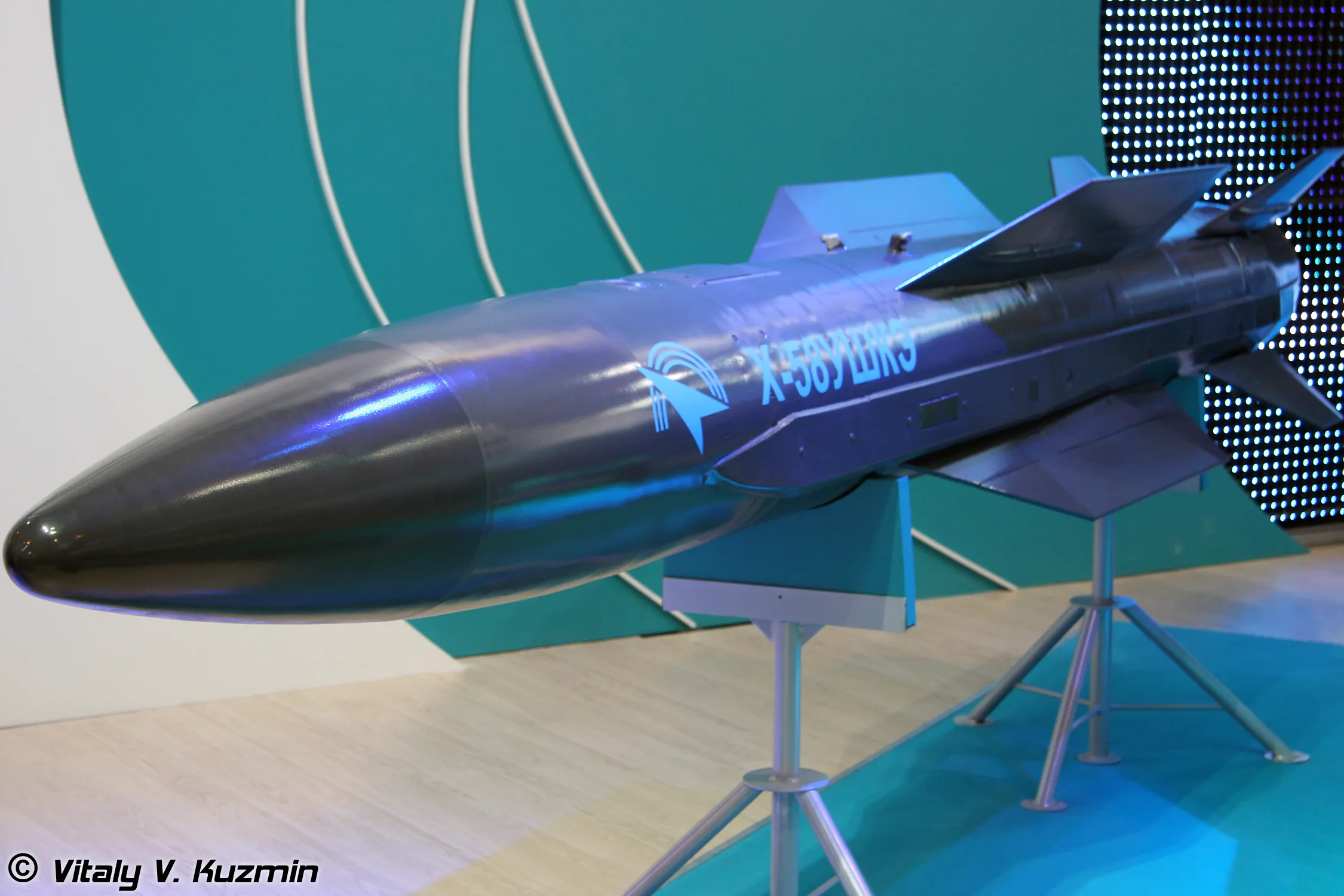
Meanwhile, the Kh-58UShK supersonic anti-radiation missile seen in the recent UAC video is a further evolution of the older Kh-58 (known to NATO as the AS-11 Kilter).

Weighing around 1,400 pounds per piece, the Kh-58UShK (in which the K suffix stands for Kompaktnaya, compact) has a missile body that is approximately 24 inches shorter than the baseline weapon. It also has folding fins to fit in the internal bays. The weapon has a reported range of 150 miles when launched from higher altitudes, although this is significantly reduced when launched from lower levels.

A mockup of the Kh-58UShK supersonic anti-radiation missile. Vitaly V. Kuzmin

Other offensive munitions that the fighter can carry internally include the ‘universal’ Kh-38M air-to-ground missile with a range of different guidance types, the Grom (thunder) missile that adds a range-extending wing kit to the Kh-38M, and the 551-pound KAB-250L electro-optically guided bomb.

The UAC footage also shows the aircraft’s ability to carry two additional air-to-air missiles inside the two so-called ‘quick-launch’ bays — these have previously been seen in some detail, unlike the main bays. The quick-launch bays are located in distinctive underwing fairings, and the design ensures the missile can be extended into the slipstream so it can lock onto its target. Each can be located with a single R-74M2 (izdeliye 760) short-range air-to-air missile. This is another weapon that was developed specifically for internal carriage, derived from the well-established R-73 (AA-11 Archer).

A sequence showing the launch of an air-to-air missile from one of the Su-57’s two small wing-root weapons bays. Russian Ministry of Defense screencap

The missile launch clip begins at approximately 1:19 in the runtime of the video below:

Carrying internal ordnance is a prerequisite if it’s paramount that the Su-57 retains its reduced radar signiture characteristics. However, for missions not requiring such a degree of low-observability, the aircraft can carry a heavier weapons load, making use of four pylons under the wing and two under the air intakes. The underwing pylons can also accomodate drop tanks for additional fuel.

Finally, for close-range combat, the aircraft is armed with a 30-millimeter single-barrel cannon within in starboard wing root and provided with 150 rounds of ammunition. You can see it in action here.

The Su-57 fires its onboard GSh-30-1 cannon. YouTube screencap

Showing off the Su-57’s relatively impressive capability to accommodate larger internal weapons will, UAC surely hopes, help to drum up more export interest in its product.

Apart from the announcement from Algeria’s state-run media earlier this year that the country was buying the Su-57, the aircraft hasn’t seen any export uptake. The sales fortunes of the Su-57 have so far suffered from a failed partnership with India as well as limited Russian orders and deliveries.

Algerian TV confirms Su-57 fighter jet deal with Russia.

“Algerian pilots are training in Russia, and deliveries are expected this year.”

Algeria becomes the first Su-57 customer. pic.twitter.com/UGEgFvY92m

— Clash Report (@clashreport) February 12, 2025

Combat employment in Russian hands has also been less than impressive, with only questionable capabilities demonstrated in Syria, and little in the way of hard evidence about its service in the war in Ukraine — aside from the reported shooting down of a Russian S-70 Okhotnik-B flying-wing uncrewed combat air vehicle (UCAV), in circumstances that remain somewhat unclear.

Overall, the Su-57 program has made only very slow progress, hampered by a lack of investment in the form of foreign orders. A significant blow was struck by India’s withdrawal from the program, with that country’s investment having been considered vital to speed development. The same had been true in the late 1990s when India’s purchase of the Su-30MKI Flanker essentially secured the development of the multirole version of this fighter, which was only later acquired by Russia.

In terms of domestic orders, the Russian Aerospace Forces only began to receive series-built Su-57s in 2022, part of an order for 76 aircraft — a notably small production run.

A pair of Russian Aerospace Forces Su-57s depart Novosibirsk, on their way to the flight test center at Lipetsk, in May 2022. NSKPlanes

While at least six aircraft were delivered to the Russian Aerospace Forces in 2022, more than 10 were handed over in 2023 before numbers tailed off again in 2024, when likely only two or three more were received. It’s unclear if any examples of the Su-57 have been delivered to Russia this year.

The full-scale invasion of Ukraine and the subsequent international sanctions against Russia have had the combined effect of slowing down the pace of Su-57 deliveries and limiting export prospects to all but the staunchest Kremlin allies. After all, any country that receives Russian weapons can expect to be on the receiving end of U.S. sanctions. In an effort to counter this, Russia has also offered a degree of local production of the Su-57, specifically with the hope of securing sales from India and the United Arab Emirates. The Dubai Airshow appearance is almost certainly calculated to try and reinvigorate interest from these two nations in particular.

At the same time, while demonstrating the Su-57’s already celebrated agility and its gradually expanding weapons options, the long-promised advanced Su-57M version has made little progress. The Su-57M is powered by the new AL-51F1 (izdeliye 30) turbofan engine, replacing the current AL-41F-1. It promises increased thrust, lighter weight, and lower operating costs. However, a lack of interest from Russia has done little to help the Su-57Ms’ chances on the export market.

The revised, flat version of the engine nozzle for the AL-51F1 turbofan (in the left nacelle), alongside the original three-dimensional version (right nacelle). via X

Recent reports based on an apparent leaked official document relating to Su-57 (and other Sukhoi) exports also pointed to official interest in the Felon from Algeria. This document, the leak of which was attributed to the Black Mirror hacktivist group, was, however, several years old and appears to have described possible export orders, rather than reflecting any kind of firm deals. It is also notable that most of the possible export deals in the document related to the Su-35 Flanker, rather than the more advanced Su-57.

This table has generated a lot of buzz lately, but remember that this is a summary of plans as of April 2022, over three years ago.

Su-57 to Algeria,
Su-35 to Iran, Bangladesh, Vietnam, and Ethiopia
Su-34 to Algeria pic.twitter.com/yQKgPvJSMY

— Piotr Butowski (@piotr_butowski) October 5, 2025

Regardless, the UAC is clearly aiming to make a big splash with the Felon at the Dubai Airshow, where it seems that the planned Su-57 flying display will demonstrate a high level of maneuverability coupled with a heavy missile load — a common sales tactic for multirole fighters. It’s also possible that more previously secretive aspects of the design could be revealed in more detail, as the campaign to secure lucrative export sales is ramped up.

Contact the author: [email protected]

Thomas is a defense writer and editor with over 20 years of experience covering military aerospace topics and conflicts. He’s written a number of books, edited many more, and has contributed to many of the world’s leading aviation publications. Before joining The War Zone in 2020, he was the editor of AirForces Monthly.


Source link