stereophonic

Arcade Fire’s Will Butler knows about volatile bands. Cue ‘Stereophonic’

The singer of the band lights up a cigarette and smoke drifts into the theater. Ditto for the pungent aroma of marijuana when a few band members share a joint. “Stereophonic,” which is playing at the Hollywood Pantages through Jan. 2, isn’t biographical, but it sure feels close.

The authenticity springs in part from the quality of the songs being recorded by the fictional band on stage, which were written by Will Butler, a multi-instrumentalist and former member of the Grammy Award-winning band Arcade Fire.

“Stereophonic,” which holds the record for the most Tony nominations of all time for a play, unfolds over the course of a single year as a rock band on the cusp of megastardom struggles to record its second album as the first reaches No. 1 on the charts. While the pressure to produce a hit builds, the band falls apart. For proof of the formula’s resilience, look no further than the success of VH1’s “Behind the Music” series, which plumbed the depths of dozens of rock ’n’ roll train wrecks.

“We really tried to just make something real,” Butler said during an interview in the small, cluttered green room at Amoeba Music before he joined the cast of the show for a brief in-store performance. “This is three hours of what it’s like to make a record.”

Is it ever. There is something inherently combustible about being in a band. (Full disclosure: I played in a semi-popular indie band for a decade, which imploded with huge amounts of drama right on cue. I know at least a dozen other groups that have unraveled in similar fashion.) Despite, or rather because of, Arcade Fire’s massive popularity, Butler knows the crash-and-burn nature of being in a band. He joined Arcade Fire after one of its original members quit in the middle of an encore following a fight with the lead singer — Butler’s older brother, Win Butler.

Will Butler left Arcade Fire at the end of 2021, saying at the time that the decision came about organically. “There was no acute reason beyond that I’ve changed — and the band has changed — over the last almost 20 years. Time for new things,” he wrote on social media.

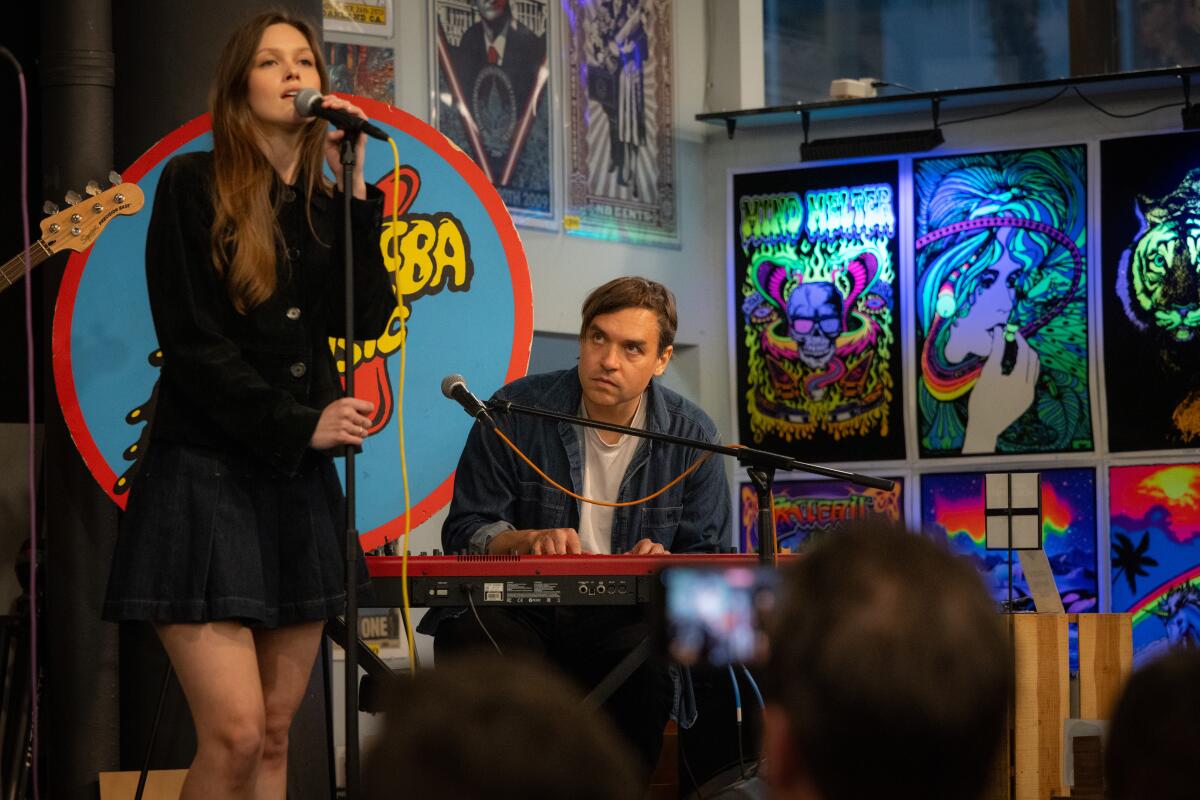
Claire DeJean sings while Will Butler plays a keyboard at Amoeba Music.

Will Butler performs at Amoeba Music with Claire DeJean and the stars of the Broadway tour of “Stereophonic,” which follows the rise of a struggling 1970s rock band.

(Jason Armond / Los Angeles Times)

“Stereophonic” was one of those new things, and Butler has brought his understanding of volatile band dynamics to bear in his work on the show, as well as his thoughts on the fragile, ephemeral nature of recording in a studio.

“There’s a little booth, and you go into the booth and you lose your mind,” Butler said of the experience of laying down a track. “And you exit the booth and you’re just a boring human.”

The boring — and boorish — parts of that humanity are on display in “Stereophonic,” where there is more control room conflict than actual music making. This also feels true to form. Romances blossom and bottom out in spectacular fashion. Drugs are consumed in copious amounts — particularly cocaine. This is 1976, after all. The long-suffering recording engineer reaches his breaking point after becoming totally fed up with the band’s self-absorbed, self-destructive behavior.

Human beings weren’t meant to create art in this particular kind of pressure cooker. Until they do. There is a moment in the making of every great song when each musician becomes part of the whole during the act of recording, and the band’s genius is temporarily realized. The song can’t be made by any one member — it can only come from the spontaneous transcendence of the group.

This moment happens in “Stereophonic” after a truly frustrating number of stops and starts, when the group plays a song so beautifully that the theater erupts in effusive applause. This is why the band stays together despite its constant feuding — and why the audience has come.

Musicians perform at a record store.

“We really tried to just make something real,” Will Butler said of “Stereophonic.” “This is three hours of what it’s like to make a record.”

(Jason Armond / Los Angeles Times)

“The music in this show has to crack open the world because it’s so much talking and it’s so much sitting around,” Butler said. “And then when they play music, you have to instantly realize why they’re together.”

Butler first met playwright David Adjmi and heard his idea for the show in 2014. Butler was intrigued, but had to wait for the script before he could work on the music in earnest. The songs needed to fit into the script like puzzle pieces, Butler said. Sometimes he needed to write a whole song and other times he needed to focus on composing the first 30 seconds of a song — which would be heard on repeat.

“And then we cast it, and now the music exists in a different way,” Butler said, noting that the music changes with every new cast. A cast — like a band — has its own particular strengths and weaknesses. No rhythm section is ever the same. You know John Bonham’s tom fills when you hear them, just as you can immediately recognize the sound of Ringo Starr’s hi-hats.

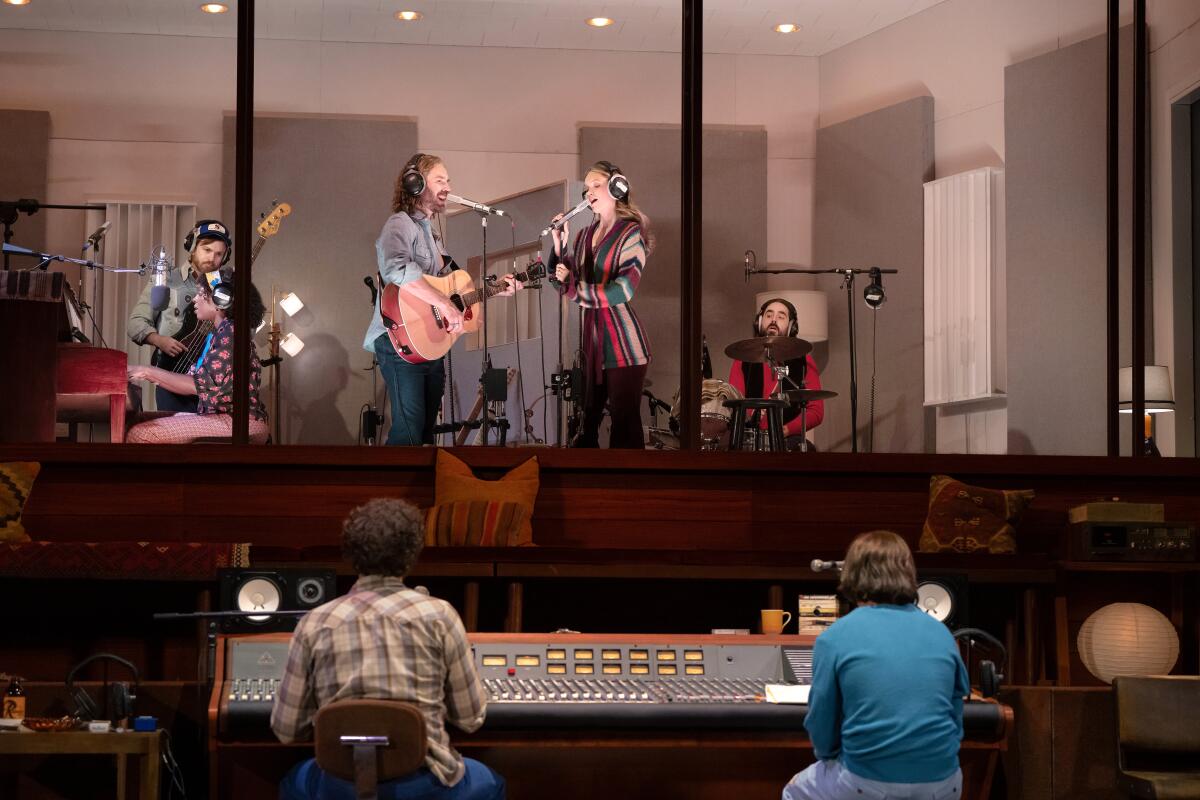
Musicians record music in a sound room as engineers watch outside in "Stereophonic."

None of the actors in the national tour cast of “Stereophonic” — except for the drummer — are trained musicians.

(Julieta Cervantes)

The whole process of constructing “Stereophonic” as a play is very meta — with Butler producing the band that is in turn producing itself onstage in the studio. During the course of the show, one of the songs is actually recorded live and played back from the control room. It is slightly different each time, in ways both meaningful and incidental. Just like in real life.

The in-store performance at Amoeba, however, is wildly different from what happens onstage at the Pantages. The cast members are not — with the exception of the drummer — trained musicians, and stripped of the confidence that comes with costumes and a set, they appear somewhat vulnerable in the process.

This is in stark contrast to Butler, who displays all the verve and conviction of a bona fide rock star. The cast will do the same across the street later that night. For the moment, however, Butler is showing them just how it’s done.
Source link

‘Stereophonic’ at the Pantages falls flat: Review

“Stereophonic,” David Adjmi’s heralded drama that won five Tony Awards including best play, is ready for its Los Angeles close-up.

The first national tour production, which opened Wednesday at the Hollywood Pantages Theatre, seems right at home in the music capital of the world. The play about a 1970s rock band on the brink of superstardom takes place in recording studios in Sausalito and L.A., where the Laurel Canyon vibe is never out of sight.

The visual crispness of this L.A. premiere goes a long way toward dispelling doubts that the Pantages is the wrong venue for this ensemble drama. If there’s a problem, it isn’t the cavernousness of the theater. The production, gleaming with period details on a set by David Zinn that gives us clear views into both the sound and control rooms, comfortably inhabits the performance space, at least from the perspective of a decent orchestra seat.

The play, which includes original music from Will Butler, the Grammy-winning artist formerly of Arcade Fire, has a sound every bit as robust as one of the blockbuster musicals that regularly passes through the Pantages. The songs, crushed by the actors at top volume, are Butler’s indie rock re-creation of cuts for a part-British, part-American band that bears such a striking resemblance to Fleetwood Mac that a lawsuit brought by a former sound engineer and producer of the group was eventually settled.

Adjmi, like Shakespeare, takes his inspiration where he finds it. And like the Bard, he makes his sources his own, alchemizing the material for novel ends.

Musicians record music in a sound room as engineers watch outside in "Stereophonic."

The touring production of “Stereophonic” makes clear just how integral the original cast was to the success of the play.

(Julieta Cervantes)

Unfolding in 1976 and 1977, “Stereophonic” offers a fly-on-the-wall perspective of a band at a crossroads. While recording a new album top-heavy with expectations, the group falls prey to romantic conflicts and self-destructive spirals, to toxic jealousies and seething insecurities. The prospect of fame magnifies pathologies that have been intensifying over time.

Diana (Claire DeJean) is the Stevie Nicks of the band. Beautiful, achingly vulnerable and awash in lyrical talent, she is entangled in a relationship with Peter (Denver Milord), the Lindsey Buckingham of the group, who strives for musical perfection no matter the cost.

Their connection is as professionally enriching as it is personally destructive. Diana’s ambition is matched by her self-doubt. She’s susceptible to a Svengali yet doesn’t want anyone to tell her how to write her songs.

Peter, angrily competitive, can’t help resenting the natural ease of Diana’s talent, even as it’s her song from their first album that has put the band back in the spotlight. His genius is ferociously exacting while hers seems to spring naturally from her soul.

Artistically they depend on each other, but the tension between them is unsustainable. And as the play makes clear, there’s no way to keep their personal lives out of the studio.

DeJean and Milord are the most captivating performers in the ensemble. The other actors are solid but this touring production makes clear just how integral the original cast was to the success of the play.

Daniel Aukin’s production, which had its New York premiere at Playwrights Horizons in 2023 before moving to Broadway the following year, hasn’t lost its confident flow. The storytelling is lucidly laid out. But the tantalizing peculiarities of the characters have been whittled down.

The British band members suffer the worst of it. Emilie Kouatchou’s Holly moves the character away from the obvious Christine McVie reference, but her role has become vaguer and less central. Cornelius McMoyler’s Simon, the drummer and weary manager, fills the bill in every respect but gravitas, which must be in place if the character’s ultimate confrontation with Peter is to have the necessary payoff.

No one could compete with Will Brill, who won a Tony for his strung-out portrayal of Reg, a deranged innocent whose addictions and dysfunctions create farcical havoc for the band. Christopher Mowod can’t quite endow this “sad man in a blanket,” as Simon dubs his bundled-up bandmate, with the same level of fey madness that Brill was able to entertainingly supply.

These casting differences wouldn’t be worth noting if it weren’t for their impact on a play that distinguishes itself by its observational detail. Everything is just a little more obvious, including the two American sound guys bearing the brunt of the artistic temperaments running riot in the studio.

Jack Barrett’s Grover, the sound engineer who lied about his background to get the job, sands off some of the character’s rough edges in a more straightforwardly appealing version of the character than Eli Gelb’s bracing portrayal in New York. Steven Lee Johnson’s Charlie, the dorky assistant sound engineer, is an amiable weirdo, though I missed the way Andrew R. Butler played him almost like a space alien in New York.

The play has been edited, but it’s still a bit of an endurance test. Art isn’t easy for the characters or for us. But the effort isn’t in vain.

Adjmi’s overlapping dialogue and gaping silences, orchestrated in a neo-Chekhovian style, renders the invisible artistic process visible. By the end of the play, the tumultuous human drama behind creative brilliance emerges in poignant, transcendent glory.

‘Stereophonic’

Where: Hollywood Pantages Theatre, 6233 Hollywood Blvd., L.A.

When: 7:30 p.m. Tuesdays-Thursdays; 8 p.m. Fridays; 2 and 8 p.m. Saturdays; 1 and 6:30 p.m. Sundays. (Check schedule for exceptions.) Ends Jan. 2.

Tickets: Start at $57 (subject to change)

Contact: BroadwayInHollywood.com or Ticketmaster.com

Running time: 2 hours, 55 minutes (including one intermission)

Source link