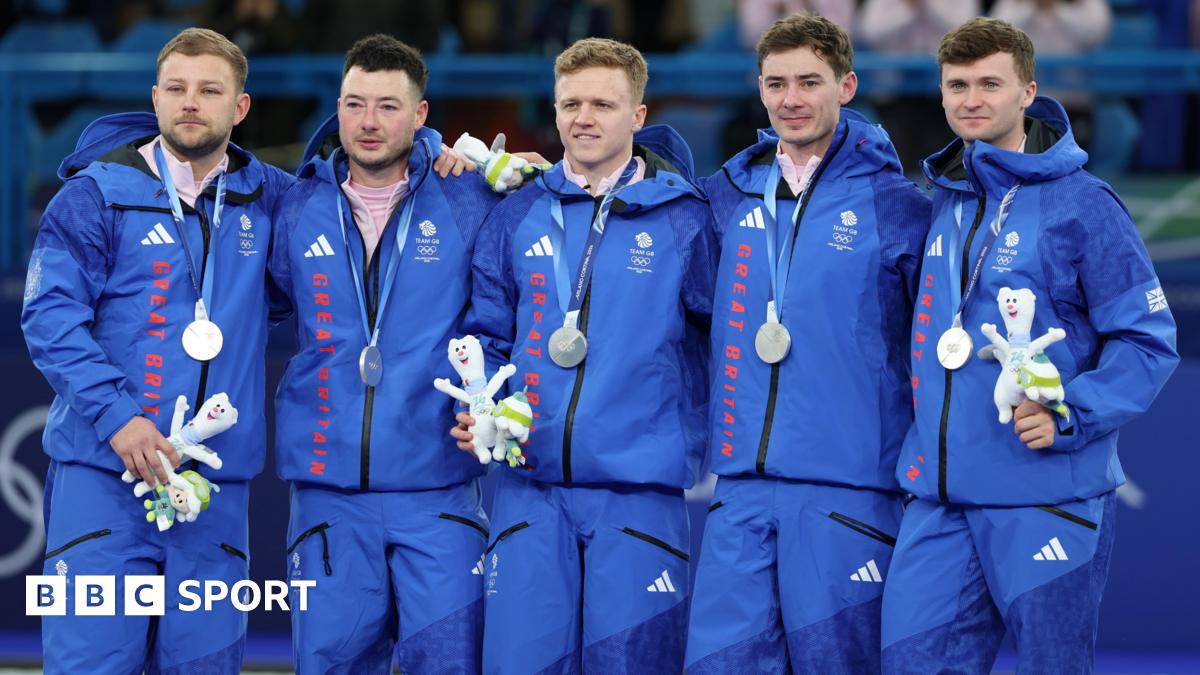
But it is the coalescence of their personalities that amplifies all that sporting talent. And underpinning the team are two key things – total honesty and trust.
As McMillan puts it, “If one of us is in the wrong, the rest can say so”, while the more measured Mouat describes it as “knowing the different things to say to get the best out of each other”.
Individually, they are all very different.
Hype man McMillan is lively enough for all four of them; Hardie is the logic guy, an engineer by trade; Mouat is thoughtful, reflective and calm; Lammie is the quiet, reliable presence; and Waddell the experienced head in the background.
It might be labelled as ‘Team Mouat’ – as per the convention of naming a rink after its skip – but this is very much a collective. In fact, Mouat is keen to share the spotlight.
“Bruce is very different from a lot of skips,” explains BBC Sport pundit and 2022 gold medallist Vicky Wright. “A lot of them are clearly the leader but the GB team operates so well because they function on a level playing field.
“The dynamic they’ve got works because they all bring a different aspect to the table and they all respect that. That’s a massive part of why they’re so successful.”
It is instructive to see how comfortable they are in each other’s company and with the position in which they find themselves.
All five have been right in among it in Cortina these past couple of weeks, be it stopping for a chat in the street or in restaurants, meeting friends and relatives, watching other British athletes compete.
Or – in Mouat’s case – going pillowcase shopping and “spending far too much money” on the morning of the semi-final.
Even in the moments before the final, McMillan and Hardie were sharing a laugh with a journalist; Mouat was picking out familiar faces in the crowd for a smile and a wave, and Lammie and Waddell were casually studying the Canadians warming up.
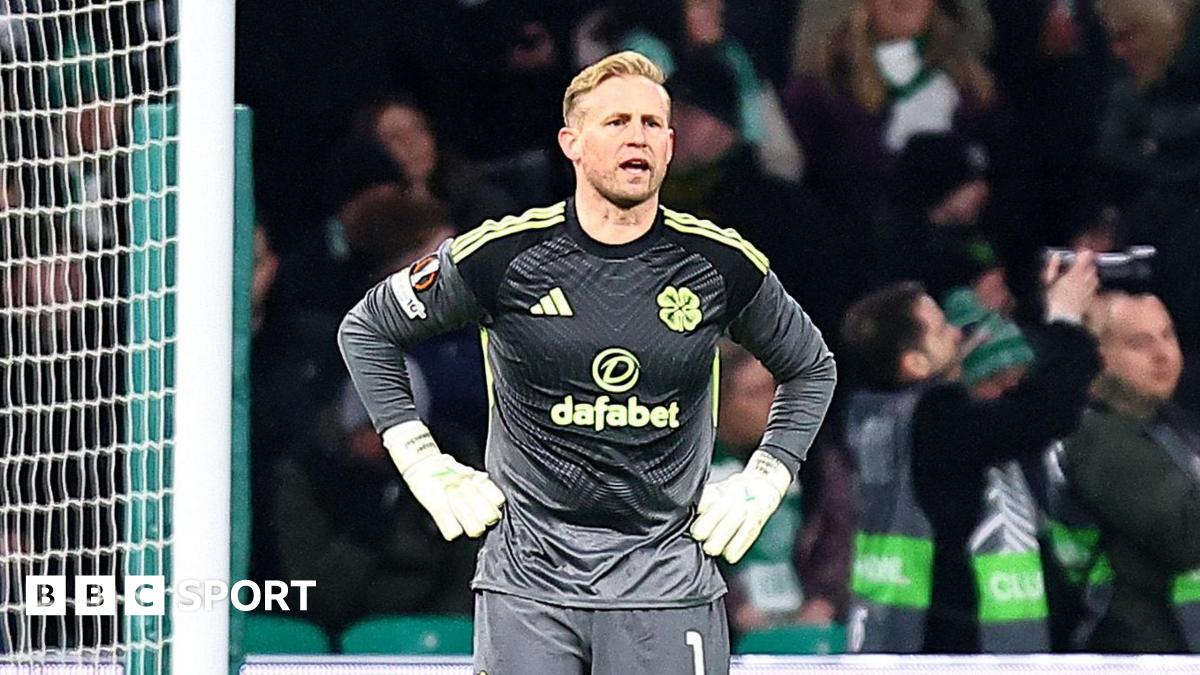
With fans protesting against the club’s board at the start of the game and later ironically cheering Schmeichel making a save, the atmosphere at Parkhead was far from harmonious.
“It’s bitterly disappointing,” former Celtic captain and manager Neil Lennon said of the jeers directed at Schmeichel.
“He had a bad night but it still doesn’t warrant that kind of treatment.”
Thursday night was the latest in a string of perceived errors made by Schmeichel, following Joe Hugill’s looping header for Kilmarnock last weekend and Jonathan Rowe’s effort for Bologna last month.
Perhaps unsurprisingly, Celtic closed ranks around their embattled goalkeeper post-match.
“It’s a tough evening for us,” interim manager Martin O’Neill said. “On paper, 4-1 looks pretty poor.
“We were masters of our own downfall in many respects, conceded some poor goals.
“Kasper [Schmeichel] has made some great saves while I’ve been here. This is a collective, there’s no doubt about that.
“We played Feyenoord in a game we probably had to win and he made an unbelievable save, otherwise we wouldn’t be here playing tonight.
“I will think about all sorts of things [before the next game], but Kasper has done really well since I’ve arrived at the football club, in both spells.”
Captain Callum McGregor added: “Everyone makes mistakes.
“Kasper has been amazing since he’s come to the club. He’ll dust that down. We win as a team and lose as a team.
“There’s no blame, he’s made so many big saves for us. He’ll bounce back for sure.”
Lakers star LeBron James eased his way to the interview podium Sunday with a giant water jug in his hand and a do-rag covering his hair, the last of the NBA All-Stars to speak with the media.
James was selected as a reserve, breaking his NBA record of 21 consecutive starts but extending his record for most appearances to 22.
At 41 and playing in his record 23rd season, James was asked about his future, because his eventual retirement always seems to be a source of curiosity.
So, James was asked before he played in the “U.S. vs. “World” All-Star Game tournament at Intuit Dome whether he had any inkling about what he wants to do next season.
“I want to live,” James said. “When I know, you guys will know. I don’t know. I have no idea. I just want to live. That’s all.”
James played on Team Stripes, joining fellow veterans Kevin Durant and Stephen Curry, who didn’t play because of a right knee injury.
They are long-time combatants, friends and U.S. Olympic teammates. And they are All-Stars again, all older than 37 and still playing at a high level.
“It’s always an honor to see those guys,” James said. “We have had such an unbelievable journey throughout our individual careers and then intersecting at certain points in our careers, matchups in the regular season, Finals appearances, postseason appearances, then Olympics two summers ago. When it comes to me, Steph and KD, we’ll be interlocked for the rest of our careers, for sure. It’s been great to be able to have some moments with those guys, versus those guys, teaming up with those guys.”
The All-Star format has changed from East versus West to U.S. versus the World.
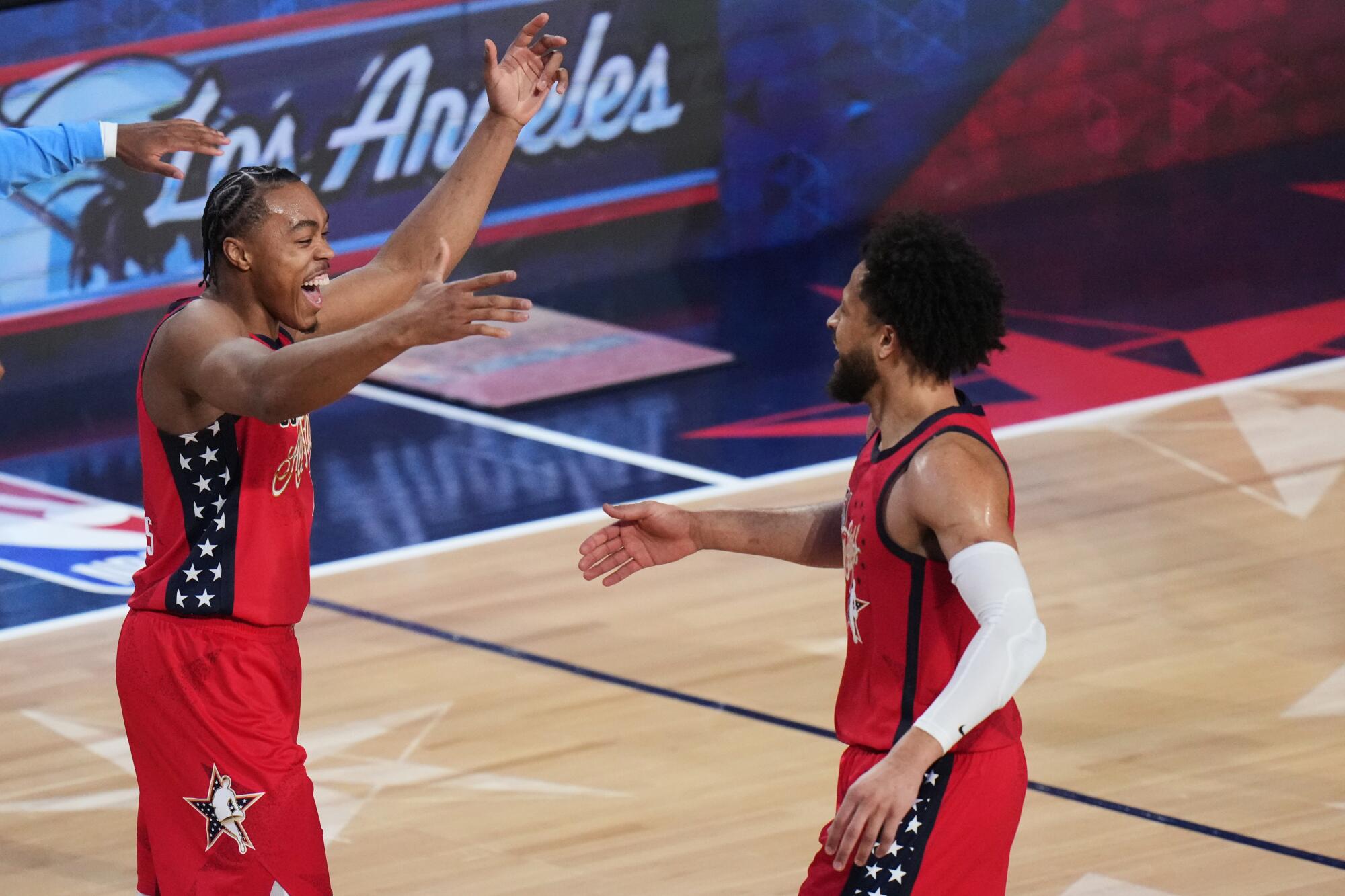
Team Stars forward Scottie Barnes, left, celebrates with Cade Cunningham after hitting a three to beat Team World in the first matchup of the All-Star Game tournament Sunday at Intuit Dome.
(Jae C. Hong / Associated Press)
There were three teams — Team Stars, Team Stripes and Team World, and they played 12-minute games in a round-robin tournament.
Game 1 was Team World vs. Team Stars, a game that went into overtime after Anthony Edwards tied the score 32-32 at the end of the first 12 minutes.
Team Stars, the first team to score five points in overtime, won 37-35 on a Scottie Barnes three-pointer,.
Victor Wembanyama led Team World with 14 points, six rebounds and three blocks.
Anthony Edwards had 13 points for Team Stars, which will play Team Stripes next.
James and Clippers star Kawhi Leonard are on the USA Stripes and Lakers superstar Luka Doncic, the leading all-star vote getter, is on Team World because he is from Slovenia.
James was asked whether he could have ever imagined a USA versus the World all-star format.
“No,” James said, laughing. “No. I mean, East-West is definitely, it’s a tradition. It’s been really good. Obviously, I like the East and West format. But they are trying something. But we’ll see what happens. I mean, it’s the US versus the World. The World is gigantic over the U.S. So, I’m just trying to figure out how that makes sense. But, I don’t want to dive too much into that. Yeah, East-West is great. We’ll see what happens with this.”
Just before the tipoff of the first game, former President Barack Obama and former First Lady Michelle Obama were introduced to a standing ovation.
MILAN — Maxim Naumov typically trembles as he waits in his opening position before the music begins. But on Tuesday, the 24-year-old U.S. figure skater stood firm at center ice with the Olympic rings beneath his feet and his right fist raised. A white gold ring with a single diamond on his ring finger glittered in the light.
It was his father’s ring.
A year after his parents, Vadim Naumov and Evgenia Shishkova, were among 67 people killed in a Washingon, D.C. plane crash, Naumov carried their strength during his Olympic debut and delivered an emotional season’s best 85.65 in the men’s short program that qualified him for the free skate.
U.S. teammate Andrew Torgashev also scored a season’s best in his Olympic debut, qualifying for Thursday’s free skate with an 89.94. His coaching team, which includes Irvine-based Rafael Arutyunyan, fist-bumped after Torgashev hit the final combination jump of his program. Skating to “Maybe I Maybe You” by the Scorpions, Torgashev flashed the rock-and-roll symbol to the crowd as he saluted.
Instead of the raw emotion Naumov released after the U.S. championship that clinched his Olympic spot last month, he smiled purely and breathed deeply while the crowd at Milano Ice Skating Arena showered him with applause. He looked toward the rafters and spoke to his parents.
“Look what we just did,” Naumov said. “We did it.”
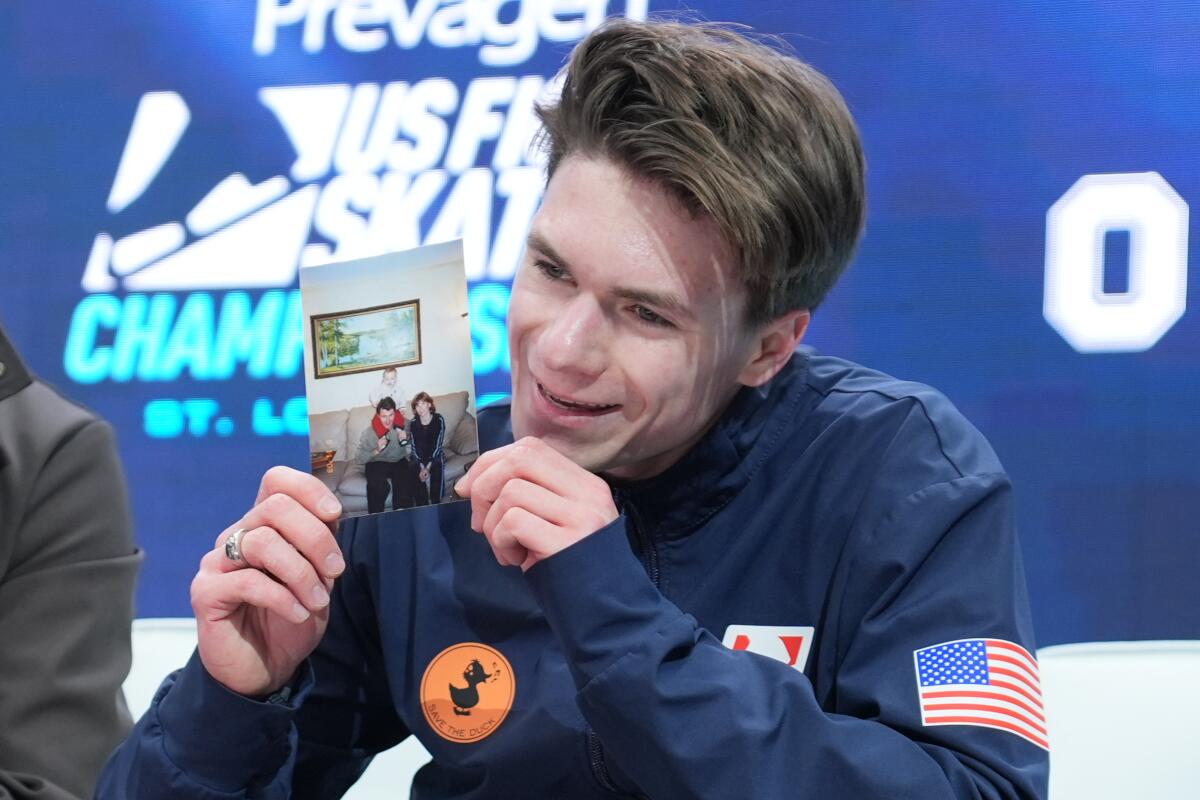
Maxim Naumov holds a photo of his parents after competing during the men’s free skate at the U.S. championships.
(Stephanie Scarbrough / Associated Press)
The elder Naumov and Shishkova were three-time world pairs skating medalists and two-time Olympians. The 1994 world champions coached at the Skating Club of Boston and remained at the 2025 U.S. championships in Wichita, Kan., after the competition to coach a development camp.
Maxim Naumov, who had finished fourth at the U.S. championships for the third time in a row, returned home immediately after the competition. In one of their last discussions as a family, Naumov’s father laid out the plan to ensure they could reach the Olympics in one year. The talk lasted about 45 minutes. After the first 30 minutes, Naumov said he was rolling his eyes the way children often do, but he understood the message: They were going to work together and revamp everything they do.
After the crash on Jan. 29, 2025, Naumov struggled to leave the house. He couldn’t bear to tie his skates. Going to the rink felt unimaginable.
At every moment, Naumov wanted to lay in bed and rot. He instead chose to find the thing that felt like the most difficult task and attack it. At first it was simply waking up. Then it was getting out of bed. Then it was going to work and coaching his parents’ former students. Now they’re his students.
“The only way out is through,” Naumov said. “Everyone has the ability to do that: to remain strong in your mind, have willpower and do things out of love instead of fear. I think if you’re able to do that, whatever it is that you’re going through, however big or small, you can have small wins every single day, and you can do things that you never thought that you could.”
Naumov earned his Olympic spot by finishing third at last month’s U.S. championships. The emotions of the national competition that would decide the family’s dream were so heavy that after he finished his free program, he found a secluded corner in the tunnel and sobbed.
Finally on the Olympic stage, Naumov felt nothing but stillness. Naumov said he felt his parents’ presence and the support of the entire figure skating community “like a hand on my back pushing me forward.”
Looking at old videos can still be painful for Naumov. But he mustered the strength to look through the family’s large photo album ahead of the U.S. championships and pick out several photos he brought to the competition. His parents had always been in the kiss-and-cry with him. With his spot on the Olympic team at stake, he wanted them there again.
Waiting for his score in Milan, Naumov flashed a photo he picked. He is flanked by his parents standing on the ice for the first time at about 3 years old.
Two decades later, he was stepping off Olympic ice.
“To be able to just have 2 minutes and 50 seconds to show what you’ve been working on for 19 years, and to be able to make it happen when it matters and when it counts, there’s no feeling like it at all ever,” Naumov said, still breathless from the emotional performance more than 30 minutes after he nailed the final note. “I just hope that I made everyone proud.”
U.S. flags waved on every side of the rink as he saluted the crowd. He knows his mother would have not been there watching in person because she was too nervous to attend. Refreshing the online score tracker to keep up with Naumov’s program, she would always find a way to send a message of support to her son.
Before his program, Naumov sent a message of his own.
“Mom and dad,” the videoboard in the arena read, “this is for you.”
Last Tuesday, Philip Glass withdrew the delayed premiere in June of his latest symphony, No. 15. Originally meant to celebrate the 50th anniversary of the John F. Kennedy Center for the Performing Arts in 2022, it is a portrait of Abraham Lincoln, but the composer decided the values of the current Kennedy Center were “in direct conflict to the message of the symphony,” which is inspired by Lincoln’s 1838 Lyceum Address.
In rebuke to Glass, Kennedy Center spokesperson Roma Daravi’s quick response was: “We have no place for politics in the arts.”
Two nights later, the chairman of the Kennedy Center board (who also happens to be president of the United States) hosted at the “no place for politics” center a bevy of Republican politicians and donors for the gala premiere of “Melania,” a documentary about and produced by his wife, the first lady.
Three days after that, the president, with no warning to Congress (which administers the Kennedy Center), center staff or the public, announced on his social media platform that he would close the facility July 4 for two years to undertake a major renovation. This may get the center off the hook for putting together a new season, what with all its departures (voluntary and not) of competent artistic directors, but it also means the center’s one remaining major institution, and its crown jewel, the National Symphony, is suddenly homeless.
The fact is, the Kennedy Center has always been political. The same goes for orchestras. And Lincoln’s seeming role as a symphonic football is nothing new, either.
But political doesn’t — or, at least, once didn’t — necessarily imply partisan. In March 1981, two months into his presidency, Ronald Reagan turned up at the Kennedy Center for the premiere of a new production of Lillian Hellman‘s “The Little Foxes,” and was photographed happily congratulating a smiling Elizabeth Taylor backstage. Also present was the gruff playwright.
Hellman, who had been a member of the Communist Party and was called up in front of the House Un-American Activities Committee in 1952, and Reagan, an avid anti-Communist, couldn’t have had much use for each other politically. But there they were, soaking up art and glamour (if maybe not in that order) together. It was also in 1952 and thanks to Sen. Joseph McCarthy’s Communist witch hunts that the first inklings of a national performing arts center in Washington, D.C. developed.
Aaron Copland’s “Lincoln Portrait,” for speaker and orchestra, written in 1942 in the wake of the Pearl Harbor attack, had been slated for a performance at Dwight D. Eisenhower’s inauguration in 1952. Complaints about Copland’s leftist leanings pressured Eisenhower to cancel the performance, but left inklings in Ike’s mind that the nation needed a performing arts center in Washington, D.C. In 1955, he instituted a District of Columbia Auditorium Commission and that led to the National Cultural Center Act of 1958.
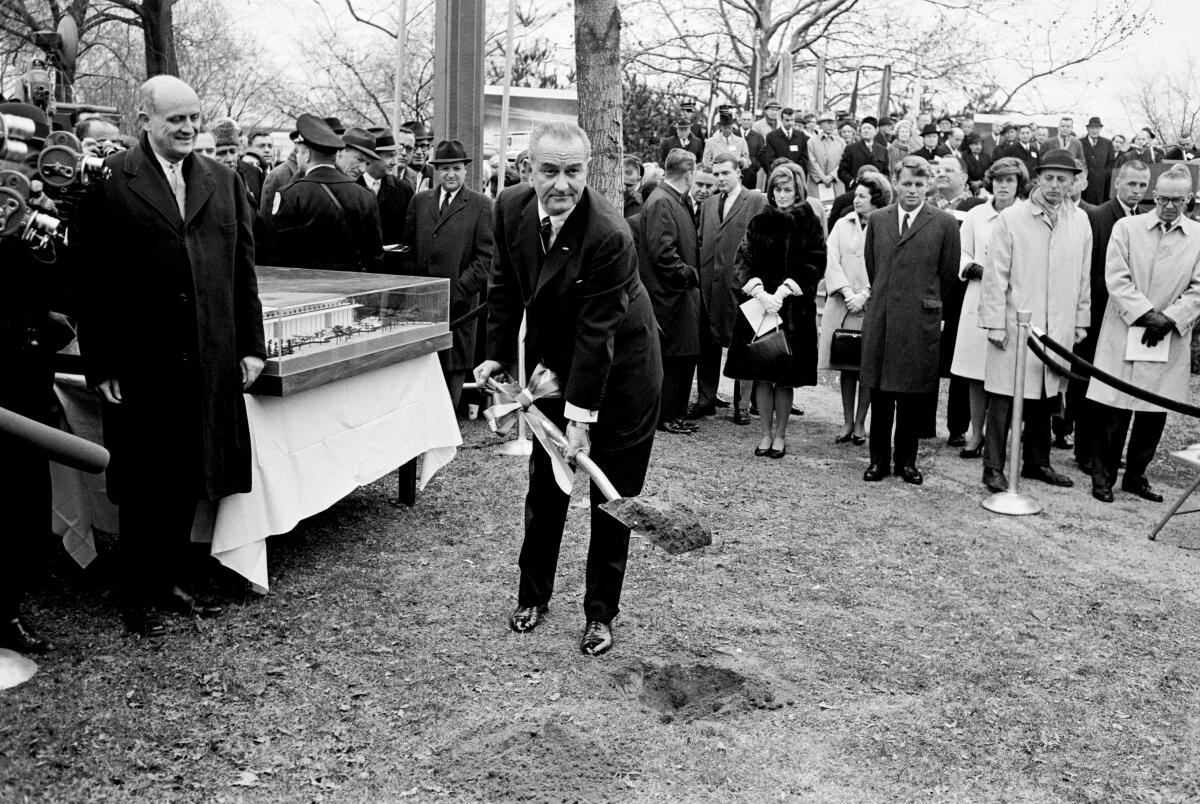
Bipartisan support became a no-brainer. Kennedy was an enthusiast and, in his presidency, both First Lady Jacqueline Kennedy and former First Lady Mamie Eisenhower worked together to support the cultural center. In 1963, just days before his assassination, JFK hosted a White House fundraiser for the center. A year later, President Lyndon B. Johnson broke ground for what was to become “a living memorial to John F. Kennedy” with the gold-plated spade that President Taft had used for the Lincoln Memorial.
President Lyndon B. Johnson lifts a shovel full of dirt during ground-breaking ceremonies for the John F. Kennedy Center for the Performing Arts in 1964 while members of the Kennedy family look on.
(Bettmann Archive / Getty Images)
The Kennedy Center proved political from Day 1. Leonard Bernstein was commissioned to write a theatrical piece for the center’s opening in 1971, which turned out to be an irreverent “Mass” — musically, liturgically, culturally and, most assuredly, politically. Most of all it was an unmistakably protest against the Vietnam War. In his own protest, President Nixon stayed home.
“Mass” was ridiculed by critics and sophisticates. And so was the Kennedy Center in its monstrosity. But the composition ultimately came to be seen as a precursor of musical Postmodernism and possibly Bernstein’s greatest work, a monument in its own right. The Brutalist monumentalism of the Kennedy Center also grew over time to be loved, increasingly bringing cachet to a diverse nation’s artistic needs.
All of that has, however, been called into question by a new administration noisily remaking the center as partisan and politicizing even renovation and Lincoln.
You don’t take on renovation of a single concert hall overnight, let alone an entire performance center with several theaters, including a major concert hall and opera house. This requires architects and acousticians deeply schooled in theaters, and each has its own acoustical needs. You touch anything, and it will affect the sound. Both the opera house and concert hall could use acoustical work, but that is a very big deal. If this sudden renovation comes as a surprise to staff, that means there have been no consultations, no proposals, no models, no feedback. Best to add to the budget some hundreds of millions of dollars to fix mistakes.
Before even considering anything else, a space has to be found for the National Symphony. It is possible to create temporary structures or renovate existing buildings into acoustical wonders, as architect Frank Gehry and acoustician Yasuhisa Toyota have proved. In Munich, the temporary Isarphilharmonie, which has Toyota acoustics, is so successful that some are saying the city doesn’t need a new concert hall after all.
So, given the timing of this precipitous announcement, it is hard to believe that something isn’t also going on with attitudes toward Lincoln and Glass’ displeasure with the Kennedy Center administration. For what it’s worth, Presidents Ford, Carter, George H.W. Bush, Clinton and Obama have all narrated Copland’s “Lincoln Portrait.”
Lincoln has been central to Glass’ work for more than four decades. The composer first used Lincoln in Act V (known as “The Rome Section”) of Robert Wilson’s 12-hour opera, “the CIVIL warS: a tree is best measured when it is down” (a prescient title for current Kennedy Center thinking), which had been intended for the 1984 Olympic Arts Festival in L.A. but was never produced here for lack of funds.
Lincoln shows up in Glass’ 2007 opera, “Appomattox,” commissioned by San Francisco Opera and later revised and expanded for Washington National Opera in 2015. The opera offers a look at how the Civil War ended with high-minded statesmanship. The first act of Glass’ 2013 opera, “The Perfect American,” about the last days of Walt Disney, ends with a flashback of Walt, who idolized Lincoln, visiting Disneyland and getting into an argument about slavery with the animatronic Lincoln, which gets so worked up it attacks Walt.
Politics are rarely far away from orchestral or operatic life. At a recent appearance of the Chicago Symphony at the Soraya, Italian conductor Riccardo Muti followed an impressively grand performance of Brahms’ Fourth Symphony by telling the audience how the arts keep us honest and played as an encore the overture to Verdi’s “Nabucco,” as an example of how an opera could motivate public support for Garibaldi’s nationalist movement. Garibaldi also makes an appearance with Lincoln in the Glass/Wilson “Rome Section.”
A few days later at the Renée and Henry Segerstrom Concert Hall, the thrilling Orquesta Sinfónica de Minería from Mexico City revealed an inspiring model of Latin American cooperation. On the program was Cuban composer Paquito D’Rivera’s “Concerto Venezolano,” featuring the fearless improvising Venezuelan trumpet soloist Pacho Flores. The concerto also featured solos on the Venezuelan cuatro by Héctor Molina, but his name was only announced last minute, due to current travel uncertainty.
One of the greatest recordings of Shostakovich’s Fifth Symphony, his grab-you-by-the-gut answer to Stalin and celebration of Russia, is by the National Symphony under Mstislav Rostropovich, recorded in 1994 at the Kennedy Center. Stalin saw the symphony as his deification. Rostropovich exuded, in the Kennedy Center aura, the expression of an overwhelmingly triumphant celebration of the end of the Soviet repression. You can take the symphony and the opera out of the Kennedy Center, but you can’t take the essence of the Kennedy Center, the living memorial to the ideal of something larger than political ego, out of the symphony and opera.