Do Terror Attacks in Nigeria Spike During Ramadan? Here’s What We Know
As Ramadan, the Islamic holy month of fasting, prayer, and reflection, entered its second week, specifically on March 5, terrorists from the Islamic State West Africa Province (ISWAP) attacked multiple military positions in Borno State, northeastern Nigeria, in a single night.
The attacks killed at least 16 soldiers and officers. The following day, a suicide car bomb detonated near Njimya village inside Sambisa Forest, forcing Nigerian troops to retreat.
That same week, Nigeria’s Minister of Defence, General Christopher Musa, convened a closed-door security meeting with President Bola Tinubu at the Presidential Villa in Abuja. When he came out, his explanation for the rise in attacks was unusually direct.
“As usual with the terrorists during the Ramadan period,” he told journalists, “they feel when they die, they are going to heaven, so they are ready to commit any offence or get killed because they believe there is a reward.”
He assured Nigerians that security forces had adjusted their strategies. “You can see in the past few days we’ve taken over those locations. We’ve killed their commanders and taken over their assets. We’ll continue to do more,” he said.
The assurance arrived against a backdrop of twelve confirmed attacks on Nigerian military bases since January 2025 — eleven of them in Borno State alone.
However, the violence did not stop.
On March 17, three suspected suicide bombings rocked Maiduguri, killing at least 23 people and wounding more than 100 others. The military said the attacks were carried out by “suspected Boko Haram terrorists”. Earlier, on March 6, terrorists from Jama’atu Ahlussunnah Liddaawati Wal Jihad (JAS), also known as Boko Haram, attacked Ngoshe in Borno’s Gwoza Local Government Area (LGA), abducting over 300 people and killing more than a hundred.
The real question is whether Ramadan genuinely drives this violence, or whether it merely overlaps with a war that was already escalating. HumAngle’s analysis of Armed Conflict Location and Event Data (ACLED)’s five-year data shows the answer is both.
But only one part of that answer is getting worse.
Sacred month recast as a season of war
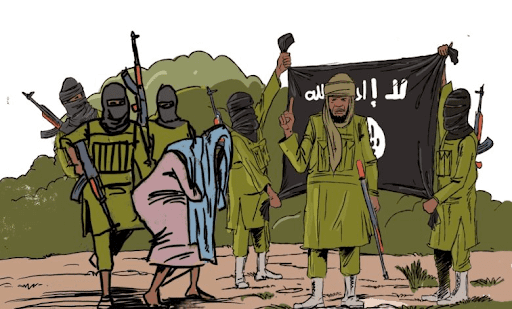
Just as it encourages insurgents to migrate to Africa, the Islamic State, ISWAP’s parent organisation, has long designated Ramadan as what its propaganda formally frames as a “season of jihad and harvest”.
The ideological foundation reaches back to events central to Muslim memory.
Prophet Muhammad waged his first major battle, the Battle of Badr, in 624 CE, during Ramadan. The conquest of Mecca in 630 CE also fell within the month.
For ordinary Muslims, these are historical moments shaped by circumstances. For jihadist organisations, they are annual instructions.
While mainstream Islam understands Ramadan as a month of fasting, prayer, and restraint, jihadist ideology inverts this completely. In their reading, violence is not a departure from religion — it is its highest expression. For them, history is more than a context; it is a whole calendar.
JAS was the first Nigerian jihadi organisation to work from this theology, though inconsistently. Its former leader, Abubakar Shekau, was unpredictable. During his time, attacks came when opportunity appeared, not when doctrine demanded.
ISWAP, which split from JAS in 2016, partly over Shekau’s methods, brought a different discipline. Trained by Islamic State commanders who operate on fixed ideological cycles, ISWAP insurgents do not treat Ramadan as one month among twelve. They treat it as a deadline. For them, the 2026 attacks were deliverables.
What the data shows and what it doesn’t
Between 2021 and early 2026, Nigeria recorded 20,317 violent incidents involving armed groups: battles, explosions, and attacks on civilians, according to ACLED. Of these, 1,774 occurred during the months of Ramadan. That is roughly one in every twelve incidents nationally occurring in a month that lasts one in twelve months. On the surface, there is no obvious spike.
The total number of annual attacks also climbed sharply, from 3,269 in 2021 to 5,242 in 2025, a 60 per cent rise in four years. Ramadan months tracked that general rise without breaking dramatically above it. When you count incidents per day rather than per month — which is fairer, since Ramadan is only 30 days — the Ramadan daily rate of 9.5 attacks only sits slightly below the non-Ramadan daily rate of 10.2. If anything, the country as a whole is marginally quieter during Ramadan than outside it.

But that national picture hides a more important local one.
Borno State alone accounts for 277 of Nigeria’s 1,774 Ramadan incidents — more than Zamfara and Kaduna combined, two states notorious for non-jihadi terrorism. Most of Borno’s violence traces to either ISWAP or JAS. And ISWAP’s Ramadan record tells a completely different story from the national trend.
In 2021, ISWAP recorded zero Ramadan attacks in the data. By 2022, that number rose to 7; by 2023, 16; by 2024, 12; and by 2025, 19. In the first three weeks of Ramadan in 2026, the figure had already reached 31, ISWAP’s highest Ramadan count on record as of the time of filing this report.
Every other major actor in the data, including communal militias from Kaduna, Zamfara, and Katsina, unidentified armed groups, and even the Nigerian military, shows a flat or inconsistent Ramadan pattern. ISWAP alone shows a line pointing upward, year after year, specifically during the holy month.
What does this mean at the national scale? ISWAP accounts for just 85 incidents across all Ramadan periods in the dataset — 4.8 per cent of all Ramadan violence in Nigeria. The majority of other attacks during Ramadan are carried out by non-jihadi terrorists, communal fighters, and unidentified groups with no relationship to the Islamic calendar whatsoever.
From the data, we can deduce that Nigeria’s broad Ramadan violence problem is a governance crisis. But ISWAP’s Ramadan violence problem is an ideological one — and it is the only one that is systematically growing.
The tactical evolution
What distinguishes ISWAP’s Ramadan 2026 campaign from previous years is not its scale, but its method.
The group has launched at least twelve coordinated attacks on military bases and infrastructure across Borno State since January 2025 alone — a pace comparable only to its 2018-2019 operational tempo, the period when it briefly seized Baga, the Lake Chad headquarters of the Multinational Joint Task Force.
The March 5 night assault hit multiple locations simultaneously.
In April 2025, fighters detonated IEDs on bridges along the Biu-Damboa road, cutting off military reinforcements to a surrounded town. This is a deliberate encirclement strategy designed to isolate and starve bases of supply.
The weapons have changed, too. ISWAP insurgents have used armed drones, rocket-propelled grenades capable of destroying armoured vehicles, and suicide car bombs. These are not the weapons of an organisation improvising from local materials; they suggest sustained external supply chains.
Reports indicate that foreign insurgents have also entered and compounded the situation. At least ten have been killed in the past two years during engagements with regional security forces, including a Senegalese national previously resident in Sweden. Cameroonian forces also killed additional foreign insurgents in February 2026 near the border.
The internationalisation of ISWAP’s fighter pool reflects the Islamic State’s central documented effort to reinforce its West African province ahead of what its propaganda calls the Ramadan offensive season.
State-backed regional cooperation, meanwhile, has deteriorated. Niger’s withdrawal from the Multinational Joint Task Force in March 2025 disrupted intelligence-sharing arrangements and opened corridors along the Nigeria-Niger border, which ISWAP has since exploited.
The geography of an insurgency
The ACLED data draws a line across Nigeria. To the North East of it, in Borno and Yobe, jihadist Ramadan operations follow a doctrinal tempo. But in the northwestern region – in Zamfara, Kaduna, and Katsina – and in the North Central, Ramadan-period violence is driven by land disputes, ethnic militia competition, and criminal enterprise. These conflicts share a calendar window, not a cause.
The distinction matters. Strategies built to counter ISWAP’s religious framing will not reduce militia attacks or cult violence in other states. Operations designed for terror suppression in Zamfara are poorly suited to ISWAP’s organised, doctrinally motivated attacks in Borno. Nigeria is not fighting one war during Ramadan. It is fighting several actors with different motives.
The northern Muslim-majority states make this clearest. Kano recorded 18 Ramadan incidents across five years. Jigawa recorded five. Gombe, three. These are some of Nigeria’s largest Muslim populations.
However, the infrastructure that turns a holy month into an operational order – the preachers, the propaganda, the pipeline from grievance to detonation – is not spread across Muslim Nigeria. It is concentrated, almost entirely, around Lake Chad.
Overall, Nigeria’s conflict is worsening across all months, actors, and regions. A 60 per cent rise in four years is a trend that contains every other story, and Ramadan does not create that trajectory. But for one group, in one geography, with one ideology, it sharpens it. And that group is growing faster, fighting harder, and planning more carefully than it was this time last year.