Seouls

S Korean firefighters tackle huge blaze in last of Seoul’s ‘shanty towns’ | Construction News

No casualties reported as huge fire breaks out in village of makeshift homes located on fringe of Seoul’s upmarket Gangnam district.

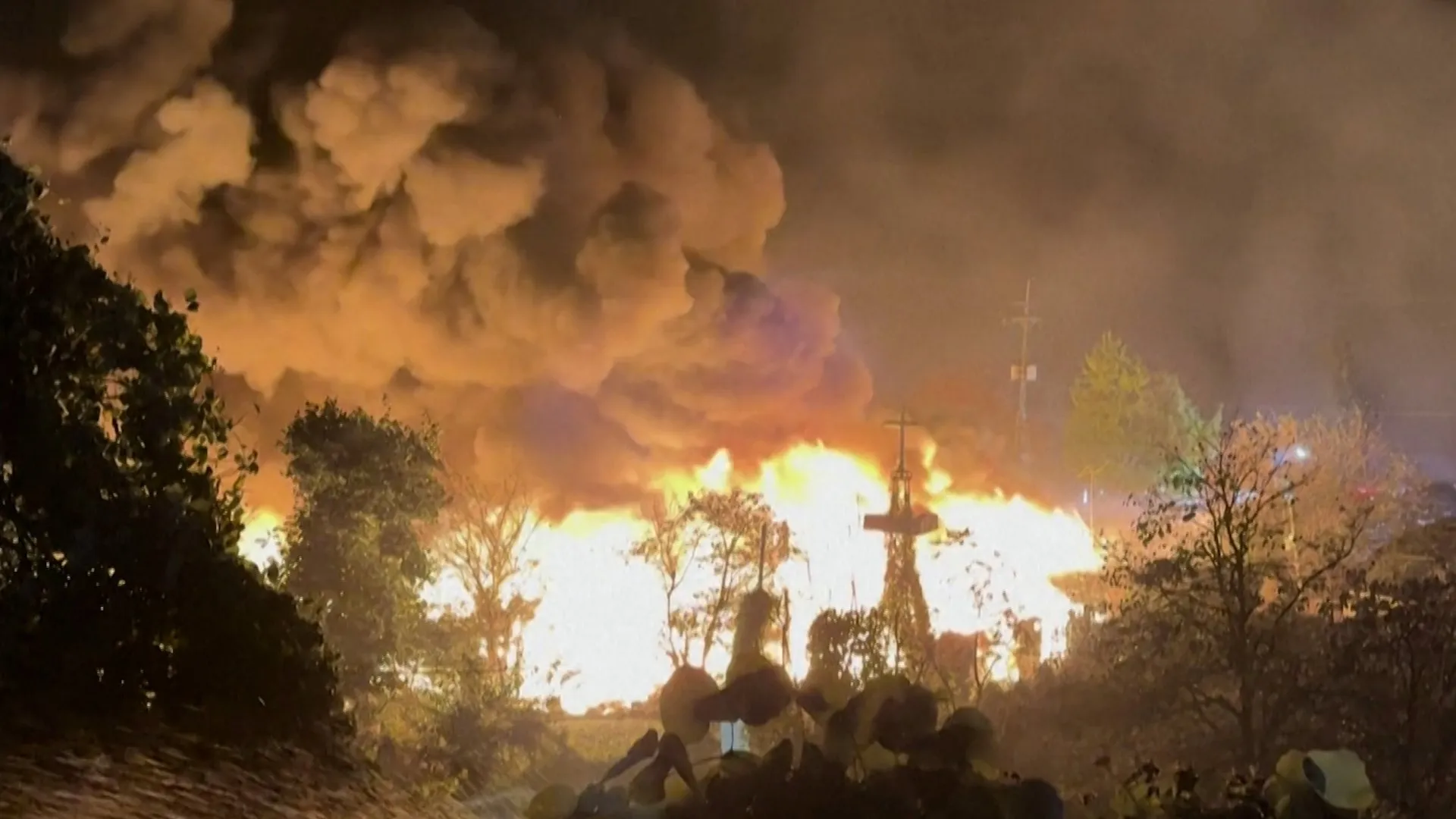
Hundreds of South Korean firefighters are battling a major fire in a deprived area located on the fringe of the upmarket Gangnam district in the capital, Seoul.

The blaze broke out at about 5am local time (20:00 GMT) on Friday, and authorities raised the fire alert to the second-highest level, with some 300 firefighters deployed to fight the blaze amid fears it might spread to a nearby mountain, the country’s official Yonhap News Agency reports.

Recommended Stories

list of 4 itemsend of list

There were no initial reports of casualties as dozens of residents in Guryong Village, which was described by Yonhap as “one of the last remaining shanty towns in Seoul”, were forced to flee their homes, according to fire officials.

Photographs from the scene showed ‍a towering column of black smoke hanging over the area, as elderly residents wearing face masks evacuated.

Yonhap reported that 85 fire trucks were sent to tackle the fire, and a firefighting helicopter was prevented from participating due to poor visibility.

“I was asleep until a neighbour called saying there was a fire. I ran out and saw the flames already spreading,” Kim Ok-im, 69, who said she had lived in the area for nearly 30 years, told the Reuters news agency.

a fire at Guryong village, the last shantytown in the Gangnam district, in Seoul, South Korea, January 16, 2026. REUTERS/Kim Hong-ji
Residents evacuate from Guryong Village, the last shanty town in the Gangnam district, in Seoul, South Korea, on Friday [Kim Hong-ji/Reuters]

Guryong Village is situated on the fringe of the upmarket Gangnam district, which is known as Seoul’s wealthiest area and commands some of the highest prices paid for real estate in South Korea.

The ramshackle housing in the village formed in the 1970s and 1980s, when low-income residents in the area were forced to move as the capital underwent major redevelopment, including during the Asian Games and the Seoul Olympics.

At that time, locals settled on the edge of Gangnam without permits, according to a Seoul city planning report.

The makeshift homes found in the village are ‌often densely packed together and built with highly flammable materials such as vinyl sheets, plywood and styrofoam, making the area particularly vulnerable to fires, according to an assessment by the fire department after a blaze in 2023.

Most residents have moved out of Guryong, but about 336 households remain, according to the Gangnam District city planning department.

Source link

President Lee says North Korea hostility reflects Seoul’s approach

South Korean President Lee Jae Myung delivers a speech during a ceremony to mark the 77th Armed Forces Day in Gyeryong, South Korea, 01 October 2025. File Photo by KIM HONG-JI /EPA

Dec. 19 (Asia Today) — President Lee Jae-myung said Friday that while North Korea’s “hostile two-state” line may reflect current realities, South Korea must “return to our proper place” and work to restore channels for contact, dialogue and cooperation.

Speaking at a joint work report by the Foreign Ministry and the Unification Ministry at the Government Complex Seoul, Lee pointed to what he described as an unprecedented buildup along the inter-Korean boundary.

“For the first time since the 1950s war, North Korea has erected triple fences along the entire demarcation line, severed bridges, cut off roads and built retaining walls,” Lee said. He added that North Korea may have acted out of concern that the South could invade, but said it was regrettable and appeared tied to “strategic desires.”

Lee said the moves could be part of Pyongyang’s strategy, but argued South Korea must respond with patience and sustained effort to improve what he described as a situation in which the North “fundamentally refuses contact itself.”

“As I’ve said before, we must find even the smallest opening,” Lee said. “We need to communicate, engage in dialogue, cooperate and pursue a path of coexistence and mutual prosperity between the North and South.”

He said there is currently “not even a needle’s eye of an opening,” repeating that the situation is “truly not easy.”

Lee also appeared to criticize the previous administration’s approach to North Korea, saying “one could call it a kind of karma.” He added that if a strategy contributed to the current impasse, “then we must change it now.”

Lee said the government should make proactive efforts to ease tensions and create conditions for trust to emerge, adding that the Unification Ministry should now take a leading role.

“It is certainly not an easy task, but it is equally clear that it is not something we should give up on,” he said.

– Reported by Asia Today; translated by UPI

© Asia Today. Unauthorized reproduction or redistribution prohibited.

Source link