secure

Democratic voters confident California election is secure, Republicans less so, poll finds

California voters are deeply divided over the trustworthiness of state elections heading into Tuesday’s primary, with most Democrats but less than half of Republicans expressing confidence in the electoral process, according to a new poll.

The polarized view follows a years-long campaign by President Trump and his Republican allies to question the legitimacy of American elections, especially in California and other blue states. It also follows robust efforts from liberal leaders, elections officials and voting rights experts to denounce Trump’s claims as baseless.

Overall, registered voters in the state — which skews heavily Democratic — expressed confidence in local election officials by a 2-to-1 margin, with 65% expressing confidence and 31% expressing a lack of confidence, according to the poll released Tuesday by the UC Berkeley Institute of Governmental Studies and co-sponsored by The Times.

However, those figures shift dramatically when sorted by political party, and even more when parsed by partisan leaning.

For example, 79% of Democratic voters expressed confidence in local officials running a secure and fair election, compared to 62% of independent voters and 42% of Republican voters, the poll found.

While 82% of voters who identified as strongly liberal expressed confidence, just 38% of voters who identified as strongly conservative did so.

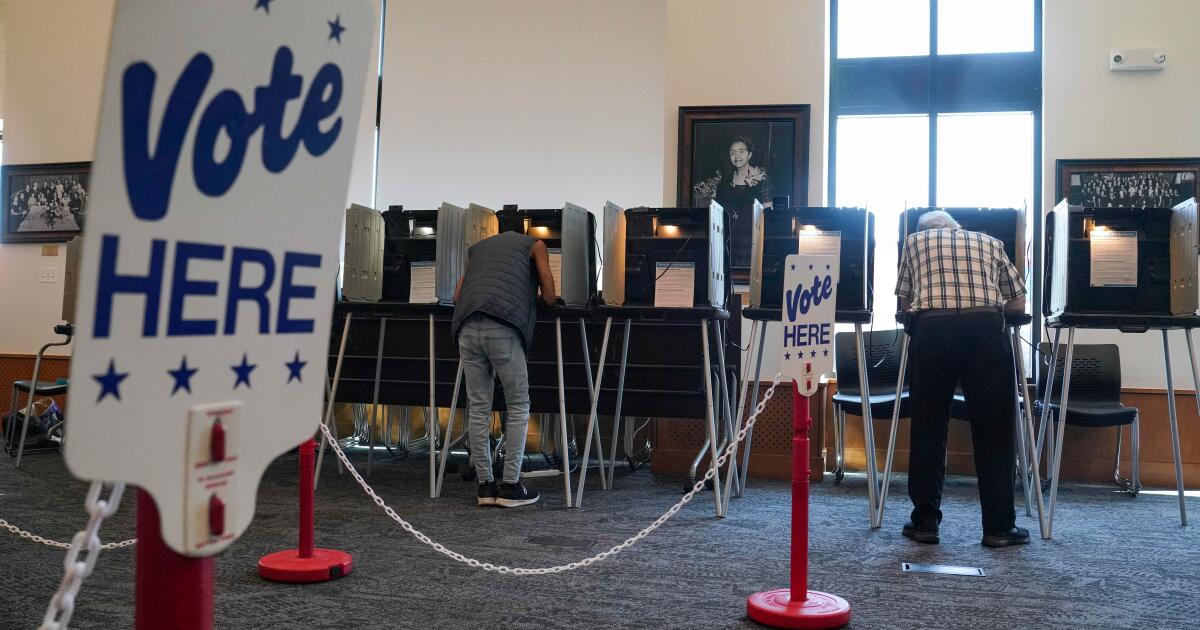
A volunteer assists a voter at a polling site.

A volunteer assists Melani Hurwitz at a polling location Monday at the Cal State Long Beach Walter Pyramid.

(Eric Thayer / Los Angeles Times)

“It’s clearly a partisan issue, and it is being promoted by the president and others who are his followers,” said Mark DiCamillo, the director of Berkeley IGS polls. “Strong conservatives and the Republicans are the least confident, and a lot of them are saying [they are] not at all confident. That’s a pretty extreme statement.”

Rick Hasen, an election law expert and director of the Safeguarding Democracy Project at UCLA Law, said he expected Republican confidence to be even lower given Trump’s decade of undermining trust in elections, especially in liberal, diverse states such as California. But he said neither Trump’s narrative nor public sentiment about election security — which generally shows voters are more confident “when their side wins” — reflects reality, which is that “our elections are administered well.”

“There’s very little evidence of manipulation or of fraud or even of incompetence,” Hasen said. “Anyone who looks objectively would see that there are numerous safeguards to ensure we have free and fair elections in California.”

Trump has long contended without evidence that voter fraud is pervasive among undocumented immigrants and in states, such as California, that use mail ballots, and blamed his 2020 loss to Joe Biden on such fraud despite experts rejecting the claim and Trump’s own allies and lawyers being unable to prove it.

A voter's feet in a poll booth.

A voter casts their vote inside the Westchester Family YMCA Annex on Monday.

(Kayla Bartkowski / Los Angeles Times)

Since returning to the White House last year, Trump has tried to implement strict new requirements for voter ID and proof of citizenship and to limit or bar mail-in voting, and called for greater federal or Republican Party control over state-run elections. In February, he said that “Republicans ought to nationalize the voting” in “at least 15 places” where they lose.

On Saturday, Trump falsely claimed that California doesn’t have any voting booths and only accepts mail ballots.

Democratic leaders, elections experts and voting rights advocates have all pushed back. They’ve backed their assurances that the state’s elections are safe with lawsuits to block Trump’s efforts to assert federal control. They also warn that his administration may try to intervene anyway, including by sending federal immigration agents to polling locations or intercepting or invalidating mailed ballots.

When Trump issued an executive order in March 2025 purporting to require voters to provide proof of citizenship, California sued, with a court blocking the policy while the litigation continues. When the Justice Department sued California Secretary of State Shirley Weber in September for refusing to hand over the state’s voter rolls, California won a dismissal in court. When Trump issued another executive order this March directing the U.S. Postal Service to take control of mail balloting, California sued again. That litigation is ongoing.

Last week Gov. Gavin Newsom signed a bill barring federal agents and other law enforcement from interfering with local and state elections officials or confiscating ballots, voter rolls or voting machines without a warrant. Newsom said California voters were experiencing “legitimate anxiety” over election integrity given the threats from the Trump administration and the recent actions of Riverside County Sheriff Chad Bianco — a MAGA-backed Republican candidate for governor who recently seized hundreds of thousands of ballots as part of what he said was an investigation into potential fraud in last year’s election.

An election worker carries a bin of ballots.

An election worker collects extracted vote by mail ballots to be tallied at the Los Angeles County Registrar-Recorder/County Clerk Ballot Processing Center in City of Industry.

(Gary Coronado / For The Times)

Newsom said he expects Trump to interfere with the upcoming election as well because “every single thing that Donald Trump is saying only suggests that he will do more, not less, to intimidate and to impact the outcome of this election,” but that the state stands ready to respond.

California Atty. Gen. Rob Bonta last week said that his office is preparing for “all different types of scenarios” involving federal interference, from ballots being seized to immigration agents showing up at polling locations.

“We are currently monitoring any potential risks or threats, and we’re ready for any possibility,” he said.

Sen. Alex Padilla (D-Calif.) last week blasted the U.S. Postal Service for issuing a proposed rule to implement Trump’s mail ballot changes, despite the ongoing litigation. In April, Rep. Nancy Pelosi (D-San Francisco) helped convene a pair of “shadow hearings” in California where fellow House Democrats and a panel of experts shot down Trump’s claims about widespread fraud and expressed confidence in state elections.

A Berkeley IGS Poll from a year ago found that California voters support requiring first-time voters to show ID to prove citizenship in order to register, and that most supported requiring a government ID every time a voter casts a ballot. However, another Berkeley IGS Poll from last month found that strong majorities of California voters believe American democracy is under attack or being “tested.”

Dean Logan, head of the L.A. County registrar-recorder/county clerk’s office, said that overall confidence, “despite a sometimes volatile state and national narrative,” was “gratifying.”

“Election officials take connection to their community seriously. We recognize that our job is to facilitate their voting experience, and that voter participation is key to election security,” Logan said. “Regardless of party affiliation, our role as election officials focuses on the function and process of ensuring the voice of the electorate is heard and that compliance with the election laws adopted in our state is achieved.”

Jesse Salinas, president of the California Assn. of Clerks and Elections Officials and the registrar of voters in Yolo County, said local elections officials are “proud to be a steady source of trust at a consequential moment,” and stand ready to “open our doors to any voter who wants to see firsthand how our elections work and to answer any questions they may have.”

Times staff writer Iris Kwok contributed to this report.

Source link

Column: Obama’s strong terms curbed Iran. Trump struggles to secure even a weak deal

President Trump, it’s well known, is into gold. Every day brings new evidence that he’s thoroughly enjoying the “golden age” he pronounced in his inaugural address — as few other Americans are — with stock trades, crypto profiteering and much more, even a new taxpayer-financed slush fund to reward his allies.

As for me, I’ve gone into silver. That is, I constantly look for the silver linings in Trump’s heinous acts.

One silver lining, of course, is his cratering job-approval numbers in the polls, especially among the young and Latino voters who made his reelection possible. But here’s another: By his humiliating failure to bring Iran to heel, nearly three months after starting a war that he said would last weeks at most, Trump has brought new, more positive attention to what he again this week derided as “Barack Hussein Obama’s Iran nuclear deal.” (The emphasis on “Hussein” is Trump’s, always.)

The president, along with his Republican cheerleaders, counts his first-term abrogation of the 2015 Iran nuclear agreement, the Joint Comprehensive Plan of Action, as a signature achievement. This week, yet again, he falsely claimed that had he not done so, Iran would have a nuclear weapon. In fact, his action in 2018 taking the United States out of the multinational deal subsequently led to Iran’s rebuilding of its nuclear program, the emboldening of the Iranian hard-liners now in power and the Middle East morass in which the United States is now mired.

That quagmire has left Trump seeming desperate for a deal — almost certainly a worse deal than the one Obama struck. Call it JCPOA Lite.

If he were able to get Iran’s sign-off on the sort of detailed, restrictive agreement that Obama and other world leaders won 11 years ago, he’d be trumpeting himself as the world’s greatest dealmaker. (He does that anyway, but his record proves otherwise.) Instead, by his own failure to date, Trump has invited reconsideration of the very agreement he decried as the “worst deal ever” on his march to election and reelection.

No sooner was the 2015 deal signed than Trump and Republicans succeeded in defining it as a giveaway to Iran that assured, not hindered, its development of a nuclear weapon to threaten Israel and the world. Opponents condemned the agreement for not addressing Iran’s other threats, notably its support for militant proxies throughout the Mideast. Some Democrats, notably Senate Minority Leader Chuck Schumer of New York, were among the foes. Other Democrats, cowed by opposition to the agreement by Benjamin Netanyahu’s Israeli government and pro-Israel lobbyists, were all but mute in the pact’s defense.

Now some Democrats are belatedly finding their voice (and, post-Gaza, some willingness to defy Israel). Along with nonpartisan experts, those Democrats are drawing comparisons between the 2015 agreement, flawed yet successful, and Trump’s promised yet ever-elusive alternative. What’s ironic for Israel and Netanyahu, still implacably against negotiating with Tehran, is that they could end up, under Trump, with a nuclear deal that gives Iran more leeway than the hated JCPOA did.

As Americans are being reminded, the 2015 deal wasn’t just between Iran and Obama, as Trump has long suggested; other signatories were China, Russia, Britain, France, Germany and the 27-nation European Union. Reconstituting that group would be all but impossible today.

The pact’s 159 highly technical pages and five appendices — a far cry from the short-lived one-pager that Trump officials teased earlier this month — required Iran for 15 years to limit its nuclear program to civilian purposes, forfeit more than 97% of its enriched uranium and submit to intrusive monitoring by the International Atomic Energy Agency to ensure compliance. In return, Iran gradually got relief from some, but not all, international economic sanctions and access to Iranian funds that were frozen after the 1979 Islamic revolution. Presumably, after 15 years, the agreement would have been extended somehow.

By all accounts, including those of Trump’s first-term intelligence and national security officials, Iran was complying when he abandoned the deal. Its “breakout time” for building a nuclear weapon was about a year — time enough for the world to intervene — instead of two to three months. Now, though the president boasts he barred Iran from having that weapon by breaking the Iran nuclear deal, he incessantly tells Americans that he went to war against Iran on Feb. 28 because it was on the brink of a bomb — never mind that he also said he had “obliterated” Iran’s nuclear program last summer, a program that was in a well-monitored box until he first took office.

If you’re confused, you’re paying attention.

A month ago, Trump posted online that he was close to a deal “FAR BETTER” than the 2015 accord. “I am under no pressure whatsoever, ⁠although, it will all happen, relatively quickly!” To several reporters, he suggested he in fact had a deal and that Iran had agreed both to suspend its nuclear activities and to forfeit all of its enriched, near-weapons-grade uranium.

Preposterous claims, given Iran’s current government, and Tehran promptly denied them. It was a sign of Trump’s squandered credibility that few, if anyone, believed him in the first place. Nor have folks believed his more recent talk of imminent success; oil markets, too, have learned not to trust the president, as prices at the pumps attest.

On Tuesday at the White House, amid a noisy tour of the billion-dollar-ballroom construction site, Trump told reporters he’d been “an hour away” from striking Iran again that very day but Mideast leaders asked for more time for negotiations.

Don’t hold your breath.

But for the tragic consequences, Obama might be enjoying some justifiable schadenfreude about Trump’s travails.

“We pulled it off without firing a missile. We got 97% of the enriched uranium out,” he told Stephen Colbert in an interview last week. Both U.S. and Israeli intelligence agreed that Iran was abiding by the nuclear limits, Obama added, “and we didn’t have to kill a whole bunch of people or shut down the Strait of Hormuz.”

That sure doesn’t sound like the “worst deal ever.” It wasn’t.

Bluesky: @jackiecalmes
Threads: @jkcalmes
X: @jackiekcalmes

Source link

Anthropic in talks to secure UK-based Fractile AI chips and diversify supply

Published on

The major AI company Anthropic is exploring a potential partnership with the British semiconductor firm Fractile to secure a steady supply of chips for custom inference and reduce the significant overheads associated with current semiconductor solutions.


ADVERTISEMENT


ADVERTISEMENT

According to reports, these talks represent a strategic effort by the San Francisco-based firm to decrease its dependency on Nvidia whilst enhancing the speed and efficiency of its current and next-generation models.

As the global demand for generative AI capacity continues to climb, the financial burden of the hardware required to run these systems has become a primary hurdle for developers.

Anthropic, which has received multi-billion-dollar investments from both Amazon and Google, currently relies heavily on Nvidia’s H100 units alongside custom processors provided by its cloud partners.

However, the high market price and limited availability of these industry-standard chips have squeezed profit margins, prompting firms to look elsewhere.

According to industry analysts, a deal with a specialised firm like Fractile could allow Anthropic to exert greater control over its technical infrastructure.

This strategy reflects a broader trend among tech giants, including Microsoft and Meta, who are increasingly moving away from general-purpose chips in favour of internal or boutique designs.

A shift in memory architecture and a boost for British technology

Founded in 2022 by Oxford PhD Walter Goodwin, Fractile has gained significant attention for its unconventional approach to processor design.

Unlike standard chips that must constantly shuttle data between the processor and separate memory modules, Fractile’s “memory-compute fusion” architecture keeps data directly on the chip using static random-access memory, or SRAM, which does not need to be refreshed.

According to the British start-up, this method can run large language models up to a hundred times faster than existing hardware while lowering operational costs by 90%.

While these performance claims are impressive, the technology is still in the development phase.

Fractile has not yet launched a commercial product, and its specialised chips are not expected to be ready for full-scale data centre deployment until 2027.

Despite the long timeline, the start-up is reportedly in negotiations to raise $200 million (€170.5m) in funding at a valuation exceeding $1 billion (€853m).

The potential partnership highlights the growing significance of the UK’s semiconductor sector on the world stage. If a formal agreement is reached, Fractile could become Anthropic’s fourth major chip supplier, joining the ranks of Nvidia, Google and Amazon.

According to market reports, the discussions remain at an early stage and no binding contract has been signed.

However, the interest from a major player such as Anthropic suggests that in the AI race, the ability to deliver faster and cheaper compute power is the defining factor.

Source link

Why are maritime laws failing to secure the seas? | Show Types

Wars and territorial disputes are rewriting the rules of global shipping.

Wars and territorial disputes are rewriting the rules of global shipping.

From the Strait of Hormuz to the Panama Canal, and the Red Sea to the Black Sea, maritime traffic is under increasing threat.

Is shipping becoming the new global battleground? And why are the decades-old laws governing the seas failing?

Presenter: James Bays

Guests:

Rockford Weitz – director of the Fletcher Studies programme at Tufts University

George Theocharidis – professor of maritime law and policy at the World Maritime University

Stavros Karamperidis – associate professor in maritime economics at Plymouth University

Source link