Harry Brook hits a humongous six for England against New Zealand, as the ball flies over square leg and into the stadium screen at the Premadasa Stadium in Colombo.
“The Gray House,” a limited series now streaming on Prime Video, purports to tell the fact-based story of Elizabeth Van Lew, who spied for the Union in the Civil War while living in the midst of Southern society in Richmond, Va. And in very broad terms it does, though it fills up the space within those outlines with an army of imagined details and melodramatic plots and subplots.
It is not the first work for the screen that betrays history by attempting to make it more exciting than it already is, and if you go in ready not to wonder or care what did or did not actually happen, and which characters are real or invented, you may make out alright. (If you do care, there is Gerri Willis’ 2025 volume “Lincoln’s Lady Spymaster: The Untold Story of the Abolitionist Southern Belle Who Helped Win the Civil War.”)
So I will not ring a bell every time the miniseries, which admittedly bills itself as “inspired by a true story,” diverts from the record, even though in my head it may be clanging.
It’s July 4, 1860, nine months before the beginning of the Civil War. Elizabeth (Daisy Head) lives in a mansion in Richmond with her mother Eliza (Mary-Louise Parker), and the two are throwing a party. Guests, including the historical Swedish novelist and social reformer Fredrika Bremer (Oxana Moravec), congressman Sherrard Clemens (Ionut Grama), Virginia Gov. Henry Wise (Mark Perry) and his awful son Obie (Blake Patrick Anderson), unload expository dialogue and provide a primer for anyone not acquainted with the roots of the Civil War. Meanwhile, a runaway slave shows up out back, pursued by hounds, having heard that the Van Lew house is the place to run for help. The women, who are against secession and for abolition but are practiced in the art of deceiving their neighbors, are involved with the Underground Railroad in some way that’s not exactly clear.
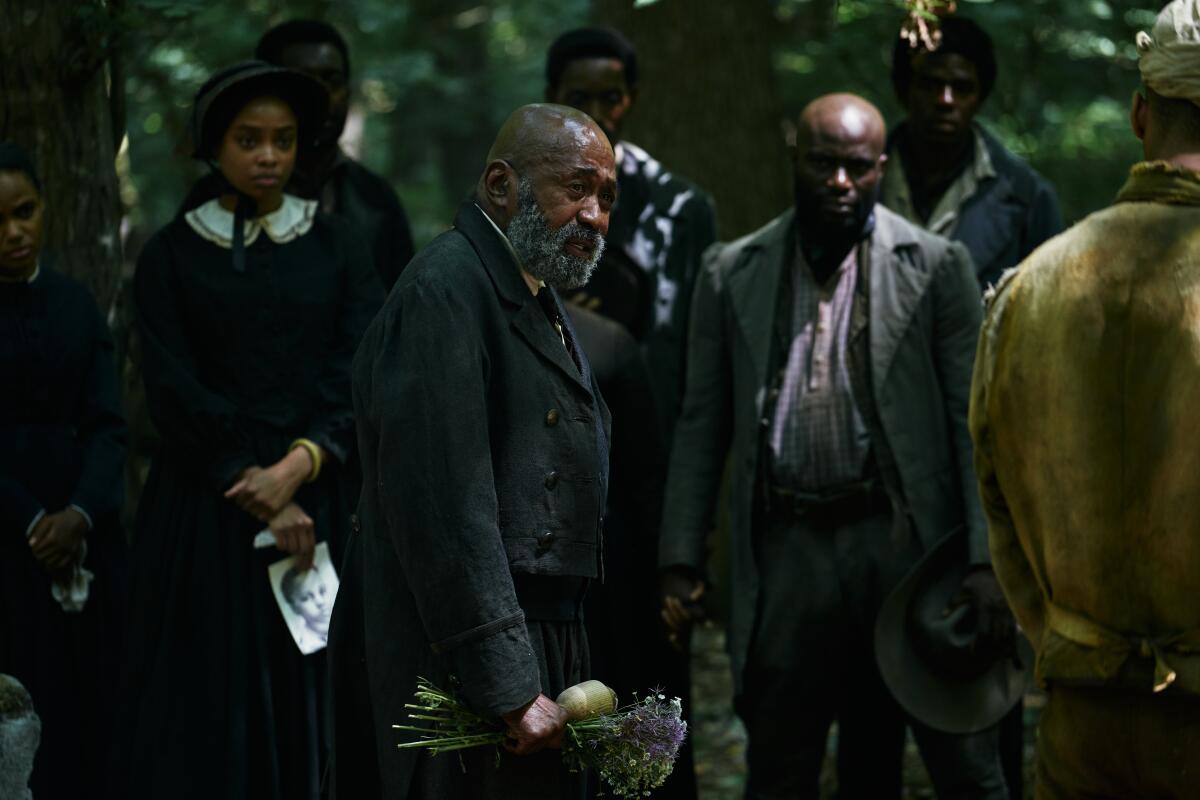
Among their servants — the Van Lew slaves were (secretly) freed upon the death of Elizabeth’s father — are head porter Isham, played by Ben Vereen, who it is a pure pleasure to see back on screen, and Mary Jane (Amethyst Davis). A well-educated, determined young woman who is just back from Liberia, which did not suit her — she calls it a “tricky little way of ridding America of free Blacks” — the series gives her a lot of agency and makes her a virtual partner in the spy ring. White and Black, they live as much like a family as is possible when some people are labor and others are management and it’s the antebellum, then the wartime South.
Also involved in Elizabeth’s tradecraft are Scottish baker Thomas McNiven (Christopher McDonald) and Clara Parish (Hannah James), a beautiful prostitute who dreams “of Bronte’s moors” and gets, of all things, a big musical number in an out-of-place Western saloon, like Marlene Dietrich in “Destry Rides Again.” (The saloon is a standing set at Castel Film Studios in Romania, where the production was based; their backlot Western street, too, makes an implausible appearance.)
Ben Vereen as Isham Worthy, a porter in the Van Lew home.
(Bogdan Merlusca/Prime Video)
Out of the loop are Elizabeth’s brother, John (Ewan Miller), whose heart is in the right place, but who’s married to Laurette (Catherine Hannay), whose heart is not. An avaricious, envious flirt on the undisguised lookout for something better, she is angry that John wouldn’t use slave labor to build their house. She’s Scarlett O’Hara, minus the intelligence and charm.
Calling roll on the enemy, we find present Confederate President Jefferson Davis (Sam Trammell), in whose house — the eponymous Gray House — Mary Jane will be embedded, with a cocked ear and a photographic memory, to gather intel; Secretary of War (and then State) Judah P. Benjamin (Rob Morrow), who has a thing for Clara, to whom he opines on property rights while they share a bathtub; and a pip-squeak John Wilkes Booth (Charles Craddock), popping in and out no reason, unless it’s to foreshadow the death of Lincoln (who makes a rearview cameo), or just because everybody’s heard of him. Below them, but more in the action, are the nasty, thuggish Sheriff Stokely Reeves (Paul Anderson) and slave hunter Bully Lumpkin (Robert Knepper); and while thuggery and violence were endemic in a racist South, caricature and cliche do your history lesson no favors, however valuable it is.
Because Hollywood hates, let’s call it a love vacuum when it comes to screen heroines, Elizabeth will find herself the object of not one, not two, but (at least) three admirers, who prize her brains and spirit and talent for conversation. (She is no frilly, fizzy, fuzzy Southern belle, like the mean girls around her sister-in-law.) There is Hamton Arsenault (Colin Morgan), a sort of Rhett Butler lite, visiting from New Orleans with a huge live alligator, because I guess that’s something you could manage in 1860 just to make a splash at a party a thousand miles away. Capt. William Lounsbury (Colin O’Donoghue) is a dashing Union officer, escaping a Confederate prison, who passes through the Van Lew house on the way to freedom; they click together like Legos. Finally, there’s shy puppy dog Erasmus Ross (Joshua McGuire), who works at the Van Lew’s hardware store and will later have a post at a prison for captured Union soldiers, which the Van Lews will turn to their advantage.
“The Gray House” isn’t all bad, and its intentions are good, but it’s dramatically predictable and at eight episodes, some over an hour, goes on much, much longer than it needs to, letting scenes play out past profitability and wasting time on extraneous subplots involving minor characters — and minor minor characters — that do nothing to enrich the fabric of the show. A duel between two characters with no significant connection to the rest of the story exists here seemingly just because their historical counterparts did fight one, and gives the filmmakers the chance to add a duel — on horseback, like jousting with guns — to the show.
Parker is always fine, though the part requires a bit too much Southern breathiness. Davis and Head make strong impressions, masking the pedestrian, sometimes cornball dialogue. (The miniseries was written by Leslie Greif and Darrell Fetty, who collaborated on “Hatfields & McCoys”, with an undiscernable assist from John Sayles.) Keith David, who plays real-life activist minister Henry H. Garnet, gives a seven-minute speech on education as if he’s performing a Shakespearean monologue, after which he faces down a murderous sheriff like he’s Shaft. It’s a high point of the series, and the one scene I was happy to see go long.
Directed by Roland Joffé, who four decades ago was Oscar-nominated for “The Killing Fields” and “The Mission,” the production is a mixed bag; much care has been lavished on the costumes; the crowd scenes are well populated; printed material is done really well. (It matters.) Battle scenes — including Bull Run, where picnicking tourists are accurately shown in attendance — are convincingly rendered. But Romania, whether on or off the studio lot, only occasionally musters a decent impression of 19th century Virginia, reminding you, as “The Gray House” often does, that this is only a movie.
Darkness engulfs me right before I step into a dream. The Oscar-winning Mexican filmmaker Alejandro González Iñárritu guides me from a pitch-black hallway into an open space, where beams of light and smoke, interspersed with sounds from the streets of Mexico City, create a vortex into a unique cinematic experience.
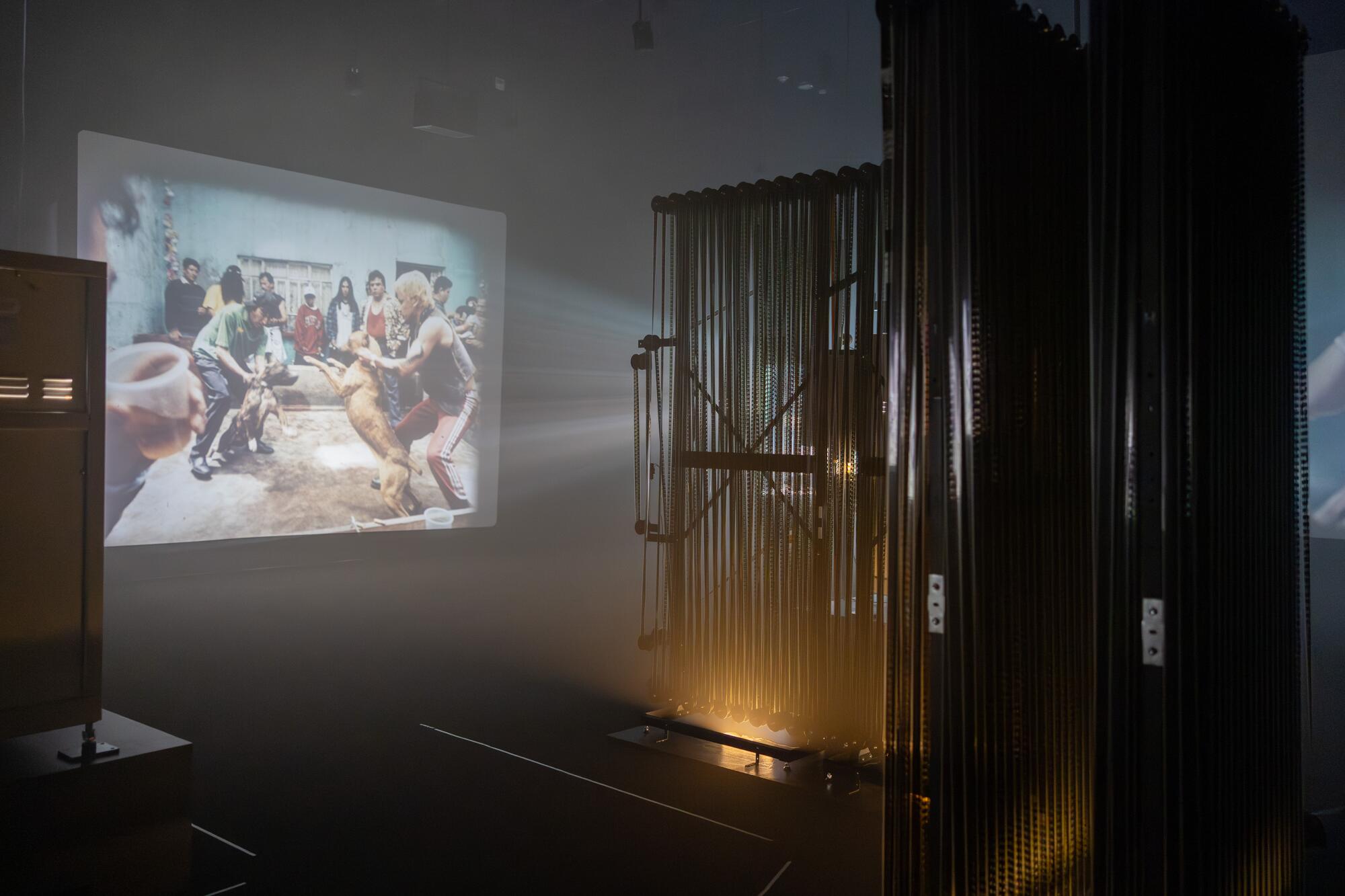
Inside the Los Angeles County Museum of Art, Iñárritu is giving me a tour of his new installation “Sueño Perro:” a sensorial celebration of his 2000 debut film, “Amores Perros,” in honor of its 25th anniversary. The only physical elements on display are six film projectors and the celluloid that contains frames of unreleased footage, which are shown on screens of different sizes around the room. Detached and unburdened by the need of a narrative, the images simply exist.
“I love doing installations,” Iñárritu says in Spanish. “It’s like playing a game with your friends. And it’s liberating for me, because I don’t have to think about selling tickets.”
Before arriving at LACMA, his “Sueño Perro” mesmerized audiences in Milan, Italy, and in his hometown of Mexico City. LACMA previously hosted Iñárritu’s intense and immersive project “Carne y Arena,” which allowed visitors to put themselves in the shoes of a person crossing the U.S.-Mexico border on foot.
In Milan and Mexico City, “Sueño Perro” occupied labyrinthine spaces with multiple rooms. Contained within a single room, the L.A. iteration is the “paranoic version,” Iñárritu says. Once inside, there’s no respite to the barrage of images and the soundscape that surround you. He aptly describes the projectors’ beams of luminosity as “light sculptures.”
Curiously, he notes, people have such reverence for these hypnotic streams of light that they duck to avoid disturbing them rather than crossing in front of them. Iñarritu wishes they would, in fact, disrupt the light, so their shadows can enter the frame and transform it.
Never-before-seen footage from “Amores Perros” projects from 35mm projectors across the walls at LACMA, Wednesday, Feb. 18, 2026.
(Sarahi Apaez / For De Los)
The projected footage is material that didn’t make it to the final cut of “Amores Perros”: a gritty, visceral drama following three different stories across different social classes in a chaotic Mexico City during the turn of the millennium. Back in 2018, Iñárritu learned that all his dailies (raw takes) from that shoot, which in most productions are thrown away, were preserved at Mexico’s National University (UNAM).
“It was like looking through an album you haven’t opened in 25 years, which smells of dust,” he says. “Because of the distance, the images actually evoked a beautiful nostalgia in me.”
And that album was substantial. Iñárritu recalls that he and cinematographer Rodrigo Prieto shot an immense amount of footage, nearly 1 million feet of film.
Gael García Bernal from a scene in “Amores Perros,” released in 2000.
“It’s like the placenta that’s thrown away when a baby is born. Suddenly, that discarded material, rich in DNA, which was already dead but was once part of a living being, has a life of its own,” Iñárritu explains vividly. “I didn’t know that these fragments, this dead material could be resurrected, but light has given new life to something that was forgotten.”
Critically acclaimed and Oscar-nominated for international feature film (foreign-language film back then), “Amores Perros” marked a watershed for the Mexican film industry, as an ambitious production that captivated both local and international audiences while unflinchingly portraying the country’s social ills from a humanistic standpoint.
“Look at Gael! He was 19 then. That’s a beautiful image of him,” Iñárritu says of “Amores Perros” lead García Bernal, whose shaved head is projected on one of the installation screens. The actor made his feature film debut in “Amores Perros” and has since had an extraordinary career.
At one point, three of the six projectors go dark — and the three remaining show the pivotal car crash that connects the film’s three narratives. Iñárritu and Prieto shot the imposing accident with nine different cameras. Seeing all nine different angles unspool in “Sueño Perro” provides a new understanding of the moment’s challenging orchestration.
Such a sequence evinces that “Amores Perros” was the work of an artist in his mid-30s willing to put it all on the line, uncertain whether he would get to make another film.
“I’ve changed a lot as a filmmaker, but I’m still the same idiot I’ve always been. That’s the bad news,” Iñárritu says laughing. “The other bad news is that I couldn’t make a film like that anymore, because of the number of shots and setups, and the energy behind each of those shots.”
The passage of time, in tandem with the film’s anniversary, allowed an opportunity for Iñárritu and screenwriter Guillermo Arriaga (who wrote “Amores Perros,” “21 Grams,” and “Babel”) to reconcile after a long-standing falling out. The two mended their bond in public last year during an event in Mexico City.
“It was very important for me to close this chapter,” Iñárritu explains. “There was something so special about our friendship as people — and our children were also very close. I truly missed him as a friend. As you get older, you realize that grudges and animosity are the worst investment; it’s like having a disease inside you and not wanting to let it go.”
While most exhibits celebrating a film’s legacy feature artifacts or costumes that appeared on screen, Iñárritu ultimately decided to opt out of that route. Initially, he admits, the director was tempted to find the scraps of the wrecked car that belonged to García Bernal’s character in the film, a black Ford, and place it at the center of the installation. But it was LACMA’s CEO Michael Govan who persuaded him to preserve the purer approach.
“Michael loved the idea of the projectors, of the light and memory. And he wisely told me, ‘Perhaps the material object will be distracting. This work is ethereal, and maybe something solid will create a knot.’ I thought it was a great reflection, and I said, ‘That’s true. I’m going to try for this exhibition to exist without physical matter, because it’s about the analogous, but also the immaterial, which is light and time.’”
The objects or “archaeological remains of a film,” as he calls them, cause Iñárritu great sadness. To him those relics are akin to looking at a collection of lifeless butterflies preserved in a box. “When I see the shoes that so-and-so wore or the dress that so-and-so wore, they seem to me like butterflies that once flew and now they’re dead,” Iñárritu says. “Objects that once appeared in film lack life afterwards. They’re like skeletons.”
(Sarahi Apaez / For De Los)
For young people who have mostly watched movies on their electronic devices, Iñárritu thinks witnessing “Sueno Perro” could spark great curiosity about the way cinema existed for most of its history: on film. It will allow them to think of cinema in a primal manner.
“We are organic beings, and our capacity for understanding and our development involves all our organs, and digital screens have forced us to perceive everything only on an intellectual level,” he says. Entering the installation, he hopes, will resemble the feeling of entering a womb or a cave. “The flickering light from the lamps in the projectors is reminiscent of the fire in caves when people gathered and shared stories,” he adds.
Sonically, “Sueño Perro” envelops attendees not in lines of dialogue or a musical score, but the sounds of life in Mexico City — from street vendors to a marching band — recorded over the years and brought to L.A. with the help of sound designer Martín Hernández, who’s worked on every single Iñárritu film since “Amores Perros.” And while some of those aural elements still exist today, “Amores Perros” also serves as a time capsule of a city that has evolved and mutated incessantly.
“I still recognize the city when I watch the film, but it makes me laugh so much to see the cars and the clothes of the time,” he says. “It now looks like the Paleolithic era. And I think, ‘I’m so old!” But yes, it was definitely a different city back then.”
(Sarahi Apaez / For De Los)
Like Iñárritu, I still lived in Mexico City, then known as Distrito Federal, when “Amores Perros” was released. In those days, international tourists often feared visiting the metropolis for fear of being kidnapped. To see Mexico City become a trendy, sought-after destination for “digital nomads” from the U.S. and elsewhere feels jarring.
“People from the U.S. have for so long been snobbish about Mexico, and now they go and say, ‘F—, this is a city with incredible cultural depth,’” Iñárritu says. “They realize that their snobbishness came from a misconception, based on propaganda they’ve been fed, which portrays us Mexicans only as “sombrerudos.’”
What’s so bewitching about Mexico City, and the country at large, Iñárritu thinks, is the people’s worldview and how they confront their realities.
“There’s no other country that has that kind of vitality, because despite all of its problems, and there are many — like how violence and corruption have become so normalized — the people have an energy, a joy, a vitality that’s very hard to find in any other city around the world,” he says.
On the subject of the ingrained issues that still plague his home country, Iñárritu recalls that those in power were not pleased with how “Amores Perros” addressed them on screen.
“The Mexican government was ashamed of the film,” he says. Whenever the film would win an award at an international festival, the Mexican ambassadors or diplomats in any given country would decline invitations to celebrate the accomplishment.
“They said it was a bad representation of Mexico, that what the film showed wasn’t Mexico,” Iñárritu recalls. “They said it showed too much violence. Give me a break, as if I were the secretary of Tourism.”
Aside from promoting this latest stop in the “Sueño Perro” installation’s journey, Iñárritu is in the post-production stage of his upcoming film “Digger,” starring Tom Cruise. Besides that, he’s also working on a project to honor Mexican American artist Judy Baca.
Baca is best known for the mural “The Great Wall of Los Angeles,” which extends for over half a mile along the Tujunga Wash and depicts the complex history of California. Iñárritu and cinematographer Emmanuel Lubezki shot a piece on this major work that will be screened at Walt Disney Concert Hall on March 7, alongside a special concert put together by Gustavo Dudamel and Gabriela Ortiz, and featuring several guest composers.
“I want to showcase the work of Judy, a Chicana who was 50 years ahead of her time and told the story of California through her eyes. I want it to be a landmark in Los Angeles. I want people to say, ‘You can’t go to L.A. and not see this mural.’”
As part of the ongoing celebration of “Amores Perros,” MACK has published a book featuring essays, behind-the-scenes photos, and storyboards. A double vinyl compilation including Gustavo Santaolalla’s score, plus tracks by generation-defining Mexican rock bands like Control Machete and Café Tacvba, has also been recently released.
Iñárritu hadn’t seen the film in a theater in many years. But when he saw it again at the Cannes Film Festival last year, he was pleased to realize it maintains its potency.
“I was struck by how well the film holds up. And it’s not just because I made it. It still has a rhythm and a muscle. It hasn’t aged badly at all. On the contrary, it’s like a young old soul,” he says with a laugh.
“Sueño Perro” will be open to the public from Feb. 26 until July 26.
Inside its sci-fi trappings — space travel, crazy technology, oodles of extraterrestrials — Pixar’s “Elio” is the story of an outsider kid who finds a new family. That’s true of the protagonist, a lonely boy who longs to leave Earth, and of the film itself.
“Elio’s” original mission was launched by Adrian Molina, co-writer of “Coco,” who worked on writing and directing the project for a couple of years before departing, officially to devote himself to “Coco 2.” Molina was replaced in “Elio’s” director’s chair(s) by Domee Shi, who helmed “Turning Red” and won an Oscar for her short “Bao,” and Madeline Sharafian, a story artist on “Coco” and story lead on “Turning Red.”
“The basic premise from Adrian’s beginning, five years ago, has stayed the same,” says Sharafian: “A lonely, weird little boy gets abducted by aliens and is mistaken for the leader of Earth. The biggest change we made, and everything rippled from there, was that Elio always wanted to be abducted by aliens, to find a place where he belongs.”
Shi says, “Both of us were weirdo kids in our respective hometowns who dreamed of not being the only one. I was one of the only kids in my school that liked anime. When I finally got into animation school, I was like, ‘I found my people, and I didn’t realize how much I wanted this.’ ”
One tectonic shift under Shi and Sharafian came from screenwriter Julia Cho, who co-wrote “Turning Red” with Shi: Instead of Olga (voiced by Zoe Saldaña) being Elio’s mom, she would be his aunt. Elio (voiced by Yonas Kibreab) would lose both parents before the film. That reconfigured his alienation, so to speak. A harsh confrontation between mother and child usually rests on the foundation that they already know and love each other. For an orphaned boy and his guardian aunt, that closeness must be earned.
“That love isn’t a given,” says Sharafian. “There was no assumption it would be there. So when it is, it’s all the more moving.”
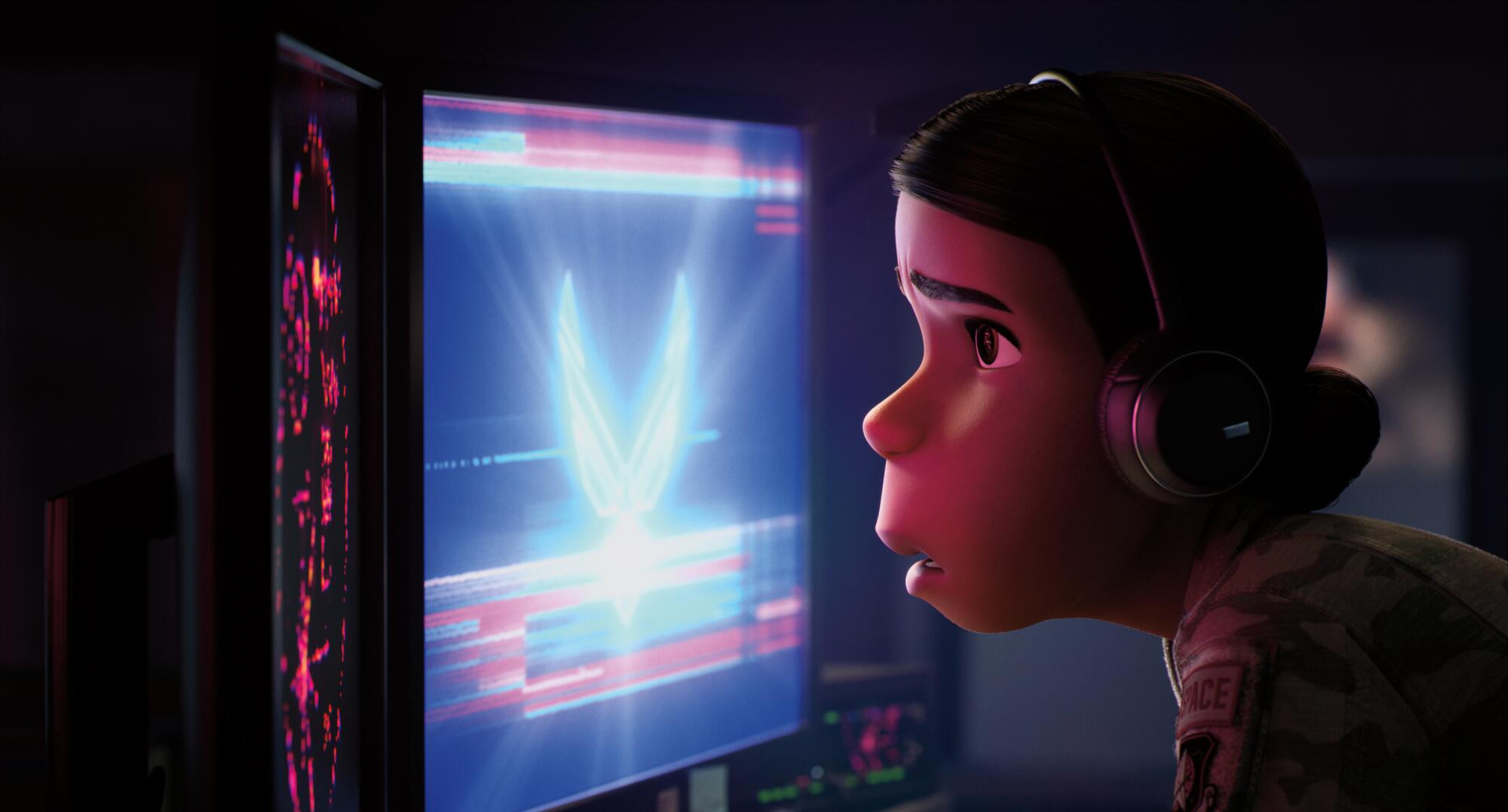
“Elio” directors Domee Shi and Madeline Sharafian’s shared “visual language” reshaped the film after they took on the project from its initial director, Adrian Molina.
(Pixar Animation Studios)
Amid the changes, Shi and Sharafian say the working relationship they established on “Turning Red” was invaluable.
Shi says, “Though we have different backgrounds, we grew up watching a lot of the same movies. Both of us love Miyazaki films, we love ‘Sailor Moon,’ we love Disney, Pixar.”
Sharafian adds, “We speak the same visual language. There would be many moments when it was time to come up with a new shot and we both drew the same thing.”
In its 28 previous features, Pixar had dabbled in sci-fi, but “Elio” is immersed in it, with just a soupçon of … horror?
“We’re huge fans of sci-fi horror,” says Shi, “and we wanted to use those moments with Elio’s clone and Olga to have fun, to playfully scare some kids — and some adults too.”
That “clone” is a dead ringer for the protagonist, but it emerged from space goo and formed into an eerily cheerful version of the boy, like something from “Invasion of the Body Snatchers” or “The Stepford Wives,” but nice.
“The movies that impacted me the most as a kid, a lot of them did scare me, but they rewarded me as well,” says Shi. “Our film has this Spielberg-y, comfortable, nostalgic, family sci-fi vibe. So when the audience is at their most comfortable, that’s the perfect opportunity to give ’em a little spook.” Both directors cackle.
Sharafian adds, “ ‘Close Encounters’ is so scary, but in an amazing, tense way, and the musical [phrase] the aliens sent, I was so haunted by that. When we had the universe reach out to Elio, we were like, ‘How do we capture that same feeling — we want to know more, but we’re unsure of their intentions?’ ”
Beyond Steven Spielberg’s “Close Encounters of the Third Kind” and “E.T.,” the shared influences of the sci-fi horror of “The Thing” and “Alien” influenced their choice of a virtual anamorphic lens for their cinematography and aping the visual noise and atmospheric mist in those films.
Among the changes Shi and Sharafian made to “Elio” is its “epic” widescreen aspect ratio.
(Pixar Animation Studios)
Shi adds that they also changed the aspect ratio from 1.85 (standard widescreen) to 2.39:1 (anamorphic widescreen, an ultrawide look): “It helped shots of Elio on Earth feel more lonely, but also made space feel more epic.”
“To lay that on top of” Molina’s existing work, says Sharafian, “completely changed what the movie looked like.”
The directors agree that most of the film seamlessly blends their input, though Shi specialized in the horror and action sequences, while Sharafian leaned into the emotional scenes.
“A lot of Act 1 was you, Maddie,” says Shi, “where he’s feeling soulful and lonely. I love that. Yearning, watching the stars. I feel like that’s probably from your own childhood.”
Sharafian chuckles and says, “Yes, I was very lonely! My sister and I say we had ‘rich inner lives’ because we didn’t have a lot going on outside.”
It’s not “Up”-level gut-wrenching, but the scenes establishing the heartbroken boy’s lingering trauma hit pretty hard.
“I feel like it’s good to be sad,” says Sharafian. “At Pixar, we’re lucky; we get to stay in a childlike headspace for a really long time. I think we forget how deep children’s emotions are and how, when you’re young, you’re already thinking about very sad things and dark things. So I don’t think it’s too much.”
MILAN — She flipped her hair. She shrugged. She dusted her hands off.
Alysa Liu makes winning an Olympic gold medal look easy.
The 20-year-old became the first U.S. woman to win the Olympic singles title since 2002, electrifying the crowd at Milano Ice Skating Arena with her “MacArthur Park” program Thursday and overtaking Japanese rivals Kaori Sakamoto and Ami Nakai, who won second and third, respectively.
Liu scored a monster 150.20 points in her free skate, the highest mark for a women’s free skate all season in international competition to win by a total of 1.89 points. Her choreographer Massimo Scali’s jaw dropped when he heard the score read in Italian. A beat later when the screen caught up to the public address announcement in the stadium, Liu nodded confidently and cracked a subtle smirk.
American gold medalist Alysa Liu hugs Japanese bronze medalist Ami Nakai after their final scores were revealed at the Winter Olympics on Thursday in Milan.
(Jamie Squire / Getty Images)
She doesn’t care about the scores.
Liu, who grew up in Oakland, has floated through her second Olympics as if she had not a single care in the world. A two-year retirement during which she climbed Mt. Everest, got her driver’s license and started college at UCLA made skating feel inconsequential. Now so unbothered, Liu spent part of her six-minute warmup cheering on teammate Amber Glenn in the leader’s chair. Minutes before taking the ice, Liu snapped a selfie with her coaches. She gives her coaches a high-five right before taking her starting position.
“She’s not like us,” her coach Phillip Diguglielmo said. “The rest of us here would be like, ‘Oh my God, I’m nervous. Oh, I can’t do this. I have a million voices in my head.’ She has one voice in her head, and it says, ‘I got this.’”
The only emotions Liu felt during her program were “calm, happy and confident.” When she sees the faces in the crowd smile, Liu said she can’t help but smile, too. And there was a lot of smiling. Her Donna Summer disco program had fans clapping within the first minute. Diguglielmo and Scali held their hands overhead to join the roar. Liu’s pre-program message to the crowd on the video board was “Y’all better turn up!”
Liu, who won the 2025 world championship with the same crowd-pleasing program, returned to the sport in 2024 with the sole objective of sharing her art. She wanted to make as many programs as possible. Winning never seemed to matter. With the gold medal hanging around her neck, Liu stopped short of saying she even wanted it. She surely didn’t need it, she said.
“What I needed was the stage,” Liu said. “And I got that.”
Once Liu processed the final scores, she rose to her feet and turned toward Nakai, clapping for the 17-year-old. Nakai, skating in her first Olympics, was shocked. She held up three fingers to Liu, asking if she had finished on the podium. Overjoyed, they hugged. Liu picked Nakai, who had entered the free skate in first place, up off the ground.
Sakamoto was less than a point ahead of Liu entering Thursday’s free skate, but small mistakes from the three-time world champion, in addition to Liu’s strong technique and infectious energy made Liu the first U.S. woman to win the Olympic gold medal since Sarah Hughes in 2002. The United States’ 20-year drought without a medal — since Sasha Cohen took silver in 2006 — was the country’s longest.
Liu held her palms up in disbelief after finishing the program of her life that put her in the lead with two competitors remaining. She leaned into the camera and pointed to the piercing on the inside of her upper lip. She did it herself.
With blond horizontal stripes dyed in her dark brown hair, bold black eyeliner and the smiley lip piercing, Liu has cut an alternative path to the top of a sport that long valued a specific kind of femininity. But the slick back bun, classical music and balletic dress was not Liu’s brand.
Her brand is joy.
And now as just the second figure skater in history to win two Olympic gold medals at the same Olympic Games — joining U.S. star Nathan Chen — Liu has the stage, and the attention, to display her joy for the next generation of athletes.
“People will be able to see how she approaches the sport now versus before and see how much more successful it is now in a healthy way,” Glenn said. “And I’m hoping people can really learn from that.”
Glenn got redemption after the short program, putting up a season’s best 147.52 during her free skate that vaulted her from 13th to fifth with a 214.91 total score. The only blemish was when Glenn put one hand down on her final jump — the same triple loop that cost her in her short program. But as she held one leg behind her during a spiral in her last sequence, Glenn smiled as she looked into the crowd. After the program, she whipped her fist through the air triumphantly.
The performance put a positive punctuation mark on Glenn’s winding Olympic journey. She has faced intense scrutiny at the Games. The same pressure that consumed Glenn and teammate Ilia Malinin could not even touch Liu’s glowing aura.
When asked Thursday if she felt any “Olympic pressure,” Liu smiled.
“You would have to explain what Olympic pressure is,” she said.
Then she bounced away, the gold medal around her neck blending perfectly with her gold dress.