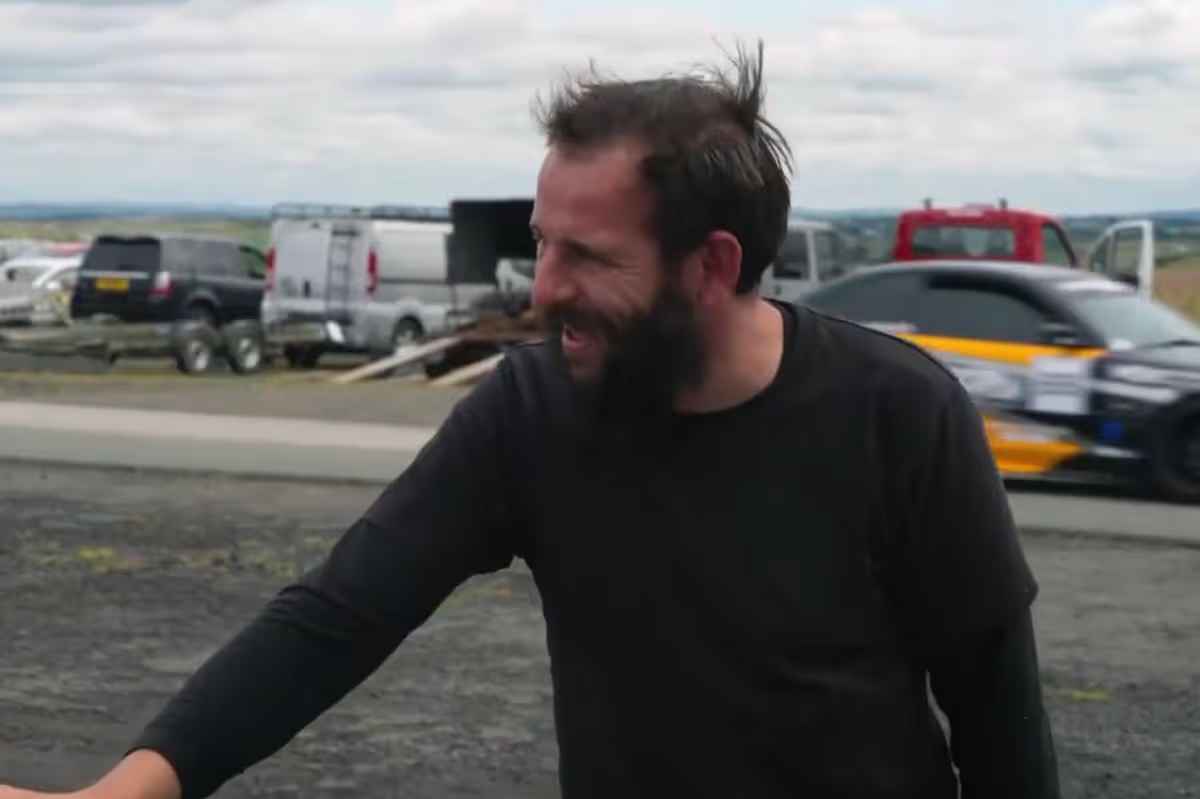
The Repair Shop star Dom Chinea was left stunned during the latest episode of Dom Chinea’s Cornish Workshop
The Repair Shop star Dom Chinea was left stunned during the latest episode of Dom Chinea’s Cornish Workshop(Image: U)
Dom Chinea suffered a massive setback on the most recent instalment of Dom Chinea’s Cornish Workshop as he tackled drift car racing for the first time.
The Repair Shop favourite, his wife Maria and their dog Wendy are embarking on the adventure of a lifetime as they exchange the commuter chaos of Kent for the rugged splendour of West Cornwall. The series chronicles Dom as he forges a new existence in the far west of Cornwall.
During the most recent instalment, Dom constructed a drift car with engineer Sam Lovegrove, where they competed in a drift car race. Dom revealed: “Today, I’m slightly nervous because Sam has emailed me with a link to a Mazda for sale. An MX5 with the title of ‘Let’s Go Drifting’, which fills me with fear.”
He continued: “But you know what? I’ve moved down here, moved down to Cornwall, willing to try new things. Drifting is something I have never done, never tried, and no experience in. But I would actually quite like to give it a go. It’s something I’d quite like to learn. So we’ll have to see.”
Subsequently, the pair went to inspect the Mazda MX5, where they purchased it and restored it. Later in the programme, they entered it into a drift racing competition, reports the Express.
Dom confessed: “This is not my world at all. It just goes to show being into cars is a very broad category, and this is something I’ve never experienced before. I am, to say I’m out of my depth here, is an understatement.
“In drift competitions, it’s not about who crosses the finish line first, but how well the cars perform on the track. Judges give points for how well drivers control their drifts, or skids, going around the corners. They’re looking for speed, and who can do it with style.”
Yet, mere minutes into the race, Dom and Sam’s vehicle swerved off track and collided with the barrier. Dom explained in a VT: “With our modifications, we’re confident our Phoenix is going to fly. The steering, the cornering, the suspension, all working together in perfect harmony. Until it didn’t.”
Exiting the car, Sam joked: “That didn’t go so well!” to which Dom replied: “Seriously? I didn’t even get a go. Are you kidding me? After all that work?” Sam then observed: “I think it’ll fix, but not this afternoon, I don’t think!”
In a VT, Dom quipped: “Well, we wanted our car to make an impact”, before adding: “We started this crazy adventure in the hope we’d meet like-minded petrolheads. I’d say this was mission accomplished.”
Discussing the episode beforehand, Dom revealed about the car race: “Sam showed me a Mazda MX5 for sale that we could fix up to try drift racing – something I’ve never done.”
He continued: “But we had to change the car quite a bit first – we needed a hydraulic handbrake, and the rear wheels needed to be able to spin, we had to lock them together to both spin at the same time. But that wasn’t completely straight forward – the underside was quite rusty.”
Dom Chinea’s Cornish Workshop can be viewed on U and Channel 4.
NEVER mind the spotlight – it seems Harry Styles prefers a different type of glow when he is not on stage.
I have been told that the fitness-obsessed pop star has splashed out £20,000 on an infrared sauna for his North London home.
Sign up for the Showbiz newsletter
Thank you!
Fitness-obsessed Harry Styles is following in the footsteps of Ronaldo with his latest purchaseCredit: ErotemeThe former One Direction star has splashed out £20,000 on an infrared sauna for his North London homeCredit: Getty
The Watermelon Sugar singer is following in the footsteps of Cristiano Ronaldo, Ellie Goulding and Lady Gaga in snapping up the very latest wellness status symbol.
A source said: “Harry is incredibly health-conscious these days.
“He loves running and needs to be on top of his health during his upcoming tour. He’ll be able to use the sauna in between shows to help repair his muscles.
“He loves running now and it’s the perfect antidote to training.”
The high-tech light therapy helps reduce pain, blood pressure and inflammation, as well as burning calories.
Harry will grace the May cover of fitness mag Runner’s World and completed the Berlin Marathon in under three hours last September.
He told the mag: “During my early days in One Direction, we spent so much time inside hotels and venues that there are countries I’ve been to that I didn’t really experience.
“So when I travel now, it’s about committing to going outdoors to see some stuff, whether that’s running or walking. You experience places in a whole different way.”
A source said: “Madonna prefers to work in the evening, so the crew filmed late into the night to make the shoot happen.”
Our sister column Biz revealed how Madonna, right, spent four days and nights holed up at Black Island Studios in West London to film the X-rated music video.
It will accompany the first single from the new album, which will be a sequel to her 2005 record Confessions On A Dancefloor.
And I have heard whispers that Madonna has also recorded a track for The Devil Wears Prada 2 film.
A source said: “Madonna’s hit song Vogue was used in the trailer and the film is set to be a massive hit.”
The comedy – which stars Anne Hathaway and Meryl Streep – is out on May 1.
Judge Amanda Holden pressed her golden buzzer last night for the group, who were founded by Jezza.
Simon said: “He has a responsibility to be there. Mind you, can he even sing?”
Robbie comes undone
ROBBIE WILLIAMS is in the best shape of his life after losing weight.
Even so, the Come Undone hitmaker, who is 52, has revealed he has been struck by a host of physical issues.
He told radio station Gold: “There’s always something going on for the middle-aged man. We used to be elasticated silly putty, and now we are frozen silly putty that just snaps.
“I did my groin in by sitting down. I did that for the first time this year – sat on a testicle.
“I put my back out by turning around – turning around! You know, what you are supposed to do as a human.”
The star added: “I’ve got arthritis in my facet joints in the base of my spine and I’ve got two discs that are popping out – one in the neck, one in the lumbar.”
Robbie is heading to Dusseldorf in June for the next leg of his Britpop world tour.
I hope there’s a good physio on the bus.
Aitch Surrey not sorry
I’m A Celeb star Aitch has splashed out on a six-bedroom mansion in SurreyCredit: Splash
I can reveal that the I’m A Celeb star has splashed out on a plush six-bedroom mansion in Camberley, Surrey, for £1.6million.
A source said: “This house is a dream come true for Aitch and shows how hard he works.”
Aitch recently shared a glimpse of his new garden to his 2.9million Instagram fans, captioned: “Go step closer to that goal cos why not.”
The move comes after proud Northerner Aitch revealed that his second album 4 was inspired by his Manchester postcode M40.
Speaking last year, he said: “Since we were kids, when we used to take pictures, we always used to throw fours up.”
Lily furs night show in West End
Lily Allen was spotted in specs and a fur-trimmed coat as she left the London PalladiumCredit: Splash
LILY ALLEN looks like she’s raided the costume department in specs and a fur-trimmed coat as she leaves the London Palladium in London’s West End following the Friday night performance of her latest album.
An onlooker revealed she headed into a cab with her fella, writer and artist Jonah Freud.
The singer has won rave reviews for the tour, where she performs her fifth album West End Girl in its entirety each night.
A source said: “Fans have been blown away by her career-defining work.
“She’s on the best form and is loving being back on stage.”
Caught Live: Don’t myth out on hit
Former X Factor star Rachel Adedeji stars as Persephone in Hadestown at the Lyric TheatreCredit: Getty
THIS odyssey through the underworld, led by former X Factor contestant Rachel Adedeji, offers a spellbinding love story.
Rachel shines as Persephone, delivering a vocally rich performance, while leads Bethany Antonia and Marley Fenton stand out.
After a storming run on Broadway, this tragedy remains compelling and haunting as ever.
The musical blends two ancient Greek mythic love stories – Orpheus and Eurydice, and King Hades and his wife Persephone.
Eurydice travels to Hadestown after being convinced by Hades that she will have a better life.
Desperate to keep her safe, her lover Orpheus follows her to bring her back to the living world.
Dancing On Ice pro Vanessa Bauer, actress Mia McKenna-Bruce, Vanessa Feltz and actor Mark Bonnar attended the gala night.
Dancing On Ice pro Vanessa Bauer was among the celebs who attended the show’s gala nightCredit: Getty