It’s never too late to go back to school. But after years of deferred admission, can a new generation of students at Hillman College score high at delivering a compelling, modern take on the groundbreaking sitcom “A Different World”?
The foundation for an updated version of the popular sitcom set at a historically Black college was set three decades ago. In the 1993 series finale, the show’s central couple — smart, bespeckled math whiz Dwayne Wayne (Kadeem Hardison) and high-maintenance Southern belle Whitley Gilbert-Wayne (Jasmine Guy) — were embarking on their next chapter as newlyweds, relocating to Japan and expecting their first child. Before their departure, a professor jokingly quips to Dwayne: “I can’t wait to have your child in my class in the year 2014.”
The only guide you need for fall entertainment.
But plans for a revival — the original series itself was a spinoff of “The Cosby Show,” centered on the Huxtables’ free-spirited daughter Denise (Lisa Bonet) — to suit that time frame were in limbo for years. Producer and director Debbie Allen, who joined the original series in its second season to help it better reflect the HBCU experience, actively pitched and tried to relaunch “A Different World” in the early 2010s, but those efforts were derailed by the highly publicized sexual assault allegations against the show’s creator, Bill Cosby.
“It’s very difficult,” Allen told The Times. “The biggest difficulty, just being totally transparent, was people’s hesitation to work with Mr. Cosby; to have anything to do with him. [But] we were so independent. He kind of put us on a boat and said, ‘Go.’ And that’s what we did. And he was happy to know that we were going on our way.”
In early 2023, another push began to revive the series while also distancing itself from Cosby. Now, its decades-long gap year finally complete, a new incarnation of “A Different World” is starting up classes this fall at Netflix. And it hopes to carry on the legacy of its predecessor, which was celebrated for its depiction of Black culture and life in a higher education setting during its six-season run on NBC, from 1987 to 1993, bringing HBCUs into the mainstream.
Rashida (Alijah Kai), left, Deborah (Maleah Joi Moon) and Hazel (Kennedi Reece) in Netflix’s “A Different World.” After years of trying to tell the story of a new class at fictional Hillman College, Debbie Allen, who returns as an executive producer and director, says the sequel arrives at the right moment: “If there’s any voice we need to hear from right now, it’s young people.”
(Daniel Delgado Jr. / Netflix)
Billed as a sequel series premiering Sept. 24, a Wayne offspring is our anchor for the freshman class at Hillman College, the show’s fictional historically Black college based in Virginia. Deborah Wayne (Maleah Joi Moon) is an aspiring artist forced to attend her parents’ alma mater on academic probation after her NYU acceptance is rescinded. As the youngest Wayne child, she continues the family’s legacy at the school: her older sister — the child Whitley was pregnant with at the end of the original series — and an older brother are both alums.
She’s joined by a mix of first-gen and legacy students: star quarterback Shaquille Johnson (Cornell Young IV), who is the only child of original character Ron Johnson (Darryl M. Bell); criminal justice major Rashida Duvall (Alijah Kai); psych major Amir Rodale (Jordan Aaron Hall); Ghanaian-Nigerian fashion merchandising student Kojo Achebe (Chibuikem Uche); and small-town pastor’s daughter Hazel Henry (Kennedi Reece).
Some of the show’s original creative team join Allen as executive producers, including Tom Werner, and original series writers Reggie Rock Bythewood and Gina Prince-Bythewood. (Mandy Summers of “That ’90s Show” is also an executive producer.) To shepherd this reimagined version of the sitcom, Allen enlisted her former “Grey’s Anatomy” colleague Felicia Pride, who was most recently part of the writing staff on “Bel-Air,” the dramatic reboot of ’90s comedy “The Fresh Prince of Bel-Air.” It was a dream call for Pride, who as a kid living in Baltimore recorded and rewatched episodes — namely, the one involving a step competition that she obsessively watched after school to learn the routine. But she was reluctant.
“I love the show so much,” Pride said, seated next to Allen inside a Netflix conference room in Los Angeles on a recent day. “I was like, ‘I don’t want to be the one to mess it up.’ But she [Debbie] was so adamant that the time was now to hear from young Black America — and that, I could get with.”
Allen remembers it this way: “I don’t have an ego. I begged her. It’s the truth. To get this show back up, we’ve tried for years. But this is the time that’s right … We had inspired all these kids, not just Black kids, all young people to go to college. This was a peep into college that had never happened before, where you saw young people being responsible and living their lives and being crazy, but still dealing with what is happening in this world. If the young people in the country don’t have a voice, that country is dead. And if there’s any voice we need to hear from right now, it’s young people.”
1
2
1.The original “A Different World”: Dwayne (Kadeem Hardison), left, and Ron (Darryl M. Bell).2.Jaleesa (Dawnn Lewis), left, Freddie (Cree Summer) and Whitley (Jasmine Guy). With Netflix’s modern take, showrunner Felicia Pride wanted the series to be intergenerational: “That’s why I’m so glad that we were able to have the legacy cast in the show — I wanted it to have the heart.”(NBCUniversal via Getty Images)
The show has been credited with boosting enrollment at HBCUs. While overall HBCU enrollment rose by 26% between 1976 and 1994, according to the National Center for Education Statistics, much of that increase occurred during the stretch of the show’s run.
Pride said she rewatched the original series, paying particular attention to the shift that materialized in Season 2 when Allen was brought on to overhaul it, as a starting point. Allen had a document of ideas detailing the types of characters she wanted to see depicted, including a star athlete, the first out queer character in the show’s universe and an African student. One major detail was a nonnegotiable: Allen wanted the show to revolve around Dwayne and Whitley’s daughter. (How they arrived at the character’s name — Deborah (pronounced Deb-OR-ah), which also happens to be Allen’s first name — is fuzzy. Pride remembers the name already being set by Allen; Allen recalls being amused upon seeing it on the page, thinking Pride had chosen the name.)
And just as in college, legacy matters on TV.
“I wanted the show to feel of now,” Pride said. “I also wanted it to be intergenerational. That was important to me, and that’s why I’m so glad that we were able to have the legacy cast in the show — I wanted it to have the heart … These [characters] were like my friends. I felt comfort in them. I felt like I could be them. It was also culture in a way that I hadn’t seen before, represented by people who look like me.”
Several familiar faces from the original make their way into the sequel, some taking on the mentor role of the older characters from the original, others representing how one gives back to the community that shaped them. Hardison and Guy lead the cast from the original series who reprise their characters, along with Bell, Cree Summer as Freddie Brooks, Charnele Brown as Kimberly Reese Boyer, Ajai Sanders as Gina Deveaux, Karen Malina White as Charmaine Brown, Jada Pinkett Smith as Lena James, Jenifer Lewis as Dorothy Dandridge Davenport and Allen as Dr. Langhorne.
Several original “A Different World” cast members reprise their roles in the new version of the series, including Charnele Brown, left, Jasmine Guy, Kadeem Hardison, Darryl M. Bell and Cree Summer.
(Quantrell Colbert / Netflix)
“They were so happy to be back,” Allen said. “There was a day they were all together —”
“That was the day where I felt like, ‘Oh, this is history,’” Pride added.
“In between takes, it was just chaos,” Allen continued. “They just laughed and acted up. It was just wonderful.”
To make the new characters and their stories resonate in a deeper, more contemporary way required as large a commitment to reflecting HBCU life as the original had under Allen’s guidance. The creative team assembled two paid student councils from various HBCUs — one to advise the writers’ room on storylines and campus issues; the other worked on the show’s Atlanta set, with students hired as production assistants that had working schedules tailored to their classes. The background performers filling up scenes in the quads, classrooms and parties feature 59% HBCU students and grads. And some key characters are portrayed by HBCU alumni who bring their lived experience to the screen, including Reece, who went to Howard University.
The freshman season will explore issues that Gen Z is grappling with such as financial insecurity, learning struggles, activism in the age of social media and matters of mental health, as well as bigger systemic issues like uncertainty around funding for HBCUs and immigration enforcement. The series also doesn’t shy away from its real-world backdrop — while it doesn’t explicitly mention President Trump by name, there is reference to the state of affairs under his administration.
Actors Jordan Aaron Hall, left, Cornell Young IV, Chibuikem Uche and Dasan Frazier are part of the new class of students at Hillman College in “A Different World.”
(Eli Joshua Ade / Netflix)
But this version of “A Different World” departs from its source material in its narrative format and tone. The original series was a multi-camera sitcom taped in front of a studio audience — and Allen initially thought any sequel of it would follow that same blueprint. But when the new series found its home at Netflix, it became a 10-episode single-camera dramedy. (Allen directed three episodes in the season, including the premiere, which set the cinematic style of the series.) As if to signal this iteration hasn’t completely deviated from its roots, in the show’s opening moments, Deborah Wayne coolly flicks the iconic flip-up frames made famous by Hardison’s Dwayne. And its memorable theme song that had versions from Phoebe Snow, Aretha Franklin and Boyz II Men hasn’t gone anywhere: Brandy was tapped to give a fresh spin on it that helps straddle the line between generations.
Now, Allen and Pride are on the cusp of seeing how this long-gestating idea will fare in the streaming world.
“You play the cards you’re dealt,” Allen said. “It took a while, but it was right for it not to happen until now. Right now is when we need it. Young people are struggling to find hope and inspiration and guidance, connection …”
Allen’s hope is that the show will have enough seasons to let the characters evolve: “On Netflix, not too many shows go past three, maybe four [seasons],” Allen said. What’s the goal? “At least three.”
Pride isn’t thinking ahead to graduation just yet. She’s still thinking about surviving the first day of school with this different (but familiar) show made for a different world.
“I came to understand we can never re-create the original show, and … even trying to pursue that is just not the thing to do,” Pride said. “It was a different time. It was a different everything, and it should stand on its own. What I wanted to do, personally, was just [focus on]: How can we capture that spirit and hopefully have a show that young people today can see themselves in, and that people [who watched the original] can also enjoy and be proud of?”
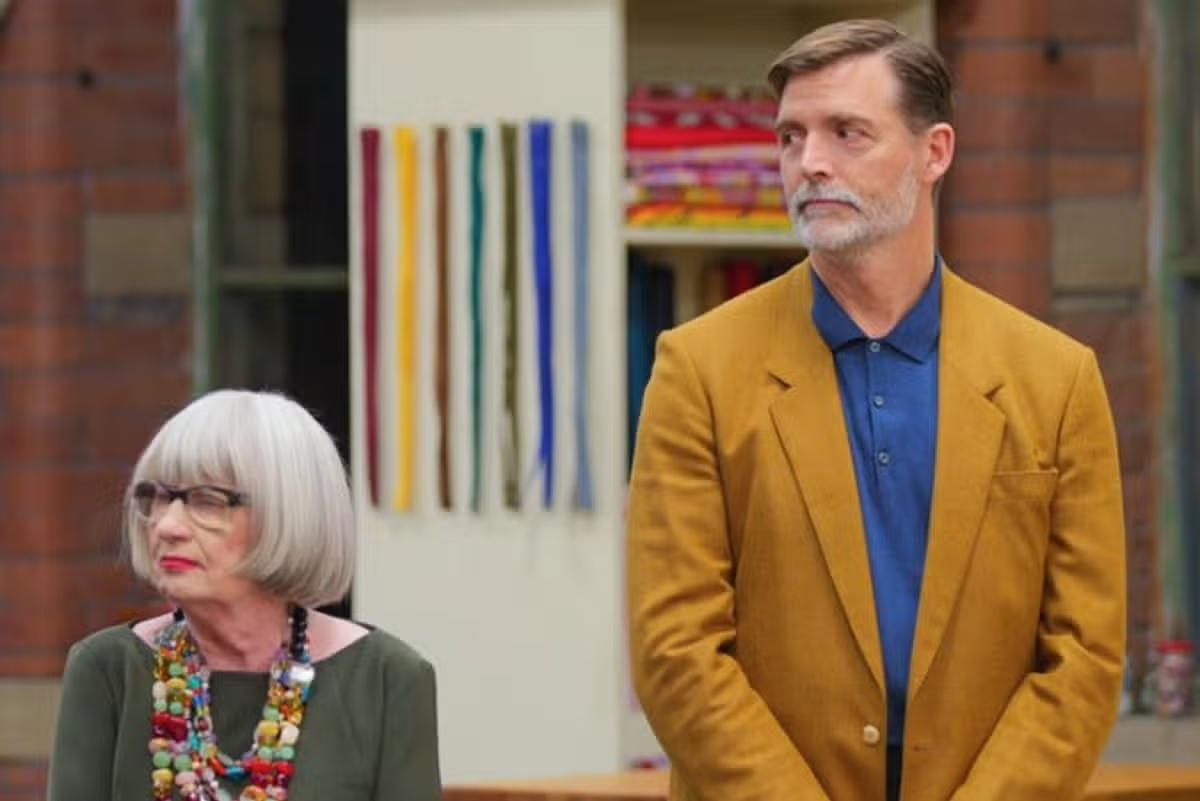
A contestant on The Great British Sewing Bee spoke about how proud they were to have made it so far.
One contestant was forced to leave The Great British Sewing Bee (Image: BBC)
A contestant on The Great British Sewing Bee has spoken of their pride in making it so far, as they were forced to leave the show. The BBC competition’s 12th series is well underway, with Patrick Grant and Esme Young returning as judges, while Sophie Willan replaced Sara Pascoe as presenter.
Just a week before the semi-finals, the remaining amateur sewers were challenged with Literary Icons week. As they channelled their inner bookworms, they were tasked with creating a deerstalker worn by Arthur Conan Doyle’s character Sherlock Holmes in the Pattern Challenge.
They were then asked to imagine what Roald Dahl’s Matilda would be like as a grown-up, creating an outfit from second-hand school uniforms. And finally, in the Made-to-Measure, the sewers created an outfit from the Regency period, inspired by the works of Jane Austen.
Despite her enthusiasm for the challenges, it was unfortunately Rebecca who missed out on a place in the semi-finals. She broke down in tears as Sophie announced she would be leaving the competition.
Sophie said: “Now for the difficult bit, one of you does have to go home today.” She went on: “You’ve all been amazing, it’s getting very serious now, it’s up here, so it’s very difficult for the judges. But unfortunately, the person going home today is Rebecca.”
Rebecca was supported by her co-stars as she wept over her exit, before sharing her pride in making it so far. She said: “I’m feeling incredibly proud of myself, I never thought I’d make it to the quarter-finals, so it’s been a privilege, every step of the way.”
Esme added: “I’ll really miss Rebecca. She was such fun, and making a dress and jacket was a lot of work. But she made so many mistakes.”
Rebecca continued: “Doing all of what I’ve achieved, being in pain the whole time, it’s just, I’m so proud of myself, and I hope that anyone who is living with an invisible disability or any disability, knows they can do incredible things.”
The Great British Sewing Bee continues next week, with the BBC teasing: “It’s the semi-final, and judges Patrick Grant and Esme Young set three challenges celebrating wardrobe heroes. These are items found in every wardrobe. However little or often they are worn, these clothes are must-haves and essentials.
“First, in the Pattern Challenge, the sewers must put their spin on the classic leather jacket, only this time, the judges have asked them to use plant-based leather.
“Next, for the Transformation Challenge, the sewers take men’s shirts and transform them into outfits for a wedding. Finally, in the Made-to-Measure, it’s the timeless little black dress that is the inspiration Four sewers remain, but only three will make it to the final.”
The Great British Sewing Bee is available to watch on BBC iPlayer.
Writer Olivia Sheed attended WorldPride Amsterdam just a week after Berlin Pride where a van drove into the crowd and hit several people
09:40, 10 Aug 2026Updated 09:46, 10 Aug 2026
This article contains affiliate links, we will receive a commission on any sales we generate from it. Learn more
It had been a long day, but a good day. I was about to go to bed after a busy day celebrating Newcastle Pride, when I saw the news alert about the attack at Berlin Pride.
Just hours ago, I’d marched with my partner in my city and felt the joy the day brought with it. That joy was shattered when I heard the news that one person had died and 29 more were injured in a car ramming attack and subsequent stabbings.
I couldn’t quite believe it when I first read it, the terror the attendees must have felt, a day of celebration ruined by a cowardly act of violence, how to reconcile with what this could mean for Pride celebrations in years to come. Would they be scaled back to allow for increased security? Would people feel afraid to attend them in future? Would I feel fear the next time I went to Pride?
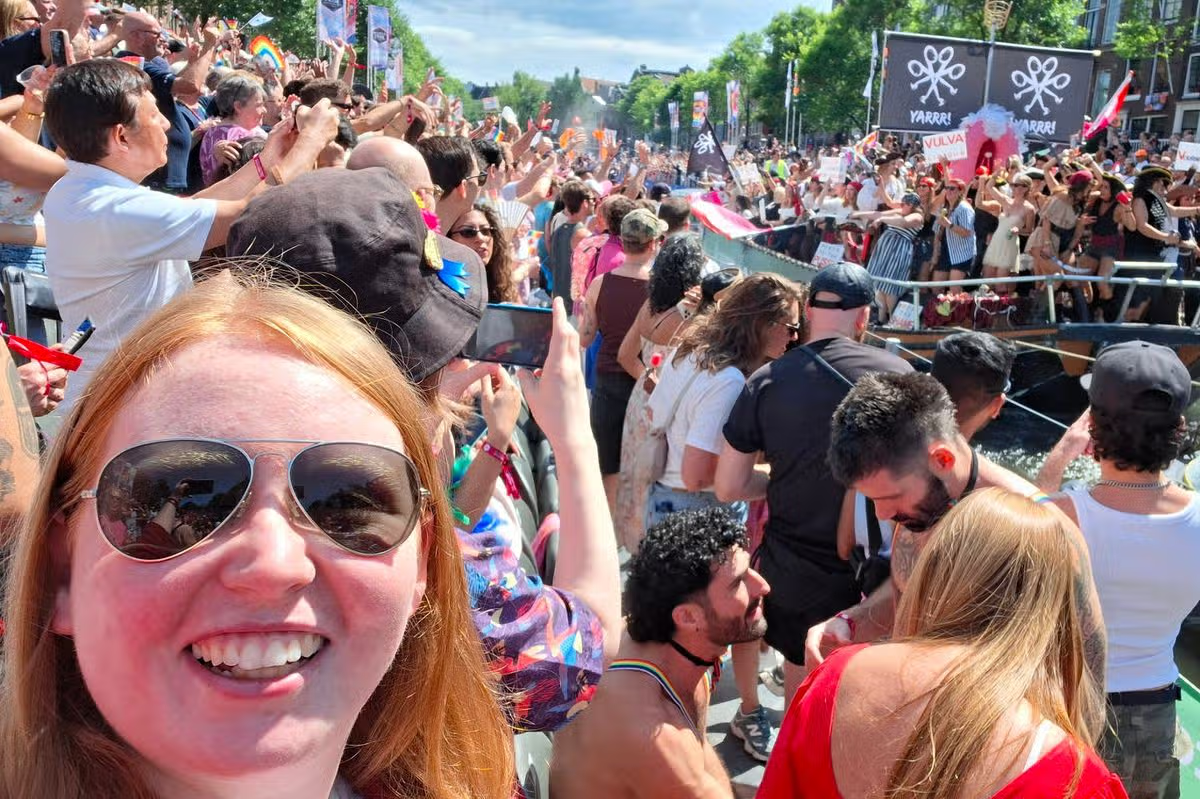
I asked myself these questions ahead of my upcoming visit to Amsterdam, where one week on from Berlin Pride, I’d be sitting along the canals of a major European city for World Pride and the famous canal parade. The Dutch city was chosen by Pride organisers to host this year’s WorldPride, as it marks 25 years since it hosted the world’s first legally recognised same-sex marriage.
However, given what had just happened in Berlin, I was aware that police and security in the city would be on high alert for another attack happening so soon after the last. This was corroborated by Mayor Femke Halsema, who said Amsterdam would take unspecified extra measures following the Berlin attack.
Despite the concerns I had, the opportunity to cover such a large event, with hundreds of thousands of people flocking to the city for the WorldPride celebration throughout July and August, was one I was so excited about. I still felt a giddy anticipation as I made my way there, but I felt a cloud hanging over me as I made my way through the streets of Amsterdam, despite the assurances of additional security.
However, if there was tension among other World Pride attendees, they didn’t let themselves show it. In the lead-up to the canal parade, people went about their lives in the city. Some partied, some enjoyed the quiet canal living can afford, and some just did their best to make the weeks of World Pride the best they could.
There was a special kind of atmosphere in the city that was different from other times I’d visited. Pride flags adorned every street you walked down, with the entire city lit in rainbow colours to welcome people from across the globe for one of the world’s largest Pride celebrations.
The flags were outside (and inside) businesses, apartments, public buildings – everywhere you looked you’d struggle to avoid a shock of rainbow. 50 major buildings arranged to light up in rainbow colours at night to literally light up the city once the sun set.
As Reform councils across the UK fight as hard as they can to get Pride flags off of public buildings, including the house of the first modern lesbian Anne Lister in West Yorkshire, it was dizzying in the best of ways seeing so many up in the streets. Each one felt like a welcome, a statement of defiance, and a call to celebrate all at once.
This continued to the day of the canal parade, where the increased security was met with open arms by participants. Police boats would make their way up and down the canals as the clock ticked down to the first floats reaching our viewing area, patrolling but still waving to the crowd as they settled into their respective seats.
Then, as the first floats began to make their way down our stretch of canal, I felt the weight that had been on my shoulders for the days leading up to the event ease. I had been so worried about something bad happening that I’d forgotten what being at Pride was meant to be.
Pride started as a protest, and for many, it still is. In a world where many people keep telling us that we can be queer if we don’t shove it in their face, where some don’t like queer people because we’re perceived as “different”, to a few who believe our existence should be met with violence, simply dancing in the sunshine is a protest in itself.
And that’s what people did. An estimated 300,000 people danced on the banks of Amsterdam’s famous canals, embraced their partner, and smiled with their friends. A week on from yet another dark day in queer history was met with a bright determination that the attempts to silence would only embolden.
Throughout the day, I could barely remember a time when I wasn’t smiling. The sun was shining, people were celebrating, we felt seen, we felt joy. When people ask what Pride is about, that to me is it. We felt joy, and we were unashamed to feel it.
Just a week after an attack that made waves through the whole LGBTQI+ community, I felt honoured to see how determined people were to show pride, show that we’ve always been here, and always will be.
Olivia attended WorldPride Amsterdam 2026 with Booking.com and stayed at the Hotel Jakarta Amsterdam.
Through its Travel Proud programme, Booking.com is helping make inclusive stays easier to find. Travellers can identify LGBTQ+ welcoming stays through the rainbow suitcase badge or ‘Travel Proud (LGBTQ+ friendly)’ filter on Booking.com.