AI is coming. AI is here. AI is a bubble. AI is the future we want. AI is the end. AI is the path to a better us (at least the ones who survive it).
A big topic, this artificial intelligence, with a lot of different ways to think about it. To grapple with AI is a worthy endeavor for any filmmaker. (And by grapple, I don’t mean asking AI to make the film for you.)
Daniel Roher, the man behind the Oscar-winning “Navalny,” has, along with co-director Charlie Tyrell, attempted a nonfiction primer of sorts on the biggest technological, societal and existential challenge of our time with “The AI Doc: Or How I Became an Apocaloptimist,” a title boasting a hybrid coinage Roher picks up from one of his interviewed experts — one of too many, it turns out. “The AI Doc” is a well-intentioned but aggravating soup of information and opinion that wants to move at the speed of machine thought.
Roher’s approach is understandable for a mainstream doc. He assumes many of us are tech-competent, anxious and confused as to what AI even is to begin with. In his pursuit of answers, Roher employs a cloying framework: his loving wife occasionally narrating as if this were a storybook and Roher the protagonist of a scary adventure. The fable construct extends to a frenetic visual scheme of handmade art and animation that interrupts our absorption process as if we were kids needing stimulation between all the talking heads.
As for the AI itself, the experts — a mix of tech founders (such as Sam Altman and Anthropic’s Amodei siblings), historians, scientists and assorted champions and skeptics — come to Roher’s home, because he wants to foreground a key question as an expectant father: Should he be bringing a child into this world?
Perhaps more urgently, should Roher have made an AI doc that treats us like children? First, he parades all the safety doomers, seeming to believe their warnings that an unfeeling superintelligence is upon us and we can’t trust it. Then, sufficiently disturbed, he hauls in the AI cheerleaders, a suspiciously positive gang who can envision only medical miracles and grindless lives in which we’re all full-time artists.
Only then, after this simplistic setup where platitudes reign, do we get the section in which the subject is treated like the brave (and grave) new world it is: geopolitically fraught, economically tenuous and a playground for billionaires.
Why couldn’t the complexity have been the dialogue from the beginning, instead of the play-dumb cartoon “The AI Doc” feels like for so long? Maybe Roher believes this is what our increasingly gullible, truth-challenged citizenry needs from an explanatory doc: a flashy, kindhearted reminder that we’re the change we need to be.
But if you thirst for a sober-minded investigation into this ominous tool — one with an approach that treats you like the intelligent being you are — you’ll have to wait for AI doc 2.0.
‘The AI Doc: Or How I Became an Apocaloptimist’
Rated: PG-13 for language
Running time: 1 hour, 44 minutes
Playing: Opens Friday, March 27 in limited release
Despite Liverpool’s dominance, the talk at half-time was of Mohamed Salah’s missed penalty. For a man who rarely misses, it was an unusually weak attempt and one that would certainly have got the headlines had Liverpool not progressed.
By now, Salah’s hunger for success is clear and it spoke volumes that instantly after his miss, he forced a save from Ugurcan Cakir.
And the Egyptian was involved in all three of Liverpool’s second-half goals to cap off a terrific all-round display.
First, Salah teed up Hugo Ekitike and it was Ryan Gravenberch who finished after Salah’s strike was saved, for Liverpool’s third.
The goal to make it 4-0 was a work of art as the 33-year-old used his left foot to curl a sublime effort into the top corner from outside the box.
“It says a lot about his mentality,” said Slot. “That was a difficult moment [when he missed the penalty] but then to come out in the second half with a great assist for Hugo and then score a trademark goal coming inside and finding the top corner.
“That tells you a lot about his mental strength, so credit to him and the whole team because adversity is something we can talk about when it comes to this season.”
Salah could have easily had more on a night where he became the first African to score 50 Champions League goals and recorded his 200th and 201st goal involvements for Liverpool at Anfield in all competitions (140 goals, 61 assists) in just 211 appearances.
There was some concern when Salah asked to be substituted in the 74th minute, with Slot saying afterwards that he had felt something.
But this was another timely reminder of his sheer class. Salah’s numbers alone are stupendous and whether or not he is still a Liverpool player come next season, there is little doubt that Liverpool have a stronger chance of knocking out PSG with him fit and firing.
I couldn’t stop looking at the thick bunches of California brittlebush, their bright yellow daisy-like flowers bursting alongside the sandy trail at Eaton Canyon.
I’d last walked the path a week after the Eaton fire, when I observed that “charred limbs of manzanita and other small trees and shrubs jerked out of the earth like seared skeletal remains. Heaps of leathery brown prickly pear pads sagged into the dirt and ash. Even the rocks were burned.”
Last Saturday, almost 14 months later, I marveled at how healthy Eaton Canyon looked as I attended L.A. County Department of Parks and Recreation’s launch of its Landscape Recovery Center. This is in large part thanks to volunteers who’ve dedicated hundreds of hours to restoring the canyon. I’m excited to tell you how you can be a part of those efforts.
You are reading The Wild newsletter
Sign up to get expert tips on the best of Southern California’s beaches, trails, parks, deserts, forests and mountains in your inbox every Thursday
The Department of Parks and Rec’s effort is a major step in repairing the damage wreaked by the Eaton fire that started Jan. 7 of last year.
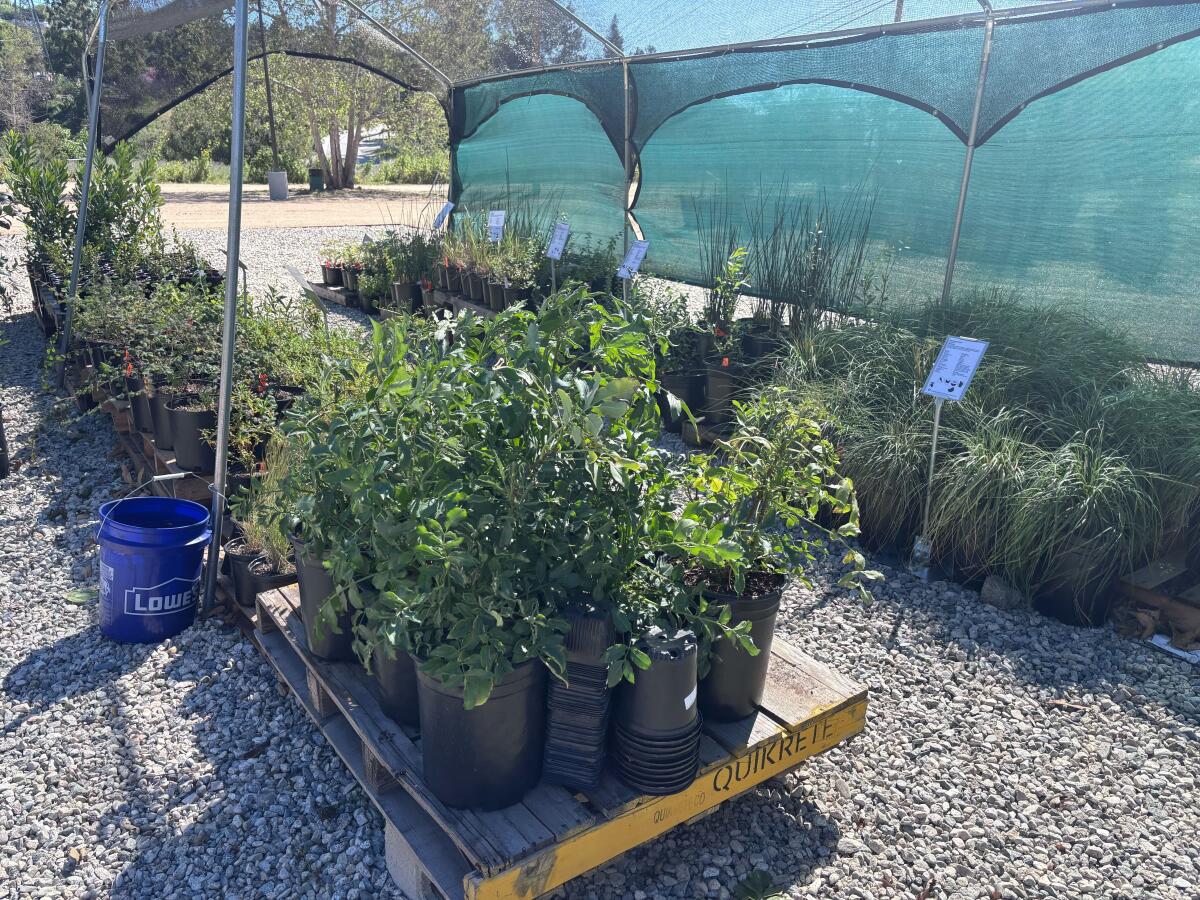
The center includes a nursery full of native plants that will be used not only in Eaton Canyon but also in six other parks damaged by fire, including five in Altadena, and Castaic Lake State Recreation Area. Workers will also reestablish vital tree canopy lost in the fire, planting coast live oak, Engelmann oak and Western sycamores.
Native plants at the nursery at the Landscape Recovery Center at Eaton Canyon.
(Jaclyn Cosgrove / Los Angeles Times)
L.A. County is partnering with the Theodore Payne Foundation and the Altadena Seed Library to achieve two key goals: 1) Grow the plants in the recovery center’s nursery from locally sourced seeds. 2) Build decentralized seed banks by procuring seeds from L.A. County nature centers.
The latter involves the “process of conserving plant genetics by dehydrating and securely storing seeds for future potential restoration or research projects,” said ecologist Nina Raj, founder of Altadena Seed Library, who is working with the county to develop the seed bank project.
“By carving out space at existing nature centers for a bit of tabletop equipment and storage space, the seeds from their adjacent natural areas [will] be conserved alongside backup populations from partnering nature centers — like an insurance policy in case of, or rather, in preparation for the next natural disaster,” Raj said.
A path near the parking lot of Eaton Canyon Natural Area, as seen on Jan. 14, 2025, and on Saturday.
(Jaclyn Cosgrove / Los Angeles Times)
In the coming months, officials estimate that more than 100,000 seeds sourced from Eaton Canyon will be propagated to aid recovery efforts. The county has also purchased more than 1,000 native shrubs and understory plants, chosen not only for their ecological value but also their cultural significance to the San Gabriel Band of Mission Indians Gabrieleno/Tongva, whose leaders have been advising the county on its canyon restoration efforts.
The county also bought 200 native trees whose seeds came from “mother” trees grown in soil “extremely compatible with the organic matter here at Eaton Canyon,” said Norma Edith García-González, director of L.A. County Parks and Recreation.
All of this intentional sowing and planting is a 180-degree turn from previous recovery efforts. After the Kinneloa fire burned through Eaton Canyon in 1993, officials rushed to stabilize the hillsides. An expert team recommended grass seed be dropped from helicopters all over the hillsides, which present-day experts say may have introduced nonnative grasses to the region.
The nursery at L.A. County’s Landscape Recovery Center at Eaton Canyon.
(Jaclyn Cosgrove / Los Angeles Times)
“The Landscape Recovery Center represents a best-practice model for restoring nature, rebuilding habitat diversity and supporting disaster recovery,” García-González said. “[We are] rebuilding with intention, using climate-resilient native species informed by both ecological science and cultural knowledge.”
Most of Eaton Canyon, including its beloved nature center, burned in the 2025 fire. The recovery center’s modular building and the land around it are among the first built improvements, and the area now has electricity, water access, irrigation systems and restrooms. (The recovery center’s footprint is south of the burned nature center, and no announcement was made Saturday regarding when it might be rebuilt.)
These improvements will allow the Landscape Recovery Center, which will have five full-time and four part-time staff members, to host volunteers interested in caring for habitat, supporting the plant nursery or working in local outreach or on community science.
Volunteer events, including hands-on nursery work, will be scheduled Tuesday through Saturday, with times varying depending on the program. Those age 14 and older can sign up by calling or texting (626) 662-5091. (A quick note: Eaton Canyon remains closed to the public, outside of volunteer opportunities.)
A cultural sign welcomes visitors to Eaton Canyon.
(Jaclyn Cosgrove / Los Angeles Times)
Many volunteers have already been hard at work. Organized by the Eaton Canyon Nature Center Associates, volunteers have donated hundreds of hours to clear out short-pod mustard, castor bean, tree tobacco and fountain grass, which choke out native plants and serve as flashy fuel for wildfires.
All of this work must be done before hikers and other outdoors lovers can return to Eaton Canyon.
Jeremy Munns, a trails planner for L.A. County Parks and Recreation, said rebuilding the Eaton Canyon Trail and other county trails in the Eaton Canyon Natural Area will be part of a future phase.
The fire and subsequent flooding washed out the trail and caused hillsides to collapse into and around the canyon. Contractors, county staff and conservation corps crews will need to install retaining walls, repair drainages and add rock walls (called rock armoring) to stabilize the canyon and protect it from further erosion, Munns said.
A path near the Landscape Recovery Center.
(Jaclyn Cosgrove / Los Angeles Times)
Munns said there isn’t currently a plan to include volunteers in that work because of safety concerns.
“In the future, there will be opportunities for volunteers to help with the maintenance of these trails, but the timing of that has not yet been determined,” he said.
As I walked through the nursery during Saturday’s event, I found myself feeling hopeful. Several rows of California sagebrush, California buckwheat, chaparral beard tongue, sticky monkey flower and more sat in their pots, awaiting their new homes in the nearby ground.
It’s easy to imagine a future in which the entire canyon is healthy once again.
3 things to do
Workers tend to plants growing at the Santa Monica Mountains Fund seed farm.
(Jacsen Donohue / Santa Monica Mountains Fund)
1. Nurture yourself and nature in Newbury Park The Santa Monica Mountains Fund and Second Nature Collective will host a yoga and volunteer day from 8 a.m. to noon Saturday in Newbury Park. Participants will first be led through a 45-minute mindful and meditative yoga session before placing hundreds of native plants in the ground. Register at eventbrite.com.
2. Nosh on nonnative plants in Studio City Urban forager Nick Mann will lead a 3-mile foraging walk from 9:30 a.m. to noon Saturday through Fryman Canyon. He will teach participants how to identify edible nonnative plants commonly found along local trails. Donations requested but not required. Register at eventbrite.com.
3. Ride the river near Azusa Active SGV will host a 12.4-mile bike ride from 9 a.m. to noon Saturday along the West Fork National Scenic Bikeway north of Azusa. Carpooling is encouraged, as the parking lot at the trailhead fills up. Register at eventbrite.com.
The must-read
Condor A1 (a.k.a. Hlow Hoo-let) soars across the sky in far Northern California.
(Matt Mais / Yurok Tribe)
In a potentially historic win for condor conservation, Yurok wildlife officials say there might be a condor pair tending to an egg in the tribe’s Northern California homeland — where condors haven’t nested for more than a century. Times staff writer Lila Seidman wrote that condors vanished from the state’s North Coast because of violence carried out by European settlers. “The pair believed to be nesting in Yurok country were captive born and released in 2022, as part of the first group reintroduced in that region,” Seidman wrote. “The pair, formally known as A1 and A0, are the oldest birds from their release cohort at nearly 7 years old — and the only ones old enough to reproduce.”
Happy adventuring,
P.S.
It’s officially baby season at the San Dimas Raptor Rescue. The L.A. County facility, which rehabilitates birds of prey, took in its first great horned owlet in early February. The center anticipates taking in dozens of great horned owlets who are found starving and need to be nursed back to health before being released. Generally, the center tries to release a bird back to the area where it was found. In this little baby’s case, that would be Venice Beach. The center is run, in part, by volunteers who are trained by the county before working with the birds. If you ever find a raptor that you perceive is in need, you can call the center at (626) 559-5732 before interacting with the animal. A great service to our local wildlife!
For more insider tips on Southern California’s beaches, trails and parks, check out past editions of The Wild. And to view this newsletter in your browser, click here.