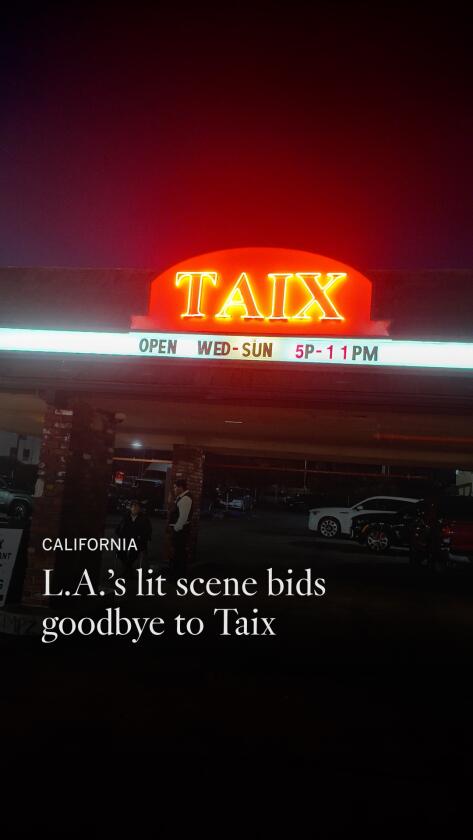
Taix French restaurant demolition: Why L.A.’s creative scene is mourning a landmark
On March 29, Taix as we know it closes forever. The iconic French restaurant originally opened downtown in 1927 and relocated to its current chalet on Sunset Boulevard in 1962. It’s a grim reminder of L.A.’s insatiable appetite to destroy its own heritage and especially devastating to a certain milieu of writers and artists, myself very much included. Since it announced its closure, I’ve been visiting as often as I can to say farewell, not only to the charmingly shabby faux-1920s interiors, but to the many lives I’ve lived at its tables. First as a young guitarist when a bandmate worked the bar’s soundboard, next with the Chinatown artist scene, then with Semiotext(e)’s avant-garde lit circle, later through firecracker romances and heartbreaks during the art party Social Club, recently floating through the louche carnival of Gay Guy Night and now with the circus of beatniks from my reading series Casual Encountersz.

-
Share via
It’s difficult to explain why this cavernous and windowless restaurant means so much, so I’ve tried to list everything I love about Taix.
I love that they don’t play music. I love the 1960s bathrooms. I love the bottomless tureens of soup. I love the complimentary crudité from the pre-pandemic era. I love the cold pats of butter. I love that you can always get a table, no matter how many people roll in. I love the free refills on Diet Cokes. I love the 80-year-old couples on dates. I love how the dim lighting makes everyone seem chic. I love the frayed carpeting. I love the fake votive candles. I love the icy martinis. I love the corner booth beside the fireplace. I love the smoked mirrors and tin-plate ceilings in the elegant back dining rooms. I love the small fortune I’ve spent there picking up the check for many strippers, poets and bohemians. I love its rundown glamour, which miraculously evokes Old Hollywood, Belle Époque and trashy Americana all at once. I unironically love the food, which isn’t spectacular, but is very comforting. I love how a waitress once ran off with a friend of mine and slept on my couch for a week. I love how my wife generally hates eating at restaurants but loves eating at Taix. I love how every L.A. artist I know has their own singular version of this list.
The only thing I don’t love about Taix is that its owners are tearing it down to erect soulless condos. I know the city needs housing, but not like this. I hope we’ll all find a new place to call home again soon.
Taix shaped me as a writer and artist, along with so many others, which is why before the new owners demolish this cultural institution, I asked other creatives what the Echo Park landmark means to them.

Chris Kraus.
(Ariana Drehsler / For The Times)
Chris Kraus, writer, artist and co-editor of the independent press Semiotext(e): When I moved to L.A. in 1995, Taix was the go-to place, with its deep banquettes, cuisine bonne-femme and its nightly prix-fixe specials. Mostly it was police officers and their wives who went there. Sylvère Lotringer and I went often, for him it was a little reprieve from the non-Frenchness of L.A. He could order in French and exchange pleasantries with an elderly French waiter who seemed to live there. Years later, when Sylvère moved to Ensenada and was less active with Semiotext(e), Taix was the site of our “Annual General Meetings” — Hedi El Kholti, Sylvère and I would have dinner together and Hedi would catch Sylvère up on all the forthcoming publications and projects. Taix was a place to run into people unexpectedly. About a decade ago, when the bar was refreshed, it changed again and I kind of lost track of it.
Rachel Kushner, novelist: I dined at Taix probably once per week for 23 years. It hurts so much that it is closing. I simply stopped going, so that I could begin to grieve, and also to avoid every last random tourist standing by the host station, on their phone, and the glum possibility of being seated in the second dining room, a.k.a “the Morgue” as my friend Benjamin Weissman put it. I want to protect my memories of the special occasions I enjoyed in this perennial special occasion establishment … I want to remember Bernard, a cheerful Basque from Biarritz who worked there 60 years, got progressively trashed over the course of his shift, went to Bakersfield on Sundays to party with his sheep-herding countrymen, came back Wednesdays sunburned and happy. The old valets who were let go during the pandemic. I used to give them a Christmas bonus every year, as a thanks for letting me park my classic out front. Look, I was born in Taix. I mean, in a way. I nursed my newborn in Taix. He grew up there. People who criticize the food are losers, and will never understand. The steak frites are great. The panna cotta, discontinued after the pandemic, was my favorite. The Louis Martini Cabernet was reliable. (Bernard told me the wine cellar downstairs took up the entire footprint of the main restaurant. Don’t know if that’s true.) Meanwhile, I can’t put my arm around a memory. All the smart girls know why. It doesn’t mean I didn’t try.
Cord Jefferson, writer and director: When I started going to Taix, in 2004, you could still gamble at the bar. They sold keno slips and lottery tickets, and whenever Powerball got over $100 million, I’d buy a ticket with my pint. Where else can you do all that while simultaneously watching a game and eating a tourte de volaille? Taix was where I watched the heroic Zinedine Zidane headbutt the gutless Marco Materazzi in the saddest World Cup final ever. When France lost that afternoon, my favorite server, Phillipe, cried. Phillipe’s teeth were often as wine-stained as his customers’. He’d bum me cigarettes in the parking lot and speak abusively about the ways the neighborhood was changing. I’m happy Phillipe is not around to see the digital renderings of what they plan to erect once they demolish the Taix chateau: another condo building with all the charm of a college dorm. It’s a damn shame what’s happening to Taix. I wish I had more money so I could buy it and keep it around, but I never won the Powerball.
John Tottenham, novelist and poet: It’s a shame that Taix is closing, not only because other plans will now have to be made for my funeral reception, but because it was the last civilized watering hole in the neighborhood. There isn’t anywhere else that one can walk into and immediately satisfy the social instinct among a convivial and refreshingly diverse clientele in what is becoming an increasingly homogenized locality. It has been the nexus of my social life for over 20 years, and is simply irreplaceable.

Jade Chang.
(Ariana Drehsler / For The Times)
Jade Chang, novelist: I’d only known Taix as a raucous bardo of a French restaurant, then there was a memorial service for Alex Maslansky, my beloved friend Max’s brother, owner of Echo Park’s best bookstore, Stories. Alex was a beautiful and beleaguered soul, born worried, born romantic, difficult and hopeful and apparently a shockingly good poker player. The room was packed with music people and book people, sober friends and poker friends, packed with the gorgeous girls who’d always loved him, our collective sorrow potent and sweet enough to pull the walls in around us tight as we said goodbye and goodbye.
Alexis Okeowo, New Yorker staff writer: I was a late discoverer of Taix, stumbling upon it when I moved to a bungalow just above Sunset during the pandemic from New York. I seemed to only see writer friends there. I met up with a journalist for drinks and then ran into a new writer friend at the bar. I later had a big, spontaneous dinner with TV writer friends and then a birthday celebration in the dining rooms that ended in two friends escorting me home, sick and happy off a mostly-martini meal and the selfies I took in the bathroom with the iconic pink and gold wallpaper. Every time, there was talk about ideas and gossip and so, so much laughter.
Alberto Cuadros, writer/curator and co-founder of the Social Club: About 10 years ago, Max Martin and I started Social Club as a weekly social salon at Taix. We thought of it as a kind of Beuysian social sculpture, it was a weekly ritual, and over time it became something of an institution in the L.A. art world. Everyone knew where to go in L.A. on a Wednesday if they wanted to meet interesting people or find friends. I even met my wife there who was visiting from Montreal.
Siena Foster-Soltis, playwright: Taix felt like one of the few remnants of the L.A. I grew up in and love so dearly.

Ruby Zuckerman.
(Ariana Drehsler/For The Times)
Ruby Zuckerman, writer and co-founder of the reading series This Friday: Taix is the only restaurant in L.A. that doesn’t lose its mind if new friends drop in halfway through dinner or if you stay at your table for hours after you stopped ordering. That kind of flexibility leads to spontaneous nights where what started off as an intimate hang expands into an all-out party. As a writer, that flexibility has allowed me to meet editors, collaborators and readers, drawn together by pure fun rather than networking. One of my favorite nights involved getting in a physical altercation with novelist John Tottenham after he stole my phone to send prank texts to my boyfriend. I’ll miss taking selfies in the bathroom.
Blaine O’Neill, DJ and events organizer: I always say Taix is the “People’s Country Club.” It is exceptional because of the staff who understand the importance of hospitality, and the scale of the space is humane. You’re able to evade feeling pinched by the noose of transactional cosmopolitanism.
Tif Sigfrids, gallerist and publisher Umm…: Taix was a cultural nexus. A space with broad range. It went from being the dark bar I read books and day-drank at in my 20s to the place where I rented a private room to host my son’s first birthday party. It’s where I watched Barack Obama get elected twice, the Lakers win back-to-back championships, and where I indulged in countless night caps and an unreasonable amount of all-you-can-eat split pea soup. You never knew what kind of hot jock, wasted poet or other type of intrigue you might run into there. You can’t make a place like Taix up. It’s a place that just miraculously happens.
Kate Wolf, writer and editor: Though I have been going to Taix for nearly 20 years, embarrassingly, it was only in the last year that I realized the building wasn’t from the 1920s. Those smoke-stained mirrors, that tin ceiling, the drapery and light fixtures are in fact set-dressed — ersatz! Which of course only makes me love the place more. Taix’s history, and its spot in the city’s cultural firmament, cannot be denied. But what really makes it so special are the people who work there and the clientele, not its past. This point is perhaps my only hope in losing what is my favorite restaurant in Los Angeles. That by some divine grace, we will all find each other again in another spot, designed to a different decade than the horror-filled present, and fill it with the same warmth, the same bottomless soup bowl, the same cheer.


Hedi El Kholti, artist and co-editor Semiotext(e): Taix is where we would end up after every reading since 2004 when I started working at Semiotext(e). I have memories of being there with Kevin Killian, Dodie Bellamy, Gary Indiana, Michael Silverblatt, Colm Tóibín, Rachel Kushner and Constance Debré among others … Taix has that particular anachronistic vibe that made L.A. so charming when I moved here in 1992, one of these places that time forgot. It was odd when it became really hip in the last 10 years. It made me think of what Warhol wrote about Schrafft’s restaurant when it had been redesigned to keep up with the fashion of the moment and had consequently lost its appeal. “If they could have kept their same look and style, and held on through the lean years when they weren’t in style, today they’d be the best thing around.”
Loren is the founding editor of the art and literary conceptual “tabloid” On the Rag and curator of the reading series Casual Encountersz.