Monica

L.A. is getting four more years of Councilmember Monica Rodriguez

Good morning, and welcome to L.A. on the Record — our City Hall newsletter. It’s David Zahniser, with an assist from Howard Blume and Noah Goldberg, giving you the latest on city and county government.

She’s blunt. She’s combative. She doesn’t go along to get along.

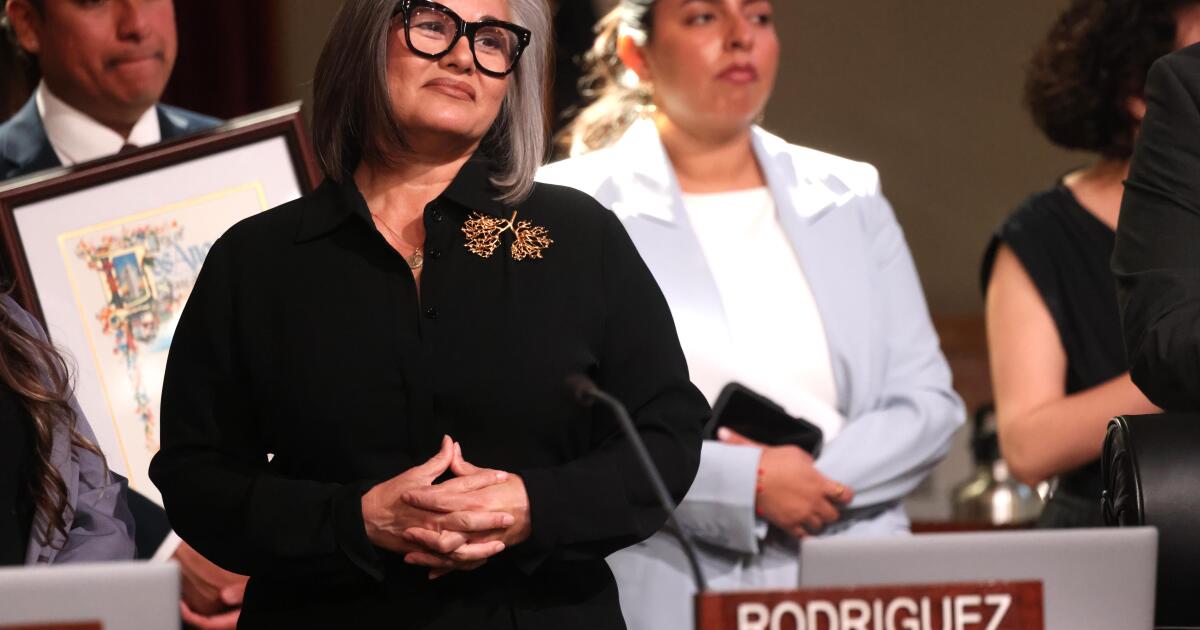
And now, Los Angeles City Councilmember Monica Rodriguez is almost certainly getting four more years in office.

On Wednesday, with the deadline past, no one filed a petition to challenge Rodriguez in the June 2 primary election. That makes her the only official at City Hall to be in that coveted position this year.

One caveat: Someone could still run as a write-in, waging a long-shot campaign. But realistically, Rodriguez has a free ride to continue representing her northeast San Fernando Valley district.

Rodriguez, who lives in Mission Hills, said she had been prepping for “another fight,” raising money and giving endorsement interviews. Now, she’s started talking about what her third and final term could look like.

“Giddyup. Everyone better buckle up,” she said, cackling.

You’re reading the L.A. on the Record newsletter

For an elected official, nothing can bolster one’s confidence like a reelection victory or two. Newly elected council members tend to keep a low profile their first few years. The longer they stay, the more outspoken they become.

Rodriguez, on the other hand, has been willing to speak her mind for quite some time.

She’s been a longstanding critic of Mayor Karen Bass’ Inside Safe program, which moves homeless people indoors. She has pushed, without success, for the city to yank its money from the embattled Los Angeles Homeless Services Authority, or LAHSA. Last fall, she told a mayoral aide that Bass’ team “botched” the Palisades fire recovery in the first few months.

Rodriguez frequently expresses her views in vivid terms, and in ways that can annoy her colleagues.

Last year, she warned a proposal to hike the minimum wage for hotel and airport workers to $30 per hour would trigger job losses, leaving the city with “the best paid unemployed workforce in America.”

She denounced the city’s plan to upgrade the Convention Center, saying the council was continuing to “fund failure.” She regularly drops the phrase “merry go round from hell” — shorthand for her struggle to get her colleagues to pull out of LAHSA, the city-county homeless agency that’s been the subject of blistering audits.

With the election approaching, the zingers have only gotten zingier.

Six weeks ago, City Councilmember Nithya Raman launched a last-minute bid to rewrite Measure ULA, the city’s tax on high-end property sales, saying it had chilled development of much-needed apartments. Raman wanted her proposal to go on the June ballot but failed to garner support from her colleagues, who said it hadn’t been vetted.

Rodriguez, in a screed delivered on the council floor, compared Raman to “the arsonist that comes showing up as a firefighter.”

That was a not-so-veiled reference to the fact that Raman promoted Measure ULA in 2022 — and downplayed concerns that it would affect housing production.

“Ms. Raman, you supported and endorsed the false notion to voters that [Measure ULA] was going to be the panacea — without study, without any of the verified proof,” she said. “We knew that these were the implications.”

Raman, in a statement on Friday, said she endorsed Measure ULA after reading through research suggesting that the tax, which generates money for housing programs, would not affect housing production. Newer analysis, she said, found that the measure “indeed resulted in less investment in multi-family housing.”

“That is a huge concern to me and should be to everyone in L.A., a City that is still very much facing a housing shortage,” said Raman, who is now running for mayor. “I am willing to take some heat to get the best outcomes for the City and to secure support for these crucial revenues.”

Stuart Waldman, president of the Valley Industry and Commerce Assn., a San Fernando Valley-based business group, said he appreciates Rodriguez’s direct approach, even when he disagrees with her.

“A lot of councilmembers, if they don’t agree with you, they won’t even meet with you,” he said. “There are council members who say they’ll listen and take [an issue] under advisement, even though they’ve made up their mind. They just don’t want to tell someone to their face that they disagree.”

Rodriguez’s approach doesn’t always reap political dividends.

Last year, Council President Marqueece Harris-Dawson removed her from a number of high-profile committees, including those that oversee homeless programs, public safety and the city budget.

Despite her warnings, the council hiked the minimum wage for tourism workers and approved the $2.6-billion Convention Center project. She championed the creation of a new youth development department, only for it to wind up on the chopping block in last year’s budget.

Rodriguez, 52, grew up in Arleta, the daughter of a U.S. Marine veteran who served in Vietnam while holding a green card, and later became one of the city’s earliest Latino firefighters in the wake of a federal consent decree on hiring. She graduated from San Fernando High School in 1992, one year after Assemblymember Luz Rivas and two years after U.S. Sen. Alex Padilla.

She worked for former Mayor Richard Riordan and former Councilmember Mike Hernandez and later ran unsuccessfully against former Councilmember Richard Alarcon. She joined the Board of Public Works in 2013, running for council a second time four years later.

With a third term looming, Rodriguez wants to take a program she launched in her district — moving homeless people out of RVs and into housing — and take it citywide. She’s excited about expanding a program for fixing sidewalks that also teaches job skills to young people.

Rodriguez acknowledged that her stances, and her remarks, can rub people the wrong way, noting that it’s “more comfortable to walk in a group than to walk alone.” Nevertheless, she doesn’t intend to change her approach.

“I know what I’m here to do, and I’m just going to continue,” she said.

State of play

— SCRAMBLE FOR SIGNATURES: The deadline for candidates for city office to turn in petitions arrived on Wednesday, and the signatures are still being counted. By Friday, 12 mayoral candidates had qualified to run against Bass, including Raman, reality television star Spencer Pratt and tech entrepreneur Adam Miller. The City Clerk’s office is still reviewing the petitions of several other mayoral hopefuls, all of them political unknowns.

— ANOTHER FREE RIDE: L.A. Unified School board member Kelly Gonez is also running unopposed in the June 2 election. On Wednesday, her one potential opponent, JP Perron, announced he was dropping out. Like Rodriguez, Gonez represents part of the San Fernando Valley.

— A HELPING HAND: For a hot minute, things were touch and go for Sylvia Robledo, a former council aide looking to unseat Councilmember Eunisses Hernandez. After filing her petitions, Robledo learned Tuesday that she was short 14 voter signatures. Raul Claros, one of her rivals in the race, stepped in to help close the gap, gathering some signatures himself. “People want options,” he said later on Instagram. “People want anybody but Eunisses Hernandez.”

Two of Robledo’s other opponents — entrepreneur Nelson Grande and nonprofit executive Maria Lou Calanche — added their own names to her petition. On Wednesday, she qualified for the ballot.

“We may have a different vision or path, but we all want new leadership,” Robledo said.

— JANISSE JETS OFF: The top executive at the Department of Water and Power, Janisse Quiñones, announced this week that she has taken a job as CEO of a privately owned electrical company in her native Puerto Rico. Quiñones, who was hired at $750,000 a year, faced criticism over the DWP’s decision to drain a reservoir shortly before the Palisades fire broke out. Her first day in the new job is March 30.

— TRUMP ON LINE 1: Bass spoke on the phone this week with President Trump to request FEMA reimbursements for the Palisades fire, KNX News reported. Bass told the station that the president was “very receptive.”

“I was reluctant to call because there are a few other things going on, like what’s happening overseas, and I didn’t think, given all that was happening internationally, that he would actually return my call,” she told the station.

— OVERDUE BILLS: The county Board of Supervisors voted this week to fund a financial review of the Los Angeles Homeless Services Authority, after finding that the agency owes tens of millions of dollars to nonprofits that oversee interim housing for the region’s homeless population. Supervisor Lindsey Horvath said her phone was “ringing off the hook” from groups needing to get paid by LAHSA.

— TIT FOR TAT: Meanwhile, the long-running feud between Bass and Horvath continued to boil over, with the two taking digs at each other over the future of the region’s homeless programs. Bass, in a statement, said pulling out of LAHSA too quickly would bring “unintended consequences” and leave “more Angelenos to die on our streets.”

“When the County created their new Department of Homeless Services and Housing, they also created a $300 million gap, which they had to close by prioritizing bureaucracy rather than services,” Bass said.

Horvath shot back, saying she is already conferring with council members on a strategy to have the city pay the county to provide homeless services.

“I’m ready to work with the City Council and show the Mayor what locking arms actually looks like,” she said, swiping one of Bass’ signature phrases.

— PALISADES BOWL IN PERIL: The owners of a mobile home park destroyed last year in the Palisades fire are marketing the site as a potential “mixed use” project — housing plus commercial space, which would result in permanent displacement of residents. City Councilmember Traci Park said any developer looking to take the sellers up on their offer should “pound sand.”

“What we are interested in doing is restoring this property as a mobile home park for the people who were there and remain displaced,” she said.

— PURSUING POT PROCEEDS: L.A. cannabis companies owe the city more than $400 million in business taxes, late fees and interest. Hoping to recoup $30 million of that total, the council voted this week to set up an amnesty program for those pot businesses that still owe money and haven’t already shuttered.

— JAIL DEATHS: Ten people have died in L.A. County jails so far this year, putting the county on track for another record-setting year of in-custody deaths. Now, county supervisors want the Sheriff’s Department to reverse that trend by beefing up safety checks, more closely monitoring cameras and increasing access to the overdose reversal drug Naloxone.

— FOR FLOCK’S SAKE: The Police Commission wants to know how data captured by the controversial license plate reader Flock Safety are being stored and shared. Commissioner Jeff Skobin asked for the information following reports that federal agencies had repeatedly accessed Flock’s surveillance data as part of Trump’s ongoing immigration crackdown.

QUICK HITS

  • Where is Inside Safe? The mayor’s signature program to fight homelessness went to a stretch of Laurel Canyon Boulevard in North Hollywood, underneath the 170 Freeway. About three dozen people went inside, according to Bass’ team.
  • On the docket next week: The council’s Planning and Land Use Management Committee meets Tuesday to take up a proposal to hike the penalties for putting up illegal billboards and other unpermitted signs.

Stay in touch

That’s it for this week! Send your questions, comments and gossip to LAontheRecord@latimes.com. Did a friend forward you this email? Sign up here to get it in your inbox every Saturday morning.

Source link

As ‘The Pitt’ suffers a digital meltdown, a human saves the day

This article contains spoilers for Season 2, Episode 9 of “The Pitt.”

Midway through Season 2, “The Pitt” has taken on the perils of the digital age and given me a reason to love the show as much as everyone else does.

Don’t get me wrong — I understand perfectly why so many people, including recent Emmy and Golden Globe voters, have lost their minds over the HBO Max medical drama: The propulsive day-in-the-life of a Pittsburgh ER conceit, the dazzling ensemble cast, the writers’ heroic attempts to showcase our perilously broken healthcare system, the healing power of empathy and, of course, the Noah Wyle-ness of it all. His brilliant and gentle-voiced Dr. Michael “Robby” Robinavitch is as aspirational a character on television as we’ve ever seen.

But having recently spent almost six hours passing out and vomiting from pain in the waiting room of my local ER (which was empty except for one other man), while being told there was nothing anyone could do until the next shift arrived, I confess I have watched “The Pitt” with a jaundiced eye. The regular crowd shots of the waiting room too often reduce the afflicted into a zombie-like horde bent on making life more difficult for our beloved medical staff.

Sure it’s tough to work in an ER when you are worried about your mother’s expectations, grieving your dead mentor, struggling with addiction or worrying about your sister, but no doubt many of those in the waiting room are experiencing similar issues while also in terrifying and hideous pain.

I’m just saying.

In this second season, however, “The Pitt” gave me reason to cheer. It chronicles the day before Robby is set to leave on a three-month sabbatical, and in the early hours, we meet his temporary replacement, Dr. Baran Al-Hashimi (Sepideh Moafi). Having already attempted to force those suffering in waiting rooms to create their own “patient portals,” Dr. Al-Hashimi goes on to advocate for an AI-supported system to aid the doctors with pesky paper work.

Robby, of course, does not think any of this is a good idea and since he is always right (and no television writer is going to openly promote AI), her plan backfires almost immediately. First, with a medical notes transcription that gets Very Important words wrong and then after a complete digital blackout.

After a nearby hospital is hacked and ransomed, the higher-ups decide to defend its system by shutting it down, which means business must be conducted in the old-fashioned, paper-and-clipboards way.

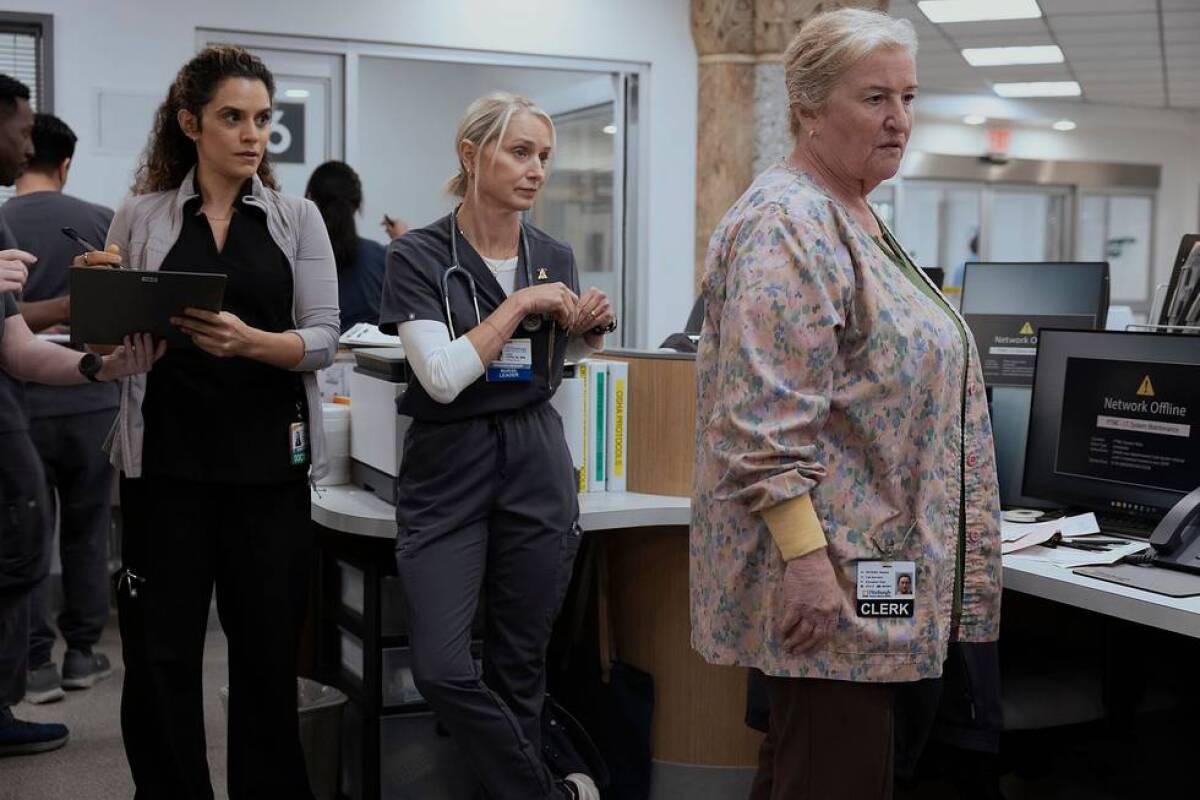
The result is chaos, and a few too many jokes about young people not knowing how to work a fax machine or manage paper. Some of the more seasoned staff, including and especially the indefatigable charge nurse Dana Evans (Katherine LaNasa), remember the days before everyone carried an iPad well enough to keep things moving. Even so, Dana wisely calls upon the services of “retired” clerk Monica Peters (Rusty Schwimmer).

Three women stand near a counter with computer screens.

When the computer system at the Pitt is shut down, Dana (Katherine LaNasa), center, calls in Monica (Rusty Schwimmer), far right, who arrives to help.

(Warrick Page / HBO Max)

“Laid off by the digital revolution, not retired,” Monica corrects her. “And how’s all this digital s— working out for you now?”

This is where I cheered. I love the digital world as much as the next person currently typing on a computer to file a story that I have discussed with my editors on Slack and that I will not see in hard copy until it appears in the physical paper. But like pretty much everyone, I have suffered all manner of digital breakdowns and mix-ups, not to mention the inevitably increased workload that comes with the perception that I can do the work of previous multitudes with a few additional strokes of a keypad.

Except, of course, that’s a lie — a keypad is capable of nothing on its own. Neither are fingers, for that matter. They must be manipulated by someone whose brain has to figure out and execute whatever needs to be done. This requires an ability to navigate the ever-changing tech systems that store and distribute information (often in ways that are not at all intuitive) while also understanding the essentials of the actual work being done.

In “The Pitt,” that is the emergency medical treatment of human beings, which requires all manner of physical tasks. As this storyline makes clear, many of the medical staff do not quite understand how to order or handle these tasks without a screen to guide them.

Hence the need for Monica, representative of a large number of support workers who do understand because it was once their job to keep everything moving, to answer all manner of questions, prioritize what needs to be fast-tracked and make sure nothing falls through the cracks while also engaging with all and sundry on a human level.

The shutdown is obviously an attempt to underline the limits of AI but it also serves as a fine and necessary reminder of how readily we have surrendered people like Monica, with their knowledge and experience, to keyboards and touch pads (which, of course, don’t require salaries, benefits or lunch breaks).

But — and this is important — computers are tools not workers. Alas, that has not kept companies in virtually every industry from drastically cutting back on trained and experienced employees and handing large portions of their work (mental if not physical) to people, in this case doctors and nurses, who already have demanding jobs of their own.

But hey, you get a company iPad!

A woman in blue scrubs stands in front of a white board looking at a woman in a mauve jacket holding a clipboard.

Nurse Dana (Katherine LaNasa), left, and Dr. Baran Al-Hashimi (Sepideh Moafi) have to resort to paper, clipboards and white boards to keep track of patients after the hospital’s systems are shut down.

(Warrick Page / HBO Max)

Often, including with those patient portals, what was once paid labor lands in the lap of the consumers, who in “The Pitt” are people sitting in an emergency room and likely not at the top of their game when it comes to filling out forms about their medical history or coming up with a unique password.

ER dramas, like the “The Pitt,” are inevitably fueled by the tension between the demands for speed and the need for humane care, something that is increasingly true, if not as intrinsically necessary, in all facets of our culture.

With computers in our pockets, we now expect everything to be available instantly. But when something in our online experience goes wrong, we need an actual human to help us fix it. Unfortunately, as the overwhelmed staff of the Pitt discover, those people are increasingly difficult to find because they have been laid off — even nurse Dana can’t do everything!

Dr. Al-Hashimi, like many, believes that patient portals and AI-assisted medical notes will save time, allowing the doctors and nurses to spend more of that precious commodity with their patients. But, as Dr. Robby and Dana repeatedly argue, what they really need is more staff.

There’s no point in saving a few minutes at the admittance window, or on an app, if you are then going to have to spend hours waiting for or trying to find someone who can actually help you when you need it.

That is certainly true in the medical sector, where digital technology has done little to eradicate long wait times for medical appointments or in emergency rooms. Being treated in a hospital hallway by people who can barely stop to talk to you is not an uncommon occurrence for many Americans. The U.S. is facing a critical shortage in hospital staff, with the ranks of registered nurses and other medical personnel having plummeted post-pandemic, often due to burn out.

The amount of time the staff of “The Pitt” spend with each patient, while dramatically satisfying, is almost as aspirational as the wisdom and goodness of Dr. Robby.

None of these problems is going to be solved by AI or any other “time-saving” device. We have not, as far as I know, figured out a way to extend an hour beyond 60 minutes or modified the human body so that it does not require seven to nine hours of sleep each night.

Medical institutions aside, I can’t think of any place I have visited lately that wouldn’t have benefited from more paid and experienced workers, especially those who know how to do things when computers glitch or fail.

The minute Monica sits down and starts barking orders in the ER, everyone feels much better. Here is someone who understands what needs to be done, why, and how to make it happen. Moreover, she has eyes, ears, hands and human experience enough to know that, in the end, people are less interested in saving time than getting the care they need.

In the ER and everywhere else.

Source link

Remembering when the Beach Boys had a clubhouse in Santa Monica

Today it’s an Italianate apartment building wedged between an Indian restaurant and a Target. But what stood half a century ago at 1454 5th Street in downtown Santa Monica was the Beach Boys’ Brother Studio, a former porn theater turned recording complex where the preeminent American rock band of the 1960s sought to coax its resident genius, Brian Wilson, back into the fold after a long stretch in the wilderness.

Nobody would consider the albums the Beach Boys made at Brother in the mid-70s — among them “15 Big Ones,” “The Beach Boys Love You” and the long-shelved “Adult/Child” — the band’s most successful. (Well, nobody except for Wilson, who frequently cited the synthed-up “Love You” as his fave.) A decade after 1966’s “Pet Sounds,” which so blew the Beatles away that they had to answer with “Sgt. Pepper’s Lonely Hearts Club Band,” the burly, bearded Beach Boys were far from the center of pop music; Wilson, in particular, had largely withdrawn from public life as he struggled with the effects of drugs and his fragile mental health.

Yet Brother offered the setting for a creative reflowering — arguably the band’s final moment of unity before the start of years of more serious infighting.

“It was like we all got back together and became Beach Boys again,” says Al Jardine, who founded the group in suburban Hawthorne in 1961 with Wilson, Wilson’s brothers Dennis and Carl and the Wilsons’ cousin Mike Love. Now, eight months after Brian Wilson’s death in June at age 82, a new box set looks back at the era as an expressive outpouring led by the band’s rejuvenated visionary.

“We Gotta Groove: The Brother Studio Years” collects 73 tracks from 1976 and ’77, including outtakes, demos, a remastered version of the “Love You” LP and the first official release of the widely bootlegged “Adult/Child,” which puts Wilson’s touchingly emotive singing amid orchestral arrangements in a glossy big-band style. Among the set’s highlights are a voice-and-piano rendition of “Still I Dream of It,” which, according to legend, Wilson wrote in the hopes that Frank Sinatra would perform it, and a majestic take on “You’ve Lost That Lovin’ Feeling” that shows how brilliant a record-maker Wilson remained despite all the well-documented turmoil.

“Brian was healing from his personal life, and he was ready to go in the studio again,” says Jardine, 83, whose latest tour with the members of Wilson’s road band will stop Friday night at L.A.’s United Theater on Broadway for a complete performance of “The Beach Boys Love You.” With quirky but heartfelt tunes about Wilson’s daughter Carnie (“I Wanna Pick You Up”) and Johnny Carson (uh, “Johnny Carson”) — not to mention the propulsive “Honkin’ Down the Highway,” on which Jardine sang lead — “Love You” has become something of a cult classic among Wilsonologists.

Says Jardine of the LP: “Brian’s spirit — his songwriting soul — is really strong on that one.”

The Beach Boys opened Brother Studio around 1974 near the corner of 5th Street and Broadway, just a few blocks from the beach. They’d traveled to the Netherlands to record their most recent album, “Holland”; before that, they cut several records at Wilson’s home on Bellagio Road in Bel-Air, though the group’s erstwhile mastermind spent as much time upstairs in his bedroom as he did recording music with his bandmates.

Wilson’s retreat after the flameout of his notoriously ambitious “Smile” project made space for the other Beach Boys to shape the band’s music, as on 1970’s fondly remembered “Sunflower.” But the lack of hits eventually took its toll: With a laugh, Love, 84, says one reason they started up Brother was that Wilson’s wife, Marilyn, eventually “threw in the towel after years of having her house flooded with people” to less-than-spectacular returns. “It was sort of like a self-preservation thing,” he adds.

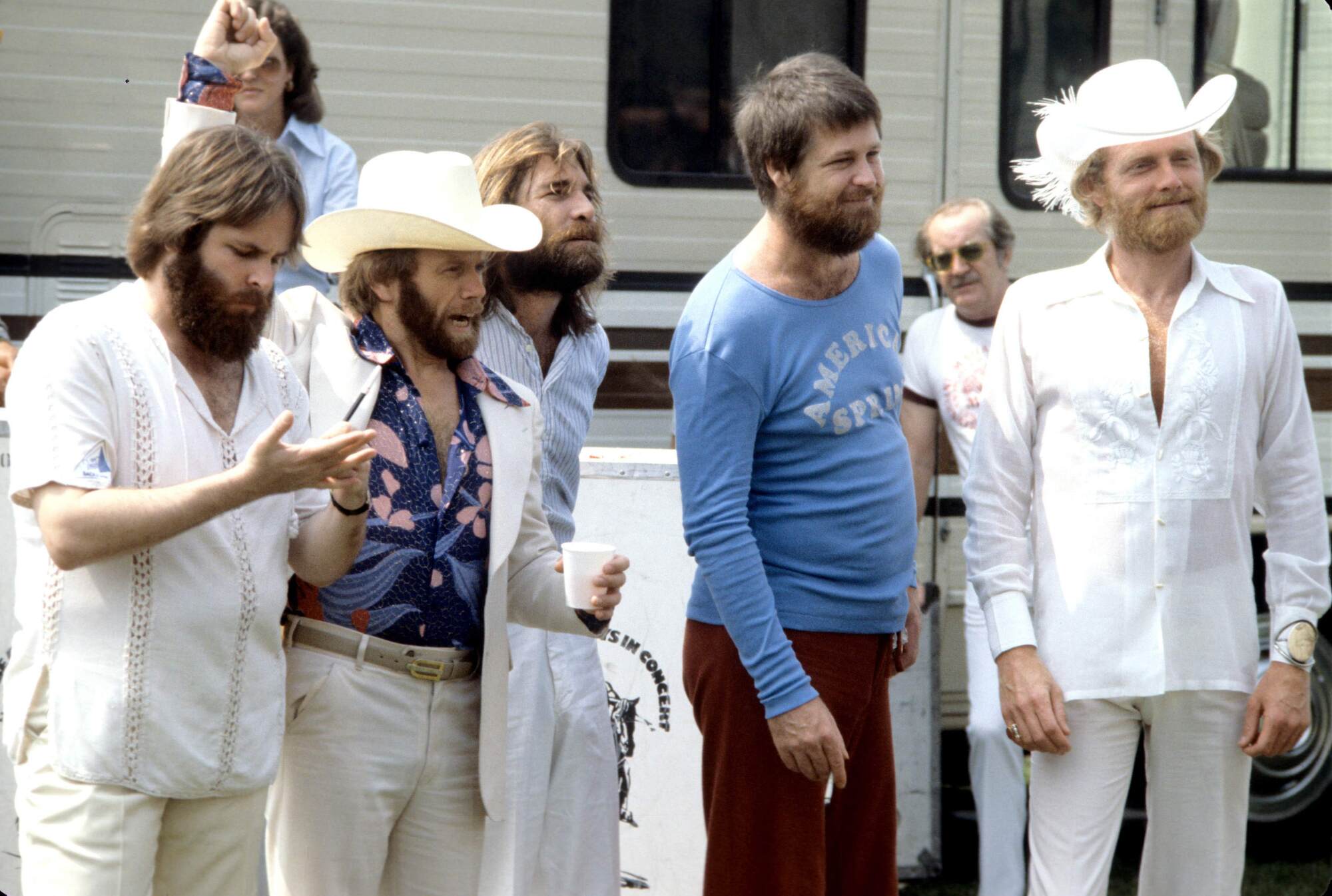
The Beach Boys backstage at New York's Central Park in 1977.

The Beach Boys backstage at New York’s Central Park in 1977.

(Richard E. Aaron / Redferns)

In “We Gotta Groove’s” liner notes, engineer Stephen Moffitt, who designed Brother after working earlier at L.A.’s Village Recorders, recalls clearing out “all the porn crap” from the building and installing a circular stained-glass window to establish the right vibe. A vintage magazine ad boasts of the studio’s high-end gear as well as its “large screen video lounge” and “a playroom with pong, pinball and bumper pool.”

“It was a respite,” Love says. “A place to go and be creative.”

Just as the band was getting Brother up and running, the Beach Boys scored an unexpected smash with 1974’s “Endless Summer,” a double-LP compilation of the group’s early material — “Surfin’ Safari,” “Don’t Worry Baby,” “California Girls” — that topped the Billboard album chart on its way to sales of more than 3 million copies. A similar hits collection issued in the U.K., “20 Golden Greats,” did just as well there. “An enormous success,” says Love. “One in every five families had it.”

Suddenly, having more or less ignored group-minded efforts like “Holland” and “Carl and the Passions — ‘So Tough,’ ” the world remembered what it loved about the Beach Boys, and that was songs written and produced by Brian Wilson.

The band got to work at Brother recording “15 Big Ones,” which featured a mix of Wilson originals and covers of oldies like “Chapel of Love” and “Blueberry Hill.” The first Beach Boys album since “Pet Sounds” to carry a solo production credit for Wilson, it came accompanied by an aggressive marketing campaign known as “Brian Is Back!”; Wilson appeared on the cover of Rolling Stone — “The Healing of Brother Brian,” the cover line read — and took part in a Beach Boys television special that showed his return to the concert stage at Anaheim Stadium.

Earle Mankey, an engineer at Brother in the mid-70s, says “15 Big Ones” was less Wilson’s attempt to relight the flame than it was “everyone else’s attempt to relight the flame.” He recalls Wilson looking like a “scared rabbit” when he walked into the studio to find some of the session musicians who’d worked with the Beach Boys back in the old days. (This was the time of Wilson’s first dalliance with the psychologist Eugene Landy, who would reenter Wilson’s life to much controversy in the early ’80s.)

Fans watch the Beach Boys perform at Anaheim Stadium on July 3, 1976.

Fans watch the Beach Boys perform at Anaheim Stadium on July 3, 1976.

(Tony Korody / Sygma via Getty Images)

Even Love admits that “Brian Is Back!” was a little overblown. “Brian was back to some degree,” Love says now. “One hundred percent? Perhaps not.”

Yet the campaign worked: “15 Big Ones” went to No. 8 on the Billboard 200 — the highest for a Beach Boys studio album in more than a decade — while the LP spun off the band’s first Top 5 single since “Good Vibrations” with a rendition of Chuck Berry’s “Roll and Roll Music.”

More important, the commercial success set up Wilson for a true artistic comeback with “The Beach Boys Love You,” which can still startle you with the purity of its emotion and the strange textures of Wilson’s production. Check out the beautifully lopsided groove of “Mona,” which Dennis sings with a bleary smoker’s rasp, or the lonely-sounding electric-guitar lick floating over the Wilson brothers’ harmonies in “The Night Was So Young”; listen to Brian and Marilyn trading marital assurances in their almost painfully guileless duet, “Let’s Put Our Hearts Together.”

“Of all Brian’s stuff, I’d say it’s his most personal album after ‘Pet Sounds,’ ” says Darian Sahanaja, who played with Wilson for the last couple of decades of his life. “Maybe even more than ‘Pet Sounds,’ because Tony Asher wrote most of the lyrics on ‘Pet Sounds’ and Brian wrote most of the lyrics on ‘Love You.’ The Brian that I knew is very much living and breathing in these songs.”

Unlike “15 Big Ones,” “Love You” was not a hit, peaking at No. 53 — even lower than “Holland.” As much as he adores the album, Sahanaja finds it amusing that anyone in the Beach Boys’ camp might have expected Wilson to try to give rock fans what they wanted.

“He wasn’t listening to the Top 40 at the time,” he says. “He just wrote whatever came out of him. There was no, ‘I wonder what Fleetwood Mac’s up to…’ ”

Indeed, Wilson went even further out with “Adult/Child,” for which he commissioned orchestral arrangements by Dick Reynolds, who’d worked in the ’50s with Wilson’s beloved Four Freshmen. Both Love and Jardine say they can’t quite remember why the album didn’t come out; Love says “it may not have suited the record company at the time” and points out that even “Pet Sounds” got the group’s A&R rep wondering “if maybe we could do something more like ‘I Get Around.’ ”

Whatever the case, “Adult/Child’s” mothballing led to another withdrawal by Wilson, who had far less to do with the band’s next few records and who eventually turned to a solo career. In 2012, Wilson produced a so-so Beach Boys reunion record — minus Dennis, who died in 1983, and Carl, who died in 1998 — but for much of the ’00s he and Jardine toured under Wilson’s name while Love toured as the Beach Boys. (Love’s band will play three shows at the Hollywood Bowl in July.)

Asked what it’s been like performing with Wilson’s band since his death, Jardine says, “I just feel like he’s still around.” Sahanaja says he’s seen Jardine tear up as they’ve been working up songs from “Love You” on the road ahead of Friday’s show. But he’s also been gratified to see the excitement among younger fans regarding what he views as the Beach Boys’ last great album.

“The reaction has been more insane than I’ve ever seen for any of the shows we ever did with Brian,” he says. “It’s like they feel they found this secret thing that they really identify with.” He laughs. “I’m telling you, these kids are freaking out — jumping up and down, singing along to all the words. They’re, like, pogo-ing.”

Source link

Call the Midwife fan favourites return as Sister Monica Joan’s health declines

Call the Midwife sees the comeback of popular characters as the nun’s health continues to spiral following her recent diagnosis.

Call the Midwife is welcoming back one much-loved family, and fans will be ecstatic.

In recent episodes of the BBC One drama, Sister Monica Joan (Judy Parfitt) has been rapidly declining in health, leaving her loved ones at Nonnatus House very concerned. On Sunday, 15 February, Doctor Patrick Turner (Stephen McGann) confirmed that the nun’s loss of appetite and exhaustion are the result of a chronic kidney disease.

The GP then devastatingly added, “Unless we can persuade her to accept what treatment there is, she’ll progress to end-stage renal failure fairly quickly”, as he also implied her deterioration has been rapid.

In the past, Sister Monica Joan has made miraculous recoveries from her medical issues, but this time, a subtle comment from her, “Maybe I do not care to go on for a long time”, appeared to seal her fate.

In forthcoming scenes airing during episode eight on Sunday, 8 March, Sister Monica Joan reunites with Bernie Mullocks (Christopher Reilly). The much-loved Mullocks’ family were introduced during series five before returning in series six as part of the ongoing Thalidomide story.

Who are the Mullucks family in Call the Midwife?

In 2016, Rhoda Mullucks (Liz White) gave birth to a daughter, Susan, who was born with birth defects after taking medication prescribed by Doctor Turner. During birth, the nurses immediately realised Susan was born without properly developed arms and legs as the newborn struggled to breathe.

Rhoda and her partner Bernie were left surprised by the developments but dedicated themselves to being the best parents they could.

The show tackled the Thalidomide scandal again in series six, catching up with the Mullucks family 18 months after Susan’s birth, as Dr Turner helped fit her with prosthetic limbs before enrolling in nursery school. Bernie found Susan’s condition hard to comprehend, and even walked out of a meeting as tears filled his eyes.

Over the years, Bernie went from despising his child he once cruelly called a “monster”, to being terrified into over-protectiveness, afraid she would be the object of ridicule.

In 2022, the Mullocks family returned as Rhoda and Bernie welcomed another baby into their beautiful family. Their story continued as the parents’ mental health was also explored.

In an advance glimpse of the Call the Midwife episode, Bernie sits beside his wife, Rhoda, as she lies in a hospital. The couple hold hands as they look dishevelled, though it is unclear why Rhoda was admitted to the hospital.

In another sneak peek, Bernie is seen pushing a frail Sister Monica Joan in a wheelchair through the streets of Poplar, carrying a bouquet of white flowers.

Bernie and Sister Monica Joan also visit a church together, though it is currently unknown what brings the two back together.

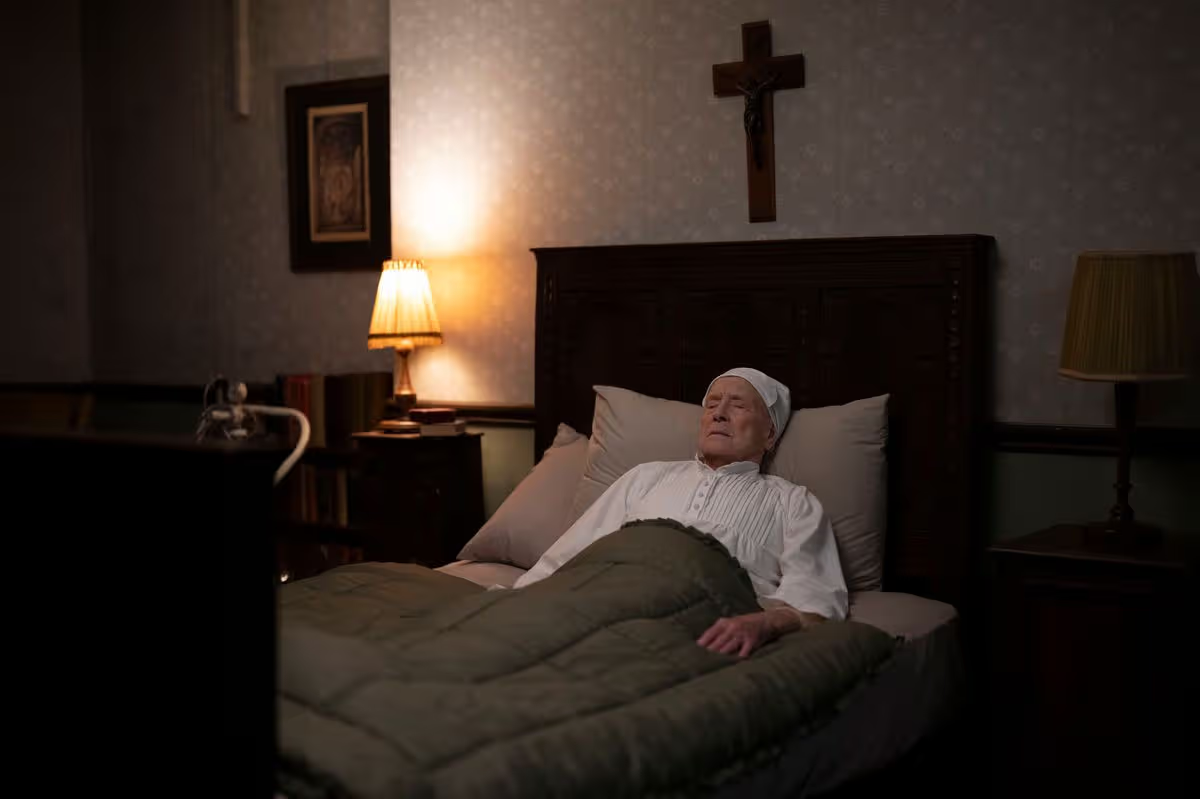
The BBC drama has also released a photo of Sister Monica Joan lying in bed, eyes closed, with her hands by her side. Is this the end for the adored sister? Viewers will have to wait and see what lies ahead for Sister Monica Joan.

Call the Midwife airs Sunday at 8pm on BBC One and iPlayer

For the latest showbiz, TV, movie and streaming news, go to the new **Everything Gossip** website.

Ensure our latest headlines always appear at the top of your Google Search by making us a Preferred Source.** Click here to activate**** or add us as your Preferred Source in your Google search settings.**

Source link

BBC Call The Midwife Sister Monica Joan’s fate ‘sealed’ after tragic health update

It looks as though BBC viewers will be saying farewell to one beloved character on Call the Midwife.

Emotions were at an all-time high on Sunday night as BBC viewers learnt the fate of Sister Monica Joan (Judy Parfitt).

Recently, Call the Midwife viewers learnt that the beloved character had kidney failure, as Dr. Patrick Turner (Stephen McGann) noted that additional tests would provide further information.

Tragically, those results were revealed during the latest instalment of the show.

As Dr Turner, Sister Julienne (Jenny Agutter) and Nurse Phyllis Crane (Linda Bassett) sat down to go over the results, Dr Turner said: “I was hoping it was something that could be treated, but chronic kidney disease is just-“

Cutting in, Sister Julienne commented: “Something that takes old people gently, but kindly.”

As Dr Turner emphasised that regardless of the matter, the disease still ‘takes’ people, Nurse Phyllis questioned how long Sister Monica Joan had been ill with the disease.

He replied: “I suspect not long.”

When asked how long she has left to live, he confessed: “The same, unless we can persuade her to accept what treatment there is, she’ll progress to end-stage renal failure fairly quickly.”

Although all seemed heartbroken by the severity of her illness, nurse Phyllis replied: “Till that day comes, we’ll just have to love her as we always have, but a bit more carefully.”

It wasn’t long before people took to X to share their thoughts on the imminent death of Sister Monica Joan as one person said: “Are they actually going to kill of sister Monica Joan? Just end Call The Midwife there!”

Someone else commented: “No, Sister Monica Joan is immortal…she can’t die.” While another added: “SISTER MONICA JOAN. Sobbing.”

Another viewer wrote: “Absolutely devastated hearing the news that Sister Monica Joan has kidney failure and may not have long left, if we lose her, it will be like losing a much-loved family member. I’d be completely heartbroken.”

For the latest showbiz, TV, movie and streaming news, go to the new Everything Gossip website ‘.

One person shared: “Don’t you dare let anything happen to Sister Monica Joan.” While another said: “#callthemidwife Oh no, surely it can’t be the demise,of Sister Monica Joan? On the other hand could it be the end on Nonnatus? What a fantastic drama this is @CallTheMidwife1 #SundayMood.”

Sister Monica Joan has been part of the beloved period drama since it began back in 2012. However, as the show marks its 15th series, it’s been reported that the final will see birth, a wedding and a funeral.

Call the Midwife continues Sundays on BBC One from 8pm

Source link