Mike

‘Song Sung Blue’ review: Jackman and Hudson sweetly croon

You won’t see a movie with better music and worse dialogue this holiday season than the bizarrely charming “Song Sung Blue,” a biopic about a husband-and-wife Neil Diamond cover band who were a fleeting sensation in 1990s Milwaukee.

If that plot synopsis isn’t a hook, the soundtrack is packed with them, as stars Hugh Jackman and Kate Hudson belt over a dozen Diamond hits including “Forever in Blue Jeans,” “I Am…I Said,” and “Holly Holy.” Of course the couple they’re playing, Mike and Claire Sardina, a.k.a. Lightning & Thunder, also do “Sweet Caroline,” although they disagree over where it belongs in the set list. Mike prefers last, allowing them to showcase his idol’s range beforehand. Claire insists it come first after an incident when withholding it triggers a biker brawl.

Written and directed by Craig Brewer (“Hustle & Flow”), the movie is itself a cover of Greg Kohs’ 2008 documentary on the Sardinas, also titled “Song Sung Blue.” The original is a quirky little indie that reveals truth to be weirder than fiction. What happens to Mike and Claire is so outlandish that you’d roll your eyes if Brewer also included the facts that their real-life wedding climaxed with a concert for a thousand people at the Wisconsin State Fair and that the groomsmen wore tuxedo T-shirts.

Both films are love stories, even if the new version compresses Mike and Claire’s decade and a half marriage into two years. He’s a divorced auto mechanic and recovering alcoholic with a surly-but-sweet distant daughter named Angela (King Princess) and a bit of local renown. She’s a single mom to son Dayna (Hudson Hensley) and her own daughter, Rachel (Ella Anderson), when Mike struts into her life wearing lightning bolts on his jacket and tooth. His manager, Dave (Fisher Stevens), is also his dentist.

This is a script that shows and tells. If Mike jokes that Dave deserves a free oil change for missing out on a $10 commission, then you better believe the movie will cut to him under the car doing the job. Every character blurts out exactly what they want with the gusto of belting out ba-ba-baaaah at a certain Neil Diamond chorus.

“I gotta be Neil but I gotta be me too,” Mike says urgently. A couple scenes later, Hudson’s Claire turns to Rachel and pleads, “I just want to sing and feel happy and be loved!” Likewise, as soon as their kids are thrust together on an awkward playdate, the girls get stoned, trauma-bonding about their unstable parents, a cute and corny moment that ensures the audience knows the risks if Lightning & Thunder are forced to hang up their spangles.

The twosome are backed by a tour booker, Tom (Jim Belushi), who dreams of getting them a residency in Vegas, and a motley crew of fellow mimics including a Buddy Holly (Michael Imperioli) and a James Brown (Mustafa Shakir). Shyaporn Theerakulstit, Chacha Tahng and Faye Tamasa have some nice moments as Thai restaurateurs who welcome the Sardinas’ family into their own. Often though, you find yourself watching Anderson as the anxious Rachel who seems most in tune with reality. Can her mom and stepdad’s fantasies of fame actually pay their rent?

There’s a spoiler in the trailer that I recommend avoiding if you can. The argument for it must have been that no one wants to see a musical about two Midwesterners in rhinestones unless something bad happens to them. Most rock biopics have a similar rise-and-fall-and-rise arc; it’s a cliché that works, like plugging “Sweet Caroline” into a bar’s jukebox. But what gives “Song Sung Blue” a wonky kind of depth is that there’s only so high Mike and Claire can rise. When the real-life couple was fired from a steady booking, the club owner justified his actions by saying, “Especially being in Neil Diamond impersonation, your limits are Neil Diamond.”

Fans will counter that the songwriter’s gifts are so ceaseless that younger generations might not even connect each hit with his name. Bopping along to the movie feels like being at a pub trivia night where the answer is always Neil Diamond: That’s right, he also wrote The Monkees’ “I’m a Believer.” Begrudgingly, you half-buy into one of the script’s more ludicrous set-ups, that Lightning & Thunder will play their biggest show on the night Diamond is headlining at another venue in town. The greater metro population of Milwaukee is just shy of one and half million people. Sure, why not.

Grinding plot gears aside, the duo’s actual biggest gig is pretty awesome: In 1995, Eddie Vedder invited Lightning & Thunder to open for Pearl Jam. (“What’s a Pearl Jam?” Mike asks.) The quirky mash-up of sequins and flannel gets reenacted here, but this would be a richer movie if it explored why a Seattle grunge band rocketing toward mega-stardom would whisk this act along for the ride. Appreciation for Diamond’s lyrical craft? Respect for the Sardinas’ genuine talents? Or just kitsch?

That Lightning & Thunder peaked when Gen Xers were ascendant makes you yearn for Brewer to grapple with how much of their fan base was ironic. That question, along with Diamond’s ear worms, won’t stop wriggling in my brain. The closest answer I’ve found is in a “Simpsons” episode from around the same time where Homer takes the stage at a cartoon version of Lollapalooza. (“He’s cool,” a pierced punk says with a snort. A buddy asks if he’s being sarcastic, and the kid collapses like a hot air balloon: “I don’t even know anymore.”)

“Song Sung Blue” couldn’t be less cool. But the Sardinas were completely sincere and Jackman and Hudson honor their innocence by playing them straight. (Brewer, however, can’t resist a pratfall where Mike trips singing “Cracklin’ Rosie” in his skivvies.) Jackman looks and sounds so much like Diamond that the concert scenes feel like top-fleet karaoke, and Hudson more than holds her own, even as her Claire is tasked to stare at her husband with starry eyes that sparkle as much as her silver makeup.

Hudson encourages the audience to use Claire’s stubborn buoyancy and perky accent as a life raft when Lightning & Thunder are deluged by extremely bad luck. But the beat Hudson gets exactly right comes in a scene where you’re certain this klutzy melodrama is going to force her to sob. Instead, she refuses. She smiles, and that’s the detail that breaks your heart.

So I cried for her. Then I groaned some more and while I didn’t need an encore, I left the theater humming.

‘Song Sung Blue’

Rated: PG-13, for thematic material, some strong language, some sexual material and brief drug use

Running time: 2 hours, 12 minutes

Playing: In wide release Thursday, Dec. 25

Source link

PDC World Darts Championship 2026: David Munyua stuns world number 18 Mike de Decker in first round

Kenyan debutant David Munyua caused a huge shock at the PDC World Championship, coming from two sets down to beat world number 18 Mike de Decker 3-2 at Alexandra Palace.

It was an enthralling encounter to end the afternoon session on Thursday, with Munyua missing darts to win the second set, doing the same in the third but coming back to win it, edging the fourth and coming back to win the fifth.

The 30-year-old, who qualified via the African Darts Group Qualifier, was broken in the first leg of the decider but produced an astounding outer bull-treble 20-bullseye 135 finish to level the fifth set, before holding his nerve to complete victory.

Another debutant, Japan’s Motomu Sakai, looked to have stolen the show earlier in the afternoon session as he beat Thibault Tricole of France in straight sets.

Sakai gained the support of the Alexandra Palace crowd with a long, exuberant walk-on and was a showman who played up to the fans throughout his match.

Elsewhere, world number 24 Ryan Joyce produced a composed display to see off fellow Englishman Owen Bates, averaging 95.27 and hitting nine of his 14 attempts at double.

Thursday’s other winner was world number 42 Callan Rydz, who only dropped three legs as he comfortably won 3-0 against Hungary’s Patrik Kovacs.

Source link

Rob Reiner’s artistic legacy was rooted in empathy and connection

I think about Rob Reiner almost every time I put on my socks.

I am old enough to remember the famously hilarious (and largely improvised) bit from “All in the Family” in which Reiner’s Mike “Meathead” Stivic and Carroll O’Connor’s Archie Bunker argue about the correct order of donning footwear — both socks first (Archie’s method) or sock/shoe, sock/shoe (Mike’s).

The straight-faced back and forth was, and is, a pitch-perfect exhibition of how much time and energy we waste judging, and arguing about, personal differences that are none of anyone’s business and matter not at all.

I also think about Reiner whenever my now-adult children and I sit down for a movie night. When all other suggestions fail, at least one of his films — ”Stand by Me,” “The Princess Bride,” “A Few Good Men,” “When Harry Met Sally…,” “Misery” — will achieve consensus, in large part, because of that same understanding.

Reiner was, above all, a compassionate filmmaker, willing to excavate all manner of conflict and tension in search of the essential humanity that connects us all.

Reiner helped shape the culture of my youth and early adulthood with such brilliant empathy that his random appearances on television — as Jess’ (Zooey Deschanel) father in “New Girl” or, more recently, Ebra’s (Edwin Lee Gibson) business mentor on “The Bear” — sparked immediate reflexive delight, as if a beloved uncle had shown up unexpectedly at a family dinner.

It helped, no doubt, that I share his political leanings. Reiner’s advocacy for gay marriage and early education were well-known, as was, in recent years, his unvarnished criticism of President Trump, who Reiner, like many others, considered a danger to democracy.

That criticism should have prepared me for the chilling invective unleashed by some, including Trump, in the wake of the news that Reiner and his wife, Michele Singer Reiner, were found dead in their home on Sunday night, victims of a knife attack, and that their son Nick, who has a history of drug addiction, was in police custody.

Even as the millions who were touched by Reiner’s work struggled to process their shock, grief and horror, Trump responded with a post in which he claimed that the Reiners’ murders were “reportedly due to the anger he caused others through his massive, unyielding, and incurable affliction with a mind crippling disease known as TRUMP DERANGEMENT SYNDROME, sometimes referred to as TDS.”

Horror unfolds around the world on a daily basis. This weekend, a father and son opened fire on a Hanukkah celebration in Australia, killing 15 and wounding many others; a gunman killed two and wounded nine at Brown University; and two members of the Iowa National Guard were killed and three others injured by gunmen in Syria.

Even so, between the shocking news of the Reiners’ deaths, the possible involvement of their son and the unhinged and cold-hearted response of the president of the United States, it is difficult to know how to react, short of tearing out one’s hair and screaming up to an indifferent sky.

No person’s life means intrinsically more than any other — many people are killed by violence each and every weekend, often by family members; that we seem to have become inured to mass shootings is another sort of horror.

But Reiner’s work, in film, television and politics, affected millions around the world personally and culturally. In “All in the Family,” his young leftie was far from the hero of the piece — Mike’s values were more humane and progressive than the bigoted Archie’s, but he could be just as narrow-minded as his father-in-law and just as capable of change.

As a director, Reiner championed independent filmmaking, which is to say smartly written movies that told interesting stories about characters that were recognizable in their humor and humanity (which is one reason he was so successful in adapting Stephen King’s work, including the novella “Stand by Me” is based on and “Misery”).

His political activism too was grounded in the desire to make life better for those historically marginalized by policy and culture. He campaigned against tobacco use and for Proposition 10, which increased the tax on cigarettes, and funded early education. In 2009, he used his considerable influence to co-found the American Foundation for Equal Rights and successfully fought to legally challenge Proposition 8, which banned same-sex marriage in California.

As an artist and a public figure, he put his money where his mouth was and remained invariably sincere, a powerful and compelling trait that has become increasingly rare in a time of the sound-bite inanities, muddy thinking, obvious contradictions and outright falsehoods that threaten our public and political discourse.

Reiner mastered many mediums and wielded a broad palette but his signature artistic trait was empathy. No story was too small, or too brutal, to be examined with kindness and an understanding that the most grave injustice we can commit is to choose apathy or revenge when connection and transcendence are always possible.

The news cycle surrounding the Reiners’ deaths is likely to get worse, as details emerge and reactions of all kinds continue. For a long while, it will be difficult to think of Reiner and his wife as anything but victims of a brutal crime of truly tragic proportions and the regrettable heartlessness that our political divisions have created.

Ironically, and mercifully, solace for this loss, and so many others, can be found in Reiner’s work, films and performances that are impossible to watch without feeling at least a little bit better.

As Hollywood and the world mourns, I will try to think of Reiner as I always have. After all, no matter the order, we all put on our shoes and socks one at a time.

And then, as his artistic legacy teaches us, we stand and try to do the best we can with whatever happens next.

Source link

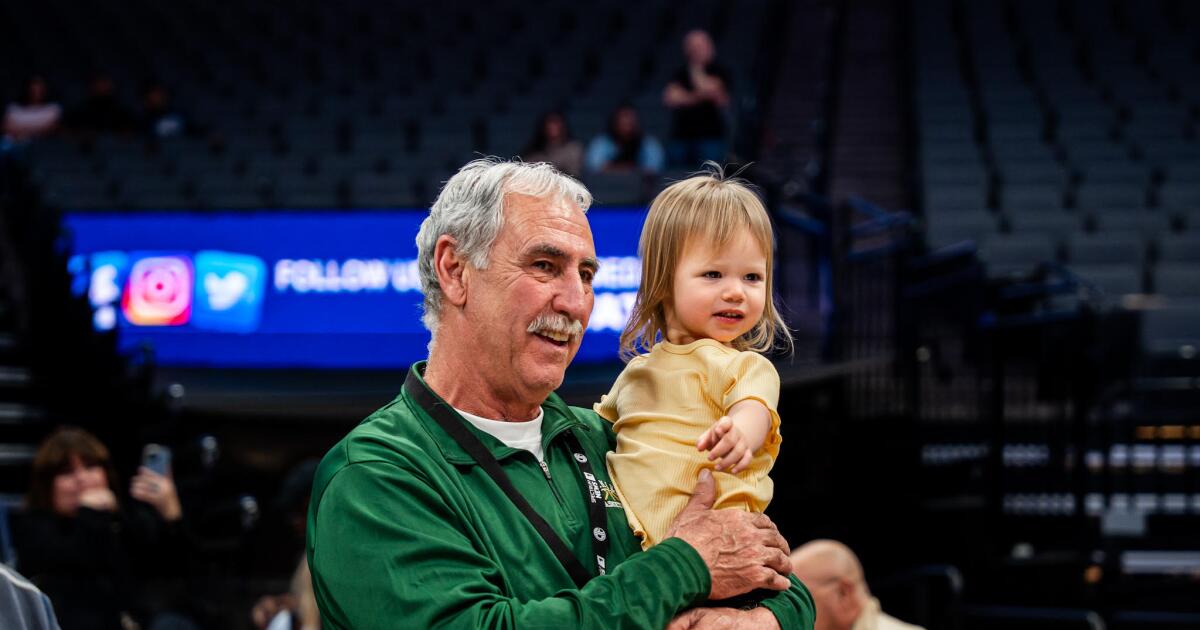
Mike White, former California and Oakland Raiders coach, dies at 89

Mike White, who had a successful career as a college coach with California and Illinois and later coached the NFL’s Oakland Raiders, has died. He was 89.

Cal said White’s family confirmed that he died Sunday in Newport Beach.

White helped the Golden Bears win a share of the Pac-8 title in 1975, led the Illini to their first Rose Bowl in 20 years in the 1983 season and coached the Raiders in their first two seasons back in Oakland in 1995-96 after leaving Los Angeles.

He also worked as an assistant for the San Francisco 49ers and was on Dick Vermeil’s staff with the St. Louis Rams when they won the Super Bowl following the 1999 season.

“Mike was special,” said Burl Toler Jr., a linebacker who played at Cal under White from 1974-77. “He treated us like men and with a lot of respect. Mike was a very gifted and smart coach who loved Cal and loved being a coach, and he surrounded himself with a lot of like minds who instilled in us a will to succeed.”

White was a four-sport student-athlete at Cal in the 1950s and spent time as an assistant with the Bears and at rival Stanford before getting the head coaching job at his alma mater in 1972.

White had a 35-30-1 record in six seasons at Cal, with his biggest success coming in 1975 when he was named coach of the year after the Bears finished tied with UCLA for first place in the conference. Cal finished 14th in the nation with an offense that featured Chuck Muncie and quarterback Joe Roth.

White also coached quarterback Steve Bartkowski earlier at Cal and helped develop him into the No. 1 overall pick in the 1975 NFL draft.

He then left for the NFL, spending two seasons as an offensive line coach for the 49ers, before returning to college in 1980 with Illinois. He led the Illini to a 47-41-3 record with three bowl trips, including a loss in the 1984 Rose Bowl to UCLA.

That 1983 Illinois team went 9-0 in the Big Ten and is the only team in conference history to beat every other conference opponent in the same season.

White then returned to the NFL in 1990, spending five seasons as an assistant with the Raiders before taking over as head coach. He had a 15-17 record before getting fired after the 1996 season.

Dubow writes for the Associated Press.

Source link