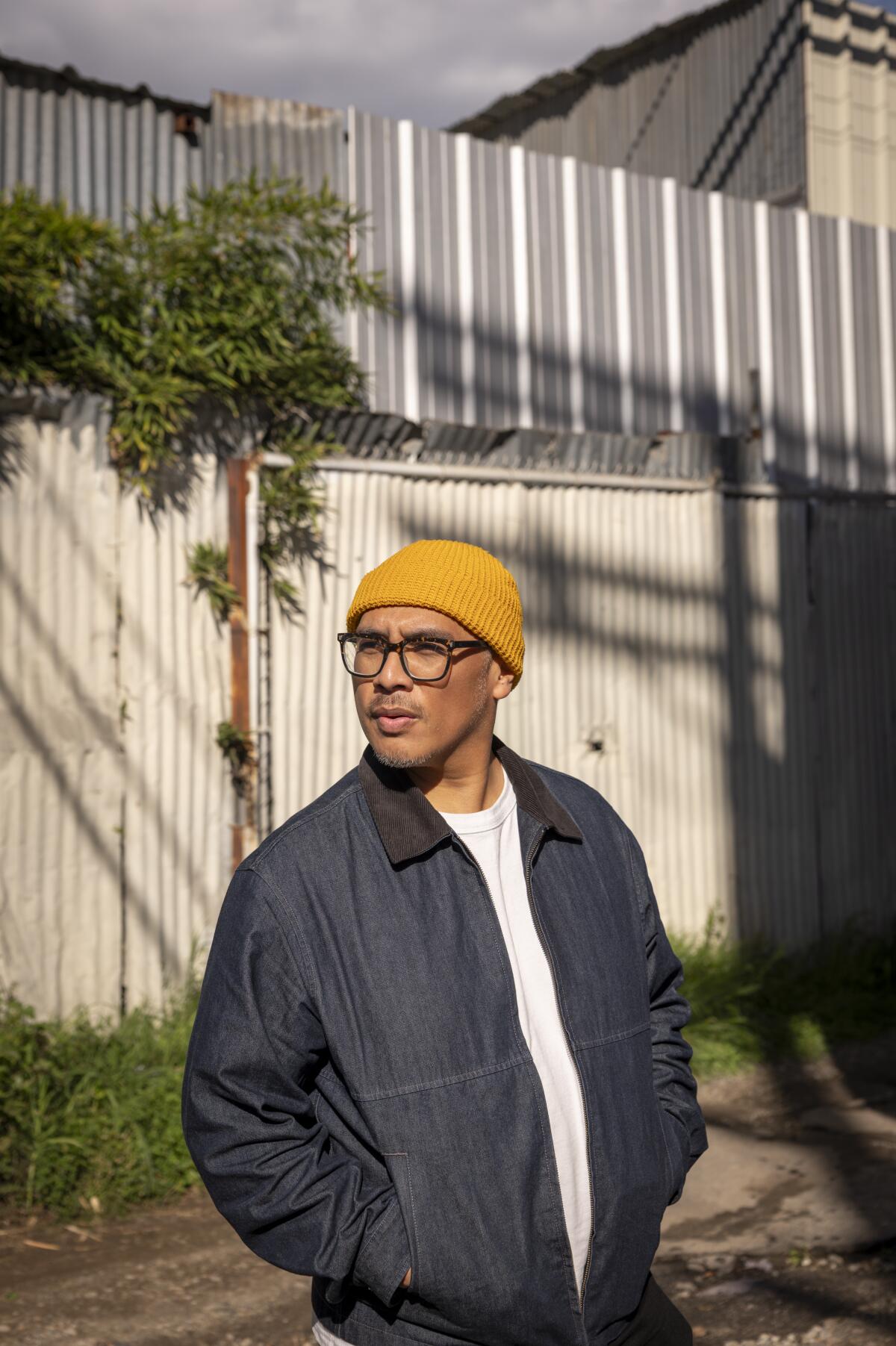
Martinez

Meet the ‘vato skateboarders’ from ‘One Battle After Another’

“It’s f— World War III out there,” says Gilberto Martinez Jr. as he skateboards while holding on to a car partway through Paul Thomas Anderson’s acclaimed crime drama “One Battle After Another,” about a group of revolutionaries being hunted by the U.S. government.

Driving the vehicle is Sensei Sergio St. Carlos (Benicio del Toro), who enlists the help of Mexican American “vato skateboarders,” the neighborhood watch, to guide his friend Bob (Leonardo DiCaprio), as he tries to escape the authorities during a chaotic protest when a sanctuary city comes under attack.

Gliding through tight indoor spaces and nimbly jumping across rooftops under the night’s sky, the courageous skating quartet is composed of El Paso natives cast locally: Martinez (34), Luis Trejo (30), Elijah Joseph Sambrano (27) and Julian Corral (29). That Anderson included them in this searingly political narrative as a heroic force felt validating.

“As skateboarders we’ve kind of always been the underdogs, seen as the outcast or the rebels,” says Martinez during a recent video interview with the whole squad gathered. “But in a way we’re showing freedom, we’re not trying to be put in a box, we express ourselves through this skateboard. We’re trying to give hope to other kids like us.”

Their skill set on the board landed them the part, but their presence influenced the production beyond their screen time.

“We all speak Spanish, and we were helping them on set to translate a lot of the things that they needed,” Martinez said.

Martinez and Trejo, who’ve been “homies” for a decade, learned about the opportunity from a mutual friend, Mark Martinez, involved in the El Paso film industry. Sambrano found out from a bartender pal, while Corral got word from the owner of the tattoo shop where he works. The four of them knew each other from hanging around the border town.

The group first met with casting director Cassandra Kulukundis, who read them their lines and asked them to recite them back to test their memorization skills.

“She pulled out her iPhone and we just started skating around her and giving her the lines,” Martinez recalls. “That’s pretty much what she showed Paul. And that’s when he was like, ‘These are our guys.’” [Laughs].

Though they had heard rumors that DiCaprio and Del Toro were in town, they couldn’t know for certain. “I was like, ‘It’s not true,’ just so I would not be so nervous about it,” Martinez said. It was only after signing nondisclosure agreements that they were made fully aware of the artists involved.

“They took us up to Sensei’s apartment to get an idea of the perimeter and what everything looks like,” says Martinez. “That’s when we first saw P.T.A. with his Adidas shoes and we were like, ‘Whoa.’”

Shot over the course of 11 days, their scenes took place in downtown El Paso, just a few minutes from Ciudad Juarez, Mexico, on the other side of the border. “Every single day was just magic,” says Trejo, who is also a musician. “This movie made us feel like we’re part of something on a big scale. It blew our minds that each of us had his own purpose in it.”

The “vato skateboarders,” as the production referred to them, recall speaking with stunt coordinator Brian Machleit ahead of their scenes. “He was very honest with us and said we needed to take this seriously,” Martinez says. “We really focused, and we weren’t playing around.” They practiced their stunts during the daytime, so that they could be prepared for shooting at night.

Anderson, they say, asks for multiple takes — often around 10 — changing his direction to have plenty of options to choose from when editing.

“Paul is always experimenting,” Trejo said. “He’s like a scientist, and he’s doing his poetry.”

Martinez revealed that his big moment, when he skates holding onto Sensei’s vehicle, transformed as they filmed it.

“My direction at first was to do it scared towards Sensei, like asustado,” he said. “After watching the dailies, Anderson came in with new notes.

“Paul’s like, ‘Hey Gil, this sounds like a zombie apocalypse. It’s not a zombie apocalypse, it’s a riot. Pretend like you’re going to go grab a beer and drink it on a rooftop, and then just say some s— like, ‘It’s f— World War III out here.’ And I was like, ‘Yeah, I like that. That sounds more me.’”

To personalize his close-up, Martinez had a suggestion of his own. “I was like, ‘Can I add some Spanish?’”

“Paul really let us use our lingo,” Martinez adds. “Leo was like, ‘Hey, how do I say ‘brothers’?’ And we told him, ‘Carnalitos,’”

In the film, DiCaprio’s Bob refers to the skaters as such.

Throughout the conversation, the group often refers to DiCaprio and Del Toro by their characters’ names: Bob and Sensei. Sharing the screen with A-listers they’ve grown up watching on screen was shocking at first, but then grew to feel a genuine closeness.

“I’d freak out when I got home,” Martinez said. “But on set, the first couple days you had to show them that you were like a brother to them. You can’t be like, ‘Hey man, we got to take a picture.’ It was more like, ‘We’re here to do our job.’ I never called him Leo. I always called him Bob. We just stayed in character. And then he’d be like, ‘What’s up bros?’”

Corral recalls a day when his foot hurt, and the production sent him to rest for a bit on his own. “Next thing you know, they put the other vatos in there and then they put Leonardo in there and we are just like, ‘How should we break the ice?’” Corral says. “And he did. He is like, ‘So what’s good around here to eat?’”

A musician like Trejo, and once involved with El Paso Kids-N-Co, a nonprofit community theater, Sambrano recalled sharing a moment with Del Toro.

“Benicio was like, ‘You play music? What kind of music is it? And I was like, ‘Alternative.’ And he said, ‘Oh, like the Mars Volta.’ And I thought, ‘Oh he knows of the culture, the Mars Volta is from El Paso.’”

Sambrano explains they were allowed to wear their own clothes on set. Early on, he happened to be wearing a T-shirt he got from Goodwill emblazoned with the image of the late wrestler Eddie Guerrero, also an El Paso native, and his nickname, “Latino Heat.”

“They were bouncing off each other, improvising,” Sambrano says. “And that’s when Benicio was like, ‘What if I just say Latino Heat?’ And then they were like, ‘OK, that’s the shirt he’s going to wear.’”

For the “vato skateboarders,” seeing their hometown depicted at the forefront of the resistance in such a high-profile film has strengthened their pride. “We’re from a frontera, a border city, and I’ve lived here my whole life. The community is amazing, people are friendly,” Sambrano said. “And seeing them highlight that is pretty awesome.”

And it’s not lost on them that immigration, and the relationship between the U.S. and Mexico, especially in a place like El Paso, are key subjects in Anderson’s film.

“Paul did do justice to how real life is in a comedic way so that maybe it reaches a different type of audience that is not tapped into these situations,” Trejo said. “The movie touches on things that a lot of people are afraid to talk about. They are afraid to get too political.”

The four skaters watched “One Battle After Another” for the first time at a cast and crew screening in El Paso at the Plaza Theater. “It was really special to watch it in a historic building in El Paso,” Martinez Jr. says. “And having our friends and family there to watch it a week before the movie came out was a beautiful moment for all of us.”

The friends wish to continue acting, and they already have other projects lined up, thanks in part to Jacob Cena, a location assistant on “One Battle After Another,” who is pushing them to seize this breakthrough.

For now, however, they’ve been diligently studying Anderson’s work. “We got pretty obsessed; these are all his movies,” says Martinez Jr. with a smile holding up a stack of the director’s movies on physical media.


Source link

Latino artists featured in Hammer Museum’s Made in L.A. biennial

Somehow in Los Angeles, everything comes back to traffic.

While making their works featured in the Hammer Museum’s Made in L.A. biennial, artists Patrick Martinez, Freddy Villalobos and Gabriela Ruiz set out to capture the essence of the city’s crammed streets through different lenses.

For over a decade, the Hammer has curated its Made in L.A. series to feature artists who grapple with the realities of living and making art here. It’s an art show that simultaneously pays homage to legacy L.A. artists like Alonzo Davis and Judy Baca, and gives a platform to newer faces such as Lauren Halsey and Jackie Amezquita.

This year’s show, which opened last month, features 28 artists. As part of that cohort, Martinez, Villalobos and Ruiz bring their lived experiences as Latinos from L.A. to the West Side art institution, drawing inspiration from the landscapes of their upbringing.

While creating their displayed works, Martinez took note of the many neon signs hanging in stores’ windows, leading him to make “Hold the Ice,” an anti-ICE sign, and incorporate bright pink lights into his outdoor cinder block mural, “Battle of the City on Fire.” With flashing lights and a shuttered gate tacked onto a painted wooden panel, Ruiz drew on her experiences exploring the city at night and the over-surveillance of select neighborhoods in the interactive piece, “Collective Scream.” Villalobos filmed Figueroa Street from a driver’s perspective, observing the street’s nighttime activity and tracing the energy that surrounds the place where soul singer Sam Cooke was shot.

This year, Made in L.A. doesn’t belong to a specific theme or a title — but as always, the selected art remains interconnected. These three artists sat down with De Los to discuss how their L.A. upbringing has influenced their artistic practice and how their exhibited works are in conversation. Made in L.A. will be on view until March 1, 2026.

The following conversation has been condensed and edited for clarity.

All three of you seem to put a spotlight on various elements of L.A.’s public spaces. How is your art affected by your surroundings?

Ruiz: I really got to explore L.A. as a whole, through partying and going out at night. I prefer seeing this city at night, because there isn’t so much traffic. That’s how I started my art practice. I would perform in queer nightlife spaces and throw parties in cheap warehouses. With my commute from the Valley, I would notice so much. I wouldn’t speed through the freeway. I’d instead take different routes, so I’d learn to navigate the whole city without a GPS and see things differently.

Martinez: That’s also how I started seeing neons. I had a studio in 2006 in downtown, off 6th and Alameda. I would wait for traffic to fade because I was staying in Montebello at the time. I would drive down Whittier Boulevard at night. And you see all the neon signs that have a super saturated color and glow bright. I thought about its messaging. None of the businesses were open that late. They were just letting people know they were there.

Ruiz: Specifically in this piece [“Collective Scream”], there’s a blinking street lamp. It reminds me of when I would leave raves and would randomly see this flickering light. It’s this hypnotizing thing that I would observe and take note of whenever I was on the same route. There’s also a moving gate, [in my piece,] that resembles the ones you see when you’re driving late at night and everything’s gated up.

Villalobos: You do experience a lot of L.A. from your car. It’s a cliche. But f— it. It’s true. When I moved out of L.A., I felt a little odd. I missed the bubble of my car. You can have what seems to be a private moment in your car in a city that’s packed with traffic and so many people. It made me think about what that means, what kind of routes people are taking and how we cultivate community.

Patrick Martinez's work, which included painted cinder blocks, is on display

Patrick Martinez’s “Battle of the City on Fire,” made in 2025, was inspired by the work of the muralist collective, named the East Los Streetscapers.

(Sarah M Golonka / smg photography)

It’s interesting that you all found inspiration in the biggest complaints about L.A. Maybe there’s something to think about when it comes to the way those born here think of car culture and traffic.

Martinez: I see its effects even with the landscapes I make. I’ll work from left to right, and that’s how we all look at the world when we drive. I always think about Michael Mann movies when I’m making landscapes, especially at night. He has all those moments of quiet time of being in the car and just focusing on what’s going on.

Beyond surveying the streets, your works touch on elements of the past. There’s a common notion that L.A. tends to disregard its past, like when legacy restaurants shut down or when architectural feats get demolished. Does this idea play any role in your work?

Martinez: The idea of L.A. being ashamed of its past pushed me to work with cinder blocks [in “Battle of the City on Fire”]. One of the main reasons was to bring attention to the East Los Streetscapers, the muralists who painted in East L.A. [in the 1960s and ‘70s as a part of the Chicano Mural Movement]. There was this one mural in Boyle Heights that was painted at a Shell gas station. It was later knocked down and in the demolition pictures, the way the cinder blocks were on the floor looked like a sculptural painting. It prompted me to use cinder blocks as a form of sculpture and think about what kind of modern-day ruins we pass by.

Villalobos: Speaking about L.A. as a whole feels almost too grand for me. But if I think about my specific neighborhood, in South Central, what comes to my mind is Black Radical Tradition. It’s where people are able to make something out of what other people might perceive as nothing. There’s always something that’s being created and mixed and mashed together to make something that, to me, is beautiful. It’s maybe not as beautiful to other people, but it’s still a new and creative way to see things and understand what comes before us.

Ruiz: Seeing my parents, who migrated to this country, come from nothing and start from scratch ties into that idea too. Seeing what they’ve been able to attain, and understanding how immigrants can start up businesses and restaurants here, speaks so much to what L.A. is really about. It’s about providing an opportunity that everybody has.

So it’s less about disregarding the past and more about making something out of nothing?

Martinez: It ties back to necessity, for me. Across this city, people come together by doing what they need to do to pay rent. It’s a crazy amount of money to be here. People need to regularly adjust what they do to survive. Recently, I’ve been seeing that more rapidly. There are more food vendors and scrolling LED signs, advertising different things. Once you understand how expensive this backdrop can be, that stuff sits with me.

Freddy Villalobos' "waiting for the stone to speak, for I know nothing of aventure," is on display.

Freddy Villalobos’ “waiting for the stone to speak, for I know nothing of aventure,” is an immersive work in which viewers can feel loud vibrations pass as they, figuratively, travel down Figueroa Street.

(Sarah M Golonka / smg photography)

We’ve talked a lot about how the past affects L.A. and the role it plays in your art. Does a future L.A. ever cross your mind?

Villalobos: I feel very self-conscious about what I’m gonna say. But as much as I love L.A. and as much as it helped me become who I am, I wouldn’t be too mad with it falling apart. A lot of people from my neighborhood have already been moving to Lancaster, Palmdale and the Inland Empire. When I go to the IE, it feels a little like L.A. and I’m not necessarily mad at that.

Ruiz: It’s really difficult to see what the future holds for anybody. Even with art, what’s going to happen? I don’t know. It’s really challenging to see a future when there’s a constant cycle of bad news about censorship and lack of funding.

Martinez: It’s murky. It’s clouded. This whole year has been so heavy, and everyone talking about it adds to it, right? We’re facing economic despair, and it’s all kind of heavy. Who knows what the future will hold? But there are definitely moves being made by the ruling class to make it into something.

Source link