
Lives

Creating a ghost town: Lives in limbo behind Israeli gates and checkpoints | Occupied West Bank

Hebron, occupied West Bank – Badr al-Tamimi, 60, lives in Hebron’s Old City, where Israeli checkpoints, iron gates and road closures turn the simplest tasks into a dispiriting daily ordeal for Palestinian residents.

The situation goes beyond mere restrictions on movement. Israel has created a ghost town in parts of Hebron, where residents feel they are being driven out. This is most pronounced in an area known as H2, where Israel has complete control and Palestinians are subject to the dictates of the military.

Recommended Stories

list of 3 itemsend of list

A few days ago, Israeli authorities installed three iron gates across a 200-metre (656-foot) stretch of Hebron’s Old City – amounting to just 0.2 dunams (200 square metres) – as part of Israel’s apparent attempts to restrict Palestinians’ freedom to move around the city.

Hebron Mayor Yousef al-Jabari told Al Jazeera that one gate was erected on al-Zahid Road, the only route accessible to vehicles reaching the Old City entrance. A second was placed at the start of al-Shalala Street, which leads to shops connecting to the Bab al-Zawiya area in the city centre. A third towers over another section of al-Shalala Street, a thoroughfare used by pedestrians to access the shopping area.

They are part of a wider web of travel restrictions across the occupied West Bank, but Hebron, which has a strong settler presence, has suffered more than most Palestinian cities.

Approximately 40 percent of the 89 checkpoints in the West Bank and 11 percent of all 925 movement obstacles are located in the H2 area of Hebron, which is under tight Israeli control, according to the United Nations Office for the Coordination of Humanitarian Affairs (OCHA).

About 7,000 Palestinians in an area of Hebron where hundreds of settlers live are affected by the latest travel restrictions. Since October 2023, when the genocidal war on Gaza began, only Palestinians with specific identification numbers could enter this area. Checkpoints at the entrance to this zone are generally only open from 7am to 8pm.

Badr Al-tamimi is forced to move between iron gates to reach other parts of the old city where he lived his whole life Photo by Sari Jaradat -1791707986
Badr al-Tamimi is forced to move between iron gates to reach other parts of the Old City where he lived his whole life [Sari Jaradat/Al Jazeera]

Al-Tamimi, who lives in the al-Sheikh neighbourhood adjacent to the city’s famed Ibrahimi Mosque, owns a shop in the Old City.

Palestinians can be kept waiting for hours at the checkpoints, and the mood of a soldier manning one can decide the commute time of a Palestinian. Worshippers attempting to enter the Ibrahimi Mosque can be held up for hours by soldiers.

“They might allow a limited number of people to enter while others are forced to wait, whereas resident movement comes to a halt during incursions, Jewish holidays, and the associated security measures,” he added.

Repeated closures have paralysed economic activity in Hebron, making it increasingly difficult for shops and companies to do business.

“Our presence in the Old City is a matter of steadfastness, not the availability of the elements needed for economic life,” al-Tamimi said.

Even after Israel’s occupation of the city in 1967, Hebron was once a bustling city with lively shops and markets. Residents could move more freely between neighbourhoods, which helped with economic life in the city.

Things changed in 1994, the year of the Ibrahimi Mosque massacre, when a US-born Israeli settler murdered 29 Palestinian worshippers.

From that point, the Old City’s geography changed, becoming isolated from its surroundings, al-Tamimi said.

He points to Shuhada Street, once a vital artery for transport and commerce in the city before road closures and restrictions transformed the area’s reality.

“They committed the crime, yet they continue to punish us for it,” he said.

In 1997, the Hebron Protocol was signed between the Palestine Liberation Organization (PLO) and Israel, dividing the city into two zones: H1, which was under relative Palestinian jurisdiction, and H2 – an area which includes the Old City, the Ibrahimi Mosque, and illegal settlements – remained under Israeli security control.

Issa Amro, coordinator of the Youth Against Settlements group, said Israeli prohibitions intensified with the outbreak of the second Intifada in 2000 when Hebron became a centre of the uprising.

During this period, vast areas of the city were sealed off, shops were forced to close, and residents often remained confined to their homes or neighbourhoods.

Since Israel’s genocidal war on Gaza began on October 7, 2023, the number of checkpoints has risen to 32, while other obstacles impeding Palestinian movement now exceed 130.

Israel installed new iron gates in Hebron’s Old City to restrict the movement of Palestinians Photo By Sari Jaradat-1791707993
Israel installed new iron gates in Hebron’s Old City to restrict the movement of Palestinians [Sari Jaradat/Al Jazeera]

The “closed zones”, designated by Israeli authorities as areas of military activity with restricted access to Palestinians, have expanded around the Ibrahimi Mosque and the illegal settlements that lie in the heart of the city.

“The movement restrictions are effectively holding residents as hostages,” Amro said.

Mayor al-Jabari said approximately 10,000 Palestinians in the Old City and the surrounding closed zones are affected by these measures.

Some parts of Hebron are inaccessible to vehicles, and Palestinian residents are subject to curfews two or three days a week, usually over the weekend.

He believes these restrictions are aimed at hindering Palestinians’ ability to return home and stifle life in parts of Hebron.

Meanwhile, Israeli authorities have helped settlers expand in the area, imposing a new suffocating reality for Palestinians in the city.

Al-Jabari said Israel’s current government could be doing this to curry favour with settlers ahead of this month’s election.

Control of Hebron, its Old City, and the Ibrahimi Mosque is a key issue for settlers, and politicians in this group occupy key posts in the Israeli government.

This has coincided with a concerted effort by Israeli authorities to cement the settler presence in and around the city.

“The seizure of buildings and land, along with the installation of gates, is a continuation of Israeli policies that have been in place for decades,” al-Jabari said.

“These include the closure of Shuhada Street and the shutting down of over 500 shops, as well as the establishment of settlement outposts and military positions within the Old City.”

He has seen more restrictions on Palestinians’ freedom of movement over the past month, measures that will undoubtedly appease settlers.

Hebron municipality has responded to this by filing lawsuits in Israeli courts, despite its scepticism about the impartiality of the judiciary.

With these measures continuing, life for Palestinians is getting worse, making work, life and education a daily struggle.

Israel cites the security situation as a pretext for erecting more checkpoints and iron gates in Hebron, but there are no such restrictions on settlers.

Since 2015, Israel has limited the number of Palestinian residents of closed zones who can pass through these checkpoints. Students and teachers frequently have their bags searched by Israeli soldiers or are detained.

Ayat al-Jabari, a 40-year-old science teacher, worked for a year at Qurtuba School, located near the closed Shuhada Street, before transferring to her current position at Al-Fayha School, near the Ibrahimi Mosque.

Although reaching Qurtuba School from her home should have been a five-minute journey, it often took an hour.

On her unsettling morning route through a nearby cemetery, often in darkness during the winter months, settlers and soldiers often appear in the graveyard to block the path of Palestinians or abuse them.

“Every day, I was forced to take a long route and walk through a cemetery to avoid passing the checkpoint, as I don’t hold a [special identification card] number. Even those who do hold numbers are sometimes forced to take this path to escape the soldiers’ moods,” she said.

After moving to Al-Fayha School, al-Jabari hoped her commute would improve, but the situation is no better than before.

“Whenever Jewish holidays arrive, these schools are closed because all the students live in areas subjected to a total lockdown, to the point where residents are even forbidden from opening their front doors,” she said.
Source link

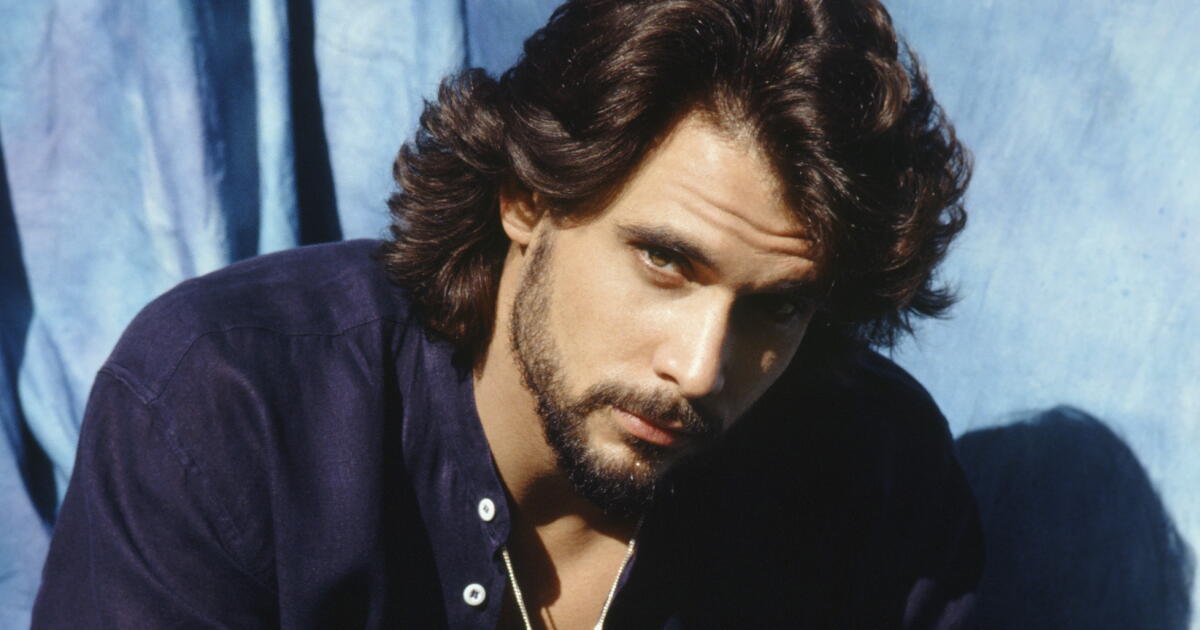
Robert Kelker-Kelly dead: ‘Days of Our Lives’ Bo Brady actor was 62

Actor Robert Kelker-Kelly, who was a familiar face in daytime dramas in the 1990s with turns in “Days of Our Lives” and “General Hospital,” has died.

Kelker-Kelly died Saturday evening at his home in St. Peters, Mo., the city’s Police Department confirmed Monday to The Times. Law enforcement officials responded Saturday evening to a report of an unconscious man who was not breathing. Police arrived at the actor’s home along with paramedics and “life-saving measures were administered but were unsuccessful,” police said.

Police said officers found nothing suspicious at the scene. A cause of death was not revealed, but police noted that Kelker-Kelly was said to have complained of chest pain before he became unresponsive. A spokesperson for the St. Charles County Ambulance District confirmed paramedics responded Saturday to a report of a man in cardiac arrest. Kelker-Kelly was 62.

Kelker-Kelly primarily acted in TV and was best known for his work in long-running daytime dramas, which also included “Another World.” Notably, he portrayed the rebellious heartthrob Beauregard “Bo” Brady in “Days Of Our Lives” from 1992 to 1995. He began his turn as Bo, which lasted for more than 586 episodes, following the departure of original actor Peter Reckell, who would return to the show off and on in the following decades.

During his tenure, Kelker-Kelly portrayed the spouse of Hope Brady and love interest of Lisa Rinna’s Billie Reed. She spoke negatively of that experience and called her co-star a bully in her memoir, released earlier this year. He did not respond to People’s request for a response at the time.

Kelker-Kelly made his official debut in “Another World” in 1987 and appeared in more than 400 episodes in a handful of roles until 1998, according to the actor’s IMDb page. He was also known for his work as Stavros Cassadine in “General Hospital” and its spinoff series “Port Charles.” John Martinuzzi originated the role. Kelker-Kelly’s “General Hospital” tenure lasted from 2001 to 2014 and was his final TV role. His television credits also include “Jack’s Place,” “Touched by and Angel” and “Rescue 77.”

The actor was born April 18, 1964, in Wichita, Kan. His mother was a nurse and his father a pathologist. Kelker-Kelly’s parents divorced when he was 7 years old, and he later moved in with his father. The actor was in and out of colleges but studied acting and grew fond of Shakespeare, according to People.

After his acting career, Kelker-Kelly became a professional pilot. He married production assistant Linda Ratner in 1988; they divorced four years later. Kelker-Kelly then married “Days of Our Lives” actor Miriam Parrish in 1997. That marriage ended in 2013. He is reportedly survived by a daughter, Amelia Rose Kelly.

Source link

Michael Araujo lives his dream as the voice of Angel Stadium

You’ve probably never seen Michael Araujo, but if you’ve attended an Angels game since 2013, you’ve definitely heard him.

On Sunday, Araujo will work the final game of his 14th season as the Angels’ public address announcer. During that time he has started more home games than Mike Trout and finished hundreds more than any reliever to come out of the bullpen.

Yet for most fans, his voice has been little more than background noise, an acapella Muzak that only gets noticed when Araujo makes a mistake.

And mistakes just don’t happen, said Davin Maske, the Angels’ director of entertainment and production.

“I don’t remember any,” said Maske, Araujo’s boss. “There isn’t that one major mistake since I’ve been here that I could recall.”

Araujo, who is also the stadium voice for the Galaxy, has worked Gold Cup and Copa América soccer matches, eight World Cup games and the 2003 Women’s World Cup final. But the Angels’ gig is his dream job and he passed 1,000 games as the team’s PA announcer last month.

“He loves sports,” said his wife Kathryn Casey. “He really does enjoy being there and being part of it because he’s a huge fan. It’s not just a job.”

It is a job that comes with high expectations, though. Because if the broadcasts of the late Vin Scully were the soundtrack for baseball fans in Southern California, for people of a certain age, the booming baritone of John Ramsey will forever be the template for what a PA announcer should sound like.

Ramsey, who died in 1990, was the original PA voice of the Angels, as well as the Dodgers, Kings, Lakers and L.A. Raiders. He also did the Rams and USC football with a calm, articulate and authoritative delivery that was so powerful, it had its own echo.

“Would you all please rise (rise, rise, rise) and honor America in the singing of our national anthem (anthem, anthem, anthem).”

It was like being spoken to by God, an impression aided by the fact that Ramsey, hidden in a small booth near the press box, was heard but never seen.

“That’s not me, Araujo said. “So I try not to emulate that.”

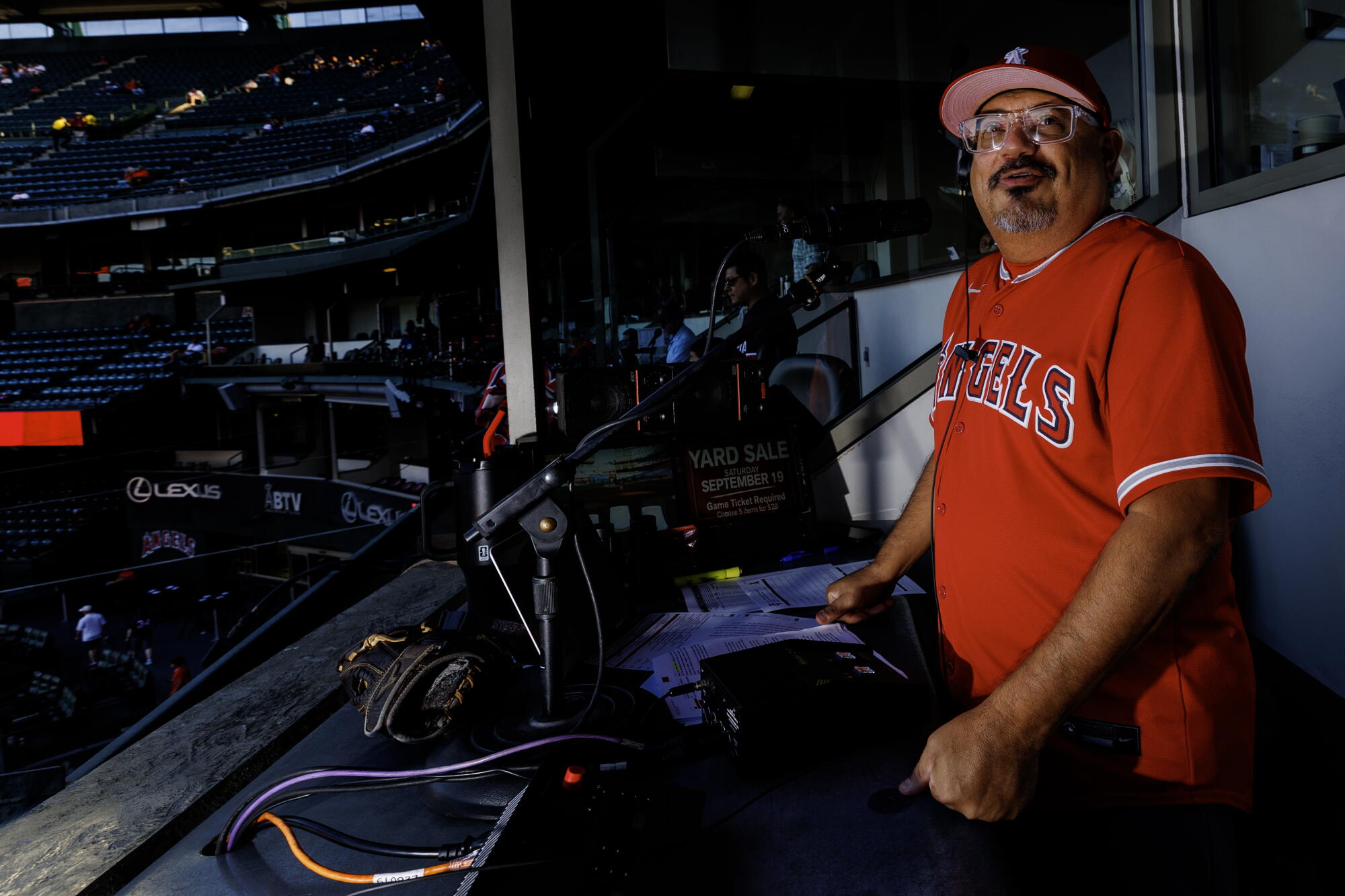
Angels public address announcer Michael Araujo overlooks the field in his booth before a game.

Angels public address announcer Michael Araujo overlooks the field in his booth before a game against the Minnesota Twins on September 17.

(Gina Ferazzi / Los Angeles Times)

Still, like Ramsey, Araujo’s gift is his voice. And though his delivery isn’t nearly as deep and commanding as Ramsey’s, it is unique in that it has a distinct, enthusiastic lilt, one he’s been able to maintain through what will likely be the Angels’ first 100-loss season.

“I try to bring the energy,” he said.

“It’s all about riding your vibes,” Maske added. That’s why Araujo’s perch on the club level behind home plate is exposed to the crowd rather than enclosed, like the booths to his right used by the radio and TV broadcasters. The idea is to feed off the fans, not lock them out.

“Baseball is gnarly. It’s repetitive. It’s a sport that’s inherently, at times, very boring,” Maske said. “So you’ve got to find those little moments to make it entertaining.

“It’s not NFL. It’s not the NBA. It’s baseball. Mike’s good at kind of finding that balance of excitement and traditionalism.”

And the excitement, even at the end of a blowout loss, is genuine, he said.

“The Angels were my team growing up, so the Angels was my dream job,” said Araujo, a former season-ticket holder. “I’ve been very fortunate.”

“I want to get paid to watch sports and that’s it,” he continued. “So whatever I’ve got to do to be invaluable so that I stay there, that’s kind of my mission.”

It’s not a mission that pays much, however, with most PA announcers across the majors earning between $100-$500 a game to announce each hitter as he comes to plate, read commercial copy between innings and, in Araujo’s case at least, to handle the play-by-play for the cartoon races that run on the scoreboard late in the game.

“It’s fun money,” said Casey who, like Araujo, is a teacher as well as the clock operator at Galaxy games, where she works alongside her husband. “We use it for travel.”

The job is one Araujo stumbled into. Despite a rich voice and a lifelong passion for sports, pairing the two was something that just happened, not something that was planned.

A teacher at an alternative-education high school in La Puente, Araujo, 54, has worked for the Galaxy since the MLS team’s second game in 1996, filling a number of roles from glorified errand boy to assistant game-day producer. That last job required him to stand behind the PA announcer and relay silent cues, and since he knew the gig, Araujo was handed a microphone and asked to fill in a few times during absences, sick days and other emergencies.

The biggest emergency came when Victor Villalba, the Galaxy’s regular announcer, left in the middle of a season to join the Dallas Cowboys radio team. Araujo was the natural choice to finish out the year and he’s been there ever since.

“That was 2002,” he said. “So I’m in my 25th season.”

It was similar desperation that led to his job with the Angels. When David Courtney, who had been with the team for nearly two decades, died at 56 two months after the 2012 season, the Angels began asking around for a replacement and Araujo’s name was the one they heard most frequently. So he was invited to spring training the following year to audition and he beat out two others to claim the job.

On game days Araujo gets to the ballpark about 2½ hours before first pitch, pausing in the parking lot to pull on an Angels cap and jersey with his name on the back. If the team wins, he’ll wear the same jersey the next day; if not, he’ll rotate through a closet of red, white, gray and City Connect jerseys.

Araujo’s only other tools are a microphone and a laptop, on which he’s installed an interactive software program he created that tracks the lineups of both teams. He can also call up pronunciation guides for players on all 30 major league teams, though he’s found the radio broadcasters for the visiting clubs are often more helpful.

Angels public address announcer Michael Araujo overlooks the field from his booth.

Angels public address announcer Michael Araujo has worked more than 1,000 games at Angel Stadium and has been the Galaxy’s public address announcer since 2002.

(Gina Ferazzi / Los Angeles Times)

His cramped work space, about 90 feet from the field, has enough room for two green vinyl chairs, though Araujo prefers to stand when he’s working. And unlike many people whose vocal chords are their livelihood, Araujo says he has few ritualistic habits to protect his voice.

“In my bag I have a gazillion cough drops; a couple of different kinds, some with honey,” he said. “I definitely wouldn’t do anything carbonated before a game. Makes you burp and all that kind of stuff.”

Araujo is one of three Latino PA announcers in the majors, alongside Marysol Castro, who works for the New York Mets, and Frank Fernandez of the Miami Marlins. Given that 30% of big-league players are from Latin America, the fact that just 10% of the PA announcers are Latino is something Araujo said he thinks about during Hispanic Heritage Month.

“Did I grow up in Boyle Heights or anything like that? No, I’m no poster child or miracle story or anything like that,” said Araujo, who was raised middle class in La Verne, where his father, a sheriff’s deputy, and mother, a nurse, often spoke to one another in Spanish.

“We are here in 2026 and it’s not a little more prevalent. It can be an aspiration to any kid, even one of my students, that bigger things are possible.”

For a PA announcer, it turns out, there are times when it’s important to be heard and seen.

Source link

Cat Deeley’s shock response to Patrick Kielty’s new romance revealed by pals as pair bury 12-year marriage for new lives

TWO years ago, Cat Deeley was in a very different place to where she is now.

The TV presenter, 49, who had replaced Holly Willoughby on This Morning in March, was grappling with a punishing work schedule, the pressure to save the ITV show from its tarnished reputation and a marriage faltering under the pressure of two “tricky” work schedules.

This Morning host Cat Deeley had an unexpected response to her ex Patrick Kielty’s new relationship Credit: Alamy
Cat’s ex, TV presenter Patrick Kielty, was all smiles as he left a north London pub with a new date following a cosy evening together Credit: TillenDove

In the three month period she became tearful three times on screen, and appeared at times “visibly overwhelmed.”

And speaking five months after stepping into her new hosting role, she admitted the scrutiny she was under had “shocked her.”

However, the popular star has rebuilt her life after her divorce from Patrick Kielty, 55, with a second National Television Award under her belt with This Morning, a series of lucrative commercial deals and new man Charlie Coleman, who she hopes to spend Christmas with.

And friends of the star this week told how ex Patrick’s new relationship with businesswoman Michelle McManus – the pair were seen cosying up at a North London boozer – is the icing on the cake – saying she told them: “She seems nice, and she is doing me a favour, he’s a better person when he’s happy.”

One said: “Cat’s attitude is: ‘Good luck to them. At the end of the day, that’s the whole point of separating in the first place.’

“She is genuinely happy for him, and knows it’s good for them that he’s happy and positive.

“Cat herself is in a great place and that’s where she wants to stay.

“She and Charlie are getting on really well and are already talking about spending this Christmas together, though they will have to work out the practicalities as she and Paddy share the childcare arrangements 50/50.”

Former So You Think You Can Dance? host Cat – who swapped her $5 million family home in Beverly Hills for a £4.9 million five-bedroom house in Hampstead in 2020 – joined This Morning during a period of extreme turbulence.

Former host Phillip Schofield had quit ITV in May after an “unwise but not illegal” affair with a younger co-worker was revealed.

Holly, who appeared on This Morning for 14 years prior to her exit, stepped back from the spotlight in October, following stalker Gavin Plumb’s terrifying plot to kidnap, rape and murder the TV star being uncovered.

Plumb was jailed for life in July following an eight-day trial.

Against this challenging backdrop, Cat and Ben Shephard, 51, took the reins of the popular daytime show.

Sources told how the pair appealed to bosses as a “safe pair of hands” who could steer them out of a crisis.

But even her early interviews showed signs she feared wading in too deep, as she said: “If it gets too much for me, I’m going to quit. I don’t need to do it – I could be a mum for most of the year and go and do the shows in America.”

And in one interview she opened up about juggling work and motherhood: “I do the juggle – the juggle is real, the struggle is real. You know, we know, we’re all just trying to make everything work. It’s all a juggle.”

Cat shares two sons, Milo and James, with ex husband Patrick – who she was married to for almost 13 years before they announced their split in July 2025.

But sources say the fault lines had appeared in late 2023, when the pair were struggling to balance their schedules.

Patrick – the host of RTE‘s The Late Late Show in Ireland – commuted to film the show in Dublin, while Cat’s So You Think You Can Dance? schedule had also created issues, requiring her to jet back to the US for long stretches.

Her move back to UK television was supposed to lessen the pressure on the duo – one of TV’s power couples.

Cat Deeley was all smiles at the National Television Awards 2026 show Credit: Getty
Patrick and his beau looked cosy- spending several hours over dinner and wine Credit: TillenDove

But fans noticed that the star appeared increasingly emotional on the This Morning set.

In March 2024, just days after she joined as host, Cat burst into tears backstage upon meeting Buddy, an autism assistant puppy introduced to the studio.

She explained to viewers that meeting Buddy triggered her grief over losing her family dog, Lilly, the previous summer.

Weeks later in April, while introducing guest Kerry Irving – whose late springer spaniel Max had helped him overcome depression – Cat broke down in tears and had to ask co-host Ben to take over reading her lines.

And two months later Cat fought back tears during an interview with the family of William Reckless, eight, who had to have both of his legs and nine fingers amputated due to a severe battle with sepsis and scarlet fever.

Her 48th birthday broadcast in October also caused the presenter to break down in tears, after she was surprised by a recorded message from British poet Pam Ayres – who she said had inspired her as a child.

But 2025 seemed to bring a more positive standpoint – and a bombshell, as Cat and Patrick announced their divorce in July.

Both were keen to insist that they remained amicable, and stressed that no third parties were involved in their decision to split.

They also made clear their intention to share the parenting of their children, Milo, 10, and James, eight.

A few months later, September brought an incredible boost for the star – when This Morning won the National TV Award for Daytime, after the repeated scandals engulfing the programme had seen it lose the title in 2023 and 2024.

After the cast and crew were seen going wild in the audience, Cat said on stage: “We are so lucky to get to do this show, we all love it.

“Every single person who comes on, we love this show and it’s like having a family.”

Sources told how the award was “a shot in the arm” for the entire team behind the show – appearing to signal they were back on track.

And in the months to follow, Cat was to build up a relationship with Amazon MGM exec Charlie Coleman – who she was spotted with at a Hyde Park Lewis Capaldi gig in July.

Two months later, she spoke out about how she was thriving as a single mum – saying it was about being “as organised as you can be.”

She also admitted she had an “amazing nanny” to keep their lives on track around her busy schedule.

And she added: “Everybody is doing their best.”

In the same month Paddy – who has signed a new deal with The Late Late Show which will see him host until 2028 – said he was “pretty good” adding that the divorce was “part of the tapestry of life.”

And now, with him also moved on with new love Michelle, it seems another piece of the tapestry is complete.

The pair were married for almost 13 years before they announced their split in July 2025 Credit: Getty
A source said Cat ‘is genuinely happy for him’ Credit: Splash

Source link