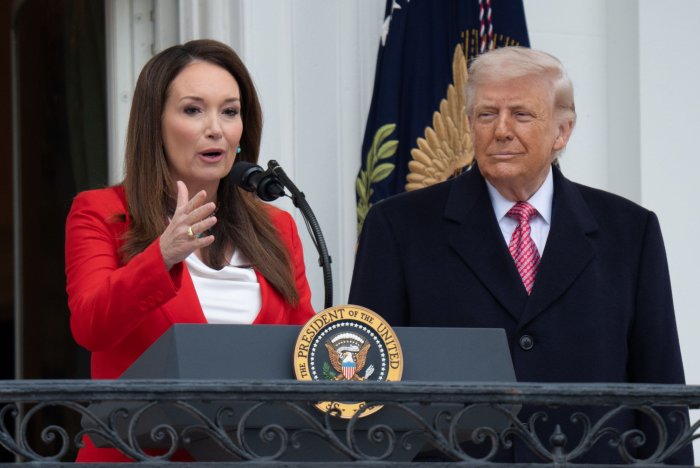
Lindsey Graham

Trump gives Iran 48 hours to open Strait of Hormuz or face ‘hell’

April 4 (UPI) — President Donald Trump on Saturday reminded Iran that his 10-day deadline for it to reopen the Strait of Hormuz is 48 hours away and “all Hell will reign down” if the trade route is not made passable.

Trump said on March 26 that he had given Iran 10 days to start allowing ships to transit the Strait of Hormuz, through which roughly 20% of the world’s oil and gas supply travels, or he would direct the U.S. military to attack the nations energy sites.

Iran on Wednesday requested a ceasefire in the war launched in February by the United States and Israel, which Trump said he would consider when the Strait is “open, free and clear.”

Saturday morning, in a post on Truth Social, Trump reiterated his expected time frame for the Strait to open, the deadline for which is April 6.

“Remember when I gave Iran ten days to MAKE A DEAL or OPEN UP THE HORMUZ STRAIT,” Trump said. “Time is running out — 48 hours before all Hell will reign [sic] down on them. Glory be to GOD!”

U.S. Sen. Lindsey Graham, R-S.C., said later Saturday after speaking with Trump that he is “convinced that he will use overwhelming military force against the regime if they continue to impede the Strait of Hormuz and refuse a diplomatic solution to achieve our military objectives,” Axios reported.

Iran’s Gen. Ali Abdollah Aliabadi in a statement reportedly called Trump’s post “a helpless, nervous, unbalanced and stupid action,” and then Aliabadi returned Trump’s threat that “the gates of hell will open for you.”

In indirect negotiations, Iran has said that it would not accept a temporary ceasefire, and instead wants an end to the war and promises that the United States and Israel will not stage future attacks against it.

President Donald Trump delivers a prime-time address to the nation from the Cross Hall in the White House on Wednesday. President Trump used the address to update the public on the month-long war in Iran. Pool photo by Alex Brandon/UPI | License Photo

Source link

Supreme Court to hear arguments in birthright citzenship case

April 1 (UPI) — The U.S. Supreme Court is hearing oral arguments in a case on Wednesday that could reshape what it means to be a U.S. citizen.

The case, Trump vs. Barbara, is over President Donald Trump‘s Jan. 20, 2025, executive order “Protecting the meaning and value of American citizenship,” which seeks to change the application of the Citizenship Clause, ending birthright citizenship.

In his executive order, Trump argued that the 14th Amendment of the U.S. Constitution “has never been interpreted to extend citizenship universally to everyone born within the United States.”

The law of the land, as it has been recognized since the ratification of the 14th Amendment in 1868, has been that “all persons born or naturalized in the United States, and subject to the jurisdiction thereof, are citizens of the United States and of the State wherein they reside.”

Trump’s executive order remains blocked from taking effect, with lower courts affirming that his attempt to end birthright citizenship is unconstitutional. In December, the Supreme Court agreed to take up the case, beginning with oral arguments starting on Wednesday.

U.S. Solicitor General John Sauer will argue on behalf of the Trump administration.

“If the Trump executive order is upheld, it would mark an enormous change in how the United States understands who is a citizen and who is not,” Kate Masur, John D. MacArthur Professor of History at Northwestern University, told UPI.

Masur filed an amicus brief supporting a challenge to Trump’s executive order.

“There’s certainly never been a president who issued an executive order trying to undermine birthright citizenship in this way,” Masur said. “Congress has repeatedly, through legislation, affirmed birthright citizenship and the Supreme Court has also affirmed birthright citizenship.”

The Trump administration’s argument against birthright citizenship hinges on its interpretation of the term “jurisdiction” in the context of the clause “subject to the jurisdiction thereof.”

In an amicus brief by Sen. Ted Cruz, R-Texas, Sen. Lindsey Graham, R-S.C., and other Republican lawmakers, they contest that the authors of the 14th Amendment could have written “subject to the laws.” Instead, the use of the term “jurisdiction” requires “allegiance” to the United States.

“Allegiance is also a reciprocal relationship. The person must be present with the consent of the sovereign, a factor on which this Court extensively relied in United States v. Wong Kim Ark,” the Republican lawmakers argue. “But illegal aliens and their children are present in the United States without consent, i.e., only by defying its laws.”

The lawmakers also argue that their interpretation of total allegiance looks to “early English caselaw.”

The challenges to birthright citizenship by Republicans are not new, Masur said.

The Wong Kim Ark case that the Republican lawmakers referred to affirmed birthright citizenship under the 14th Amendment. The case was brought on when the U.S. government denied the son of Chinese Immigrants, Wong Kim Ark, re-entry into the United States.

Ark, who was born in San Francisco, had taken a trip to China and was detained upon his return to the United States. The case took place in 1898, more than a decade after the passage of the Chinese Exclusion Act, which prohibited Chinese workers from seeking citizenship in the United States.

Since Wong Kim Ark, there have continued to be opponents of birthright citizenship, though the immigrant groups their movements targeted have changed. Since the 1990s, immigrants from Spanish-speaking countries have largely been the central focus of those seeking to end birthright citizenship.

Former Sen. Steve King, R-Iowa, repeatedly introduced legislation on Capitol Hill trying to end birthright citizenship. His most recent effort was in 2015. In 2019, King was removed from all committee assignments after defending white supremacy and white nationalism, following years of racist comments throughout his 17-year career.

“The thing that these movements have in common over time is their desire to limit who among people born in the United States gets to be a citizen,” Masur said. “Usually it is driven by various anti-immigrant sentiments.”

Daisy Hernandez, author of Citizenship: Notes on an American Myth, told UPI that there are modern examples of what happens when birthright citizenship is taken away.

The Dominican Republic amended its constitution in 2010 to remove birthright citizenship for Haitians in the country. In 2013, it made the law retroactive to 1929, removing the citizenship of an estimated 200,000 people overnight.

“That is an example of what would happen in the United States. However, for us it would happen in terms of millions of people,” Hernandez said.

Children of immigrants who have their citizenship revoked become stateless, Hernandez explained. With no country to call home, they are left adrift without the right to exist anywhere.

“Statelessness means that you have no government which you can turn to in any way,” she said. “It means you do not have any documentation of any kind. You don’t have documentation that you have a right to be anywhere. The philosopher Hannah Arendt said ‘citizenship is the right to have rights.’ You need a government to recognize that you have rights.”

There are more than 4 million children in the United States who have parents who are undocumented immigrants.

If Trump’s executive order is allowed to stand by the Supreme Court, Hernandez and Masur said the United States could return to an era of the 19th century when citizenship varied from state to state.

“It is really jarring to remember once upon a time certain states within the United States recognized the citizenship and humanity of Black Americans and we had other states that did not,” Hernandez said. “So are we going to end up in a situation where a child born to an undocumented parent is recognized as a citizen as long as they stay within the state of New York or of Massachusetts but would then become stateless if they crossed into Connecticut or further south or further west?”

Most countries in the Western Hemisphere recognize birthright citizenship. The Dominican Republic and Colombia are rare exceptions.

“We have always understood being American as being very closely tied with birthright citizenship,” Hernandez said. “It would be a collapse of how we understand American identity in the United States.”

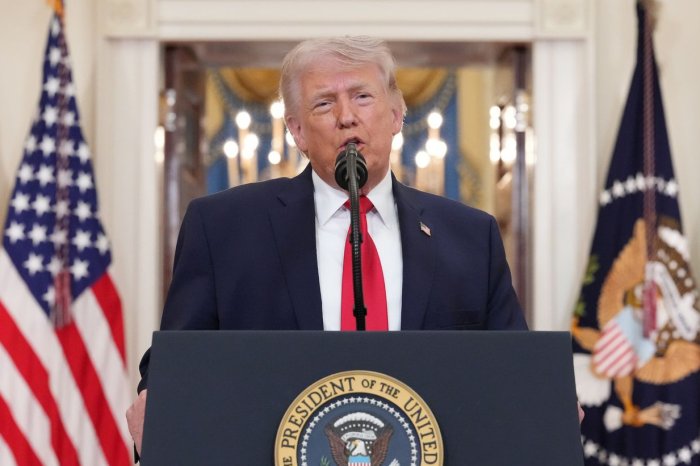
President Donald Trump stands with U.S. Secretary of Agriculture Brooke Rollins during an event celebrating farmers on the South Lawn of the White House on Friday. Photo by Aaron Schwartz/UPI | License Photo
Source link

Acting TSA leader: Officers sleeping in cars, selling plasma

March 25 (UPI) — Ha Nguyen McNeill, acting administrator for Transportation Security Administration, said Wednesday that TSA agents are struggling during the shutdown.

She made the comments during a hearing before the House Committee on Homeland Security amid funding issues for the Department of Homeland Security.

“Officers are reportedly sleeping in their cars at airports to save gas money, selling their blood and plasma, and taking on second and third jobs to make ends meet, all while expected to perform at the highest level when in uniform to protect the traveling public,” she said in her opening statement to the committee.

“Many have received eviction notices, lost their childcare, missed bill payments and been charged late fees, damaged their credit, defaulted on loans, and have been unable to even qualify for a loan to help ease the financial burden during the shutdown.”

According to TSAcareer.com, the starting base salary for officers is $34,454. The average is $46,000-$55,000 with locality adjustments.

Officials from TSA, the Coast Guard, the Federal Emergency Management Administration and the Cybersecurity Infrastructure and Security Agency said their readiness has been severely hurt by the partial government shutdown.

McNeill testified that 480 officers have quit the TSA since their pay stopped Feb. 14 and that the agency will not be able to replace them before visitors begin arriving for the World Cup in June.

She said officers spend four to six months in training before working at checkpoints, while the World Cup games begin in 80 days.

“Even if TSA were to hire new officers upon conclusion of the DHS shutdown, those officers would not be able to work on the checkpoints until well after the World Cup has concluded,” she said. “We are facing a potential perfect storm of severe staffing shortages and an influx of millions of passengers at our airports.”

On Tuesday, Senate Republicans said President Donald Trump was on board with their plan to reopen the Department of Homeland Security.

On Wednesday, Sen. Lindsey Graham, R-S.C., said he will “expeditiously move” to write the reconciliation process for the new Republican-led measure that will bypass the filibuster even without the 60 votes needed.

“The purpose of the second reconciliation bill is to make sure there is adequate funding to secure our homeland and to support our men and women in the military who are fighting so bravely,” Graham said in a statement.

Senate Democratic leader Chuck Schumer, D-N.Y., said on the Senate floor that “this morning, Democrats sent Republicans our counteroffer on legislation to reopen DHS, pay TSA workers, while at the same time, rein in [Immigration and Customs Enforcement] with common sense guardrails.”

“Our offer is a reasonable, good-faith proposal that contains some of the very same asks Democrats have been talking about now for months,” he said.

Schumer also noted that the ICE reforms are not new or surprise demands.

First lady Melania Trump speaks during the Fostering the Future Together Global Coalition Summit roundtable event in the East Room of the White House on Wednesday. Photo by Bonnie Cash/UPI | License Photo

Source link

Senate Republicans block Democrat’s war powers resolution

March 19 (UPI) — Senate Republicans have blocked a Democrat-led effort to curb President Donald Trump‘s powers to wage war against Iran, as the nearly three-week-old conflict escalates and rattles global energy markets.

The Senate voted 53-47 mostly along party lines Wednesday night to reject a resolution that would withdraw U.S. armed forces from conflict with Iran absent congressional approval.

Sen. Rand Paul of Kentucky was the only Republican to join his Democratic colleagues and vote in favor of the motion, while Democratic Sen. John Fetterman of Pennsylvania was the only member of his caucus to vote against it.

“We do not have a king. We are a democratic republic with a constitution and no one is above the law,” Sen. Cory Booker, D-N.Y., said Wednesday from the Senate floor before the vote.

“This president cannot take us to war without coming through this body. He is not able to do that unless this body supplicates itself before that man and surrenders its responsibilities.”

Senate Democrats forced the vote on the resolution that Booker sponsored as the conflict escalated on Wednesday, with Iran attacking Persian Gulf energy facilities in retaliation for Israel striking its South Pars gas field.

Thirteen American service members have been killed, and another 200 have been wounded so far in the conflict, which is threatening to become a regional war as Iran has retaliated by attacking U.S. bases and its allies in the Middle East.

Democrats of both chambers of Congress have been attempting to rein in Trump’s war powers through resolutions since the war with Iran began late last month. They argue the United States’ ongoing war with Iran violates the Constitution, which mandates that only Congress has the power to declare war.

The conflict has also seen the cost of oil surge. On Thursday, Brent crude reached nearly $110 a barrel, up from an average $71 before the war began on Feb. 28.

Wednesday’s vote is the third time — and the second by the Senate — that the majority Republicans have blocked war powers motions.

From the floor, Senate Minority Leader Chuck Schumer said, “Enough is enough.”

“To my Republican colleagues: The American people are watching. They oppose this war. They expect us to do our jobs,” he said.

“No more senseless wars in the Middle East. No more gas prices shooting through the roof. No more U.S. service members fighting and dying for in endless wars.”

Though the war has exposed fissures in the Republican Party, its members still mostly stand behind the president, who campaigned on ending conflicts and warning Americans that the Democrats would wage war with Iran if they won the White House.

Sen. Lindsey Graham, a staunch Trump ally, argued on the Senate floor that the war is intended to prevent Iran from securing a nuclear weapon.

He said during the prior negotiations the United States offered Iran what he called “a lifetime fuel supply for free” if the Islamic regime agreed to hand over its cache of highly enriched uranium. It is believed that Iran had enriched uranium to 60%, according to a recent International Atomic Energy Agency report, which is below weapons grade enrichment at 90%.

Graham compared the Islamic regime of Iran to Nazi Germany.

“If you do not see this as an imminent threat, then you’re blind from your hatred of Trump,” he said.

“There are people on the left and people in my own party that are more afraid of Trump being successful than the Ayatollah having a nuclear weapon. That’s sick.”

Source link