legend

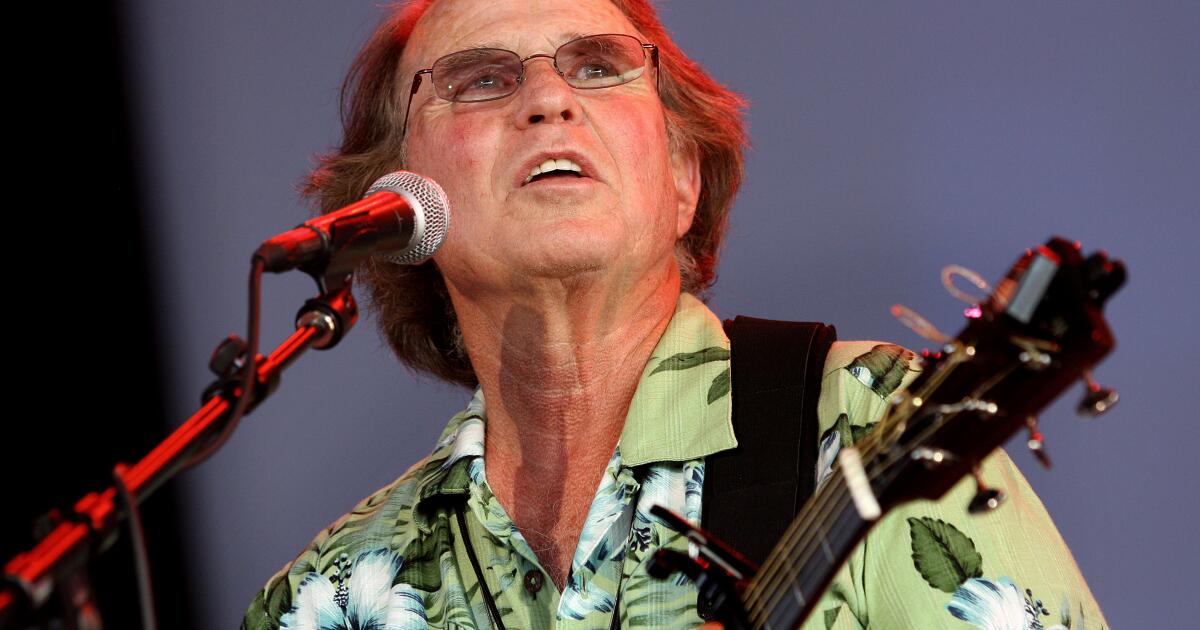
Joe McDonald, Woodstock legend and anti-war activist, dead at 84

Joe McDonald, lead singer and songwriter of Country Joe and the Fish — the band known for its resounding anti-war chant at Woodstock — has died. He was 84.

His wife, Kathy McDonald, announced his death Sunday morning. He died Saturday in his Berkeley home due to complications from Parkinson’s disease.

As a formative member of the American counterculture in the 1960s and ‘70s, McDonald leaves a legacy of bridging contemporary political satire and brazen anti-war sentiments with the early sounds of acid rock.

“We’re just so proud of him. He’s our hero. He instilled in us that we have to speak up when we can, on whatever platform we can, about issues that we feel are important,” said his daughter Seven McDonald, a film producer, music manager and writer.

“While he was a very serious, earnest activist, he also had such an acute sense of cynical humor that is so fantastic and was capable of scathing satire,” her brother Devin added. “He’s most famous for that, but he also did so many heartfelt benefits for different causes.”

The siblings, who spent their childhoods on the road and in recording studios with him, joke that he was always doing a benefit show.

The musician was born on Jan. 1, 1942, in Washington to Worden McDonald and activist Florence (Plotnik) McDonald, who were both members of the Communist Party. The family soon moved to the Southern California city of El Monte, where Joe McDonald was raised.

His musical roots reach back to when his father taught him to play the guitar at 7 years old. But before embarking on his career in music, McDonald enlisted in the Navy at age 17. He served as an air traffic controller at the Atsugi, Japan, air facility for three years. Upon coming back to the states, he tried out college for a short time before dropping out and moving to Berkeley.

Before experimenting with an early variation of Country Joe and the Fish alongside guitarist Barry Melton in the mid-1960s, McDonald started a small magazine called Rag Baby. Once the group was solidified, they decided to turn their folksy roots electric and made the move to San Francisco — just before the city’s legendary Summer of Love.

The group, born out of the Bay Area psychedelic rock scene, was soon signed by Vanguard Records and in 1967 released its debut album “Electric Music for the Mind and Body.” At the time the band’s label and producer were hesitant to let the musicians fully express their politics, and excluded the soon-to-be-hit anti-war anthem “I-Feel-Like-I’m-Fixin’-to-Die Rag” with the catchy chorus that began, “And it’s 1, 2, 3 what are we fighting for?”

Instead, they went with tracks like “Superbird,” a spoof of President Lyndon B. Johnson, which received little to no backlash. When the second album came around, the band was allowed to run with “I-Feel-Like-I’m-Fixin’-to-Die Rag” as the title track. Trouble started to arise with the anti-Vietnam war anthem when the group changed the beginning chant of F-I-S-H to a more profane four letter word that starts with an “F.”

They performed this altered cheer at a gig in Massachusetts, where McDonald received a charge for inciting an audience to lewd behavior and a $500 fine. With this police run-in, Country Joe and the Fish received a slew of press, riling up the public ahead of their Woodstock performance.

The moment the band members began this chant at Woodstock became arguably the biggest moment of their careers, with over 400,000 people joining in. It’s a moment of protest that has gone down in history.

Not long after the festival, the band went their separate ways. McDonald continued to release solo music that stuck with the similar themes of politics and the Vietnam War.

“He took the toll for taking the stand,” said Seven. “He was not the biggest pop star, because he just opted to speak his mind and do his thing.”

In 1986, McDonald released “Vietnam Experience,” an album full of songs analyzing its long-term impacts on his generation. And in 1995 he was “the driving force” according to an Associated Press story, behind a war memorial to honor Berkeley veterans killed in the Vietnam War.

He told The Times in 1986 that he had “an addiction to Vietnam … I’ve been doing work with veterans now for 15 years, and I probably know more about Vietnam veterans than any other person in the entertainment industry.”

“I’ve always believed that the veterans are a basic element to the understanding of war,” he added, “and the understanding of war is the only path to peace.”

McDonald is survived by his wife of 43 years, Kathy; his five children, Seven, Devin, Ryan, Tara Taylor and Emily; a brother, Billy; and four grandchildren.

Source link

The Sullivans star and former Playschool presenter Lorraine Bayly dies aged 89 as tributes paid to ‘showbiz legend’

An image collage containing 1 images, Image 1 shows Black and white photo of Australian actress Lorraine Bayly smiling while looking slightly up and to the right

MUCH-LOVED Australian actress Lorraine Bayly has died at 89.

The Sullivan’s star died in her Sydney care home on Saturday morning.

Lorraine Bayly - Australian Actress - Personality.
Australian actress Lorraine Bayly has died at 89Credit: Getty

Lorraine’s close friend, journalist Craig Bennett confirmed her death to 2GB on behalf of her family.

She was best known for starring in The Sullivans as Grace and presenting popular children’s show Playschool.

The hit show ran from 1976 to 1983.

After leaving The Sullivans, Lorraine took on a role that had been speficially written for her.

She played solicitor Jennifer Carson in Carson’s Law.

In a heartbreaking social media post, the actresses’ friend Craig called Lorraine a “showbiz legend, a bona fide star of stage and screen, a triple Logie winning TV treasure and beautiful friend to many”.

He noted that the award-winning actress only retired 10 years ago.

Source link

Hollywood legend, 63, looks unrecognisable in sexy all-leather look at Milan Fashion Week

A HOLLYWOOD beauty whose resurgent career saw her bag a Golden Globe last year looked unrecognisable at Milan Fashion Week today.

The 80s and 90s pin-up wowed in a sexy all-leather look with an on-trend short hairdo and oversized shades.

This Hollywood beauty has transformed her lookCredit: Getty
The actress looked much younger than her 63 yearsCredit: Getty

She sat on the front row of a star-studded Gucci show and held her tiny pet chihuahua on her lap.

On the catwalk itself, Kate Moss and Emily Ratajkowski led the glam, while Brit actor Bobby Brazier also modelled.

Joining the Hollywood star on the sidelines was Romeo Beckham, Donatella Versace and Paris Hilton.

So who is the rock chick turning heads in Italy?

LESS IS MOORE

Age-defying Demi Moore wows in plunging see-through playsuit at TV premiere


GIMME MOORE

Demi Moore’s X-rated sex confessions, from pre-wedding romp to celeb threesome

Well it’s age-defying Demi Moore, 63.

Just months ago, Demi capped off a stellar career comeback by being named Glamour’s Woman of the Year.

She was interviewed by her Substance co-star Margaret Qualley for the mag and said: “With everything I’ve been through, which has been a lot, I wouldn’t trade where I am today.”

She added a difference with her younger self is the “freedom to know I don’t have to have the answer, and life is not going to be completely stolen from me if I somehow don’t know”.

During Demi’s emotional Golden Globes acceptance speech last year, she spoke of having been at a “low point” and not thinking she was “enough”.

The actress has battled countless traumas and rejections during her life – including her biological dad leaving before she was born, saving her drug addicted mum from suicide, two spells in rehab and being raped aged 15. 

The star of Ghost, Indecent Proposal and A Few Good Men’s return to form in the satirical horror movie The Substance is one of the greatest Hollywood comebacks of all time.

Having struggled to land a hit movie over the past couple of decades, Demi thought “this was it.”

In her speech, Demi said: “In those moments when we don’t think we’re smart enough, or pretty enough, or skinny enough, or are basically just not enough, I had a woman say to me, ‘Just know you will never be enough but you can know the value of your worth if you just put down the measuring stick.’”

Demi didn’t follow up her win by bagging an Oscar, that award went to Mikey Madison, however she wasn’t upset by it.

She told Time: “I didn’t feel gutted.

“I didn’t feel any of those kinds of things.

“I just trusted, and am in trust of, whatever is going to unfold.”

She is set to present an award at this year’s ceremony on March 15 in LA, alongside other A-list talent lie Javier Bardem, Adrien Brody and Zoe Saldaña.

Demi Moore held her pet chihuahua at the fashion showCredit: Getty
She wore her shorter hair in a wet look styleCredit: Getty
Demi is flying high after her Golden Globes win last yearCredit: Getty
Demi in 1996 cult flick StripteaseCredit: Alamy

Source link

Snoop Dogg: Rap legend and Swansea City – the story behind football’s unlikeliest link-up

It’s certainly done that.

Responsible for selling 35 million records worldwide, Snoop Dogg can now add record ticket sales to his resume.

The club have opened up sections of the away end because of the spike in interest, meaning not only have the ‘sold out’ signs gone up for the visit of Preston North End, the game is also set to see more Swansea fans in the ground than ever before.

It’s a short term hit of buzz for a club that lost its way after relegation from the Premier League in 2018.

Eyes, however, are now on a return – with the involvement of Snoop part of a longer-term plan that Swansea chief executive Tom Gorringe says has “no limits”.

Brought on board by the club’s US owners Brett Cravatt and Jason Cohen in July, Snoop’s minority stake didn’t mean a large injection of cash.

But it did mean a huge boost to its ability to sell itself.

“The reality is that if we operated within our natural resources we couldn’t compete financially,” says Gorringe, speaking just after helping show Snoop around the club’s training base on Monday afternoon where he met players and staff.

“PSR (profit and sustainability rules) is our biggest constraint. We are up against sides with parachute payments and we have one of the lowest turnovers.

“We have to think of new ways to generate income. We are an underdog and part of the attraction for him is the difference he can make with the pull he naturally has.”

That pull includes more than 100 million social media followers – more than Wrexham’s ownership combined – that Swansea have already looked to make the most of.

Beyond growing the brand and the wider fan base, which Gorringe admits “takes time”, there have already been tangible benefits.

Income has been tie-ins including clothing collaborations with Snoop’s own publishing label, the iconic Death Row Records that was once the home of Dr Dre and Tupac Shakur.

“By December, our retail business surpassed last year’s revenue,” says Gorringe, who has previously suggested that sponsorship deals for next year are set to be bigger and better than any previous agreement.

Source link

Willie Colón dead: Salsa trombone legend was 75

Willie Colón, a legendary trombonist and pioneer of salsa music, has died. He was 75.

His death on Saturday was confirmed in a Facebook post by his longtime manager, Pietro Carlos.

News of the singer’s condition circulated on the web in recent days. Yonkers Voice News reported Colón was admitted to NewYork-Presbyterian Westchester hospital in Bronxville, N.Y., on Tuesday with respiratory problems and he appeared fragile.

:

Born William Anthony Colón Román on April 28, 1950, to Puerto Rican parents in New York City, Colón first picked up the trumpet in school. It seemed like a natural choice for the former bugle-playing Boy Scout, who attended the youth program at the suggestion of his grandmother.

“So I could learn how to be a good boy,” said Colón in a 1988 interview with Associated Press.

By age 13, Colón had started a band and played at some weddings and in the bustling nightclubs of New York City. At one point, he forged a cabaret card, a mandated ID for musicians and entertainers between 1940 and 1967 who worked in establishments serving alcohol, which required individuals to be 18 years and older.

The thrilling 1960s Latin music scene in New York consumed Colón, who was deeply inspired by Latin jazz pioneer and bandleader Eddie Palmieri, once part of a main act at the Palladium Ballroom who went on to form La Perfecta, a Cuban conjunto that revolutionized the New York Latin music scene with its inclusion of two trombones, played by Barry Rogers and Jose Rodriguez, instead of the costly four-set trumpets.

But Colón’s instrumental preference changed once he heard the bodied timbre of Mon Rivera’s all-trombone brass lineup marching to a bomba beat. “It would knock my socks off,” said Colón in a 1988 interview with Associated Press, leading the singer to teach himself how to play the instrument.

By age 15, Colón was signed to Fania Records. Two years later at age 17, he went on to release his debut album, “El Malo,” a record that defined the fierce sounds of New York’s salsa scene, which Colón later described as the Latin equivalent of rap.

According to his former label, the name of “El Malo” was bestowed upon Colón by older musicians who sought to mock his trombone range at the time, though the young bandleader would find a way to use the label to his advantage.

On the LP, Colón’s sound moved away from the polished mambo sounds of orchestral bands decades prior, in large part due to Puerto Rican singer Héctor Lavoe, whose vocals can be heard in tracks like the gritty “El Malo” that vows to knock out any wanna-be street phony.

The pair would go on to record a total of 14 albums through 1973, with Lavoe’s talents for improvisation complementing Colón’s raw, aggressive trombone.

“Salsa came from the same kind of situation that rap does,” Colon said in a 1992 interview with The Times. “It was kind of a hybrid of a bunch of different elements. Hector had just come from Puerto Rico and didn’t speak English. I didn’t speak much Spanish, I was a little New York kid. We got together and just started with the same kind of irreverent, rebellious attitude, writing songs about the baddest guy on the block, drugs and sex. Before that, the lyrics and whole attitude of Latin music was, ‘Look at me dance, listen to those drums, I’m cutting sugar cane.’ It was a rural, folkloric emphasis; we changed it to an inner-city kind of culture.”

Colón’s impact went beyond live music. The album cover of “El Malo,” which showed two serious profiles of Colón, depicted the singer as a sly bad boy, and ultimately gave rise to his gangster persona, which would be a throughline in future projects, including his sophomore 1968 album, “The Hustler” which featured the band with fitted suits, smoking cigars and placing bets in a pool hall. His 1970 album “Cosa Nuestra” featured Colón smoking a cigar while overlooking a dead body in broad daylight in Manhattan’s East River Bikeway. Most famously, his 1971 album, “La Gran Fuga,” depicted the singer on a fake FBI “Most Wanted” poster.

These mob-like depictions occurred long before cult-favorite films like Francis Ford Coppola’s 1972 “The Godfather” and Brian De Palma 1983’s “Scarface” became the prominent gangster storylines various male acts venerate in their music.

By 1973, Colón and Lavoe split — allegedly due to Lavoe’s drug addiction leading to many missed concert performances — although the two would remain frequent collaborators until the latter’s death in 1993 due to complications of AIDS.

The Nuyorican musician would introduce Blades as the new singer of his orchestra, whom he had met years prior while visiting Panama during carnivals. They collaborated briefly on Colón’s 1975 LP “The Good, the Bad, the Ugly,” cementing their partnership in the 1977 album “Metiendo Mano,” which delved into socio-political themes, notably in their track “Pablo Pueblo,” which shares the story of a working class man with broken dreams halted by toils of daily life. Other tracks like “Plantación Adentro,” detailed the story of Camilo Manrique, a fictionalized enslaved character who died at the hands of a Spanish colonizer in 1745.

Many considered this album Colón’s first foray into intellectual salsa — in large part because of Blades, who had a knack for storytelling and political interests (he unsuccessfully ran for president of Panama in 1994) — that addressed colonialism and class disparities. Together they released three albums, including their 1978 “Siembra,” one of the bestselling salsa albums at that time; from the start, their track “Plastico” fused the popular disco music of the moment while addressing superficial beauty standards and colorism in Latin America.

According to 1996 reporting by The Times, “Siembra” delivered pulsating salsa rhythms that “carried messages of freedom at a time when most of Latin America was oppressed by military dictatorships.”

By 1982, Blades and Colón parted ways, but they collaborated again on projects like their 2005 LP “Tras La Tormenta” — which led the bandleader to sing for the first time in his career, “I had to start from zero, and it took me many years to feel comfortable,” Colón said.

This newfound independence gave rise to some of Colón’s most famous songs, including his 1995 track “Talento de Televisión,” an upbeat song with his signature trombone wailing in the backdrop as he sang about an attractive woman with a lack of talent.

Many across Latin America might be familiar with his 1989 song “El Gran Varon” — which narrated the story of a trans woman who is rejected by her father and presumably dies of AIDS — a landmark salsa song that brought awareness to LGBTQ+ themes during the AIDS crisis. Colón would later serve as a member of the Latino Commission on AIDS. “El Gran Varon” is an anthem to this day.

Colón released more than 40 albums in all.

He also acted, taking roles in films including 1982’s “Vigilante,” the 1983 sports drama “The Last Fight,” as well as one-episode stints in TV shows like “Miami Vice” and “The Cosby Show.” He was even featured in Bad Bunny’s “Nuevayol” music video, cutting a slice of cake; the 31-year-old superstar pays homage to the singer in its lyrics: “Willie Colón, me dicen el malo, ey. Porque pasan los años y sigo dando palo”/ “Willie Colón, they say I’m bad, because the years come and I’m still hitting.”

In his later years, he became more involved in politics. In 1994, he unsuccessfully went up against U.S. Rep. Eliot Engel of the Bronx in the Democratic primary. He also ran as a Democrat for Public Advocate in 2001, focusing on community issues, education and AIDS awareness, but failed to gain the popular vote. In 2008, he endorsed Hillary Rodham Clinton over Barack Obama in the primary election.

On May 26, 2014, after graduating from Westchester County Police Academy, Colón was sworn in as a deputy sheriff for the Department of Public Safety, later becoming deputy lieutenant.

As President Trump took office in his first term, Colón’s politics shifted in support of the right-wing candidate, and he said he would be open to performing at his inauguration in 2017.

Billboard magazine named him one of the most influential Latino artists of all time in 2018.

Colón is survived by his wife, Julia Colón, and his four sons and grandsons.

Source link