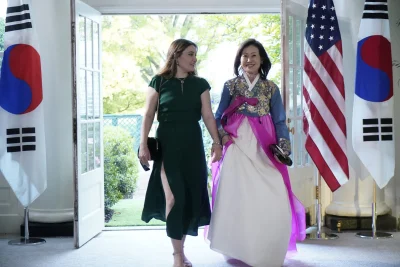
Trump nominates former Rep. Michelle Park Steel as U.S. ambassador to S. Korea

U.S. President Donald Trump has nominated a former Korean American congresswoman as the United States’ top envoy to South Korea, a presidential nomination document showed Monday.
Trump tapped Michelle Park Steel, a former two-term Republican lawmaker from California, as the U.S. ambassador to South Korea — a post that has been left vacant since former Ambassador Philip Goldberg left South Korea in January last year.
The nomination came as Seoul and Washington face a series of joint tasks, including “modernizing” the bilateral alliance, addressing trade and investment issues, and cooperating on regional and global challenges, including North Korean threats and the Middle East conflict.
If confirmed by the Senate, Steel is expected to help enhance communication between the two allies following more than a yearlong vacancy in the ambassadorial post.
After Goldberg left the post, Joseph Yun, former special representative for North Korea policy, served as acting ambassador, followed by Kevin Kim, former deputy assistant secretary at the State Department’s Bureau of East Asian and Pacific Affairs.
Steel, if confirmed, would become the second Korean American to serve as U.S. ambassador to South Korea, following former Ambassador Sung Kim, who served in Seoul as ambassador from 2011-2014.
Since Trump took office in January last year, Steel has frequently been bandied about as one of the strongest candidates for the ambassador post. She has reportedly gained strong support from former and current Republican grandees, such as House Speaker Mike Johnson.
During Trump’s first term, she served as part of the President’s Advisory Commission on Asian Americans and Pacific Islanders.
She was first elected to the House in 2020 and then reelected in 2022. She lost to her Democratic rival by a small margin in the 2024 general election.
In a social media post ahead of the 2024 vote, Trump gave Steel his “complete and total” endorsement, casting her as one of the “strongest congresswomen” in the country and an “America First Patriot whose family bravely fled Communism.”
During her time in Congress, she was active in pushing for legislation to address the issue of Korean Americans who have been separated from their relatives in North Korea in the wake of the 1950-53 Korean War.
She previously served as a member of the Orange County Board of Supervisors and the California State Board of Equalization.
Her husband is Shawn Steel, an attorney who served as the California Republican Party chairman from 2001 to 2003. He has been the Republican National Committeeman from California since 2008.
Born in Seoul in June 1955, Steel is known to have grown up and studied in South Korea, Japan and the U.S. She speaks fluent Korean.
She earned a bachelor’s degree from Pepperdine University in Malibu, California, and an MBA from the University of Southern California in Los Angeles.
Copyright (c) Yonhap News Agency prohibits its content from being redistributed or reprinted without consent, and forbids the content from being learned and used by artificial intelligence systems.