Hi, and welcome to another edition of Dodgers Dugout. My name is Houston Mitchell reminding you we are only 22 days away from the season opener.
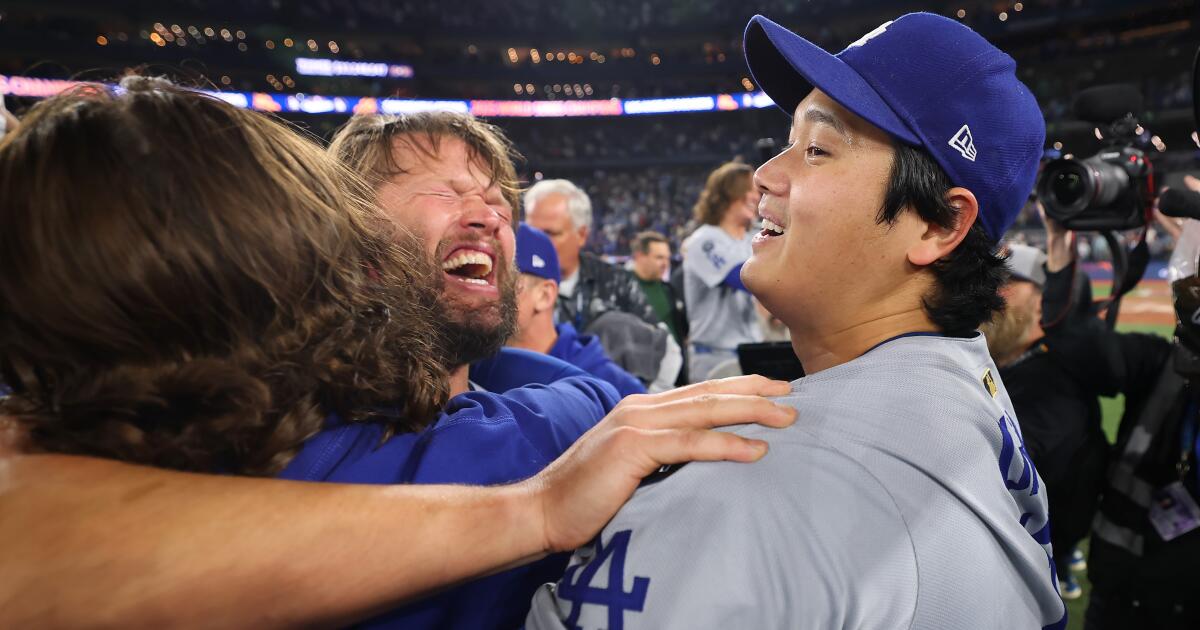
Clayton Kershaw appeared on “The Pat McAfee Show” on Monday and had this to say about Shohei Ohtani:
“With Shohei, he’s got to pitch and he’s got to hit, and he’s a monster in the weight room, and he’s so fast, all these things,” Kershaw said. “So it’s amazing what Shohei does. And as far as secrets, I don’t know how he does it. I have no idea. I’ve watched him for a few years, still have no idea how he does it.
“I think with the media circus that follows him everywhere and all the Japanese reporters that are in L.A., as a team, we don’t see that. He does such a good job of handling all that and still being a good teammate and still playing really well. So, like I said, it all bakes into the formula … I don’t know how he does everything that he does, because he literally does have a country watching him every second of the day.
“We played opening day in Tokyo last year and that was wild. I think it was probably like what the Beatles were. It’s kind of like that’s what I would experience, just being around Shohei and being on the Dodgers. That was once in a lifetime to see him in Tokyo last year.”
“And he’s funny. He speaks a lot of English, which I don’t know if he lets on to the media too much. But Shohei’s great, and he’s been a great addition to the clubhouse.”
Do Spring Training games matter?
The Dodgers are 8-3 in exhibition games. But does it mean anything? Let’s take a look at the team with the best spring training record since 2016 and also how the Dodgers did each year:
2016
Best spring record: Washington, 19-4, .826
Season record: 95-67, .586
Dodgers: 13-17, .433
Season record: 91-71, .562
World Series winners: Chicago Cubs
Their spring record: 11-19
2017
Best spring record: NY Yankees, 24-9, .727
Season record: 91-71, .562
Dodgers: 18-17, .514
Season record: 104-58, .642
World Series winners: Houston Astros*
Their spring record: 15-15
*-Astros cheated to win the 2017 World Series.
2018
Best spring record: Boston, 22-9, .710
Season record: 108-54, .667
Dodgers: 17-15, .531
Season record: 92-71, .564
World Series winners: Boston Red Sox
2019
Best spring record: Oakland, 14-8, .636
Season record: 97-65, .599
Dodgers: 14-15, .483
Season record: 106-56, .654
World Series winners: Washington Nationals
Their spring record: 17-12
2020
Best spring record: Philadelphia, 15-6, .714
Season record: 28-32, .467
Dodgers: 13-7, .650
Season record: 43-17, .717
World Series winners: Dodgers
2021
Best record: Miami, 14-5, .737
Season record: 67-95, .414
Dodgers: 13-11, .542
Season record: 106-56, .654
World Series winners: Atlanta Braves
Their spring record: 15-13
2022
Best spring record: Angels, 11-6, .647
Season record: 73-89, .451
Dodgers: 5-9, .357
Season record: 111-51, .685
World Series winners: Houston Astros
Their spring record: 8-5
2023
Best spring record: St. Louis, 17-7, .708
Season record: 71-91, .438
Dodgers: 14-13, .519
Season record: 100-62, .617
World Series winners: Texas Rangers
Their spring record: 13-15
2024
Best spring record: Baltimore, 23-6, .793
Season record: 91-71, .562
Dodgers: 14-7, .667
Season record: 98-64, .605
World Series winners: Dodgers
2025
Best spring record: San Francisco, 21-6, .778
Season record: 81-81, .500
Dodgers: 14-9, .609
Season record: 93-69, .574
World Series winners: Dodgers
As you can see, only once has the team with the best spring record gone on to win the World Series. Four times, the team with the best spring record had a losing record in the regular season. The last time the Dodgers had a losing spring record, they went on to win 111 games. So, just enjoy the exhibition games for what they are, meaningless fun.
Or, as Andrew Friedman told my colleague Bill Shaikin about spring training games, “It’s always fun to win. That is always way more fun than losing. But so much of spring training is, just don’t get a call from our trainer. Keep guys healthy.”
Blake Snell unlikely to be on opening day roster
Dave Roberts said that Blake Snell won’t appear in a spring training game this season, which would seem to indicate he won’t be on the opening day roster.
“He’s not on a mound right now. He’s not in games,” Roberts told reporters. “The odds of him starting the season are probably zero…. I think he’s working through it in the sense of, last year he was on a new team. He pushed through things to start the season healthy, which is understandable. And you learn from it, he was never right all year. I think that this year, he’s going to make sure that he is ready to go.”
Gavin Stone sidelined
Gavin Stone, who sat out last season after shoulder surgery, has had a setback.
“Stone threw the inning and then he had a bullpen the next day, and then his shoulder flared up and was sore,” Roberts told reporters Monday. “And so right now, we put him on ice, and trying to let the soreness dissipate. So, given everything that he’s gone through with the shoulder, we wanted to make sure that we kind of pushed pause, so I don’t know when he’s going to start throwing again, but I think it is a setback unfortunately.”
Stone had an MRI on Tuesday that showed no structural damage, just inflammation, which is the best possible news. He will stop all throwing activities for two weeks and be re-evaluated.
WBC schedule
The World Baseball Classic starts today, and five Dodgers are participating: Will Smith for the U.S., Shohei Ohtani and Yoshinobu Yamamoto for Japan, Edwin Díaz for Puerto Rico and Hyeseong Kim for Korea. Former Dodger (how weird does that sound) Clayton Kershaw is also on the U.S. team. Three Dodger minor leaguers are participating: pitcher Antonio Knowles for Great Britain, infielder Jake Gelof for Israel, and pitcher Shawndrick Oduber for Netherlands.
Here is the schedule for the U.S. games. You can find the entire schedule by clicking here.
Friday
5 p.m.: USA vs. Brazil, Fox
Saturday
5 p.m.: Great Britain vs. USA, Fox
Monday
5 p.m.: Mexico vs. USA, Fox
Tuesday
6 p.m.: Italy vs. USA, FS1
Quarterfinals are March 13-14
Semifinals are March 15-16
Title game is March 17 at 5 p.m. on Fox
In case you missed it
Dodgers’ Roki Sasaki struggles early in second Cactus League start, then settles down
Shaikin: Will Klein isn’t surprised he saved the Dodgers’ World Series dynasty
Shaikin: Clayton Kershaw’s ‘perfect’ ending has one final chapter in WBC
‘That’s what I expect.’ Dodgers’ Mookie Betts seeks to regain his All-Star form
For pitching prospect Jackson Ferris, Dodgers organization is ‘a breath of fresh air’
Shaikin: In L.A. and in Cooperstown, Freddie Freeman will forever be a Dodger, not a Brave
Edwin Díaz is unquestionably the Dodgers’ closer. How the rest of the bullpen shapes up
‘Maybe you’re in the wrong business.’ Blake Treinen fires back at Dodgers’ spending critics
Shaikin: Dodgers hype time: How many games will they win in 2026?
‘Just go out and pitch.’ Dodgers’ Tyler Glasnow is efficient in his first spring start
‘Things I need to work on.’ Dodgers’ Roki Sasaki struggles in first Cactus League start
After ‘a normal offseason,’ Freddie Freeman drives in two in Cactus League debut
SoCal product Pete Crow-Armstrong disses Dodgers fans with a curious comment
‘Pretty healthy’ Kyle Tucker content to fit in among Dodgers’ galaxy of stars
And finally
Maury Wills hits a walk-off single to win the 1966 All-Star game for the NL. Watch and listen here.
Until next time….
Have a comment or something you’d like to see in a future Dodgers newsletter? Email me at houston.mitchell@latimes.com. To get this newsletter in your inbox, click here.