Kuala Lumpur, Malaysia – Smoke from forest and peatland fires burning across Indonesia has pushed air quality in parts of Malaysian Borneo to hazardous levels, triggering a surge in respiratory illness and forcing the cancellation of outdoor Independence Day celebrations.
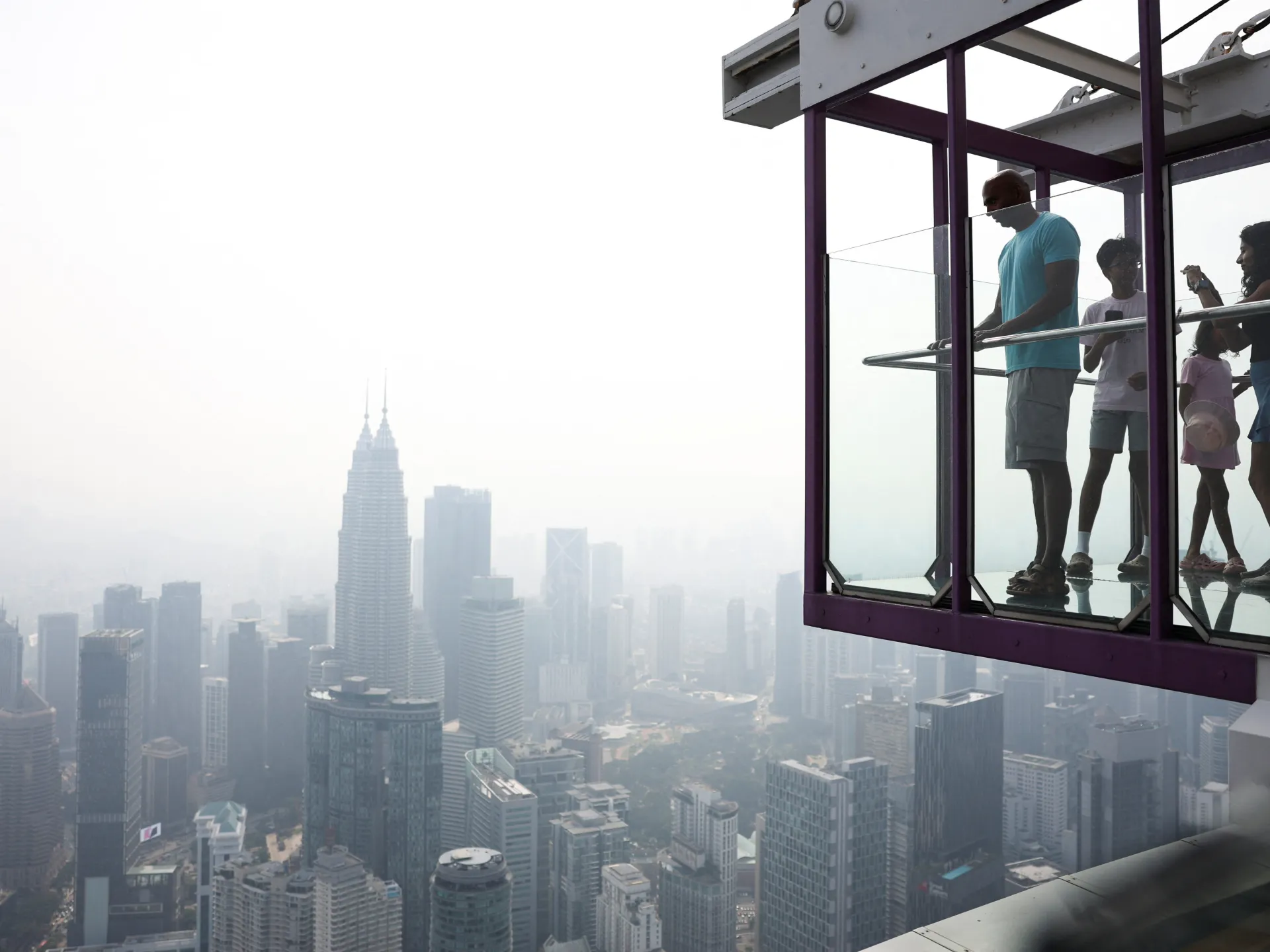
The smoke – drifting from fires in Kalimantan in the Indonesian portion of the island of Borneo – has settled over the Malaysian state of Sarawak, on the same island, for much of August. It has also reached peninsular Malaysia, Brunei and Singapore.
Recommended Stories
list of 4 itemsend of list
It is the region’s worst haze episode since 2015, when fires in Indonesia exposed tens of millions of people to toxic smoke and caused more than 500,000 people to suffer respiratory ailments.
On Tuesday, six areas in Sarawak recorded hazardous air quality, with readings above 300 on Malaysia’s Air Pollutant Index. Anything above 100 is considered unhealthy. In Kuching, the state capital, the index hit 407, while in Serian, a town close to the Kalimantan border, it hit 408.
Mia Emylia Hassan, 33, a mother of two in Kuching, said the smell of smoke was inescapable.
“The air here is very thick,” she said. “It smells like smoke, and it’s just white all over.” Visibility from her house, she said, had dropped to about a kilometre, or roughly half a mile. “We have not seen blue sky for over a month,” she said.
The haze arrived in early August, shortly after her 10-month-old daughter came home from the hospital after a lung infection. “She’s not healing properly because her lungs are still developing,” Hassan said. “She’s been on medication this whole month, and she has been coughing and vomiting.”
Twice, the family has had to rush the infant back to the emergency room because she could not breathe.
“It’s a mini heart attack for us every time,” Hassan said.
Asthma cases surge
Malaysia’s Ministry of Health has reported a sharp rise in illness nationwide. During the week of August 23 to 29, asthma cases climbed to 1,811, up from 219 the previous week, the ministry said on Saturday, while conjunctivitis cases also rose to 720, from 146.
In peninsular Malaysia, Karen-Michaela Tan, an asthma patient who lives near the capital, Kuala Lumpur, said that a week after the haze thickened, she was “wheezing audibly” and “breathless when climbing stairs”. The 52-year-old said she needed two nebuliser treatments back to back to stop the wheezing, along with a heavy dose of steroids.
“Doctors are erring on the side of caution when it comes to asthma patients, choosing to up dosages rather than risk a patient being hospitalised for shortness of breath,” she said.
Her house is sealed, and two purifiers run continuously. Still, “I battle throat scratchiness and nasal dryness even with these measures”, she said.
The Association of Southeast Asian Nations (ASEAN), a regional bloc, has activated a Level 3 transboundary haze alert – its highest – for the southern part of the region. The alert signals a high risk of severe cross-border haze. ASEAN cited an increase in fire hotspots and prolonged dry weather, fuelled by an intensifying El Nino weather pattern.
The toxic smoke has forced Sarawak to cancel its outdoor Independence Day celebrations on Monday, and officials warned that worse restrictions could follow. Any area where readings cross 500 will be placed under a local emergency, and all public and private offices will be closed, the deputy premier, Douglas Uggah Embas, told reporters. “Only essential services will be allowed to operate,” he added.
In Kuala Lumpur, where skies were grey for most of the month, the haze thinned enough to reveal blue sky for the first time in a week, just as the Independence Day parade got under way early in the morning.
Schools, too, have been hit hard. Under Ministry of Education rules, outdoor activities are suspended when the index reaches 100, and schools must close at 200. On August 20 and 21, nearly 600 schools in and around Kuching shut, affecting some 200,000 primary and secondary students. And on August 28, 30 more schools in Sarawak closed, keeping more than 4,000 children at home.
This week, schools are closed for the Independence Day holiday.
Youth sport has been affected, too. Yap Kai Jinn, 31, a coach at Square One Football, a Kuala Lumpur academy, said the club had cancelled all training sessions and matches since last week.
“Along with our parents, we decided that it is not healthy; it is not safe for our players to play under these conditions,” he said. “For now, we are looking for an enclosed area to do sessions, and for outdoor, we have to wait and hope that the weather gets better.”
Fires surge in West Kalimantan
The toll of the haze has been far heavier in Indonesia.
The country’s deputy health minister, Dante Saksono Harbuwono, told reporters on Monday that some 13,500 people were treated for respiratory infections in July and August, while about 5.5 million people on the islands of Borneo and Sumatra have been directly exposed to smoke.
Borneo is the world’s third-largest island and is divided between Indonesia, which controls the southern two-thirds as Kalimantan; Malaysia, whose states of Sarawak and Sabah run along the north; as well as the sultanate of Brunei.
According to the Indonesian government, fires between January and July burned more than 200,000 hectares (about 494,000 acres), an area three times the size of Indonesia’s capital, Jakarta, across Borneo and Sumatra. Nearly 95,000 hectares (about 235,000 acres) burned in July alone.
And despite efforts to control the blazes, the fires continue to surge in parts of Indonesian Borneo.
Hotspots in West Kalimantan nearly doubled on Monday, rising by 3,553 to 7,377, while the number of active fires rose by 88 to 104, and visibility fell below a kilometre, said Berton Panjaitan, an official at Indonesia’s National Disaster Mitigation Agency. In Central Kalimantan, hotspots declined by 147 to 5,244, while fire spots increased by 16 to 72, he said.
Cities in Kalimantan have recorded hazardous air, too.
Readings in Palangkaraya in Central Kalimantan reached 780 on Monday on the air quality index used by IQAir, a Swiss company that monitors pollution data. Pontianak in West Kalimantan reached 593.
The fires are largely set on purpose, analysts say, with plantation companies and smallholders alike burning rainforest and carbon-rich peatland to clear ground for palm oil, farming, and pulp and paper production. The practice is illegal, and Indonesian police said last week that they had arrested 72 people suspected of setting recent fires.
Super El Nino
Researchers warned people in Southeast Asia to brace for a long fire season.
El Nino – the naturally occurring pattern that shifts winds, air pressure and rainfall worldwide – appears headed for “super” strength, said Helena Varkkey, a specialist on transboundary haze at Universiti Malaya.
In Southeast Asia, she said, “the intensifying El Nino means hotter and drier conditions”, so “any fires that happen will have a bigger and longer regional impact”.
Jayaprakash Muralitharan, a Malaysian atmospheric scientist, said the worst was still ahead.
Haze conditions are “going to be severe and longer, because the hot weather started much earlier last year”, he said. “El Nino came in and made conditions drier. Now you have the extreme drying of the peatland.”
And peat can make fires stubborn, he said. What looks extinguished on the surface can smoulder underground for weeks and flare up again, and nothing short of sustained rain will soak the soil enough to put it out.
Until the rains arrive, Muralitharan said, there is little to be done.
“Human intervention now is only a temporary solution. It would go on until end of September or October when the rain comes in. I hope that rain comes in by then.”