hurdle

After falling during hurdles, Beckham Borquez shall rise again

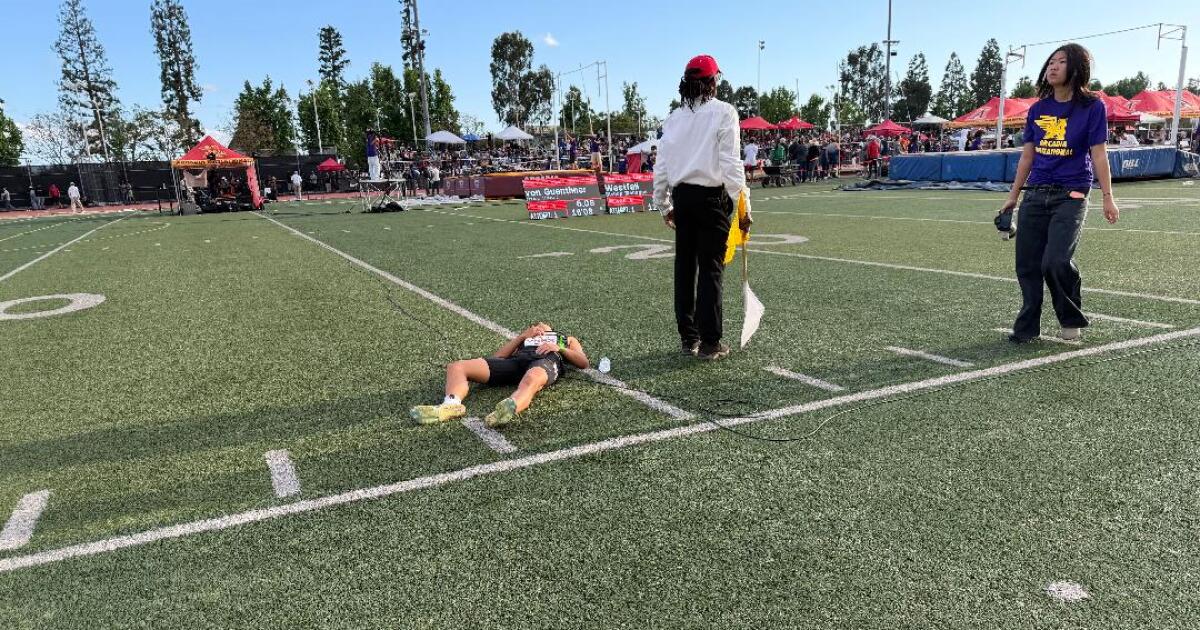
Beckham Borquez of Sherman Oaks Notre Dame suffered a spill during the running of the 110 high hurdles on Saturday night at the Arcadia Invitational.

Initially, he was more upset at himself for falling over one of the last hurdles and landing on the track. You could see skin on his shoulder was exposed after scrapping the track, but the real pain came from his hip.

He gathered himself, feeling frustrated, then rested on the infield turf waiting for an athletic trainer to arrive to offer assistance. Track coach Joe McNab was first to arrive to check on him. McNab quipped about being pre-med in college. Soon Borquez was seen walking off to get his shoulder bandaged.

I snapped a photo of him on the ground only to keep it as a reminder when he’s back winning races because that’s what he’s going to do, like getting back on a horse that you fall from, learning and succeeding next time.

He’s run 13.91 in the event, should be favorite to win the Mission League title on April 30, then take aim at a Southern Section title. High school athletes are tough and resilient, and that’s what he showed in his moment of misery.

“I’m pretty bruised,” he said Sunday morning. “I’m coming back.”

He got his shoulder taped and was sent home. He’s going through rehabilitation this week so he could be back for a dual meet and the Mt. SAC Invitational on Saturday.

“That’s the first time I’ve fallen in the 110,” he said. “It was tricky. I was moving fast, clipped the eighth hurdler and lost my balance. That’s never happened to me before.”

Have no fear, for Beckham has learned.

“These next two weeks, I’ll be on my redemption,” he said.

This is a daily look at the positive happenings in high school sports. To submit any news, please email eric.sondheimer@latimes.com.

Source link

EU Parliament unblocks key political hurdle in digital euro negotiations

Published on

EU lawmakers have overcome a key political hurdle in the negotiations of digital euro, making the project closer to approval, according to a draft text seen by Euronews.


ADVERTISEMENT


ADVERTISEMENT

The Parliamentary rapporteurs involved in the legislation have found an agreement on the design of the digital euro, which will be able to function both online and offline.

The digital euro would be an electronic form of cash issued by the European Central Bank, designed to sit alongside banknotes and the payments services offered by commercial banks.

It has taken on new political weight as economic tensions between the EU and the US sharpen the debate over Europe’s reliance on American payment giants, such as Visa and Mastercard.

Under the European Commission’s proposal, digital euro users would have a wallet for both online and offline payments, with transactions designed so they are not trackable.

The situation in Parliament changed on Wednesday evening, when the centre-right politician Fernando Navarrete, who is the leading rapporteur on the file, announced the withdrawal of his position to reduce the scope of the digital euro to offline use only.

His position blocked the advancement of negotiations for months, jeopardising the whole legislative process, according to three sources familiar with the negotiations.

The political deadlock has pushed EU leaders to accelerate progress on the digital euro. At the European Council meeting on 19 March, they set a goal to have the digital euro legislation approved by the end of 2026.

With the Council, representing EU countries, having already adopted its position, the European Parliament is now the only institution left to advance the law.

“Thanks to our amendments and firm stance, we have finally broken the political deadlock on the digital euro. The distinction between online and offline has been removed, and it is now established as a single payment system,” Pasquale Tridico, the rapporteur for The Left, told Euronews.

However, lawmakers still need to agree on two key aspects: the “hold limits” and the “compensation.”

The hold limits determine the maximum amount a user can store in a digital euro wallet, while compensation sets out a model for reimbursing commercial banks that provide digital euro services.

Although negotiations are not yet complete, the text is expected to be voted on in the Parliament’s economy committee before the summer, according to a source familiar with the matter.

Source link