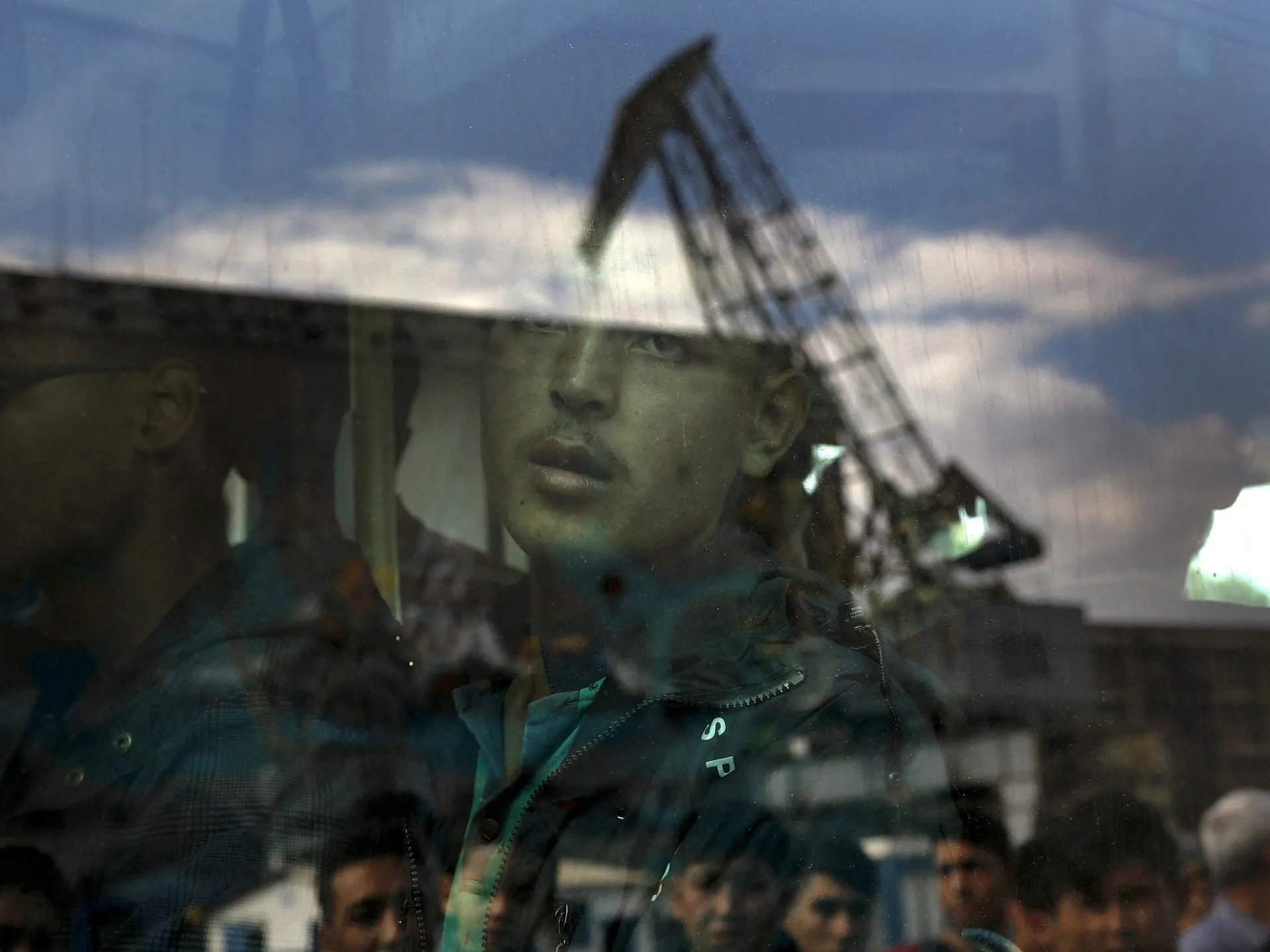
Athens, Greece – Bashir is a Syrian Muslim who has lived in Greece since 2014. He married a fellow Syrian in the country, and three months ago, they had a son. After years of picking olives and oranges, learning Greek and a trade in metalwork, and finally buying his own equipment to start work as an independent trader, Bashir felt his life was finally coming together.
Two months ago, the authorities handed him a piece of paper asking him to restate his reasons for coming to Greece and why he should now return to Syria.
Recommended Stories
list of 4 itemsend of list
Bashir, who requested to withhold his surname, had been granted asylum in Greece in 2015 because of the civil war then raging in Syria. The war ended in December 2024, and Bashir became one of 1,200 Syrians whose asylum cases were reopened in February.
“It’s a catastrophe,” he told Al Jazeera. “I don’t understand how this can happen. If they decide I should leave the country, should my family stay here?”
Bashir’s lawyer said only men are currently receiving such notices – and not just from Syria but Afghanistan, another country whose civil war is deemed to have ended, with the Taliban’s sweeping victory in August 2021.
But neither Syria nor Afghanistan is necessarily safe to return to, said the lawyer, Angeliki Theodoropoulou.
“We believe this has to do with the European Union’s stance towards Syria and Afghanistan, and with the fact that there are quite a few voluntary returns, which encourages authorities to say, ‘Let’s see if these people can return’,” Theodoropoulou told Al Jazeera.
She said the entire regime of international protection was being tightened for these two nationalities. “We’re also seeing asylum being given in very few cases, and a lot of rejections,” she said.
“We don’t understand on what criteria they decided Syria is safe,” Bashir said.
Earlier this year, renewed clashes erupted between the Syrian government and the Kurdish-led Syrian Democratic Forces (SDF), while Israel has continued attacks on the country sporadically.
Bilal said he feels uncomfortable about the idea of living in Syria for cultural and political reasons, having spent 15 years away.
“Many of the refugees here are like me,” he said.
Jihad, who requested to withhold his surname, has similar concerns but for the opposite reason. He has lived in Greece legally since 2001 and runs a small clothes shop. When the regime of Bashar al-Assad fell, the rest of his family also fled, because he and his family were Assad supporters.
He fears that he would be mistreated in Syria over his views.
“If they just look at my Facebook page or look at things I wrote in the past, they will send me to jail for sure,” Jihad said. “I’m afraid even to go to the embassy. I have never held a gun, I have never killed anyone, I just have an opinion.”
Both men have clean criminal records, pay taxes and social security contributions, and have nurtured families in Greece. Both say they would flee to another country rather than return to Syria. So why is Greece considering their eviction?
Greece’s turn to exclusion
Greek Migration Minister Thanos Plevris announced in February that he had ordered a reopening of any asylum cases that could be revoked. As a temporary status, it can be.
Last year, Greece revoked the asylum of almost 200 people, compared with 400 in the previous decade. Dozens more cases are under review this year. And there appears to be a religious element to the policy.
Greece suspended asylum applications for mainly Muslim asylum seekers arriving from Libya for three months last year. Most of the people whose asylum is being revoked are from majority-Muslim countries.
At a recent parliamentary committee hearing, Plevris stated clearly that Greece prefers non-Muslim migrant workers.
“There are countries with which we don’t have common values, and that’s mainly because of religion, let’s be clear, it’s because of hardcore Islam,” Plevris said. “So, you have to pick countries that are religiously neutral or Christian. We’re talking to Georgia, the Philippines, Armenia, India.”
Greece has been tightening its migration policy in other ways as well.
In September 2025, it adopted what Plevris described as “the strictest returns policy in the whole EU”, empowering the government to imprison people who refuse to be deported. Rejected asylum applicants can be fitted with ankle monitors and given just two weeks to remove themselves voluntarily. If they don’t, they face a 5,000-euro fine ($5,870) and two to five years’ confinement in closed camps.
In February, the governing conservative New Democracy party passed a law stipulating that if any aid worker is charged with helping to smuggle asylum seekers into Greece, their entire aid organisation can be delisted from the ministry’s registry. That means they could lose their funding and access to refugee camps, and could shut down.
The broader context
Europe is undergoing a transition as it prepares to put into force an Asylum and Migration Pact next month. The pact demands a hard-border policy and a returns policy for rejected asylum seekers, both of which each member state must manage itself.
“We’re at a pivotal point in time. We’re about to see the implementation of the European pact. This will fundamentally change the way that migration works,” Kristin Fabbe, chair in Business and Comparative Politics at the European University Institute, recently told a Delphi Economic Forum event in Athens.
The largest bottleneck, she said, “is that Europe has not yet figured out how to do returns at scale … in order to reform asylum and reform migration, you have to execute returns at scale, and the data show that that has been impossible”.
Greece, an EU front-line state, already has 938,000 legally resident migrants in a population of 10.3 million, a relatively high number. Of these, more than 137,000 are recipients of asylum or international protection.
As the Middle East and North Africa region remains unstable, the government is worried about the potential scale of future refugee flows.
More than a million asylum seekers crossed the Greek borders in 2015. In the years that followed, certain EU members took on thousands of asylum cases from Greece and Italy in a show of solidarity, and tens of thousands more asylum recipients in Greece moved to other EU states. Those states have agreed to keep them, but that would not necessarily happen again under the pact.
Observers say this explains Greece’s hardline attitude.
Commenting on the political mood in Europe, Fabbe said, “The legality, the sanctity of the [returns] solutions is being challenged, but I think we’re going to see the proliferation of those solutions and new institutional mechanisms.”