Harbor

Trump places statue of Christopher Columbus near the White House

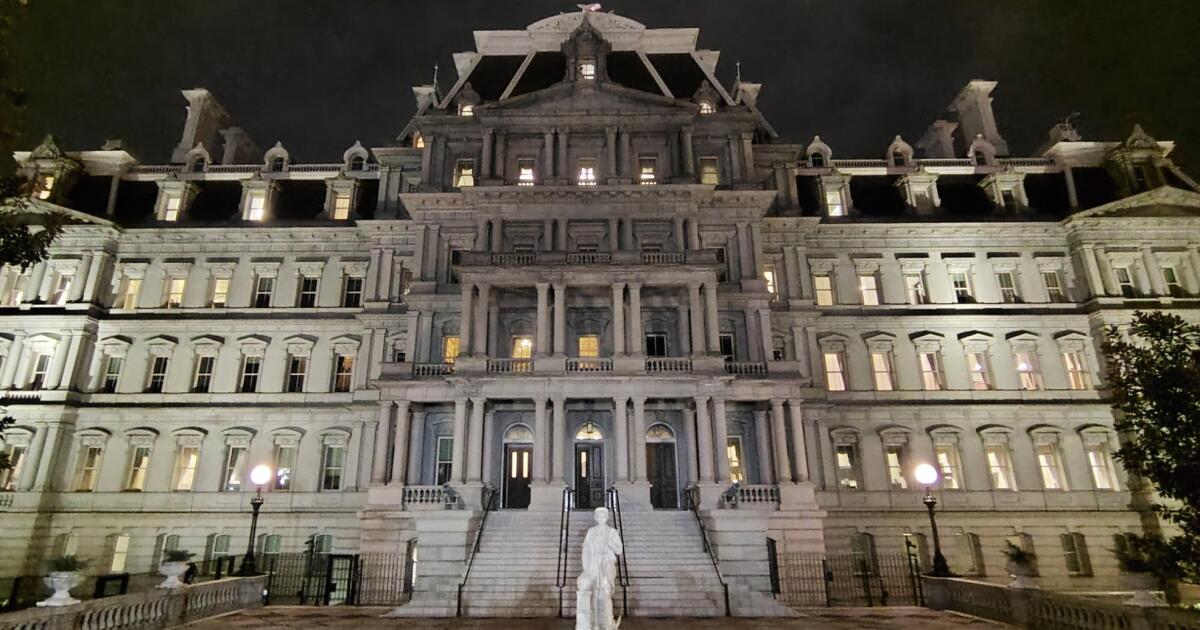
A statue of Christopher Columbus has been placed on the grounds of the Eisenhower Executive Office Building adjacent to the White House, the latest effort by President Trump’s administration to recognize the controversial explorer.

The statue is a replica of one that was tossed into Baltimore’s harbor in 2020 during Trump’s first term at a time of nationwide protests against institutional racism.

Trump endorses a traditional view of Columbus as a leader of the 1492 mission seen as the unofficial beginning of European colonization in the Americas and the development of the modern economic and political order. In recent years, Columbus also has been recognized as a primary example of Western Europe’s conquest of the New World, its resources and its Native people.

“In this White House, Christopher Columbus is a hero, and President Trump will ensure he’s honored as such for generations to come,” the White House posted on X.

“We are delighted the statue has found a place where it can peacefully shine and be protected,” said John Pica, a Maryland lobbyist and president of the Italian American Organizations United, which owns the statue and agreed to lend it to the federal government for placement at or near the White House.

The statue, made mostly of marble, was created by Will Hemsley, a sculptor based in Centreville on Maryland’s Eastern Shore.

The original statue was toppled by protesters July 4, 2020, and thrown into Baltimore’s Inner Harbor during the national social justice reckoning in the months after the police murder of George Floyd in Minneapolis. It was one of many statues of Columbus that were vandalized around the same time, with protesters saying the Italian explorer was responsible for the genocide and exploitation of Native peoples in the Americas.

In recent years, some people, institutions and government entities have displaced Columbus Day with the recognition of Indigenous Peoples Day. President Biden in 2021 became the first U.S. president to mark Indigenous Peoples Day with a proclamation.

Trump dismisses the shifting views on Columbus as the work of “left-wing arsonists,” bending history and twisting Americans’ collective memory. “I’m bringing Columbus Day back from the ashes,” he declared last April. Echoing his 2024 campaign rhetoric, he complained that “Democrats did everything possible to destroy Christopher Columbus, his reputation, and all of the Italians that love him so much.”

Witte writes for the Associated Press.
Source link

Unease in Japan after Trump cites Pearl Harbor to defend Iran war | News

US president’s reference to Japan’s 1941 attack on naval base in Hawaii has shaken the Japanese public as PM Takaichi’s silence gets mixed reaction.

There has been embarrassment, confusion, and unease in Japan after US President Donald Trump used the Pearl Harbor attack during World War II to justify his secrecy before launching the war on Iran.

Trump was asked by a reporter why he did not tell allies in Europe and Asia in advance of the US-Israel attack on Iran during a news conference with Japanese Prime Minister Sanae Takaichi at the White House on Friday.

Recommended Stories

list of 4 itemsend of list

Trump cited Pearl Harbor to defend his decision saying, “Who knows better about surprise than Japan? Why didn’t you tell me about Pearl Harbor, OK?”

Following the remarks, social media reaction has ranged from accusations of ignorance and rudeness by the US president to claims that he does not see Japan as an equal partner. There were calls for Japan to protest Trump’s comments.

Tsuneo Watanabe, a senior fellow at the Sasakawa Peace Foundation, said in an opinion piece in the Nikkei newspaper on Saturday that the remarks signalled Trump is “not bound by existing American common sense”.

“I get the impression that the comment was intended to bring the Japanese reporter [who asked the question] or Ms Takaichi into complicity in order to justify his ‘sneak attack’ on Iran during diplomatic negotiations and without telling allied countries,” Watanabe wrote.

There is also a feeling that an unspoken understanding exists between United States and Japanese leaders to tread carefully on the subject.

Both sides need each other, with Washington relying on Japan to host 50,000 troops and an array of powerful hi-tech weapons, and Japan relying on the US nuclear umbrella to deter hostile, nuclear-armed neighbours.

Japan’s post-World War II constitution bans the use of force except for its self-defence, but Takaichi and other officials are now seeking to expand the military’s role.

Mixed reaction to Takaichi’s response

Takaichi, a hardline conservative, was praised by some for not reacting to Trump’s comments, letting them pass with a roll of her eyes and a glance at her ministers seated nearby.

The goal of her summit was to deepen ties with her most important ally, and she arrived shortly after Trump suggested Japan was among the nations that did not quickly join his call to help protect the Strait of Hormuz.

Some, however, criticised Takaichi for not speaking up.

Hitoshi Tanaka, a former diplomat and a special adviser at the Japan Research Institute think tank, wrote on X that he felt embarrassed to see Takaichi flattering Trump.

“As national leaders, they are equals … To make an equal relationship is not to flatter,” he said. “Just doing what pleases Trump and calling it a success if you are not hurt is too sad.”

Initially, social media placed some of the blame on the Japanese reporter who asked the question that prompted Trump’s Pearl Harbor comment.

The reporter, Morio Chijiiwa with TV Asahi, later said on a talk show he asked the question to represent the feelings of Japanese who are not happy about Trump’s one-sided attack on Iran, and because other countries, including Japan, are now being asked to help out after the US and Israel started the war.

“So that’s why I asked the question. I was meaning to say, ‘Why didn’t you tell us, why are you troubling us?’” he said.

“Then President Trump hit back with the Pearl Harbor attack … I found it extremely awkward for him to change the subject.”

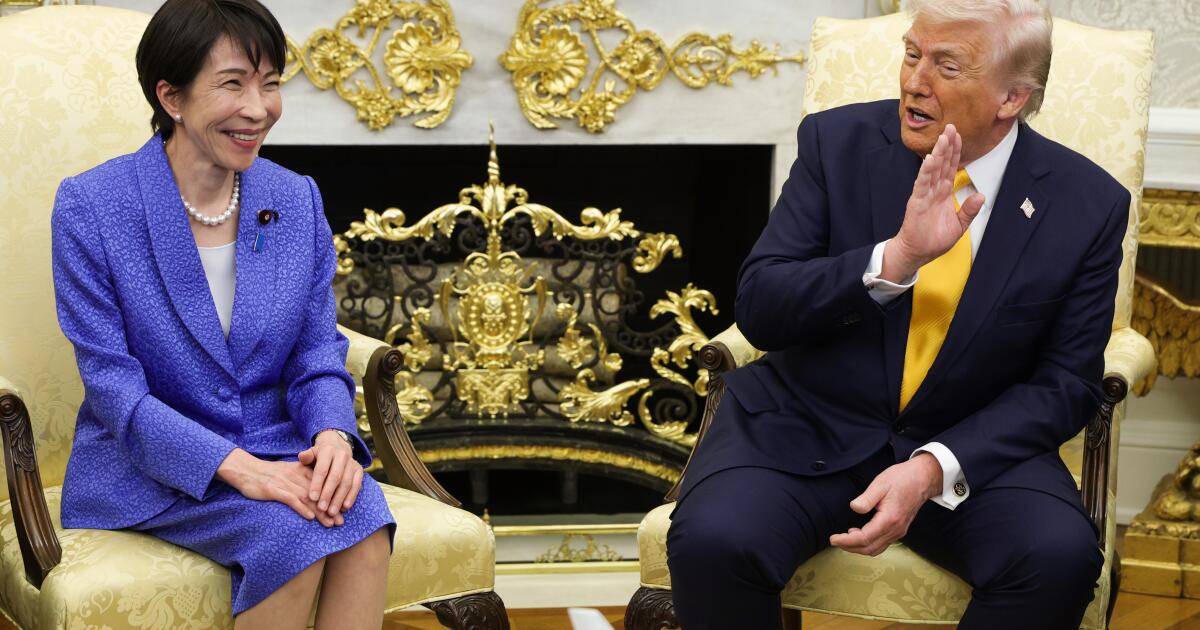
Donald Trump and Sanae Takaichi meet in the White House
Japanese Prime Minister Sanae Takaichi, left, meets President Donald Trump [Evelyn Hockstein/Reuters]

Source link

Trump cracks a joke about Pearl Harbor

Before Japanese Prime Minister Sanae Takaichi departed for Washington, she told her nation’s lawmakers that her Oval Office meeting with President Trump on Thursday would be “very difficult.”

Actually, it was awkward.

After a reporter questioned Trump about not warning Japan before launching his “surprise” offensive in Iran, Trump said that surprise was the point.

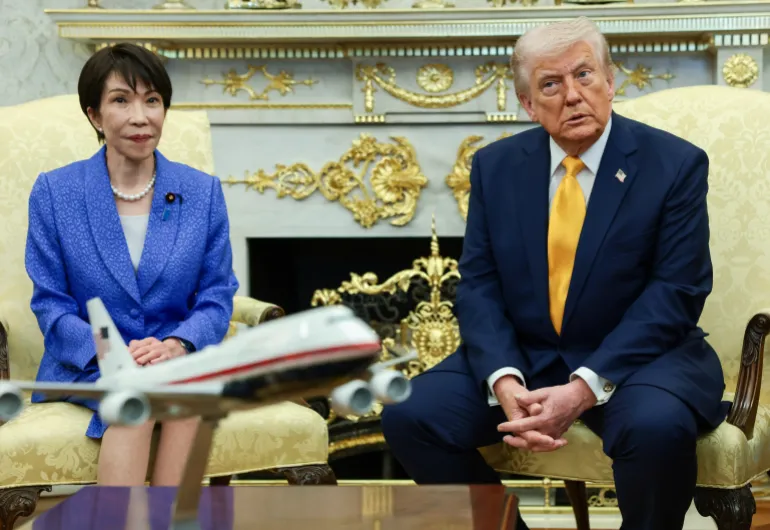
“Who knows better about surprise than Japan?” Trump said, turning toward a visibly tense Takaichi, seated next to him. “Why didn’t you tell me about Pearl Harbor, OK?”

The joke hung in the air. There was brief and muted laughter.

Takaichi’s eyes appeared to widen, but she kept her expression neutral as the the cameras rolled. She did not comment on the president’s remark. (She smiled at other times during their meeting.)

When leaders of the United States and Japan have raised the events of Dec. 7, 1941 — the day of “infamy” that plunged the U.S. into World War II — the circumstances have previously been far more solemn.

In 2016, President Obama and Japanese Prime Minister Shinzo Abe scattered petals together on the waters of Pearl Harbor to honor the more than 2,400 killed in the attack. Abe laid a wreath in honor of the dead.

“Ours is an alliance of hope that will lead us to the future,” Abe said, speaking to World War II veterans after paying tribute at the Pearl Harbor memorial. “What has bonded us together is the power of reconciliation, made possible through the spirit of tolerance.”

Japan, long constrained by its pacifist constitution, is now under intense pressure from the White House to support the U.S.-led war in Iran.

“Look, I expect Japan to step up, because, you know, we have that kind of relationship, and we step up in Japan. We have 45,000 soldiers in Japan,” Trump said. “We spend a lot of money on Japan, and we’ve had that kind of relationship.”

Trump has made a habit of going off script during televised Oval Office encounters with foreign leaders.

A meeting with Ukrainian President Volodymyr Zelensky devolved into an on-camera shouting match with Trump and Vice President JD Vance repeatedly berating Zelensky for “gambling with World War III” and not showing enough gratitude for U.S. support.

And when South African President Cyril Ramaphosa visited the White House, he said he was “ambushed” when Trump dimmed the lights and played a video promoting widely debunked claims of white genocide in South Africa.

By comparison, the Japanese prime minister’s summit in Washington was mild. For her part, Takaichi focused her statements on a new $550-billion trade pact involving Alaskan oil.

As for Iran, along with America’s European allies, Takaichi had already signaled she would not send warships to the embattled Persian Gulf to protect oil shipments through the Strait of Hormuz. But Takaichi promised cooperation in other areas, perhaps in a logistical support role.

“I firmly believe that it is only you, Donald, who can achieve peace across the world,” she told Trump.

Source link