SEVERE storms have caused flooding on a popular Greek holiday island.
Crete in Greece is currently suffering from mass flooding causing widespread disruption across the island including some tourists being evacuated from coastal accommodation.
Severe storms have caused mass flooding in CreteCredit: ReutersThe popular holiday island has even had to evacuate some resortsCredit: Reuters
Some cars and trees have even been washed into the sea.
Here is the current advice for travel to or from Crete right now:
Sign up for the Travel newsletter
Thank you!
Where is the flooding?
Flooding in Greece right now is mainly impacting the island of Crete.
Massive storms have been battering the island since October 1 and resulted in torrential rainfall with bad flooding and mudslides.
Worst hit areas include the Milopotamos district and the village of Zoniana, as well as Kato Gouves, Finikia, and Heraklion city.
In Chania, there have been big waves as well which have damaged seafront restaurants.
Is it safe to travel to Crete right now?
There is currently a Red Alert warning in Crete, which has been issued by the local authorities and the Hellenic National Meteorological Service (EMY).
Emergency services are still currently clearing mudslides and damage caused by the flooding.
There is currently a Red Alert in place for weatherCredit: AP
“Greece can experience extreme natural phenomena such as earthquakes, wildfires, extreme heat and flash floods.
“To be alerted to events near where you are located in Greece, make sure your mobile phone is set to allow emergency alerts.
“For instructions on how to do this see:
for iPhones go to Settings > Notifications and enable the ‘Emergency Alerts’ option at the bottom
for Android 11 and higher go to Settings > Notifications > Advanced Settings > Wireless Emergency Alerts
for Samsung devices go to Settings > Apps > Messages > Notifications > Emergency Notifications and enable the ‘Emergency Alerts’ option
“This will allow the Greek government’s Emergency Communication Service alerts to reach you. Always keep your phone with you as you will receive alerts according to the location of your phone.
“Adverse weather conditions, including floods, can happen quickly. Register for Emergency alerts and follow ‘112 Greece’ on X for official updates.”
Are flights still going to Crete?
Currently, flights are not impacted to or from Crete.
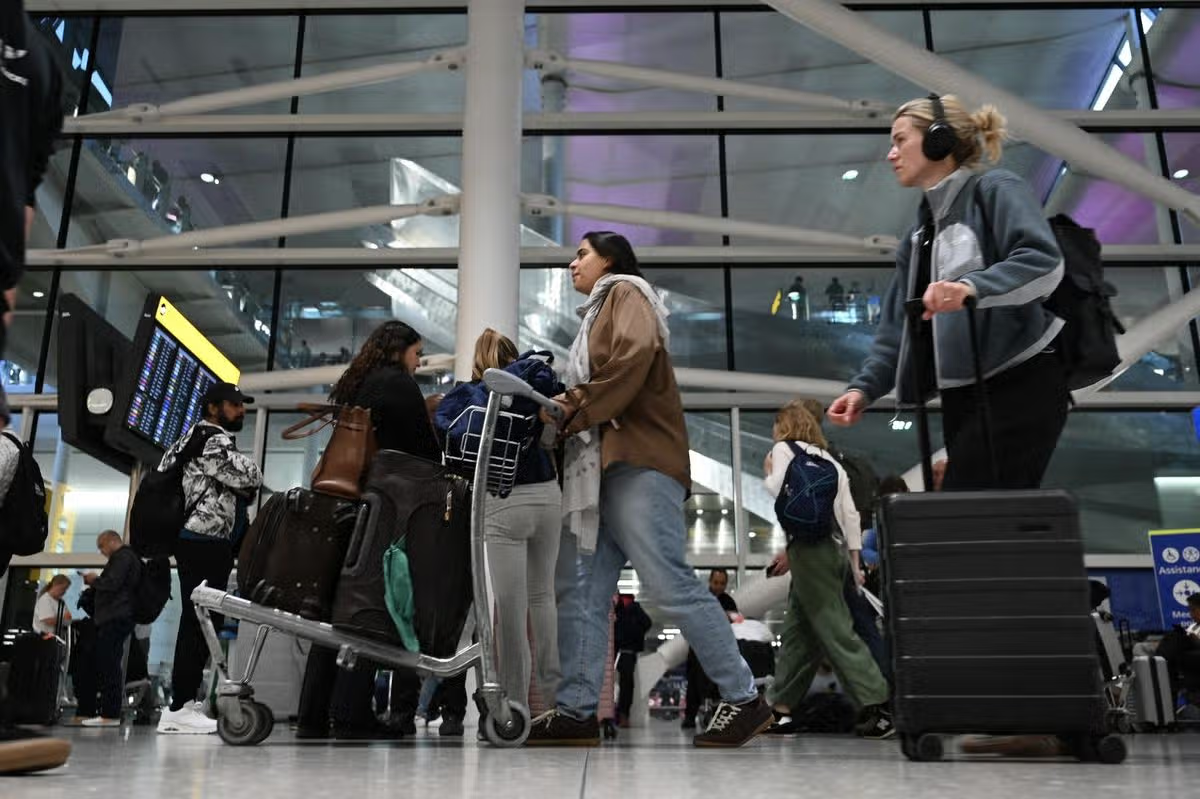
However, if you are already in Crete and need to get to the airport you may want to allow for more extra time.
If you are due to fly in and have concerns, it may be worth contacting your airline to check if they are operating normally.
Though flights are not being cancelledCredit: EPAIf you have a holiday to Crete booked, it is worth checking with your travel insurance if you wish to cancel itCredit: EPA
What if I have a holiday to Crete booked?
As the Foreign Office has not warned against travel to Greece, there are no special circumstances in place for holidaymakers to cancel their trip and receive a full refund.
Depending on what travel insurance you have, your policy might include natural disaster cover.
If so, your insurance policy should cover you for when you are unable to reach your holiday destination due to natural disasters, like wildfires.
So it is worth checking your travel insurance policy.
Can I cancel my trip?
If you do choose to cancel your trip, it is best to contact your airline or holiday provider.
There is no obligation for companies to refund bookings unless government advice changes.
The TikToker posted a side by side comparison of prices at a Greek airport, and many holidaymakers, despite visiting the country several times, didn’t know there was a ‘secret menu’ available
Food and drink can be expensive at the airport(Image: Rasid Necati Aslim/Anadolu via Getty Images)
Holidays are an expensive business, especially if you plan to grab a coffee and a toastie at the airport. Even a bottle of water can set you back £2-3, which is a kick in the teeth when you’re delayed and stuck in a hot terminal.
So, when one TikToker posted the prices at a busy Greek airport, it inspired a flood of comments, but not for the reason you might think. The Greek holiday fan, who posts under the username @zantegeezer with videos about the party island, went to an outlet at the airport that sold the usual pre-departure fare, and one thing surprised his followers.
He started his video saying: “I always post this every time I come to the airport. There is a regulated menu. Basically it means Greek government enforce these very good value for money options.”
Do you have a travel story to share? Email webtravel@reachplc.com
He goes on to show the regulated menu, which includes inexpensive prices for coffee, tea, toasties, and water, all the basic airport staples. He then holds up the café menu, saying:
“That’s a normal menu. You see the price difference there? I mean, look at the proper espresso you get off the regular menu”. The cafés usual menu shows a single espresso costs €4.80, just over £4, but travellers who order it via the regulated menu can get it for €1.80, a more reasonable cost of around £1.53.
A filter coffee is listed as €4.70 on the normal menu, yet if customers were to order off the regulated menu they’d spend just €1.60, around £1.36. And the bargains don’t stop there. Bottled water, in 0.5 or 0.75 litre bottles can be bought for €0.60 or €0.90, around £0.51 and £0.77 respectively.
Content cannot be displayed without consent
Hungry travellers can enjoy a toast with ham and cheese for €1.80, and if you’re dying for a cuppa before you get on the plane, a hot tea costs €1.60 on the regulated menu, or €4.00, about £3.43, if you order from the normal menu.
The TikToker finished by saying: “Just so you know, any airport in Greece you can get cheap stuff by law. Sort it out.” Regulated menus are also available in other locations across Greece in spots such as ports and ferries and places with a captive audience such as certain tourist sites.
However, there is a slight catch. The regulated prices only apply to basics such as water, coffee, and simple snacks like toasties, and only have to be offered on a takeaway basis, so the establishment isn’t under any obligation to let you use its tables. You’ll also generally be offered Greek brands, so don’t expect Volvic or San Pellegrino for the low price.
The video received many positive comments from people sick of rip-off airport prices. Over the summer, a number of airport prices came under scrutiny by fed-up travellers, from food costs to the hike in airport drop-off fees across major hubs.
Many shared their experiences with finding these cheaper deals. One said: “Santorini Airport only had €6.50 Evian water on display but they had the cheap Greek stuff when I asked.”, while another was unaware of these ‘secret menus’: “I didn’t know! Paid €4 for a bottle of water and € 7.90 for a sandwich at Zante airport!”
And there were plenty of calls for other countries to follow suit. “I need to call my representatives for the local and European Parliament. this has to be a European wide directive.”, said one. While another poster commented, “This is one of the best things about Greek airports. needs to be made Europe-wide”
Have a story you want to share? Email us at webtravel@reachplc.com
Normally we stay around Plaka, so Anana is the coffee shop I go to most often. There’s also Behold The Man in Exarchia, which is one of the coolest coffee shops I’ve been to. Exarchia has a really rebellious, anti-establishment feel and this place completely fits that – it has great music, great coffee and it’s just very cool. I don’t think there’s a coffee shop in London that’s quite like it. DC
‘Casual and low-key’: Anäna Cafe, Plaka, Athens.
My favourite is also Anana; It’s casual and low-key, with somewhere to sit down and relax. I’ll have a freddo espresso (espresso shaken over ice), which is basically the Greek national coffee now. NM
For pastries, Akra is one of the best places in Athens. The food itself is rustic, simple and delicious, and the pastries are unbelievably technical. There’s something almost incongruous about it – you eat very simple savoury food and then a dessert arrives that’s incredibly elaborate. It shouldn’t necessarily work, but it does. DC
Roll up! No Crumbs bakery.
No Crumbs opened this year and I’ve already been a few times. It’s a little outside the centre, but it’s where I’d go for breakfast or something to eat on the move. In central Athens, I also like Fillo, which specialises in traditional pies from around Greece. Last time I went, they had three different spanakopitas from three different regions. NM
Breakfast
I don’t really do breakfast in Athens. We’ll normally get coffee, then at about 11am go to Diporto, which is usually our first proper stop. It’s this incredible, old, rundown restaurant near the market: cash only, orders taken with a pen, massive wine barrels in the room, no choice of wine. They just put wine and water on the table. The food is incredibly simple: chickpeas, beans, vegetables cooked down slowly, sometimes grilled sardines or fish from the market. You could recreate a Greek taverna in London, but you could never recreate Diporto. There’s such magic in it. DC
If I want to start the day properly, I go to Ipiros inside the meat market, at about 10.30am. It’s not really breakfast; it’s a proper meal. They serve slow-cooked dishes in huge pots and we usually get the tripe soup, which is good for a hangover, with loads of bread. Then we walk around the corner to Diporto and have the opposite: braised beans, chickpeas, salad and, whatever time it is, wine. NM
Traditional tavernas
Whenever we fly into Athens, we try to go straight to Taverna To Trigono in Kalyvia, out by the airport. It’s as magic as a taverna gets. One side of the menu is salads, tzatziki, cheeses and breads; the other is grilled meat such as sausage, spit-roast lamb, offal, lamb chops, sheep chops. Everything is cooked to order and served with incredible abundance and generosity. It’s very simple: good produce, salt, oregano and lemon; nothing is over-embellished. I wouldn’t go to Athens without going there. DC
Chop-chop! Manári restaurant, Athens.
Manári is a proper meat chop house in central Athens. It’s relatively new, but it feels as traditional as possible, and you don’t need to travel into the mountains outside the city to find meat that good. I order the lamb chops, pasta with meat juices and tomato salad. The lamb chops are as good as – if not better than – a good dry-aged steak. Another favourite is Tavern Spanos in Kato Patisia, for lamb chops and meats cooked slowly on the spit. Once they run out, they run out. NM
New-wave restaurants
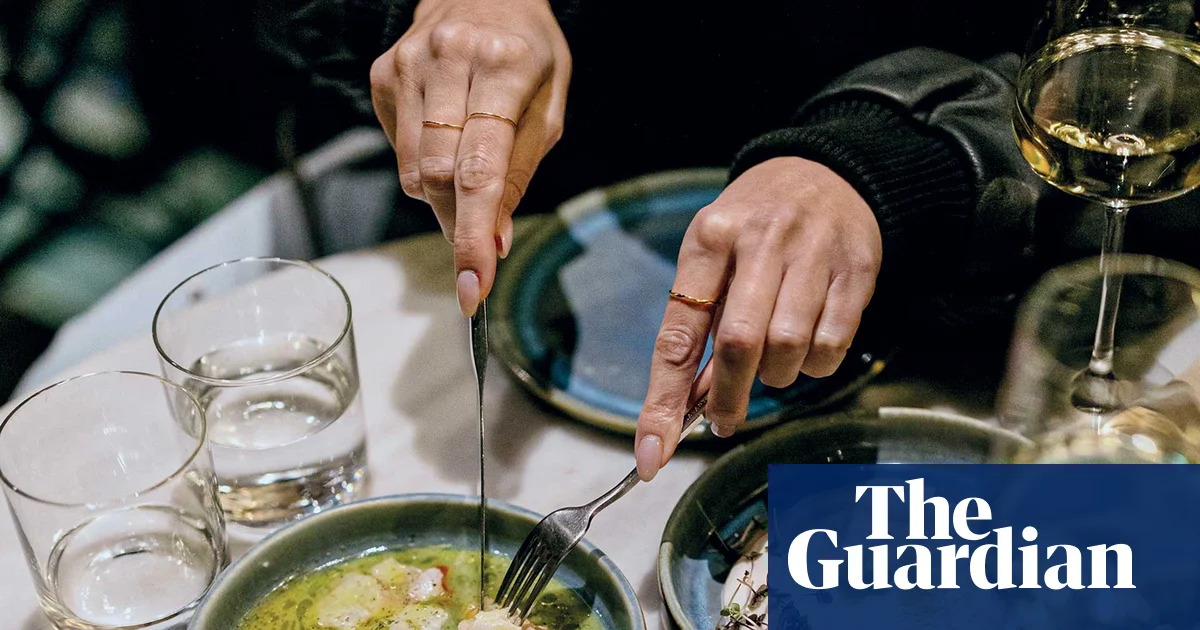
Linou Soumpasis & Sia is probably the most forward-thinking restaurant in Athens right now, and probably one of the best in Greece. It takes quite humble, seafood-led food and gives it a fine edge without losing its simplicity. The room is incredibly simple and every detail is really considered. Last time I went, they served a version of kakavia, the traditional fish soup, which was essentially a beautiful fish and vegetable broth with olive oil. Something that simple, done that well, is incredible. DC
‘Restrained and modern’: Linou Soumpasis and Sia restaurant, Athens.
Linou is one of my go-tos, too. It reminds me a bit of Lyle’s meets Brat. It has a restrained approach to food that still feels very modern. I’d also go to Pharaoh, particularly for the vegetables and whatever they’re doing with fermented wheat, and Ateno, which we went to twice in two days on my last trip. Get the Greek salad, stuffed vegetables and fries with mushrooms and eggs. I also really like Ex Machina: their saganaki is fried cheese but served cold, and I always want to see what [the chef] Adam Kodovas is doing with the seafood broth because the dish changes every few months, while the formula remains the same. I go to Akra for lunch because they serve smaller portions and I can order as many dishes as possible. NM
Seafood
Travolta is banging; it’s old-school and a bit like Bentley’s in London. You get huge plates of crudo and whole fish, and they have an amazing prawn and squid skewer with squid ink and olive oil that they mix at the table. It can get expensive (fish is incredibly expensive in Greece), but if you’re really into seafood it’s very cool. Phita is another good seafood place, a little further out. DC
Travolta would be my choice for more classic seafood, too. If you want something more elevated, I’d go to Iodio near Kolonaki. There’s one dish I’ll always remember, which is raw fish served cold with a crisp sheet of rice paper on top and a warm avgolemono sauce – a classic Greek sauce made with egg and lemon. You grab everything together in one bite and it’s great. NM
Cheap eats
For souvlaki, the best is often at little roadside or market stalls. Last time we were in Exarchia, we found a tiny souvlaki stall mainly serving the market vendors. For souvla, the bigger rotisserie-style meats, we go to Psitopoleio Peloponnhsos. They serve huge pieces of meat, lamb heads; all sorts of pretty gnarly stuff cooking on the rotisserie. DC
Gyros are a dangerous subject for Greeks because everyone has their favourite. Achilleas in Neos Kosmos is one of the few places that still makes their own [meat rotisserie] (rather than buying it ready-made). In the centre, I really like Hoocut. They aren’t technically gyros because they slice the meat raw, cook it and then chop it again into small strips, but the mentality is similar. For a late-night version, go to Mandraki in Kaisariani. They’re open until about 2am and cook meat on spits late into the night. Their gyros are huge and often sell out. It’s cheap, traditional and the sort of thing people actually eat every day. NM
Wine and cocktails
Wine is Fine is really good for a pre-dinner drink, and I also love Epta Martyres, from the people behind Loggia [on Sifnos]; I’d been to both loads of times before I even realised they were connected. In Greece, I tend to want wines that are light and bright. Assyrtiko is the obvious one; in that climate you want something really zippy. DC
Baba Au Rum, Athens.
Pharaoh has a great wine list, and Tanini Agapi Mou is an amazing wine bar. A Greek grape I discovered this year is Vidiano. Vidiano can lean quite dry but still feels really pleasant and crisp; depending on where it’s grown, the fruit and minerality change a lot. It’s easygoing but complex at the same time. NM
Line Athens is quite molecular and it’s the kind of place you stay for the night. The cocktails are some of the best I’ve ever had in my life, let alone Athens. Baba au Rum is right in the mix, too. There’s also Rumble in the Jungle behind The Bar in Front of the Bar. The first is a bar where you walk in and think, “This is cool,” then go through another door into the second, even cooler bar hidden behind it. It’s very Athens. DC
You have to mention Line and The Bar in Front of the Bar. At Bar in Front, they’re trying to be as zero waste as possible, and you basically order through a window in a wall and sit drinking in the street. I choose what to drink according to the weather – last time I had a frozen martini that was almost like a slushie. At Line, the Paloma is usually my go-to, although on my last two visits I had one of their punches, which changes regularly. NM
We always go to Athens’ central fish and meat markets. I particularly recommend being in Athens on a Saturday because that’s when you find all these farmers’ markets around the city. Some of my best times in Athens have been wandering around those. DC
Preparing fish ahead of a busy day at the central fish market. Photograph: Image Professionals GmbH/Alamy
Near Diporto there’s Miran, a charcuterie shop with a huge range of cheeses and cured meats that they make themselves. Buy something there, pick up some bread and take it home. There’s also a huge farmers’ market every Saturday around Exarchia with outstanding produce. NM
Out of town
I really like Vouliagmeni, down on the coast where the Four Seasons is. We used to drive down there in the morning for sunrise, or chase the sunset if we were filming. Lake Vouliagmeni is there, too. It’s much more suburban, with huge houses and tree-lined boulevards, and it’s absolutely beautiful. You probably need a car. I don’t have one particular restaurant to send you to; for me it’s the area itself. DC
Lake Vouliagmeni, near Athens. Photograph: Nito/Shutterstock
For meat, go out towards the airport to Kalyvia. There are two enormous tavernas, Christoforos and To Trigono. During the week they can be completely empty, but at the weekend you’ll struggle to get a table. People tend to swear allegiance to one or the other; I don’t have a favourite. It normally depends on who’s driving me and where they want to go. Although the last few times I’ve been to Christoforos. NM
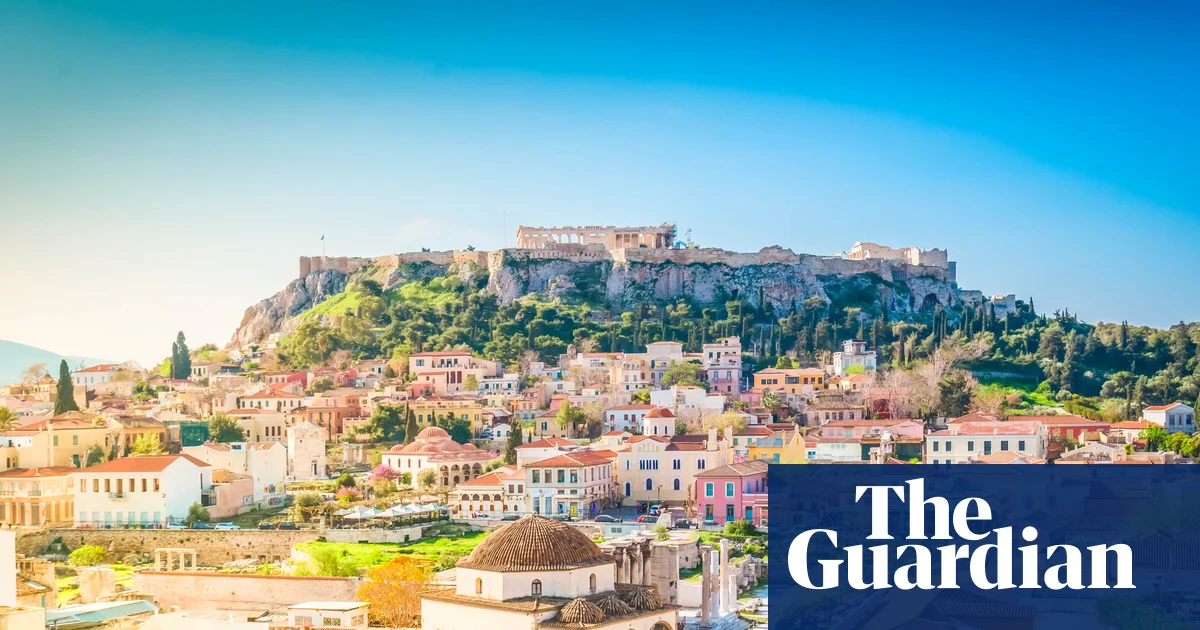
Visiting Athens for its food might have sounded like a joke to previous generations. Unlike many other Mediterranean countries, including Italy, Spain and Turkey, Greece had no renaissance and no aristocracy to fund chefs and develop sophisticated cuisines. Simple village dishes didn’t always translate well: in the past, tourists would suffer a summer scorching and some desiccated moussaka so they could puff up the Acropolis in August before skedaddling to an island. However, recently the Greek capital has undergone a gastronomic renaissance.
Athens always offered the joys of eating outdoors – by the sea in summer, or winter sunshine on the city’s streets – but these days chefs are rethinking the uses of Greece’s unrivalled ingredients, such as scented, sun-ripened tomatoes, barrel-aged feta, and the best olive oil in the world. Enlightened visitors are also re-thinking their trips, arriving at more temperate times of year, and taking advantage of how culinary traditions are moving in exciting directions. They’re exploring beyond the tourist traps and over-Airbnb-d areas around the Acropolis, finding treasures in humbler neighbourhoods such as Petralona, Keramikos, or hipster Kypseli. A bonus is the growing number of restaurants serving food from Asia, Africa, the Balkans and the Middle East.
A bustling outdoor farmers’ market in central Athens. Photograph: Dimitris Asproloupos/Alamy
In the 1980s, Athenians were leaving behind a history of rural poverty, fasoláda bean stew, and a largely vegetarian diet. They discovered fast food and began eating too much meat. The 1990s saw new levels of wealth; brunch, sushi and lobster spaghetti were aspirational goals for the upwardly mobile. By the time of the 2004 Athens Olympics, a cohort of Athenians existed who had never known hunger, war or dictatorship. Consequently, the economic crisis that began in 2009 was a devastating shock and the next decade saw severe unemployment and deprivation, accompanied by an influx of traumatised refugees and migrants.
Athenians who didn’t depart during the brain drain took stock. Unable to pay the rent, some moved back in with parents and grandparents, and others relocated to ancestral villages; rare is the person who has no toehold on an island or mountainside. Family olive groves beckoned, vineyards were tended, organic farming debated. Alongside the unlikely flourishing of the arts in Athens during the crisis (actors, musicians and artists often worked unpaid), there was a flowering of Greek foodies. They examined things previously taken for granted by most Athenians: eating seasonally, shopping at farmers’ markets, sourcing locally. Covid provided a final push.
A mix of modern and traditional: Travolta restaurant in Athens.
Boosted by foreign appreciation of the Mediterranean diet and its delicious, healthy basic ingredients, Athenians returned to their grandmothers’ kitchens – literally in the case of Anastasia Miari, who wrote the celebrated Yiayia: Time-perfected Recipes from Greek Grandmothers. This trend “isn’t just nostalgia or a return to tradition”, chef and writer Carolina Doriti told me. “It’s a new confidence in Greek cuisine, where tradition has become something alive that we can build on, rather than something fixed in the past.” Doriti celebrated this trend for “honest and rooted cooking” in her wonderful books Salt of the Earth and The Greek Islands Cookbook. For this sort of excellent but unpretentious food, she loves the restaurants Lesvion in the Galatsi neighbourhood of Athens and Athos in Votanikos.
Alongside simple and enlightened Athenian tavernas are Michelin-starred restaurants, where local ingredients are metamorphosed in exquisite concoctions for tasting menus. There are riffs on grandma’s chickpeas and wild greens as she never imagined, and Yiayia might be even more astonished at how her descendants dine on Japanese-Greek hybrids, such as soba noodles with tahini, Ethiopian doro wat, Georgian khachapuri and Lebanese fattoush. Eating in Athens has changed.
Sofka Zinovieff has lived in Athens for 25 years. Her latest novel is Stealing Dad. To buy it for £9.89, to go the Guardian bookshop
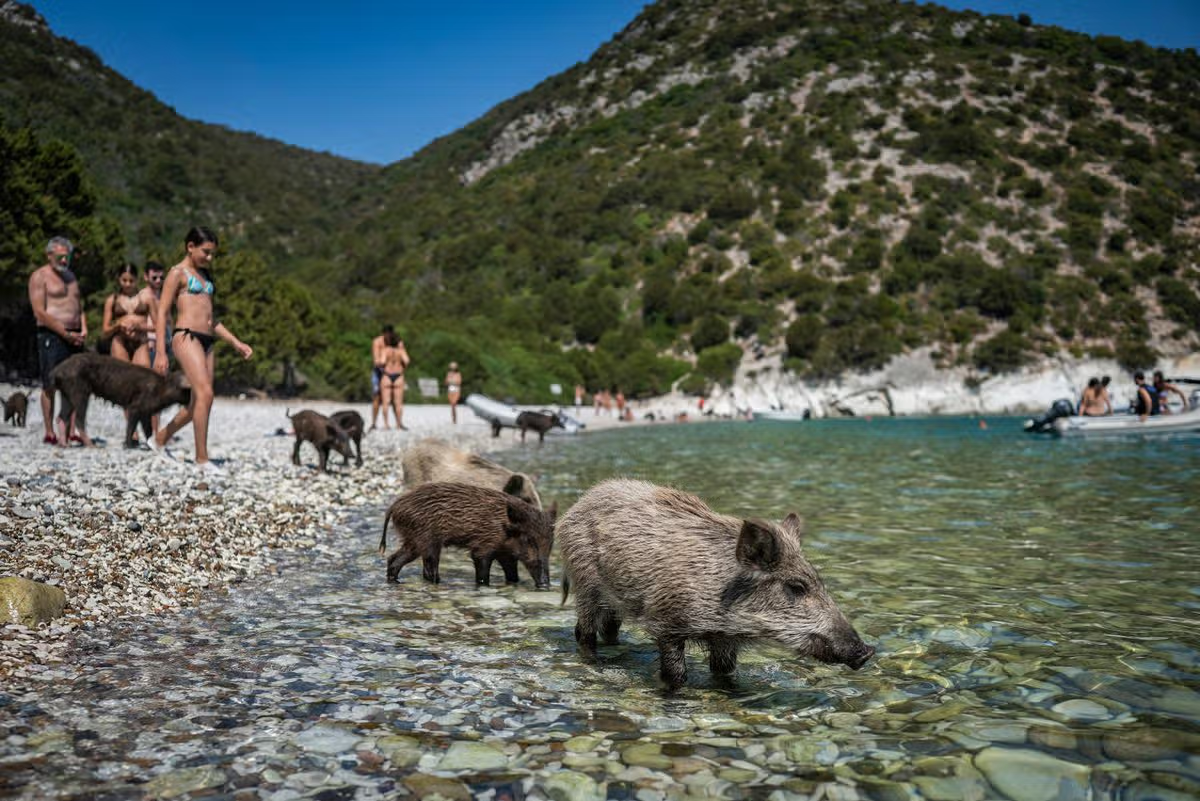
Atokos is a tiny island near Lefkada in the Ionian Sea, off the coast of Acarnania. It is one of the most westerly and remotest of the Echinades Islands, home to no one but a colony of pigs
No one lives on Atokos, except the pigs(Image: AFP via Getty Images)
Pig Beach is an irresistible place. It’s a place where a family of adorable hogs, as pink as a Brit at the end of a long summer holiday, trot around on the sand, run through the shallows and piggy-paddle in the waves.
It’s not clear exactly how the colony of oinkers made it to their Bahaman paradise home. Some say the pigs were dropped off by a group of sailors who wanted to come back and cook them, only to get diverted, leaving the pigs to survive on excess food dumped from passing ships. Another tale suggests the pigs were survivors of a shipwreck, while a third argues that they were placed there as a cynical ploy to attract tourists.
If the final explanation is true, then fair play to the inspired swine herder responsible. The Bahamas’ swimming pigs are one of the most popular tourist attractions in the whole region, attracting thousands of porcine enthusiasts into the shallows each year. Pig Beach has about 20 individual piggies and a cast of piglets that varies in size each year, but other islands, including Eleuthera, Rose, Abaco, and Ship Channel Cay, have also gotten in on the action in recent years.
Charmed by the idea of splashing around in the warm waves with a lovely little swine, when I heard that Europe has its very own version of Pig Island, and that it was a short sail away from where I’d be exploring, I couldn’t resist.
Do you have a travel story to share? Email webtravel@reachplc.com
Atokos is a tiny island near Lefkada in the Ionian Sea, off the coast of Acarnania. It is one of the most westerly and remotest of the Echinades Islands. No one lives on Atokos, not even its shipping magnate owner, Panayiotis Tsako. But it attracts a handful of brave yachtspeople who are allowed to anchor in the shallows.
My friends and I found ourselves in their number on a hot May day, jumping into the water and swimming onto the beach, wetsuit shoes providing crucial protection against the burning-hot pebbles. We’d expected to be met by a group of friendly pigs splashing around in the shallows, but the beach was empty. Of both pigs and people.
Assuming that the hogs were sheltering in the woods at the top of the beach, we walked in, finding them ringing with loud cicadas as we wandered down a path. At the bottom was a single two-storey house, which appeared habitable enough despite its doors being locked and its windows boarded up. Not a pig in sight.
We wandered back towards the beach down winding paths thick with pinecones and sticks, swiping away the thick spider webs that stretched between the trees. Despite the intense Greek sunshine and glistening blue water, the place had a spooky atmosphere, intensified by the empty chapel rising above the sand. I’d read it was well looked after by a visiting janitor, but it looked dusty and unloved. I flicked a large spider off my shoulder.
And then the pigs arrived.
Just as we’d resigned ourselves to returning to the boat light of a soul-cleansing frolick with the promised porsine inhabitants, guess who came snuffling out of the woods? Not a sweet piggy, but a hog. A big, hairy, grunting hog. I’m not an expert, but I’d put a 50/50 wager on it being a wild boar.
The pig wandered towards us, stopping about a metre away. He looked at us, and we looked back. Then out of the woods came three more pigs, seemingly a mum and two piglets. They joined the bigger, dad-looking pig.
There was something about the biggest pig’s tusks and the way it was looking at our now shivering, unprotected but for swimming trunks bodies, that made us feel nervous. These piggies didn’t look amenable to a quick pic.
Suddenly, the big pig roared and lurched forward towards us. I don’t know whether we’d strayed too close to his family, looked at him the wrong way, or stayed too long on the creepy island, but the noise was far from an Instagram-reel-friendly oink. To our shame, we ran. We ran all the way into the sea, powering through the shallows before launching ourselves into a swim. It was only once back to our boat that we risked a look back towards the Atokos and its inhospitable pig masters. There they stood, looking out across the water, unfriendly stares boring into us.
THE holiday destinations without the crowds that want MORE tourism have been revealed.
Intrepid has released its annual ‘Not Hot’ List, partnering with Globetrenders to look at alternative destinations to visit instead of the popular, oversaturated places.
Intrepid’s underrated travel destinations for 2027 have been namedCredit: AlamyAlonnisos island in Greece sees a fraction of tourists compared to other islandsCredit: Alamy
Using both Intrepid’s local leaders and destination experts, along with trend forecasts, the study looks at three key elements – areas with few visitor numbers, their ability to welcome more tourists, and any new infrastructure for 2027 such as big events or transport systems.
When it comes to Europe, you might be surprised to realise there are still some Greek islands that don’t have the tourist crowds.
Sign up for the Travel newsletter
Thank you!
Intrepid named Alonnisos as a “not hot” destination which is a more sustainable holiday experience in the region.
They said: “Alonnisos is a slice of paradise that plays host to an array of aquatic and land-based delights, including the endlessly entertaining – and endangered – Mediterranean monk seals.”
The island is actually home to the National Marine Park of Alonnisos and Northern Sporades (Europe’s largest marine protected area), as well as Greece’s only underwater museum, the Peristera shipwreck.
It remains off the radar for most tourists as you can’t fly to the island, with it only accessible by ferry or private yacht.
In 2024, it saw just 70,000 tourists – compared to its neighbour Skiathos’ 500,000 or Santorini’s 3.4million.
Another European destination highlighted was Liepāja, a beach city in Latvia.
Nicknamed the Baltic Mediterranean, next year it will become Europe’s Capital of Culture, meaning hundreds of events, festivals and shows.
Samburu Game Reserve in Kenya is a quieter safari destinationCredit: AlamyCanad’s Whitehorse, in Yukon Territory was named as wellCredit: AlamyWhen it comes to Europe Dalsland in Sweden was highlighted, often nicknamed the country’s ‘Lake District’Credit: AlamyCarretera Austral in Chile also made the listCredit: Alamy
Just under 120,000 tourists visited last year, meaning you’ll get the five-mile, white sand beach all to yourself.
To get there, Ryanair fly to Palanga from London Stansted for £25, which is around an hour from Liepāja
Sweden‘s Dalsland made the top 10 list as well, for being “unspoilt and unexplored”.
Around two hours from both Gothenburg and Oslo, it is known as Sweden‘s ‘Lake District’ for all of its outdoor activities from wild camping to kayaking and hiking.
Just 320,000 people visited last year, compared to the capital of Stockholm which saw 16million.
Other destinations on Intrepid’s list included Samburu National Reserve in Kenya, named for being the place for both “crowd-averse safari fans” and an “emerging astrotourism destination”.
Georgia is fast becoming a new holiday destination, after both British Airways and easyJet launched direct flights to the capital Tbilisi last year.
But Intrepid praised Mestia as an alternative, quieter place which, while popular with neighbouring tourism, is set to become bigger with international tourism due to new infrastructure plans.
The Pekoe Trail is Sri Lanka’s first long-distance walking trail, and an alternative way of seeing the island nationCredit: AlamyTimor-Leste is one of Southeast Asia’s least visited destinations, and is getting easier to go to thanks to new flight connectionsCredit: AlamyJordan’s North Highlands were named as a great alternative to the country’s iconic desert landscapesCredit: AlamyAnd Mestia in Georgia is set to become more popular as wellCredit: Alamy
Otherwise it is popular as an outdoor adventure holiday destination, with both hiking and skiing experiences.
Also mentioned was the Northern Highlands in Jordan, a green “alternative to the country’s iconic landscapes” while “Arctic tourism” was highlighted for visiting Whitehorse in Canada.
Timor-Leste, one of South East Asia’s least-visited destinations was also highlighted, with new flight routes to connect the capital of Dili to major hubs such as Kuala Lumpar.
Sri Lanka‘s first long-distance walking trail Pekoe Trail (with a new 10-day Intrepid trip launched) and Chile‘s ‘route 7’ Carretera Austral rounded out the list.