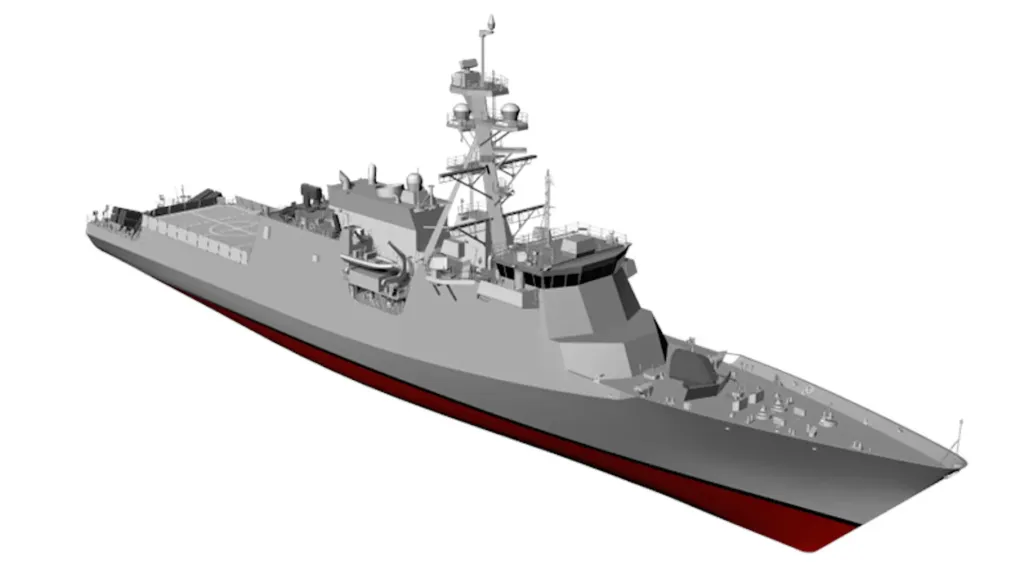
frigate

Navy’s New Frigate Will Not Have A Vertical Launch System For Missiles

The U.S. Navy has confirmed to TWZ that the armament package for its first “flight” of its new FF(X) frigates will not include a built-in Vertical Launch System (VLS). There had been widespread questions about whether the ships would include a VLS array after renderings were released with no such feature readily apparent.

A lack of any type of VLS on the FF(X) design is a glaring omission that can only raise questions about the operational utility and flexibility of the ships. At the same time, the new frigates will be able to carry modular payloads, including containerized missile launchers, on their sterns. The Navy also has an explicit plan to employ the FF(X)s as “motherships” for uncrewed surface vessels (USV), likely offering a distributed arsenal, as well as additional sensors, for the frigates to leverage during operations.

One of the renderings the Navy released last week of the FF(X) design. USN via USNI News

The Navy announced its plan to acquire a fleet of new FF(X) frigates last Friday, which followed the cancellation of the abortive Constellation class program earlier in the month. The service previously confirmed that the FF(X)s will be based on the Legend class National Security Cutter (NSC), which Huntington Ingalls Industries (HII) first developed for the U.S. Coast Guard.

I have directed a new Frigate class as part of @POTUS Golden Fleet. Built on a proven American design, in American shipyards, with an American supply chain, this effort is focused on one outcome: delivering combat power to the Fleet fast. pic.twitter.com/ovnASiHYaF

— Secretary of the Navy John C. Phelan (@SECNAV) December 19, 2025

“The initial flight of FF(X) will have a 57mm gun, 2 x 30mm guns, a Mk 49 Rolling Airframe Missile [launcher], various countermeasures, and a flight deck from which to launch helicopters and unmanned systems. Aft of the flight deck, there will be a flexible weapons system, which can accommodate containerized payloads (Counter-UAS, other missiles),” a Navy spokesperson told TWZ today. “Much like the successful DDG-51 [Arleigh Burke class destroyer] program, we are building this in flights. The frigate will be upgraded over successive flights to evolve and has the space reservations needed to improve capability over time.”

“The goal is to get [FF(X)] hulls in the water ASAP,” another Navy official told TWZ. “Minimal design changes will be incorporated into the first flight so that we can get hulls into the water as soon as possible.”

“The [FF(X)] design changes are in the process of being finalized and we are confident that our extensive experience and collaboration with the U.S. Navy will lead to a successful approval process,” a HII spokesperson also told us. “Specific and targeted changes will be implemented to meet unique mission requirements. The process will be similar to a baseline upgrade on the DDG program, which has been successfully used to introduce new capabilities multiple times over the class’ history. Design work is ongoing and we understand the Navy’s intent is to minimize changes in order to expedite procurement.”

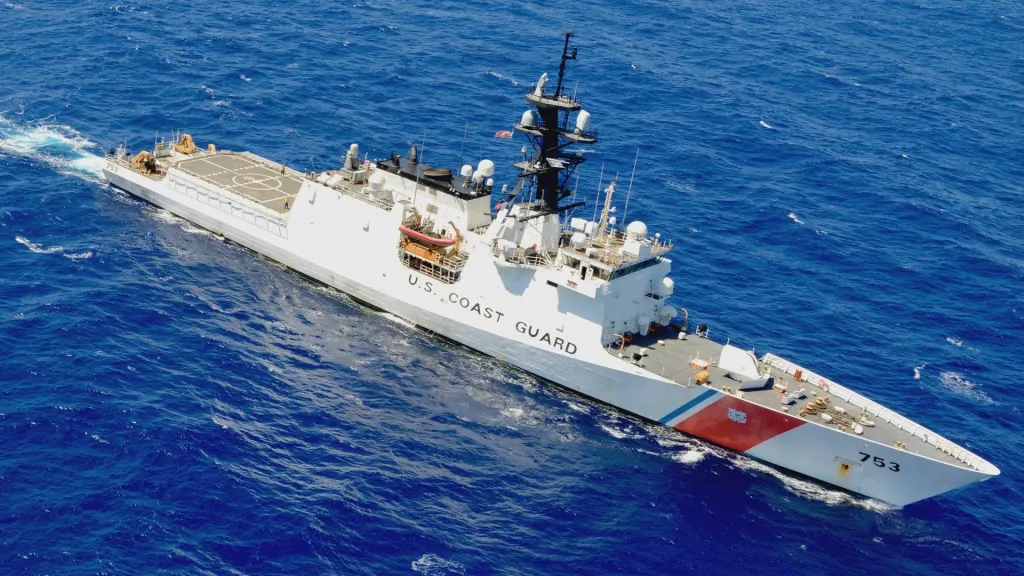
One of the US Coast Guard’s existing Legend class National Security Cutters. USCG

As we mentioned in our initial reporting on FF(X), the size of the Mk 41 VLS array on the previously planned Constellation class frigates was a hot topic of debate. Questions had been raised whether the 32-cell VLSs on those ships would be sufficient to meet their expected operational taskings, as you can read about more in this past TWZ feature.

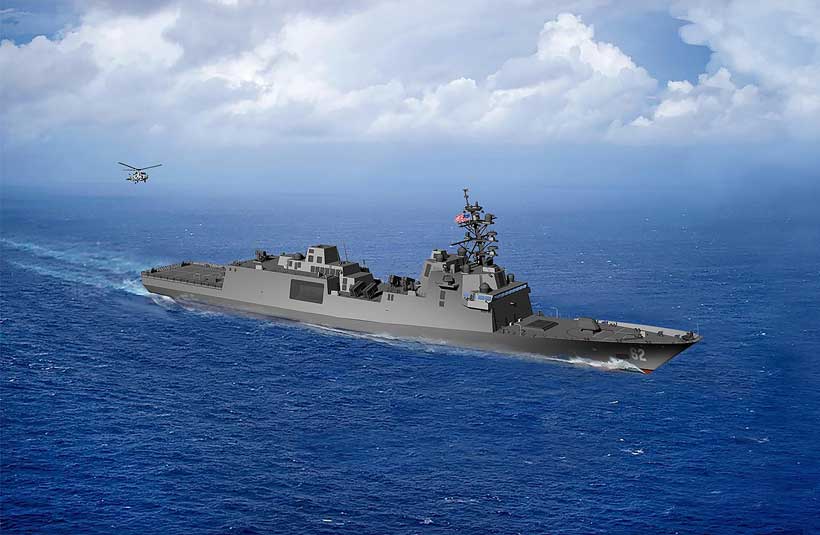
A rendering of a Constellation class frigate. USN

Overall, the Mk 41 VLS requirement was central to the FFG(X) program that led to the Constellation class design. This was viewed as a key element of righting the wrongs of the Navy’s chronically underperforming Littoral Combat Ship (LCS) program. The Independence class and Freedom class LCSs both lack a VLS array. In addition, it’s worth remembering here that HII’s losing FFG(X) bid was notably a Patrol Frigate concept derived from the National Security Cutter that featured a VLS. The company had also pitched other VLS-equipped Patrol Frigate variations to the Navy before then, as seen in the video below.

Patrol Frigate Variants – Information Video


Integrating a VLS into future flights of FF(X) frigates is certainly an option, but one that could be complex and costly if the design is not configured to accommodate one to begin with. As TWZ previously highlighted, the FF(X) configuration, as it has been seen so far, has a significantly redesigned main superstructure compared to the Coast Guard’s Legend class and previous Patrol Frigate concepts. This includes a prominent ‘shelf’ that extends forward into the space on the bow utilized for VLSs on previously seen Patriot Frigate configurations. With what we know now, that extension seems more likely to be utilized in the future as a mounting place for some type of point defense system, possibly even a laser directed energy weapon. It’s possible it could be adapted to accommodate a small VLS array in the future, as well. The lack of an integrated VLS could explain the lack of a more advanced radar in the renderings of the FF(X) that have been shown so far.

A rendering showing the FF(X) design from the top down with the ‘shelf’ extending forward of the main superstructure clearly visible. USN capture

Installing missile launchers on the FF(X)’s fantail would give the ships a boost in firepower in the absence of an integrated VLS array. Renderings so far have shown what look to be launchers for up to 16 Naval Strike Missiles (NSM) installed in that position. NSM is an anti-ship cruise missile with secondary land-attack capability that the Navy has already integrated onto a portion of its LCSs and at least one Arleigh Burke class destroyer, and that the Marine Corps is fielding now in a ground-based configuration. There also looks to be space there for a least one containerized Mk 70 Payload Delivery Systems (PDS), another capability the Navy is already acquiring. Each Mk 70 contains a four-cell launcher derived from the Mk 41 VLS, and similarly capable of firing a variety of weapons, including SM-6 multi-purpose missiles and Tomahawk land-attack cruise missiles. FF(X)s could also leverage sensors on larger crewed warships for targeting purposes when operating as part of a surface action group.

An SM-6 missile seen being fired from a Mk 70 containerized launcher mounted on the stern flight deck of a US Navy Independence class LCS. USN

“The FF(X) will be designed to command groups of unmanned vessels, acting as a sort of ‘mothership,’ providing the commander tailored force packages based upon the weapons and sensors fielded on those unmanned craft,” a Navy spokesperson also told TWZ today.

In this way, an FF(X) could still call upon a deeper and more flexible array of weapon options without having to have a VLS integrated directly onto the ship. The uncrewed platforms would also be able to operate across a much broader area than any single crewed frigate and present a different risk calculus for operating in higher-risk environments. All of this would expand the overall reach of the combined force and present targeting challenges for opponents. But there are also substantial development and operational risks with this kind of arrangement. As it sits, this kind of autonomous vessel and manned vessel teaming is still in development. Operationally, leaving the ship without, or with very limited, area defense capability is at odds with many future threat scenarios.

The Navy is already separately pursuing a family of larger uncrewed surface vessels (USV) able to carry an array of containerized payloads to bolster the capability and operational capacity of its crewed surface fleets as part of a program called Modular Surface Attack Craft (MASC), which you can read more about here.

Even with all this in mind, the lack of a VLS still raises significant questions about the FF(X) plans, especially about the ability of the ships to operate more independently. This has been a key issue for the Navy’s existing LCS fleets, and one that the Constellation class was supposed to help address.

The USS Freedom, seen at the rear, sails alongside the USS Independence. USN The USS Freedom, at rear, sails alongside the USS Independence, in the foreground. The lead ships in both of their classes of Littoral Combat Ships (LCS), these vessels were both been decommissioned in 2021. USN

Omitting a VLS capable of at least employing Evolved Sea Sparrow Missiles (ESSM) imposes particular limitations on the ship’s ability to defend itself against aerial threats. Navy experiences during recent operations in and around the Red Sea have served to put a notable spotlight on the ever-growing dangers posed by anti-ship missiles and drones, which would be far more severe in any future high-end fight in the Pacific. All of this also means FF(X)s will not be able to provide area defense for convoy operations without a modular containerized payload, and that would only offer a very limited supply of munitions compared to a highly efficient VLS array.

The Navy is also clearly focused on just trying to get more hulls into service as quickly as it reasonably can. The service has major operational demands for more surface warships, in general, and now has an additional gap to fill following the collapse of the Constellation class program. The goal is for the FF(X) to be launched in 2028.

“We will start as soon as a funding contract and material are available,” the HII spokesperson told TWZ today. “We are confident in our ability to launch the first ship into the water in 2028, then conduct final outfitting, systems activation, and testing before delivering to the Fleet.”

HII also plans to leverage materials already acquired under the Coast Guard’s Legend class National Security Cutter program to help accelerate work on the first FF(X) hull. The current timeline for that ship to enter operational service remains unknown.

Overall, just how aggressively the Navy is moving to get these new frigates into the fleet as fast and cheaply as possible is now clear with today’s news. While expanded variants in the future with VLS arrays and more exquisite combat systems seem like a real possibility, when it comes to installed armament, America’s next frigate is set to be just as lightly armed as the LCS that came before it.

Contact the author: joe@twz.com
Joseph has been a member of The War Zone team since early 2017. Prior to that, he was an Associate Editor at War Is Boring, and his byline has appeared in other publications, including Small Arms Review, Small Arms Defense Journal, Reuters, We Are the Mighty, and Task & Purpose.


Howard is a Senior Staff Writer for The War Zone, and a former Senior Managing Editor for Military Times. Prior to this, he covered military affairs for the Tampa Bay Times as a Senior Writer. Howard’s work has appeared in various publications including Yahoo News, RealClearDefense, and Air Force Times.


Source link

This Will Be The Navy’s New FF(X) Frigate

The U.S. Navy has confirmed its decision to acquire a new FF(X) frigate with a design based on the U.S. Coast Guard’s Legend class National Security Cutter, though there are immediate questions about its expected configuration. The new warships, the first of which is set to be launched in 2028, are intended to fill the gap left by the cancellation of the abortive Constellation class frigate program. As TWZ just recently explored in detail, axing Constellation, itself intended to help make up for the chronically underperforming Littoral Combat Ship (LCS) program, had highlighted a concerning hole in the service’s future force structure plans.

The Navy had previously announced its intention to acquire a new class of frigates, but had only said they would be based on an unspecified American design. Breaking Defense had reported last week that the Legend class National Security Cutter, developed by Huntington Ingalls Industries (HII), was the design in question, citing anonymous sources.

The USGCS Hamilton, one of the US Coast Guard’s Legend class National Security Cutters. USCG

Secretary of the Navy John Phelan announced the decision to cancel the Constellation class program at the end of November. The Navy had awarded the first contract for what had been expected to be a fleet of at least 10 of those frigates, based on the existing Franco-Italian FREMM design, in 2020. With the idea that only relatively minor changes would be necessary in the Americanized version, and that this would help keep the program on track, the original goal was to see the future USS Constellation delivered in 2026. However, extensive Navy-directed design changes resulted in an almost completely different vessel with only 15 percent commonality with its European ‘parent,’ and the delivery schedule had slipped to 2029 at the earliest.

A previously released rendering of a Constellation class frigate. USN

Now, “to deliver at speed and scale, I have directed the acquisition of a new frigate class based on HII’s Legend class National Security Cutter design, a proven American-built ship that has been protecting U.S. interests at home and abroad,” Secretary Phelan said in a video announcement today. “The President [Donald Trump] and SECWAR [Secretary of War Pete Hegseth] have signed off on this as part of the Golden fleet. Our goal is clear: launch the first hull in the water in 2028.”

I have directed a new Frigate class as part of @POTUS Golden Fleet. Built on a proven American design, in American shipyards, with an American supply chain, this effort is focused on one outcome: delivering combat power to the Fleet fast. pic.twitter.com/ovnASiHYaF

— Secretary of the Navy John C. Phelan (@SECNAV) December 19, 2025

“We look forward to supporting the Navy on this critical program,” Chris Kastner, President and CEO of HII, also said in a statement in a company press release. “Speed matters, and the NSC ship design is stable and producible and will lead to predictable schedules. I have great confidence in the Ingalls team to execute this program, and in our ongoing efforts with our partners to successfully expand the U.S. shipbuilding industrial base to meet the Navy’s needs.”

In terms of the future frigates themselves, “the FF(X) is a highly adaptable vessel. While its primary mission will be surface warfare, its ability to carry modular payloads and command unmanned systems enables it to execute a broad spectrum of operations, making it ready for the challenges of the modern maritime environment,” according to a Navy release. “Small surface combatants have always been essential to the fleet, handling a wide range of missions where a large warship isn’t required. The FF(X) will continue this vital role, and will take on more routine operations, enhancing the fleet’s operational flexibility, adaptability, and mission readiness.”

The Navy has not yet released more specific details about FF(X)’s expected capabilities, but has shown renders of the design. USNI News has also published an additional Navy rendering of the design, seen at the top of this story. What is seen is notably distinct in various ways from Patrol Frigate concepts derived from the National Security Cutter that HII has previously proposed to the Navy, including in the FFG(X) competition that led to the Constellation class. In particular, a very prominent ‘shelf’ has been added to the bottom of the front end of the main superstructure.

A rendering of the FF(X) design as seen from the side. The shelf in front of the main superstructure is clearly visible. USN capture
A comparative rendering of a previous Patrol Frigate concept, called the FF4923, that HII has presented in the past. HII capture

Where a Vertical Launch System (VLS) array might be found is an immediate question. This is something that one would expect to be a key feature on any future Navy frigate. Past HII Patrol Frigate concepts have included VLS arrays of varying sizes between the main superstructure and the turreted gun on the bow, as can be seen in the video below.

Patrol Frigate Variants – Information Video


However, the FF(X) design, as it has been shown so far, does not have a VLS clearly installed in its bow, and the new shelf cuts into the space used in previous Patrol Frigate concepts for this purpose. With this in mind, it is possible that a VLS array will be, or at least could be, installed directly in the expanded forward superstructure. This design change would presumably make it easier to fit a larger VLS array into the existing Legend class hull configuration, as below deck alterations to accommodate it would be reduced, especially if longer strike-length cells are not planned.

The shelf could also serve as a pedestal for other weapon systems, such as a laser directed energy weapon or some other form of point defense system, but this seems far less likely given the other features of the design.

A rendering of the FF(X) design as seen from the top down, which underscores how much the new shelf extends past the rest of the forward superstructure. USN capture

The VLS requirement was a particularly hot topic of discussion around the FFG(X) effort that led to the Constellation class. After work began on those ships, there continued to be questions about whether their 32-cell VLSs were sufficient for meeting their expected mission requirements, as you can read more about in this past TWZ feature.

The FF(X) renderings do clearly show angled deck launchers for missiles at the stern end of the ship, but what they are intended to be filled with is unknown. What is depicted does align with launchers for 16 Naval Strike Missiles (NSM), an anti-ship cruise missile with secondary land-attack capability that the Navy has already been integrating onto some of LCSs, and has been exploring as an option for arming other ships. The U.S. Marine Corps is also fielding a ground-based NSM system.

The ship’s only other clearly visible weapon systems are a Mk 49 launcher for RIM-116 Rolling Airframe Missile (RAM), for close-in defense, and what appears to be the same 57mm gun in a turret on the bow that is found on the Coast Guard’s Legend class configuration. Whether this has anything to do with the FF(X) nomenclature for the new frigate effort, which notably lacks the “G” reflecting naval vessel designs explicitly intended to carry guided missiles, is unknown.

A wider look at the stern end of the FF(X) rendering showing the Mk 49 RAM launcher, at right, and additional angled missile launchers, at left. USN via USNI News

The FF(X)’s main mast configuration, as depicted in the rendering, also looks largely unchanged from the existing Legend class design. It does appear to feature a Saab AN/SPS-77 Sea Giraffe medium-range multi-mode surveillance radar that is not found on the Coast Guard’s cutters. A much larger AN/SPY-6(V)3 Enterprise Air Surveillance Radar (EASR), coupled with a derivative of the Aegis combat system, had been set to be a key feature on the Constellation class frigates. More significantly expanded sensor suites were also a feature in past HII Patrol Frigate concepts.

The explicit mention of modular payloads in the Navy’s release raises additional questions. One of the most significant areas where the LCS program has failed to deliver has been in the promise of its modular mission modules. These were supposed to allow the ships to rapidly shift from one mission set to another. As it stands now, the Navy’s Independence and Freedom class LCSs are deployed with largely fixed configurations. It is also worth noting that modular payloads for the FF(X) could refer to containerized systems, such as the Mk 70 Payload Delivery System, which contained a four-cell missile launcher derived from the Mk 41 VLS. There is space on the fantail of the FF(X) design, behind the box launchers, that could be used for a containerized payload.

An SM-6 missile seen being fired from a Mk 70 containerized launcher mounted on the stern flight deck of a US Navy Independence class LCS. USN

The Navy has otherwise made clear that it expects the new frigate design to allow for the integration of new and improved capabilities and functionality down the line.

“The frigate will follow the same proven approach we’ve used with the Arleigh Burke destroyers, building it smart from the start, then upgrading it in steps over time, as the threat and technology evolve,” Chief of Naval Operations Adm. Daryl Caudle also said in today’s video announcement.

Arleigh Burke class destroyers, also sometimes referred to as DDG-51 class ships, are the primary workhorse of the Navy’s current surface fleets, something that looks unlikely to change for decades to come. The service has now begun fielding the Flight III subvariant, which features significantly improved capabilities. There are a number of major upgrade programs underway for existing versions, as well. At the same time, it is worth noting that Navy officials have been warning for years that the underlying design is ‘maxed out’ from a structural perspective, as well as when it comes to meeting the needs of increasingly power-hungry mission systems.

The USS Jack H. Lucas, the US Navy’s first Flight III Arleigh Burke class destroyer. USN

Any major physical modifications to the initial FF(X) design, such as the installation of a larger VLS or a new mast for a larger and/or more capable radar array, could be complex and costly. The Navy has its own history with large-scale upgrade programs becoming expensive boondoggles, with previous work on its Ticonderoga class cruisers having become a particular case study in what not to do.

The Navy has shared details about its acquisition strategy for the new frigates, which it clearly hopes will help avoid some of the issues that befell the Constellation program. The service also plans to eventually competitively award contracts for additional hulls to multiple shipyards. This is in line with broader trends across the Navy and the rest of the U.S. military to be better about obtaining and retaining key intellectual property rights for major weapon system programs to prevent being locked into a particular vendor.

“We will acquire these ships using a lead yard and competitive follow-on strategy for multi-yard construction,” according to Secretary Phelan in today’s video. “Shipyards will be measured against one outcome, delivering combat power to the fleet as fast as possible.”

A 2023 Navy briefing slide showing work on the future USS Constellation. USN

“Leveraging a complete design and production baseline approach will allow the Navy and shipbuilders to reduce costs, schedule, and technical risk,” Adm. Caudle added. “We know this frigate design works. We know it operates with the fleet, and most importantly, we know how to build it now.”

The new frigate program is also being presented as a way to help bolster domestic U.S. shipbuilding capacity. America’s shipbuilding industry has contracted to a very worrying degree over the past few decades, especially in contrast to China’s heavy investment in the opposite direction, as you can read more about here.

“We will deliver on a wartime footing, and we will unleash the American industrial base to do it, competition, accountability, and real output, steel in the water,” per Secretary Phelan.

Comments from Navy officials today also seem clearly intended to head off questions about why the service is not considering any of the wide array of capable frigate designs that allies and partners have in active production now. This is something TWZ explicitly touched on in our recent piece on the Navy’s future frigate outlook.

“We’ve also been clear-eyed about what happens in conflict. Other countries will always prioritize their own fleets, not us, ships that depend on foreign industry,” Adm. Caudle said in the video released today. “That’s why this is an American design backed by American workers, American suppliers, and an established logistics and maintenance network. So wherever the ship sails, when the American flag goes into port, it does so with American industry firmly behind it.”

National Security Cutter – Ingalls Shipbuilding


What is not in question is the Navy’s need for more capable small surface combatants, and more of them overall, especially given the underperformance of the LCS program. In particular, the new frigates will offer a way to free up Arleigh Burke destroyers for more pressing taskings, as well as reduce operational strain on the destroyers overall.

“Recent operations from the Red Sea to the Caribbean make the requirement undeniable,” Adm. Caudle stressed in the video today. “Our small surface combatant inventory is a third of what we need. We need more capable blue water, small combatants to close the gap and keep our DDGs focused on the high-end fight.”

With what happened to the Constellation class program, one can expect the new FF(X) effort to be subjected to a particular significant degree of scrutiny, including from Congress. With the official plan now declared to be to leverage the Legend class National Security Cutter design already in Coast Guard service, more specific details may begin to emerge.

Contact the author: joe@twz.com

Joseph has been a member of The War Zone team since early 2017. Prior to that, he was an Associate Editor at War Is Boring, and his byline has appeared in other publications, including Small Arms Review, Small Arms Defense Journal, Reuters, We Are the Mighty, and Task & Purpose.


Source link

Cancellation of Constellation-Class Frigate Program Marks Setback for U.S. Navy Modernization

The recent decision by the United States Navy (USN) to cancel the Constellation-class frigate program after eight years of development and billions of dollars in investment represents a significant setback in US naval modernization drive. The Constellation-class was meant to become a modern, multi-mission combat vessel capable of relieving operational pressure from Arleigh Burke-class destroyers and narrowing the growing numerical advantage of the China’s People’s Liberation Army Navy (PLAN). Instead, continuous design changes, and subsequent delays changed what was supposed to be an easy-to-construct warship platform into a costly and significantly delayed project. After failure of several major projects like Zumwalt destroyer and Littoral Combat Ships (LCS), the cancellation of the Constellation-class frigate project has degraded Washington’s efforts to sustain the naval balance of power against rapidly expanding naval fleet of PLAN.

The Constellation-class project was a product of USN’s urgent need to fill the gap left behind Oliver Hazard Perry-class (OHP) frigates which were phased out from USN services in 2015. The OHPs, despite lack of built-in vertical launch system (VLS), were regarded for their reliability, and versatility in missions ranging from open-ocean escorting to anti-submarine warfare (ASW) and anti-surface warfare (ASuW). The retired hulls of OHPs were purchased by navies of several US allies including Australia, Bahrain, Chile, Egypt, Pakistan, Spain, Taiwan, and Turkiye. Their withdrawal from USN created a capability void that the Littoral LCS program – comprising of Freedom class and Independent class vessels – was expected to fill. However the LCS encountered numerous mechanical failures in hulls and propulsion system, cost overruns, and capability gaps that rendered it unsuitable for missions in contested naval environments.

As USN halted further procurement and early retirement of LCS, it attempted to follow a new approach, i.e., opt for a proven design tailored to meet USN requirements. Franco-Italian FREMM frigate design was chosen as the baseline for a modern, affordable American Constellation-class frigate. At initial stage, it appeared a sound idea. The FREMM platform had already proven itself in European naval forces, and the USN specific variant was modified to carry 32 Mk-41 VLS cells capable of firing SM-series interceptors and even Tomahawk cruise missiles, alongside Naval Strike Missiles. This program committed to be a potent yet affordable and rapid addition in USN fleet while retaining 85 percent commonality with original design. But as USN continued to impose new requirements, complications in construction, and alteration in designing began to inhibit the efficiency of the program. Constellation-class frigate undertook major size increment than parent FREMM design, stretching from 466 feet to nearly 500 and increasing to over 7,200 tons. Instead of leveraging a proven design, USN trapped itself with a pseudo-original design which now shared mere 15 percent commonality with the original design. By 2024, the first frigate was already three years behind schedule, and the program’s cost enlarged well beyond initial estimations. Faced with increasing costs, long delays, and design complications, the USN eventually axed the Constellation-class frigate program too, leaving behind a significant gap in USN surface fleet which this frigate was supposed to fill.

USN now wants a new frigate class structured on proven American design by 2028. Reportedly, the design of US Coast Guard (USCG) Legend Class cutter will be used as baseline to develop a USN specific variant. These 4,600 tons class ships are capable of conducting blue water operations and support 57mm deck gun, Phalanx CIWS, and flight deck with hanger to support rotary wing operations.  Its USN specific frigate version can accommodate a 16-cell Mk-41 VLS module, 8x Harpoon/NSM cruise missiles in canisters, RIM-116 Sea RAM, and torpedo tubes. Using an American proven design for mass producing USN specific frigate of relatively smaller size and low tonnage will allow USN to produce and commission larger number of hulls in relatively less time. But on flip side, this new frigate class will be far less capable than recently cancelled Constellation-class as they are unlikely to carry Aegis CMS, and will have significantly less range, endurance, and weapon load-out.

Nowhere is this challenge more evident than in the rapid growth of China’s naval power. PLAN is now commissioning highly capable naval combatants including flat-deck aircraft carrier (Fujian), next generation destroyers (Type-055 and Type-52DL) and frigates (Type-54B), and new class of conventional as well as nuclear submarines. Chinese coast guard, and maritime militia collectively operate more than 750 vessels – more than twice the number of hulls under US control. While the US Navy still retains qualitative advantages, especially in nuclear submarines and carrier aviation, trends in shipbuilding capacity significantly favor Beijing. China commands more than half of global commercial ship production, while the US share barely registers at a tenth of a percent. This allows China to mass produce modern warships for PLAN at a pace the United States cannot simply match.

Although USN plans to expand its fleet from 296 manned warships to 381 manned warships and 134 unmanned vessels by 2045, but so far trends of decline hull strengths have been observed. Ticonderoga class cruisers are gradually retiring, next-generation DDG(X) destroyers are still in far future, Ford class nuclear aircraft-carriers and Columbia-class ballistic missile submarines (SSBNs) are facing delays, and Arleigh Burke Flight-III destroyers are not producing at rate faster enough to accommodate these growing gaps. Unmanned vessels are sometimes perceived as a viable solution to fill-up the gaps but these vessels cannot replace manned warships on one-on-one basis. In sum, aforementioned projects expose the persistent limitations of ship production capacity of US shipyards. The Congressional Budget Office estimates that reviving the shipbuilding sector to meet the USN long-term needs would require annual investments of more than $40 billion for three consecutive decades—a staggering commitment that would require political consensus and sustained strategic vision.

The cancellation of the Constellation-class frigate, just like past projects of Zumwalt and LCS- thus represents a persistent crisis in US naval build-up. As China accelerates its naval production and expands power projection into the Indo-Pacific, the United States finds itself struggling to revive its own shipbuilding capacity. Whether Washington can reverse this trajectory will depend on its ability to reform procurement processes, invest in industrial capacity, and adopt realistic designs aligned with strategic needs. Without such changes USN risks entering the next decade with too few ships to meet global demands.

Source link

U.S. Navy Now Wants A New Frigate And Fast

The U.S. Navy says it is aiming to have the first of a new class of frigates based on an existing American design “in the water” by 2028. The U.S. Coast Guard’s Legend class National Security Cutter is reportedly the basis for the design in question. This all follows a decision to cancel the Constellation class frigate, a program marred by major delays and cost growth, which has now further exposed a highly concerning gap in the service’s future force structure plans. Constellation, meant to right the wrongs of the disastrous Littoral Combat Ship (LCS) program by buying a largely off-the-shelf frigate, had turned into a boondoggle of its own.

Navy Secretary John Phelan had announced the cancellation of Constellation just over two weeks ago. The Navy had awarded the first contract for a fleet of at least 10 of those warships in 2020. The service picked a design based on the existing Franco-Italian FREMM frigate, with the expectation that only relatively minor changes would be needed, and that this would help keep the program on track. However, over the past five years, the Constellation design morphed into almost a completely different vessel with only 15 percent commonality with its ‘parent.’ As of April, construction of the future USS Constellation was only around 10 percent complete, and the delivery timeline had slipped to 2029.

Navy Secretary John Phelan seen here speaking at a Marine Corps 250th anniversary event in October 2025. DoW

Finally deciding to axe Constellation, though driven by harsh realities, is the latest addition to now decades-long struggles the Navy has had in bolstering its surface fleets. As noted earlier, the frigate debacle follows on from the acquisition of two chronically underperforming classes of Littoral Combat Ships (LCS) and the decision to slash purchases of Zumwalt class stealth destroyers (also known as DDG-1000s) down to just three hulls. The service currently relies heavily on its Arleigh Burke class destroyers and Ticonderoga class cruisers, the last of the latter of which are set to be retired in 2029. As such, the service has a very pressing need for additional smaller, but more capable surface combatants, as well as more surface warships overall.

“We believe the future frigate can be in the water in 2028,” Jason Potter, the official currently performing the duties of the Assistant Secretary of the Navy for Research, Development, and Acquisition, told attendees at the U.S. Naval Institute’s annual Defense Forum Washington on Wednesday, according to Breaking Defense.

“We will be building a frigate. It will be based on an American design,” Phelan had said last weekend at the Reagan National Defense Forum, according to Defense One. “It is something we can build that we think, actually, will be done before the old Constellation.”

Phelan also said the follow-on frigate effort was part of a larger naval force structure and shipbuilding plan the Navy has been crafting under the current Trump administration, referred to as the “Golden Fleet.”

In addition, Breaking Defense reported that Phelan recently told individuals at a private dinner that the Legend class National Security Cutter, developed by U.S. shipbuilder Huntington Ingalls Industries (HII), would be the basis of the new frigate, citing two unnamed sources. That outlet said the Navy and HII declined to confirm or deny any connection between the National Security Cutter design and the post-Constellation frigate plans.

The Coast Guard’s Legend class cutter USCGC Hamilton. USCG

TWZ has also reached out for more information. In response to our queries, HII declined to speak to the Navy’s current frigate plans.

Starting with the National Security Cutter, 10 of which were built for the Coast Guard between 2005 and 2024, would not necessarily be a surprising choice. HII notably entered a variation of its Patrol Frigate concept, derived from the National Security Cutter, into the Navy’s FFG(X) competition that led to the Constellation class, something we will come back to later on.

As TWZ has explored in the past, the 4,600-ton-displacement Legend class ships are themselves modern and capable, and are intended for open-ocean ‘blue water’ operations. In Coast Guard service, the cutters have often operated far from America’s shores and regularly integrate with elements of the Navy and other branches of the U.S. military.

A US Navy MH-60R Seahawk helicopter seen embarked on the Coast Guard’s Legend class cutter USCGC Midgett for an exercise in 2022. USCG

At the same time, the National Security Cutter design would have been modified significantly to meet Navy mission requirements for a frigate. The primary armament of each one of the Coast Guard’s Legend class cutters consists of a single 57mm gun in a turret on the bow. They also have a Phalanx Close-In Weapon System (CIWS) with a 20mm Vulcan cannon, and mounts for crew-operated machine guns at various points around the ship. The possibility of arming them with Harpoon anti-ship cruise missiles has come up in the past, but there has been no actual movement to integrate that capability.

In comparison, the Constellation class frigate design, with a displacement approaching 7,300 tons (at least per the original target), included a 32-cell Vertical Launch System (VLS) intended to fire SM-2 Block IIICs and Evolved Sea Sparrow Missiles (ESSM). These are both surface-to-air missiles. Some of those VLS cells were also expected to be loaded with a vertically-launched anti-submarine warfare weapon, likely a member of the RUM-139 Vertical Launch Anti-Submarine Rocket (VL-ARSOC) family or a follow-on design. All variants of the VL-ARSOC carry lightweight anti-submarine torpedoes as their payloads. There had been talk of integrating SM-6 multi-purpose missiles and Tomahawk land attack cruise missiles onto Constellation in the future.

There had been much discussion in the past about whether even the 32-cell VLS was sufficient for the Constellation‘s expected combination of anti-air, anti-surface warfare, and anti-submarine mission profiles, as you can read more about in detail in this past TWZ feature.

A rendering of a Constellation class frigate. The design’s 32-cell VLS array is seen right in front of the main superstructure. USN

Beyond the VLS, each Constellation class frigate was set to be armed with launchers for 16 RGM-184 Naval Strike Missile (NSM) cruise missiles (which have anti-ship and land-attack capabilities), a single launcher loaded with RIM-116 Rolling Airframe Missiles (RAM) for close-in defense, a 57mm main gun, and mounts for multiple crew-operated machine guns.

Navy requirements for sensors and other systems missions, as well as other design features, would also differ from what the Coast Guard has laid out for the Legend class, which would require significant changes to the existing design. As one example, the Constellation class frigates were expected to feature a version of the Aegis Combat System, a key capability not found on the Coast Guard’s cutters.

There is also the matter of the Navy’s distinct shipbuilding and survivability standards for surface warships. Power generation, cooling, and even tweaks to propulsion could be needed.

It is important to remember, as mentioned, that a central factor in the collapse of the Constellation class program was the excessive changes between that design and the Franco-Italian FREMM (which stands for Fregata Europea Multi-Missione, meaning European Multi-Mission Frigate in English), from which it was derived. The Navy had expressly intended to reduce risks for that program by starting with a proven, in-production warship.

An infographic from circa 2021 with details about how significantly the Constellation class design differed from its ‘parent’ design, the Franco-Italian Fregata Europea Multi-Missione (FREMM). USN via CRS

As mentioned, HII has already done significant design work on the Patrol Frigate concept over the past decade or so. HII has put forward multiple variations of that design, including ones with 12 and 16-cell VLS arrays, as well as various other weapons and mission systems beyond what are found on the Legend class configuration.

Patrol Frigate Variants – Information Video


“Regarding the original frigate competition, we did bid a variation of the NSC [National Security Cutter] that was lethal, low risk, and affordable,” an HII spokesperson had told Breaking Defense when asked about Phelan’s reported comments. “We look forward to partnering with the Navy on designs for the ships they need.”

There is also a question of whether the Navy might be able to more directly leverage the Coast Guard’s National Security Cutter program in its new frigate plans. In June of this year, HII confirmed to USNI News that it had stopped work on what was expected to be the 11th member of the Legend class, set to be named the USCGC Friedman, following the settlement of a contract dispute with the Coast Guard. How far along work on that ship was at the time, and whether it would be feasible to complete it in a new Navy-specific configuration, is unclear. Fabrication of the future Friedman had started in 2021. In addition, Congress previously approved funding for the Coast Guard to purchase long lead time materials in relation to an option to buy a 12th Legend class cutter, which has never been executed.

A picture HII release in 2021 showing workers cutting steel for the future USCGC Friedman. HII

The National Security Cutter’s career with the Coast Guard to date has not been entirely smooth sailing, either. The service has been open about the challenges it has been facing in operating and sustaining its Legend class ships.

“When a National Security Cutter pulls into port, we do a controlled parts exchange, which is a fancy term for cannibalizing our readiness,” Acting Coast Guard Commandant Adm. Kevin Lunday had said at the Navy League’s annual Sea Air Space conference earlier this year. “You can only cannibalize your readiness and eat your own readiness for so long in that downward death spiral, and that’s where we’re at.”

Lunday made clear that this was reflective of broader readiness issues facing his service, compounded by budgetary challenges. The Navy fielding a fleet of National Security Cutter-derived frigates might help here by spreading cost burdens differently across a shared supply chain. The Navy already has a history of cooperating with the Coast Guard on major shipbuilding efforts.

Though the Navy’s plan to use the National Security Cutter as a starting place for a new frigate does remain unconfirmed, it’s unclear what other options there might even be for a new warship in this category that is “based on an American design.” The U.S. subsidiary of Australian shipbuilder Austal and Lockheed Martin did compete for FFG(X) with expanded versions of their respective Independence and Freedom class Littoral Combat Ships (LCS). Lockheed Martin dropped out of the running early, reportedly because it could not rework the Freedom design enough to meet the Navy’s requirements. Austal USA had continued on, but the Navy passed on its offer, as well. Variations of the Freedom class LCS are still being built, including four Multi-Mission Surface Combatant (MMSC) derivatives for Saudi Arabia. The last Independence class LCS was delivered to the Navy earlier this year.

A Navy briefing slide highlighting the FFG(X) competitors. In addition to the FREMM, Independence class, Freedom class, and Patrol Frigate-based designs, General Dynamics’ Bath Iron Works (BIW) had submitted an offer in partnership with Spanish shipbuilder Navantia. USN

The FFG(X) effort was itself widely seen as a rebuke of the long-troubled LCS program. Independence and Freedom class ships have both suffered from a variety of major issues over the years that have called their basic utility into question, though the Navy has made certain strides in expanding their operational employment in recent years. This all underscores the Navy’s clear, continued desire for new frigates, despite Constellation‘s cancellation.

It should also be noted that there are several modern frigate designs available on the open market elsewhere in the world. Japan’s futuristic Mogami class stands out particularly in this regard, with examples of an expanded version with a larger 32-cell VLS array now being built and a historic export deal for additional hulls for Australia secured earlier this year. This means two U.S. allies in the Pacific are now set to have fleets of these ships, which could offer operational and sustainment benefits, especially in the context of a major conflict or other contingency that both nations might find themselves involved in. Finding ways to maximize that kind of commonality would also be advantageous for the U.S. Navy when selecting a new frigate.

A Japanese Mogami class frigate. JMSDF

There are two more frigate designs, the Type 26 and Type 31, in active production in the United Kingdom, and there are export orders for both on the order books already. There is also South Korea’s Daegu class, export versions of which are set to be built in Peru, and the F110 from Spanish shipbuilder Navantia, among others.

A rendering of a Type 26 frigate. BAE Systems
The South Korean Batch II Daegu class frigate ROKS Chuncheon. South Korean Defense Acquisition Program Administration
The first F110 frigate for the Spanish Navy seen being launched earlier this year. Navantia

A version of the Type 26 now in development for Canada, called the River class, as well as the F110, both notably feature the Aegis Combat system, as well as versions of Lockheed Martin’s still very new AN/SPY-7 radar. It’s also worth pointing out that the Canadian armed forces also refer to the future River class warships as destroyers rather than frigates, reflecting a particular view of their expected capabilities and mission sets. In the context of the U.S. Navy’s new frigate plans, being able to leverage an existing design that already has key desired systems baked in, at least in certain subvariants, could be highly beneficial. Integrating Aegis, and the radar arrays that go along with it, in particular, is a major design driver for any warship, and having to modify an existing type to incorporate those features would come along with costs and complexities.

This all can only prompt questions about whether the Navy may be hamstringing itself now by centering its new frigate plans on an existing American design. The U.S. shipbuilding sector, overall, faces significant challenges at present, especially around workforce retention, after decades of contracting in size. This contributed to delays with Constellation, and continues to impact other Navy shipbuilding programs. These issues have become increasingly concerning from a broad national security perspective, especially given the huge gap now that exists in shipbuilding capacity compared to that of China, and the U.S. government has been trying to take steps to reverse the worrisome trends. The prospect of leveraging foreign yards to help build future Navy warships, as well as sustain existing fleets, has been raised. American authorities have also been courting foreign investment in the shipbuilding industry in the United States. A U.S.-South Korean trade agreement announced in November notably included a pledge by the latter country to pump $150 billion into America’s shipbuilding sector.

Given what happened with the Constellation class, any future Navy frigate program is likely to face significant scrutiny, including from Congress, in general, and be seen as a major test of the service’s ability to avoid past pitfalls. Since he was confirmed to the post in March, Navy Secretary Phelan has been consistently pledging to shake up how the service buys ships and submarines, especially when it comes to accelerating delivery timelines and cutting costs.

From day one I made it clear: I won’t spend a dollar if it doesn’t strengthen readiness or our ability to win.

To keep that promise, we’re reshaping how we build and field the Fleet—working with industry to deliver warfighting advantage, beginning with a strategic shift away… pic.twitter.com/pbTpIPDfR8

— Secretary of the Navy John C. Phelan (@SECNAV) November 25, 2025

“The requirements are going to be put in and done before we start building the first one,” Phelan also said about the new frigate plans at the Reagan National Defense Forum this past weekend, according to The Washington Times. “When we start building the first one, any change order will have to be put through me.”

“The Constellation class frigate was canceled because, candidly, it didn’t make sense anymore to build it,” Phelan also said. “It was 80 percent of the cost of a destroyer and 60 percent of the capability. You might as well build destroyers.”

Locking in the design of any future class of frigates for the Navy, and doing so relatively quickly, will be absolutely key to avoiding what happened with Constellation. This, in turn, will require the service to accept the fact that frigates are not destroyers, and the tradeoffs and risks that come with that, especially when it comes to potentially employing the ships more independently in a higher threat environment.

Plenty of good frigate designs to put directly into production with MINOR subsystem tweaks to meet U.S. Navy’s basic needs. Rapid design lock prior to construction.

Off the shelf should mean off the fucking shelf.

— Tyler Rogoway (@Aviation_Intel) December 12, 2025

They could have spiraled in new capabilities and done an expanded variant down the line. They just couldn’t keep their hands out of the cookie jar. Even after LCS and DDG-1000 disasters, they couldn’t help themselves and went totally against the programs core objective.

Hold…

— Tyler Rogoway (@Aviation_Intel) December 12, 2025

How the Navy proceeds in its push now to right the wrongs of the Constellation class program, and have the first example of a still sorely needed class of new frigates launched by 2028, will be an area of keen interest going forward.

Contact the author: joe@twz.com
Joseph has been a member of The War Zone team since early 2017. Prior to that, he was an Associate Editor at War Is Boring, and his byline has appeared in other publications, including Small Arms Review, Small Arms Defense Journal, Reuters, We Are the Mighty, and Task & Purpose.


Source link