North Korea frames nuclear sub work as response to Seoul debate

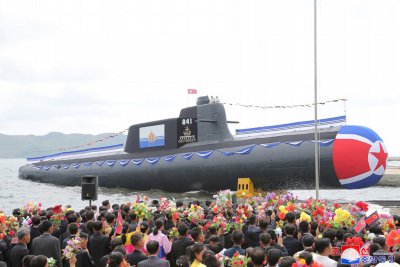
Dec. 25 (Asia Today) — North Korea released images of Kim Jong-un inspecting what it called a nuclear-powered submarine construction project, a move analysts said was aimed at casting South Korea’s debate over nuclear-powered submarines as a security threat while justifying Pyongyang’s own push to strengthen its strategic nuclear forces.
The Korean Central News Agency reported Thursday that Kim described South Korea’s pursuit of nuclear-powered submarines as a threat that must be countered and offered remarks defending North Korea’s development of nuclear-powered submarines. Analysts said the message used Seoul’s discussion as a pretext to portray North Korea’s strategic weapons buildup as inevitable.
North Korea has previously unveiled undersea capabilities, including what it called a Sinpo C-class ballistic missile submarine, the “Kim Gun Ok Hero Submarine,” which it claimed was its first “tactical nuclear attack submarine” when it was introduced in September 2024, according to state media.
South Korean maritime defense experts, including Hanyang University professor Moon Geun-sik, said the latest disclosure appears intended to showcase parallel development of what North Korea described as an 8,700-ton nuclear-powered strategic guided missile submarine – believed by analysts to be a ballistic missile submarine – along with an underwater unmanned system, believed to be an underwater drone.
KCNA said Kim called for a “qualitative leap” in maritime nuclear forces and described nuclear-powered submarines as a core pillar of North Korea’s nuclear deterrent.
Experts said North Korea’s claims about a “threat” from South Korea diverge from how Seoul has described its own debate. Moon and Jeong Seong-jang, deputy director at the Sejong Institute, said South Korea’s discussion has not been framed around nuclear armament or preemptive strikes. They said it has been presented as a defensive option to support longer submerged operations and covert tracking to counter North Korea’s nuclear and submarine-launched ballistic missile threats.
North Korea experts also say Pyongyang has pursued sea-based missile capabilities in recent years, including efforts they describe as adapting the KN-23 short-range ballistic missile into a sea-based short-range submarine-launched ballistic missile and conducting an underwater test launch from a new 3,000-ton diesel-electric submarine.
Analysts said Kim’s remarks amount to political framing meant to discredit South Korea’s nuclear submarine discussion while rationalizing North Korea’s strategic weapons development. They said North Korea has steadily unveiled intercontinental ballistic missiles, submarine-launched ballistic missiles and tactical nuclear weapons and is now presenting nuclear-powered submarines as a further step in that progression, with an eye toward both internal cohesion and external pressure.
Attention has also focused on the suspected construction site. Experts reviewing the newly released video and images alongside past satellite analysis pointed to shipyard facilities in the Sinpo area of South Hamgyong Province as the most likely location.
Sinpo is widely viewed by analysts as North Korea’s primary hub for submarine and submarine-launched ballistic missile activity, with infrastructure and specialized personnel linked to construction and testing, including launch test facilities and underwater launch barges.
Some experts urged caution about North Korea’s technical capacity to field and operate an 8,700-ton nuclear-powered submarine, noting it would require reliable reactor miniaturization and shielding, radiation safety and a fuel cycle and maintenance system that can support long-term operations. Jeong and other analysts said it remains unclear whether North Korea has achieved those capabilities on a stable basis.
Still, analysts said the strategic impact can be felt regardless of the project’s maturity. Once North Korea publicly declares a nuclear-powered submarine program, they said, it reduces ambiguity and can heighten instability in the maritime environment around the Korean Peninsula.
Experts said Seoul should avoid being drawn into North Korea’s rhetorical framing while recognizing that sea-based nuclear and missile threats are becoming more entrenched. They said South Korea’s nuclear-powered submarine discussion should be refined as a defensive option within international norms and alliance cooperation and paired with broader maritime deterrence steps, including underwater surveillance, anti-submarine warfare and unmanned systems.
KCNA also reported Thursday that Kim reviewed the progress of what it described as newly developed underwater weapons and outlined plans tied to naval force reorganization and the creation of new units.
Analysts said that while Kim’s statement about South Korea’s nuclear submarine push was directed at Seoul, the broader objective was to justify North Korea’s own strategic weapons advancement. They said South Korea should separate principle from reality in its response and focus on capability building and international legitimacy rather than mirror rhetoric.
— Reported by Asia Today; translated by UPI
© Asia Today. Unauthorized reproduction or redistribution prohibited.