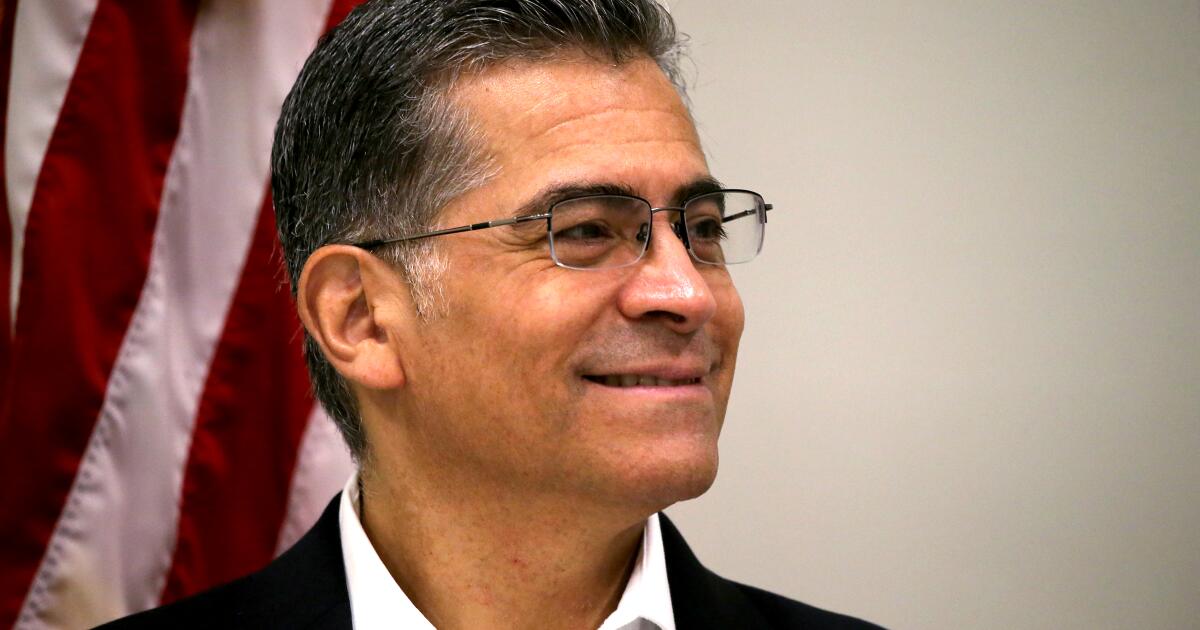
Becerra blasts USC and ABC for excluding candidates of color from gubernatorial debate
Former U.S. Health and Human Services Secretary Xavier Becerra, one of the top Democrats running for California governor, on Friday blasted USC and the ABC affiliate in Los Angeles for hosting a debate that he argues purposely excludes all candidates of color.
Becerra said he and the other candidates were excluded from the televised debate unfairly, a decision that he said “smells of election rigging” in a hotly contested race less than three months before the June primary.
“My father used to tell me of the days when he would encounter signs posted outside establishments that read ‘No Dogs, Negroes or Mexicans Allowed,’” Becerra wrote in a public letter to USC President Beong-Soo Kim. “USC’s actions may not seem so transparent. But, you have deliberately chosen to selectively filter the voters’ view of the field of gubernatorial candidates in what all observers characterize as a wide-open race.”
The university said in a statement that it authorized a political expert to create the formula to determine who would be included in the debate.
“At the request of the Center for the Political Future, Dr. Christian Grose, Professor of Political Science and International Relations, independently established the methodology that determined eligibility for the debate,” according to a statement from the center. “No one in the USC administration had any role in developing, reviewing or approving those criteria.”
The center later said in a statement on Friday that it reiterated the criteria that determined which candidates were invited to participate in the debate, and that nothing had changed since the forum was first planned.
The criteria for gubernatorial candidates to participate considered opinion polling and campaign fund raising. Six candidates were asked to participate in the March 24 debate, which is cosponsored by ABC7 Los Angeles and Univision.
There was conflicting information about USC’s stated criteria, however. The methodology says that the fundraising totals considered were based on semi-annual reports campaigns filed with the California Secretary of State’s office. However, the document later says that the fundraising figures also includes large donations that campaigns are required to immediately report.
This is a critical difference, because San José Mayor Matt Mahan did not enter the race until late January, and thus far has not been required to file any semi-annual fundraising disclosures with the state. However, he has received significant donations since he entered the race.
Mahan agreed with Becerra, saying that he ought to be part of public forums about who will lead the state.
“The former Secretary is absolutely correct, he should be included in the debate,” Mahan said in a statement. “His long record of service to California has earned him a place on every debate stage in this campaign for Governor.”
USC officials said they are clarifying how they selected candidates to participate in the race.
“We are reissuing the criteria to make clear that they include current fundraising totals, including semi-annual and late reports, which were always part of the formula,” the Center for the Political Future said in a statement. “We are not changing the criteria. We have updated even as of today and the rank order includes the same top 6 candidates.”
Grose said that the selection of candidates was based upon polling and fundraising numbers, and that the sentence about semi-annual fundraising reports was inaccurate.
“It was just a wording issue. It’s not a methodology issue,” he said.
Six candidates are scheduled to appear at the debate: Republicans Riverside County Sheriff Chad Bianco and conservative commentator Steve Hilton; and Democrats Northern California Rep. Eric Swalwell, former Orange County Rep. Katie Porter, billionaire hedge-fund founder Tom Steyer and Mahan.
The kerfuffle occurs after Democratic candidates of color accused state party leaders of trying to oust them from the race in favor of white candidates, who have more support in opinion polls.
In addition to Becerra, other prominent Democratic candidates excluded from the debate include former state Controller Betty Yee, state Supt. of Public Instruction Tony Thurmond and former Los Angeles Mayor Antonio Villaraigosa, who also condemned the candidate-selection formula.
“Californians deserve a fair process, and voters deserve to hear from all qualified voices,” Villaraigosa, who taught public policy at USC for three years after leaving office, said in a statement. “But this biased and bigoted action by USC to manipulate the data to exclude every qualified Black, Latino, and API candidate in favor of a less qualified white candidate is shameful.”
Becerra said USC went to great lengths to justify the candidates that were excluded, but the bias was clear.
“You can’t escape the detestable outcome: you disqualified all of the candidates of color from participating while you invited a white candidate who has NEVER polled higher than some of the candidates of color, including me,” he said.
Becerra was clearly referring to Mahan, who recently entered the race and has received millions of dollars of support from Silicon Valley leaders. Becerra noted that veteran GOP strategist Mike Murphy, co-director of the USC Center for the Political Future, which is a sponsor of the debate, is assisting an independent expenditure committee backing Mahan.
Murphy said he had recused himself from anything involved in the debate, and that he was a volunteer for the outside group backing Mahan. If he becomes a paid advisor to the independent expenditure committee, he said he has requested unpaid leave from the university through the June 2 primary.
“I’ve been transparent that I’m personally a Mahan supporter,” Murphy said. “I’ve had zero to do with the debate.”