‘Zootopia 2’: Disney movie’s best animal puns, references explained
Following a $1-billion-grossing, Oscar-winning smash could have left writer and director Jared Bush and director Byron Howard feeling like rabbits in the headlights, but they seem to have outfoxed the challenge. “Zootopia 2” has already stampeded past $1 billion to surpass its predecessor, and the awards nominations have just begun slithering in. But how did the sequel survive such high expectations, stay as socially relevant as the original and navigate the peril of too many cooks in the kitchen?
“Animation’s a team sport,” says Howard, referring to the sheer number of people who worked on the film over five years. “It’s 700 in the crew, but in this building, it’s about 1,000 and another 300 in Vancouver. So it’s everyone’s collective ideas, saying, ‘Here’s where we can do better.’ So everyone has skin in the game and they all want these movies to be great. It’s an emotional investment.”
The creative team screened “Zootopia 2” for all of Disney Animation multiple times in various stages of development. A feedback system enabled every employee to respond.
Bush says Disney regularly seeks internal reactions after screenings, “but we asked way more direct questions for this one, like at an audience preview. Then we shared that feedback, unfiltered, with the entire building. That allowed people to see that their feedback mattered because you could actually see ideas that came in [manifest] from screening to screening.”
Bush and Howard acknowledge that having that many collaborators keeps the inspiration flowing but also allows fragments of the colossal group brain to sneak into the film unnoticed. Even they aren’t sure where all the in-jokes are planted.

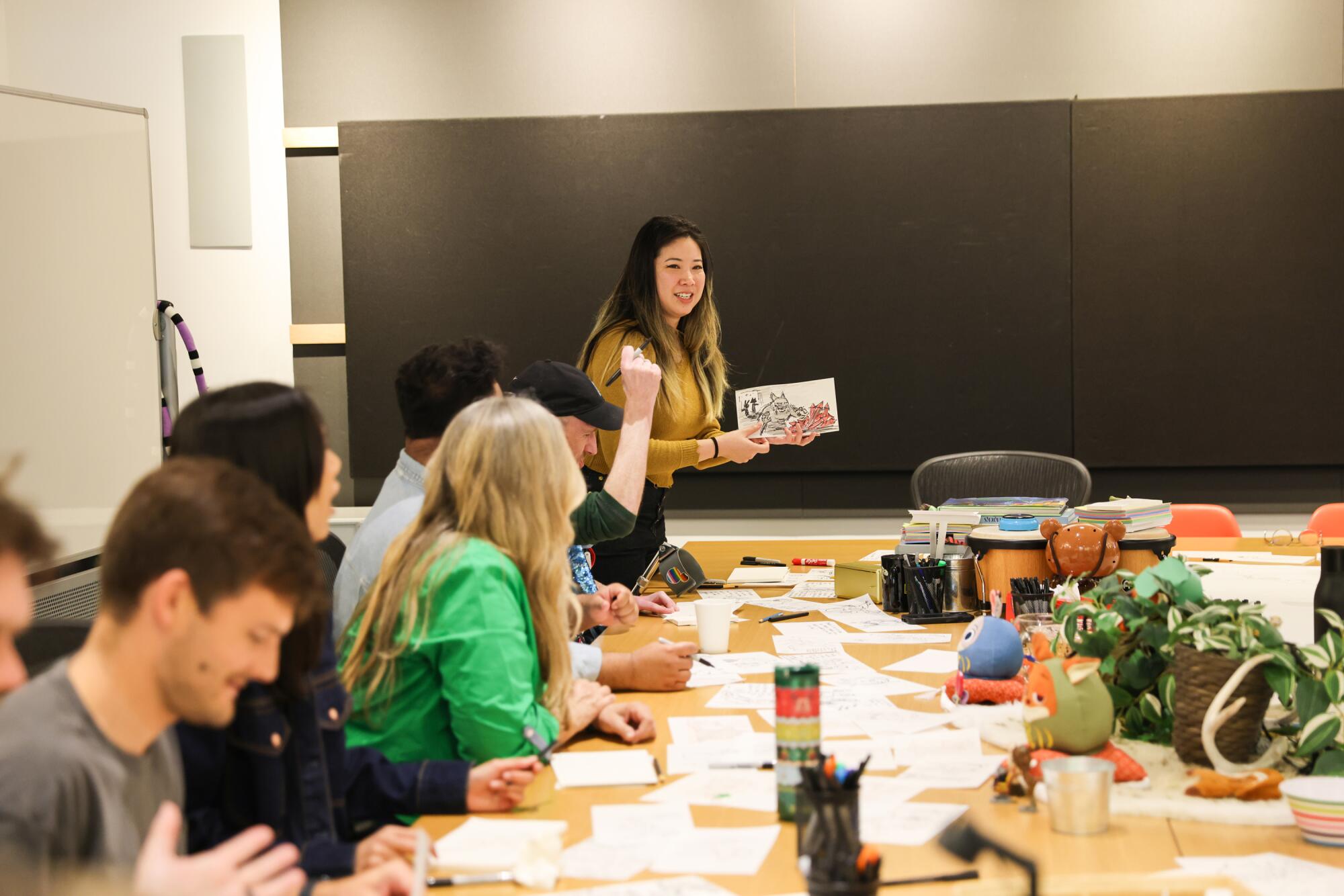
A “story jam” — reminiscent of a TV writers room — was just one of many avenues for collaboration in the making of “Zootopia 2.”
(Disney)
Like its predecessor, the sequel is packed with movie references and animal puns — “A Moose Bouche”; “Gnu Jersey” — and the directors are quick to spread the credit (or blame). “ ‘A Moose Bouche’ — we’ve gotten emails about that one,” says Howard. “Cory Loftis, our production designer, came up with it.”
There’s a “Star Wars” cantina bit, a soupçon of James Bond in the score at a fancy gala and dashes of Steven Spielberg in the camerawork. It’s easy to spot “Ratatouille” when an animal chef is revealed to have a rat under its hat, but Bush asserts there’s a second reference in that moment — the animal declaring “I knew it!” isn’t just any raccoon, but “Raccacoonie” from “Everything Everywhere All at Once.” That character is itself a “Ratatouille” reference (and, Bush points out, “EEAAO’s” Oscar-winning supporting actor Ke Huy Quan voices “Zootopia 2’s” lead snake, Gary). So it’s a reference coupled with another reference to another film’s reference to the first reference. Whew.
Those Easter eggs, including an extended callback to Stanley Kubrick’s “The Shining” — the realization of which they credit to animator Louaye Moulayess, a “Shining” superfan — speak to a willingness to cater to audiences beyond kids. Presumably, most children attending “Zootopia 2” haven’t watched Kubrick’s film. That’s a shoutout to the grown-ups for bringing the kids and, hopefully, discussing the historical practice of redlining with them after the show.

Byron Howard, left, and Jared Bush.
(Christina House / Los Angeles Times)
The first “Zootopia” was not notable just for funny talking animals but also the fact that the funny animals were talking about bigotry and stereotyping. Perceptive viewers may have noticed a mammalian bias in the original — there were no reptiles to be found in its near-perfect society. It turns out they were discriminated against as a class and denied their rightful place as residents, as we learn in “Zootopia 2.” Bush said that concept fit right in with “continuing this discussion about how we as human beings have a hard time looking past each other’s differences.”
Howard says the diversity-as-strength theme plays out not just in grand terms but also in the dynamic between the two protagonists, Judy (a rabbit, voiced by Ginnifer Goodwin) and Nick (a fox, voiced by Jason Bateman): “Nick and Judy are such different, contrast[ing] characters that are really stronger [together] because of those differences, and that speaks to something we really value, which is differences between each other as a working pair,” he gestures to Bush and himself. “We continue to thrive in that way.”
Howard agrees with the comparison of him and Bush to conductors of a giant orchestra, listening for notes being played just right. He thinks of composer Michael Giacchino “onstage with those virtuosos at their respective instruments; we work with masters all around us, so we have a lot of trust in them.”
However, he admits with all those voices, “Writers have a tough time here because we scrutinize these movies and redo them over and over and over again. Jared is a great example of someone who thrives in this environment.”
Bush, explaining he came from the culture of TV sitcoms and all their constant revisions in writers rooms, says, “We have this amazing luxury of being able to rewrite and rethink and absorb these better ideas over years. It is an extreme luxury.
“There’s nothing else like this in Hollywood that I’ve seen — that level of deep collaboration and iteration. There’s no place I’m ever going to be that I will love as much as this.”