farewell

Canada’s Snowbirds Say Farewell To The CT-114 Tutor Jet

The Canadian Forces Snowbirds brought the Canadair CT-114 Tutor’s aerobatic career to a close on Friday, October 16, with a final home-base demonstration at 15 Wing Moose Jaw, Saskatchewan. The private event, which was livestreamed, honored the Canadian-built jet trainer that defined the team for more than half a century, as well as the aircrew and support personnel who kept the increasingly demanding aircraft flying.

While Friday’s performance marks the end of the Tutor’s aerobatic display career with the team, a Grey Cup flyover in Calgary on November 15 remains on the schedule.

Speaking to MooseJawToday on October 15, Snowbirds team lead Maj. Maciej “Match” Hatta described the Tutor’s final season as an emotional milestone for the squadron, as well as an opportunity to recognize the families and support personnel who sustain the team during its annual touring season.

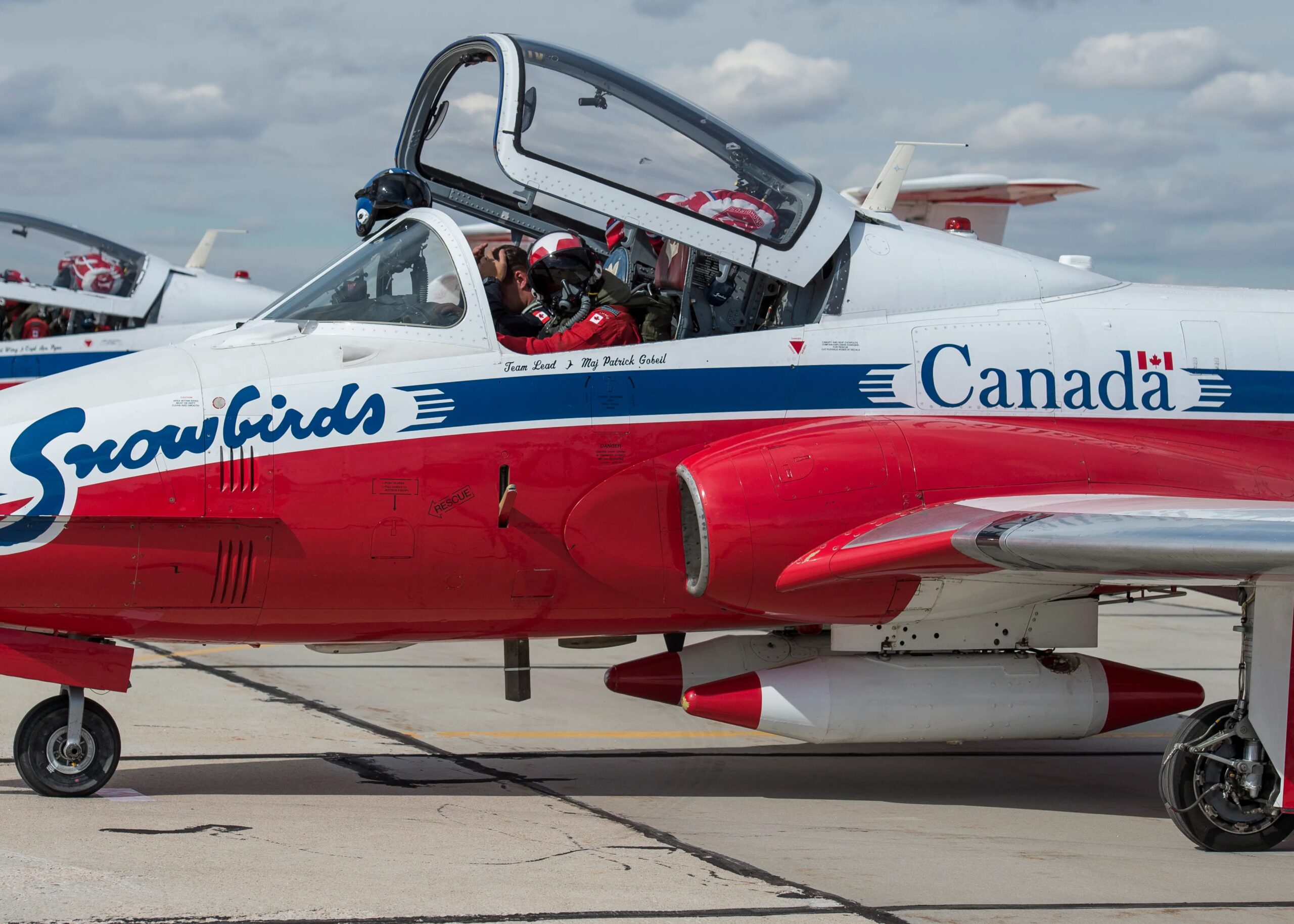
The Royal Canadian Snowbirds taxi at Gowen Field, Boise, Idaho Oct. 12, 2017. The Snowbirds performed during the Gowen Thunder Open House and Airshow. (U.S. Air National Guard photo by Master Sgt. Joshua C. Allmaras)
The Snowbirds taxi at Gowen Field, Boise, Idaho, during the Gowen Thunder Open House and Airshow, in 2017. Note the twin smoke tanks below the fuselage. U.S. Air National Guard photo by Master Sgt. Joshua C. Allmaras

Hatta has a long personal history with the aircraft. He flew with the Snowbirds from 2014 to 2017, subsequently worked on testing the Tutor’s avionics upgrades, and returned this year to lead the team through its final season with the jet. Despite having flown around 30 different aircraft as a test pilot, he has a particular attachment to the Tutor.

“This is still my favorite airplane to fly,” he said.

Fly With The RCAF Snowbirds thumbnail

Fly With The RCAF Snowbirds

Hatta recalled flying a maintenance test sortie alone the previous day, enjoying the opportunity to look out over the wings without the near-constant radio communications involved in leading a formation display. He also noted the differences between individual aircraft in the fleet.

“They all have their own personality,” Hatta said. “Some of them howl a little more than others. Some get hotter inside. Some have poor air conditioning.”

Lt.-Col. Guillaume Paquet, commanding officer of No. 431 Air Demonstration Squadron, Royal Canadian Air Force (RCAF), said the final season has prompted strong reactions from spectators, many of whom have grown up watching the Snowbirds perform in the Tutor.

“The reality is we’ve been touring this country for 55 years, so everyone has a story, a childhood memory,” Paquet said.

Golden Hawks To Snowbirds

Canada’s military aerobatic tradition dates back to 1929, when the biplane Armstrong Whitworth Siskin helped establish the country’s formation-flying heritage. The modern era began in 1959 with the creation of the Golden Hawks, formed to mark the 50th anniversary of powered flight in Canada and the 35th anniversary of the RCAF. Flying gold-painted Canadair-built F-86 Sabre fighters, the team initially was intended to operate for a single season. Its popularity led to several more years of performances across Canada and the United States before it was disbanded after the 1963 season amid the high costs of maintaining it.

Iconic Aircraft Series - F-86 Canadair Sabre thumbnail

Iconic Aircraft Series – F-86 Canadair Sabre

Canada’s centennial celebrations in 1967 brought a new demonstration team, the Golden Centennaires, which flew CT-114 Tutor jet trainers at 100 airshows across Canada and the United States. The Tutors would subsequently become the foundation of the Snowbirds. In 1969, Colonel O.B. Philp, newly appointed commander of No. 2 Canadian Forces Flying Training School at Moose Jaw, Saskatchewan, encouraged instructors to practice formation aerobatics using surplus Tutors left over from the Centennaires program. Initially presented as training and proficiency flying, the formations soon attracted public attention and gradually evolved into an established demonstration team.

The Golden Centennaires existed for only one year to celebrate the centennial of Canada in 1967. Canadian Forces

The formation grew from four aircraft in 1970 to seven in 1971, when the Snowbirds name was adopted following a competition among schoolchildren. Two solo aircraft were added in 1972, establishing the team’s familiar nine-aircraft format. That year, its pilots were assigned to demonstration flying on a full-time basis. The team’s Tutors were modified to support solo operation from the right-hand seat and the demands of inverted flight during aerobatic displays. In 1974, the Tutors received their distinctive red, white, and blue paint scheme, and the team was authorized to perform a fully aerobatic display.

The Canadian Forces Snowbirds perform an aerial demonstration over Rickenbacker International Airport, June 19 2026, as part of the Columbus Air Show. This year’s event featured more than 20 military and civilian planes and static displays, including a KC-135 Stratotanker from the 121st Air Refueling Wing, which served as the base of operations for military aircraft participating in the show. (U.S. Air National Guard photo by Tech. Sgt. Mikayla Gibbs)
Seven Canadian Forces Snowbirds jets perform an aerial demonstration earlier this year. U.S. Air National Guard photo by Tech. Sgt. Mikayla Gibbs

The Snowbirds subsequently achieved full squadron status as No. 431 Air Demonstration Squadron, becoming one of the most recognizable symbols of Canadian military aviation. Their officially stated mission was to demonstrate the professionalism, teamwork, and flying skills of the Canadian Armed Forces to audiences across North America.

150625-N-SN160-356 EVANSVILLE, Ind. (Jun, 25, 2015) The U.S. Navy Flight Demonstration Squadron, the Blue Angels, join their signature Delta formation with the Canadian Air Demonstration Squadron, the Snowbirds, for a scheduled photo shoot over Evansville, Ind. The Blue Angels are scheduled to perform at 68 demonstrations at 35 locations across the U.S. in 2015.. (U.S. Navy photos by Mass Communication Specialist 1st Class Michael Lindsey/Released)
The U.S. Navy Flight Demonstration Squadron, the Blue Angels, join their signature Delta formation with the Snowbirds for a scheduled photo shoot over Evansville, Indiana, in 2015. U.S. Navy photos by Mass Communication Specialist 1st Class Michael Lindsey/Released

However, the Tutor’s final years were marked by a series of serious accidents and renewed scrutiny of its aging systems.

In October 2019, a Snowbirds aircraft crashed in Georgia after an engine fuel-delivery failure, with the pilot surviving an ejection that was itself affected by a parachute malfunction. In May 2020, another Tutor crashed shortly after takeoff near Kamloops, British Columbia, killing the Snowbirds public affairs officer and seriously injuring the pilot; investigators determined that a bird strike had triggered an engine compressor stall. The fleet was temporarily grounded following that accident, with operations resuming under additional restrictions in August 2020.

A further accident at Fort St. John, British Columbia, in August 2022 prompted another fleet-wide operational pause after an engine failure during takeoff; investigators identified an improperly assembled oil filter as the cause. The aircraft returned to service the following month.

The Royal Canadian Air Force’s Snowbirds are parked on the flight line at Peterson Air Force Base, Colo., May 12, 2018. The Snowbirds aerial demonstration team performed a fly over in missing-man formation during the North American Aerospace Defense Command's 60th Anniversary Celebration. (DoD photo by Staff Sgt. Emily Kenney, USAF)
The Royal Canadian Air Force’s Snowbirds parked on the flight line at Peterson Air Force Base, Colorado, in 2018, during the North American Aerospace Defense Command’s 60th Anniversary Celebration. DoD photo by Staff Sgt. Emily Kenney, USAF

Subsequent safety measures included restrictions on certain aerobatic maneuvers and formations, minimum runway-length requirements, and limits on flying over water or performing some maneuvers outside gliding distance of a suitable landing surface.

At the same time, the persistent engineering challenges involving the Tutor’s airframe, engines, and ejection system were all factors in its retirement, with the RCAF concluding that further life-extension work was no longer practical.

Developing Canada’s Jet Trainer

Canadair Limited of Montreal began developing the CL-41A Tutor in the mid-1950s as a high-performance jet trainer to prepare RCAF pilots for the Canadair-built F-86 Sabre. The all-metal, low-wing, single-engine aircraft featured side-by-side seating and duplicate flight controls, allowing instructors to monitor students closely and take control when necessary. Two prototypes were built, with the first making its maiden flight on January 13, 1960, with Canadair test pilot Ian MacTavish at the controls.

CANADA - SEPTEMBER 01: Snowbirds roar over metro. Capt. Wes MacKay banks his Canadian Forces Tutor jet over downtown Toronto yesterday in a practice run before he and fellow Snowbirds perform today at the CNE. Canada's crack aerobatics team will make no changes in their thrilling performance despite Sunday's West German air show crash that killed 49 and injured 500. (Photo by Boris Spremo/Toronto Star via Getty Images)
Capt. Wes MacKay banks his Canadian Forces Tutor jet over downtown Toronto in a practice run before a performance at the Canadian National Exhibition in 1988. Photo by Boris Spremo/Toronto Star via Getty Images

Following an extensive testing and demonstration program, Canadian Minister of National Defence D.S. Harkness announced an order for 190 production aircraft on September 11, 1961. Deliveries began in 1963, with each aircraft reportedly costing approximately C$425,000 (around $394,000). Powered by a General Electric J85-CAN-40 turbojet built under licence by Orenda, the aircraft entered RCAF training service in late 1964 under the designation CT-114 Tutor.

As well as the RCAF, the Tutor found one other military operator in Malaysia. The Royal Malaysian Air Force received 20 examples designated the CL-41G Tebuan (meaning “Wasp” in the Malay language), which served between 1967 and 1986 in the ground-attack role.

A Royal Malaysian Air Force CL-41G Tebuan. The Aviation Historian Archive

The Tutor served as the RCAF’s primary jet trainer for decades, accumulating more than one million flight hours before its training role ended in 2000. It was replaced by the CT-156 Harvard II and CT-155 Hawk. The aircraft nevertheless remained in military service with the Snowbirds.

The Next Chapter

The Tutor’s retirement will bring an end to a long chapter in Canadian military aviation, but the Snowbirds are expected to continue flying with a new aircraft type. In May of this year, the Department of National Defence announced plans to replace the CT-114 with the CT-157 Siskin II, based on the Pilatus PC-21 turboprop trainer. The new demonstration capability will remain at 15 Wing Moose Jaw and is expected to become operational in the early 2030s.

The Siskin II has already been procured under Canada’s wider Future Aircrew Training (FAcT) program, for advanced fixed-wing and jet preparation. It is one of five aircraft types being procured under a 25-year, C$11.2-billion (approximately $7.9 billion) contract awarded to SkyAlyne in 2024. The other four types are the CT-102B Astra II (Grob G 120TP) for basic pilot training; CT-157 Siskin II for advanced fixed-wing and jet preparation; CT-145E Expeditor II (Beechcraft King Air 260) for multi-engine training; CT-153 Juno (Airbus H135) for helicopter training; and CT-142Q Citadel (De Havilland Canada Dash 8-400) for training air combat systems officers and airborne electronic sensor operators.

One of the first two Pilatus PC-21s departs Stans in Switzerland bound for Canada on September 14, 2026. These first aircraft mark the start of a new chapter in Canada’s Future Aircrew Training (FAcT) program. Pilatus

Paquet, the No. 431 Air Demonstration Squadron boss, said all Tutors are to be flown to IMP Aerospace in Trenton, Ontario, by March 31, 2027, where they will be disposed of. Some aircraft are expected to be preserved in museums or mounted on pedestals for public display, while others will be used as training aids for aircraft maintenance apprentices in Borden, Ontario.

“They’re not going to be flying. They’re not going to be flyable,” Paquet said.

Snowbirds team lead “Match” Hatta hopes to contribute his test-pilot experience to the transition, including testing the replacement aircraft and developing the new demonstration program.

“I would love to contribute to the team in terms of seeing them through the transition,” he said. “If I’m able to use my test background as well in helping that out, testing the new show, testing the new airplanes, and passing it on to a new boss down the road, then I’d love to do that.”

Royal Canadian Air Force CT-114 Tutor pilots with the Canadian Forces Snowbirds 431st Air Demonstration Squadron, perform pre-flight demonstrations during the Defenders of Liberty Air & Space Show at Barksdale Air Force Base, La., May 19, 2019. Serving as ambassadors of the CAF, the CF Snowbirds demonstrate a high level of skill, professionalism, teamwork, discipline and dedication inherent in the men and women of the CAF. (U.S. Air Force photo by Airman Jacob B. Wrightsman)
Royal Canadian Air Force CT-114 Tutor pilots with the Canadian Forces Snowbirds perform pre-flight checks during the Defenders of Liberty Air & Space Show at Barksdale Air Force Base, Louisiana, in 2019. U.S. Air Force photo by Airman Jacob B. Wrightsman

For Paquet, the immediate priority is completing the final display season without incident before turning to the next phase of the team’s history.

“I will definitely be emotional. The only thing I’m hoping for is that all the planes land safely, bring everybody home, and then we can check the box and say it was an extremely successful season. I brought everybody home, and we’ll move on to the next chapter.”

After more than six decades since its development began, the Tutor leaves behind a legacy spanning generations of military pilots and millions of spectators. Its final Snowbirds aerobatic display represents not simply the retirement of an aging aircraft, but the end of a long tradition in which the little jet trainer was one of the country’s most recognizable symbols of military flying and aerial performance.

Contact the author: thomas@thewarzone.com

Thomas Newdick is a staff writer at TWZ, where he covers military aviation, defense technology, weapons systems, and international security. Based in Berlin, Germany, he reports on conflicts, military modernization efforts, and emerging aerospace technologies around the world, with a particular interest in airpower and its role in contemporary warfare. His reporting is informed by deep expertise in modern and historical airpower, particularly in Europe, with a focus on military aviation, air campaigns, and aerospace developments across the continent and beyond.


Source link

Cristiano Ronaldo pays tribute to Lionel Messi after Argentina farewell | Football

‘I have the utmost respect for what you’ve accomplished with Argentina,’ Ronaldo writes in response to Messi’s post.

Cristiano Ronaldo has hailed his longtime adversary Lionel Messi in a tribute to the Argentinian icon, who bid a grand farewell to international football.

The Portuguese forward wrote the message in response to Messi’s social media post on Wednesday, a day after Argentina’s friendly match against Benin in Buenos Aires, where the local idol and global icon bid an emotional goodbye.

Recommended Stories

list of 4 itemsend of list

“Leo, ‌‌after so many years of defending your country, you’ve made history that will last forever,” Ronaldo said in his reply to Messi’s Instagram post in which the Argentinian poured out his emotions after hanging up his boots for his country.

“I have the utmost respect for what you’ve accomplished with Argentina,” Ronaldo added, ending the message with: “A hug”.

Soccer Football - La Liga Santander - Real Madrid vs FC Barcelona - Santiago Bernabeu, Madrid, Spain - December 23, 2017
Ronaldo and Messi in action during a match between Real Madrid and Barcelona in 2017 [File: Sergio Perez/Reuters]

The careers of Messi and Ronaldo followed a similar trajectory and crossed paths for many years in club and international football.

It resulted in a hotly contested rivalry, mostly between the two players’ supporters over the past two decades.

The pair dominated the sport for more than 15 years, winning the prestigious Ballon d’Or award 13 times between them.

Their rivalry grew over the nine years in which they faced off against each other in Spain, with Messi starring for Barcelona and Ronaldo for Real Madrid.

Soccer Football - International Friendly - Argentina v Benin - Estadio Monumental, Buenos Aires, Argentina - October 6, 2026 Argentina fans in the stands display a flag that reads, "Ronaldo is Cristiano (Christian), but (Lionel) Messi is God." REUTERS/Rodrigo Valle
Fans display a banner that reads ‘Ronaldo is Cristiano [Christian], but Messi is God’ during Argentina’s friendly match against Benin at the Monumental Stadium in Buenos Aires [File: Rodrigo Valle/Reuters]

Messi, 39, announced his retirement from international football after leading his country to the World Cup final in July in the United States, where the 2022 champions were runners-up behind Spain.

“Yesterday was my last game, and I already miss wearing the blue and white. I know I’m making the right decision,” Messi said in a lengthy message a day after his final match in the famous number 10 blue and white shirt. “It’s been an incredible journey, full of ‌‌joy and also some sadness, but I know for sure that every step I took was worth it.”

“I don’t want to forget Diego [Maradona], who put our country where it deserved to be and who, as I always say, I know helped us both by being here with us and also from heaven, with every step we took,” he said.

“Thank you to the clubs where I played, for always ⁠⁠respecting my feelings and allowing me to dedicate myself to ⁠⁠my country whenever it was time to put on the national team jersey.”

An artist adds final touches to a painting featuring football players Argentina's Lionel Messi and Portugal's Cristiano Ronaldo in Amritsar on June 11, 2026 on the eve of the 2026 FIFA World Cup tournament. (Photo by Narinder NANU / AFP)
An artist adds final touches to a painting featuring Messi and Ronaldo in Amritsar, India [File: Narinder Nanu/AFP]

Messi scored Argentina’s final goal in a 3-0 win and provided assists for the other two as the Albiceleste played in front of 85,000 fans at the Monumental Stadium.

Messi captained Argentina to the 2022 World Cup title and Copa America triumphs in 2021 and 2024, while also helping them win ⁠⁠the 2022 Finalissima.

“I am grateful. I love you all very much; I’m going to miss you, and I will always thank ⁠⁠you for having been by our side, by my ⁠⁠side,” the Inter Miami playmaker added.

Messi and Ronaldo have vied for recognition as the greatest player of their generation throughout their illustrious careers.

The 41-year-old Portuguese forward was among the hundreds of thousands who responded to Messi’s post.

Messi’s final game came the same day Ronaldo apologised for his controversial departure from the Portuguese national team’s camp after a fallout with coach Jorge Jesus. It remains unclear whether Ronaldo will play for his country again, despite his apology for walking out, which leaves the door open to a return.

Messi and Ronaldo last met on the pitch in an exhibition match in Saudi Arabia in January 2023, when they took fans back in time to the heyday of their storied rivalry, as both forwards got on the scoresheet.

Ronaldo, who plays for Saudi Pro League champions Al Nassr, was part of a Riyadh Season Team that took on Messi’s then-club Paris Saint-Germain (PSG).

Source link

Lionel Messi and Cristiano Ronaldo: Two icons, a glorious farewell & an acrimonious ending

In stark contrast, Messi brought the curtain down on his illustrious Argentina career, where he has won one World Cup and two Copa Americas, in front of an 85,000-strong sellout crowd inside the Monumental in Buenos Aires.

The 39-year-old announced his retirement from international football in August after Argentina finished runners-up at the World Cup and following the death of his father Jorge.

Messi marked his final appearance for La Albiceleste with a goal before addressing the adoring fans in a speech lasting nearly 10 minutes.

Some of his team-mates were in tears as Messi admitted he did not want to leave the field.

“There are so many emotions going through me right now,” he said. “I’m surely forgetting many things I would like to say because this is a very difficult moment for me. The first person who comes to my mind is my dad.

“I leave grateful, proud and at peace. Thank you for everything.”

Writing on social media on Wednesday, , externalMessi added: “Yesterday was my last match and I’m already missing the light blue and white jersey.

“I know I’m taking the right decision. It was an incredible journey, full of joy and some sadness, but I know for sure that every step I took was worth it.”

Messi also thanked his family, team-mates and clubs and paid tribute to another Argentina legend, the late Diego Maradona.

His Instagram post also drew a response from Ronaldo, who wrote: “Leo, after so many years of defending your country, you’ve made history that will last forever.

“I have the utmost respect for what you’ve accomplished with Argentina. A hug.”


Source link

Head coach Scaloni’s emotional farewell to ‘irreplaceable’ Messi | Football

Argentina’s head coach Lionel Scaloni said it was an ‘emotional day’ as Lionel Messi brought his international career to an end, calling it a ‘dream’ to have coached him. Messi scored in his final game, a 3-0 friendly victory over Benin.

Source link

East Asia: How AI is changing the way we bid farewell to loved ones | Technology

101 East meets innovators across East Asia using digital technology to transform how we grieve those we love.

East Asia is facing a demographic reckoning, with societies in Japan, South Korea and Taiwan ageing rapidly.

With a drastic shortage of burial space, a lucrative new market is emerging.

From AI avatars to DNA gems, technology is bringing loved ones back to life – in digital forms – raising questions about whether it will help heal or hinder the grieving process.

101 East investigates how new technology is transforming the way we bid farewell to those we love.

Source link

Dodgers Dugout: Another year, another division title; Farewell Ryan Ward, we hardly knew ye

Hi, and welcome to another edition of Dodgers Dugout. My name is Houston Mitchell. Thirteen division titles in 14 seasons, and in the year they didn’t win, they had 106 victories. We don’t have a lot to complain about.

Are you a true-blue fan?

Get our Dodgers Dugout newsletter for insights, news and much more.

Division titles and Ryan Ward

—The Dodgers won the division title again, clinching it Thursday with their win over the Reds. Remember the olden days of yesteryear when winning the division was a huge deal? Now it is blasé. Dodgers fans live in a time where they have an embarrassment of riches,

Let’s look at how many NL West titles each team has won since divisional play began in 1969:

Dodgers, 24
San Francisco, 9
Cincinnati, 7
Arizona, 5
Atlanta, 5
San Diego, 5
Houston, 2

There was no official winner in 1994, which was ended by a labor dispute.

I guess I’m feeling extra nostalgic today, but I remember growing up the Dodgers’ biggest divisional rival was the Cincinnati Reds, who moved to the Central division in 1994 and have since won a grand total of zero division titles.

If we narrow NL West titles since 2000, we get:

Dodgers, 16
San Francisco, 5
Arizona, 4
San Diego, 2

Poor Colorado.

—The Dodgers made room for pitcher Kris Bubic on the 40-man roster by designating outfielder Ryan Ward for assignment. Ward has been a favorite of newsletter readers for a couple of seasons now, but he really had no place on the team anymore. He’s too old (28) to really be a prospect and his best triple-A season came in his third season at that level. His numbers declined in triple-A this season (you can see his numbers here).

He’s not great defensively, and the team already has corner outfielders who aren’t great defensively. They passed him over for Josue De Paula when they needed someone to fill in for Shohei Ohtani, and there are several outfielders in the system who are considered better than Ward.

In all likelihood, another team will pick him up and give him more playing time in the majors, something he wasn’t going to get with the Dodgers. Hopefully we see him next season in the “There names seem familiar” section of this newsletter.

Evidence of Dave Roberts’ growth

One of the knocks on Dave Roberts has always been his poor postseason managing. But his postseason managing has dramatically improved the last few seasons, and I’m not just saying that because they won the last two World Series. His decisions appear to not always be guided by analytics, like they are during the regular season. And it appears Roberts has indeed learned some things during his tenure. He recently appeared on the 6-1-1 podcast, hosted by former major leaguers Ryan Howard and Jimmy Rollins, and had this to say:

“When you’re talking about winning 11 games in October, I couldn’t believe more that it’s about people, and players you can bet on,” Roberts said. “The heartbeat that the analytics doesn’t line up with. I think that early on, my mistake was I continued to use that same method of the regular season in the postseason….

He also had high praise for two of his players.

“Mookie has said to me, ‘Doc, we wouldn’t have won the World Series if it wasn’t for Shohei and Yamamoto. And his point was, the discipline that they had every single day, how they worked with intention every single day … it raised the level even higher for our guys.”

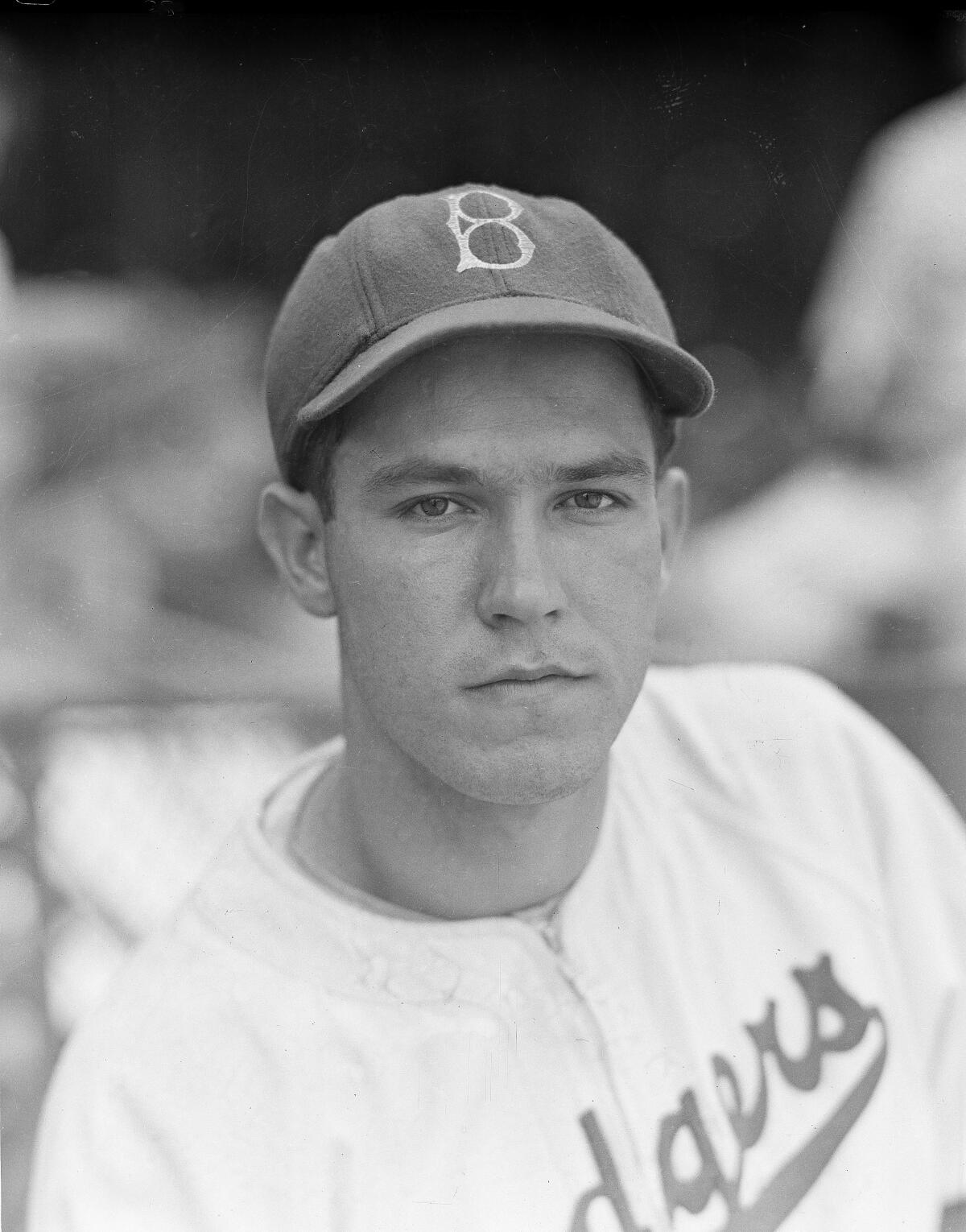
Forgotten Dodger: Pete Reiser

Pete Reiser in 1941.

Pete Reiser in 1941.

(Associated Press)

Pete Reiser never met an outfield fence he didn’t like crashing into and it may have cost him a Hall of Fame career.

Harold Patrick Reiser was born on March 17, 1919, in St. Louis. He loved westerns and as a child often walked around wearing a cowboy hat and carrying toy guns, so people started calling him Pistol Pete, which stuck with him throughout his baseball career.

After playing in 58 games with the Dodgers in 1940, Reiser came into his own in 1941 when he hit a league-leading .343 to go with 117 runs, 39 doubles, 17 triples, 14 homers and 76 RBIs. He also played great defense in center. That got him second place in NL MVP voting behind teammate Dolph Camilli (Reiser should have won). Reiser led the league in nine categories.

He followed that by hitting .310 with 33 doubles and 10 homers in 1942, leading the league with 20 steals and making his second straight All-Star team. However, on July 18 of that year, he crashed full speed into the center-field fence, which was made of concrete, while chasing a fly ball. He ended up with a separated shoulder and fractured skull. In those days though, you didn’t let little things like a fractured skull slow you down. He returned to the lineup a week later, but he wasn’t the same. He hit .244 the rest of the season.

He then enlisted in the Army and spent three years there. In 1944, after a long march in below-zero weather, Reiser was diagnosed with pneumonia. The Army decided to put him in Fort Riley, Kan., so he could play for the camp’s baseball team. With Reiser on the team, they were virtually unbeatable and Reiser was given his own room and excused from all other duties.

Reiser returned to the majors in 1946 and broke his leg while stealing second. He crashed into the fence in St. Louis and missed some time. But he still led the league with 34 steals, though his batting average dropped to .277.

In 1947, he was chasing another fly ball when he crashed into the wall face first. This caused another fractured skull. He was given the Last Rites by a priest in the hospital before making a miraculous recovery. He ended up playing 110 games that season.

He was a bench player the following season, as he had put on a little weight and had been slowed tremendously by his numerous injuries. The Dodgers traded him to the Boston Braves after the season for Nanny Fernandez and Mike McCormick.

By unofficial count, Reiser’s injuries over the years included four fracture skulls, multiple dislocated shoulders, two broken ankles, torn ligaments in both knees and and two beanings. He was carried off the field on a stretcher eleven times—five times when he was unconscious.

He retired after the 1952 season and came back to the Dodger organization as a roving minor-league hitting instructor. He joined Walter Alston’s coaching staff in L.A. in 1960 and helped tutor Maury Wills on how to steal bases. In an interview with this newsletter a few years ago, Wills made sure to give praise to Reiser as being a big part of his 104-steal season.

Reiser had a heart attack in 1965, went on to coach for other teams. He smoked a pack of cigarettes a day throughout his adult life and died of emphysema in Palm Springs in 1981. He was only 62.

The postseason race

Here are the postseason seedings as of Thursday’s games. The three division winners get the top three seeds, followed by the three teams with the best records. The top two division winners get a first-round bye. Milwaukee and the Dodgers have clinched division titles.

Division leaders
1. Milwaukee, 95-58
2. Dodgers, 93-60, 2 GB
3. Atlanta, 89-64, 6 GB

Wild cards
1. Chicago, 85-68
2. Philadelphia, 85-68
3. San Diego, 84-69
4. Arizona, 80-73, 4 GB

Remember, there are no extra games to break ties anymore. It all comes down to tiebreakers. Atlanta and Milwaukee have the tiebreaker over the Dodgers. For the wild card, the Cubs have the advantage over the Phillies, having won six of seven games against each other. The Diamondbacks and Padres have split 10 games, but their final three games this season are against each other, so that very well could determine the final wild-card spot.

These names seem familiar

How notable players who were with the Dodgers the last couple of seasons are doing with their new teams (through Wednesday). Click on the player’s name to be taken to their full stats page:

Anthony Banda, Twins: 2-0, 4.46 ERA, 2 saves, 34.1 IP, 31 hits, 15 walks, 33 K’s, 95 ERA+, out for the season

Cody Bellinger, Yankees: .276/.351/.444, 533 PA’s, 25 doubles, 3 triples, 16 homers, 71 RBIs, 121 OPS+

Walker Buehler, Padres: 8-6, 4.58 ERA, 143.1 IP, 142 hits, 54 walks, 122 K’s, 88 ERA+

Mike Busch, Cubs: .238/.347/.393, 671 PA’s, 27 doubles, 2 triples, 19 homers, 76 RBIs, 104 OPS+

Michael Conforto, Cubs: .238/.336/.471, 286 PA’s, 15 doubles, 14 homers, 43 RBIs, 120 OPS+

Justin Dean, Cubs: .375/.500/.625, 10 PA’s, 1 triple, 3 RBIs, 209 OPS+, in the minors

Caleb Ferguson, Cardinals: 1-0, 5.18 ERA, 1 save, 33 IP, 37 hits, 19 walks, 31 K’s, 81 ERA+, released by Cardinals

Jack Flaherty, Tigers: 3-8, 4.59 ERA, 86.1 IP, 80 hits, 42 walks, 102 K’s, 92 ERA+, on the IL

Kenley Jansen, Tigers: 4-6, 3.43 ERA, 20 saves, 42 IP, 24 hits, 23 walks, 48 K’s, 123 ERA+

Craig Kimbrel, Royals: 1-5, 4.50 ERA, 1 save, 46 IP, 40 hits, 22 walks, 40 K’s, 94 ERA+

Gavin Lux, Rays: on the IL

Dustin May, Brewers: 7-9, 4.49 ERA, 138.1 IP, 132 hits, 46 walks, 133 K’s, 88 ERA+

Zach McKinstry, Tigers: .204/.289/.301, 411 PA’s, 15 doubles, 4 triples, 4 homers, 26 RBIs, 66 OPS+

James Outman, Tigers: .172/.235/.318, 157 PA’s, 4 doubles, 2 triples, 5 homers, 17 RBIs, 54 OPS+, in the minors

Joc Pederson, Rangers: .235/.329/.487, 432 PA’s, 12 doubles, 2 triples, 26 homers, 53 RBIs, 134 OPS+

Luke Raley, Mariners: .225/.284/.439, 287 PA’s, 9 doubles, 1 triple, 15 homers, 39 RBIs, 105 OPS+, on the IL

Corey Seager, Rangers: .234/.326/.436, 393 PA’s, 15 doubles, 18 homers, 46 RBIs, 120 OPS+

Justin Turner, Tijuana (Mexican League): .295/.395/.469, 263 PA’s, 21 doubles, 6 homers, 28 RBIs. Tijuana won the Mexican League title on Tuesday.

Trea Turner, Phillies: .240/.292/.382, 654 PA’s, 27 doubles, 1 triple, 19 homers, 57 RBIs, 79 OPS+

Miguel Vargas, White Sox: .249/.357/.473, 662 PA’s, 30 doubles, 1 triple, 31 homers, 84 RBIs, 131 OPS+

Kirby Yates, Pirates: 2-5, 3.40 ERA, 3 saves, 39.2 IP, 31 hits, 17 walks, 47 K’s, 125 ERA+, on the IL

Up next

Friday: San Francisco (*Cesar Perdomo, 0-1, 3.68 ERA) at Dodgers (Tyler Glasnow, 4-1, 3.50 ERA), 7:15 p.m., Apple TV, AM 570, KTNQ 1020

Saturday: San Francisco (TBD) at Dodgers (*Tarik Skubal, 10-7, 2.70 ERA [3-2, 2.52 ERA with Dodgers]), 6:10 p.m., SportsNet LA, AM 570, KTNQ 1020

Sunday: San Francisco (TBD) at Dodgers (TBD), 1:10 p.m., SportsNet LA, AM 570, KTNQ 1020

All times Pacific

*-left-handed

In case you missed it

Dodgers clinch 13th NL West division title in 14 years: ‘Something I know we can build on’

Plaschke: No more bubbly — NL West champion Dodgers appear headed for early fall

Dodgers co-owners Mark Walter, Todd Boehly sell Chelsea shares

Dodgers might be forced to leave Edwin Díaz off postseason roster

And finally

Vin Scully is amazed by Clayton Kershaw‘s curveball. Watch and listen here.

Until next time …

Have a comment or something you’d like to see in a future Dodgers newsletter? Email me at houston.mitchell@latimes.com. To get this newsletter in your inbox, click here.

Source link